Genealogy Services, Old Photos, Postcards, Trade Cards, Etc.

Amager Woman

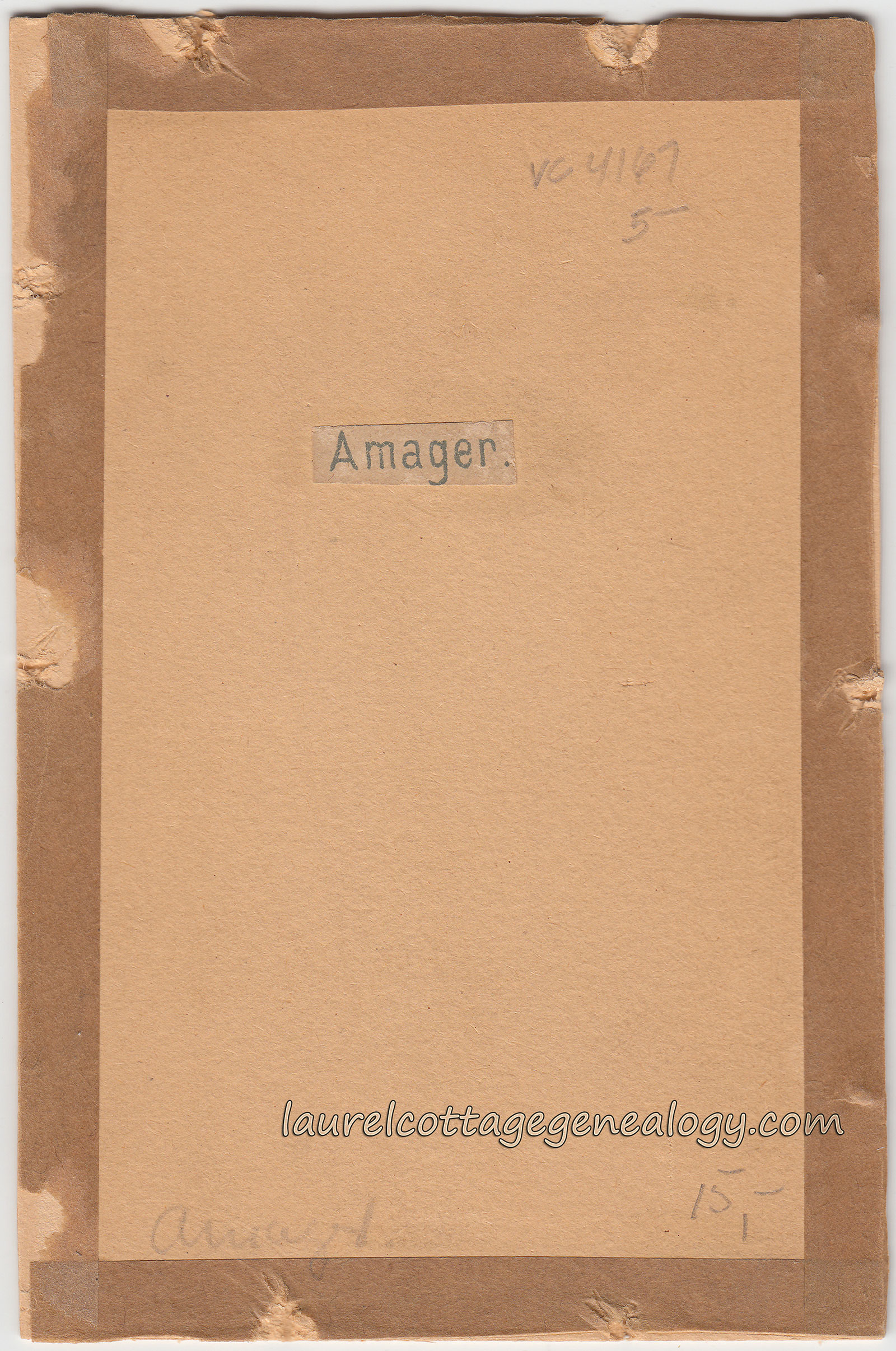
Amager 1Amager 2

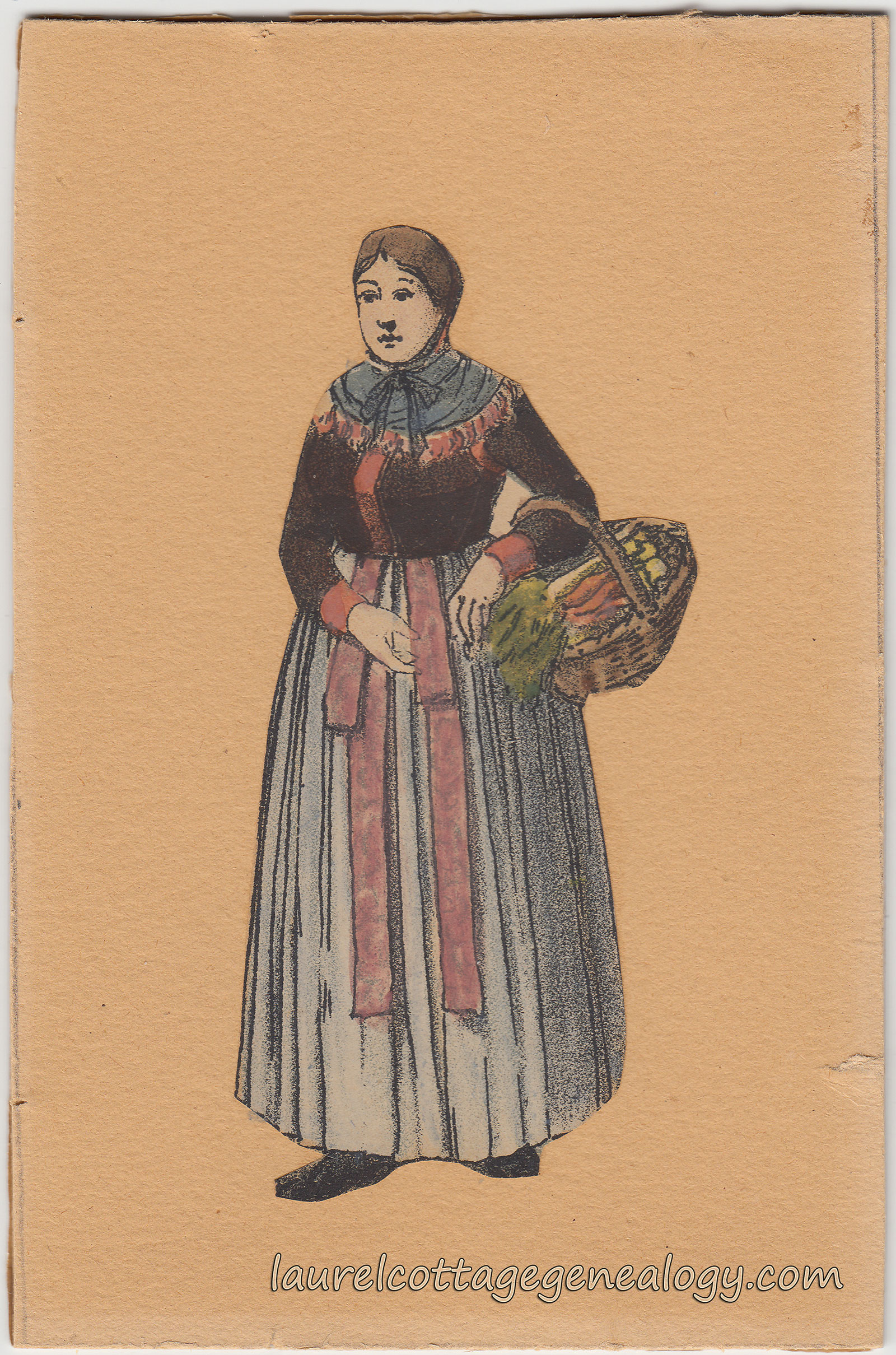
Collectable card, circa 1880s to 1890s. Size:  5 and 1/2 x 3″

Price: $7.00

This was an unusual find that was tucked in a large group of old postcards for sale. It’s a cutout of a figure of a woman, (a cute little lady) wearing what was probably the typical dress of the day, and carrying a basket of fresh vegetables. Maybe she has just come from the market. The cutout was pasted onto the cardboard card, and the back shows that the same was done with the word “Amager,” so I think maybe this was part of a series available for collecting, showing different styles or traditional costumes from around the world, or perhaps just from many of the European countries. Amager is a Danish island in the Øresund, in which part of the Danish capital of Copenhagen is situated. The Øresund or Öresund, is a region spanning parts of Denmark and Sweden, centering on their two respective cities of Copenhagen and Malmö.

Sources:  Amager. n.d. Wikipedia. Accessed 24 Aug 2014 [http://en.wikipedia.org/wiki/Amager]

Øresund Region. n.d. Wikipedia. Accessed 24 Aug 2014 [http://en.wikipedia.org/wiki/%C3%98resund_Region]

Artist John Paul Burnham

John Paul Burnham (1882 or 1883 – 1956)

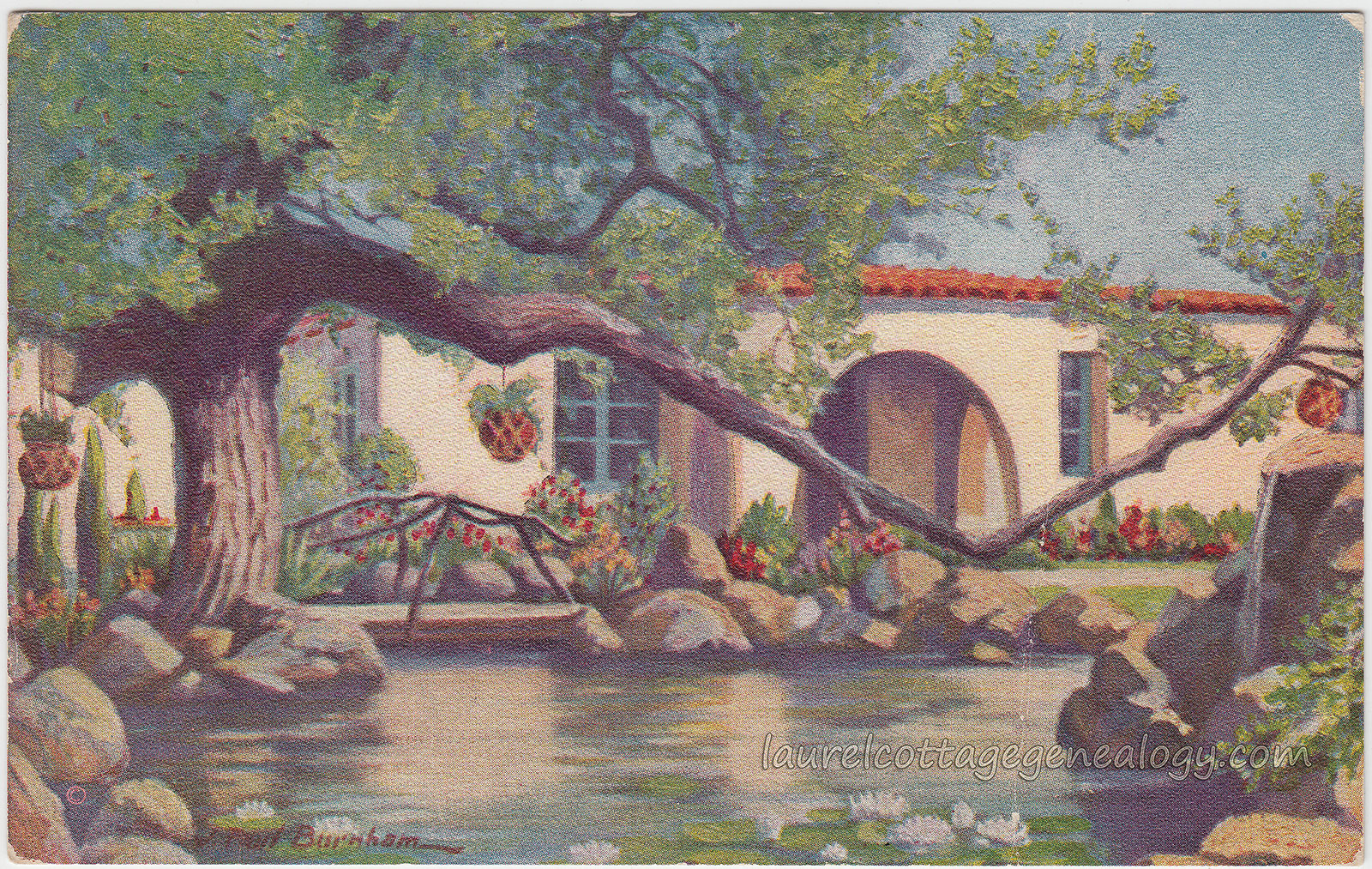
See Agua Caliente Villa for our postcard by the artist.

According to the very helpful website AskArt, which we’ve accessed before for research, “John Paul Burnham was born in Illinois on August 14, 1883. John Paul was the son of architect Franklin Burnham, and a resident of Los Angeles by 1900. By 1910 he had a home in South Pasadena and was a magazine illustrator. He worked there as an artist until his death on Feb. 8, 1956.

Census records show that John Paul’s mother’s first name was Adelia. From this we find the marriage record showing that Franklin P. Burnham married Adelia S. Milliken on January 29, 1877 in Cook County, Illinois. Franklin was about age 23, and Adelia about age 20.

The 1880 Federal Census taken in Chicago shows the young family, including one year-old daughter, Jenni, living with head of household Paul, (John Paul’s grandfather) and Paul’s daughter Mary Orcutt, (Franklin’s sister) her husband, William Orcutt, and their daughter, May. John’s father, Franklin Pierce Burnham, became a well-known architect, and is listed on this census record under that occupation.

The 1900 Federal Census, taken in Los Angeles, shows Franklin, Adelia, Jennie and John Paul, age 17, dealer in bicycles.

By 1908, at about age 25, John was listed as having joined the staff of The Art Students League of Los Angeles, teaching illustration and composition.

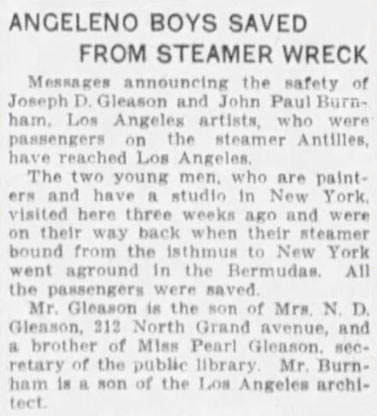
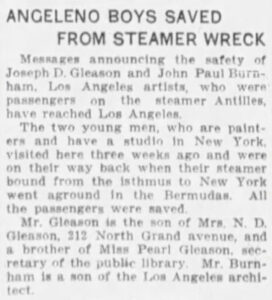
The following clip from the Los Angeles Evening Express, October 14, 1909, indicates Burnham had a studio in New York City. He and fellow artist, Joseph D. Gleason, along with the crew and the rest of the passengers, had a close call in the Bermudas when their steamer, Antilles, went aground. “Angeleno” means being from Los Angeles:
The 1910 Federal Census for Pasadena, California shows he is living with his mother (widowed) and his unmarried aunt, Grace Milliken. At this time, he is working as an artist for a magazine.

By 1918, Burnham had gone back to the East Coast. His WWI Draft Registration card shows he was living in New York City and working as an art manager and artist at the ad agency Ruthrauff & Ryan. (On this record he gives his year of birth as 1882, rather than the 1883 stated above which shows up officially under the California Death Index.)

The Dartnell Advertising Agency Guide, compiled in 1924, shows J. P. Burnham with the above-mentioned, Ruthrauff & Ryan, now working as head of the art department.

Presumably, Burnham would have moved from NYC back to California sometime from 1924 through 1930 when he shows up listed as John Burnham on the 1930 Federal Census for Pasadena; occupation artist, and listed as a “guest” at the grand and exclusive Hotel Huntington. (Estimated date of birth on this record is 1887 but we know this is John because the AskArt website shows a Burnham painting of the Huntington.)

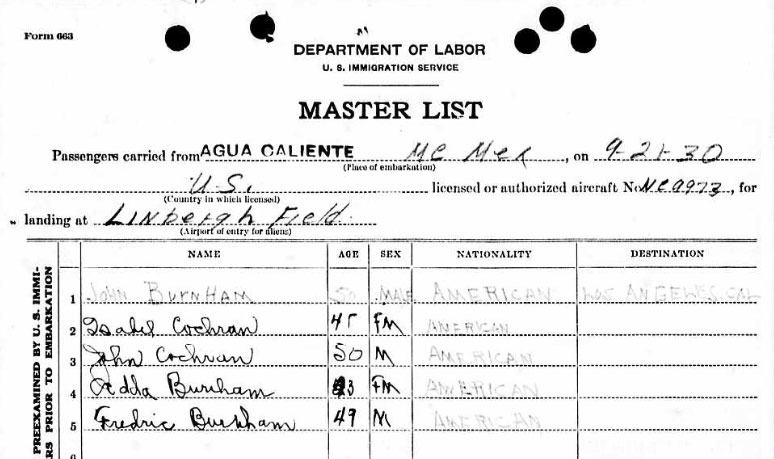
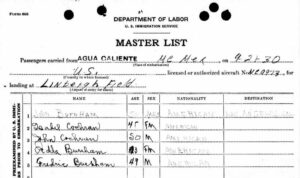
Below, a 1930 airplane passenger list showing John Paul traveling from Agua Caliente, Mexico to California. By chance, there are two other Burnhams on this record, husband and wife Frederic and Adda, but as far as we know, there was no relation:
The Smoketree School 

Continuing on with our research, it seems that John Paul may have been best known for being a member of the “Smoketree School” of artists. According to a magazine article by author, Ann Japenga, John Paul Burnham was one of 27 artists who lived and painted in the Coachella Valley, California area. Burnham’s address was 147 S. Tahquitz Dr., Palm Springs, circa late 1920s.

When Japenga started writing about the desert artists of the early 1900s, she coined the phrase for their genre as being of the “Smoketree School” in the way that the Hudson River, New York area artists became known under that geographical heading, or that art critics refer to the “Eucalyptus School” because of the Eucalyptus tree being a popular subject for the California coast artists. (The smoke tree or bush is part of the native California desert vegetation, and has various shades of “smoky” pink flowers that bloom from June through August, with the leaves changing color to shades of orange, red and purple in autumn.) John Paul Burnham, according to one of two Japenga articles, was better known as a patron to the local artists. Among others in the desert art community were Agnes Pelton, R. Brownell McGrew, John Hilton, Axel Linus. See the prior post on our Laurel Cottage site for a beautiful example (albeit from a postcard) of Burnham’s work that he did in Tijuana, Mexico.

The 1940 Federal Census shows him living in Los Angeles, occupation artist and painting teacher.

_____________________________________________________________________

Sources:  “John Paul Burnham.” AskArt. Web accessed 21 Aug 2014 [http://www.askart.com/AskART/B/john_paul_burnham/john_paul_burnham.aspx]

“Illinois, Cook County Marriages, 1871-1920,” index, FamilySearch (https://familysearch.org/pal:/MM9.1.1/N7XC-G4S : accessed 23 Aug 2014), Franklin P. Burnham and Adelia S. Milliken, 29 Jan 1877; citing Cook, Illinois, , Cook County Courthouse, Chicago; FHL microfilm 1030100.

Franklin Pierce Burnham. n.d. http://en.wikipedia.org/wiki/Franklin_Pierce_Burnham. (accessed August 23, 2014)..

Year: 1900; Census Place: Los Angeles Ward 5, Los Angeles, California; Roll: 89; Page: 5B; Enumeration District: 0050; FHL microfilm: 1240089. (Ancestry.com)

“A Seed of Moderism:  The Art Students League of Los Angeles, 1906 – 1953.” Traditional Fine Arts Organization. Feb. 29, 2008. Web accessed 22 Aug 2014 [http://www.tfaoi.com/aa/8aa/8aa6.htm]

“Angeleno Boys Saved From Steamer Wreck.” Los Angeles Evening Express, October 14, 1909. Thursday, p. 18. (Newspapers.com).

Year: 1910; Census Place: South Pasadena, Los Angeles, California; Roll: T624_87; Page: 2B; Enumeration District: 0347; FHL microfilm: 1374100. (Ancestry.com)

Registration State: New York; Registration County: New York; Roll: 1765791; Draft Board: 105. (Ancestry.com).

Ruthrauff & Ryan. n.d. https://en.wikipedia.org/wiki/Ruthrauff_%26_Ryan (accessed February 2, 2024).

The Dartnell Advertising Agency Guide, 1925 Edition. (1924) New York:  The Dartnell Corporation. (Google.com book search).

Passenger Lists, 1929-1954, and Crew Lists, 1941-1954, of Airplanes Arriving at San Diego, California. Microfilm Publication A3472, 10 rolls. NAID: 3950379. Records of the Immigration and Naturalization Service, Record Group 85. The National Archives in Washington, D.C.

Japenga, Ann. “Where Artists Thrived” Palm Springs Life. Web accessed 22 Aug 2014. [http://www.palmspringslife.com/Palm-Springs-Life/Art-Culture/Winter-Spring-2013/Where-Artists-Thrived/]

Ann Japenga. PBS SoCal. https://www.pbssocal.org/people/ann-japenga (accessed February 2, 2024).

Brown, Renee, “History:  Early artists captured beauty of valley desert.” The Desert Sun. July 17, 2014. Web accessed 21 Aug 2014. [http://www.desertsun.com/story/life/entertainment/arts/2014/07/17/palm-springs-history-desert-artists/12819525/]

Japenga, Ann. “The Smoketree School:  Painters Respond to the Call of the Desert.” Palm Springs Life. Web accessed 24 Aug 2014 [http://www.palmspringslife.com/Palm-Springs-Life/Art-Culture/Winter-Spring-2011/The-Smoketree-School/]

Year: 1930; Census Place: Pasadena, Los Angeles, California; Roll: 169; Page: 16B; Enumeration District: 1250; Image: 396.0; FHL microfilm: 2339904. (Ancestry.com).

Coachella Valley. n.d. https://en.wikipedia.org/wiki/Coachella_Valley (accessed February 2, 2024).

“United States Census, 1940,” index and images, FamilySearch (https://familysearch.org/pal:/MM9.1.1/K9CV-8JN : accessed 24 Aug 2014), John P Burnham, Councilmanic District 5, Los Angeles, Los Angeles Township, Los Angeles, California, United States; citing enumeration district (ED) 60-326, sheet 61B, family 557, NARA digital publication of T627, roll 402.

Agua Caliente Villa By John Paul Burnham

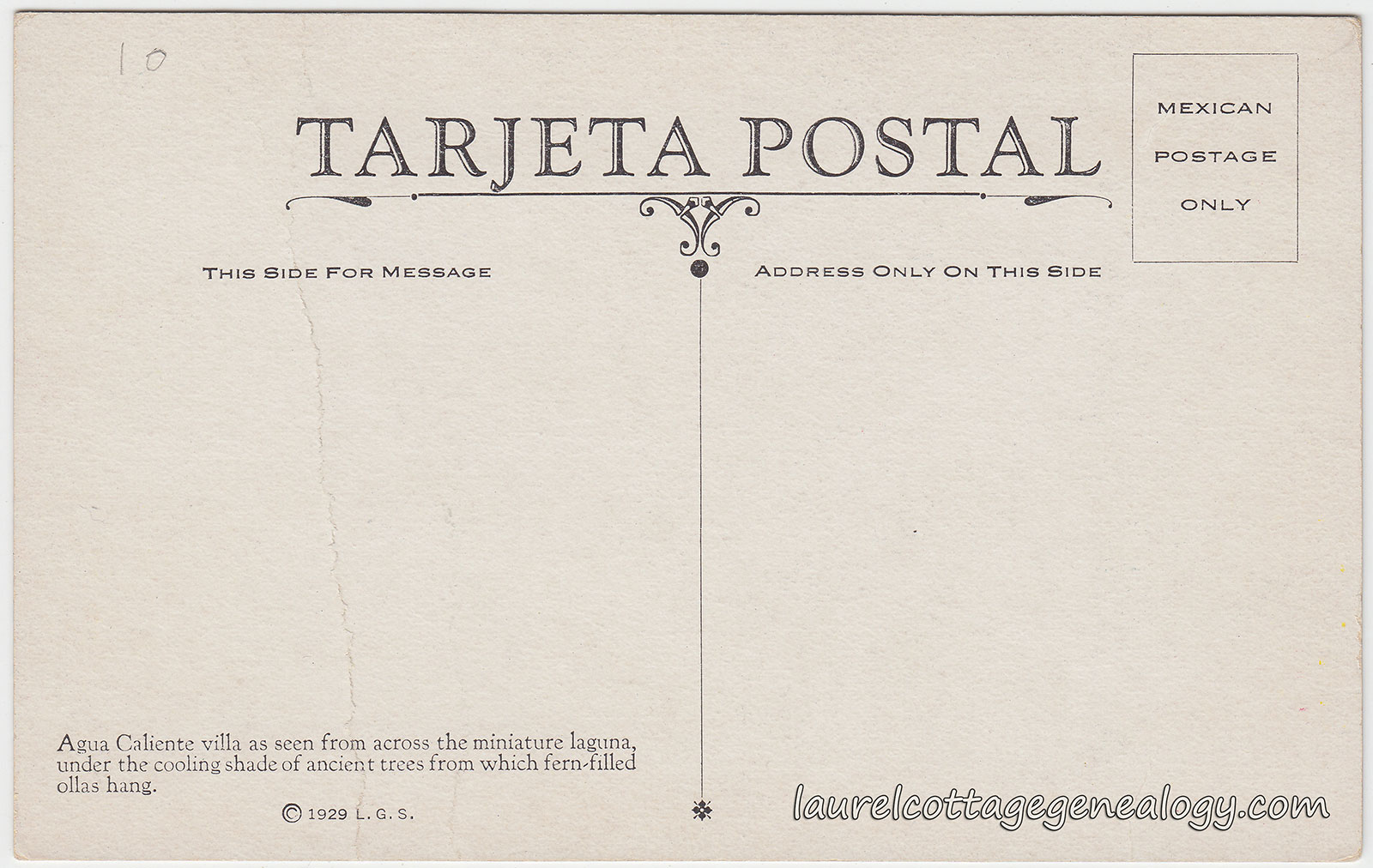
Agua Caliente Villa By J Paul Burnham pc1Agua Caliente Villa By J Paul Burnham pc2

Divided back, artist-signed, unused postcard. Artist:  John Paul Burnham. Publisher information:  Copyright 1929 L.G.S.

Price:  $12.00

See the following post for more on the artist.

“Agua Caliente villa as seen from across the miniature laguna, under the cooling shade of ancient trees from which fern-filled ollas hang.”

1929 artist-signed Mexican postcard of a painting by John Paul Burnham, showing a view of the bungalows at Hotel Agua Caliente. The hotel bungalows were part of a grand Tijuana, Mexico resort, casino, race track and hot springs complex that was built in 1928, and was a major West Coast attraction for the rich and famous.  (Movie star Rita Hayworth is said to have been discovered there while dancing in a show.) The resort was particularly popular since at that time Prohibition was in effect in the U.S. and gambling was also illegal in the States. With the change in gambling laws in Mexico the casino was closed down in about 1935 (another source indicates 1938) although the racetrack continued to operate for many years. Sadly, as so often happens, most of the buildings fell into disrepair and were destroyed. (Among others the notable minaret remains.) The hotel buildings were used as a school, but most of those were demolished and rebuilt years later. If you have the time, check out the websites below (and/or any others) as well as related images galore online. This short paragraph here is just by way of identifying the location of this postcard. See the post on this Laurel Cottage site for more about the artist.

Sources:  “Agua Cliente & ‘the Boulevard.’ ” Tijuana Gringo,  n.d. Web accessed 21 Aug 2014. [http://tijuanagringo.com/turinfo/tjmptx05.html]

Yannek. “Rita Cansino at Fox.” Hollywood Filmograph, Aug. 3, 2014. Web accessed 22 Aug 2014 [http://hollywoodfilmograph.com/]

Agua Caliente Casino and Hotel. n.d. Web accessed 22 Aug 2014 [http://en.wikipedia.org/wiki/Agua_Caliente_Casino_and_Hotel]

Ain’t It Hot

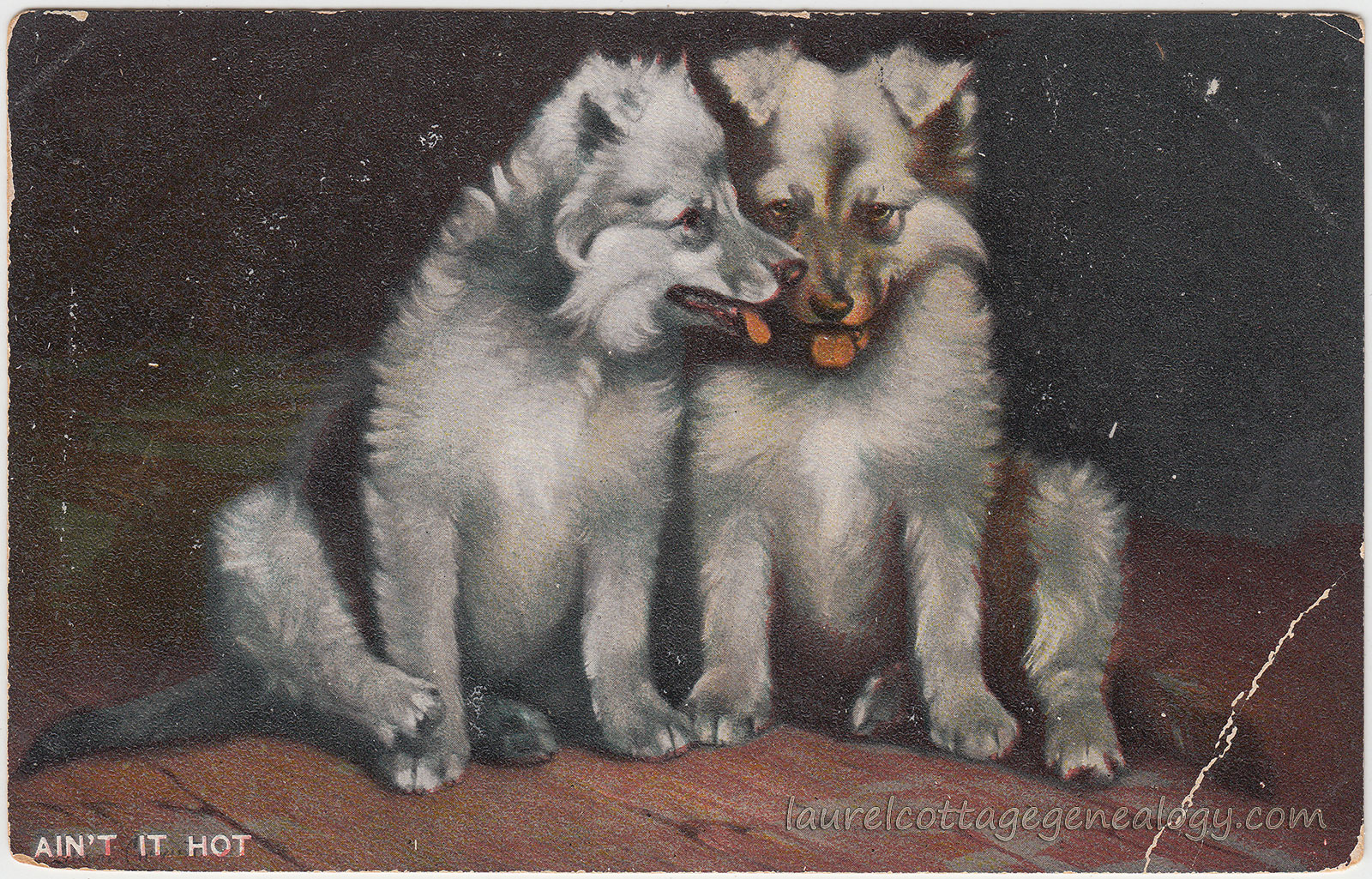
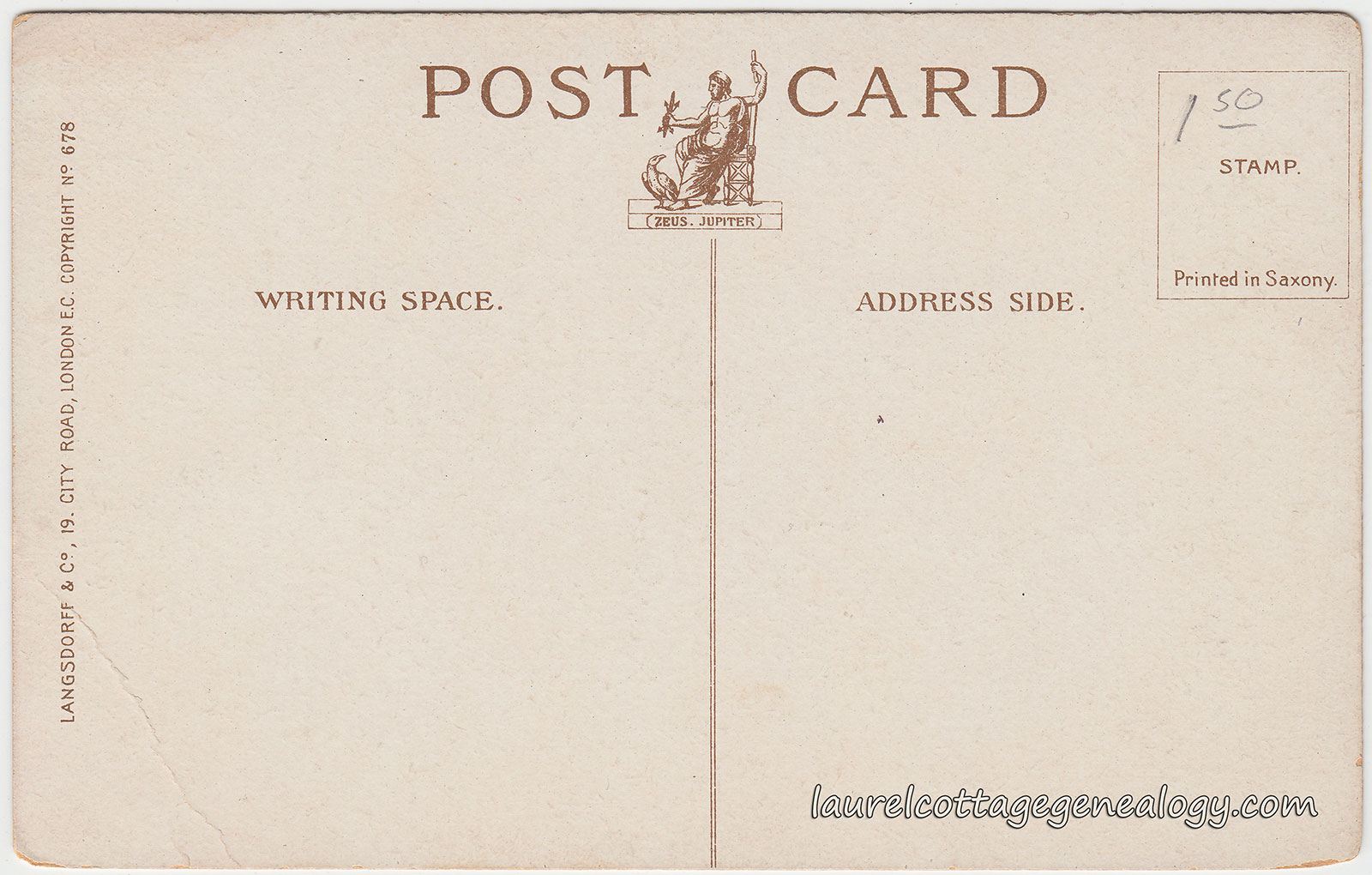
Aint It Hot pc1Aint It Hot pc2

This was a new one for me – the publisher logo on the back header of Zeus/Jupiter, but the card is nice, too, showing a couple of dogs commiserating on the fact that it’s hot, especially when one has a fur coat. A timely one to put up in August re the “dog days of summer.”

According to a wonderful genealogy site for Hertfordshire, U.K., this publisher, Langsdorrf & Co., who referred to themselves as “Fine Art Publishers,” started selling postcards in as early as 1901. Reference is made to a postcard found from this date with the same address that appears on our postcard here of 19 City Road, London. However, according to this same Hertfordshire genealogy source, Langsdorff & Co. didn’t apply for their trademark logo until May of 1906, and then appears to have stopped trading in 1914 with the outbreak of WWI. The “E.C.” after London in the address, stands for Eastern Central, and refers to a group of postcode districts in central London.

Divided back, unused postcard. Printed in Saxony (Germany.) Publisher:  Langsdorff & Co., 19 City Road, London E.C. Copyright number 678. Circa 1906 – 1914.

Price:  $5.00

Source:  “The Langsdorff & Co. Art Postcards of Hertfordshire”  Genealogy in Hertfordshire. June 2006 article with update November 2012. Web. Accessed 20 Aug 2014.

An Unusual Pose

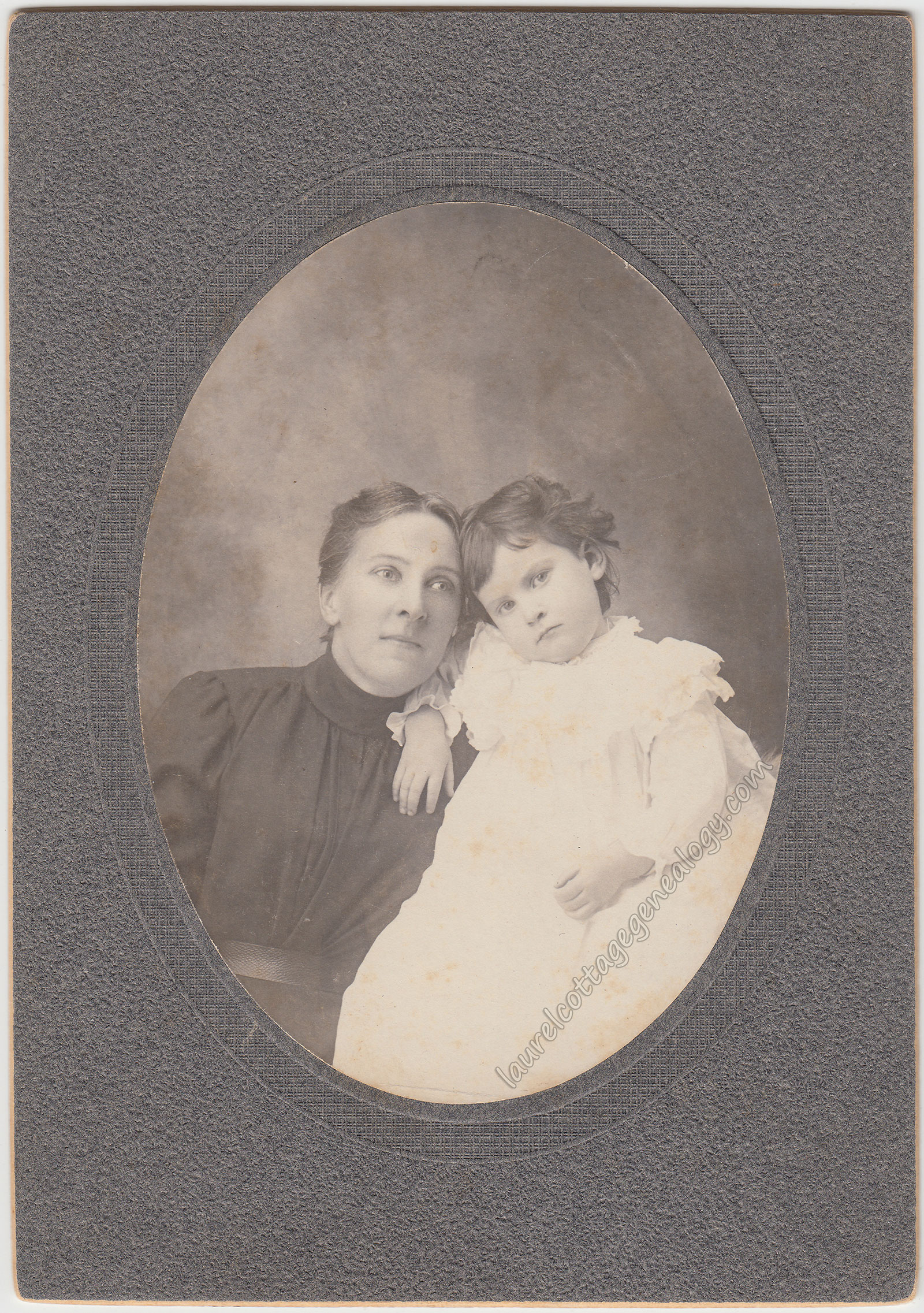
An Unusual Pose p1An Unusual Pose p2

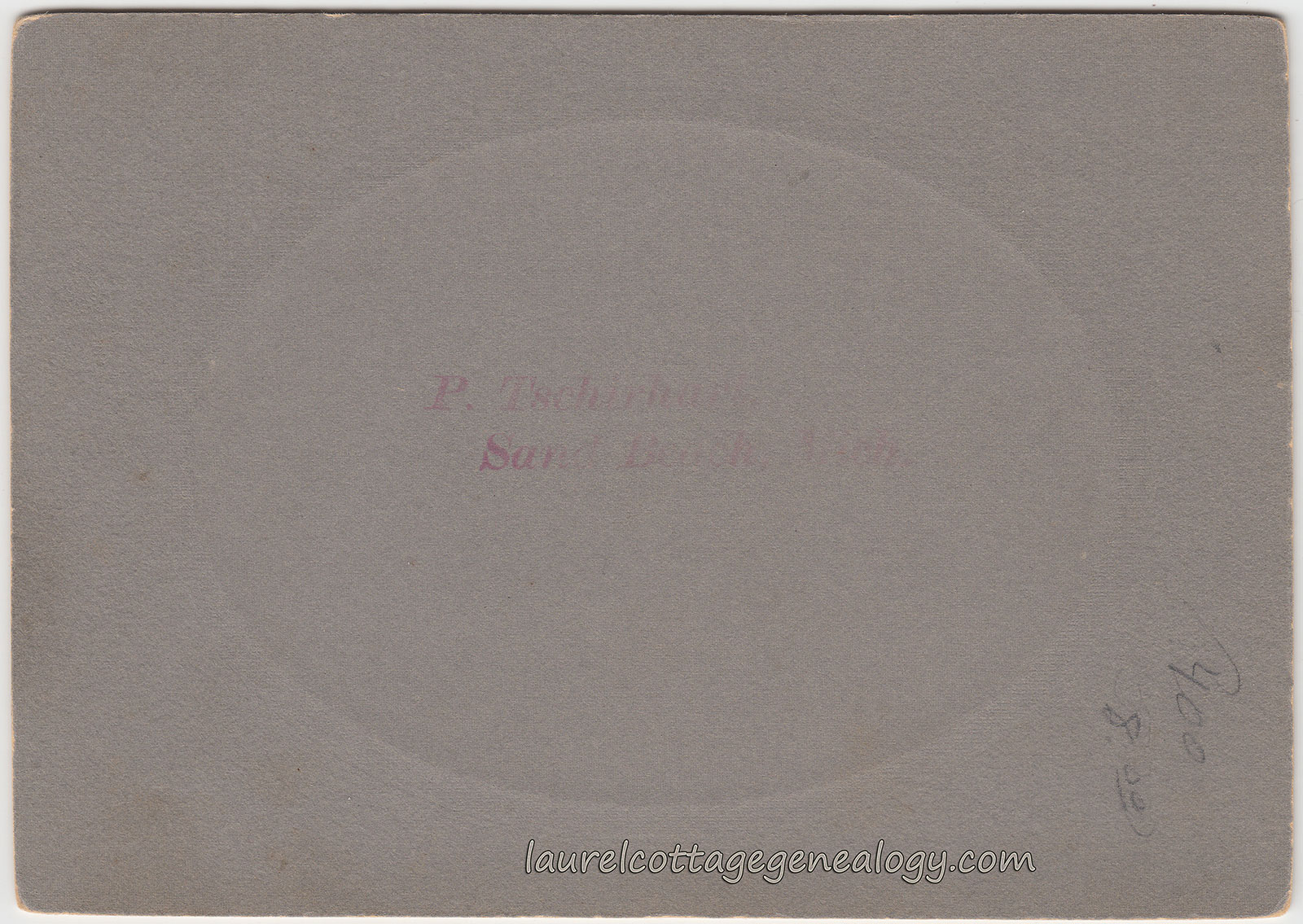
Studio photo in cardboard frame with oval setting. Circa 1891 – 1910. Photographer:  Peter Tschirhart. Studio location:  Sand Beach, Michigan.

Price:  $15.00   Size including frame:  About 6 x 4 and 1/4″

Ha, what to name this one? There are already mother and daughter type titles for other posts on this website, if memory serves, but what strikes the viewer about this one is probably the wonderful casual pose of the child with the elbow resting on the mom’s shoulder. The child looks into the camera while the mom gazes a little off into the distance. It’s a beauty of a photo. Unfortunately, the two subjects were not named, but we do at least have the photographer’s stamp on the back which is barely readable.

The photographer’s name and location is P. Tschirha ..?. – Sand Beach, Michigan. Sand Beach Township is located in Huron County, at almost the tip of the thumb, and this photo was found in an antique store in Dearborn, MI, this year, 2014.

Since the last couple of letters were so hard to read for the photographer’s name, I googled it and found a German family name under this spelling ending in “rt” – so the likely last name would be Tschirhart. The 1891 Polk’s City Directory for Sand Beach showed a Peter Tschirhart under this profession, voila!  From there it was easy to locate Peter on the 1900 Federal Census record taken in Sand Beach. This record shows him born in Canada April 1843, married to Annie E., born Canada, December 1857, and daughter Katherine M., born Canada, April 1884. Peter’s profession is photographer, the couple has been married about ten years, and although Katherine is named as a daughter, the census indicates Annie had two children and none living, so this may indicate that Katherine is a stepdaughter and Peter was previously married, or possibly just be an error on the census. Year of immigration to the U.S. for the family is given as 1890.

The 1910 shows Peter and Annie boarding in Sand Beach, Peter is about 66 years old and retired at this point. (Annie’s information re children shows mother of five, three living.) Well, there are more census records and more to look up for this photographer and his family, but I’ll leave that for another post, under the photographer heading (quite behind on these but will get to them.)

Sources:  Polk’s Michigan State Gazetteer and Business Directory, 1891. p. 1422 (Google Books snippet view.) Accessed 18 Aug 2014.

Year: 1900; Census Place: Sand Beach, Huron, Michigan; Roll: 715; Page: 6A; Enumeration District: 0019; FHL microfilm: 1240715. (Ancestry.com)

Year: 1910; Census Place: Sand Beach, Huron, Michigan; Roll: T624_649; Page: 8A; Enumeration District: 0019; FHL microfilm: 1374662. (Ancestry.com).

Life On The Front Porch

Life On The Front Porch pc1Life On The Front Porch pc2

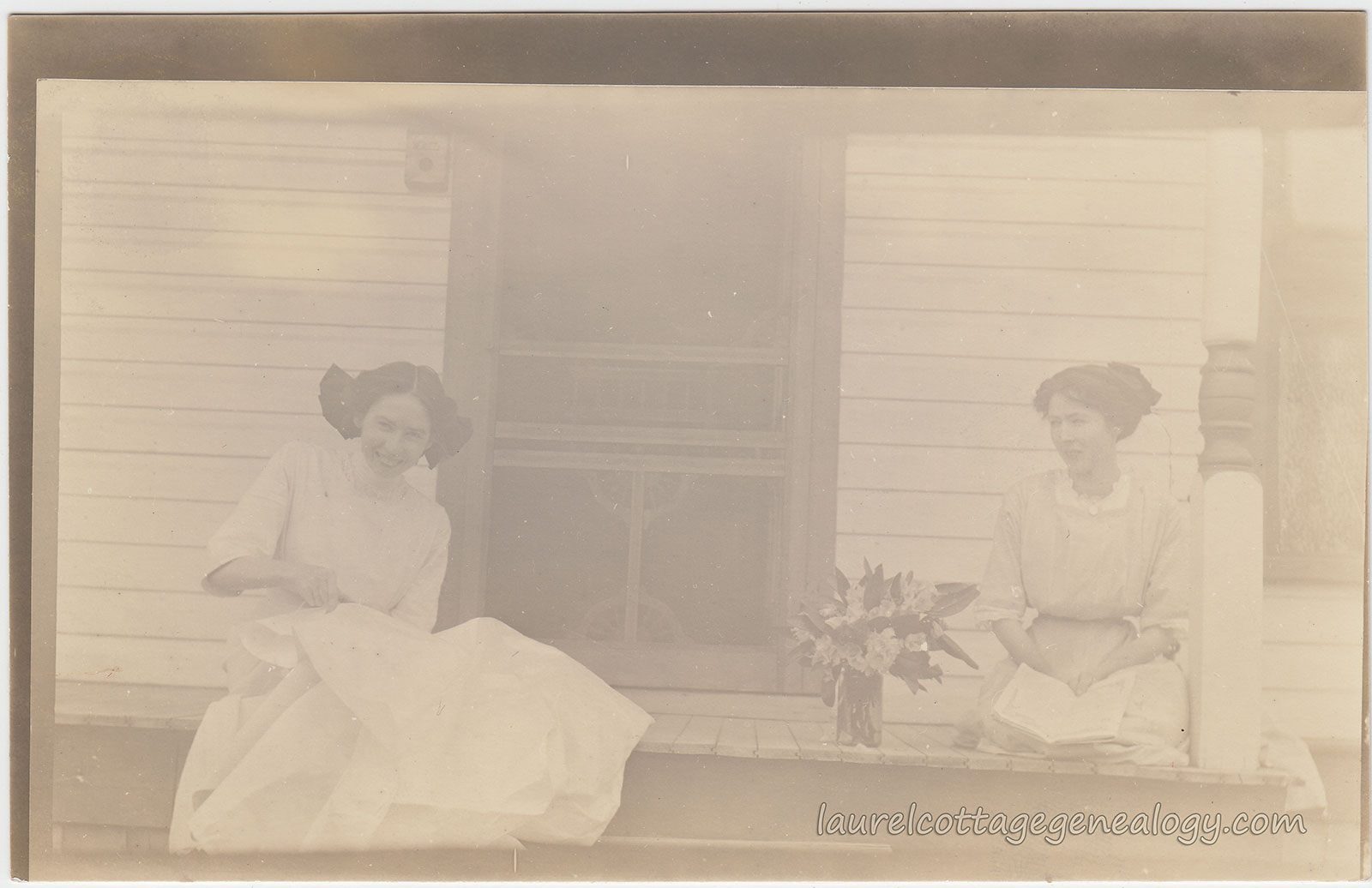
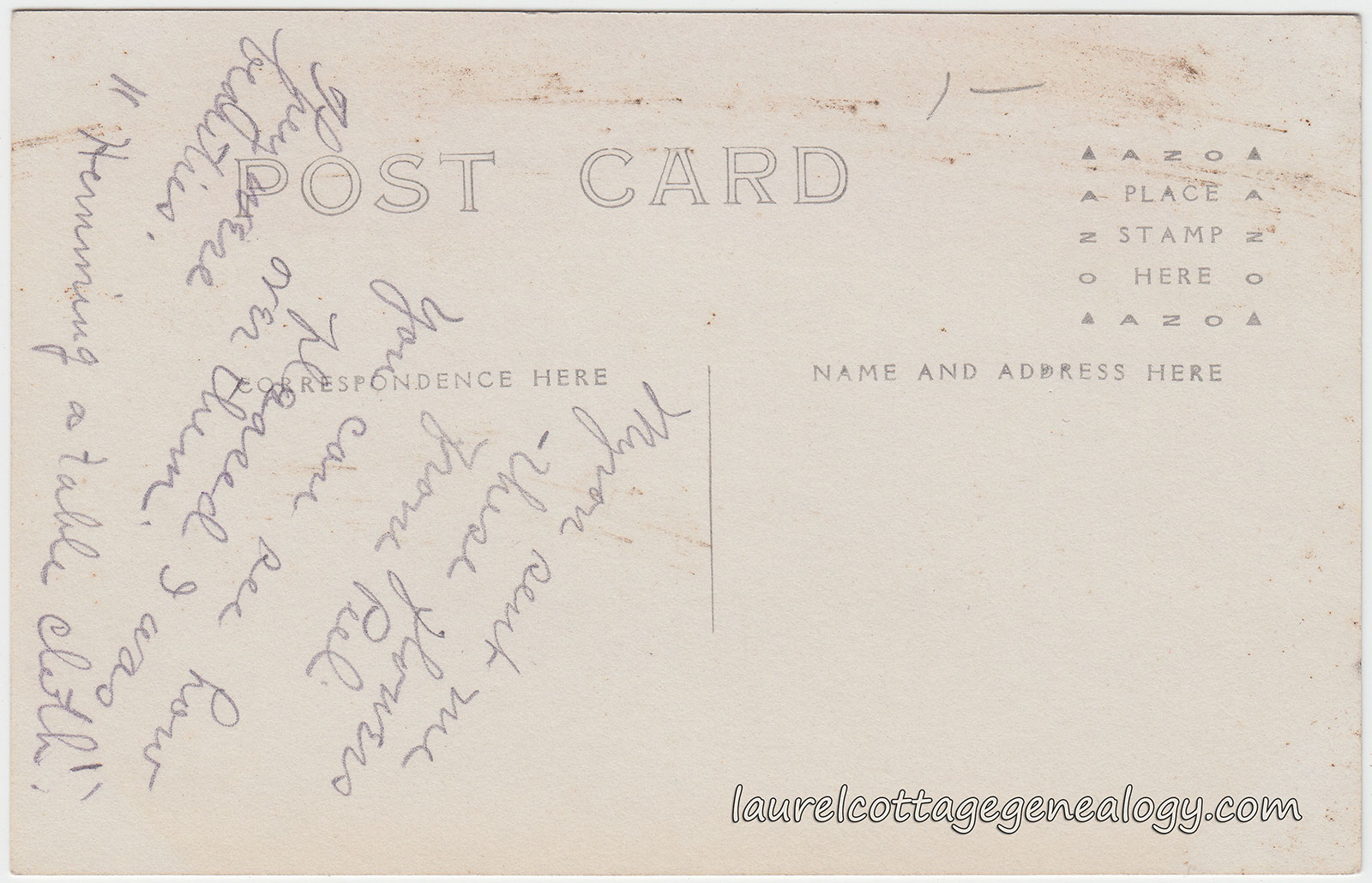
Here’s a Real Photo Postcard of a wonderful photo (though light) of two beautiful young women sitting on their (one assumes) front porch. A vase of flowers is next to the woman on our right, who is holding an open book and gazing off to the side, while the other woman is smiling into the camera and (as is explained in the message) hemming a table cloth.

On the back is written,  “Myron sent me these flowers from Peel. You can see how pleased I was over them. They were beauties. ‘Hemming a table cloth!'”

Real Photo Postcard, divided back, unused with writing. AZO stamp box, circa 1907 – 1918.

Price:  $5.00

Two Cats And A Rocking Chair

Two Cats And A Rocking Chair pc1Two-Cats-And-A-Rocking-Chair-pc2

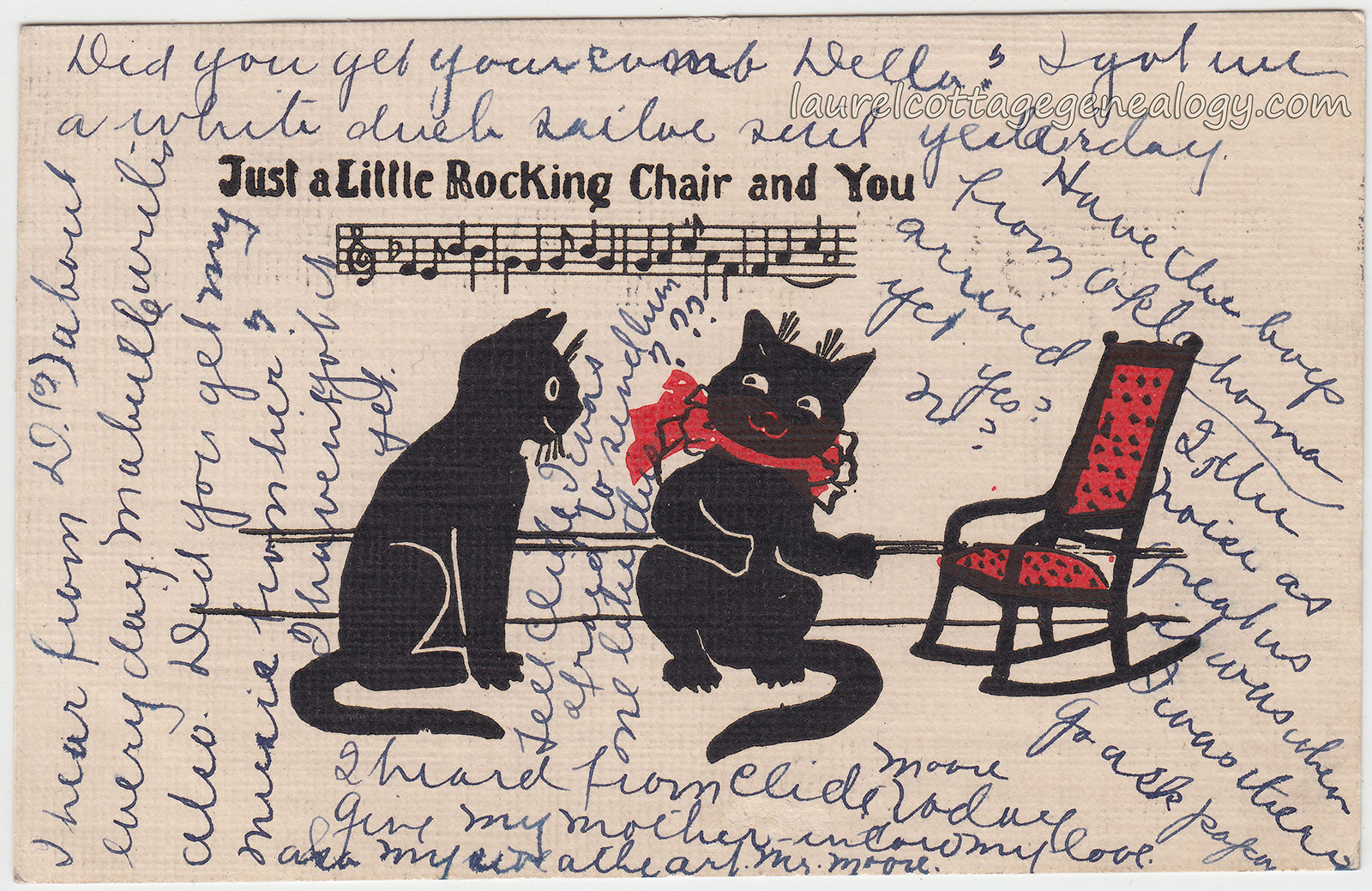
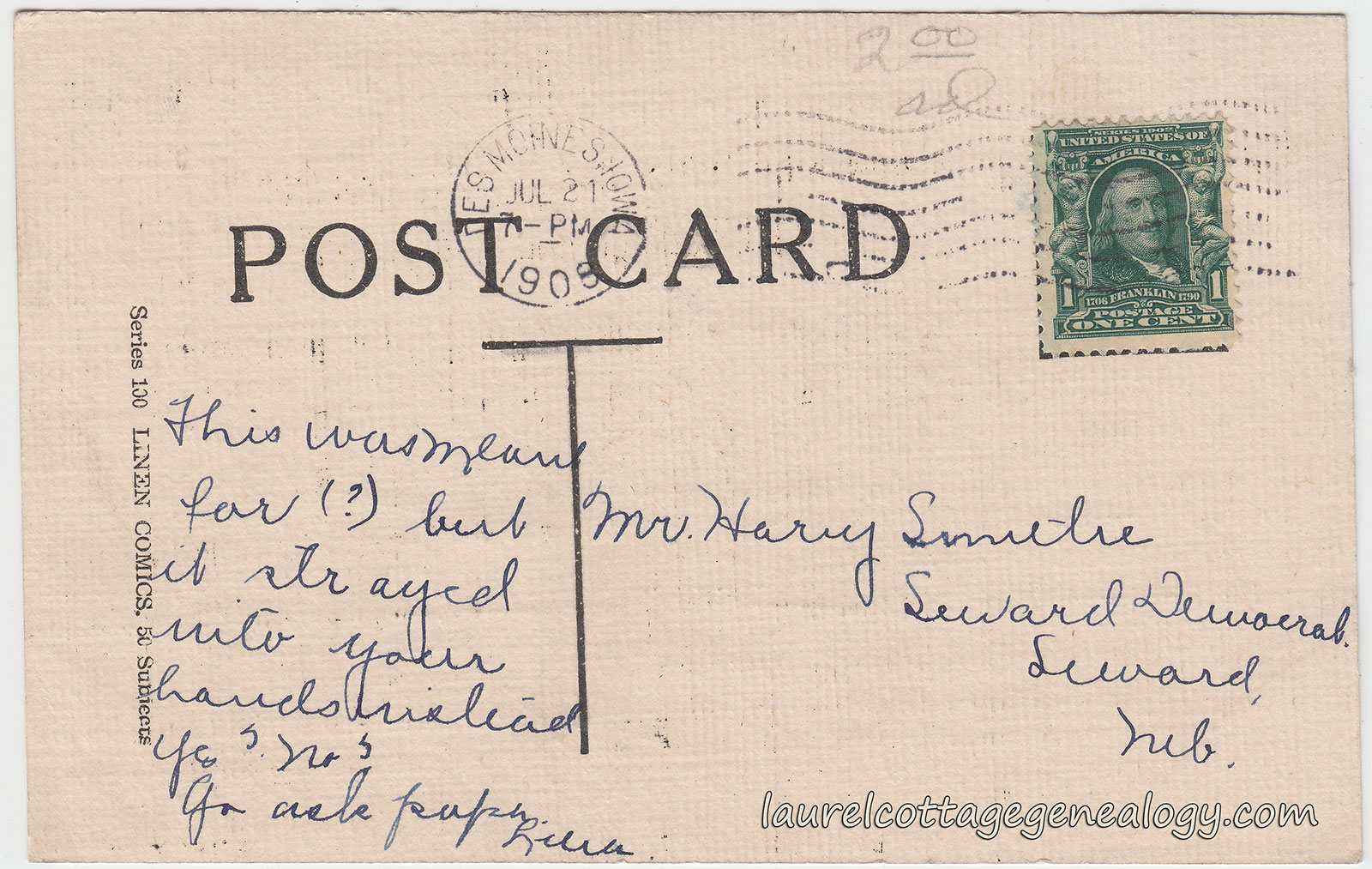
Divided back, used postcard. Postmarked July 21, 1908, Des Moines, Iowa. “Series 100, Linen Comics. 50 Subjects.” Publisher:  possibly R. L. Wells.

Price:  $7.00

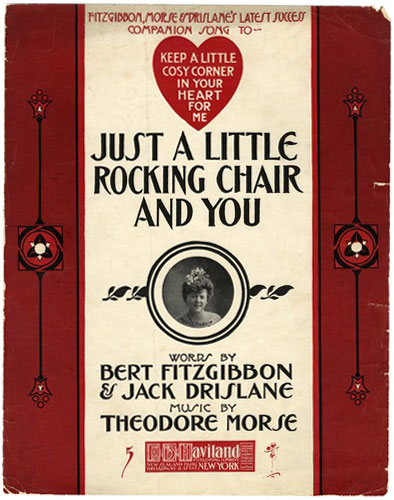
Here’s the second postcard we have for the likely publisher of R. L. Wells. (See prior post.) This one shows one kitty, who wears a red bow, inviting another kitty to sit down in a rocking chair. The caption is  “Just a Little Rocking Chair and You”  with a treble clef staff underneath. This postcard caption is the title of a song: music by Theodore Morse, lyrics by Jack Drislane and Bert Fitzgibbon, released in 1906. The sheet music cover below shows singer Ada Jones.

Rocking Chair Cover Page

Card addressed to:  “Mr. Harry Smithe, Seward Democrat, Seward, Neb.”  To the left of the address was written  “This was meant for [?] but it strayed into your hands instead. Yes? No? Go ask papa.  [?]”  

The front of the card may or may not have been written by the same person as the above message and says,  “Did you get your comb Della? I got me a white [?] sailor suit yesterday. Have the boys from Oklahoma arrived yet. Yes? No? Is the noise as great as it was when I was there go ask papa. I hear from D. (?) about every day. Mabelle writes[?] also. Did you get my music[?] from her? I haven’t got it yet. Tell Clide I was afraid to send him one like this ??? I heard from Clide Moore today. Give my mother-in-law my love. Also my [?]  Mr. Moore”

Editor and publisher William H. Smith

Thanks to the corrections (see comment below) from Leo, we found that Harry or Harvey, was William H. Smith, born in 1873 in Henry County, Illinois, son of William L. Smith and Maria (Edwards) Smith. William H. Smith came to Seward about March 1897 and bought the Seward County Democrat and then the Independent, consolidating them into the Seward Independent Democrat. Della (Fletcher) was his wife. They were married June 12, 1901 in Seward.

This card is rather fascinating for the message content and writer’s or writers’ style:  Why was the sender afraid to send a postcard like this to Clide? Funny – the whole “Yes? No?” thing, and how did the postcard stray into someone else’s hands? And the “Go ask Papa” refrain would make a good song title. Speaking of which, the short research into old song titles leaves me wondering (as per usual) what we’re currently missing. Just the titles alone are worth looking at, and what about all of the music – the catchy tunes, the charming and often comic lyrics, the insight into a prior century, etc.

Sources:  “Just a Little Rocking Chair and You.”  ASU Libraries. Arizona State University sheet music collection. Web accessed 14 Aug 2014.

“Memorial and Biographical Record and Illustrated Compendium of Biography.” (1899). Chicago:  George A. Ogle & Co. (Google Books).

Year: 1910; Census Place: Seward Ward 2, Seward, Nebraska; Roll: T624_855; Page: 22A; Enumeration District: 0176; FHL microfilm: 1374868. (Ancestry.com).

Marriage record for William H. Smith and Della Fletcher. Library and Archives of the Nebraska State Historical Society; Lincoln, Nebraska. (Ancestry.com).

T’is The Wise That Visit

Tis The Wise That Visit pc1Tis The Wise That Visit pc2

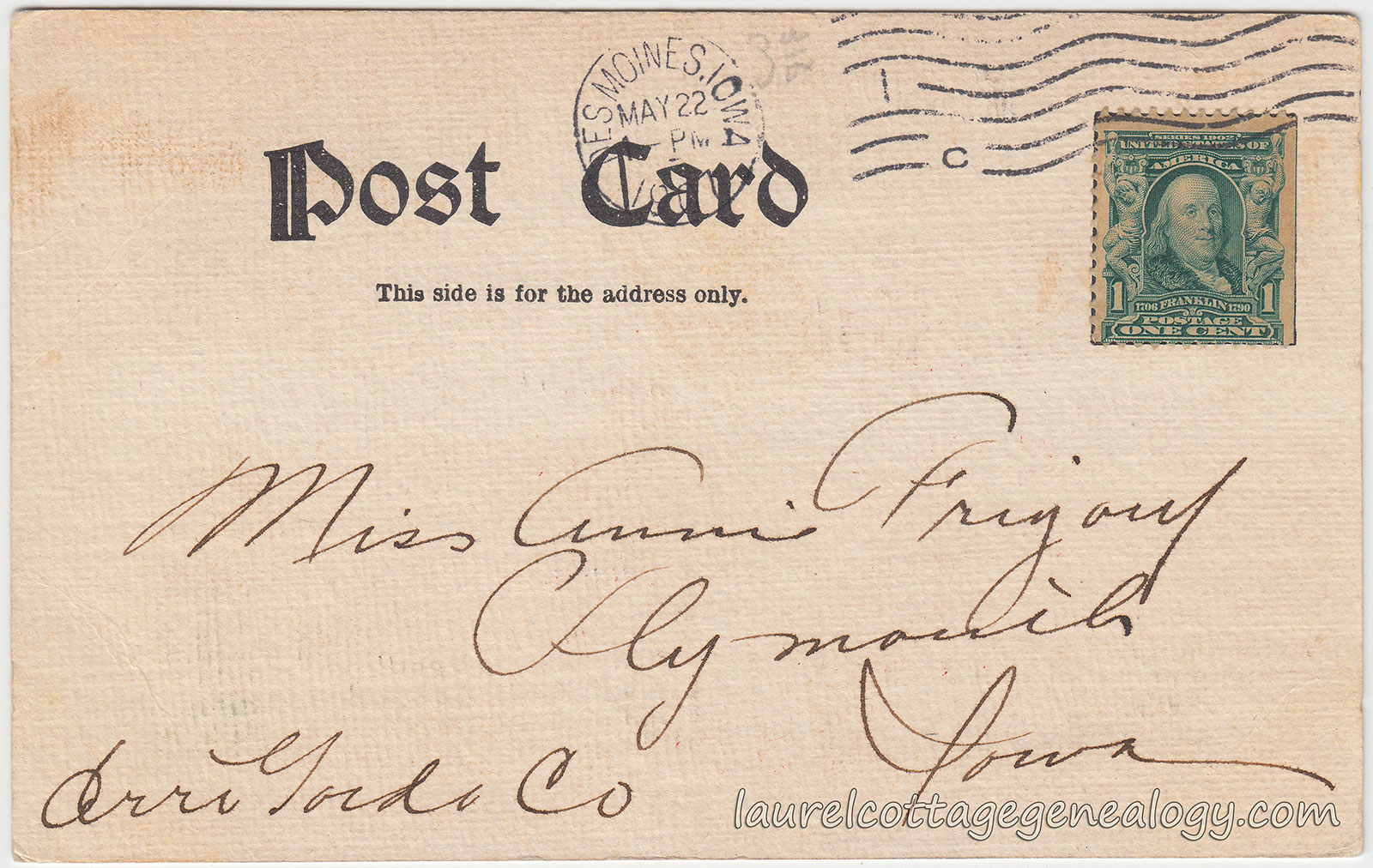
Undivided back, used postcard. Postmarked May 22, 1907 in Des Moines, Iowa. Publisher possibly R. L. Wells.

Price:  $15.00

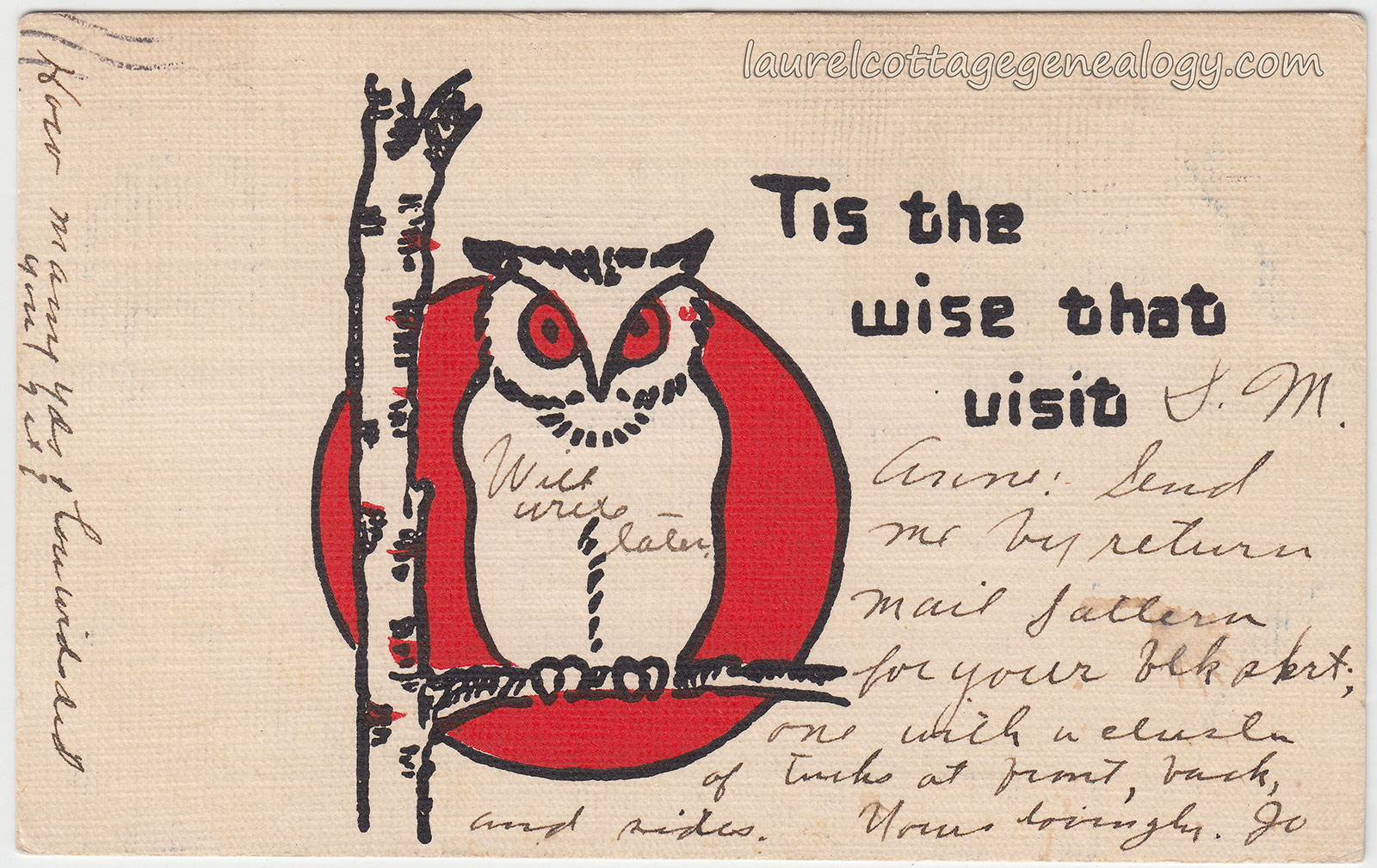
Owl on tree branch with red moon in the background, with the caption  “Tis the wise that visit.”

The sender wrote:  “S.M. Anne:  Send me by return mail pattern for your blk skrt; one with a cluster of tucks at front, back, and sides. Yours lovingly, Jo.”  Inside the owl drawing Jo wrote,  “Will write – later”  and on the side,  “How many yards / how wide did you get?”

Postcard addressed to:  “Miss Annie Friyouf, Plymouth Iowa, Cerro Gordo Co”

Anne Friyouf turns up on the 1930 Federal Census for Plymouth, Iowa, as Anna Bliem, widowed head of household, born Iowa, about 1884, married at about age 31. Living with her is her widowed mother Barbara Friyouf, born Czechoslovakia about 1842; sister Mary Friyouf, single, born Czechoslovakia about 1872; and sister Barbara V.[?] Friyouf, single, born Czechoslovakia about 1874. No one in the family is listed as having an occupation on this census.

Anna married John Bliem on August 30, 1915 in Mason City, Iowa. The marriage record shows Anna as born about 1884 in Plymouth, Iowa and that her parents are Joseph Friyouf and Barbara Mar…k? (original image not available from online source.) John Bliem was born in New York City, age at time of marriage about 49, and his parents are John Bliem and Clara Claus.

The 1940 census, which shows Anna as head of household and includes her sisters, is very interesting in that it states Anna’s occupation is Postmaster.  National Archives (NARA) records shows she was nominated for the post on April 23, 1934, was confirmed on May 7th, and that she retired on December 31, 1949. You might be surprised (as I was) to learn that it was not uncommon for women to be appointed as Postmaster (this is the official title, though some say Postmistress.) There were women postmasters before the Revolutionary War when the country was still under British rule, and in fact (without going into much researching and comparison) on May 5, 2008, in the United States, there were more women than men holding the position. The NARA website indicates also that it was common in rural areas for women to be appointed.

As far as Jo, the sender of the postcard, it’s possible she was a relative. There is a Josephine Friyouf showing up in city directories in Des Moines. Regarding the publisher, this info is not given but similar postcards found online show a copyright mark for R. L. Wells.

Sources:   “Iowa, County Marriages, 1838-1934,” index, FamilySearch (https://familysearch.org/pal:/MM9.1.1/XJNP-46Y : accessed 11 Aug 2014), John Bliem and Anna Friyouf, 30 Aug 1915; citing Mason City, Cerro Gordo, Iowa, United States; FHL microfilm 1481039.

Year: 1930; Census Place: Falls, Cerro Gordo, Iowa; Roll: 647; Page: 2A; Enumeration District: 0006; Image: 695.0; FHL microfilm: 2340382.  (Ancestry.com)

Year: 1940; Census Place: Plymouth, Cerro Gordo, Iowa; Roll: T627_1146; Page: 1B; Enumeration District: 17-8. (Ancestry.com)

National Archives and Records Administration (NARA); Washington, D.C.; Record of Appointment of Postmasters, 1832-Sept. 30, 1971; Roll #: 36; Archive Publication #: M841.  (Ancestry.com)

“Post Office Records” National Archives Records Administration. Web accessed 12 Aug 2014.

“Women Postmasters”   United States Postal Service. July 2008. Web accessed 12 Aug 2014.

Dilworth’s Coffee

Dilworths Coffee tc1Dilworths Coffee tc2

Trade Card circa 1884 – 1888.  Size:  About 3 and 1/4 x 2 and 1/2″

Price:  $10.00

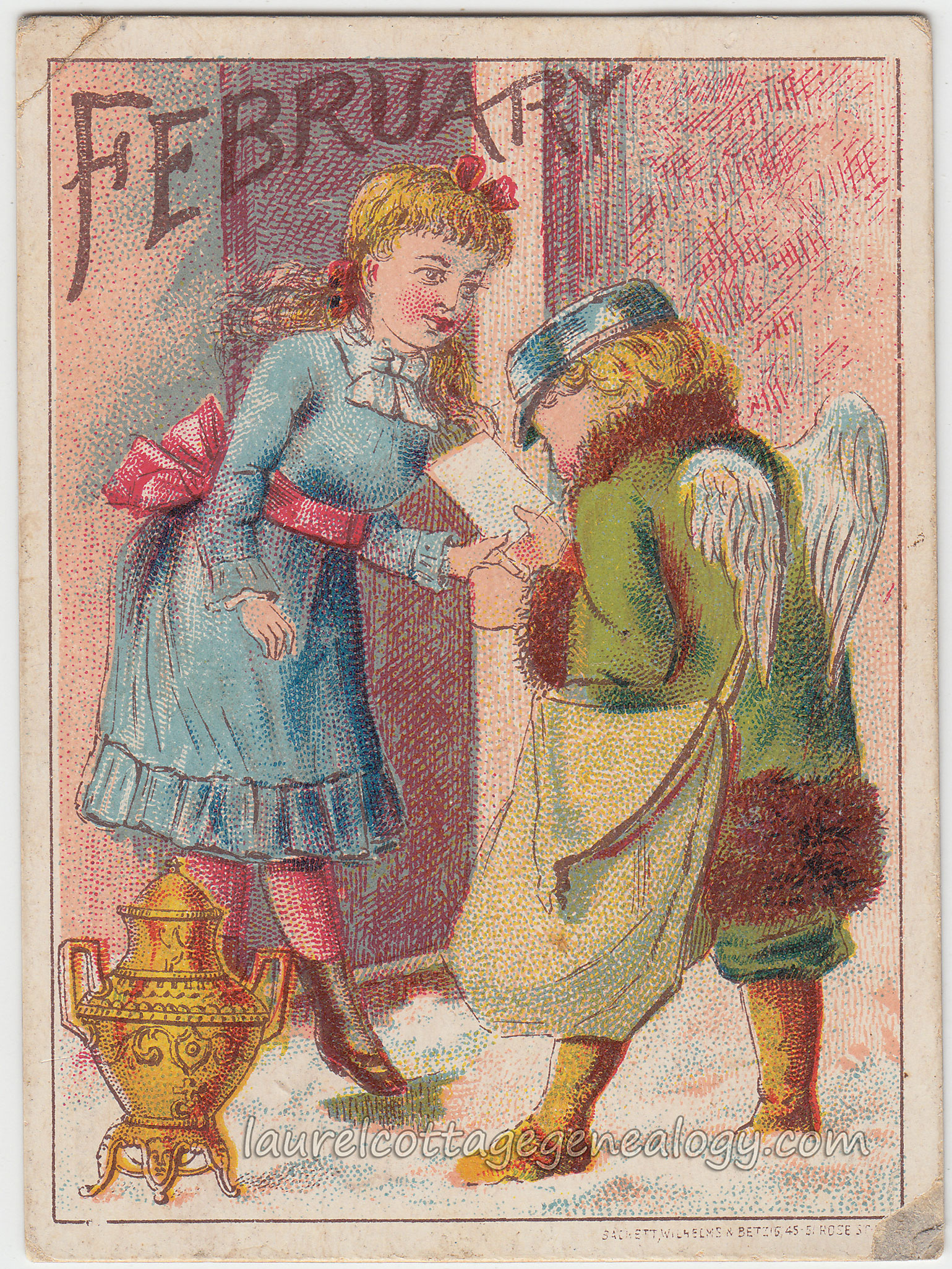
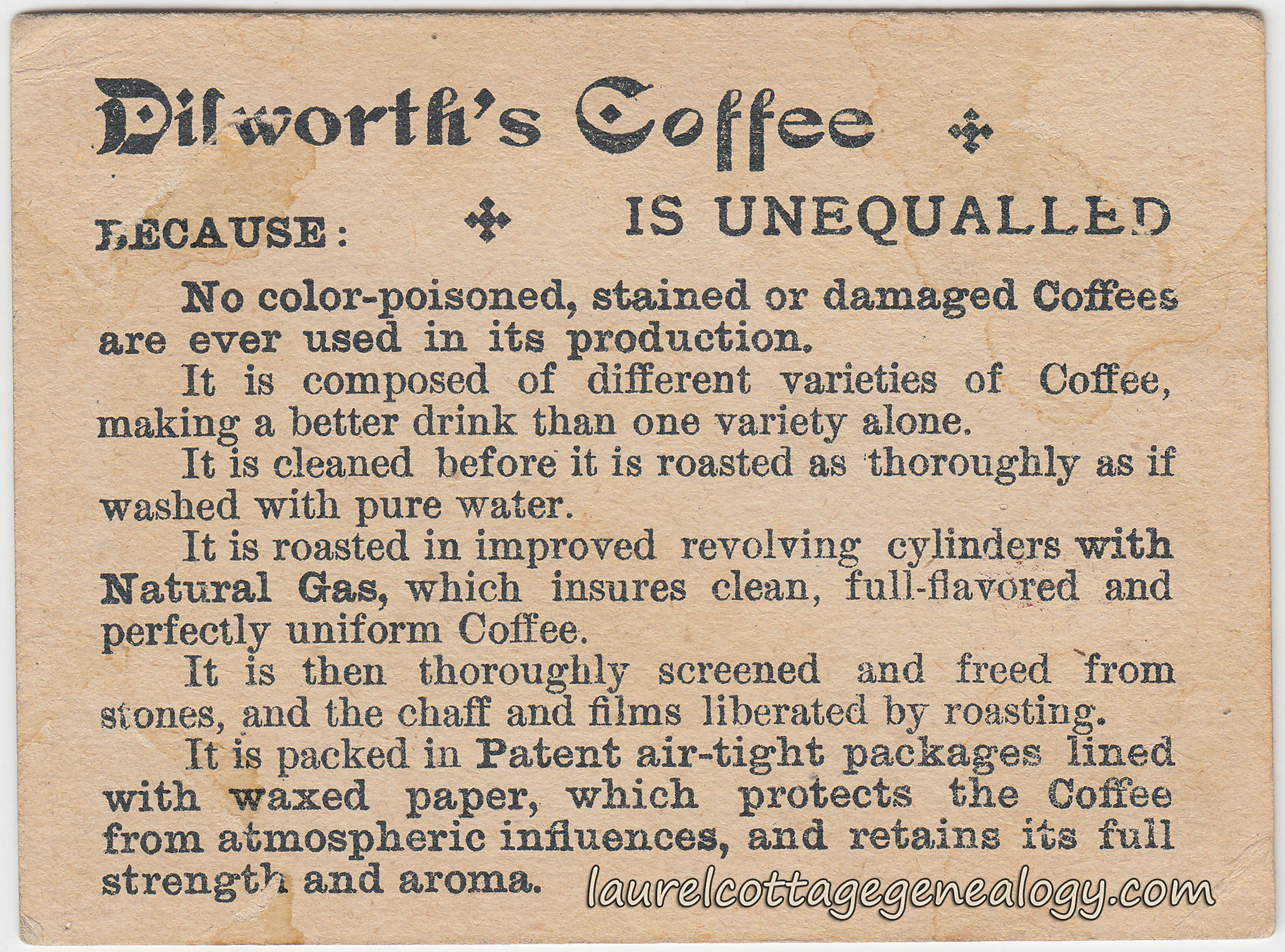
Old trade card for the Dilworth Brothers Company, which was located in Pittsburgh, Pennsylvania. This one shows shows an angel in a fur-trimmed coat, carrying a large mail pouch, delivering the daily postals to a young woman who’s just answered the door. There is snow on the ground, and the calendar month of February is printed at the top. As one can well imagine, trade cards like these were a great marketing scheme, to keep people coming back to get the other eleven months of the year, or the rest of the countries of Europe or for whatever other theme was being used. Dilworth’s advertised here that  “No color-poisoned, stained or damaged Coffees are ever used in it’s production.”  I don’t know what was meant by “color-poisoned” (yikes) and did not find any other online references to this term; hopefully clarification will show up in later research. I did find a similar old trade card (for Arbuckle’s) that mentioned coffee beans being glazed with a mixture of egg and confectioner’s sugar. The egg maybe as a binder for the sugar or for shine, but the sugar was to close the pores of the beans in order to preserve the flavor. The gold coffee urn in the trade card was Dilworth’s symbol and is placed here (charmingly slightly off-kilter) with it’s feet in the snow.

As for the manufacturer of this trade card, the small print at the bottom on the front shows Sackett, Wilhelms & Betzig, 45-51 Rose St. (New York, NY.) This was a lithography company and shows up in the New York City directories from at least 1884 – 1888.

Sources:  Trow’s City Directory Co.’s Trow’s New York City Directories for 1884-’85, Vol. 98 p. 1520. (Ancestry.com. U.S. City Directories, 1821-1989)

Trow’s City Directory Co.’s Trow’s New York City Directories for year ending May 1, 1888, Vol. 101. p. 1714. (Ancestry.com. U.S. City Directories, 1821-1989)

Greyhound Depot, Grants Pass, Oregon

Greyhound Terminal Grants Pass Oregon pc1Greyhound Terminal Grants Pass Oregon pc2

Real Photo Postcard, unused. Circa 1941 – 1945. EKC stamp box.

Price:  $25.00

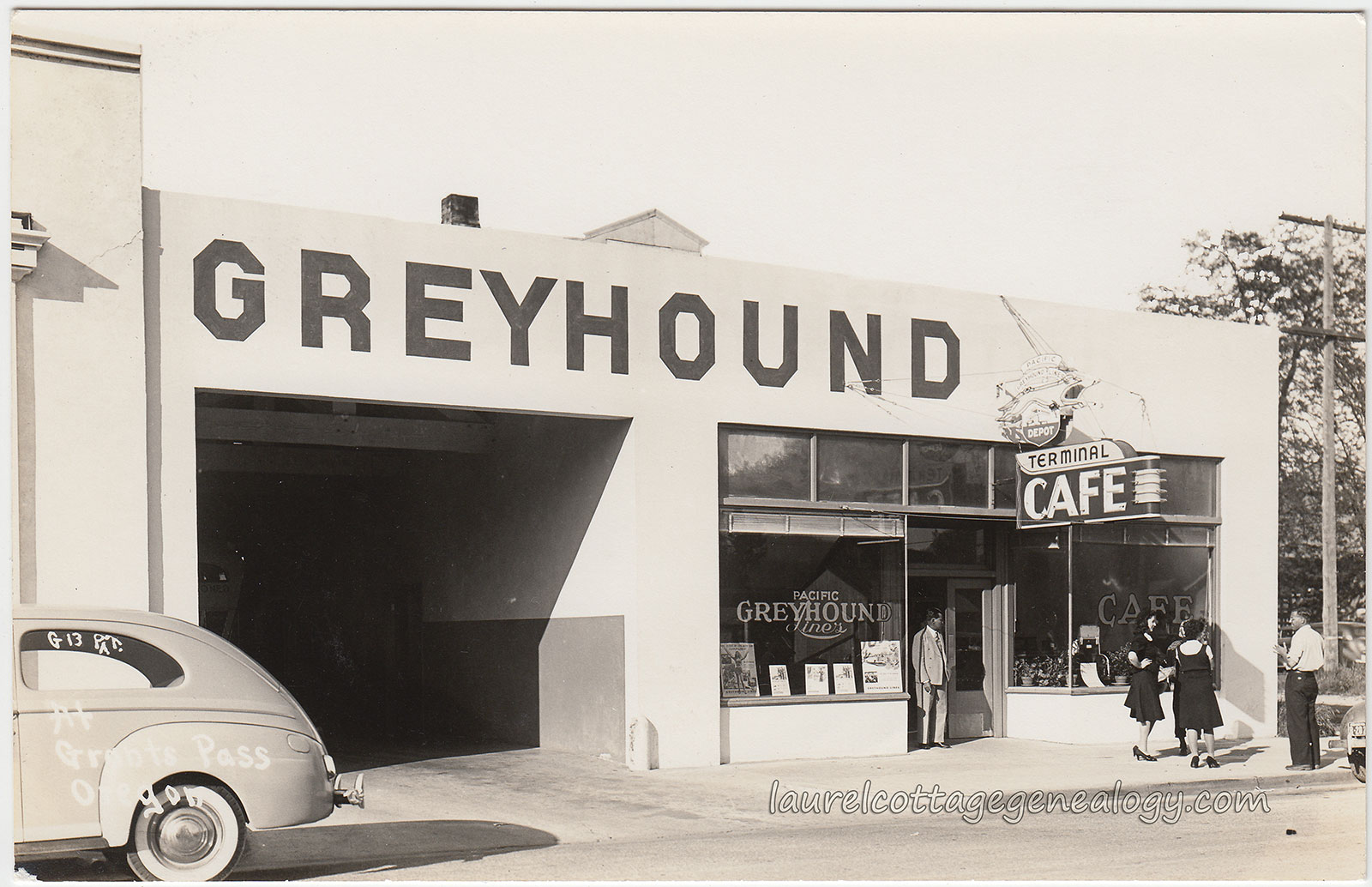
Early 1940’s Real Photo Postcard of the Greyhound Depot in Grants Pass, Oregon, showing the depot entrance and café with a small group of several people (a gentleman and three young women) exchanging conversation and to their right, a gentleman in a double-breasted suit, holding a cigarette, on the doorstep of the entrance. This postcard appears to have been manufactured for the Grants Pass station for travelers to purchase. The location and probably the photographer or printer information shows at the bottom left in white as  “G13 PAT. [or P^T?] At Grants Pass Oregon.” The partial view of the vehicle in the photo is the best clue in dating this postcard:  The car is a 1941 Ford Super Deluxe 2 Door Sedan.