Genealogy Services, Old Photos, Postcards, Trade Cards, Etc.

Pretty Soon I Owe You A Letter

Pretty Soon I Owe You A Letter pc1Pretty Soon I Owe You A Letter pc2

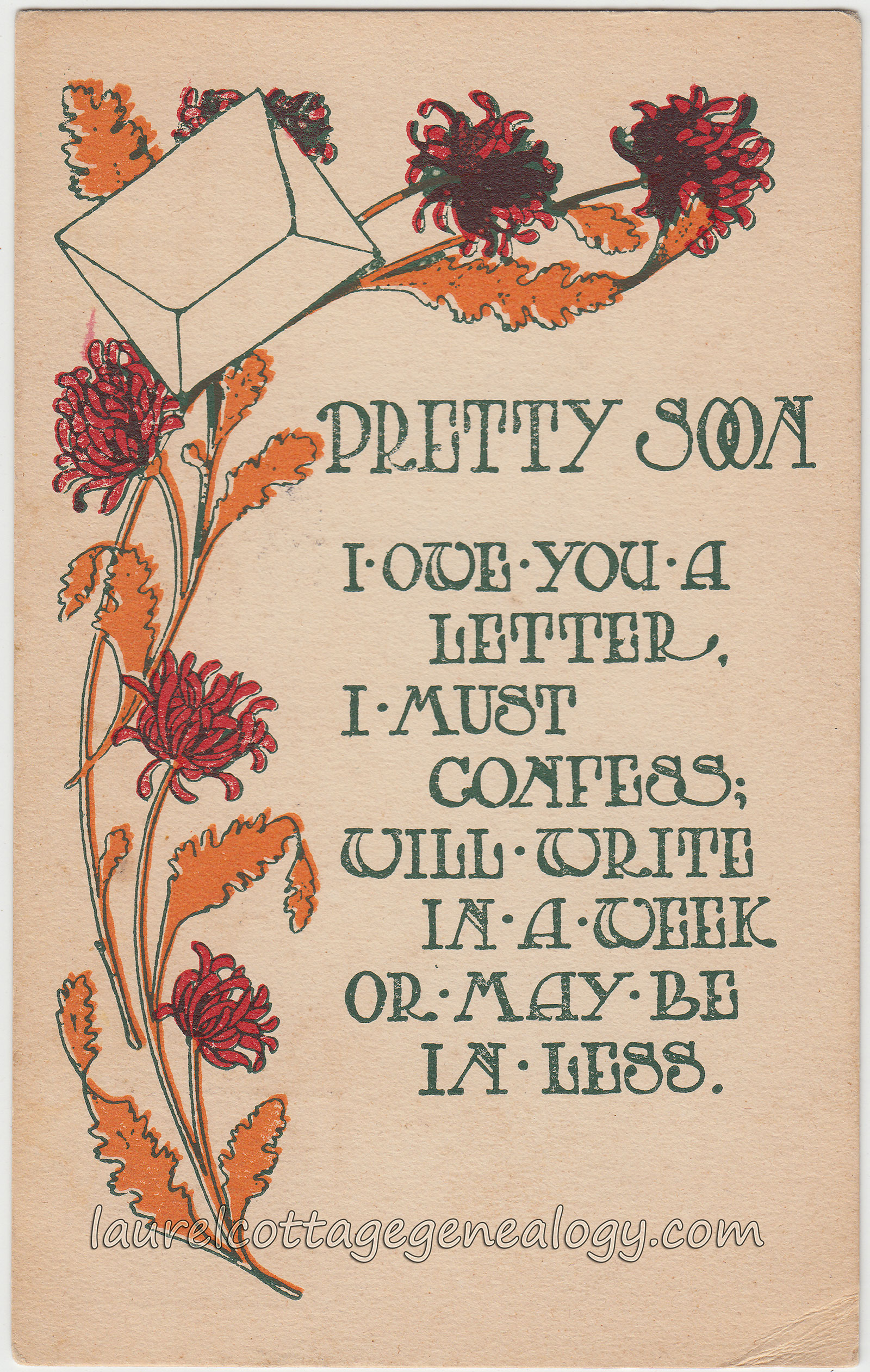
“Pretty soon

I owe you a letter,

I must confess;

Will write

In a week

Or may be

In less.”

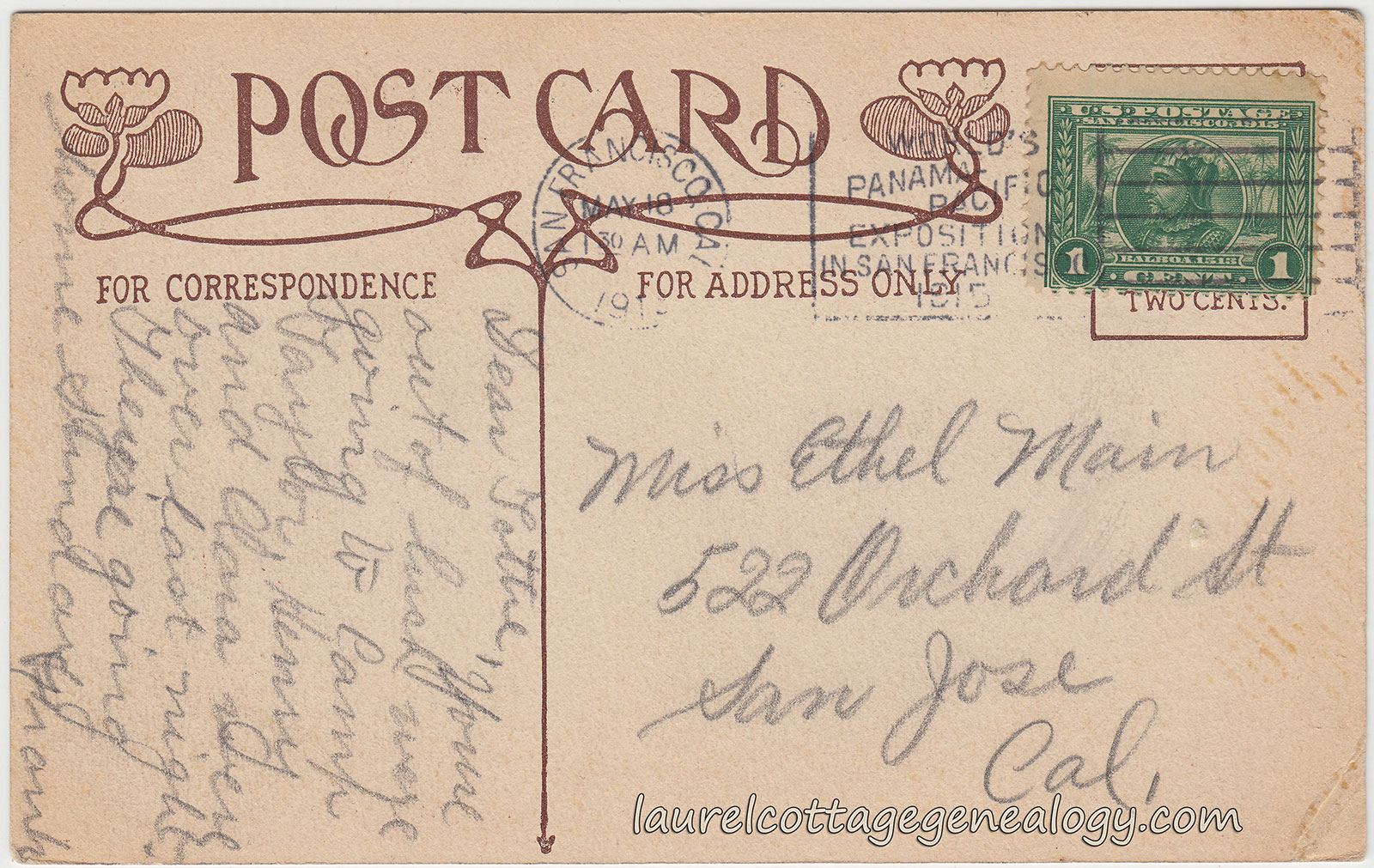
The sender wrote:  “Dear Lottie, Youre out of luck were going to Camp Taylor. Henry and Clara were over last night. They’re going home Sunday. Frank”

Addressed to:  “Miss Ethel Main, 522 Orchard St., San Jose Cal.”

I don’t know why, but I’m always surprised by the seemingly endless amount of different lettering styles that show up on old postcards, miscellaneous cards, and the like. Delighted though, to be sure. This one is no exception. Love the way the “o’s” overlap in “soon”, the rounded “w”, the dots added between the words, and the “n”, although the “n” in “confess” is different. I guess the ink got filled in on that one by mistake. Anyway, this is an Art Nouveau style card, as you can see by the flow-y lines of the few sprays of flowers and leaves, (timely for fall colors right now) and is also unmistakably Art Nouveau in the beautiful postcard header on the back of the card.

This is the first in a collection of postcards that are addressed to Ethel Main. Camp Taylor that is mentioned in the message to “Lottie” (or is that Lettie?) is today Samuel P. Taylor State Park, located in Marin County, about 30 miles northwest of San Francisco. Samuel Penfield Taylor, was a successful gold rush ’49er, who purchased 100 acres along Lagunitas Creek for the whopping 😉 price of $505.00 in 1855. Imagine paying $5.00 an acre today! On this land, Taylor set up the first paper mill on the West Coast. The full history of the park is really interesting. Check it out here:  Samuel P. Taylor State Park.

Divided back, used postcard. Postmarked May 18, 1915 from San Francisco, California. Publisher unknown.

Price:  $15.00

Source:  Samuel P. Taylor State Park. Marin Conservation League. Web accessed October 26, 2014.

Hearty Greetings

Hearty Greetings pc1Hearty Greetings pc2

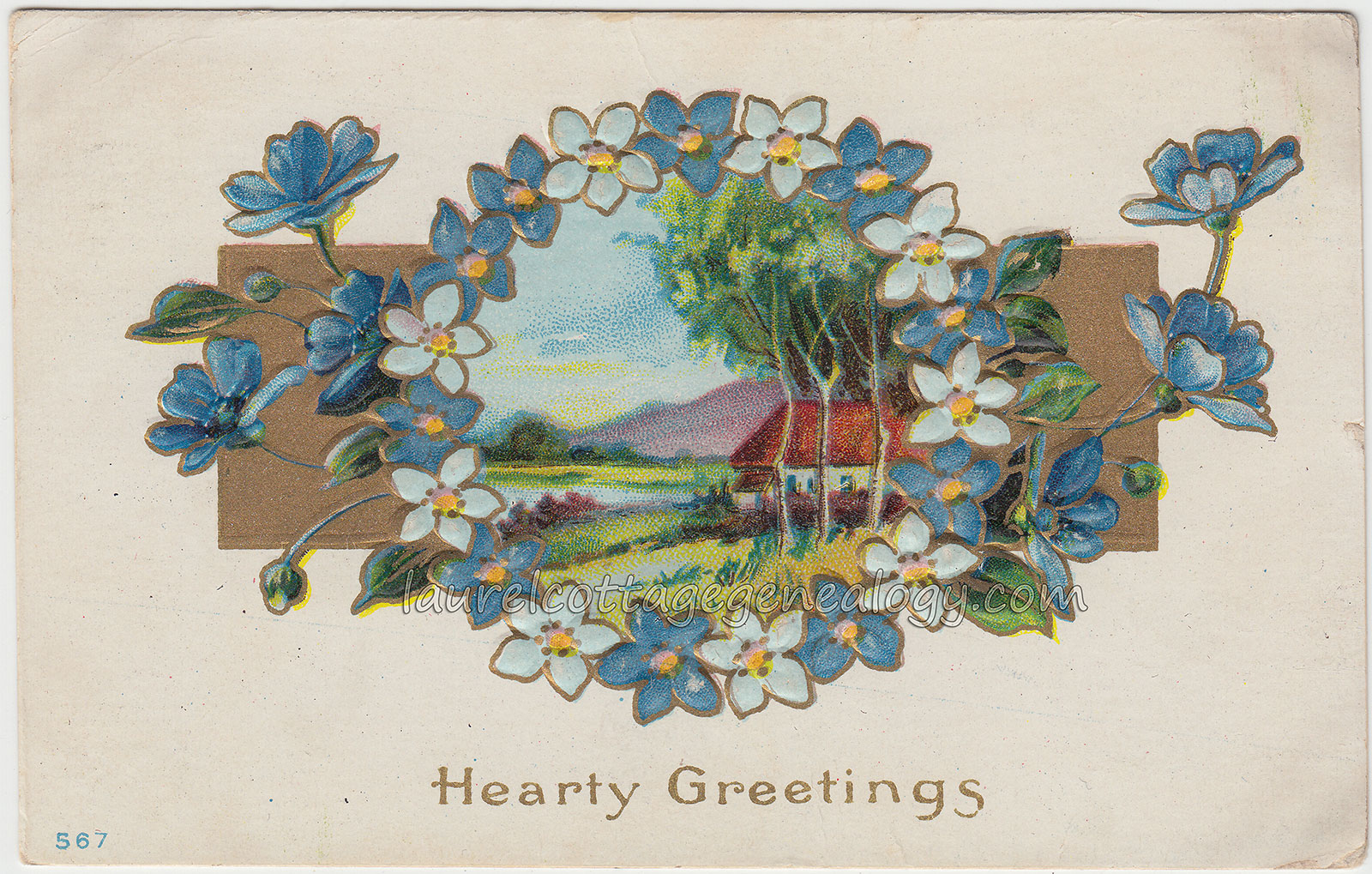
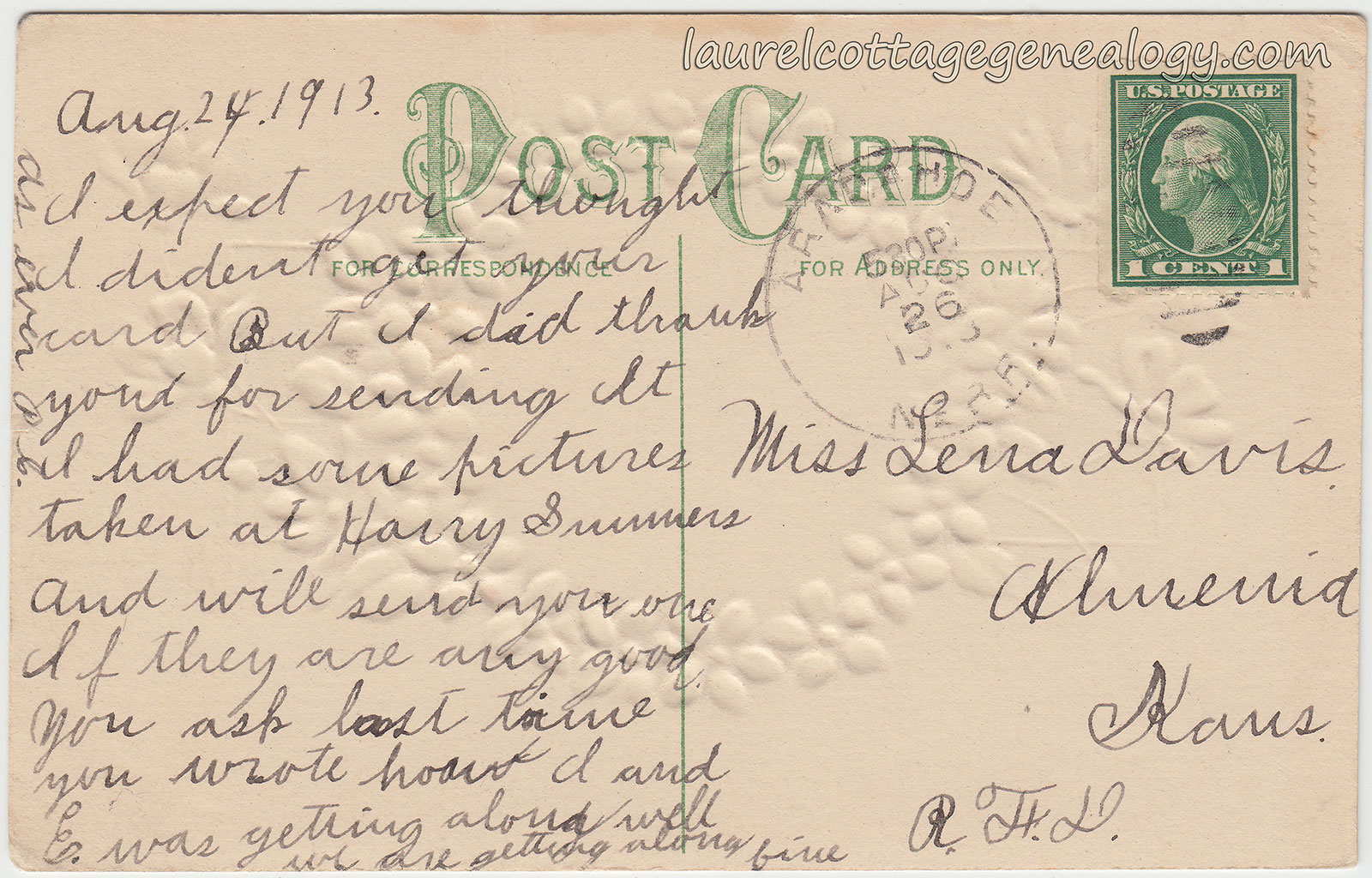
Here’s a beauty sent from Arapahoe, Nebraska in 1913, carrying a message of  “Hearty Greetings.”  This postcard is embossed and shows a little scene of a cottage by a lake or river, with some purple hills and a blue sky in the background, framed by a wreath of alternating dark and light blue forget-me-nots, with some larger blue flowers happily appearing out from the sides. Underneath it all is a gold-tone rectangular bar.

This is another in the Lena Davis collection, and the address shows:  “Miss Lena Davis, Almena, Kans.  R.F. D.”

The sender wrote:  “Aug. 24, 1913. I expect you thought I didnt get your card But I did thank you for sending It. I had some pictures taken at Harry Summers[?] and will send you one If they are any good. You ask last time you wrote how I and E. was getting along/ well we are getting along fine.  – as ever P. C.[?]”

Divided back, embossed, used postcard. Postmarked August 26, 1913 from Arapahoe, Nebraska. Publisher unknown. Series or number 567.

Price:  $5.00

San Blas, Republic of Panama

Panama pc1Panama pc2

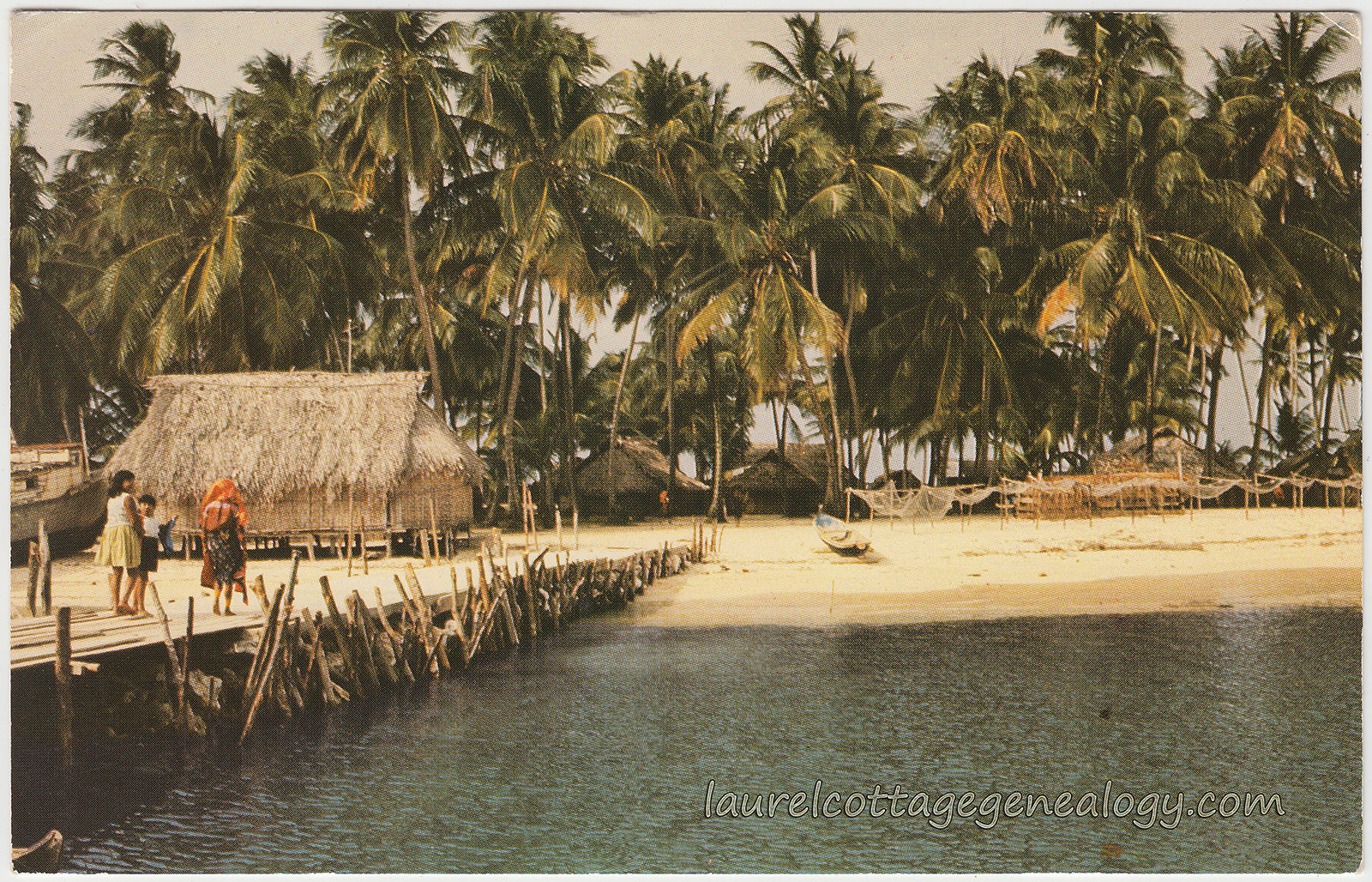
“Una de las islas del archipiélago de San Blas, República de Panamá.

One of the islands in San Blas, Republic of Panama.”

Palm trees, thatched roof buildings, a few natives, and a beautiful beach at the  “puente del mundo, corazon del universo”  – bridge of the world, heart of the universe.

Divided back, unused postcard, circa 1960s. Mirro-Krome Card by H.S. Crocker Co., Inc., San Bruno, California, 94066. Reproduction Y Distribution Exclusiva Foto Flatau – Apartado 391 – Panama, R. P. Series or number FF-8-018.

Price:  $5.00

Girl In Hat

Girl In Hat p1

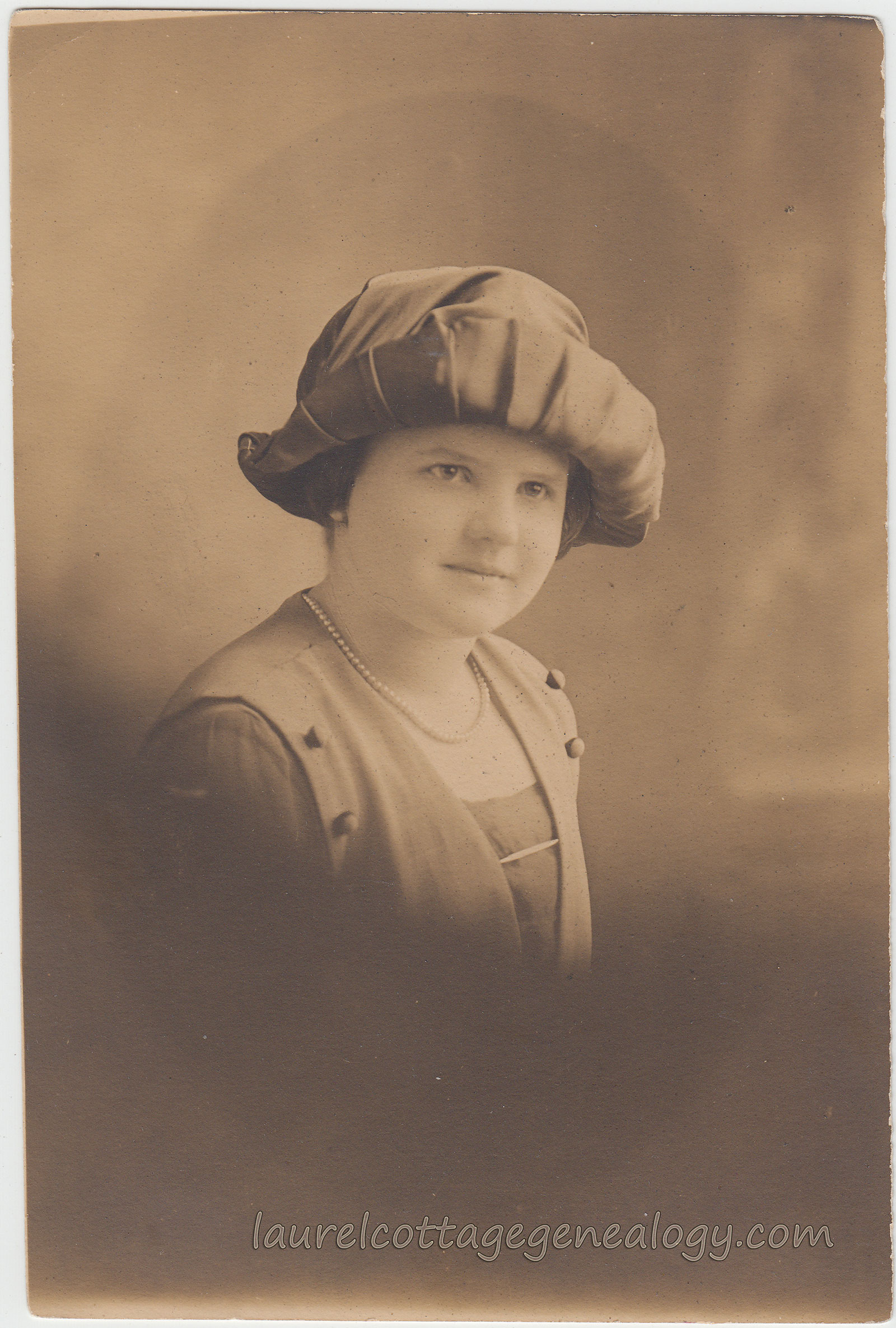
Studio photo of unidentified girl, circa 1920s. Size:  4 x 6.

Price:  $5.00

Here’s a charming studio photo of a beautiful little girl, perhaps around eight to twelve years old. How to describe her hat? Well…cloth, perhaps satin or silk, with a turned up brim, much larger in the front, with pleats or folds. The crown’s material is folded over to the side….The perhaps square neckline on her dress or blouse shows under a vest of a lighter color that has two decorative cloth buttons at the shoulders. She wears a short pearl-type necklace and probably matching earrings. Her hair is either short or pulled up under her hat, she has a direct gaze and wears a slight smile. We can clearly see that this photo was at one time in an oval frame. Back to this hat…this particular style wasn’t showing up while browsing online through all manner of hats for girls and women. One thing is clear on the subject of hats – the styles are limited only by the imagination. What one could dream up, one could make or have made. This photo is estimated to be from the 1920s.

Update, April 10, 2024:  We have a potential i.d. for this young girl, from another portrait photo found later. See what you think:  Katheryn Earhart, Elizabeth’s Best Friend.

Calle Angamos, Antofagasta, Chile

Antofagasta Chile pc1Antofagasta Chile pc2

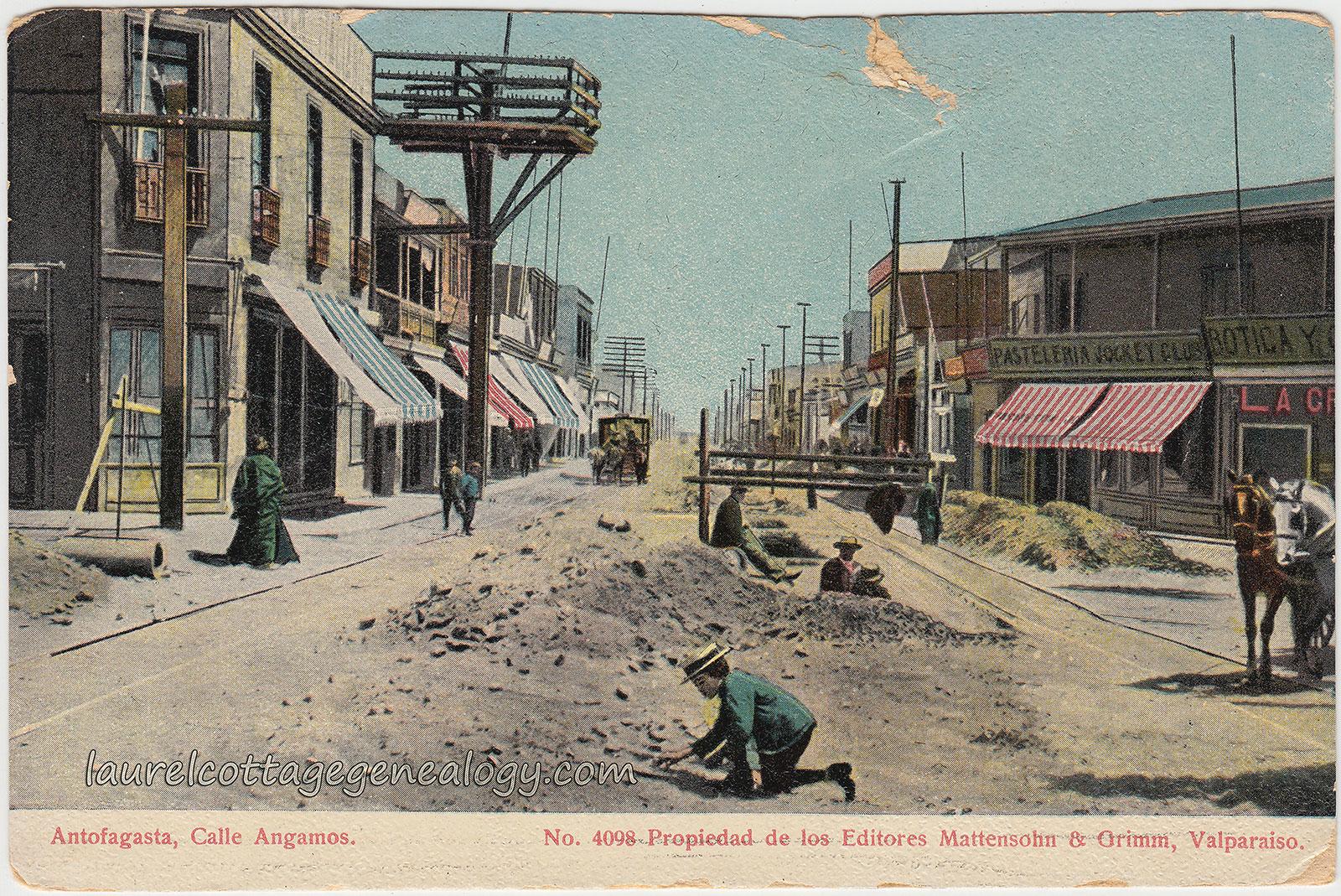
This is a tinted postcard that was produced from a photo. The exact same photo of this street in Antofagasta, Chile was found on a black and white postcard on Flickr. (See first listing in sources below.) The image here has been altered from the original photo, though. A child that was in the foreground, and a horse on the right have been taken out of this photo. Also, ours is more cut off on the right, while the black and white image is more cut off at the bottom. This is the second time we’ve come across this type of photo altering for postcards. (See the Chinatown post.) And according to the Flickr author, from a quick online translation to English, this street name changed several times. It was Manuel Antonio Matta Street; in 1872 it was called Nuevo Mundo; in 1892 Angamos Street; and in 1917 went back to Manuel Antonio Matta Street; in 1927 don Oscar Fuenzalida, Segundo Alcalde de la Junta de Vecinos de la Municipalidad, (Google translates as Second Mayor of the Neighborhood of the Municipality) tried to have it changed back to Angamos, but the request was not approved…..There are a couple of shops on the right that we can read the names of:  Pastelería Jockey Club (pastry shop) and Botica y….the rest of the shop name shows up on another postcard found online as Drogueria, so that was a pharmacy and drugstore.

What is the man in the green jacket looking for (or at)? The area in and around Antofagasta is known to be rich in minerals, perhaps he is rock hunting? As to the piles of dirt in the middle of the street:  A Wikipedia entry states sewer construction was ordered in 1905 in the city of Antofagasta, and it does look like we’re seeing a couple of rectangular shaped holes that have been dug in the ground further back in the photo. Plus, notice how on the left behind the woman on the street, there is a large pipe. So, sewer construction is the best guess.

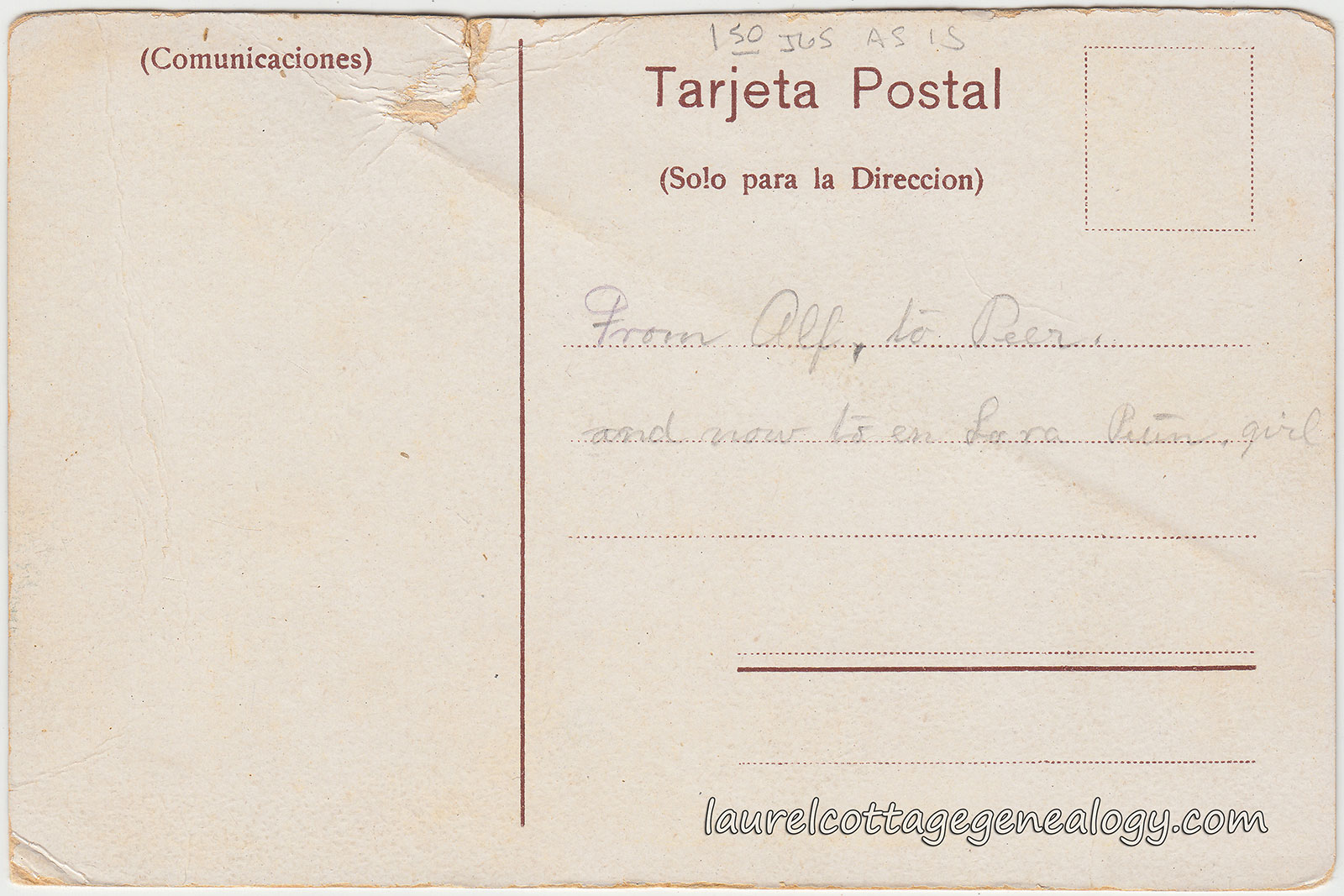
The back has some writing in pencil on the address side which appears to read  “From Alf to Peer and now to en[?] Lora Petin, girl.”  Anyway, this is my best guess on the last part. Though this postcard is not in the best of shape, it is the only one that I’m seeing online as of the date of this post, and prices seem to be varying wildly for old Chilean postcards.

Divided back, unused with writing. Propiedad de los Editores Mattensohn & Grimm, Valparaiso. Circa 1905 – 1915.

Availability Status:  SOLD

Sources: Vista hacia el sur desde las calles Matta esquina Prat en Antofagasta, Chile. Circa 1915.” by “Aliwenco.” Copyrighted. https://www.flickr.com/photos/76983769@N00/378539392/ (accessed October 21, 2014).

Antofagasta. n.d. http://en.wikipedia.org/wiki/Antofagasta (accessed October 21, 2014).

Atacama Desert. n.d. http://en.wikipedia.org/wiki/Atacama_Desert (accessed October 21, 2014).

Woman Seated At Table

Woman Seated At Table pc1Woman Seated At Table pc2

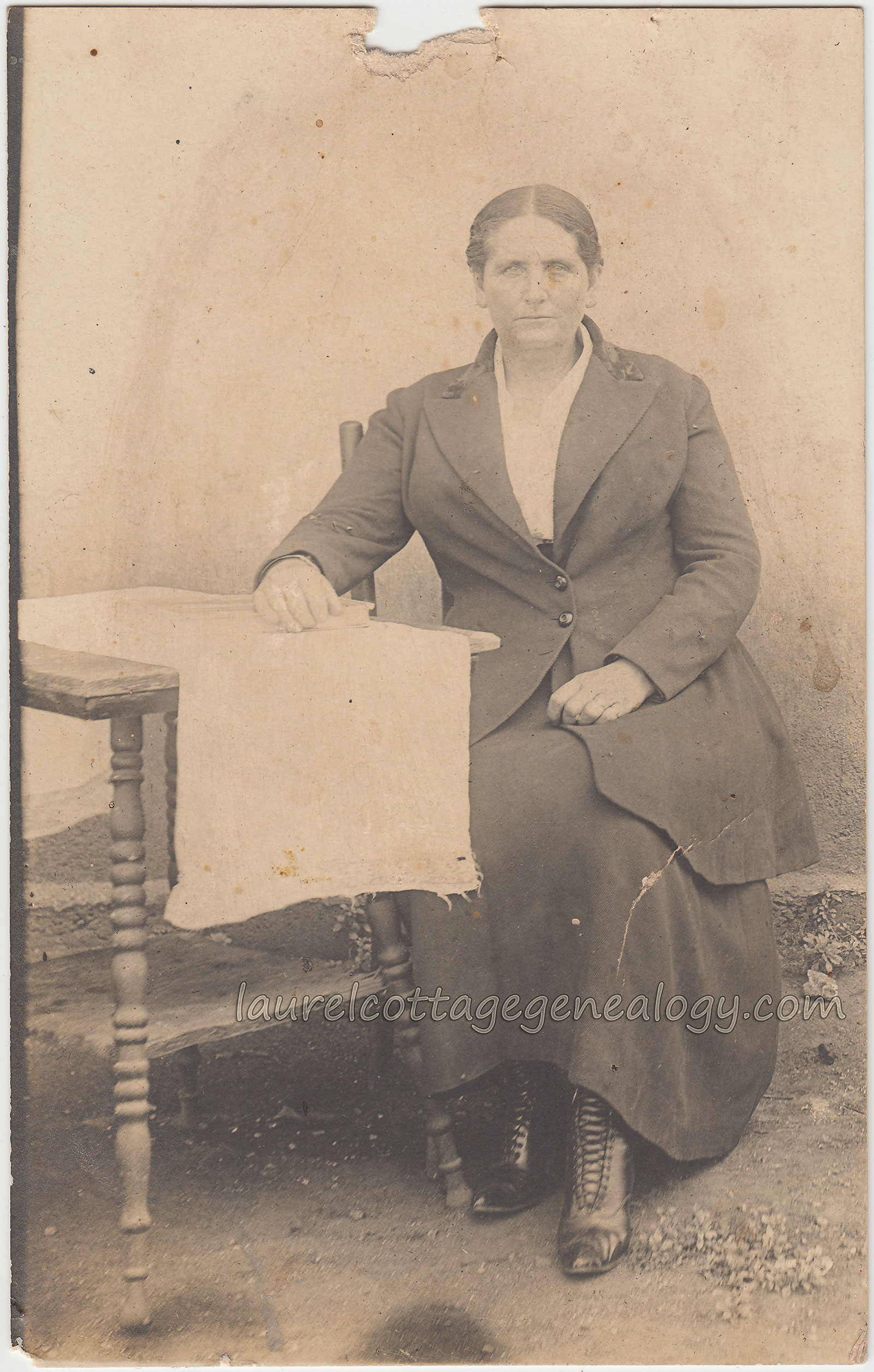
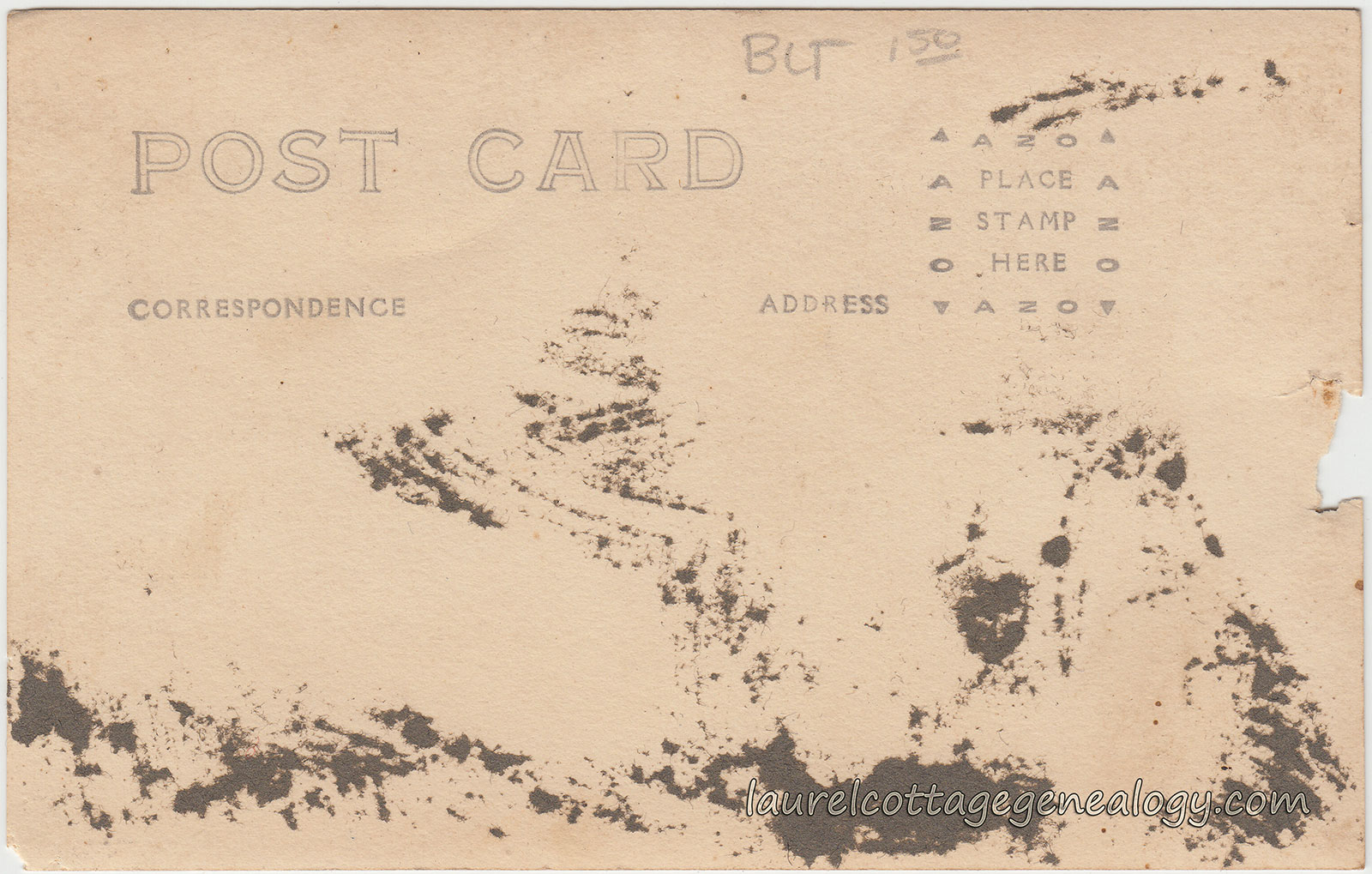
Real Photo Postcard of an unknown woman with a rather intent gaze. She looks to be possibly in her 50s, has dark hair, slightly graying at the sides, worn pulled up and back and parted in the middle. She wears a long skirt and a matching long jacket that’s designed with wide lapels and a velvet collar, and a white blouse, and heeled lace-up boots. She is outside as evidenced by the rustic setting, the ground showing as dirt with a couple of small weeds, and directly behind her is what looks like an adobe-type wall. Her arm rests on a book (a common photo prop) which lays on top of a small cotton or linen towel or table runner that is draped over the table. The black marks on the back of the card show that this postcard had been saved in someone’s photo album, but at some point it must have been in an oval frame since we can see the darker oval shape over the center of the photo. The stamp box is an AZO with two triangles up, two down, which is estimated as dated between 1910 – 1930, but the photo may be from closer to the late 1910s or early ’20s. We also might get the impression that this was taken in one of the Western states, maybe Arizona, New Mexico or California. It was found in Salinas, California.

Real Photo Postcard, unused. AZO stamp box. Circa 1910 – 1920.

Price:  $6.00

As You Like It Horse Radish

As You Like It Horse Radish tc

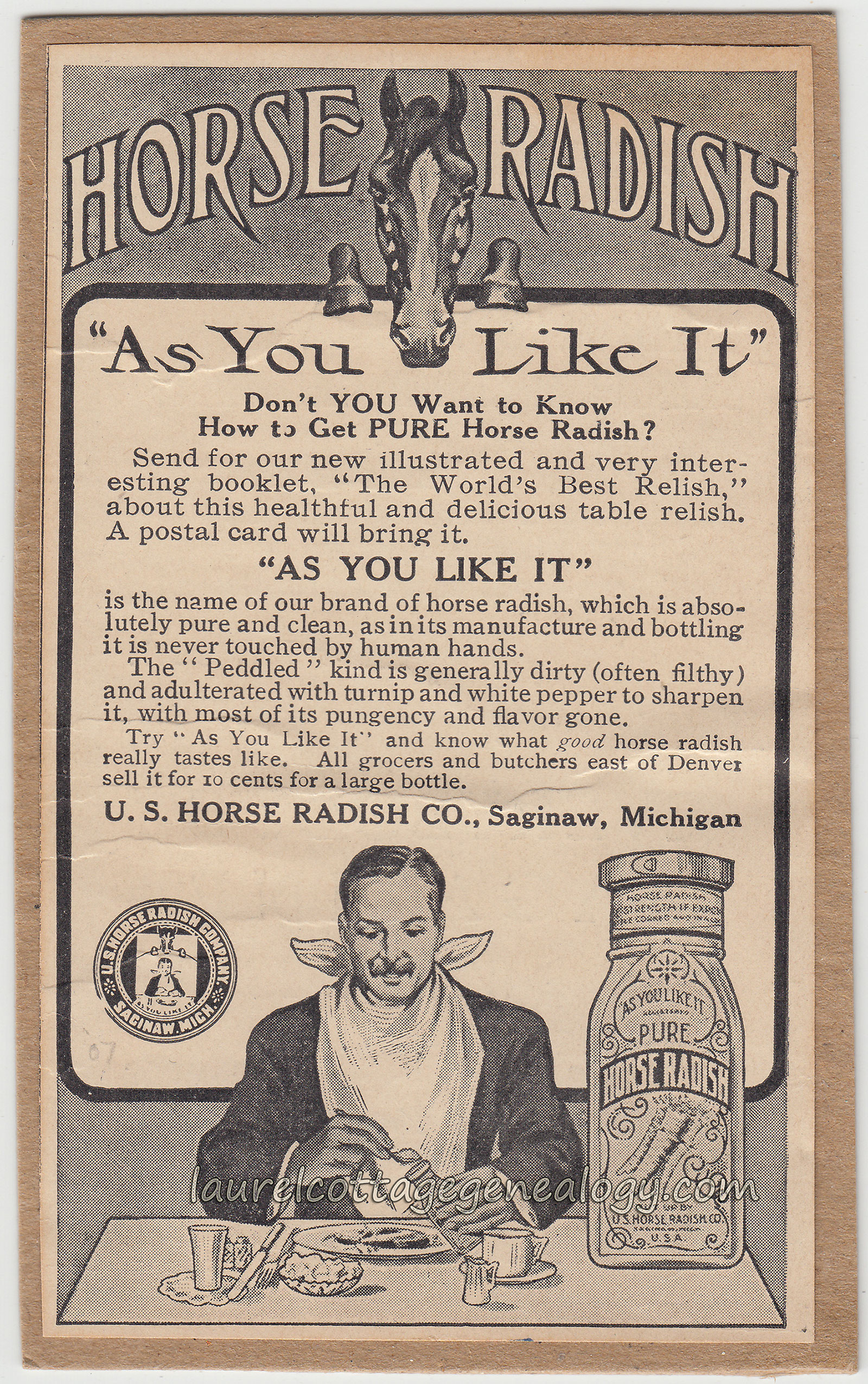
 Old advertisement, circa 1907.  Size including cardboard back:  2 and 3/4 x 4 and 1/2″

Price:  $6.00

This is an old advertisement that someone had pasted on to a piece of cardboard, not in pristine shape due to the crease running across the middle, and I suppose due to the fact that it was pasted at all. The brand was called “As You Like It” and was made by the U.S. Horse Radish Co. of Saginaw, Michigan. As you can see it was advertised as  “absolutely pure and clean, as in its manufacture and bottling it is never touched by human hands.”  Going on to say that the  ” ‘Peddled’ kind was generally dirty (often filthy) and adulterated with turnip and white pepper to sharpen it, with most of its pungency and flavor gone.”  This particular ad can be found in the July – December 1907 Life magazine. (I love the horse.) And ten cents for a large bottle. Imagine!

Records were found from 1903 through 1912 for this company. The earliest being a U.S. Patent Office record shows an entry of   “40, 207. HORSERADISH. Julius C. Vogt, Saginaw, Mich. Filed Mar. 16, 1903  AS YOU LIKE IT  The words ‘As You Like It.’ Used since October 1902.”  A 1904 factory inspection publication shows for April 14th, (only naming the city for the address) under the heading of “Sausage and mincemeat” for “Kinds of goods manufactured or handled” that they were employing 7 men, 4 women, and no one under age 16. The Polk’s Saginaw City Directory for 1909 has a listing as follows:   “UNITED STATES HORSE RADISH CO,  Wallis Craig Smith Pres, J C Vogt Vice-Pres and Genl Mngr, Emil F Vogt Sec, Otto W Vogt Treas, Mnfrs and Producers of  ‘As You Like it’  Food Products, 219-223 N Water, Tels Mich 334, Val 554.”  One of the 1912 references found shows a different address of 219 N. Tilden St. in Saginaw. This company sold many other products including sea foods, breakfast cereals, popcorn and peanut butter.

Reading the ad posted here brought up a funny childhood memory of Dad often making a joke that something was “untouched by human hands” if for example you were being passed something at the dinner table. But since Grandpa “Pappy” was born and raised in Saginaw, I wonder if this saying was something that had passed from father to son, having originated with the As You Like It horseradish ad. It’s possible. This brings up the idea in general of those kind of “running jokes.” What tickles us? What phrases do we hold on to for that reason, and even communicate with? And after storing up tons of phrases over the years, how many days in a row could you use only them (provided the person you’re talking to is with you on all the jokes) to communicate with? A very small portion of the sayings flying around in my household are:  The defense is wrong…I wore this ridiculous thing for you… the two ‘yutes’…Does that thing come turbo-charged? Only on the floor models. (My Cousin Vinny). President Not Sure…idiocracy (the term, in general, which is never more relevant than it is today)…Now back to you, Formica…We got this guy, Not Sure…I like money, though. (Idiocracy). Your vacuum cleaner ate my pants; there was nothin’ I could do about it. (Pepsi ad with Dave Chappelle). My room was filled with long-stem roses… My butler knew exactly how I took my tea…I was not to be awoken before 10 a.m….I think of this as a temporary exile. (Celebrity? Lines Cruises).  I’m outdoors you know…The clock on the wall says 3 o’clock…Everybody funny, now you funny, too…Lord, she was lovey-dovey…That don’t befront me, long as I get my money next Friday. (George Thorogood’s version of “One Bourbon, One Scotch and One Beer”). I see you T. Hunter (or whoever has just made a great play, or gotten a big hit. (Rod Allen, former Detroit Tiger baseball analyst). He’s got summer teeth – some are there, some are not. (Mickey Redmond, Detroit Red Wings analyst)….Along these lines, my friend and her sister have something they call “the funny list” – all the stuff over the years that they crack up over. Same friend and I crack up over two words – Donut Nation, the name of a donut shop in Los Banos, California.

But getting back around again to the subject of horseradish – check out Horseradish.org regarding the history of the root (aphrodisiac…back rub…cough syrup ingredient….growing wild in Boston by 1840…) and if you happen to be a fan of Regency Romance, you’ll be interested in the following quote, “The English, in fact, grew the pungent root at inns and coach stations, to make cordials to revive exhausted travelers.”  I’m picturing myself in the future, reading a Georgette Heyer or Clare Darcy novel, at the point where the characters have had to stop at an inn (during one of those zany travel adventures they keep finding themselves in) and a cordial is handed to them. (I’m thinking, “It’s got horseradish in it.”)

Sources:  Life, Vol. 50. Mitchell, John Ames (ed.) (1907) p. 702. (Google eBook)

United States. U.S. Patent Office. Official gazette of the United States Patent Office, April 28, 1903. p. 2165 (Google eBook)

State of Michigan Twenty-second Annual Report of the Bureau of Labor and Industrial Statistics. Lansing, Michigan:  Wynkoop Hallenbeck Crawford Co., 1905. p.115 (Google eBook)

R.L. Polk & Co.’s Saginaw City Directory, 1909. p. 948. (Google eBook)

Ice and Refrigeration Blue Book. Chicago: Nickerson and Collins Co.,1911-1912. p. 221 (Google eBook)

Horseradish History. Web accessed October 17, 2014. [http://horseradish.org/horseradish-facts/horseradish-history/]

At The New House Site

At The New House Site pc1At The New House Site pc2

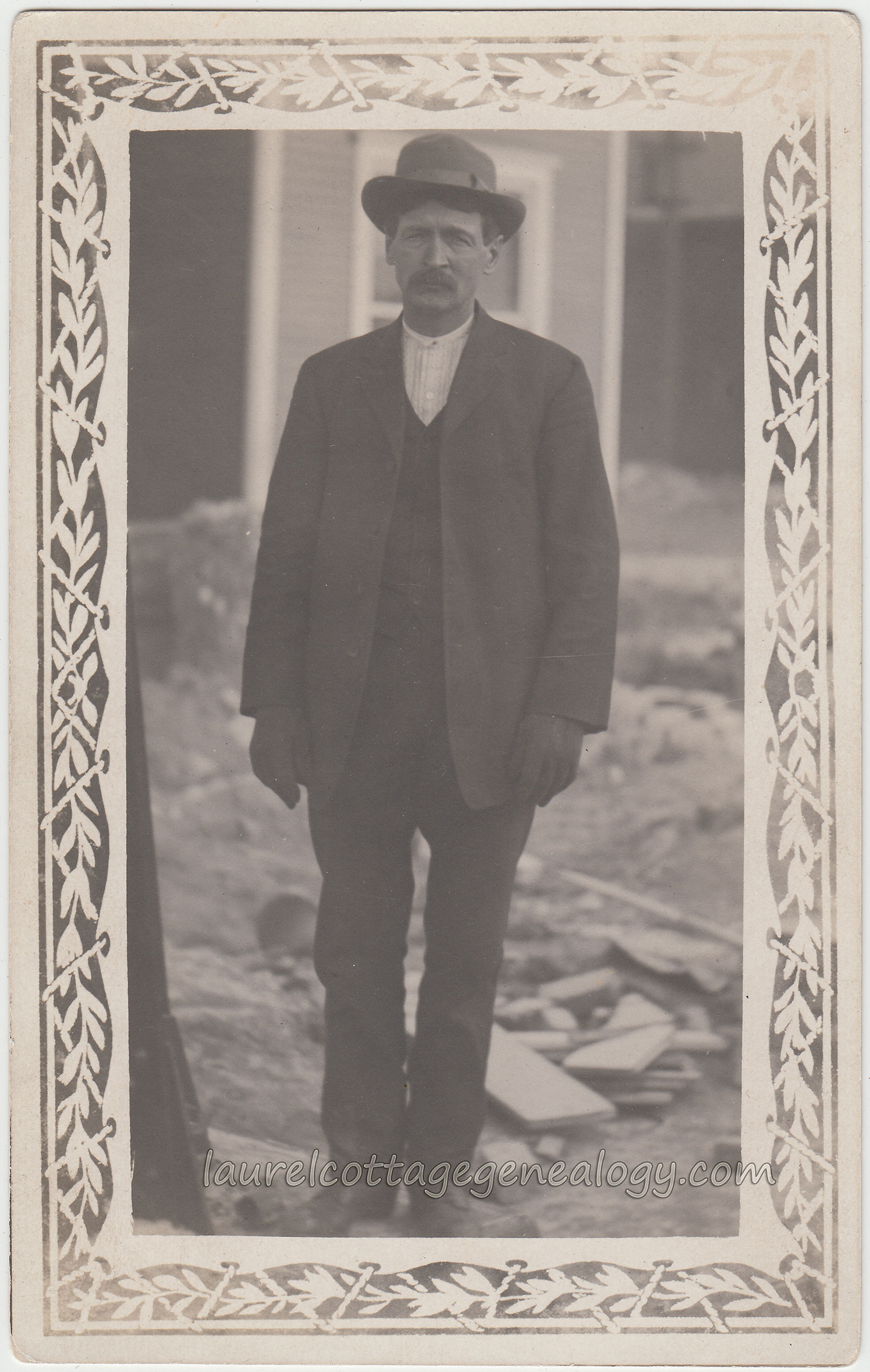
Hmmm, well maybe this title is a bit awkward, but here is beautiful photo of a nice-looking, middle-aged gentleman. He has a mustache, and is dressed in a suit, hat and gloves. His shirt shows a band type collar; this type could also be worn with the many varieties of the detachable collar. The hat is banded, and perhaps the style is best described as a bowler a.k.a derby, though if someone can come up with something more exact, do please let me know.

This Real Photo Postcard is unusual because of the border. This is the first I’ve seen like this, and it’s really lovely, although faded at the top. It shows a leaf pattern with a rope design lacing back and forth over the leaves, giving the appearance of the man’s photo being on a canvas, and the rope holding the canvas unfurled for us to view.

Last but not least, it looks like this photo was taken in front of a house that had just recently been built, due to the uneven ground and the scraps of boards in the background.

Divided back, unused Real Photo Postcard. AZO stamp box, circa 1907 – 1918.

Price:  $7.00

Peter Hendrickson, Waukon, Iowa

Peter Hendreckson p1Peter Hendreckson p2

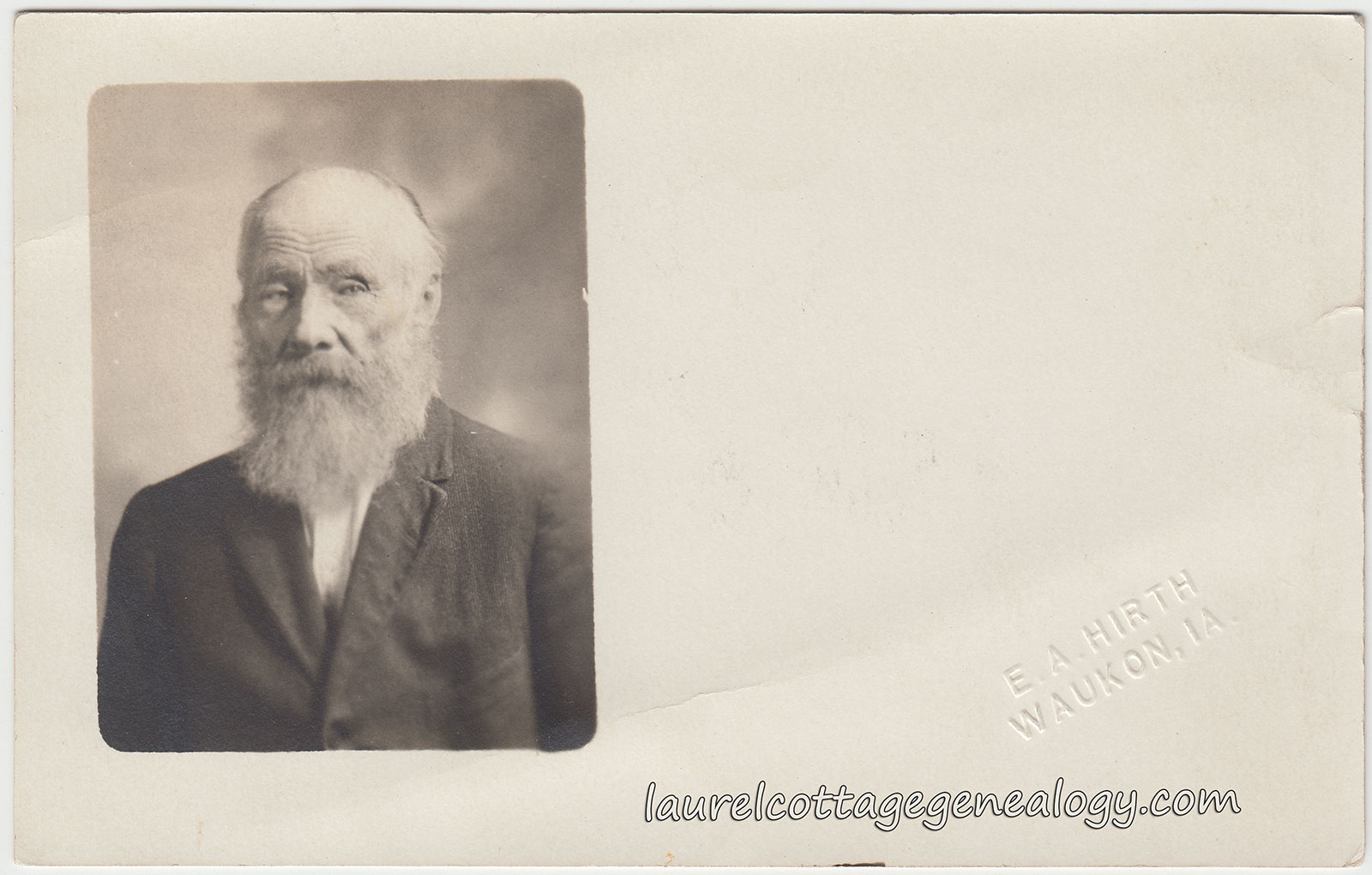
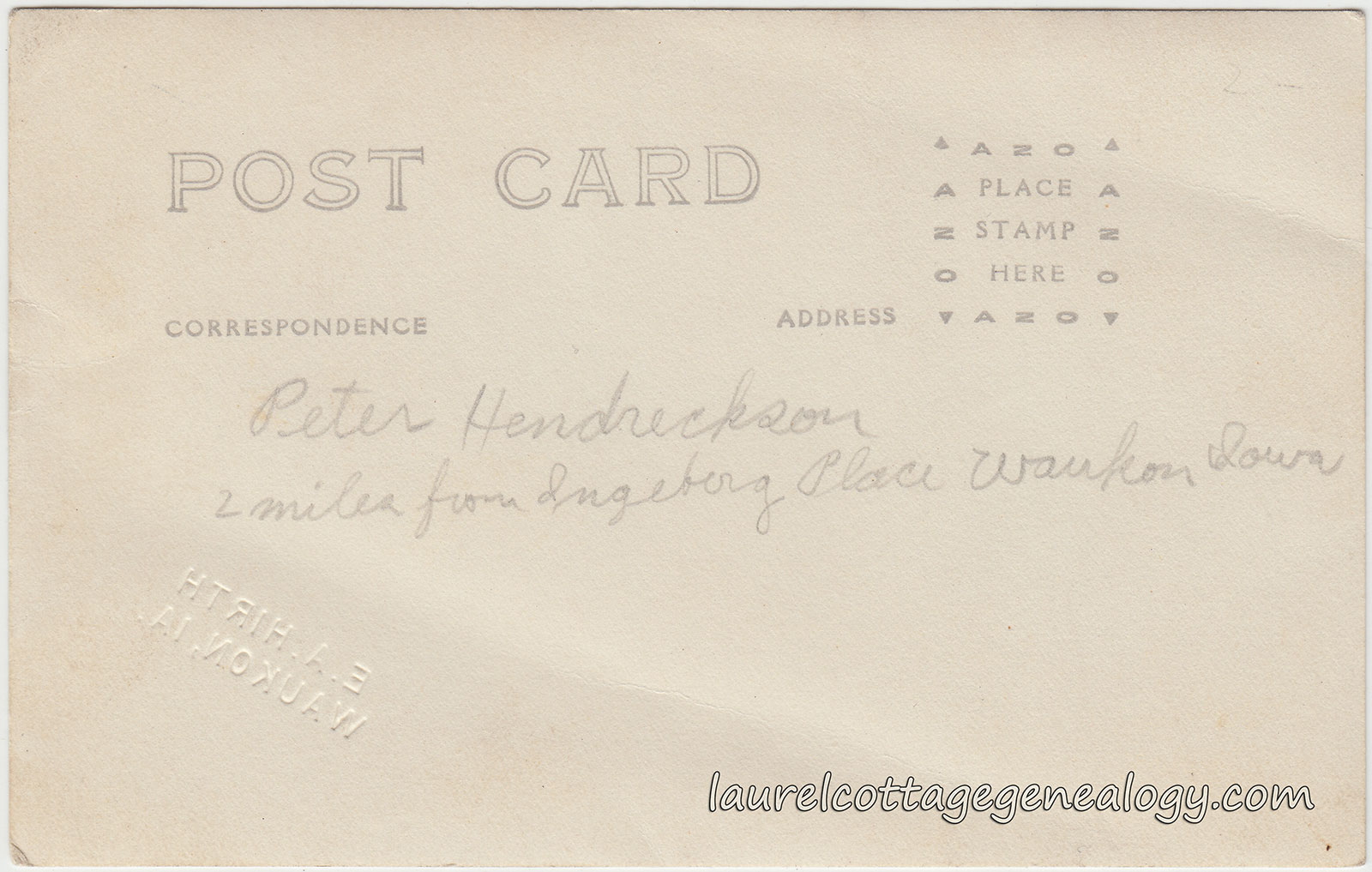
A Real Photo Postcard showing a lovely studio photo of an elderly, bearded gentleman with the name and location identified on the back as  “Peter Hendreckson, 2 miles from Ingeberg Place Waukon, Iowa.”  This one has the photographer’s stamp embossed on the front showing  “E. A. Hirth, Waukon, IA.”

The 1915 Iowa State Census shows Peter Hendrickson,  age 66, born about 1849 in Norway of Norwegian-born parents; residence Waukon, Allamakee County; religious affiliation Lutheran; married; naturalized U.S. citizen; retired; owns own home or farm worth valued at $2200.00; able to read and write; years in the United States appears to be 38, years in Iowa 37.

Looking further back, on the 1880 Federal Census for Waukon, we find Peter Hendrickson, his wife Carrie, and their young son Henry, three months old, born March 1880, in Iowa. Carrie is approximately the same age as her husband, and also Norwegian born, of Norwegian parents.

The 1900 census for Waukon shows Peter and wife Karen, and two sons, Albert O., age 14 and Peter C., age 6. A daughter, Annie Mary Hendrickson was born about 1881, according to her marriage record to to Ole Severson in 1904. This record shows her mother’s name as Karen Annunson, but is spelled Amunson on son Peter Cornelius Hendrickson’s marriage record to Grace Kvamme (sp?) in 1925. Son Albert O. Hendrickson married Ida B. Vangen in 1915, and on this record mother Karen’s maiden name is spelled Amundson.

Though this particular type of AZO stamp box (two triangles up and two down) is estimated as being used between 1910 – 1930, Peter Hendrickson looks to be at least in his seventies in this photo, but possibly eighties or even early nineties. A Find A Grave entry was found for him which states he was born December 25, 1848 in Gran, Oppland Fylke, Norway, and died 1941 in Winneshiek County, Iowa. I would estimate this photo then between about 1925 – 1941, as it’s possible that the photographer’s studio was using old card stock past the 1930 estimated date for the stamp box.

As for the photographer (nice to have him identified on the card) he is Edgar A. Hirth, born Iowa, about 1876, per the Iowa State Census for Waukon taken in 1915.

Real Photo Postcard, unused with writing. Condition:  card has a couple of creases. AZO stamp box. Circa 1925 – 1941.

Price:  $15.00

Sources:  Ancestry.com. Iowa, State Census Collection, 1836-1925. Original data: Microfilm of Iowa State Censuses, 1856, 1885, 1895, 1905, 1915, 1925 as well various special censuses from 1836-1897 obtained from the State Historical Society of Iowa via Heritage Quest.

Year: 1880; Census Place: Makee, Allamakee, Iowa; Roll: 325; Family History Film: 1254325; Page: 414D; Enumeration District: 013; Image: 0833.

“Iowa, Marriages, 1809-1992,” index, FamilySearch (https://familysearch.org/pal:/MM9.1.1/XJPL-RKG : accessed 12 Oct 2014), Peder Hendrickson in entry for Ole E. Severson and Annie Mary Hendrickson, 11 Feb 1904; citing Waukon, Allamakee Co., Ia., reference 2:3R852JT; FHL microfilm 1479486.

“Iowa, Marriages, 1809-1992,” index, FamilySearch (https://familysearch.org/pal:/MM9.1.1/XJP1-HKF : accessed 12 Oct 2014), Peter Hendrickson in entry for Peter Cornelius Hendrickson and Grace Cornelia Kvamme, 23 Sep 1925; citing Waukon, Allamakee Co., Iowa, reference 2:3WP7ND1; FHL microfilm 1479486.

“Iowa, Marriages, 1809-1992,” index, FamilySearch (https://familysearch.org/pal:/MM9.1.1/XJPZ-3QJ : accessed 12 Oct 2014), Peder Hendrickson in entry for Albert O. Hendrickson and Ida B. Vangen, 05 Jul 1915; citing Waukon, Allamakee, Iowa, reference 2:3JJQBRC; FHL microfilm 1479485.

Peter Hendrickson. Find A Grave Memorial# 100916903. Web accessed October 13, 2014. (Findagrave.com)

The William S. Cox Family, Otselic NY

Set of six Real Photo Postcards, unused with writing. 1904 – 1910.

Availability status:  SOLD

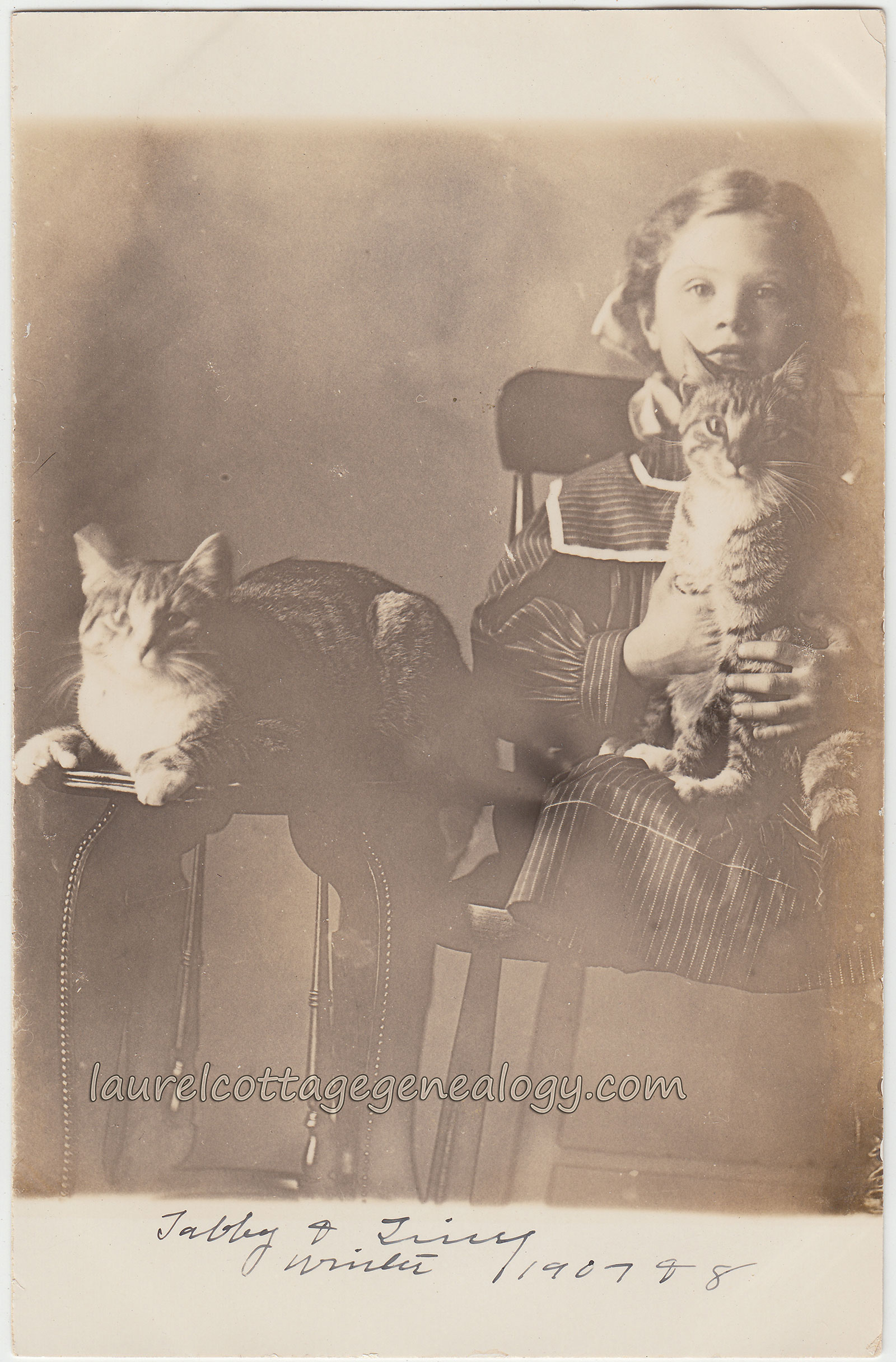
Here’s a wonderful set of six Real Photo Postcards, taken from 1904 to 1910, showing William S. Cox, his son Frank E. Cox, Frank’s daughter and William’s granddaughter Madola E. Cox, and Madola’s two kitty cats, Tabby and Tiny. The photos were very likely all taken in Otselic, Chenango County, New York. (The records that we’ve looked at here are just a partial foray into the Cox family, and not meant to represent the full picture of all siblings, marriages, parents, etc.)

The 1905 New York State Census for Otselic shows William S. Cox, about age 84, retired farmer; living with him are his daughter Minerva M. Tallett, about age 53, keeping house, and granddaughter Grace Kenyon, about age 21, clerk in a dry goods store. The same census, a few pages later, shows Frank E. Cox, about age 49, wife Mamie, about age 30, daughters Cammilla, about age 14, and Madola, about age 4. Frank is employed at a drug store. The 1910 Federal Census for Otselic shows Frank, Mamie and Madola, with Frank’s occupation as bank cashier. William S. Cox is several entries down on the same page, with daughter Minerva Tallett.

Camilla Cox is the daughter of Frank E. Cox and Belle Peck, according to Camilla’s marriage to Carl E. Ladd in 1912. Madola E. Cox is the daughter of Frank E. Cox, and his second wife (after Belle died) Mamie Young. Madola married Ralph E. Cunningham in 1922.
William S Cox 1904 pc1William S Cox 1904 pc2

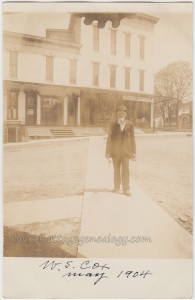
A smiling W. S. Cox, crossing the street, May 1904. This must have been taken in Otselic, New York, according to the grocery and hardware store sign with proprietor name George B. Angell that we see in the background. George B. Angell is found on the 1900 Federal Census for Otselic, with his wife Nettie P., sons Earl J., F. B. and Cyril B. and niece Louise Pudney. George’s occupation is listed as general merchant. Other things to note in the photo are the Meat-Market sign on the far left, the dirt streets with what looks like a concrete crosswalk that W. S. is using, and what appears to be a concrete sidewalk meeting the crosswalk. I don’t know what the dark wavy image is at the top of the photo, but it looks more like something that happened in the photo process, rather than part of an awning or some other item. William S. Cox would have been 83 years old in this photo.
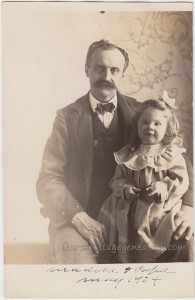
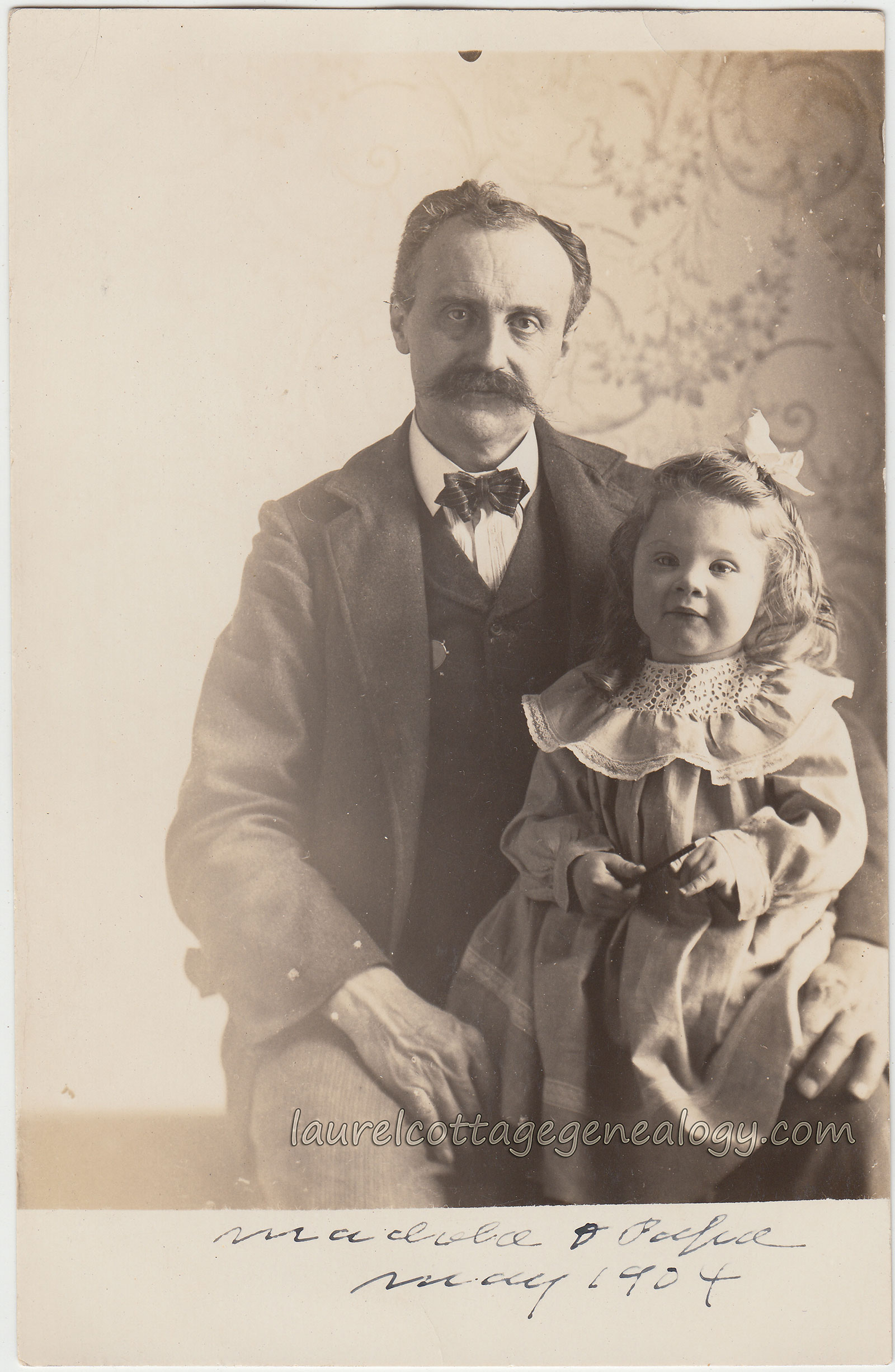
Madola And Papa May 1904 pc1Madola And Papa May 1904 pc2

Madola & Papa, May 1904. The son and granddaughter of William S. Cox:  Frank E. Cox, and his daughter Madola E. Cox. A beautiful father-daughter photo, showing Frank in suit with vest and bow tie, Madola seated on his knee, in long-sleeved dress with large frilly collar with lace, and wearing a hair bow.
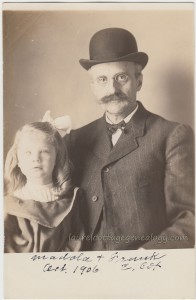
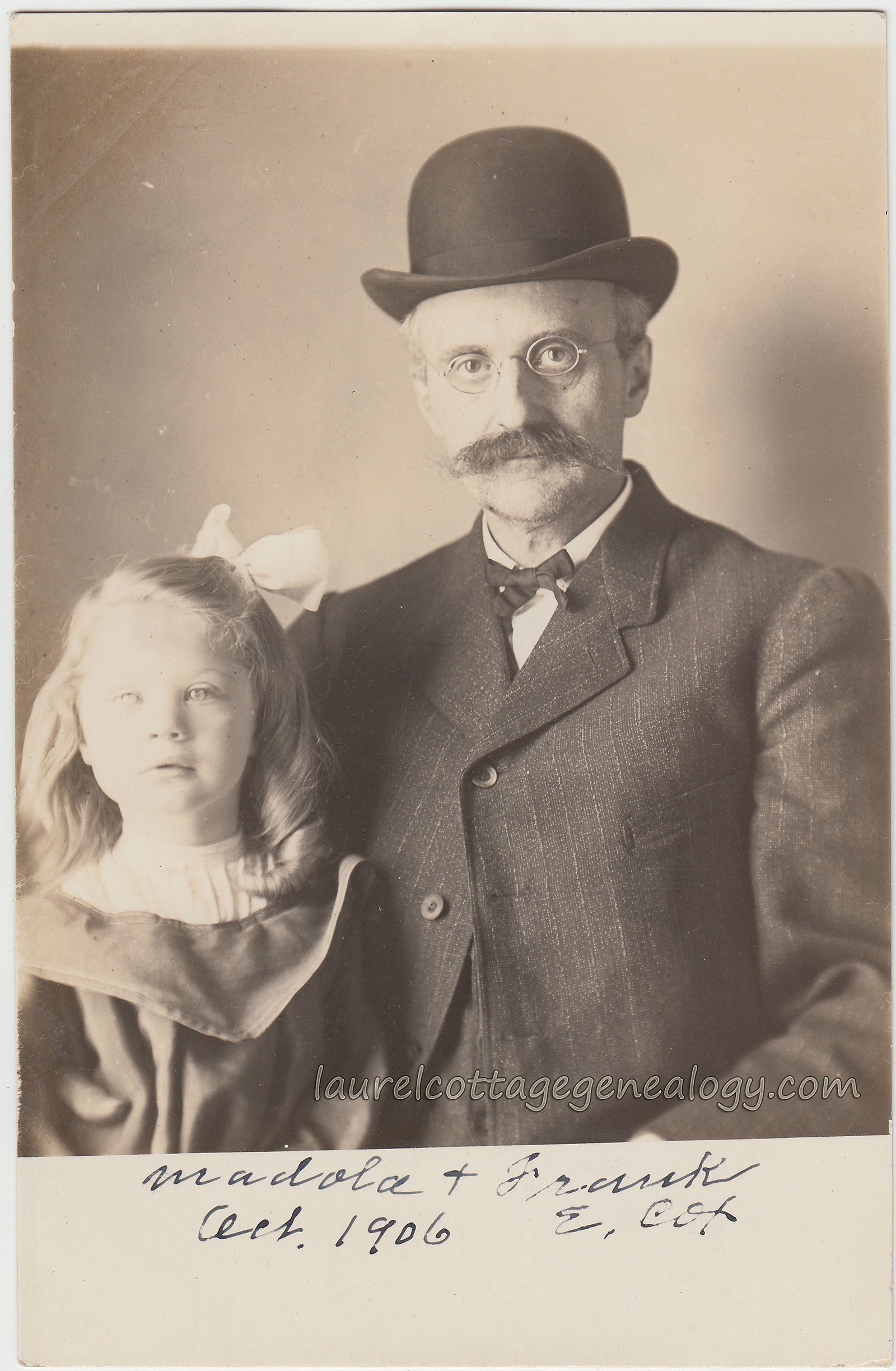
Madola And Frank E Cox Oct 1906 pc1Madola And Frank E Cox Oct 1906 pc2

Madola & Frank E. Cox, Oct. 1906.
Another beautiful father-daughter photo:  In this one Frank Cox wears his derby hat and wire-rim spectacles, and his suit jacket buttoned at the top button just below the lapels. Madola is dressed in similar fashion to the prior photo, high-necked dress, darker in color this time, with large collar and again wearing a hair bow.
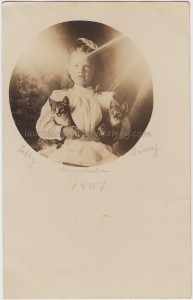
Tabby Madola And Tiny 1907 pc1Tabby Madola And Tiny 1907 pc2

Tabby – Madola – Tiny – 1907.
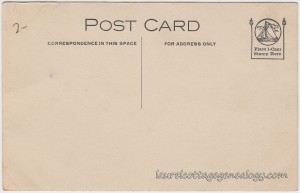
A lovely round photo with a special lighting effect of “sun rays” shining on Madola and her two charges, Tabby and Tiny, that she holds, one in each arm. Beautiful Madola is very grown-up looking, and all three adorable subjects are posed just right. Love how the kitties are both looking in the same direction, and there is no blurriness. The stamp box on the back of this one shows the sailboat logo, and it’s nice to find this logo substantiated by the date of 1907 on the front, as very little is known about this company.
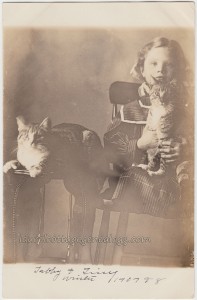
Tabby And Tiny Winter 1907 And 08 pc1Tabby And Tiny Winter 1907 and 08 pc2

Tabby & Tiny (& Madola) Winter 1907 – ’08.
A posed but less formal photo than the prior. Madola, seated in a child’s wooden chair, holding Tiny in her lap, and Tabby (understandably a little blurry) draped on top of a small table just next to them.
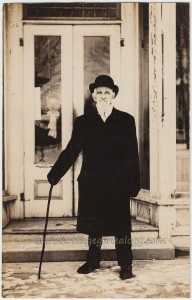
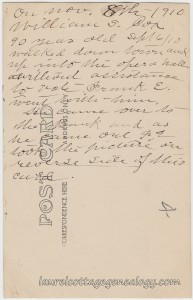
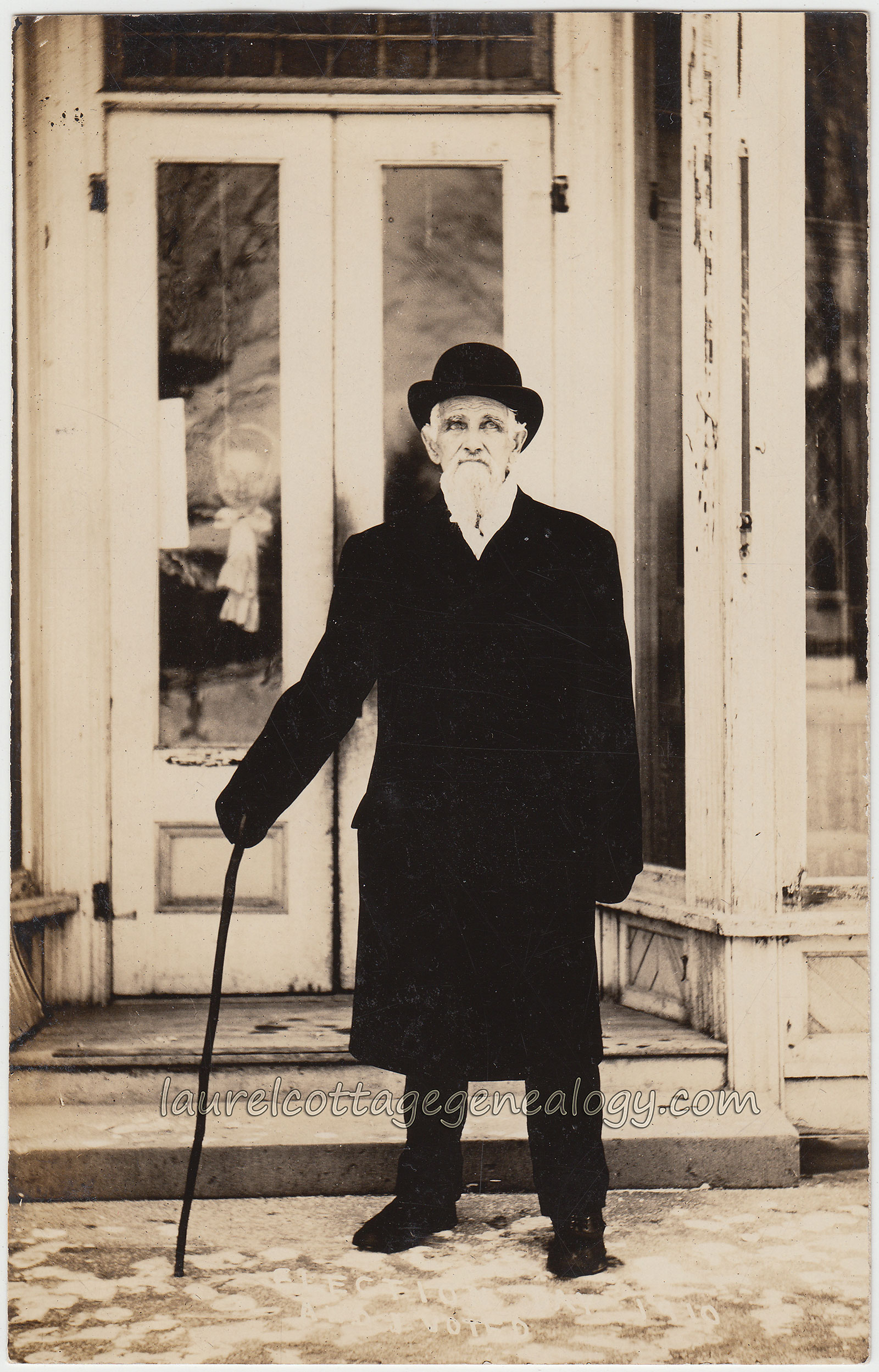
William S Cox After Voting pc1William S Cox After Voting pc2

“Election Day 1910 and I voted.”

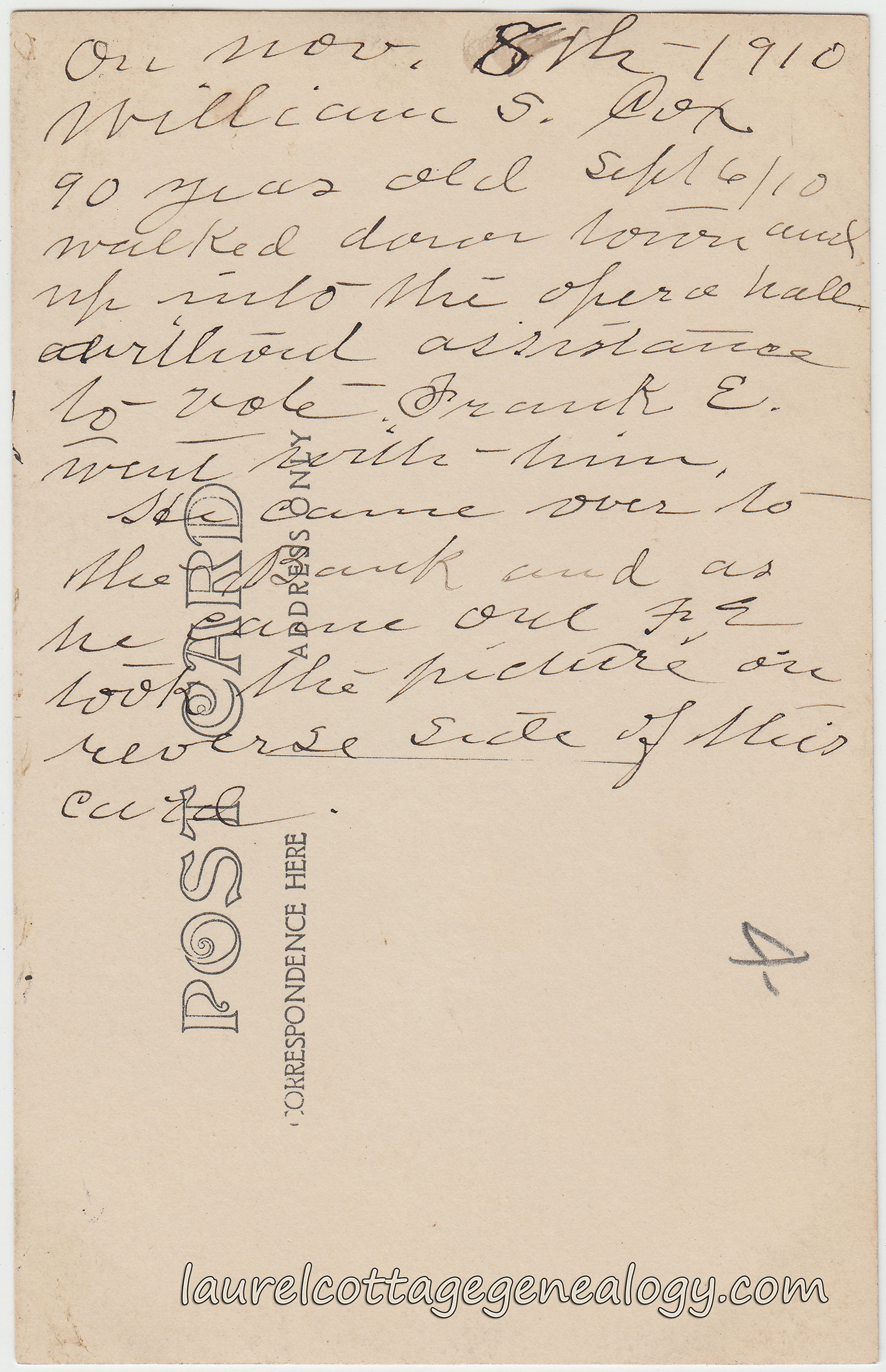
“On Nov. 8th – 1910 William S. Cox 90 years old Sept. 6 ’10 walked down town and up into the opera hall without assistance to vote. Frank E. went with him. He came over to the Bank and as he came over F. E. took the picture on reverse side of this card.”

Thank you to whoever recorded the detailed description on the back. (Wouldn’t it be great if all photos had detailed writing on the reverse side like this one?) Was the recorder the smiling woman with the charming head scarf tied in a bow under her chin, that we see through the long glass door window? There is also an inscription at the bottom of the photo in white that was put in during processing. It is:  “Election Day 1910 and I voted.”
The composition of this one is just beautiful:  W. S. in his dark coat, hat, cane, contrasting with his white beard, the overall white “shabby chic” appearance of the building behind him – the wooden post, the beautiful double doors with the long glass windows, the grid-looking window above the doors, and the darker reflections of the windows, the white scarf of the lady in the bank building….This photo happens to be going up timely, as election day is coming up soon.

Sources:  New York State Archives; Albany, New York; State Population Census Schedules, 1905; Election District: E.D. 02; City: Otselic; County: Chenango; Pages: 9 and 12. (Ancestry.com)

“New York, County Marriages, 1908-1935,” index and images, FamilySearch (https://familysearch.org/pal:/MM9.1.1/V6H2-RSV : accessed 12 Oct 2014), Frank E Cox in entry for Carl E Ladd and Camilla M Cox, 08 Mar 1912; citing , , New York, United States; FHL microfilm 1023095.

“New York, County Marriages, 1908-1935,” index and images, FamilySearch (https://familysearch.org/pal:/MM9.1.1/FFRC-S6K : accessed 12 Oct 2014), Frank E Cox in entry for Ralph E Cunningham and Medola E Cox, 25 Oct 1922; citing , Chenango, New York, United States; FHL microfilm 1023091.

“United States Census, 1910,” index and images, FamilySearch (https://familysearch.org/pal:/MM9.1.1/M5CW-LQ8 : accessed 12 Oct 2014), Frank E Cox, Otselic, Chenango, New York, United States; citing enumeration district (ED) 94, sheet 2A, family 42, NARA microfilm publication T624, FHL microfilm 1374937.