Genealogy Services, Old Photos, Postcards, Trade Cards, Etc.

The Happy Families of Norwalk Connecticut

The Happy Families of Norwalk CT pc1The Happy Families of Norwalk CT pc2

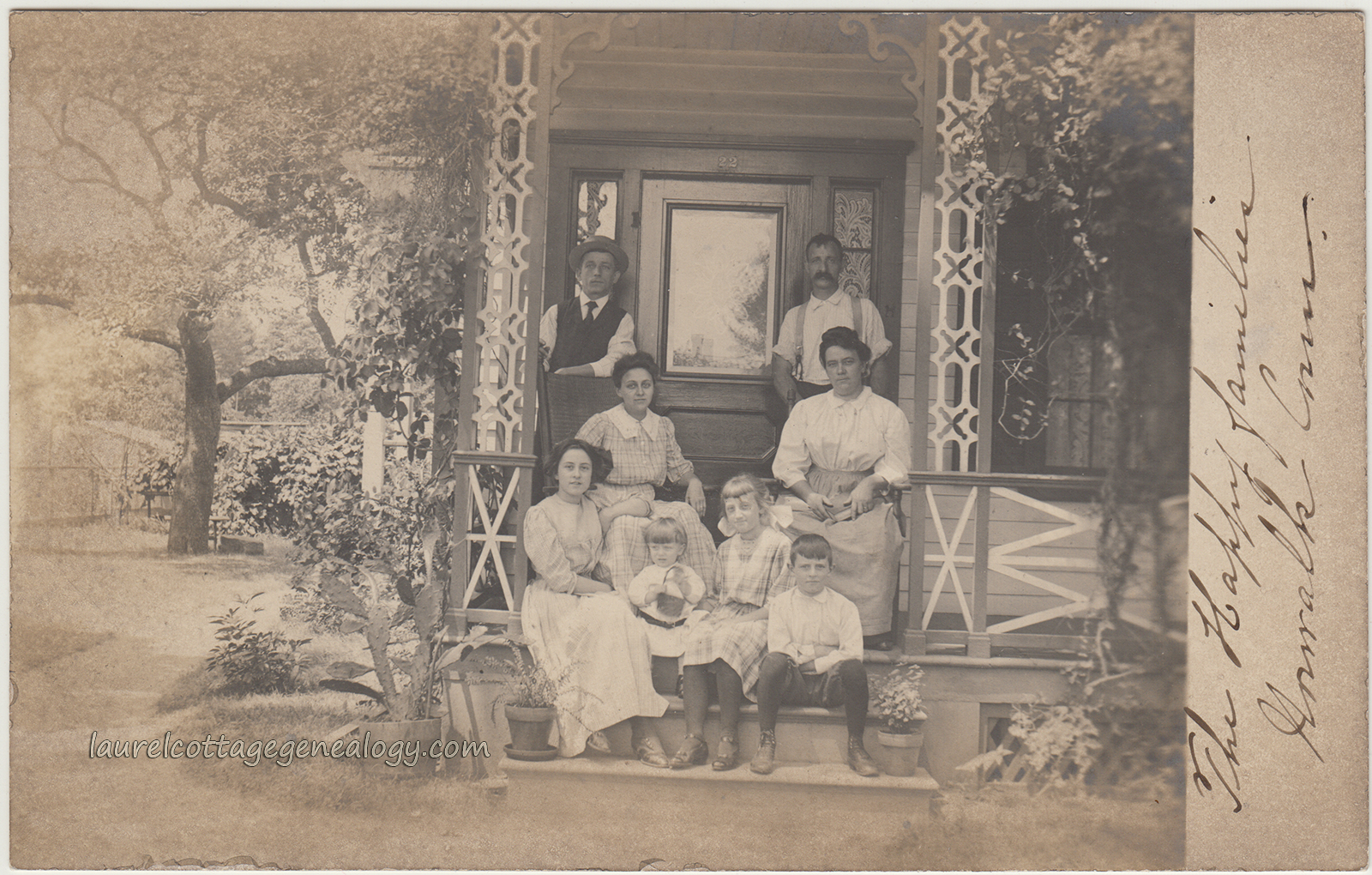
An excellent Real Photo Postcard of the Happy Families of Norwalk, CT. Judging by the family resemblances, placement of the subjects, and pose of the youngest woman, we might guess that the one family is the three adults on the left – husband, wife and young adult daughter; which leaves the other as the family on the right –  the husband and wife and their three small children. Up-close scrutiny shows that the two ladies in the middle are wearing wedding rings. Too bad we can’t see the left hand of the youngest woman, but her pose with her arm draped on the knee of the woman behind her, seems to denote daughter and mother. The other interesting details are the porch lattice work, which is ever-so nice, the beautiful lace curtains that we can see in the windows, the reflection in the door’s window of what looks to be some type of building across the way, the potted cactus plant to the left of the porch stairs, and very importantly – the house number which shows as 22. Aside from the scrutiny of the details, this is just a wonderful image of two beautiful families, posing for the camera, in the early 1900s.

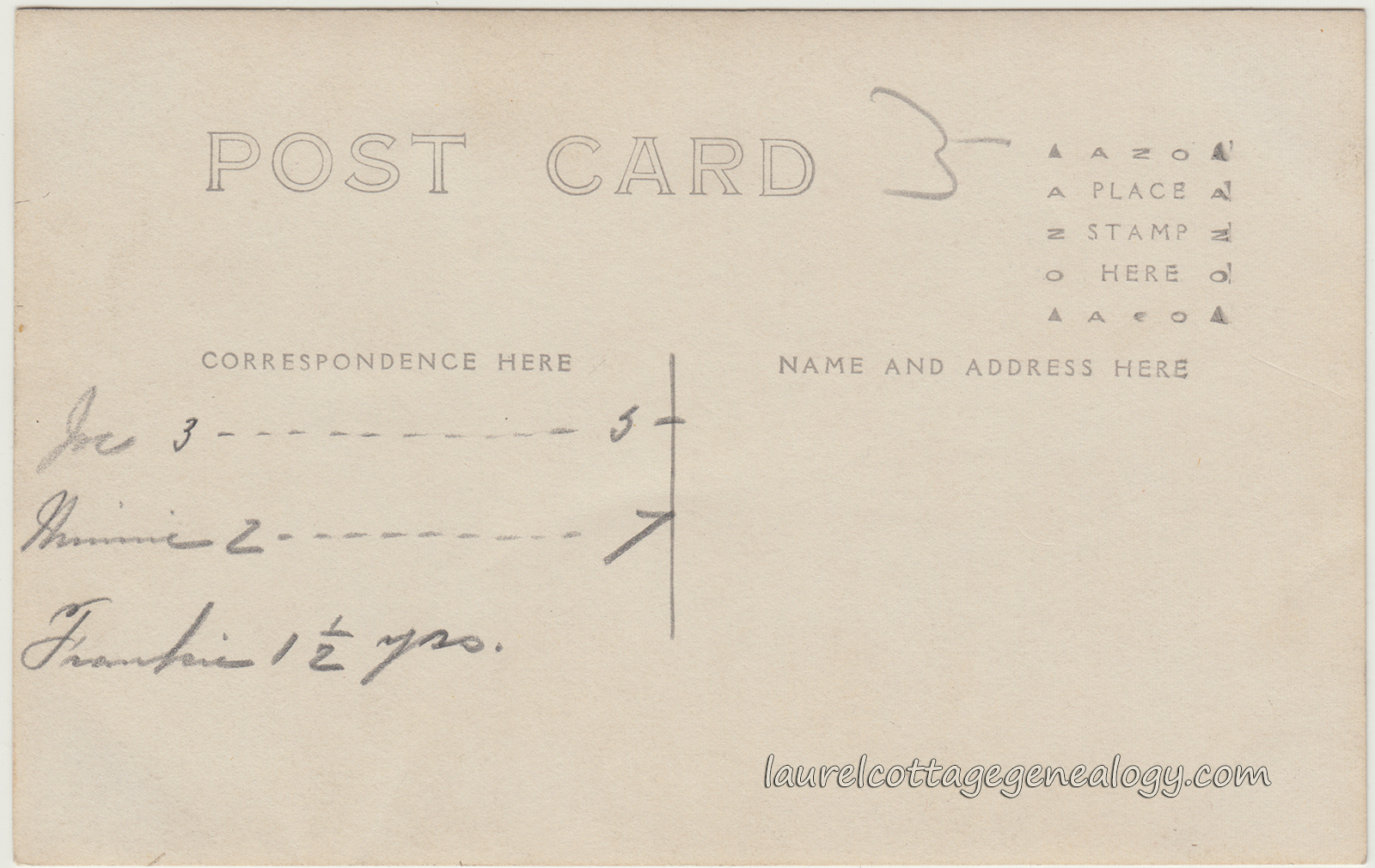
The AZO stamp box with all four triangles pointing up, plus the fact that it’s a divided back dates this postcard circa 1907 – 1918. The writing on the back is a little puzzling, but it possibly indicates that Joe is 5 years old and Minnie is 7. Frankie’s age is given as 1 and 1/2 years, so there’s no question about that one. However, what the writer meant by the numbers 3 and 2 respectively after Joe and Minnie, is unclear. Online research for these two families is not turning up anything concrete, but the Happy surname most certainly turns up in Connecticut, as well as in other states and Canada.

Divided back, Real Photo Postcard, unused with writing. AZO stamp box, circa 1907 – 1918.

Price:  $10.00

May Every Hour…

May Every Hour pc1May Every Hour pc2

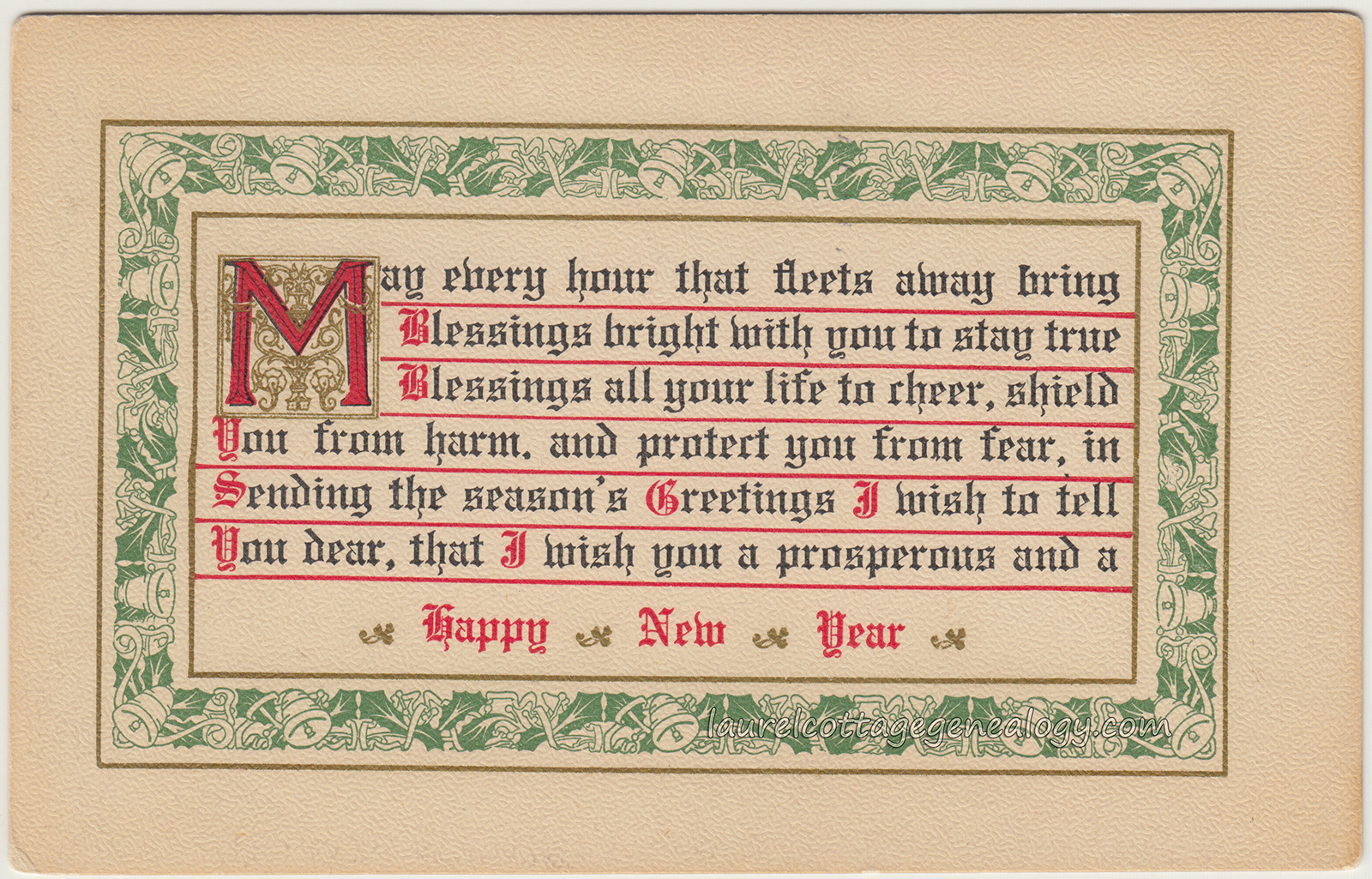
“May every hour that fleets away bring

Blessings bright with you to stay true

Blessings all your life to cheer, shield

You from harm, and protect you from fear, in

Sending the season’s Greetings I wish to tell

You dear, that I wish you a prosperous and a

Happy New Year”

The funny thing about this card is the way the poem is arranged. In reading the lines you can see that it wasn’t organized correctly for riming, and that might make you wonder a little about the process that took place in getting this particular postcard set up for production. Perhaps after deciding on the border and large M, they discovered that they didn’t have enough room to have the lines come out right. This kind of thing, and other things, like funny spellings of words and odd capitalizations, always add a little to the charm of these old postcards (in the opinion of this blog’s author.) Anyway, it’s a beautiful card and poem. The scroll work around the M and the border of bells are both great.

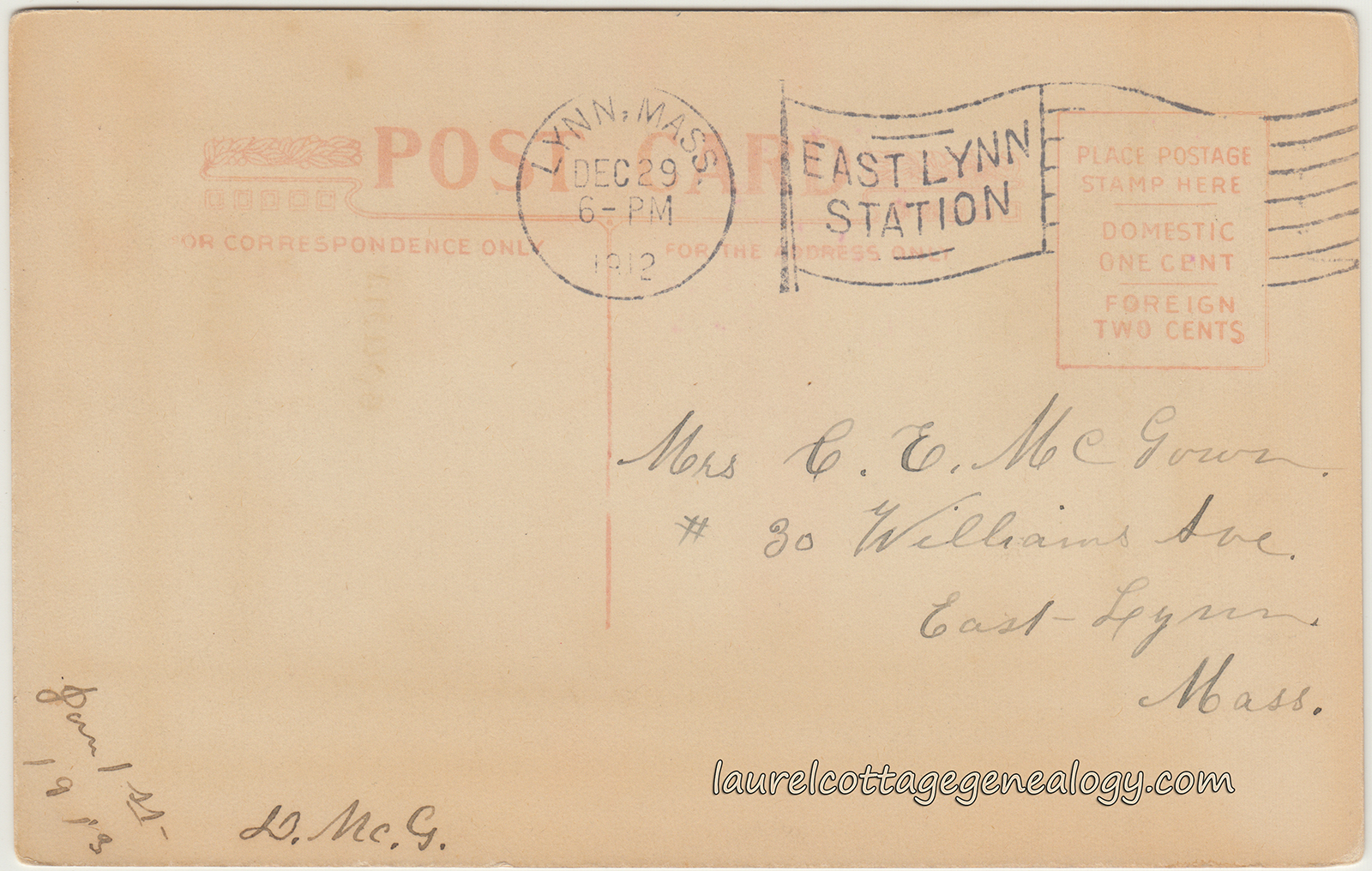
Addressed to:  “Mrs. C. E. McGown, #30 Williams Ave., East Lynn, Mass.” It looks like the card was signed “D. Mc.G.” (as in D. McGown) and then dated by whoever received it, as the date in the bottom left corner shows “Jan 1st – 1913.” The card is postmarked Dec. 29, 1912, Lynn, Mass, and the postmark also shows East Lynn Station.

Mrs. C. E. McGown is not showing up in records online. However, there is a Clara E. McGown born about 1887 in Massachusetts, at the address of 30 Williams Ave, on the 1900 Federal Census taken in Lynn, Mass. Clara is shown there as age 13, living with parents, Serimos and Lizzie R. McGown, and boarder, Thomas B. Stewart. And there is a marriage record dated March 31, 1907, for Clara E. McGown and Gerrish B. Wiggin. Clara’s parents are listed there as Cyrenus E. McGown and Lizzie R. Martin, and Gerrish’s parents are listed as James B. Wiggin and Frances M. Hazen. Perhaps the sender of these New Year greetings simply forgot to write Clara’s married name, or maybe they weren’t sure what it was. If so, this would account for the fact that Clara is addressed as “Mrs.” while still in her maiden name. Then if all of this is correct, we would assume that Clara and her husband Gerrish were either living with Clara’s parents at the time the card was sent, or the sender did not have the Gerrish address.

Divided back, used postcard. Postmarked December 29, 1912. Publisher unknown. Card is on somewhat heavier card stock.

Sources:  Year: 1900; Census Place: Lynn Ward 3, Essex, Massachusetts; Roll: 644; Page: 7B; Enumeration District: 0366; FHL microfilm: 1240644. Ancestry.com. 1900 United States Federal Census [database on-line]. Provo, UT, USA: Ancestry.com Operations Inc, 2004.

Ancestry.com. Massachusetts, Marriage Records, 1840-1915 [database on-line]. Provo, UT, USA: Ancestry.com Operations, Inc., 2013. Original data: Massachusetts Vital Records, 1840–1911. New England Historic Genealogical Society, Boston, Massachusetts. Massachusetts Vital Records, 1911–1915. New England Historic Genealogical Society, Boston, Massachusetts.

A Happy New Year

HNY Clock and Mistletoe pc1HNY Clock and Mistletoe pc2

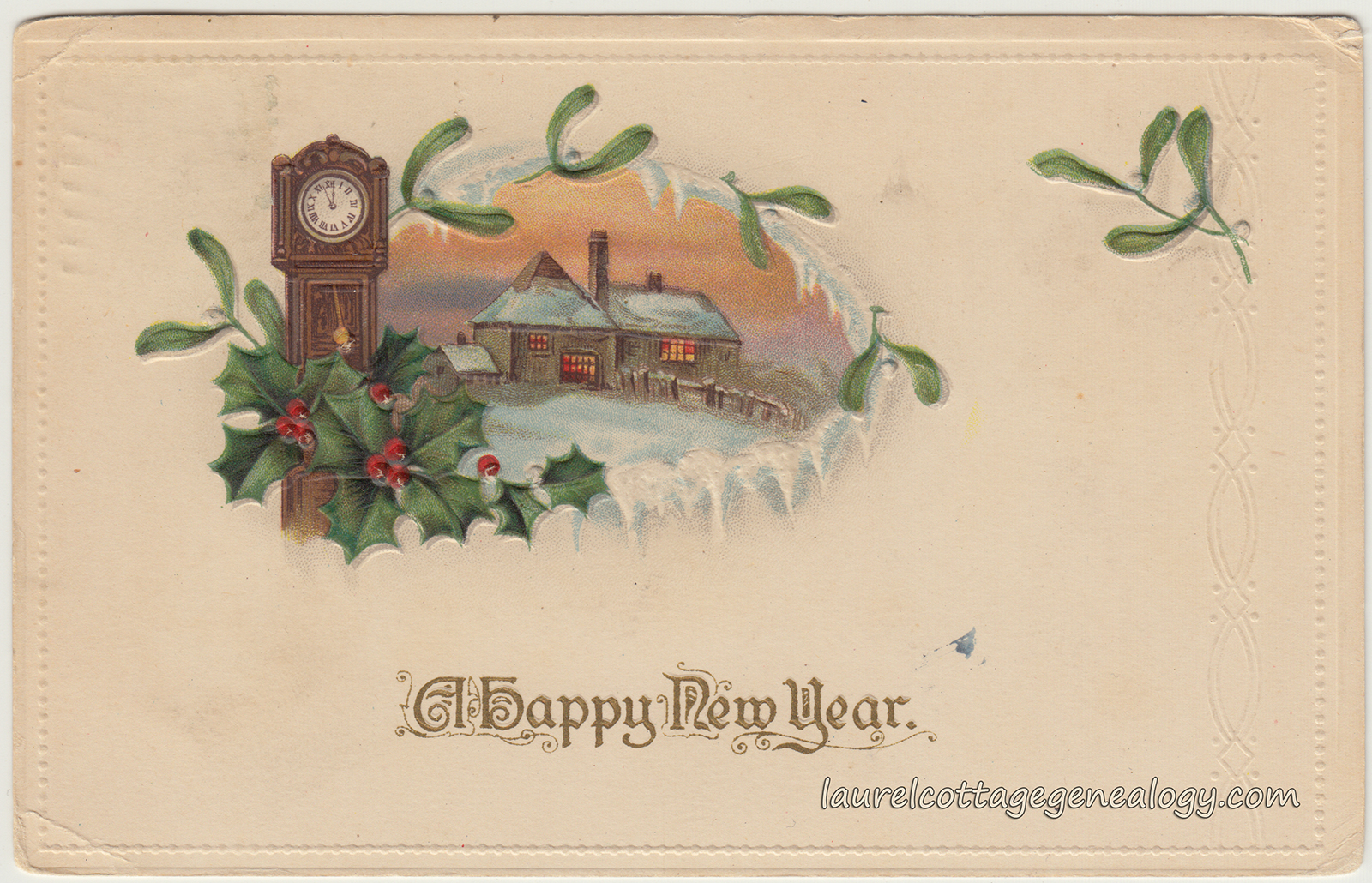
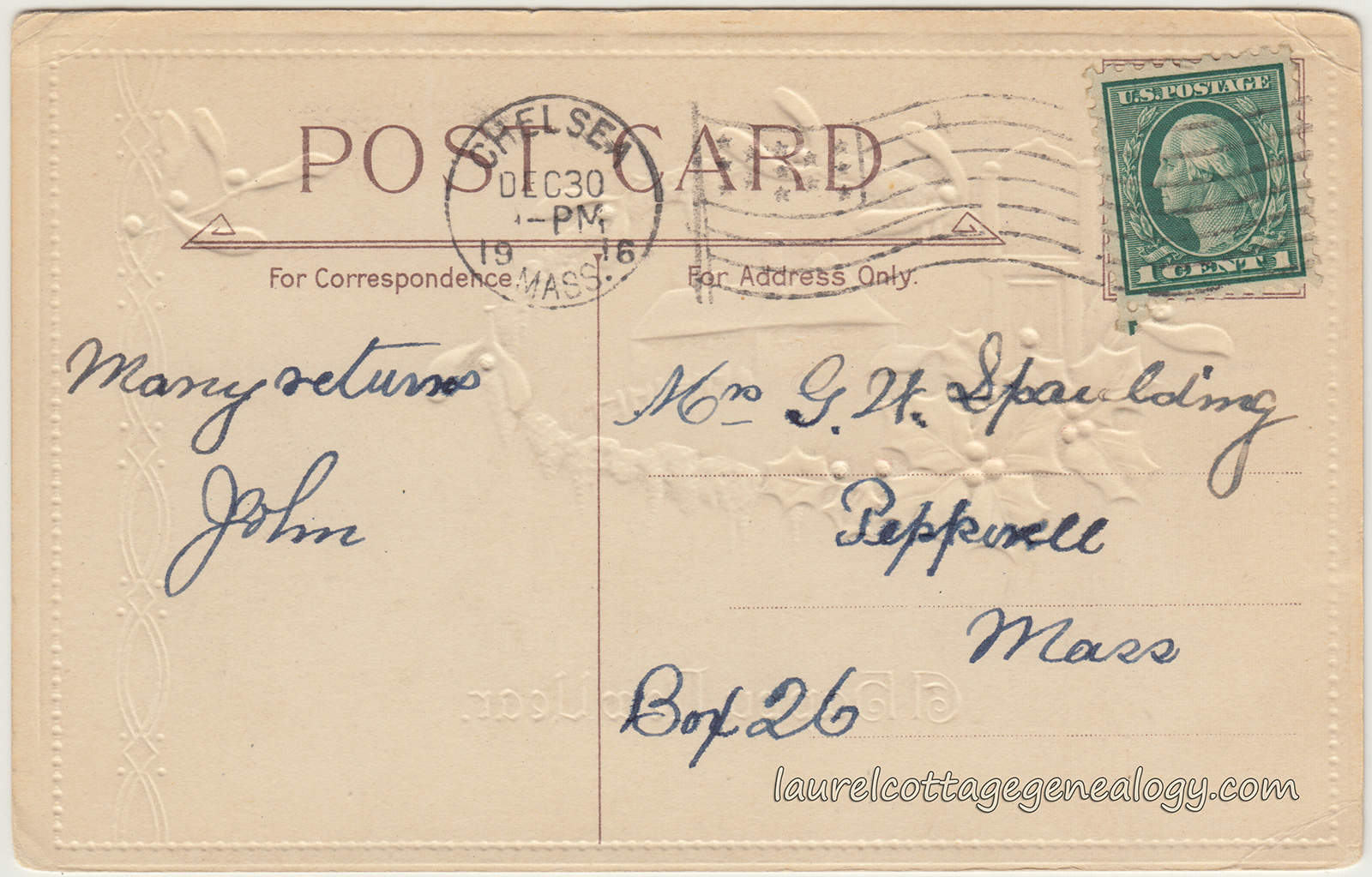
Mistletoe, holly, snow and grandfather clock border this home scene in winter at sunset. Clock appropriately shows about 3 minutes to midnight. Embossed card is dated December 30, 1916 and sent from Chelsea, Massachusetts. Sent to “Mrs G. W. Spaulding, Pepperell, Mass., Box 26” and signed, “Many returns, John.” Census and online city directories are not showing a G. W. Spaulding, a George Spaulding, or a G. H. Spaulding in or very close to Pepperell, but this is nevertheless, a very nice card. I like the snow border, in particular.

Divided back, embossed, used postcard. Dated December 30, 1916. Publisher unknown.

G. Meachum Millinery

G. Meachum Millinery cc

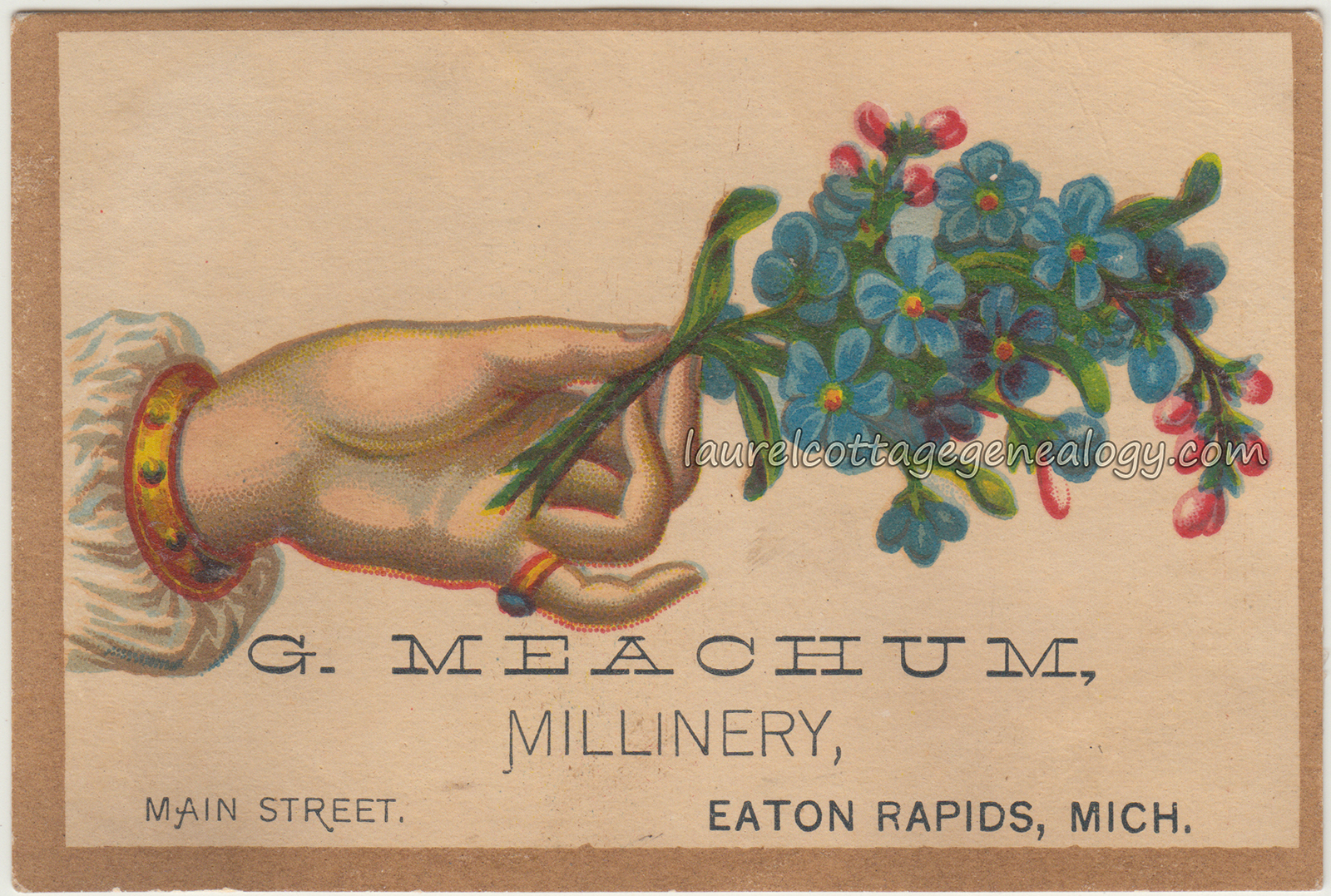
Calling card, circa 1880s – 1900

Price:  $7.00             Size:  About 2 and 1/4 x 3 and 1/4″

Calling card for G. Meachum in the millinery business, who was located on Main St. in Eaton Rapids, Michigan. As of the date of this post, a record of G. Meachum has not been located in online sources, though there is a reference found for a Mrs. M. H. Hackings, millinery on Main St. in the same city.

This calling card shows the oft-used (but lovely) image of a hand and flowers. In this card the flowers offered are forget-me-nots, and part of the sleeve is visible, a blousy sleeve gathered at the wrist with a studded gold band, with the offer-er wearing a gold and blue ring on the little finger.  Does this remind you, too of an old arcade fortune-teller gypsy? Estimating the date of the card is maybe from the late 1800s.

Source:  Polk’s Michigan State Gazeteer and Business Directory for 1875. R. L. Polk & Co., Compilers. The Tribune Printing Co., Detroit, 1875. Page 339. (Google eBooks)

Winter Scene in Bell New Year Greetings

Winter Scene in Bell New Year pc1Winter Scene in Bell New Year pc2

“May the New Year

     bring success to you.

And each day give its best to you.

     And every week as it flys past

Be better, brighter than the last.”

Charming postcard, year printed unknown, maybe circa 1910, showing New Year’s poem and image of bell with winter country scene inside, with gold-tone border. Check out the spelling “flys” – this is amusing, but the poem is lovely and it’s wish is offered to all in our new year of 2014.

Divided back, unused postcard. Publisher unknown. Made in the U. S. A. Series 1071B.

Price:  $3.00


The Leaf – White Sewing Machine Trade Card

Leaf tc

Trade card in leaf shape for White Sewing Machines. Circa 1886.

Price:  $20.00        Size:  About 3 x 4″

Beautiful leaf trade card in shades of green, red and gold, for White Sewing Machines. This is the second trade card for White appearing on this website. The wonder of it though, is how this paper leaf survived this amazingly well through the years, only showing a small fold on the right-hand side. (The card is the leaf itself; the yellow background was just for scanning purposes.) The White was immensely popular, with it’s factory in Cleveland at 10 and 40 Canal St. and sales office at 57 and 59 Euclid Ave. The company shipped not only all over the United States and Canada, but also had a large overseas market. The statement here of 100,000 machines being sold yearly would be the best clue as to this card’s date. A couple of old publications help to somewhat define the time-period. An 1879 issue on Cleveland Industry states “from July 1876 to the eve of 1878, the demand for the White Sewing Machine has increased from ten or twelve per day to one hundred and fifty or two hundred per day…”  An 1886 publication on Cleveland manufacturers and merchants states that the factory on Canal St. was a “substantial building, nearly 500 feet long, 50 feet wide, and four to six stories high, with a capacity of manufacture of three hundred sewing-machines per day.”  So, perhaps this card was printed somewhere around year 1886.

Sources:  Industries of Cleveland:  Trade, Commerce and Manufactures for the Year 1878. Published by Richard Edwards, Cleveland, 1879. Pages 107-108. (Google eBooks)

Leading Manufacturers and Merchants of the City of Cleveland and Environs. A Half Century’s Progress. 1836-1886. International Publishing Co., 102 Chambers St., New York, Boston, Cincinnati and Chicago. Page 76. (Google eBooks)


Bortree Duplex Corset Trade Card

Duplex Corset1Duplex Corset2

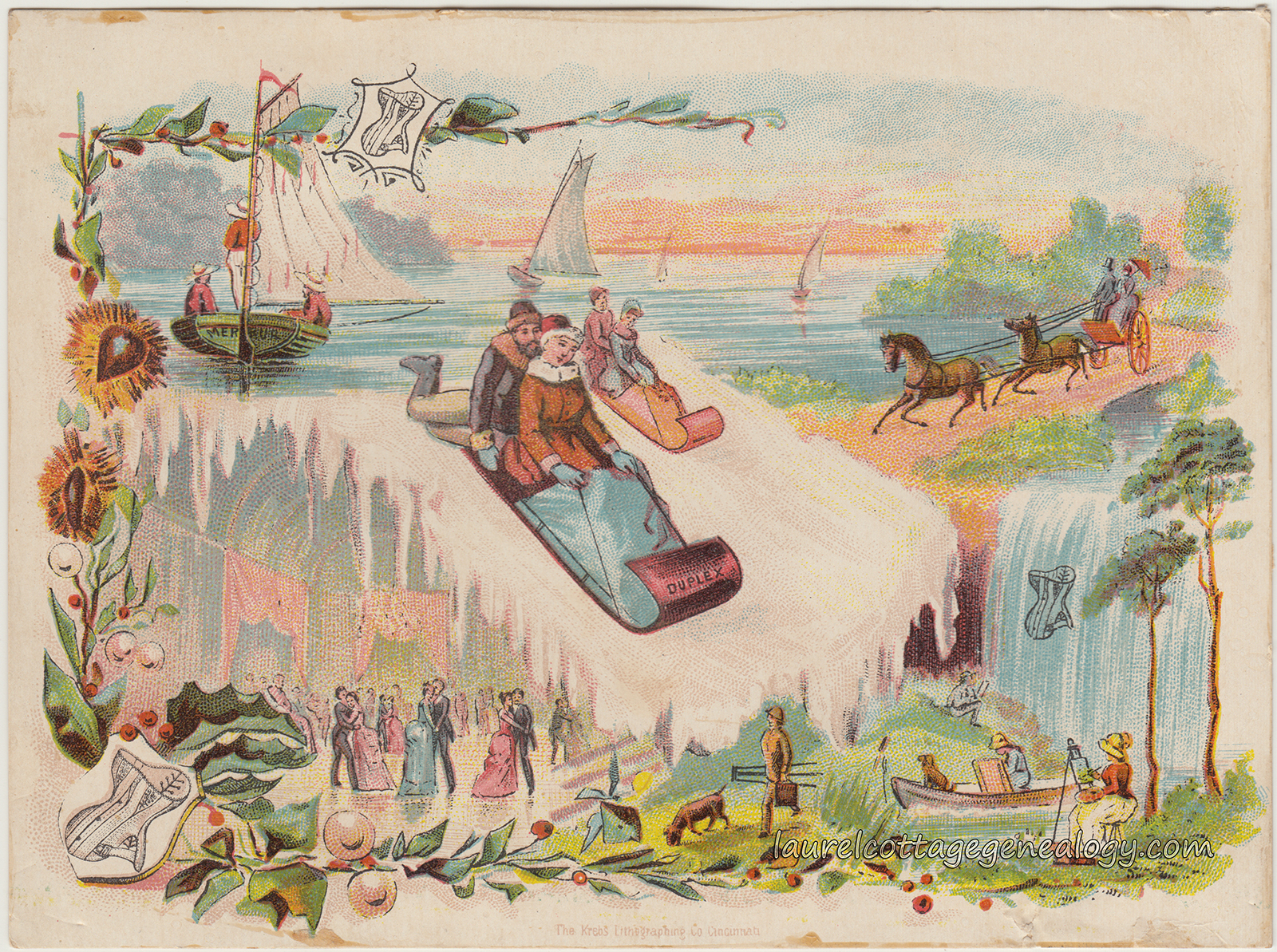
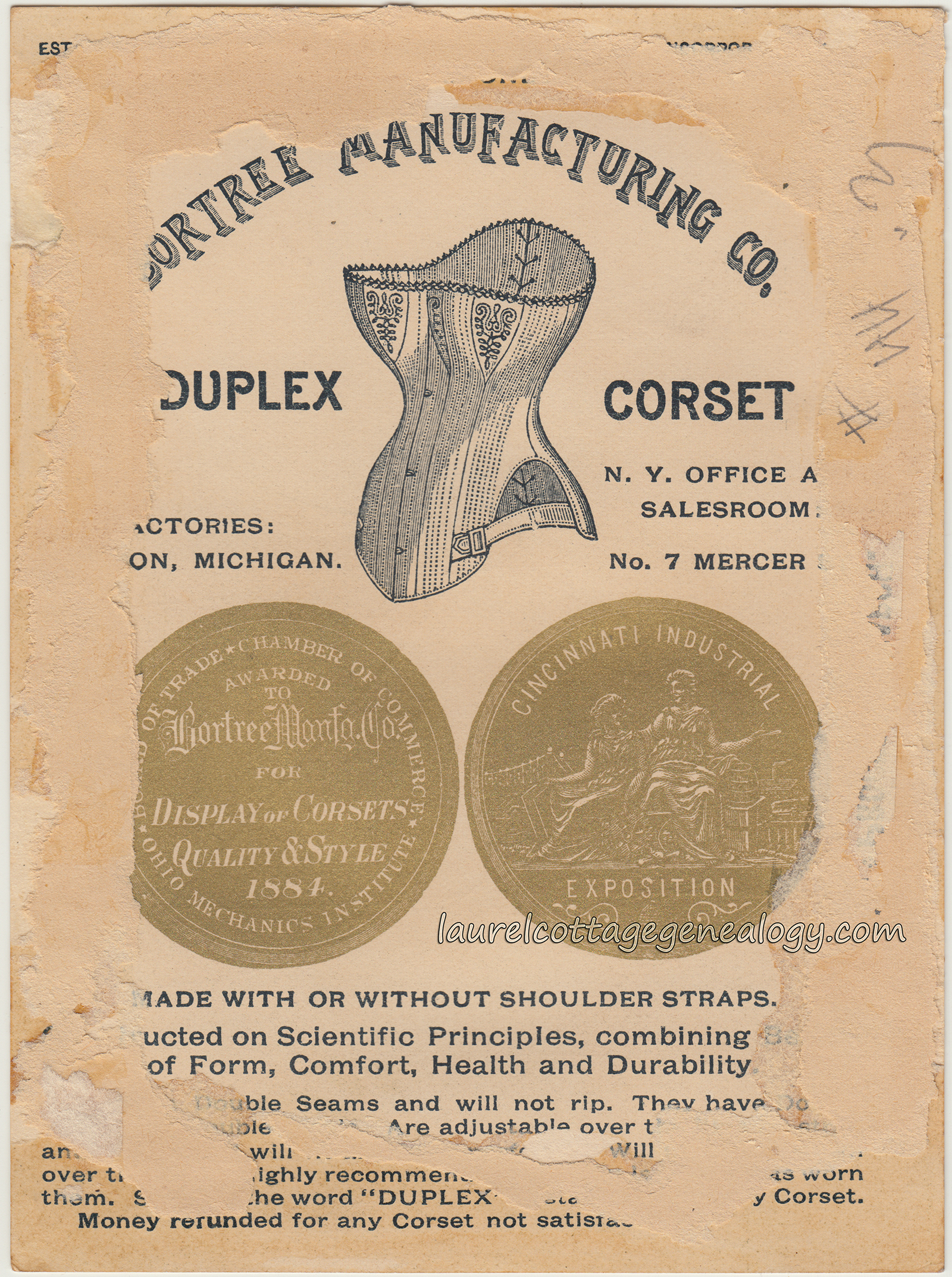
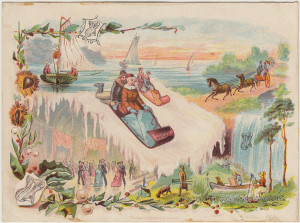
Bortree Manufacturing Company, Duplex Corset Trade Card. Circa 1884. Card printed by The Krebs Lithographing Company of Cincinnati.

A wonderful, colorful, slightly comical, (depending upon how this strikes you) trade card for Duplex corsets and the Bortree Manufacturing Company. This lithographed card shows six (maybe four, depending upon interpretation) different scenes:  three gentlemen in a sailboat with other sailboats in the background; a couple taking a drive in the country in a cart pulled by two horses; two couples tobogganing; a country scene showing four artists, two of whom are accompanied by their dog; a ballroom dancing scene. The details in this card are wonderfully done:  the different poses of the couples dancing cheek to cheek; the smitten-looking gentleman with his lady love on the toboggan; the lively “movement” of the horses; the dogs in the artists scenes that are naturally intent upon their own interests; the concentration of the woman artist in the rowboat; the understandably happy expression of the gentleman (or lady in trousers?) that is either on his or her way to the plein air site, or heading home, well satisfied with the day’s work.

There are also a few puzzling things about this lithograph:  the name on the sailboat, the two brownish objects on the left, and the type of plant in the border. The sailboat name looks like Merrur or Merkur; maybe these were the initials of the artists involved, or maybe mer for sea and then the artist’s initials, or maybe it’s a street name in Cincinnati, but I only see Mercer (this speculation could go on forever) or after looking at the back of the card again, maybe it’s a reference to the New York City address of No. 7 Mercer St. As to the two unknown, rather highlighted objects on the left – could these be buckeyes or flax seeds? Maybe, but the shapes for either don’t quite seem correct. And the plant making up the border seems familiar but if it is supposed to depict a real plant, I’m not able to verify it. Maybe some horticulture experts will come across this post and be able to solve the mystery.

As for the three little images of the Duplex corset, one appears on a shield, another inside some nice scroll work, but the placement of the one on the waterfall is priceless! (Is the artist furthest in the background seeing corsets in the waterfall? Is this depicting our litho artist himself, and showing that the inspiration for the card has come to him while gazing at a waterfall?)

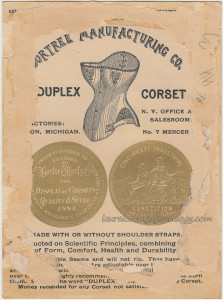
As you can see, this card was glued in someone’s scrapbook or glued somewhere, so a little of the wording is missing, but the Bortree Manufacturing Co. had a factory in Jackson, Michigan, and as the card indicates, had an office and salesroom at 7 Mercer St., New York, NY. According to an online article by Leanne Smith at mlive.com on Jackson, Michigan’s corset industry, “Bortree Corset Co., 112 W. Cortland St., was the first corset company founded west of New York. Moses Bortree, who migrated to Michigan from Pennsylvania in 1866, opened the factory in 1868 to manufacture crinoline skirts and bustles. In 1875, Bortree switched to corsets. Within five years, he was producing 50,000 to 300,000 corsets per year. In its heyday, the company employed almost 400 people, 350 of whom were women.”  This trade card would have to be from at least 1884 though, per the date on the image of the medal shown on the back, that was awarded to Bortree at the Cincinnati Industrial Exposition.

The Krebs Lithography Company was established in about 1875, but had evolved from Ehrgott & Forbriger, a company founded in 1856 by Peter Ehrgott, a “practical lithographer” and Adolphus Forbriger, “an excellent artist.” The company had a reputation for it’s fine artistic work, and was located in the Carlisle Building at 4th and Walnut in Cincinnati. When Mr. Forbriger died in 1869, German-born lithographer, Adolph Krebs, became partner with Mr. Ehrgott in November of the same year, and the company became Ehrgott & Krebs.  In 1874 Peter Ehrgott left the partnership, and Adolph Krebs became president of the company. The American Stationer, in a March 1883 publication, made note of The Krebs Lithography Company’s plans to build a new factory on Sycamore St, as by this time, they had outgrown the 4th and Walnut location. The new factory was located at 138, 140 and 142 Sycamore St., between 4th and 5th, in Cincinnati, and comprised six floors with a basement. Adolph Krebs died September 1884 at age 53 (unfortunately before he could see the completion of the new factory.) His son, Hermann T. Krebs, was then elected as the new president, having been with the company for about 8 years. The 1888 City Directory for Cincinnati shows Hermann as president, along with the other company officers, and that the company was still at the same Sycamore St. address. The company’s name changed to Henderson Achert Krebes Lithographing Company on February 22, 1889, according to an annual report to the governor showing corporate name changes.

Trade card, circa 1884.

Price:  $20.00

Sources:  Michigan Historical Collections, Volume 2, Michigan Historical Commission. Pioneer Collections Report of the Pioneer Society of the State of Michigan, Together with the Reports of County, Town and District Pioneer Societies. Vol. 2, 2nd edition. Robert Smith Printing Co.State Printers and Binders, Lansing, MI, 1901. Page 342 (Google eBooks)

Peek Through Time: Corset business thrived in Jackson during the early part of the 20th century. Leanne Smith article dated July 9, 2010. (http://www.mlive.com/news/jackson/index.ssf/2010/07/peek_through_time_corset_busin.html)

Leading Manufacturers and Merchants in Cincinnati and Environs. The Great Railroad Centre of the South and Southwest. An Epitome of the City’s History and Descriptive Review of the Industrial Enterprises that are making Cincinnati the source of Supply for the New South. 1886, International Publishing Co., 102 Chambers St., New York, Boston, Cincinnati and Chicago. Page 67. (Google eBooks)

The Philadelphia Print Shop, Ltd. (http://www.philaprintshop.com/effirm.html)

Artists in Ohio 1787 – 1900. A Biographical Dictionary Compiled and Edited by Mary Sayre Haverstock, Jeannette Mahoney Vance and Brian L. Meggitt. Kent State University Press, 2000. Page 500. (Google eBooks)

The American Stationer. Vol. XIII – No. 11. New York, March 15, 1883, pg. 358. (Google eBooks)

Ancestry.com. U.S. City Directories, 1821-1989 [database on-line]. Provo, UT, USA: Ancestry.com Operations, Inc., 2011.

Annual Report of the Secretary of State to the Governor of the State of Ohio for the Fiscal Year Ending November 15, 1890. The Westbote Company, State Printers. 1891. Page 447. (Google eBooks)

Antarctica FDC

Antarctica

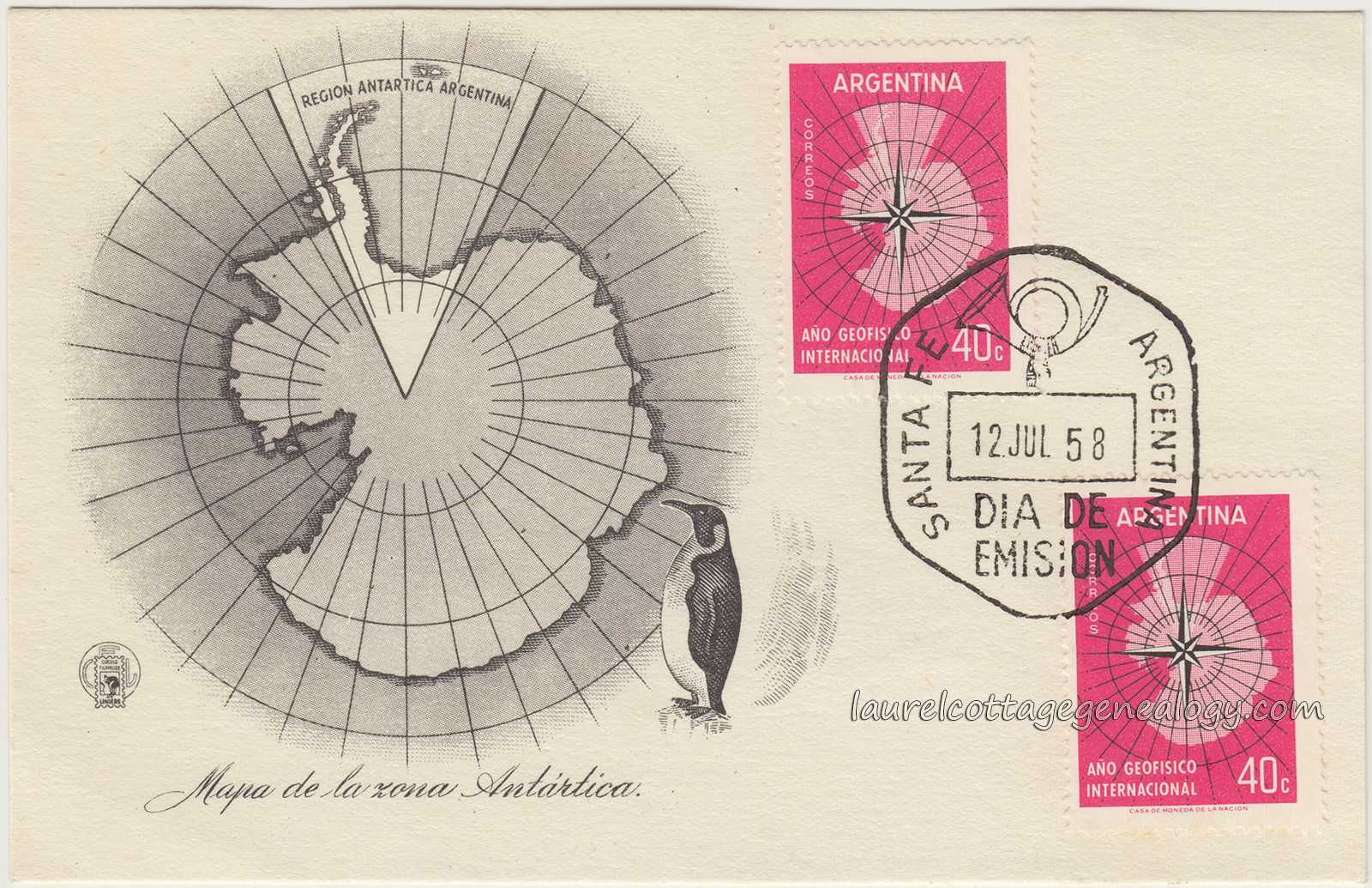
This is the first First Day Cover I’ve ever picked up. I have to admit that prior to researching this card I knew nothing about First Day Cover, a.k.a. First Day of Issue collecting. I bought this because I hadn’t yet come across any postal related items on Antarctica and because the penguin is adorable! So, I went to the American First Day Cover Society website and took their FDC Short Course, and learned that the FDC is a card or an envelope that bears a cancelled stamp for the first day that stamp is put on sale by the postal authorities. In this case we have two stamps with the nice cancellation mark (I like the bugle) showing that July 12, 1958 was the first day of issue for this stamp, and showing the city and country of issue was Santa Fe, Argentina. The artwork on the left is called the cachet (pronounced ka-shay as in the french pronunciation.) This cachet shows a map of Antarctica (Mapa de la xona Antártica) with the region marked off at the top that was claimed by the country of Argentina. This first day cover was issued before the Antarctic Treaty was enacted in 1961. Per a Wikipedia entry, the Antarctic Treaty and related agreements (collectively known as ATS or Antarctic Treaty System), currently has 50 signatory nations and “sets aside Antarctica as a scientific preserve, establishes freedom of scientific investigation and bans military activity on that continent.”

This particular stamp honors the Año Geofisico Internacional (International Geophysical Year or IGY.) Per another Wiki entry, the IGY was an international scientific project, in which 67 countries participated in eleven earth science studies on the topics of aurora and airglow, cosmic rays, geomagnetism, gravity, ionospheric physics, precision mapping, meteorology, oceanography, seismology and solar activity. The project lasted from July 1, 1957 to December 31, 1958, (ending almost 55 years ago to the day, as I am just noticing that the day of this posting will be December 30th.) Both the United States and the former Soviet Union launched artificial satellites to commemorate the IGY.

Sources:  http://www.afdcs.org/fdccourse.html

http://en.wikipedia.org/wiki/Argentine_Antarctica

http://en.wikipedia.org/wiki/Antarctic_Treaty_System

http://en.wikipedia.org/wiki/International_Geophysical_Year

George Rowell Butler, Photographer

Butler Logo

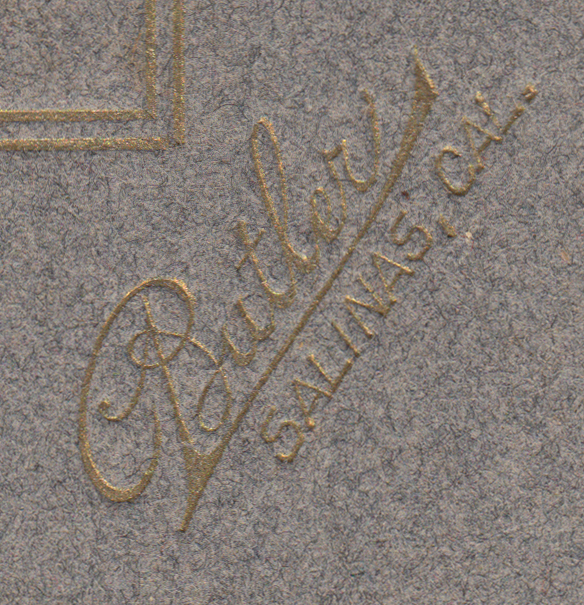
Butler photographer’s logo that appears at the bottom right of theSalinas California Couple” photo.

George R. Butler (1861- c. 1935) California-born photographer, active in counties of San Francisco, San Benito, Monterey and San Mateo. This post refers back to the photo of the Salinas, CA couple posted earlier on this site. It’s uncertain without the photographer’s first name being given, but I believe George R. Butler to be the likely photographer for that photo, as records substantiate the fact that he did work and live in Salinas for part of his career.

What we learn from the various census, voter registration and city directory records is that George R. Butler was born about September 1861 in California. The 1870 Federal Census taken in San Francisco, shows George to be the youngest of five children born to Miner Butler and Anna M. (Anna Mary Eves Bennet per unsourced Ancestry trees. 1880 census shows Anna’s sister Maria Bennett, single and living with then widowed Anna, so it would appear Anna’s maiden name is Bennett.) The 1880 shows George at the start of his career, listed there as Photo Apprentice, age about 18, and living with his mother, three of four siblings, and aunt. The 1882 San Francisco voter reg shows George and older brother Charles, both photographers and living at 212 Octavia, which is either their mother’s address or right next door. The 1886 – 1892 voter reg records show George living in San Francisco still, but at 305 Polk.

George married Sadie (Sarah, Sallie, born CA about October 1869) in about 1892. The couple is residing in Hollister in 1894 and by at least 1897 they are in Salinas (voter reg records.) The 1900 census shows that the Salinas address is possibly 240 Main St., though the street number is not recorded there; boarding with them is James W. Church, occupation Constable. By 1910 George and Sadie had moved up to San Francisco and are shown on that census as staying with George’s mom. The 1920 shows that the couple had moved to San Mateo; with them is Margret Blattner[?], listed as sister-in-law to George. There is a California Death Index record that shows a George R. Butler, born approximately 1863 with a death date of June 14, 1930 in San Mateo County. However, there is a 1935 city directory record for Hillsborough, San Mateo County, showing a George R. Butler and wife Sarah. So, George’s date of death is uncertain.

The above is a pretty good rundown of biographical information from online sources, which of course, are always good to check into, in order to corroborate, clarify and sometimes even offer corrections to existing career info. But, career-wise, besides the Salinas CA couple photo example on this website, (surmised to be George R.’s work) other examples can be found at the excellent website California Views:  The Pat Hathaway Photo Collection; see the last source listed below for that web address which has a link for George R. Butler and some of wonderful examples of his Monterey County and San Benito County landscape and building photos. 

Sources:  Year: 1870; Census Place: San Francisco Ward 11, San Francisco, California; Roll: M593_84; Page: 565A; Image: 290; Family History Library Film: 545583. Ancestry.com. 1870 United States Federal Census [database on-line]. Provo, UT, USA: Ancestry.com Operations, Inc., 2009.

“United States Census, 1880,” index and images, FamilySearch (https://familysearch.org/pal:/MM9.1.1/M6PX-YMG : accessed 29 Dec 2013), George Butler in household of Anna M. Butler, San Francisco, San Francisco, California, United States; citing sheet 275A, family 3, NARA microfilm publication T9-0079

Year: 1900; Census Place: Alisal, Monterey, California; Roll: 94; Page: 5A; Enumeration District: 0002; FHL microfilm: 1240094. Ancestry.com. 1900 United States Federal Census [database on-line]. Provo, UT, USA: Ancestry.com Operations Inc, 2004.

Year: 1910; Census Place: San Francisco Assembly District 37, San Francisco, California; Roll: T624_99; Page: 5B; Enumeration District: 0169; FHL microfilm: 1374112. Ancestry.com. 1910 United States Federal Census [database on-line]. Provo, UT, USA: Ancestry.com Operations Inc, 2006.

Year: 1920; Census Place: San Mateo, San Mateo, California; Roll: T625_145; Page: 15A; Enumeration District: 72; Image: 563. Ancestry.com. 1920 United States Federal Census [database on-line]. Provo, UT, USA: Ancestry.com Operations Inc, 2010.

California State Library, California History Section; Great Registers, 1866-1898; Ancestry.com. California, Voter Registers, 1866-1898 [database on-line]. Provo, UT, USA: Ancestry.com Operations, Inc., 2011.

Ancestry.com. U.S. City Directories, 1821-1989 [database on-line]. Provo, UT, USA: Ancestry.com Operations, Inc., 2011.

Ancestry.com. California, Death Index, 1905-1939 [database on-line]. Provo, UT, USA: Ancestry.com Operations, Inc., 2013.Original data: California Department of Health and Welfare.

http://caviews.com/A_1.html


Christmas A Song A Smile

Christmas A Song A Smile1Christmas A Song A Smile2

“Christmas

A song, a smile,

A laugh, a tear.

A glancing back throughout the year.

The worst forgotten – laid away,

The best to bless you on this day.”

Lovely Christmas sentiment in gold-tone framing of garland with red bows, topped with winter scene in gold, green, red and black.

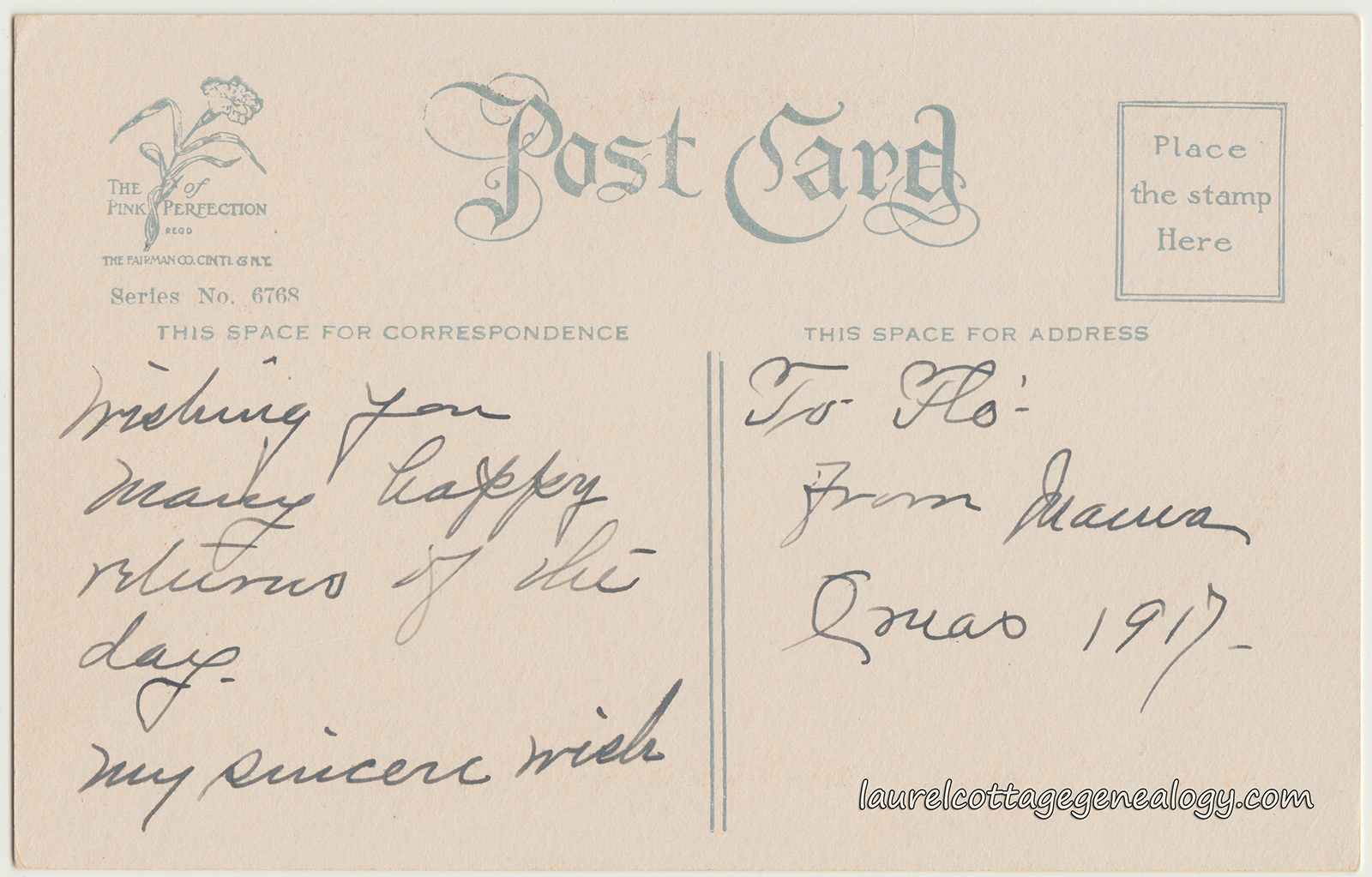
“To Flo, from Maura[?] Xmas, 1917 – Wishing you many happy returns of the day. My sincere wish.”

Divided back, unused with writing. The Pink of Perfection. Series No. 6768. Published by The Fairman Company, Cincinnati & New York. Dated 1917 by the sender.