Genealogy Services, Old Photos, Postcards, Trade Cards, Etc.

Triplett Loop Setter

Triplett Loop Setter

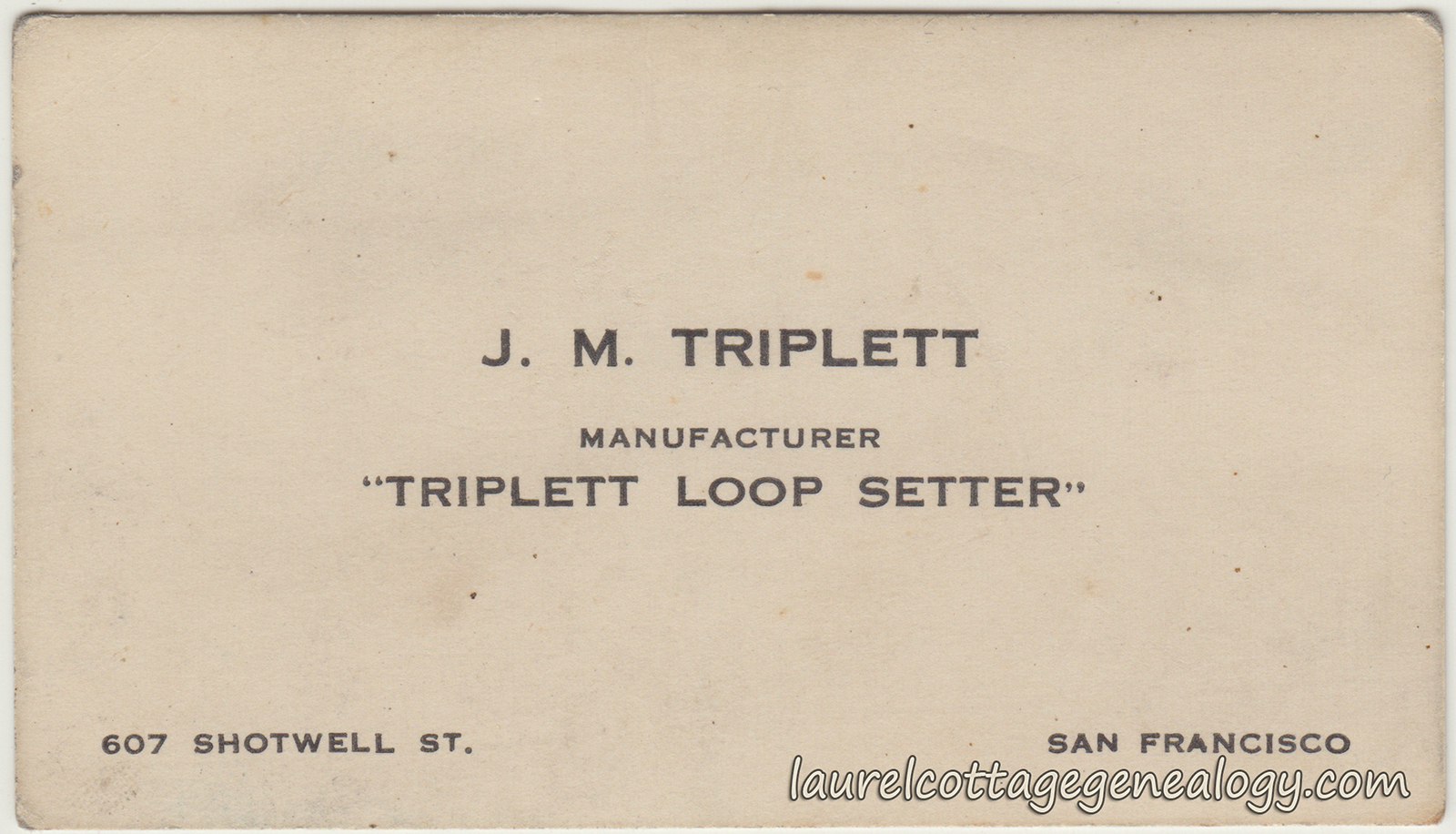
Business card for James Melvin Triplett (1886-1947), manufacturer of the Triplett Loop Setter, address 607 Shotwell St., San Francisco, California. Card circa 1916.

Price:  $10.00

Well, the first question is – What is a loop setter? One might imagine it had something to do with textiles, but it is actually a term from the old movie industry. One of the entries under the heading of recently patented inventions in the Scientific American, published in 1914, is for Triplett’s Loop Setter:

“Loop Setter, – J. M. Triplett, 6 North Columbia St., Wenatchee, Washington. This invention relates to moving picture apparatus and provides means for setting the loop of the film without interfering with the operating of the machine. The mechanism is of a simple nature under the immediate control of the operator. It is adapted for use in connection with any standard moving picture machine.”

Wow, if you’d like to get sidetracked, look through this 1914 publication. There are articles, photos, advertisements, classified ads, and of course, other patent listings like the one above. The entry three up from this one is for a “torpedo steering mechanism.”

James M. Triplett married Anna A. Kreth in 1909 or 1910, according to the 1910 Federal Census for San Francisco. The interesting thing about this census is that James’ occupation is given as Baseball Player (currently employed). His name is not showing up in any online references for minor league players, though. Too bad, as that would be another very interesting line of research – what team he played on, etc. On the 1910, he and wife, Anna, are living with Anna’s mom, widowed head of household, Anna A. Kreth, and the widow Anna’s older daughter (the younger Anna’s sister) Aline (Caroline) Watson and Aline’s husband, Albert Watson. Aline and Albert are listed here respectively, as theater actress and actor. So, it would seem that James might have gotten his start in the movie film industry through his wife’s sister and brother-in-law. (No references were found for Aline and Albert Watson, but maybe they used stage names.)

James Triplett was born either in 1885 or ’86 (his WWI Draft Registration Card shows he gave 1886 as the year but the California Death Index shows ’85.) A Washington State Census for Kent in 1892, shows him with his parents and siblings. The 1900 Federal Census shows San Jose, CA with mother and some of the siblings, married brother as head of household. The 1910, 1920 and 1940 show San Francisco: the 1910 is mentioned above; the 1920 shows James and Anna with their two young daughters, James working as a machinist and owner of a stage manufacturing company, with them is Albert Watson and his wife Caroline (Aline), Albert is now listed as bookkeeper for stage manufacturing company, (so probably working for James); the 1940 shows James’ occupation as motion picture operator, with wife, Anna, their two daughters and Caroline (Aline) Watson, widowed. James was the son of Silas D. Triplett and Rebecca N. Mothersead (mother’s maiden name according to family trees on Ancestry.com)

Another reference to the Triplett Loop Setter is found online indicating:

“THE LAEMMLE FILM SERVICE, Minneapolis, U. S. A. NOW READY FOR DELIVERY “Triplett’s Loop Setter” For Power’s, Edison and Motiograph Machines. ALL MODELS. Do away with operators’ “Bugaboo” by installing “Trip- lett’s Loop …”

The above is found in The Moving Picture World, Vol. 22. This is full (and extremely long) text re the film industry in 1914. The full reference is in there somewhere but (good grief!) who has time to search for it? Like the Scientific American publication, this one from the film industry of it’s day is fascinating and diversionary, showing all kinds of film-related entries, including descriptions of the plots of movies, with great names like, “Hello Mabel”, “A Law Unto Herself”, “The Phantom Light”, “When Slippery Slim Met the Champion” and “The Family That Did Too Much For Nellie”. The description on this last one is, “How a family discovered that it didn’t pay to Doll Up the cook in Glad Rags.”

Sources:  Scientific American, Vol. CX, No. 25, June 20, 1914; Page 509. Munn & Co., Inc. Publishers, New York, N.Y. (Google eBooks)

https://www.google.com/search?tbo=p&tbm=bks&q=%22triplett+loop+setter%22&num=10

http://chestofbooks.com/reference/Wonder-Book-Of-Knowledge/The-Story-Of-The-Motion-Picture-Projecting-Machine.html

Ancestry.com. Washington State and Territorial Censuses, 1857-1892 [database on-line]. Provo, UT, USA: Ancestry.com Operations Inc, 2006. Original data: Washington. Washington Territorial Census Rolls, 1857-1892. Olympia, Washington: Washington State Archives. M1, 20 rolls.

Year: 1900; Census Place: San Jose Ward 2, Santa Clara, California; Roll: 111; Page: 1B; Enumeration District: 0067; FHL microfilm: 1240111. (Ancestry.com) Year 1910; Census Place: San Francisco Assembly District 32, San Francisco, California; Roll: T624_96; Page: 1A; Enumeration District: 0058; FHL microfilm: 1374109. Year: 1920; Census Place: San Francisco Assembly District 26, San Francisco, California; Roll: T625_135; Page: 4B; Enumeration District: 111; Image: 399. Year: 1940; Census Place: San Francisco, San Francisco, California; Roll: T627_302; Page: 5B; Enumeration District: 38-108. (Ancestry.com)

San Francisco City Directory for 1916. Ancestry.com. U.S. City Directories, 1821-1989

Registration State: California; Registration County: San Francisco; Roll: 1544243; Draft Board: 6. Ancestry.com. U.S., World War I Draft Registration Cards, 1917-1918.

Ancestry.com. California, Death Index, 1940-1997 [database on-line]. Provo, UT, USA: Ancestry.com Operations Inc, 2000. Original data: State of California. California Death Index, 1940-1997. Sacramento, CA, USA: State of California Department of Health Services, Center for Health Statistics.

Moving Picture World (Volume 22) Oct-Dec 1914. http://archive.org/stream/movingpicturewor22newy/movingpicturewor22newy_djvu.txt
Locust Bloom Perfume

Locust Bloom Perfume tc1Locust Bloom Perfume tc2

Size: About 5 and 1/2 x 3 and 1/2″  Year:  Circa 1893 – ? (possibly through 1910s to early ’20s)

Availability status:  SOLD

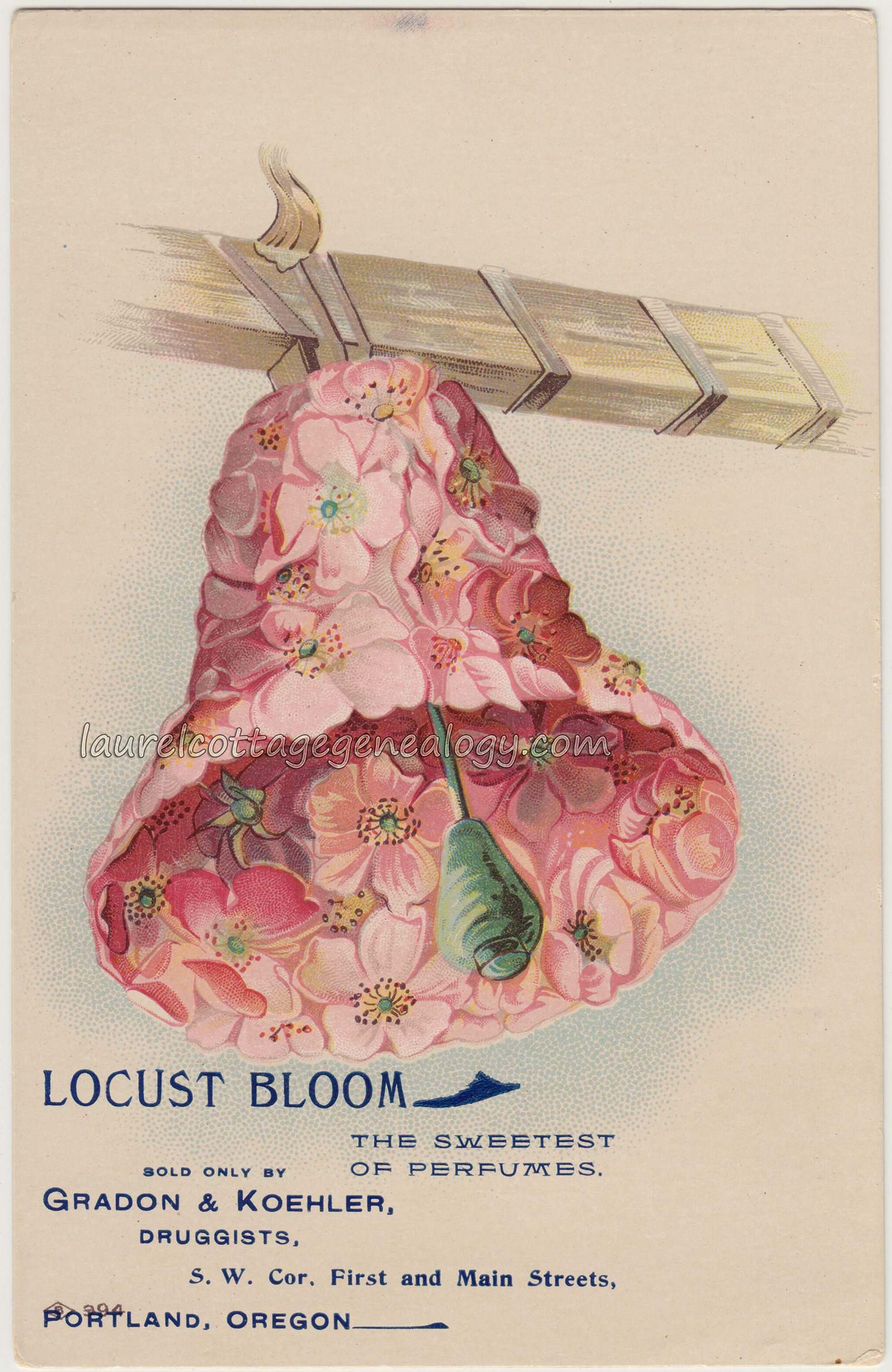
“Locust Bloom. The sweetest of perfumes. Sold only by Gradon & Koehler, Druggists, S. W. Cor. First and Main Streets, Portland, Oregon. A logo of the letter B inside a diamond shape appears at the bottom left of the card; next to this appears what looks like the number 994. This is likely the printer or publisher info.

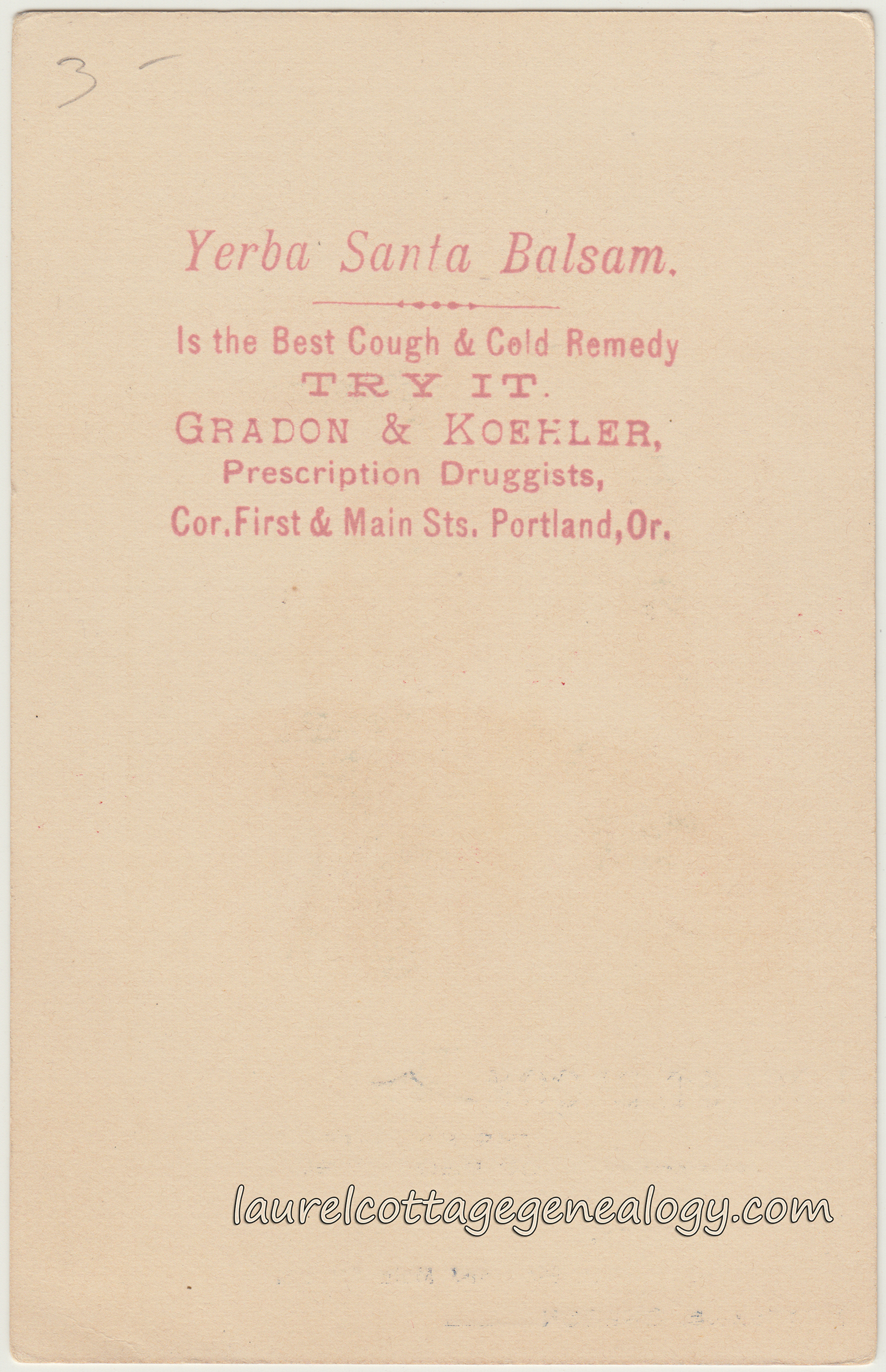
Printed or stamped on the back of the card is, “Yerba Santa Balsam. Is the Best Cough & Cold Remedy. Try It. Gradon & Koehler, Prescription Druggists, Cor. First & Main Sts. Portland, Or.”

On the front:  Stunning trade card for Gradon & Koehler Druggists showing an image of a bell made out of single-petal pink roses. The bell has a green clapper and hangs from a wooden beam. I guess, depending upon where you live, but “locust bloom” is not a term you may hear much, so you might be thinking, (as I was) “What is a locust bloom?” A locust bloom is the flower from the locust tree, of which there are two species, Black Locust and Honey Locust. Both of these have different subspecies. Though some varieties do produce pink flowers, their flowers do not resemble the flowers in the bell on this card. But the single-petal rose was probably the best choice from which to “construct” the bell, as the locust flowers are smaller and bloom in clusters, and wouldn’t have worked quite so well here. The flowers of the Black Locust are edible, and many different uses can be found for them, as you might imagine, a few of which are:  raw in salads, as jelly, as wine, as fritters, steeped with water, honey and lemon to make a refreshing drink. (Though the flower is edible to humans the other parts of the tree are toxic.) Of course, as this card indicates, the blossoms are wonderfully sweet-smelling. Searching online confirms that the flowers are still widely used today in perfume:  Fifty different brands were found that list locust blossoms as an ingredient. As for the Honey Locust tree it is known for it’s large thorns that grow out of the trunk (though there are thornless varieties) and for it’s seed pods having edible pulp. The thorns were used by Native Americans and were also used by soldiers (as makeshift buttons) in the Civil War.  (Just a few quick facts here, in trying not to veer off too much from the original topic. Not easy!)

On the flip side:  The product advertised as Yerba Santa Balsam probably contained an extract of the plant Yerba Santa (Holy Herb in Spanish) and maybe Balsam needle extract, as we find both with lots of info online re their historic and present-day medicinal uses.

About the drugstore:  Gradon & Koehler was Walter A. Gradon and William F. Koehler. The store address was 241 1st St., Portland as early as 1893, as an 1893 city directory shows an ad for the store, indicating they were the successors to John A. Child & Co. Walter Gradon died in 1931, but a 1934 city directory shows Gradon & Koehler, still operating but at 1101 S.W. 1st Ave. Various city directory and census records are online for both gentlemen and their families. The 1920 Federal Census for Portland indicate Walter A. Gradon was born about 1858, wife Nettie, about 1861, and daughter Florence about 1903. All three were native Oregonians. The same 1920 census finds William F. Koehler, born Oregon about 1867, his wife Sarah A., born Washington about 1870, and their son Frank, born Oregon about 1901. Living with the family is William Allison, listed as brother-in-law to William Koehler.

Update:  Bill, Grandson of William F. Koehler contacted me with more info:  Walter Gradon was born in 1859 and died April 1931. W. F. Koehler was born July 17, 1865, and died March 2, 1956, both in Portland. Wife, Sarah Antoinette (Allison) Koehler, was born November 1869 in Steilacoom, Washington, and died January 29, 1937 in Portland. Son, Frank Koehler, was born June 22, 1900 and died January 16, 1991, both in Portland.  (AH – editor. June 2, 2014.)

Sources:  http://the3foragers.blogspot.com/2011/06/black-locust-flowers.html

http://www.fragrantica.com/notes/Black-Locust-296.html

http://mosurvival.blogspot.com/2012/06/honey-locust-thorn-tree.html

http://www.uky.edu/hort/Honeylocust

http://sbhealthandhealing.com/blog_files/feed.xml

Portland city directories, various years. Ancestry.com. U.S. City Directories, 1821-1989 [database on-line]. Provo, UT, USA: Ancestry.com Operations, Inc., 2011.

Year: 1920; Census Place: Portland, Multnomah, Oregon; Roll: T625_1501; Page: 2A; Enumeration District: 118; Image: 866, and Page: 4A; Enumeration District: 126; Image: 1107. (Ancestry.com)

Oregon State Library; Oregon Death Index 1931-1941; Reel Title: Oregon Death Index M-Z; Year Range: 1931-1941. (Ancestry.com)

Old Ironsides

Old Ironsides 1Old Ironsides 2

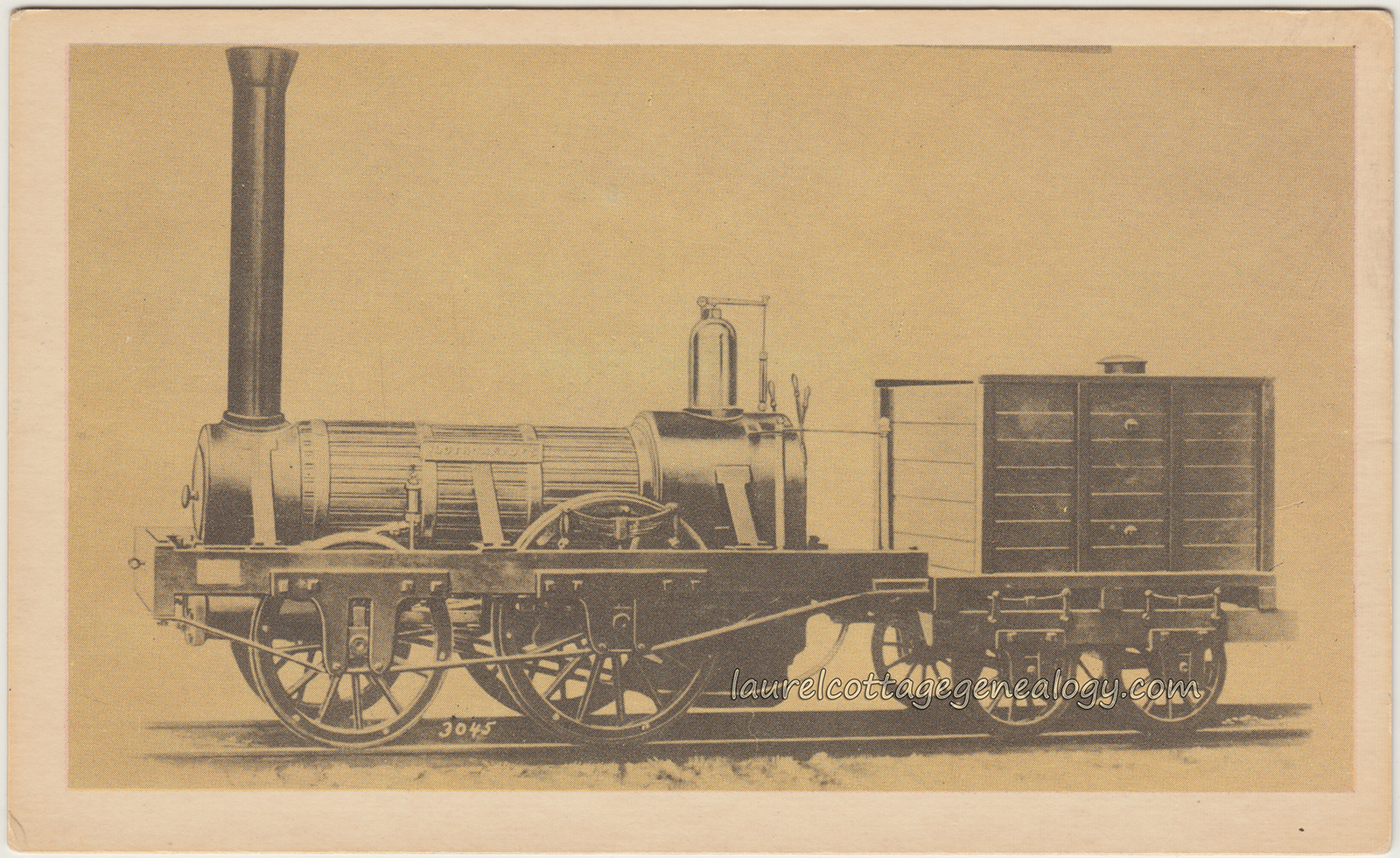
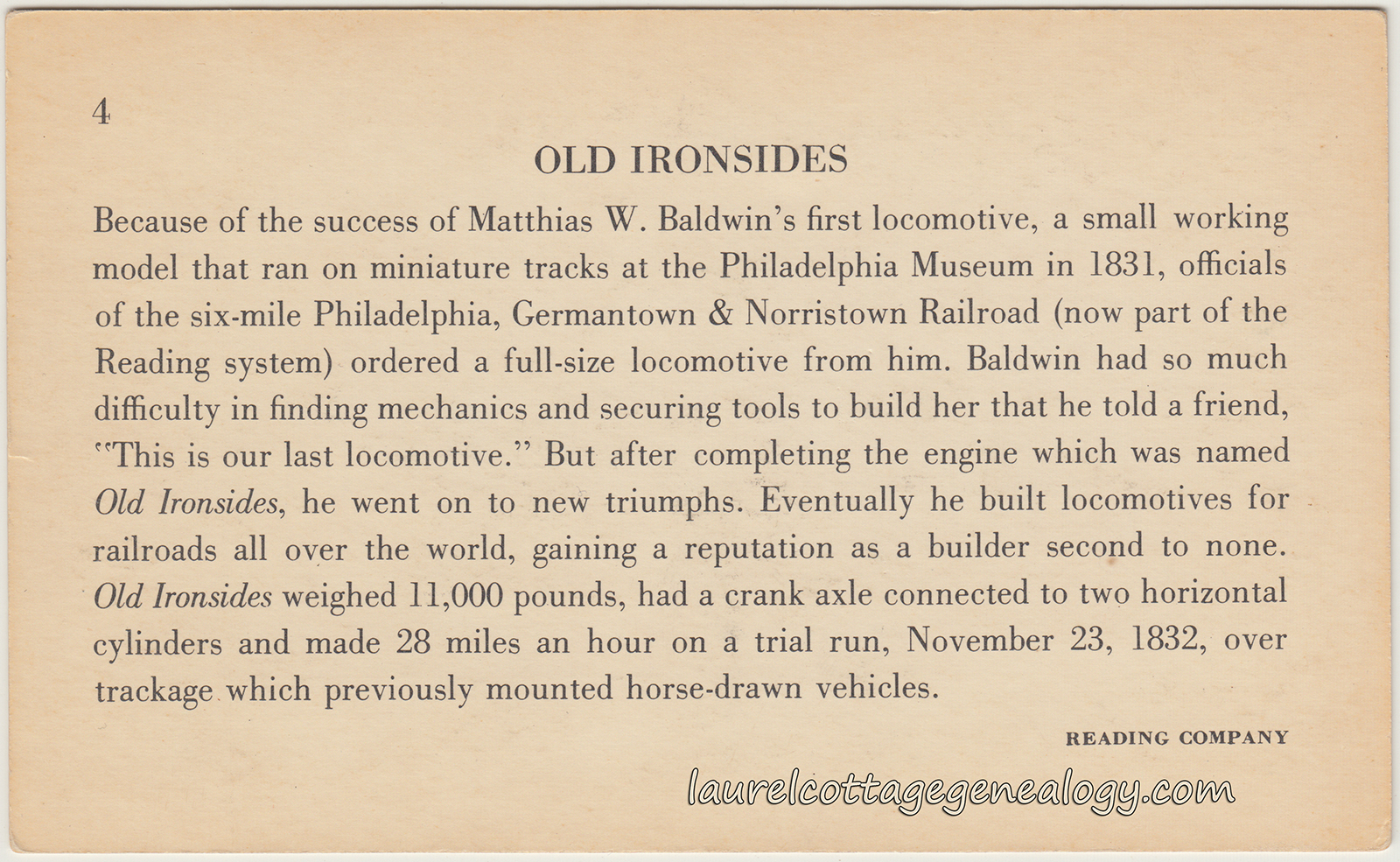
“Because of the success of Matthias W. Baldwin’s first locomotive, a small working model that ran on miniature tracks at the Philadelphia Museum in 1831, officials of the six-mile Philadelphia, Germantown & Norristown Railroad (now part of the Reading system) ordered a full-size locomotive from him. Baldwin had so much difficulty in finding mechanics and securing tools to build her that he told a friend, ‘This is our last locomotive.’ But after completing the engine which was named Old Ironsides, he went on to new triumphs. Eventually he built locomotives for railroads all over the world, gaining a reputation as a builder second to none. Old Ironsides weighed 11,000 pounds, had a crank axle connected to two horizontal cylinders and made 28 miles an hour on a trial run, November 23, 1832, over trackage which previously mounted horse-drawn vehicles. – Reading Company”

Matthias William Baldwin (1795-1866) was an American inventor and machinist, born in Elizabethtown, New Jersey. He was a jewelry maker and silversmith before partnering with machinist David Mason to produce equipment for printers and bookbinders. The need for more power to support the machine shop led to the building of steam engines, which led to the founding of one of the largest, most successful locomotive manufacturing firms in the United States: Baldwin Locomotive Works. A statue of Matthias Baldwin appears in front of Philadelphia’s city hall. Baldwin is also known for his support of charitable causes, was outspoken in his support to abolish slavery, and donated money to help establish a school for African-American children in Philadelphia.

The Reading (pronouncing “Redding”) Company was in operation from 1833-1976. Officially the Philadelphia and Reading Rail Road (later Railway) and was one of the most successful railroad corporations in the U.S. This card is number four of a series, date printed unknown, possibly from the 1950s through the last possible year of 1976.

Sources:  http://en.wikipedia.org/wiki/Matthias_W._Baldwin

http://en.wikipedia.org/wiki/Reading_Company


Romeo And Juliette Ferry, New Brunswick, Canada

Romeo and Juliette Ferry 1Romeo and Juliette Ferry 2

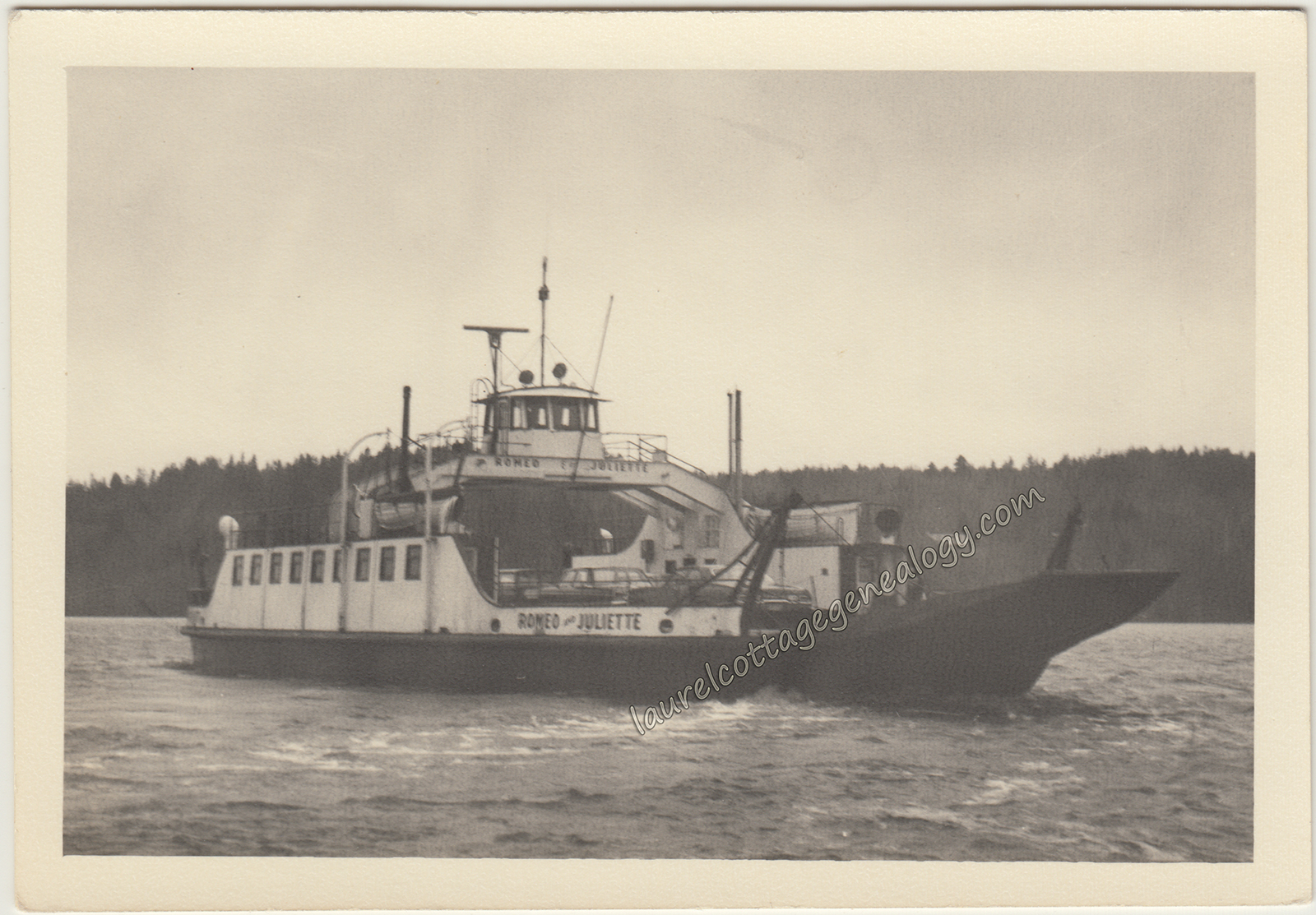
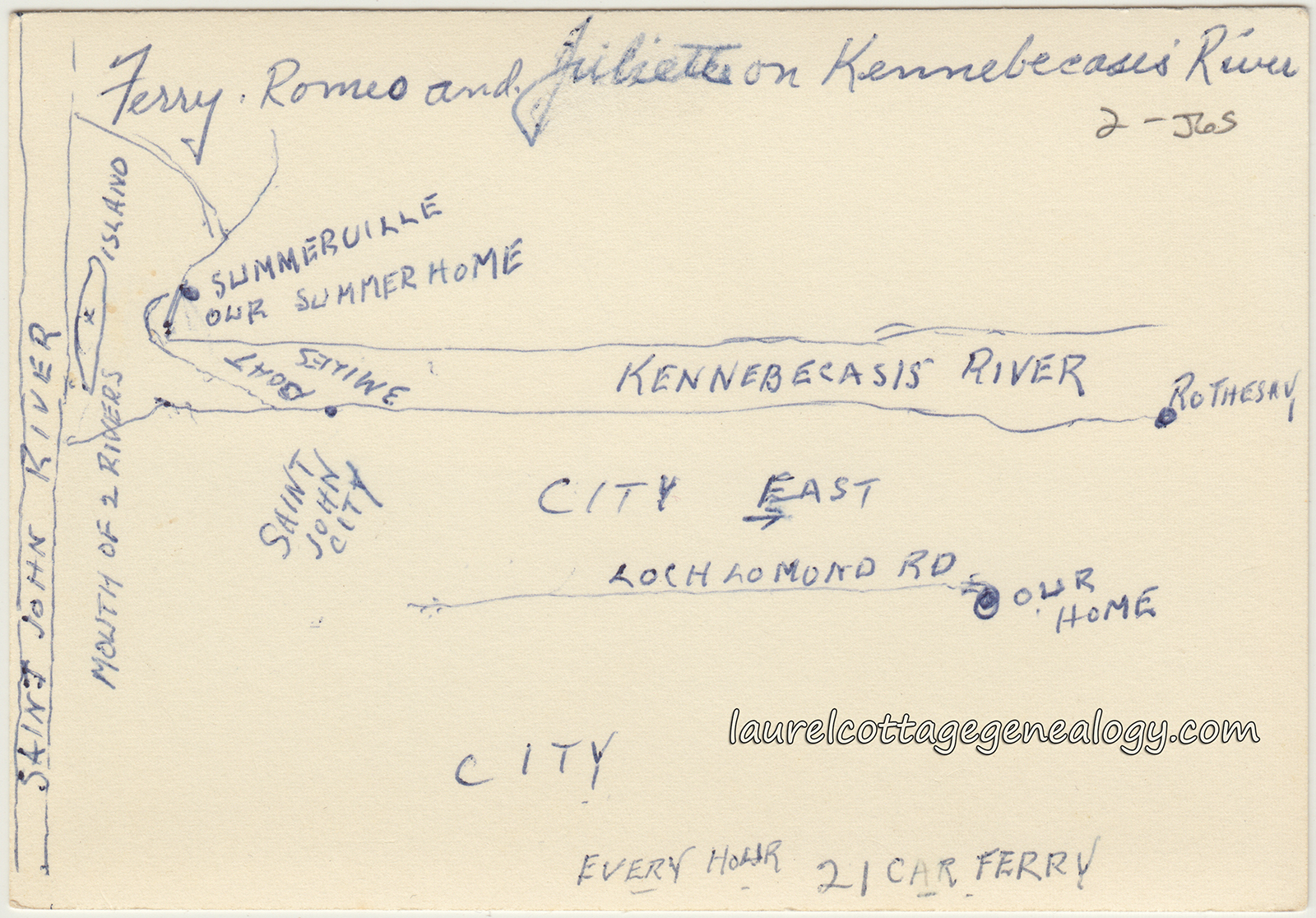
Photo of the ferry Romeo and Juliette on the Kennebecasis River with something not often found on the back (and totally awesome) – a hand drawn map of the area. There are three vehicles that we can see that are making this ferry trip. The one on the right appears to be a 1967 Chevy Biscayne. The middle may be a ’67 Plymouth Belvedere. This photo then would be from about 1967 to maybe the early ’70s.

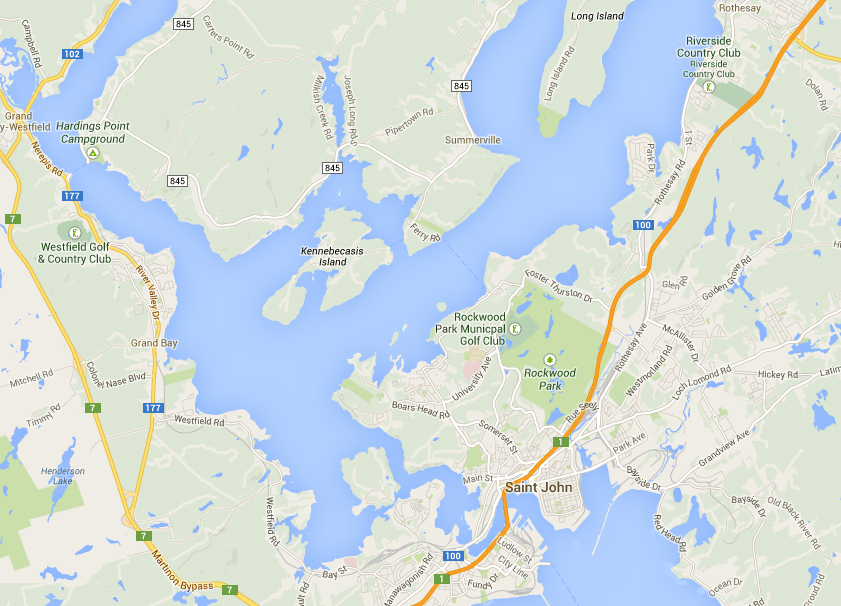
According to a Wikipedia entry, the Romeo and Juliette’s former service route had been between downtown Chatham and Ferry Road, but upon the opening of the Centennial Bridge, a steel arch bridge crossing the Miramichi River in Northumberland County, New Brunswick, the Romeo and Juliette’s service was moved to a route across Kennebecasis Bay between Summerville and Millidgeville, near St. John. This was in 1967.

St. John NB area map

In comparing the drawing to an actual map of the area, we can see that ours must have been just a quick sketch to give the receiver a general idea of the area, and well, it’s not that easy to draw a map of rivers, islands, towns etc. on the back of a photograph. The island indicated in the drawing must be Kennebecasis Island since it’s that island that is situated in the intersection of the St. John and Kennebecasis rivers. Anyway, the degree of accuracy in the sketch is not important, we just appreciate the fact that the person drew this map on the back of this great photo, and that this photo made it’s way all the way out to California to be picked up some forty-something or so years later. (And just to mention that looking at present-day photos of the area leaves us with a definite longing to go up to one of those cottages for a summer.)

The Romeo and Juliette was a passenger and vehicle ferry, built in 1953 at Owen Sound, Ontario and launched on April 16, 1953 by Russel Brothers, Ltd. She was built from steel, was about 79′ in length, weighed 234 gross tons, and could carry 21 cars. According to a CBC article, the “much-loved” Romeo and Juliette made her last run (a ceremonial last run with present and past crew members) at the end of December 2001. She had operated for 48 years, carrying cars from New Brunswick to Québec in the 1950s, working the Miramichi River in part of the ’60s and from 1967 through 2001 worked the St. John area that we’ve been looking at here.

Availability Status:  SOLD

Sources:  http://en.wikipedia.org/wiki/Centennial_Bridge_%28New_Brunswick%29

https://maps.google.com

http://stevebriggs.netfirms.com/osmrm/xromeoandjuliette.html

http://www.cbc.ca/news/canada/n-b-ferry-makes-its-last-run-1.267025

Greetings From Louisiana

Louisiana pc1Louisiana pc2

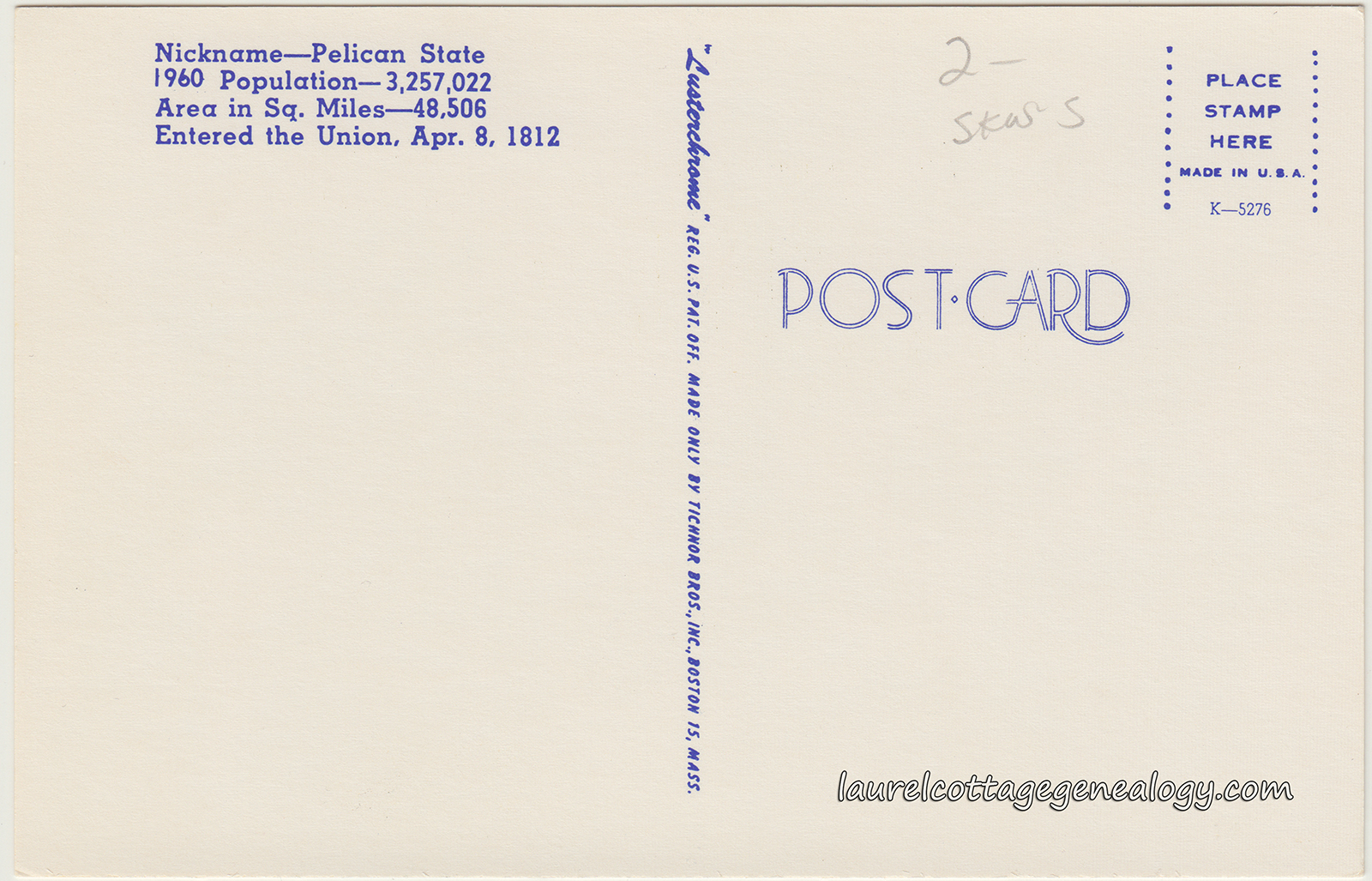
“Nickname – Pelican State. 1960 Population – 3,257,022. Area in Sq. Miles – 48,506. Entered the Union, Apr. 8, 1812.”

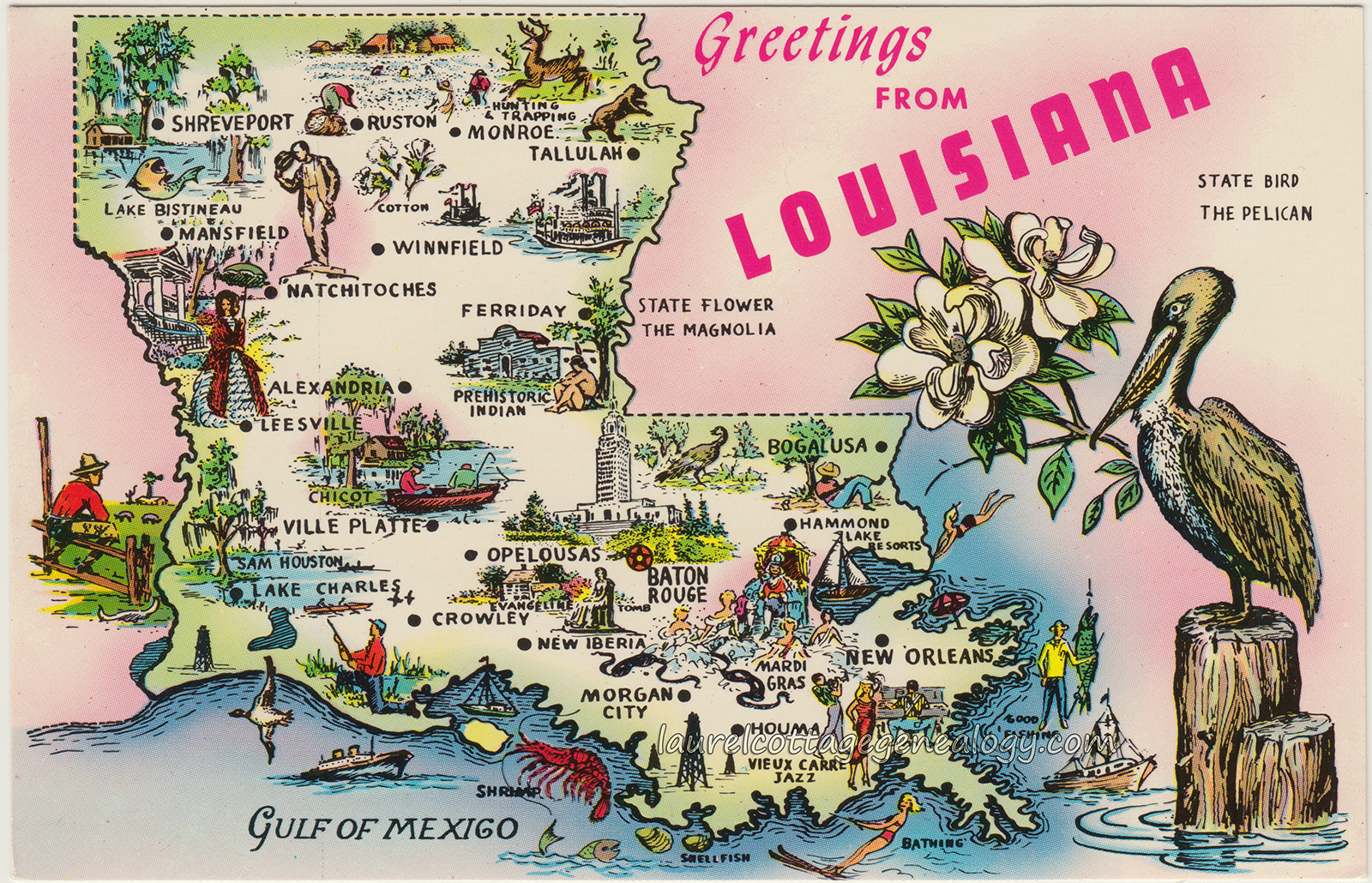
Very pretty state map vintage postcard. Wonderful colors. For being on such a small scale, the faces and poses are so full of expression. Look at the fish (!) And though it’s not mentioned on the back of the postcard with the other facts, the pelican is holding the state flower – the magnolia.

Divided back, unused, State Map View postcard of Louisiana. Circa 1960.  “Lusterchrome” Reg. U. S. Patent Office. Publisher:  Tichnor Bros., Inc., Boston 15, Mass. No. K -5276.

School Days

School Days pc1School Days pc2

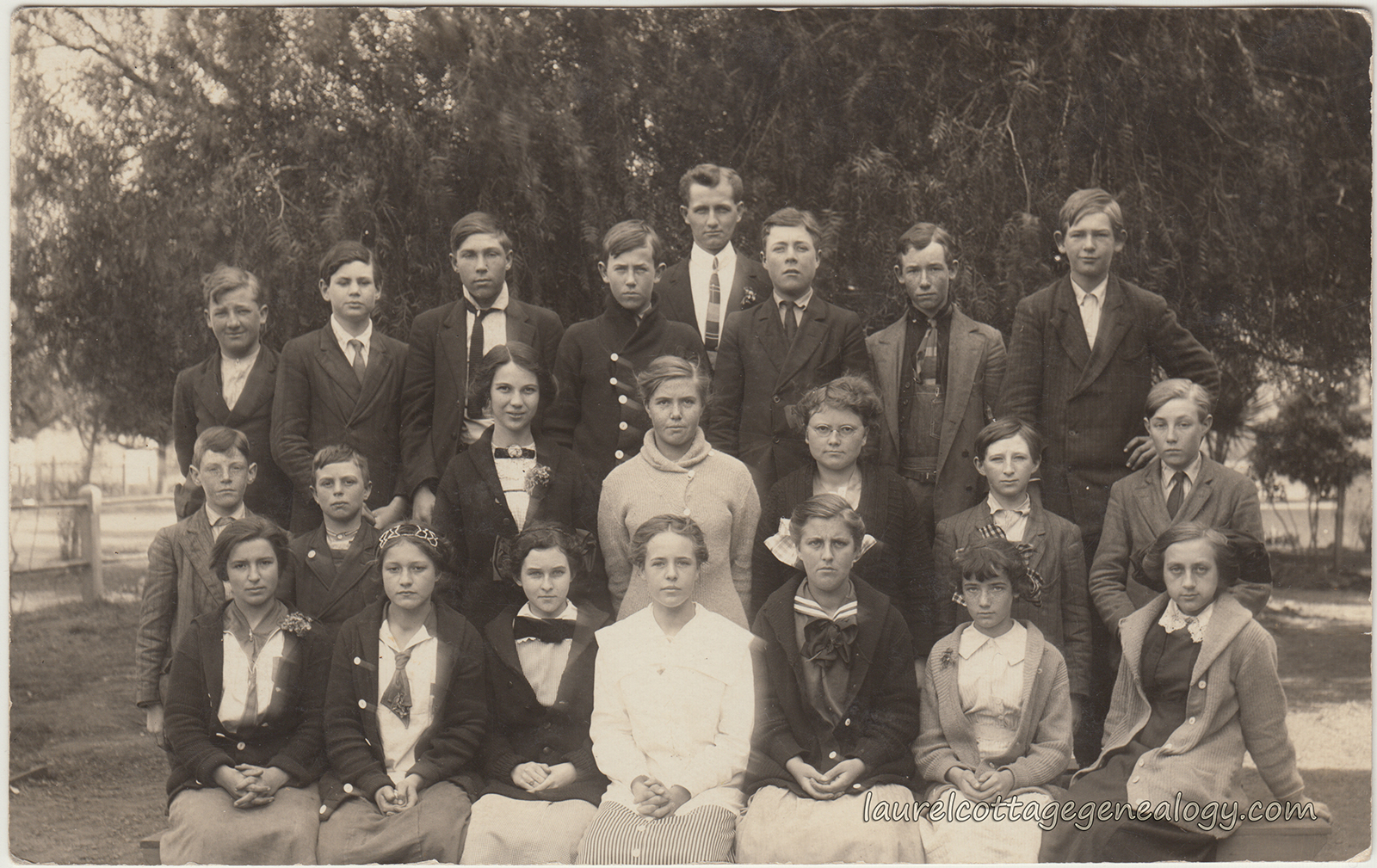
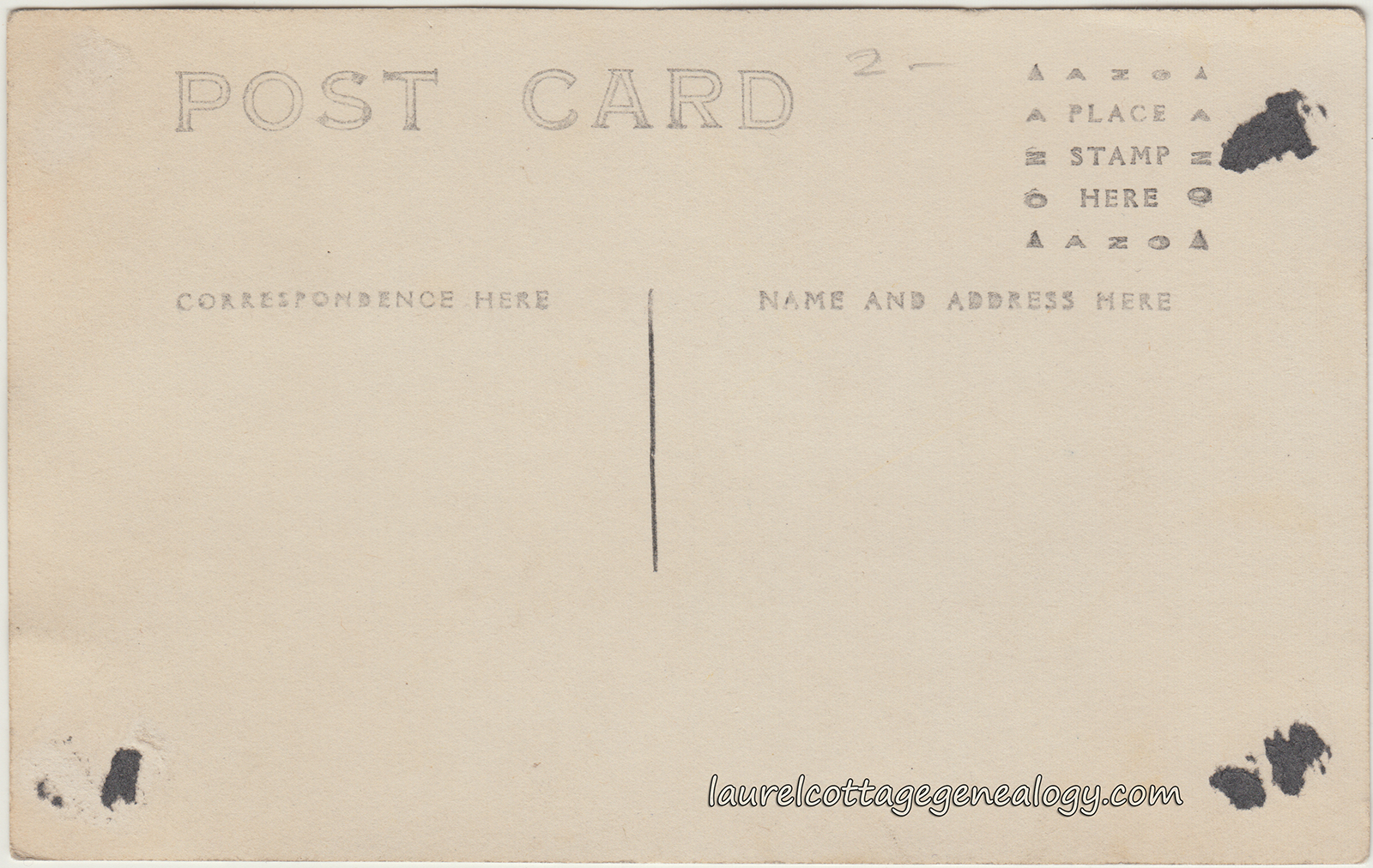
Divided back, Real Photo Postcard. Unused. AZO stamp box with four triangles up. Circa 1907 -1918.

Price:  $6.00

Real Photo Postcard of an outdoors shot, location unknown, of what is probably a class photo of school children that look to be about junior high age. It looks like the guy in the back center might be the teacher. There are two corsages being worn in this photo and three other maybe herbal decorations that might be best described as posies. Posies included small herbal cuttings, as well as flowers, and could be worn by men as well as women. Maybe the flowers and herbs were a local tradition for picture day? We don’t know, but in any case this is a great photo.

A Middle Eastern Happy Birthday

Middle Eastern Happy Birthday pc1Middle Eastern Happy Birthday pc2

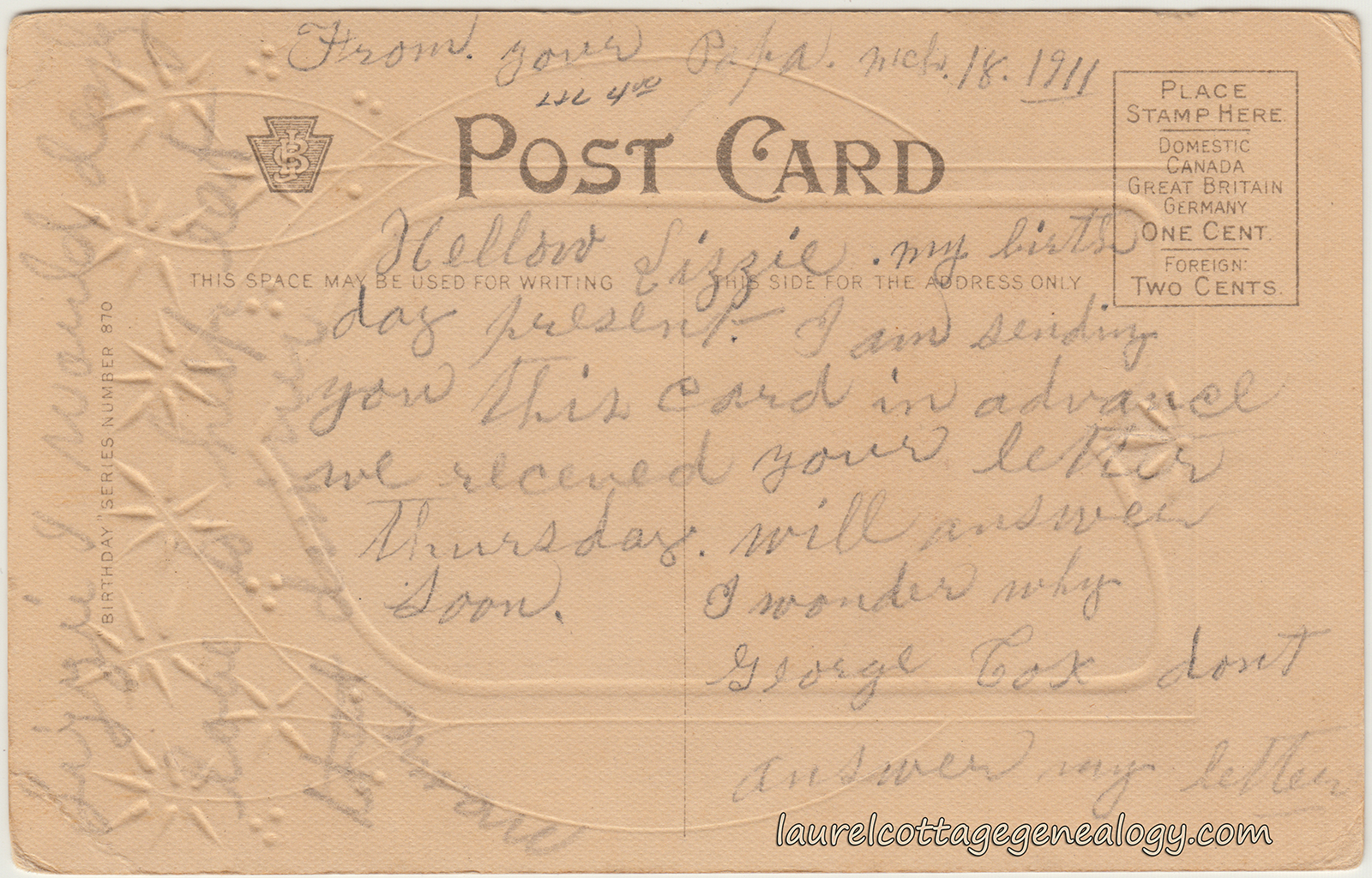
“Hellow Lizzie. my birthday present. I am sending you this card in advance we received your letter Thursday. will answer soon. I wonder why George Cox dont answer my letter. From your Papa. Mch. 18, 1911”

“Lizzie, I would dearly love to help eat that dinner. Mama[?]

From the charming writing on the card, it seems like Lizzie was born on her papa’s birthday, so he calls her “my birthday present.” And it appears that possibly her mama (or is that Mame?) added a note about wanting to be there for Lizzie’s birthday dinner.

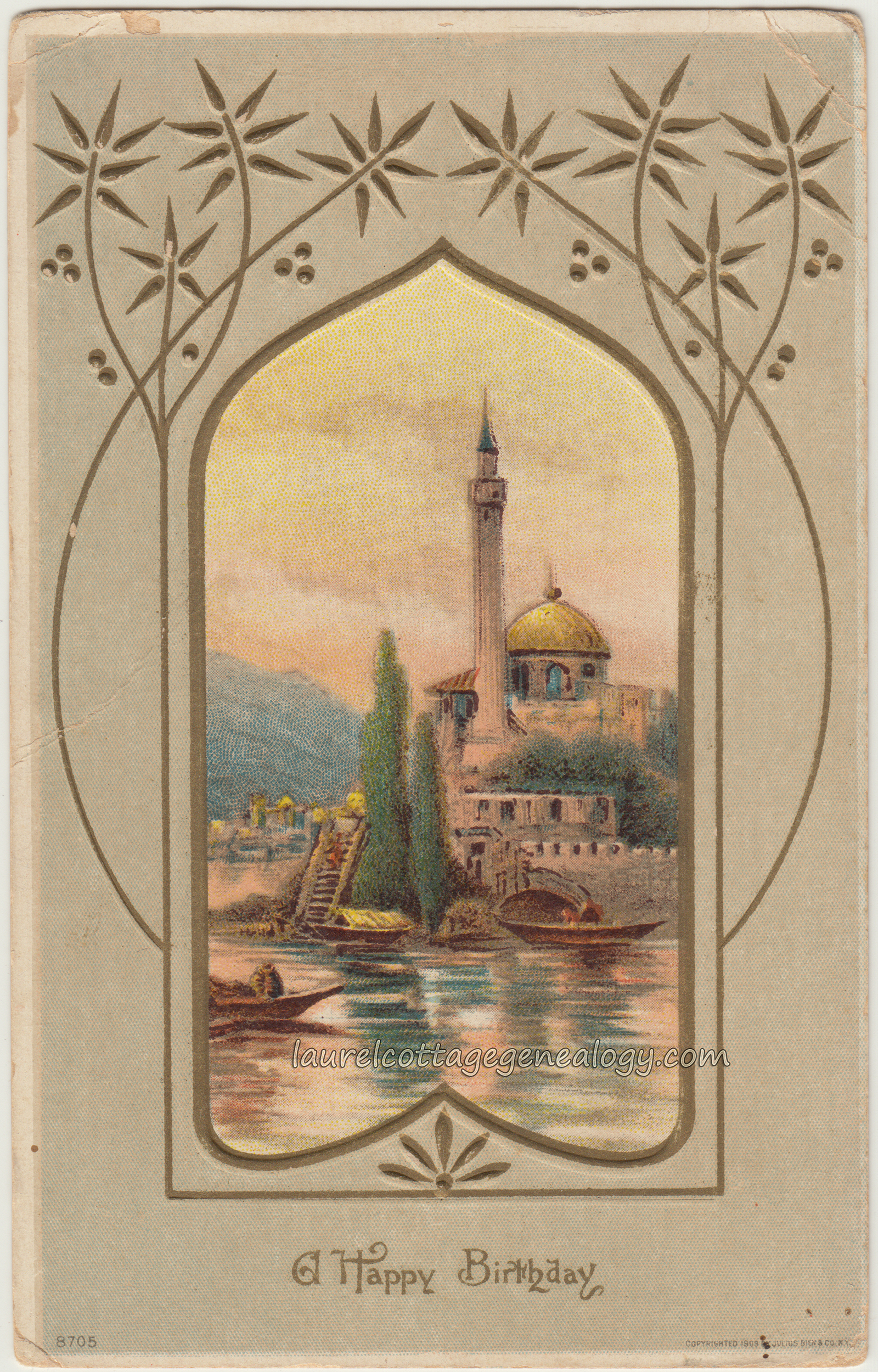
The front of this beautiful card shows a Middle Eastern scene at sunset or sunrise, of a mosque, a minaret, some Italian Cypress trees, some boats on the water, and mountains in the background. The scene is set inside an Islamic architectural style arch, bordered by what looks like a palm tree and coconut design. At the bottom is the message “A Happy Birthday” in lovely, and a little bit unusual type lettering.

Divided back, embossed postcard. Unused with message on the back. Publisher: Julius Bien & Co., New York. Birthday Series 870, No. 8705. Copyrighted 1909. The sender’s message is dated March 18, 1911.


Girl With Bow

Girl with Bow pc1Girl with Bow pc2

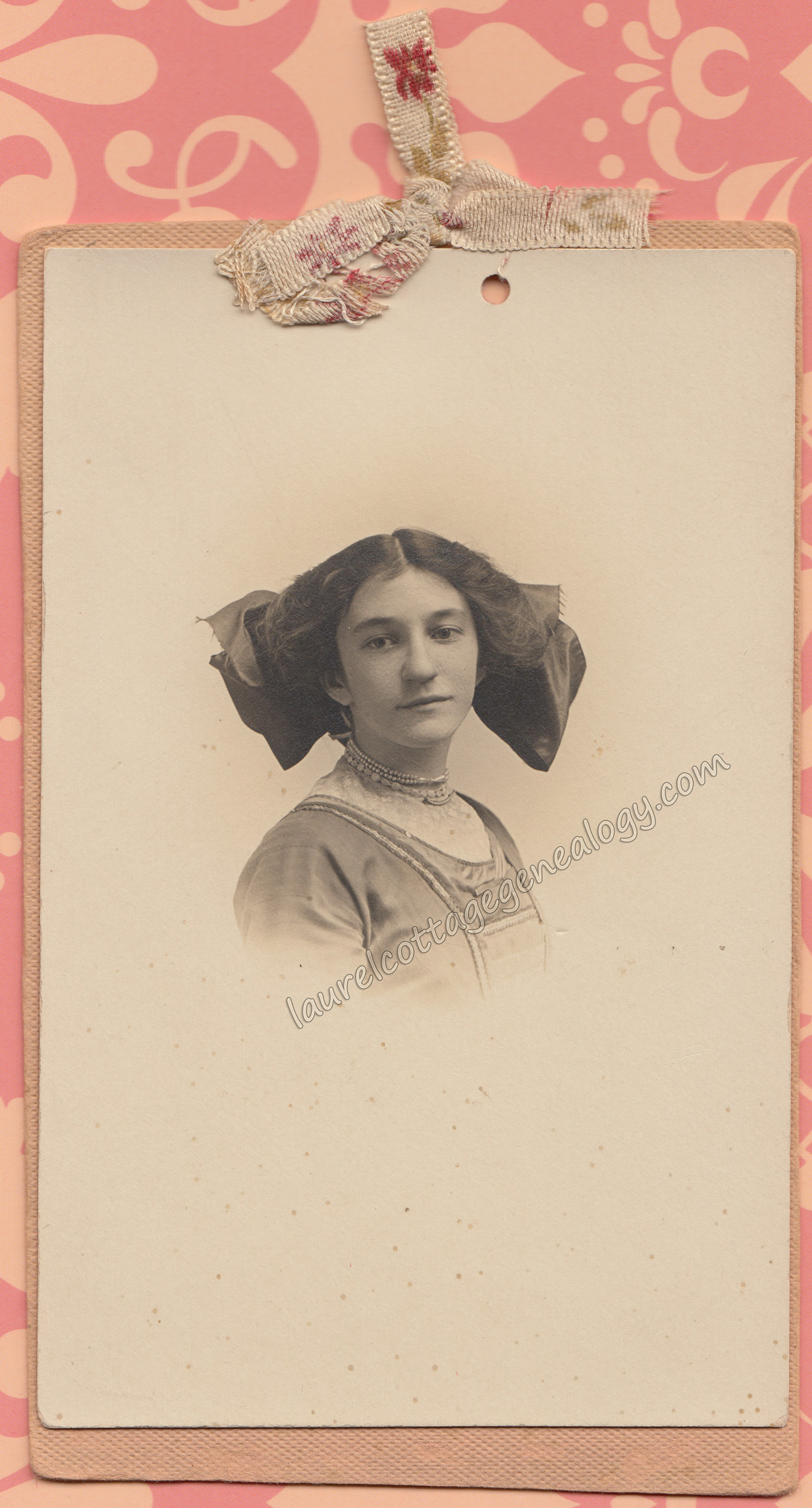
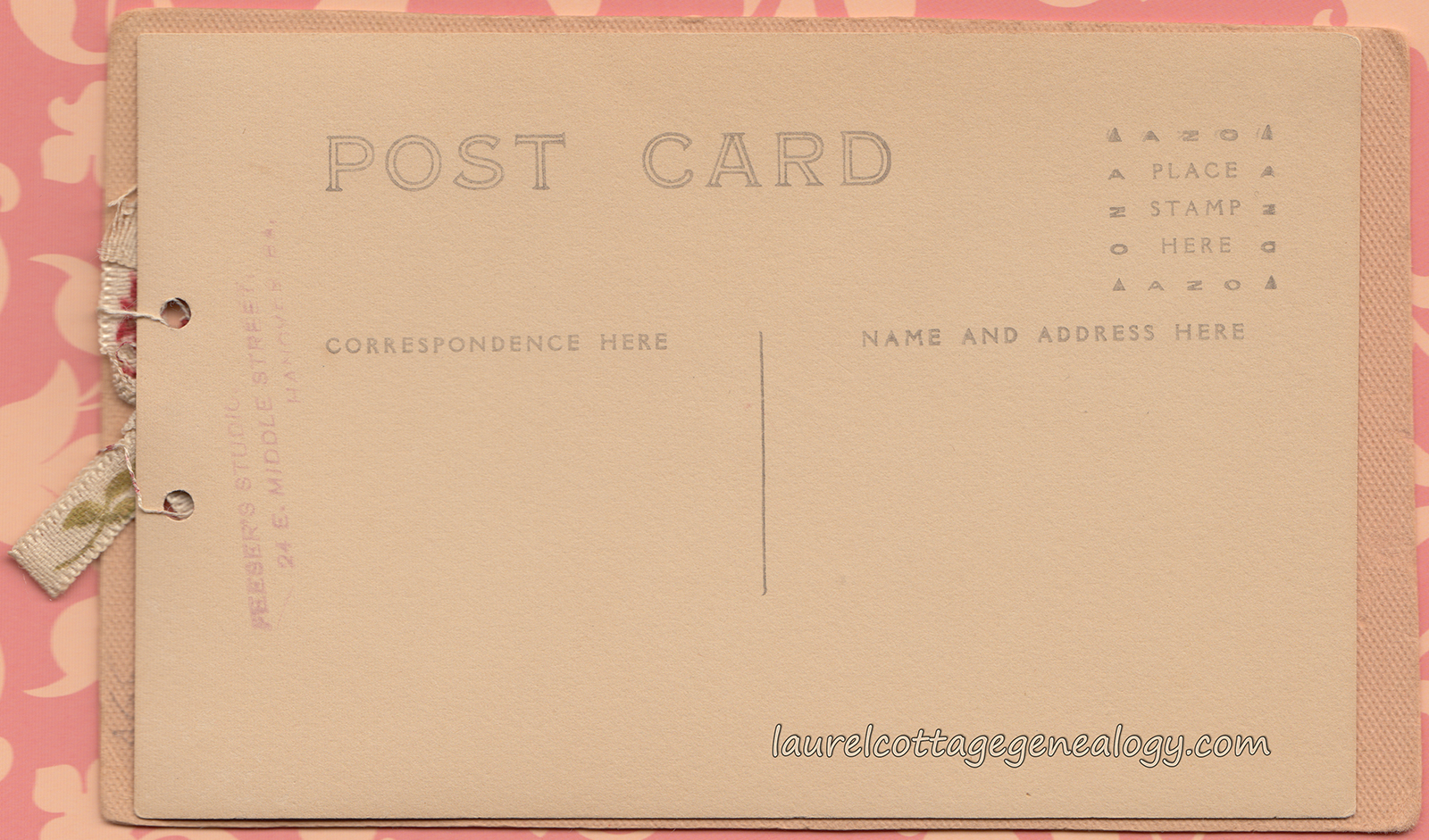
Divided back, Real Photo Postcard, unused, circa 1907 – 1909. Feeser’s Studio, 24 E. Middle Street, Hanover, PA.

Price:  $15.00

See John G. Feeser, Photographer.

Beautiful young girl wearing very large hair bow. Her gorgeous dress is decorated with what looks like brocaded or velvet (or both) ribbons, with an insert of satin at the top of the scoop neck, and lace from the satin up to the neckline. You can see that the lace is topped with it’s own decorative border, which at first glance appears to be a necklace. Upon closer scrutiny we see that she wears just one necklace:  a double strand, choker-style pearl or faux pearl, that is centered with a small bow design. The finishing touch to this (can we say slightly Bohemian?) look, is a slim, crescent-shaped pearl type pin. (Not that the neckline was unconventional but it has a little bit of a gypsy look to it, with the double strand, the lace and the pin.) All in all, a stunning fashion choice and an excellent photo. This postcard is unusual in that it is presented with a separate card-type backing; both portions being held together loosely at the top, by a flowered, and by this time frayed, ribbon.

The back of this Real Photo Postcard shows the AZO stamp box with four triangles up (approximate date 1904 -1918), and something that we do not usually see, but are most happy to have included:  the photographer’s stamp. The stamp shows “Feeser’s Studio, 24 E. Middle Street, Hanover, PA.” We then find an entry in the 1898 York City and County directory (Hanover section) for a John G. Feeser, photographer, business address at 24 Middle St., residence at 26 Middle St. (Eureka!) So, it’s likely that this photo is the work of John G. Feeser. (Of course, it could have been taken by an assistant.) Additionally, a Google search for the address brings up an approximate street location showing a photo of a present-day business:  Poist Studio and Frame Shoppe, located at 20 E. Middle Street. Their website indicates they’ve been in business since 1883.

More research under a separate post will be put up under the Photographer heading of this website, but just to narrow down the date of this RPPC the 1900 Federal Census shows John Feeser and family, his occupation photographer, but the 1910 shows he is working as a “retail merchant.” So, this info, along with the AZO stamp box, plus the fact that it’s a divided back, dates the postcard at about 1907 – 1909.

Sources:  York, PA City and County Directory, including Hanover for 1898. Ancestry.com. U.S. City Directories, 1821-1989 [database on-line]. Provo, UT, USA: Ancestry.com Operations, Inc., 2011.

http://www.poiststudio.com/

Year: 1900; Census Place: Hanover Ward 1, York, Pennsylvania; Roll: 1501; Page: 22B; Enumeration District: 0150; FHL microfilm: 1241501. (Ancestry.com)

Year: 1910; Census Place: Hanover Ward 1, York, Pennsylvania; Roll: T624_1433; Page: 4B; Enumeration District: 0058; FHL microfilm: 1375446. (Ancestry.com)

Edward Payson Butler (1834-1923)

Photographer, Edward Payson Butler was born in Clinton, Pennsylvania May 13, 1834, son of Hezekiah Goodwin Butler and Emily White, according to the 1879 genealogy compilation of Benjamin Cleveland and family. All seven U. S. Federal Census records, as well as one of two online California voter records indicate the year of birth as 1834, with the 1900 census showing the month as May. The 1850 census, taken in Dyberry, Wayne Co., Connecticut, shows Edward P. Butler, age 16, with parents Hezekiah Butler, born about 1800 in Connecticut and Amelia W., (Emily) born about 1801, also in CT (the middle initial W possibly standing for her maiden name of White) and sister, Mary E. Butler, born PA about 1836. This census shows the father’s occupation as Shoemaker.

A quick rundown of the rest of the census records for Edward and a couple of voter registrations are as follows:  1860 census, San Francisco, E. P. Butler, renting a furnished room, occupation “fruitirer”; 1867 California voter reg., Santa Cruz, photographer; 1870 census, Santa Cruz, Edward P. Butler, photographer, staying with other renters; 1871 California voter reg., Santa Cruz, photographer; 1880 census, San Rafael, CA, Edward P. Butler, photographer, living with him is partner Francis A. Cook, photographer, born NY about 1833; 1900 census, Reno, NV, Edward P. Butler, photographer, listed here as married for 34 years; 1910 census, Hamilton Township, Butte Co., CA, Edward P. Butler, widowed, staying at the Odd Fellows Home (I.O.O.F.); 1920 census, Saratoga Township, Santa Clara Co., CA, Edward P. Butler, widowed, staying at the Odd Fellows Home. This last Odd Fellows residence (a beautiful Spanish-style building) still exists today, operating under the name of Saratoga Retirement Community, and is still owned by the Odd Fellows (but membership is not required.)

According to the above-mentioned Cleveland Family genealogy compilation, Edward was married to Mary Jane Harvey in 1856 and they had two children, Ira G. and Edward P., who sadly died very young:

Edward Payson, b. in Clinton, Pa., May 13, 1834, m. in 
Princeton, Ill., Aug. 13, 1856, Mary Jane Harvey, dau. of 
Daniel Harvey, Esq. Children, all b. in Illinois : 1. Ira 
Goodwin, b. June 28, 1857; d. Aug. 27, 1858. 2. Edward 
Payson, b. Nov. 20, 1858; d. June 12, 1860. Divorced 
from wife Mary Jane, and resides in Santa Cruz, Cal. 
Photographer.

The marriage year of 1856 listed above is ten years off from what is stated on the 1900 census. If the 1856 date is correct, then the year could either have been mistakenly given or mistakenly recorded at the time of the census. However, there is further information in an online source for a marriage of E. P. Butler and Mary J. Harvey, May 13, 1885; both are listed as Reno residents. So, it would seem that Edward and Mary Jane divorced and later re-married. Mary Jane does not appear on any of the census records, and must have died after the 1900 census, but before the 1910.

As to Edward’s professional life, much as already been recorded, and can be found in the book entitled Pioneer Photographers of the Far West: A Biographical Dictionary, 1840 – 1865, by Peter E. Palmquist and Thomas R. Kailbourn. This same info plus additional detailed information can be found in an MAH (Museum of Art and History, Santa Cruz) blog posted by Stanley D. Stevens, dated May 12, 2007. The following is a professional timeline for Edward P. Butler, gleaned mostly from the research of the above authors but with a little new information added in here, regarding San Rafael, the date Edward was in Reno, and the mysterious “Paige” partner:

1862 – 1863 Petaluma, CA Ambrotypist, photographer. Advertisement stressed expertise in photographing small children, and detailed price list of photos in casing types including, Turtle Shell, Jewel, Jenny Lind, Union, Papier Maché. 1864 Watsonville, CA May 28, 1864 announcement for new photographic gallery, located opposite Mr. Dorrance’s Harness Shop. Butler’s ad stated there was “no humbug about this gallery” as he used only the best materials, and promised “perfect satisfaction guaranteed, or no pay.” By August 13, 1864, partner “with a person known only as Paige” (possibly Gaige, see below.) November 1864, tax permit purchased to operate a traveling photographic business. 1865 – 1879 Santa Cruz, CA September 8, 1868 ad for new gallery located on second floor at corner of Pacific Ave. and Locust St. 1880 – 1883? San Rafael, CA Partner Francis A. Cook. 1883 – 1885 Virginia City, NV Owns Nevada Art Gallery in partnership with G. Waterhouse. 1885 – 1900 Reno, NV Reno Art Gallery owner by at least 1886. 1910 Hamilton Township, Butte Co., CA Probably retired, living at the first of two Odd Fellows homes, no occupation listed.

Searches for the photographer listed as Butler’s partner in August of 1864, and known only as Paige, come up empty. However, there appear to be likely two possibilities under Gaige. Authors Palmquist and Kailbourn, referenced above, list entries for A. G. Gaige, George A. Gaige, and J. G. Gaige, all active in Arizona and New Mexico. It’s likely that of these three Gaiges, two of them are the same person. It is very common in census records, for instance, for the first and middle initials to be reversed, and people often went by their middle names. And there is the additional possibility that J. G. Gaige was incorrectly heard and reported as A. G. Gaige. Author Jeremy Rowe (Photographers in Arizona 1850-1920, A History & Directory) cites photographer J. C. Gaige, who was active in New Mexico and Arizona, but this person would be the same as J. G. Gaige (both Rowe and Palmquist and Kailbourn state he died at Camp Goodwin, AZ  July, 1869.) Rowe lists photographer Francis A. Cook in the paragraph just prior to his J. C. Gaige reference, Cook being well-documented in early Arizona photography, and a known partner to Butler per the 1880 Federal Census taken in San Rafael, CA.  So, not finding any references to Paige, knowing that typos occurred in newspapers, and with the fact that many of these photographers, as we can see, moved around quite a bit, sometimes working as “traveling photographers,” therefor having occasion to know each other first-hand or at least to have known of each other, it’s possible then that Edward Payson Butler partnered with either of the Gaige photographers for a very short time.

Edward Payson Butler died in 1923, age about 89. A photo of his gravestone can be found online at Findagrave. He was buried in the I.O.O.F. Cemetery, Saratoga, Santa Clara County, CA.

Sources:  Various census records. Year: 1860; Census Place: San Francisco District 5, San Francisco, California; Roll: M653_67; Page: 476; Image: 476; Family History Library Film: 803067. Year: 1870; Census Place: Santa Cruz, Santa Cruz, California; Roll: M593_89; Page: 419A; Image: 165; Family History Library Film: 545588. Year: 1880; Census Place: San Rafael, Marin, California; Roll: 68; Family History Film: 1254068; Page: 106A; Enumeration District: 235; Image: 0215. Year: 1900; Census Place: Reno, Washoe, Nevada; Roll: 943; Page: 12A; Enumeration District: 0041; FHL microfilm: 1240943. Year: 1910; Census Place: Hamilton, Butte, California; Roll: T624_73; Page: 8A; Enumeration District: 0010; FHL microfilm: 1374086. Year: 1920; Census Place: Saratoga, Santa Clara, California; Roll: T625_146; Page: 1B; Enumeration District: 212; Image: 1067. (Ancestry.com)

Voter Registrations for 1867 and 1871:  California State Library, California History Section; Great Registers, 1866-1898; Collection Number: 4 – 2A; CSL Roll Number: 127; FHL Roll Number: 978581. (Ancestry.com)

Godfrey Memorial Library, comp. American Genealogical-Biographical Index (AGBI) [database on-line]. Provo, UT, USA: Ancestry.com Operations Inc, 1999. Original data: Godfrey Memorial Library. American Genealogical-Biographical Index. Middletown, CT, USA: Godfrey Memorial Library. (Benjamin Cleveland genealogy record)

Web: Western States Marriage Index, 1809-2011 [database on-line]. Provo, UT, USA: Ancestry.com Operations, Inc., 2011. Original data: Western States Marriage Index. Brigham Young University–Idaho. http://abish.byui.edu/specialCollections/westernStates/search.cfm.

http://researchforum.santacruzmah.org/viewtopic.php?t=52

http://sanjoserealestatelosgatoshomes.com/

Palmquist, Peter E.; Kailbourn, Thomas R. Pioneer Photographers of the Far West: A Biographical Dictionary, 1840 – 1865; Stanford University Press: Stanford, CA, 2000; pp 255-256. (Google eBooks)

Rowe, Jeremy. Photographers in Arizona 1850-1920, A History & Directory; Carl Mautz Publishing: Nevada City, CA, 1997; pp 7, 85.

Find A Grave memorial # 33093840 (www.findagrave.com)

Howdy Greeting Card

Howdy

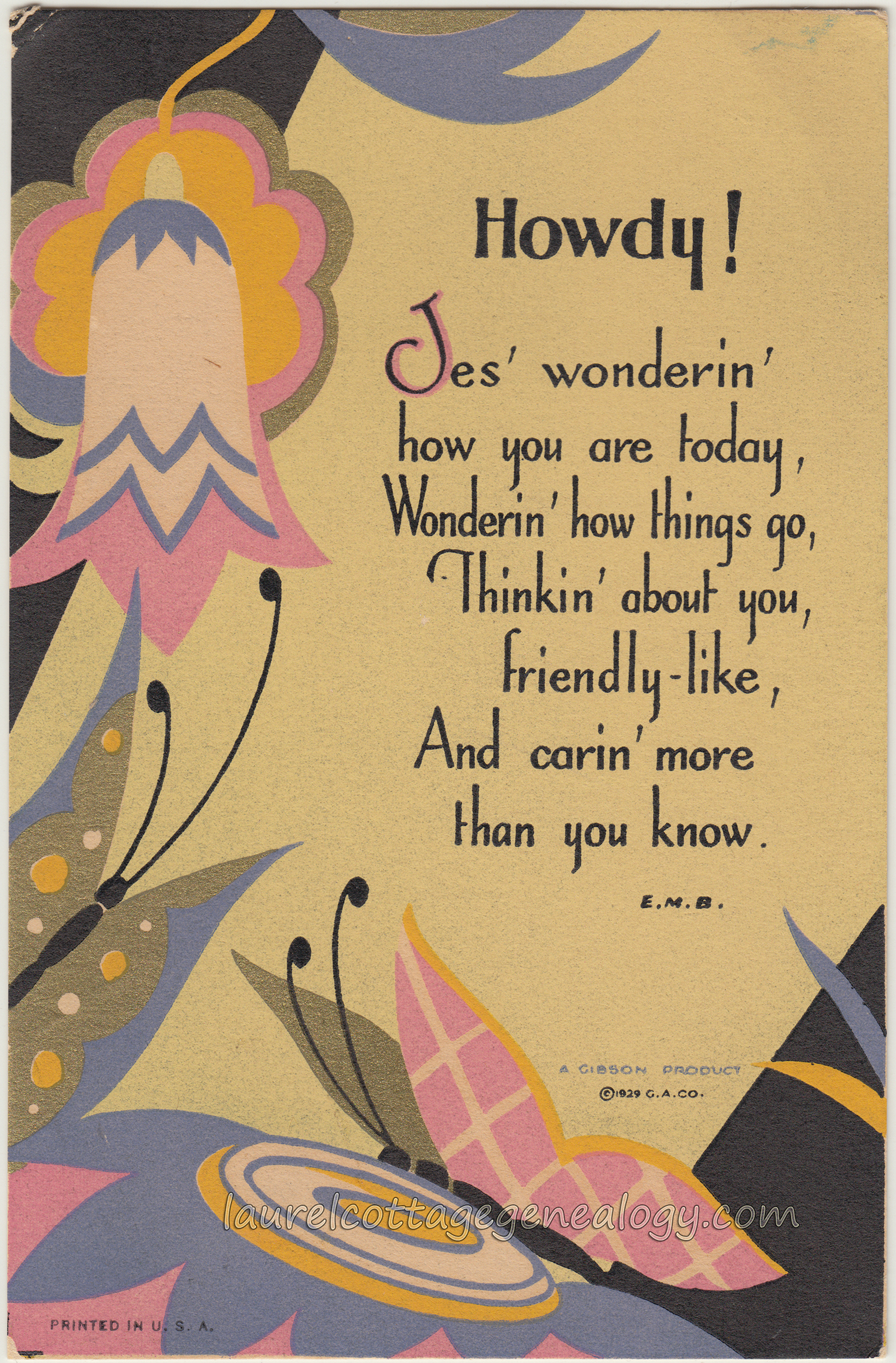
       “Howdy!

   Jes’  wonderin’

   how you are today,

   Wonderin’  how things go,

   Thinkin’  about you,

   friendly like,

   And carin’  more

   than you know.”

Cool, Art Deco style, greeting card of butterflies and flowers in pink, blue, black and gold tones, with metallic-type gold highlights of the type that stand out when you tilt the card toward the light. The background is a dark cream color. This is a beauty of a card.

Produced by the Gibson Art Company, 1929. Verse by E. M. B. Made in the U. S. A.

Size:  About 5 and 3/4 x 3 and 3/4″