Genealogy Services, Old Photos, Postcards, Trade Cards, Etc.

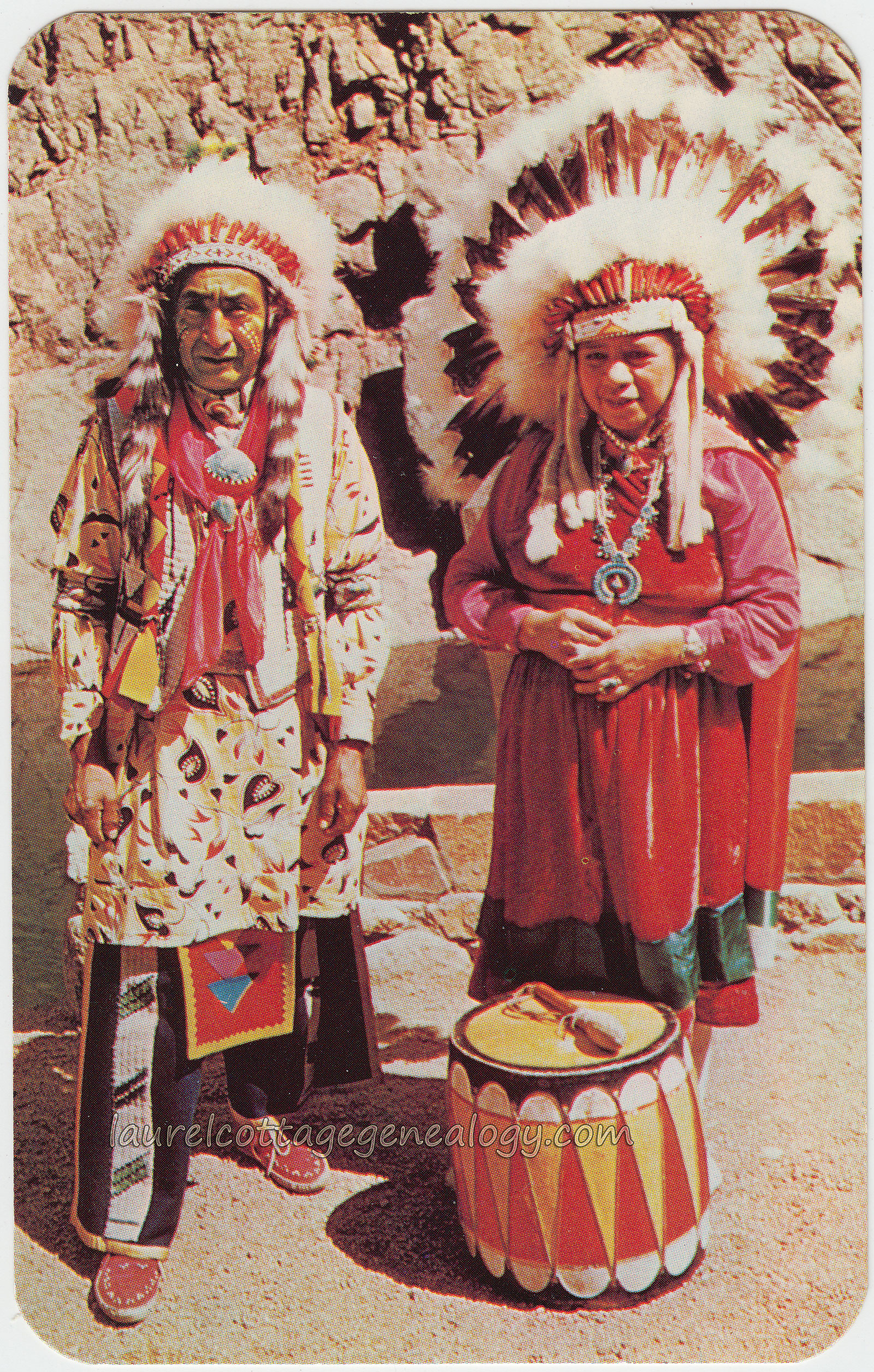
Chief Caping And Jaro

Chief Caping And Jaro pc1Chief Caping And Jaro pc2

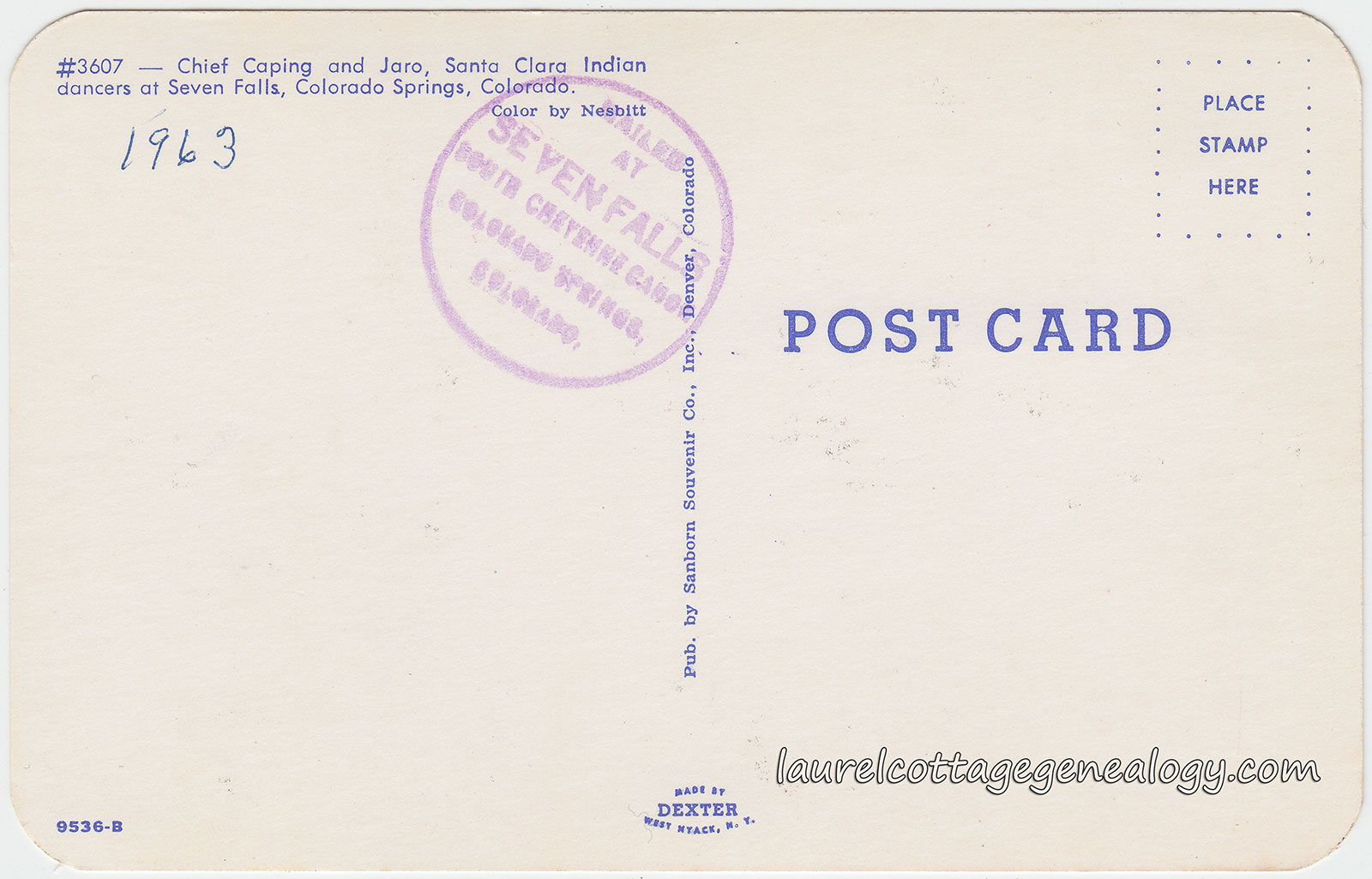
Divided back, unused postcard. Publisher:  Sanborn Souvenir Co., Inc., Denver, Colorado. Color by Nesbitt. Printed by, West Nyack, New York. Series 9536-B, Number 3607. Circa 1963.

Price:  $8.00

There is a black and white 1947 postcard online at Princeton University which shows this couple:  Chief Caping and wife Jorro (different spelling) posing next to the sign for the Cliff Dwellings Museum. The sign indicates the museum was founded in 1904. The writing on the back of this one gives the date the postcard was purchased as 1963, and the postcard was stamped, probably by the souvenir shop, in the anticipation that it would be mailed. The stamp says:  “Mailed At Seven Falls, South Cheyenne Cañon. Colorado Springs, Colorado.”

The caption on the back states  “#3607 – Chief Caping and Jaro, Santa Clara Indian dancers at Seven Falls, Colorado Springs, Colorado.”

Source:  Princeton University Digital Library. Western Americana Collection. Chief Caping and Wife, Jorro, Pueblo Indians. Web. 15 June 2014 [http://pudl.princeton.edu]/sheetreader.php?obj=r207tp696

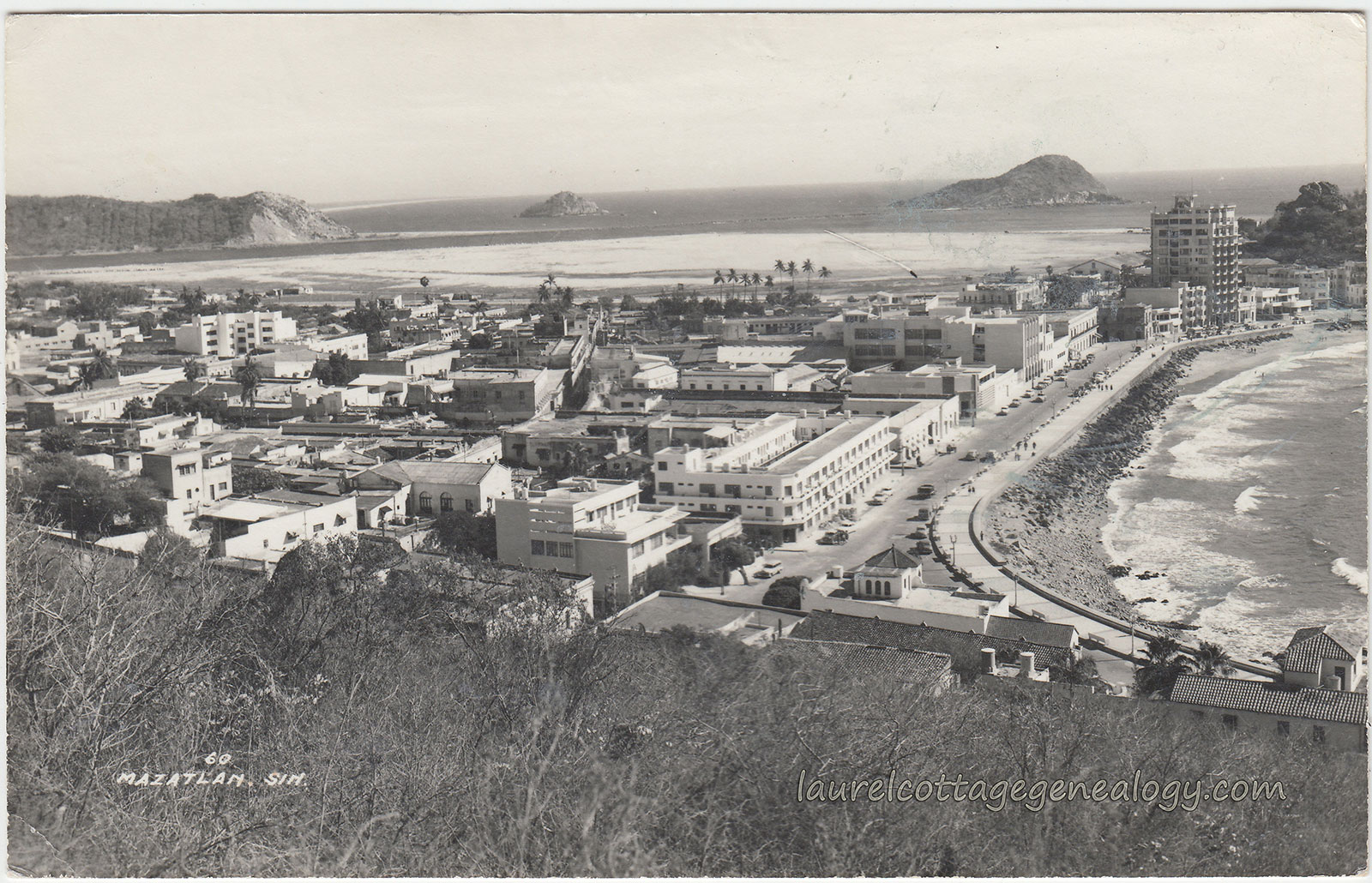
Mazatlán 1958

Mazatlan 1958 pc1Mazatlan 1958 pc2

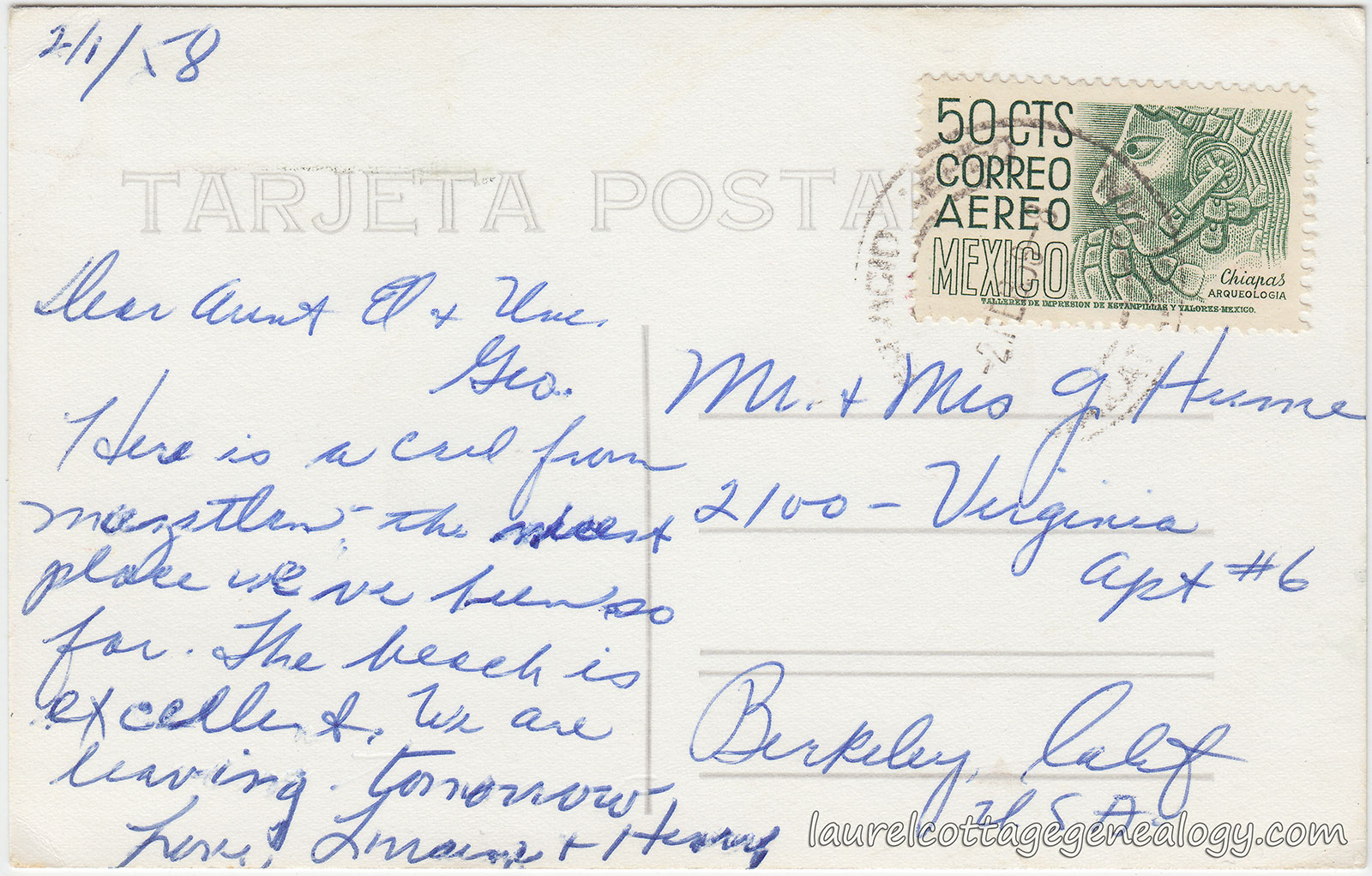
Divided back, used postcard. Publisher unknown. Number or series 60. Postmarked in Mazatlán, Sinaloa, Mexico on February 2, 1958.

Price:  $15.00

“2/1/58.   Dear Aunt El & Unc. Geo.   Here is a card from Mazatlan, the nicest place we’ve been so far. The beach is excellent. We are leaving tomorrow. Love, Lorraine[?] & Henry[?]”

Card addressed to  “Mr. & Mrs. G. Hume, 2100- Virginia, apt #6, Berkeley Calif. U.S.A.”

A few brief facts:  Mazatlán is the second-largest city in the Mexican state of Sinaloa, and situated on the Pacific coast.  The city’s name is a Nahuatl word meaning “place of deer.” The larger hill rising up out of the ocean, on the right, is Cerro Crestón, atop which is El Faro Mazatlán, the highest lighthouse in the world at about 500 feet above sea level. Cerro Crestón today is described as part of the city, but is stated to have been an island before a connecting land mass was built to it. (Another account I read was not sure if this was correct.) Hmm, it appears to be an island in this photo. The city was founded in 1531 by an army of Spaniards and by indigenous settlers. German immigrants helped develop it in the mid-1800s into a thriving seaport; Banda, a brass instrument based form of traditional Mexican music came about through the Bavarian folk music influence, and another tie to Germany is that the brand of beer Pacífico, was started by three Germans in around 1900. It’s still brewed there today (but also in Mexico City) and you can take a tour of the plant. Mazatlán is a popular tourist spot and well-known for it’s beaches and cliff divers. (The only trouble with researching destinations is that it always makes you want to jump on a plane and go. Why not?)

Sources:  Mazatlán. n.d. http://en.wikipedia.org/wiki/Mazatl%C3%A1n (accessed February 14, 2024).

Pacific (beer). https://en.wikipedia.org/wiki/Pac%C3%ADfico_(beer) (accessed February 14, 2024).

El Faro Lightlouse in Mazatlán. http://www.mazatlantoday.net/el_faro_lighthouse_mazatlan.html (accessed February 14, 2024).

Emma, Lionel And Marie

Emma Lionel And Marie pc1Emma Lionel And Marie pc2

Real Photo Postcard. Divided back. Unused with writing. AZO stamp box. Circa 1907 – 1918.

Price:  $12.00

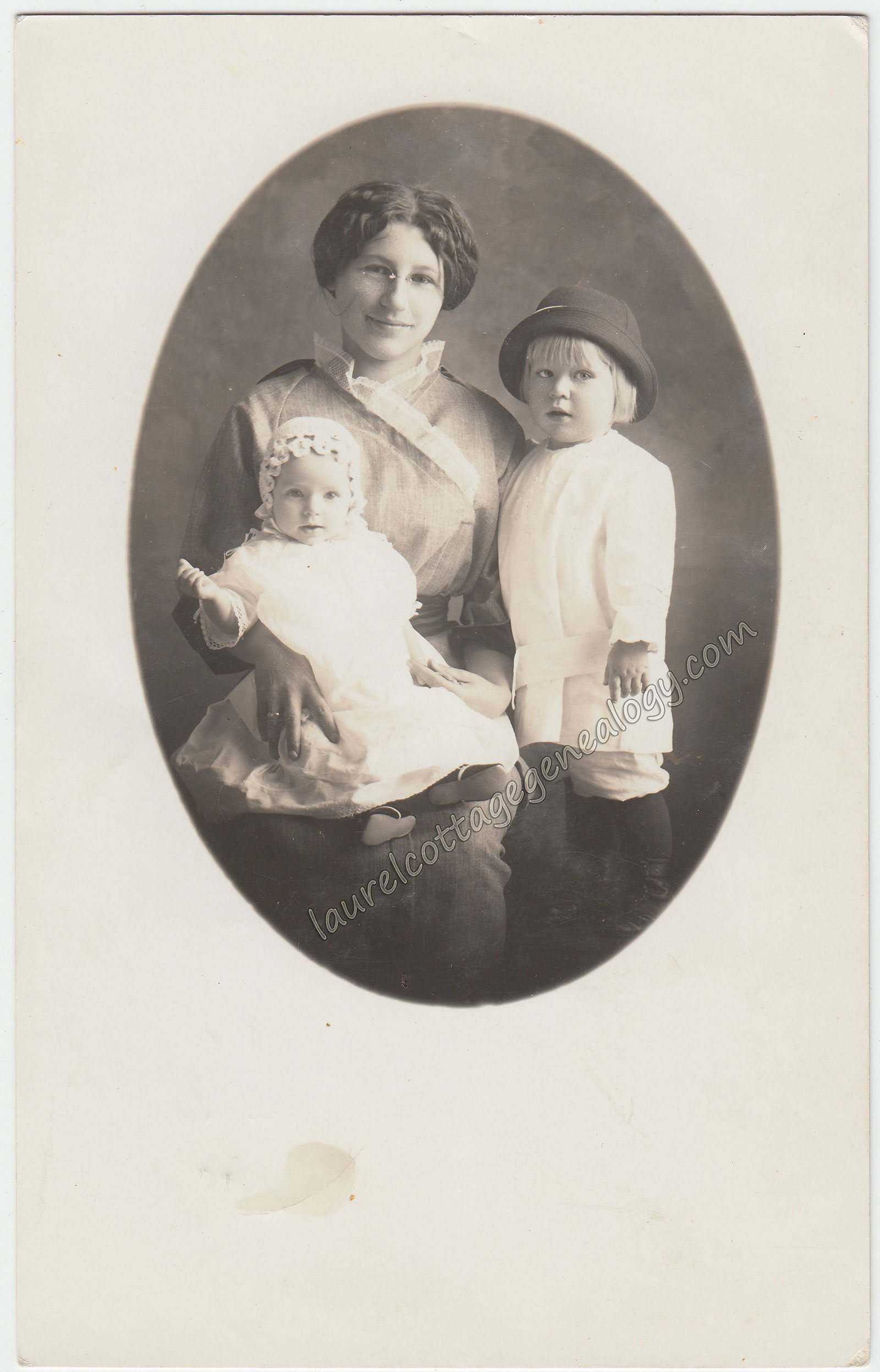
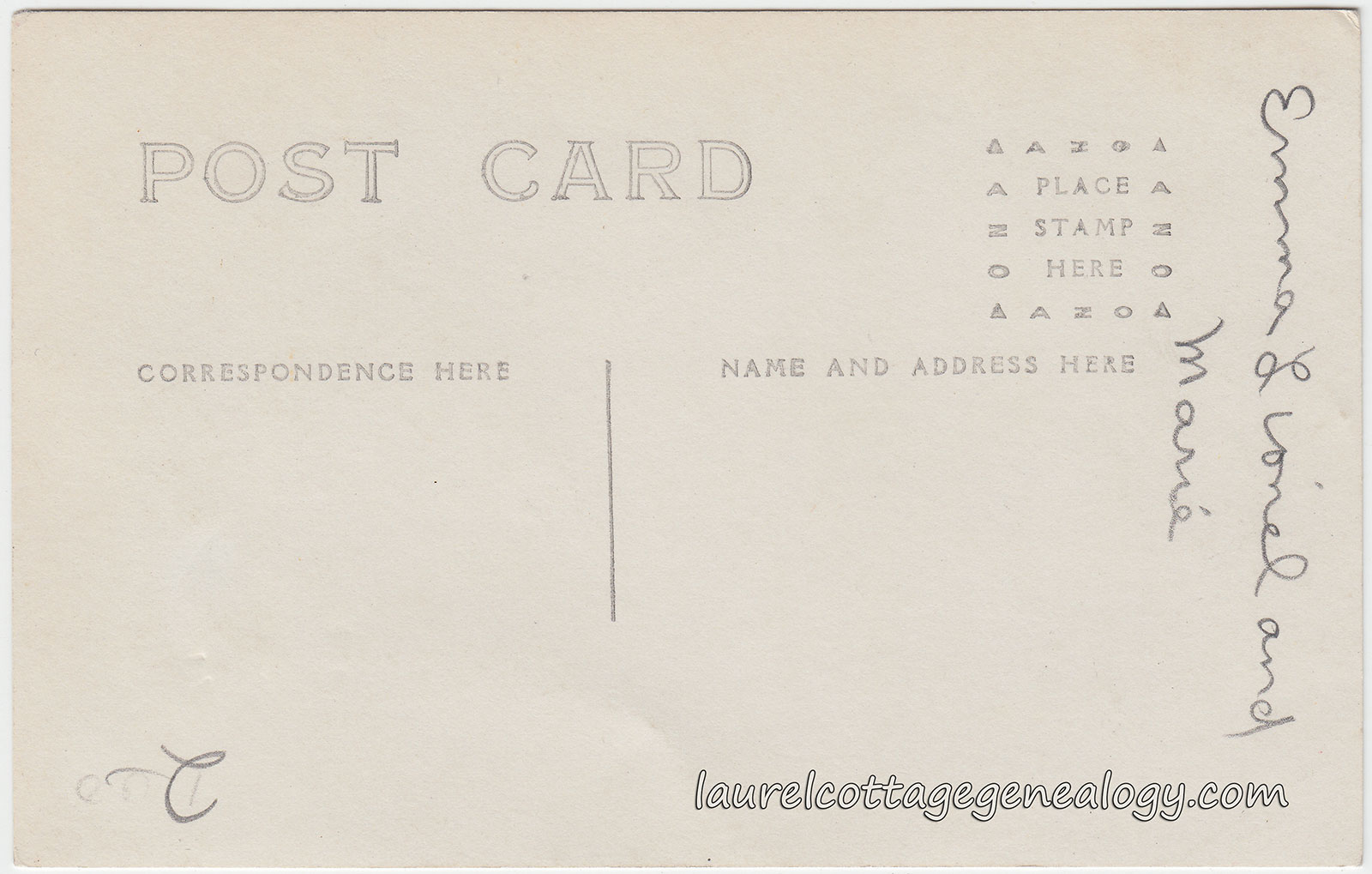
Real Photo Postcard showing a wonderful oval studio portrait of Emma, and her two children: toddler Lionel, and baby Marie. Although the back of the photo does not specify that the mother is Emma, I think we can presume that whoever wrote it would put the mom’s name first. I did some searching through the 1910 and 1920 U. S. census records but was not lucky enough to find any possible fit (what a time-consuming endeavor it would be to do a thorough search) but perhaps the photo will be recognized by a family member…..The stamp box is an AZO with four triangles pointing upward, so circa 1904 to 1918, but then with divided back puts it around 1907 – 1918. To pick out the details in these images is always interesting and revealing:  In this one I love how Emma is holding baby Marie’s hand; the look on Marie’s alert little face; Lionel’s blonde, blonde hair; his gazing off-to-the-side expression, and chubby cheeks; the lacework on Marie’s cap and sleeves; the contrast between Lionel’s dark hat, dark stockings and high button boots, with his white (or maybe very pale pastel) tunic and knickers; Emma’s stylish dress with the darker underside to the sleeves to match the darker waistline sash; her stand-up neckline trim of dotted lace and ruffle; and her eyeglasses which appear to be not eyeglasses at all, but a monocle with a pince nez, also called nose piece or nose bridge.

Kids And Donkey Picture Day

Kids And Donkey Picture Day pc1Kids And Donkey Picture Day pc2

Real Photo Postcard. Divided back. Unused with writing. Circa 1907 – 1918.

Price:  $16.00

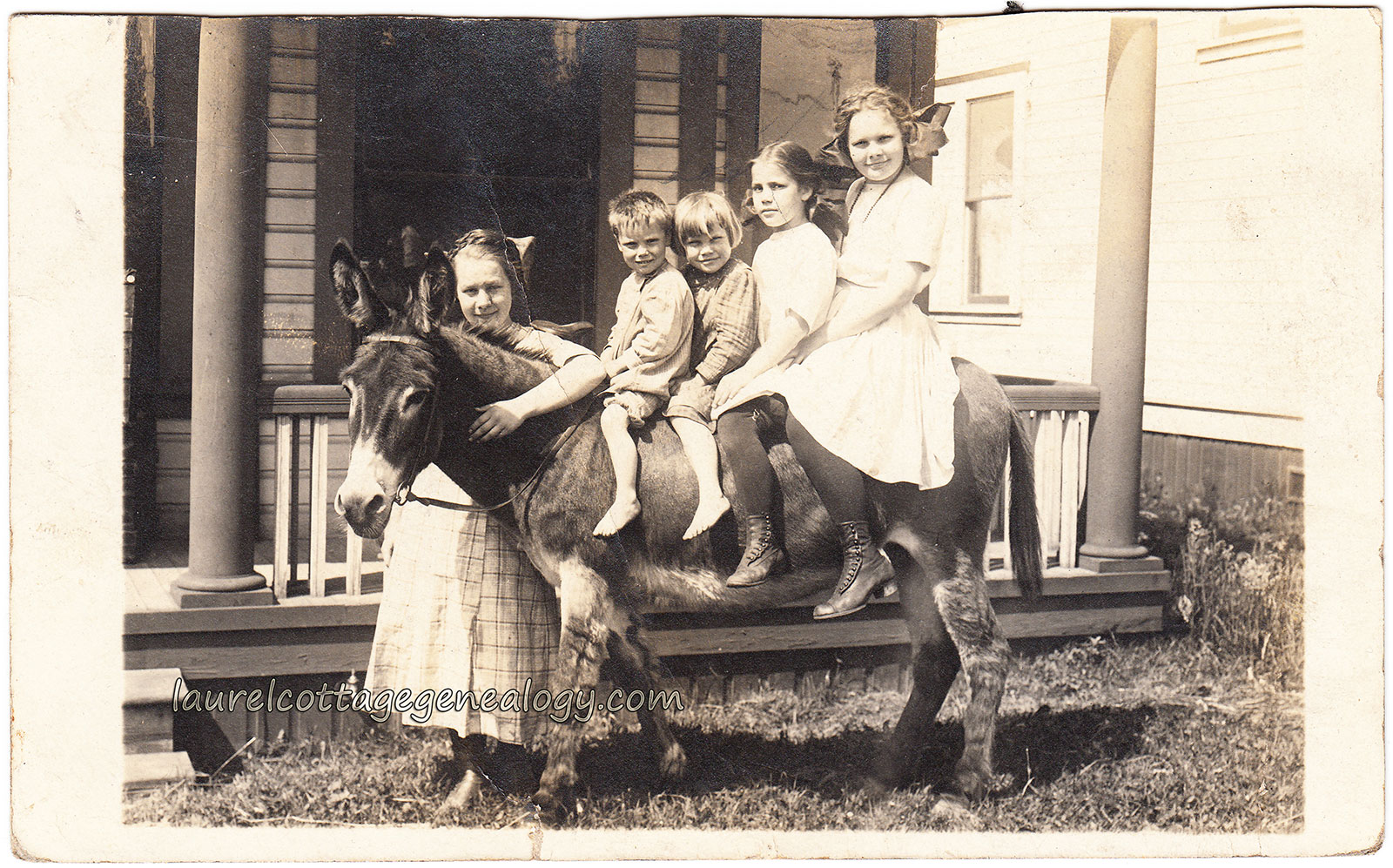
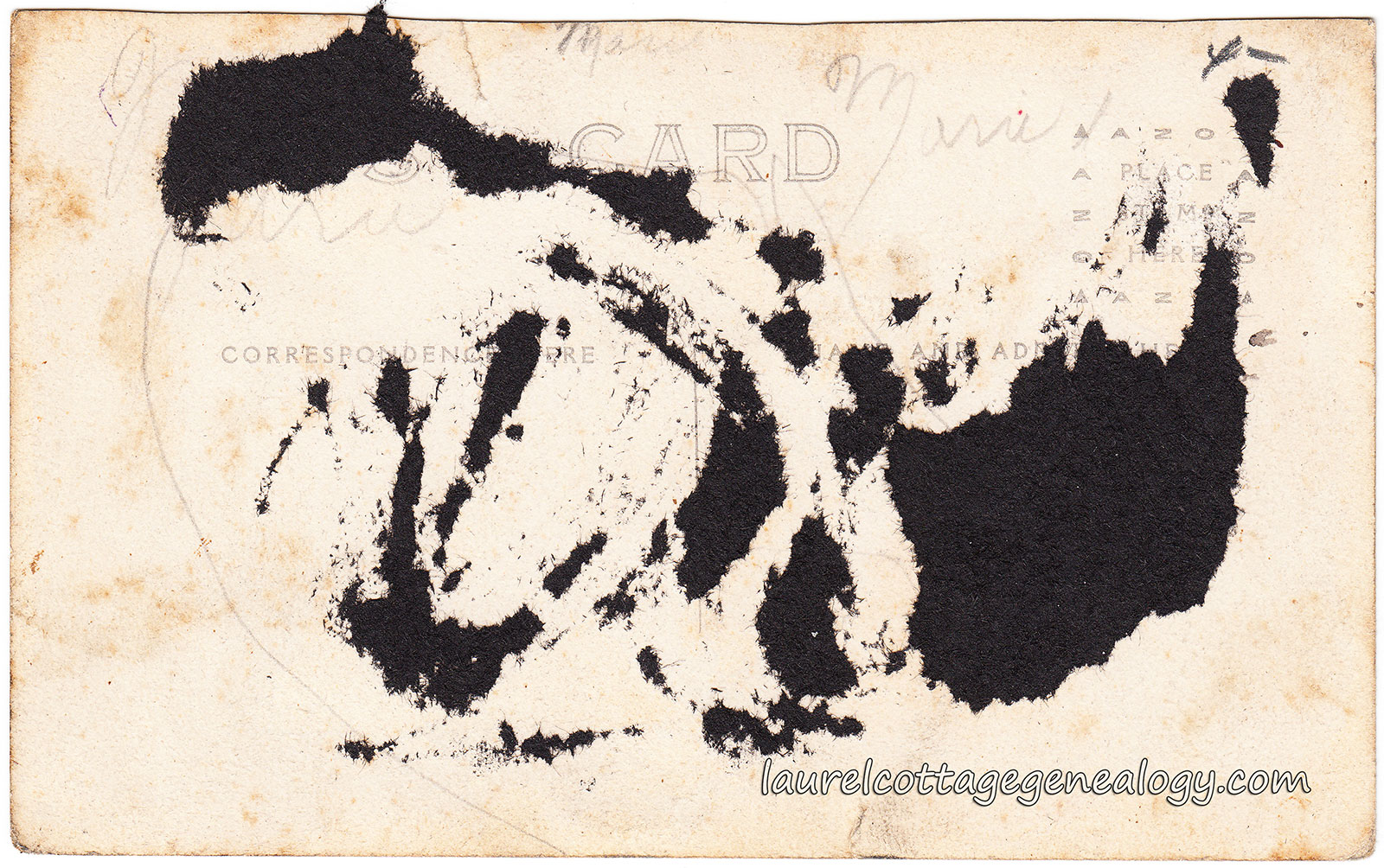
An ever-so charming Real Photo Postcard of five beautiful children, and one beautiful donkey. The four youngest kids are lined up astride the animal and the oldest, a girl, stands with her arm gently draped over the donkey’s neck. That looks like the seat of a bicycle just behind the girl’s arm, so there must have been a bike on the porch. There is some writing on the back of the postcard, along with part of the black photo page that the postcard was glued on. The writing shows the same name written a few times; maybe one of the girls was practicing her penmanship; and the name looks like it could be Maria. The divided back plus AZO stamp box, with all four triangles pointing upward, indicates an approximate date for the postcard of 1907 – 1918.

Into The Envelope

Into The Envelope

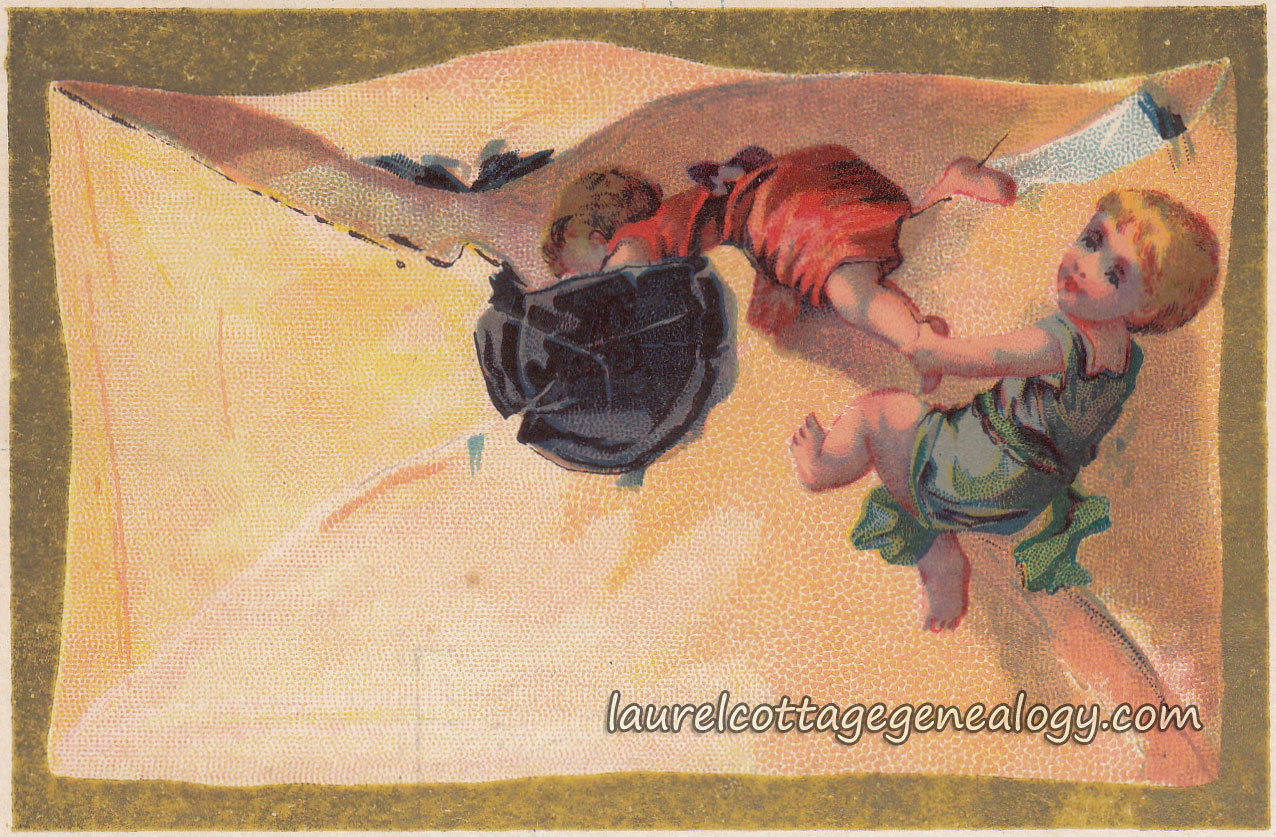
Here’s an antique card, that must of at one time been in someone’s scrapbook, that has a theme along the lines of the prior post. I wanted to put this one up next for the sort of “before and after” effect. Similar examples can be found online of adorable children, cherubs, puppies, hearts, birds, etc. usually appearing as having traveled in the envelope to bring the sender’s good wishes, and sometimes bringing tokens of love or good luck, like the clover in the prior post. In this scene the artist playfully depicts a couple of cherubs:  The one is just about to tumble into the opened envelope, while the other, looking back with a bit of an apologetic smile, tries (unsuccessfully we presume) to stop him. Black seems to be an odd color choice for the wax seal…..But anyway, for sure this will have to be a new sideline for Laurel Cottage – searching for more of these type at card shows and antique stores.

Price:  $12.00  Size:  About 3 x 4 and 1/2″  Circa 1890 – 1910.

A Token Of Love

A Token of Love pc1A Token Of Love pc2

Divided back, embossed, used postcard. Publisher unknown. Postmarked February 13, 1908 from Pueblo, Colorado.

Price:  $10.00

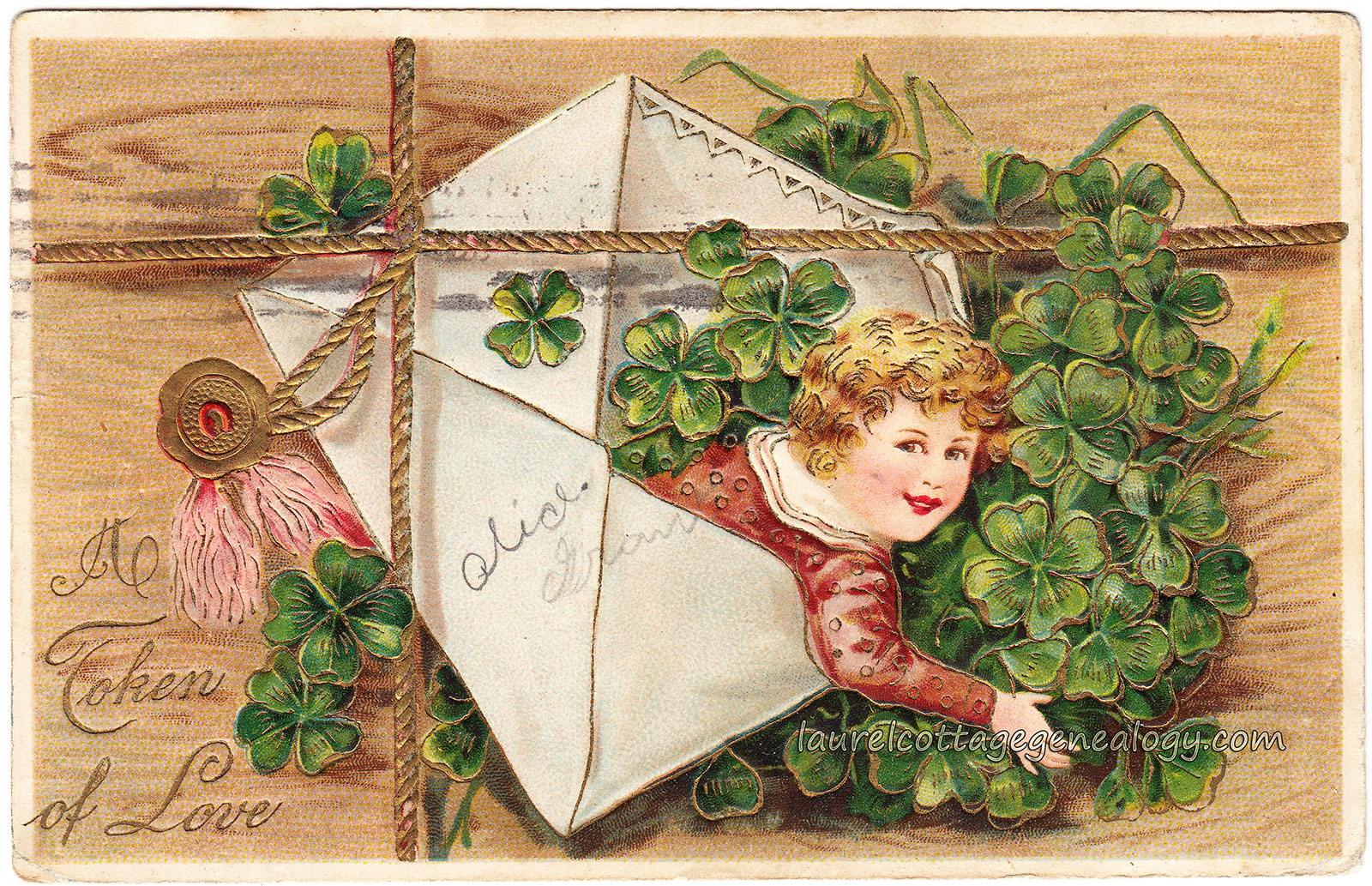
Cute postcard from 1908 showing a happy little guy in an opened envelope who’s brought the receiver a bunch of four-leaf clovers. The artist has depicted a wooden background and the appearance of the whole image being “tied up” with brown string which has a wax seal and a pink tassel. On the seal the artist put a small red horseshoe. At the bottom left are the words  “A Token of Love.”

Addressed to:  “Miss Henrietta Ellison, 26 St. Cheyenne Ave, Pueblo, Colo.”
The sender, Alice, signed her name on the front.

Timber – My Kingdom For A Tree

My Kingdom For A Tree pc1My Kingdom For A Tree pc2

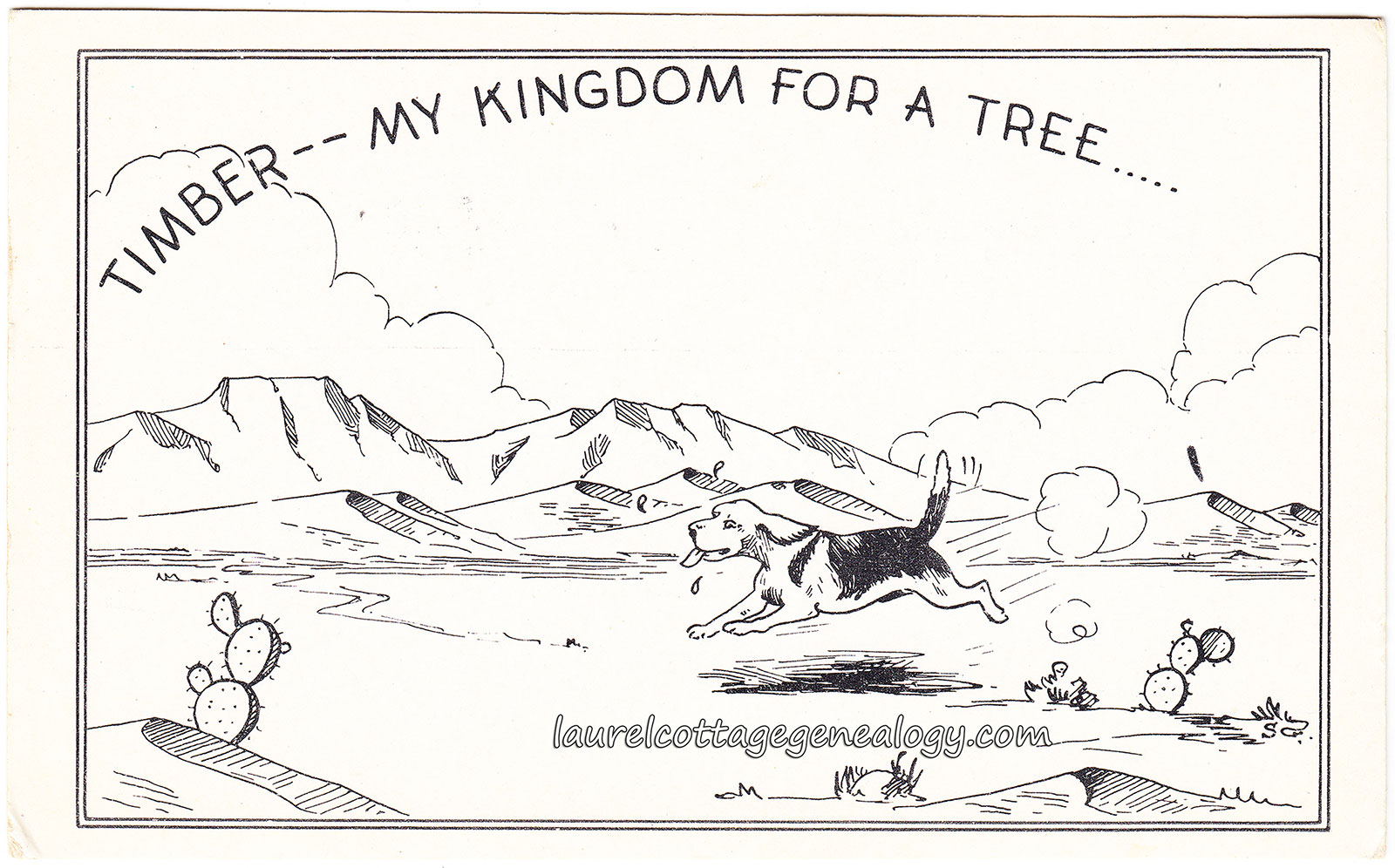
“Timber – – My Kingdom For A Tree…..”

Comical postcard showing black and white drawing of a dog running through the desert, in desperate need of a tree. It looks like that might be the artist’s initials of “S. C.” at the bottom right. Although the back does not show a divider, this postcard seems to more vintage than antique. No duplicates of this card are showing up online, as of the date of this post…The expression “My kingdom for a …” is credited to Shakespeare from his line in Richard III:   “A horse, a horse! My kingdom for a horse!”

Unused postcard. Possibly artist-signed. Circa 1960s.

Price:  $10.00

Source:  http://www.enotes.com/shakespeare-quotes/horse-horse

Mystery Building

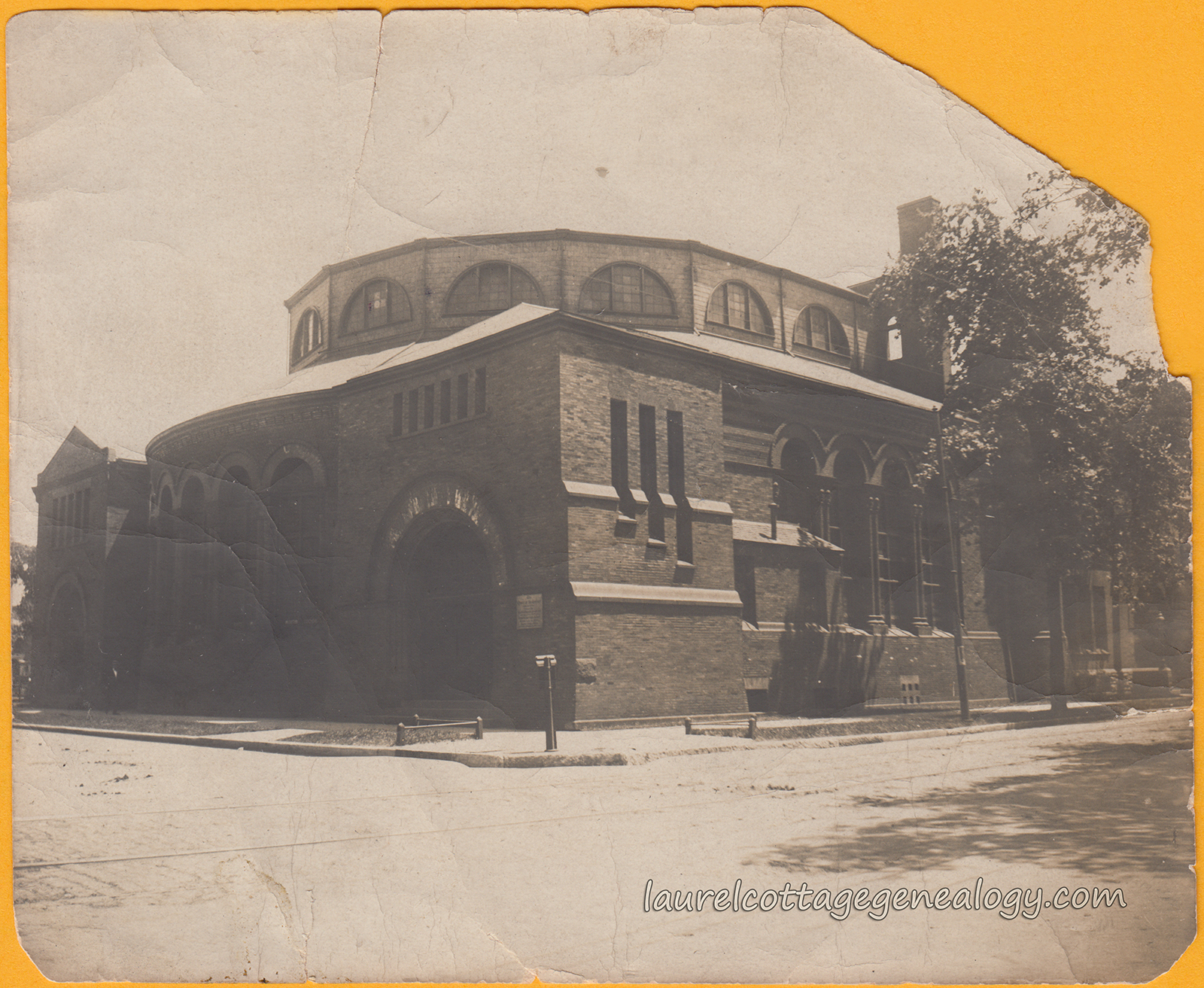
Mystery Church

Old photo of a building that appears to be a church, or perhaps was once a church. If you look closely at the arched windows on the top, you will notice that each window has panes of a different opacity or maybe color to make a cross shape. (One of the windows is open slightly.) There is a plaque that identifies the building but, maddeningly, it is unreadable, although, you can come up with many different possibilities. Up by the part that sticks up like a chimney (but is it?) you’ll see an opening that looks like it once held a bell. Also, you’ll notice that there is a man walking in front of the building:  he wears a dark suit, white shirt and a hat. The brick-paved section of the street shows trolley or streetcar tracks , and the dark spots on the street give an indication that horses might still be in use for transportation. I was puzzled by the thing on the pole at the corner, until my husband informed me that, of course, it’s a mailbox:  The dark part is the box; you can see the two brackets that are holding the box to the pole. The side of the box blends in with the building but there’s a little bit of a shadow under the top of the box, so when you’re looking at it as a mailbox, it makes sense. There were different styles of lamppost mailboxes by different designers; it’s possible that this one might be one of the Doremus boxes or maybe an Owens. According to an online article by Allison Marsh of the National Postal Museum, the four-footed mailbox was first “suggested” in 1894, and took off from there. So, this seems to be a pretty old photo, maybe from the Eastern part of the U. S., estimating late 1800s to just after the turn of the century. Looking at the plaque again – perhaps it’s in another language: German, for instance. Would there have been plaques on buildings in the U. S. in other languages around the turn of the century? That’s another line of research to pursue. Another intriguing detail are the corner guards for the lawn segments. We don’t see these much today, at least not on the West Coast, but I remember seeing them a lot while growing up in Michigan, but of course the style was different. These in this photo look like they might be made from wood.

Antique photo, circa late 1890s – early 1900s. Size:  3 and 3/4 x 4 and 5/8″

Price:  $15.00

Sources and related reading:  Marsh, Allison, “Postal Collection Mailboxes.” National Postal Museum, 20 March 2006. Web. Accessed 10 June 2014. [http://arago.si.edu/index.asp?con=1&cmd=1&tid=2032051]

http://arago.si.edu/index.asp?con=1&cmd=1&tid=2032051

http://www.uvm.edu/landscape/dating/mail_service/doremus_mailbox.php

http://postalmuseumblog.si.edu/postal-service/page/3/

Mae’s Homemade Calling Card

Maes Calling Card cc1Maes Calling Card cc2

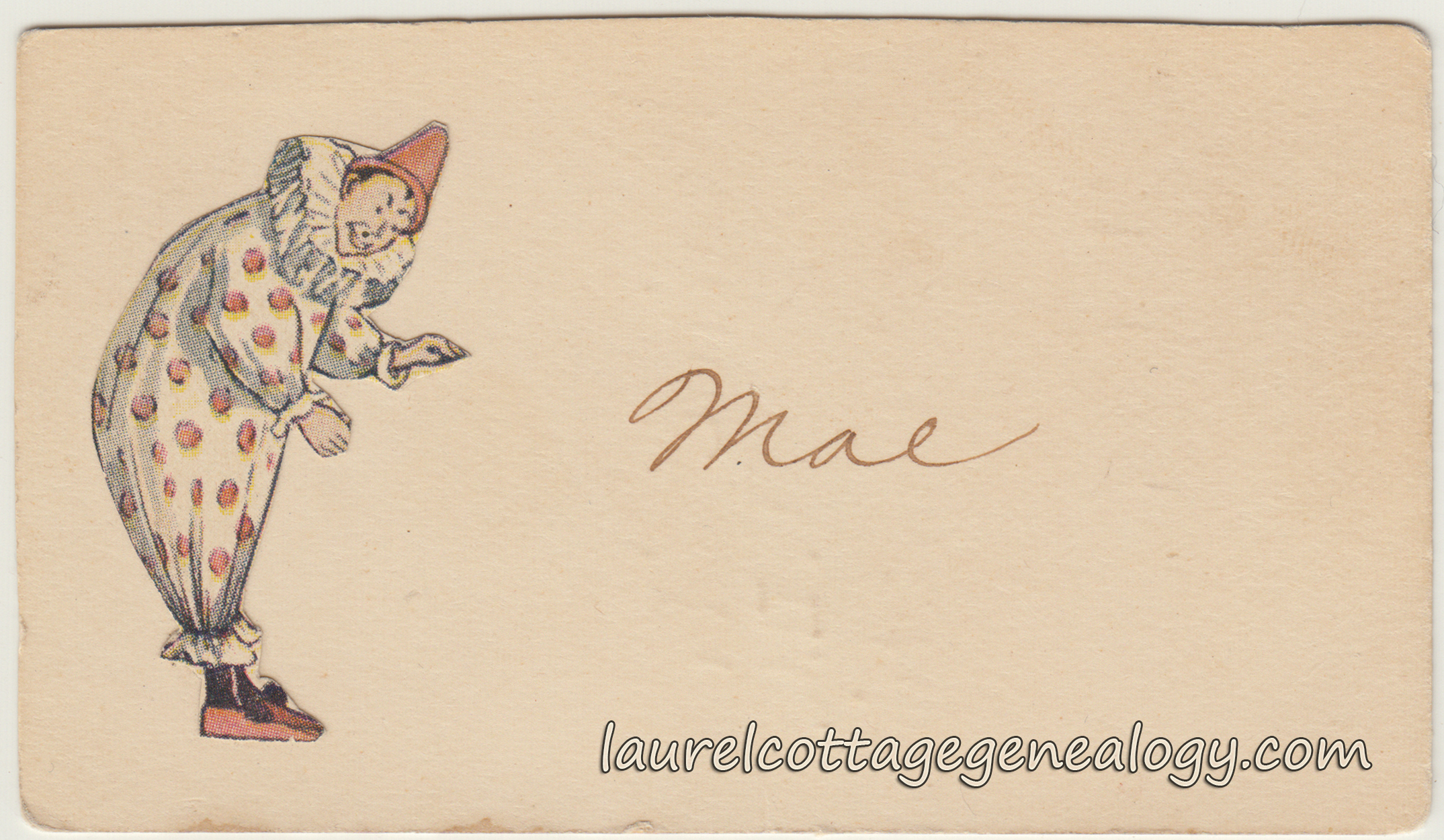
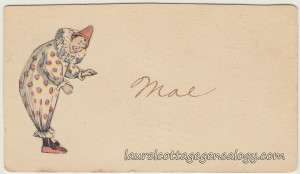
Handmade calling card, July 10, 1917

Price:  $12.00  Size: 2 x 3 and 1/2″

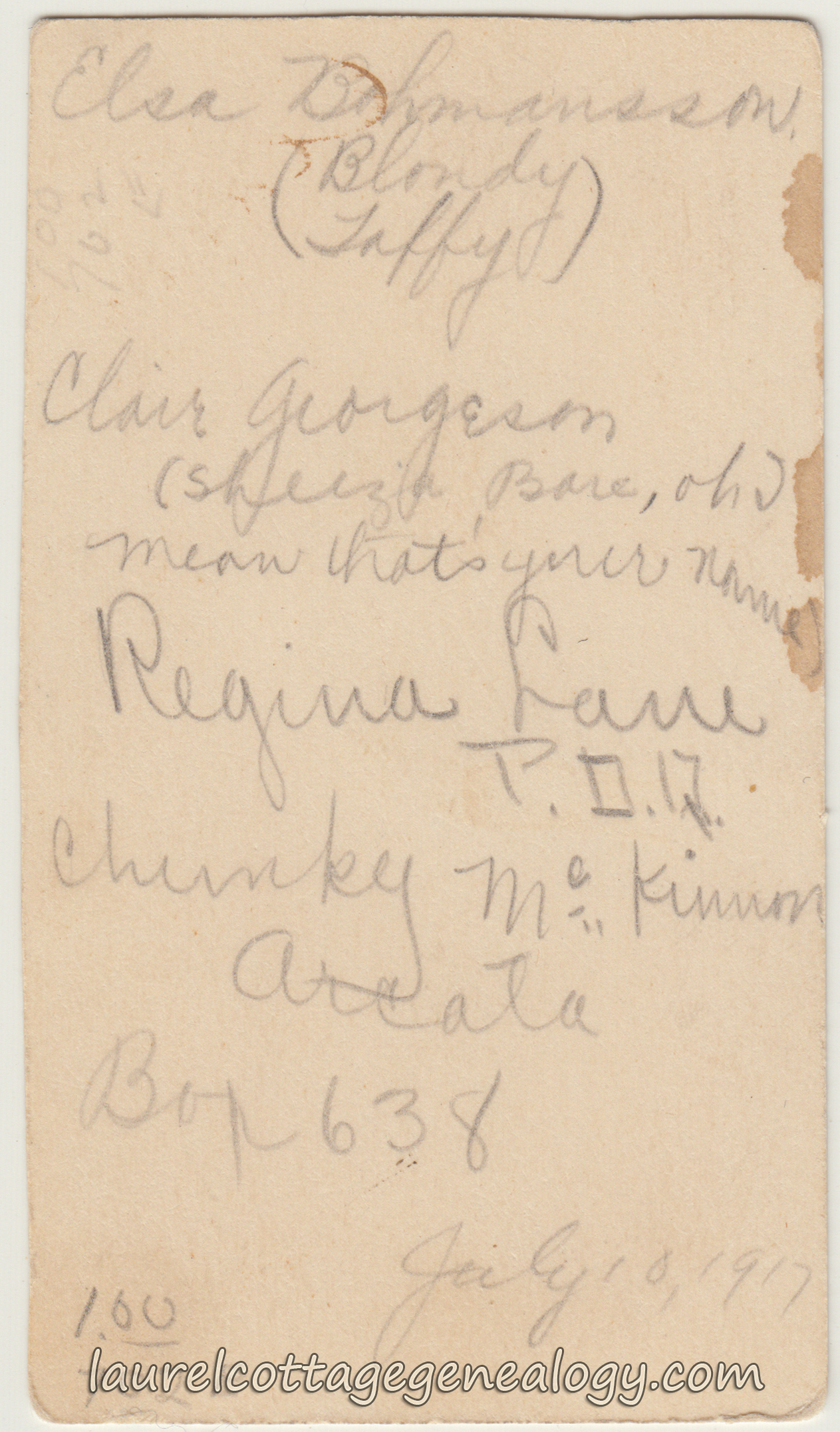
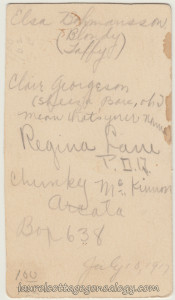
It looks like this very cute calling card might have been hand made by or for Mae. It has the owner’s name written on it with a drawing of a clown in polka dots that was cut out and pasted on, and we can see that the clown was thoughtfully chosen, since his bowing pose with hands extended, perfectly fits for the presentation of the owner’s name. The back is charming and humorous and maybe a little politically incorrect. On the back, in pencil, are written the names and nicknames of Mae’s friends. Elsa Bohmansson was called Blondy or Taffy. After Clair Georgeson, someone (probably Mae) wrote, “(She is a bare, oh I mean that’s your name)”. (Isn’t this always the way, when you are trying to stick to a format and you flub it.) We then have Regina Lane, who was called P.D.Q. and last but not least Chunky McKinnon, with his or her address of Arcata, Box 638. The card is dated at the bottom July 10, 1917. After much research, it was found that in 1917, the ages for the friends were between about 14 and 19.

Elsa Bohmannson is listed in the city directories in Eureka, California and there are two photos of her in the school yearbook “The Sequoia” for Eureka High in 1916. She played tennis and basketball. She is also on the 1930 Federal Census in Eureka, living with her widowed father, Robert H. Bohmannson, born in Sweden. He is a druggist, and the 1930 shows Elsa working at the drug store as a stenographer. The California Death Index shows Elsa was born November 13, 1897 and died December 1, 1992, both in California.

Clair Georgeson is in the Federal Census records in Eureka, the Cal death index and Ancestry.com trees. Clair Jean Georgeson was born June 20, 1903; died December 4, 1991; married Donald Guthrie; parents George Robert Georgeson and Alice (Randall) Georgeson; siblings Loyd W., Vira A. and Roberta.

Regina Lane is on the 1910 Federal Census in Eureka, born Texas, about 1900, daughter of Charles E. Lane and Sarah Lane, siblings Rosebud J. (unusual name) and Henrietta E.

“Chunky” McKinnon (too bad we don’t know the first name) could have been Wilfred C. McKinnon, born California about 1900, son of George W. and Anna L. McKinnon. The family is living in Arcata, Humbolt County per the 1920 Federal Census.

As for Mae, there are multiple possibilities:  There are separate entries in the census’ records for Mae Falor (or Falon?), Allen and Smith, which may or may not be for Mae (no pun intended.) Or Mae may have been short for something. Mabel Davis or Mayo Hamilton (Mayo – love these unusual names) appear with Elsa Bohmansson in the “Sequoia” the Eureka High school year book in 1916.

This card was interesting to research. I had pictured a group of giggling and adorable girls, maybe age ten or twelve (although true, the writing does look mature) making calling cards for themselves. But of course, after the research that impression changed to one of a group of high school friends, maybe even with the thought in mind that they wanted to keep in touch, as some of them had or would be graduating. Not that these impressions matter but it made me think:  Imagine what nutty and probably incorrect things someone would think about us – almost one hundred years later after seeing something we’ve written on.

Sources:  Year: 1910; Census Place: Eureka Ward 2, Humboldt, California; Roll: T624_77; Page: 15A; Enumeration District: 0008; FHL microfilm: 1374090. Year: 1920; Census Place: Union, Humboldt, California; Roll: T625_98; Page: 4A; Enumeration District: 74; Image: 696Year: 1930; Census Place: Eureka, Humboldt, California; Roll: 120; Page: 9A; Enumeration District: 0019; Image: 302.0; FHL microfilm: 2339855. (Ancestry.com)

Ancestry.com. California, Death Index, 1940-1997

Ancestry.com. U.S. School Yearbooks. Eureka High 1916,  “The Sequoia.”
Edinburgh Castle, Scotland

Edinburgh Castle pc1Edinburgh Castle pc2

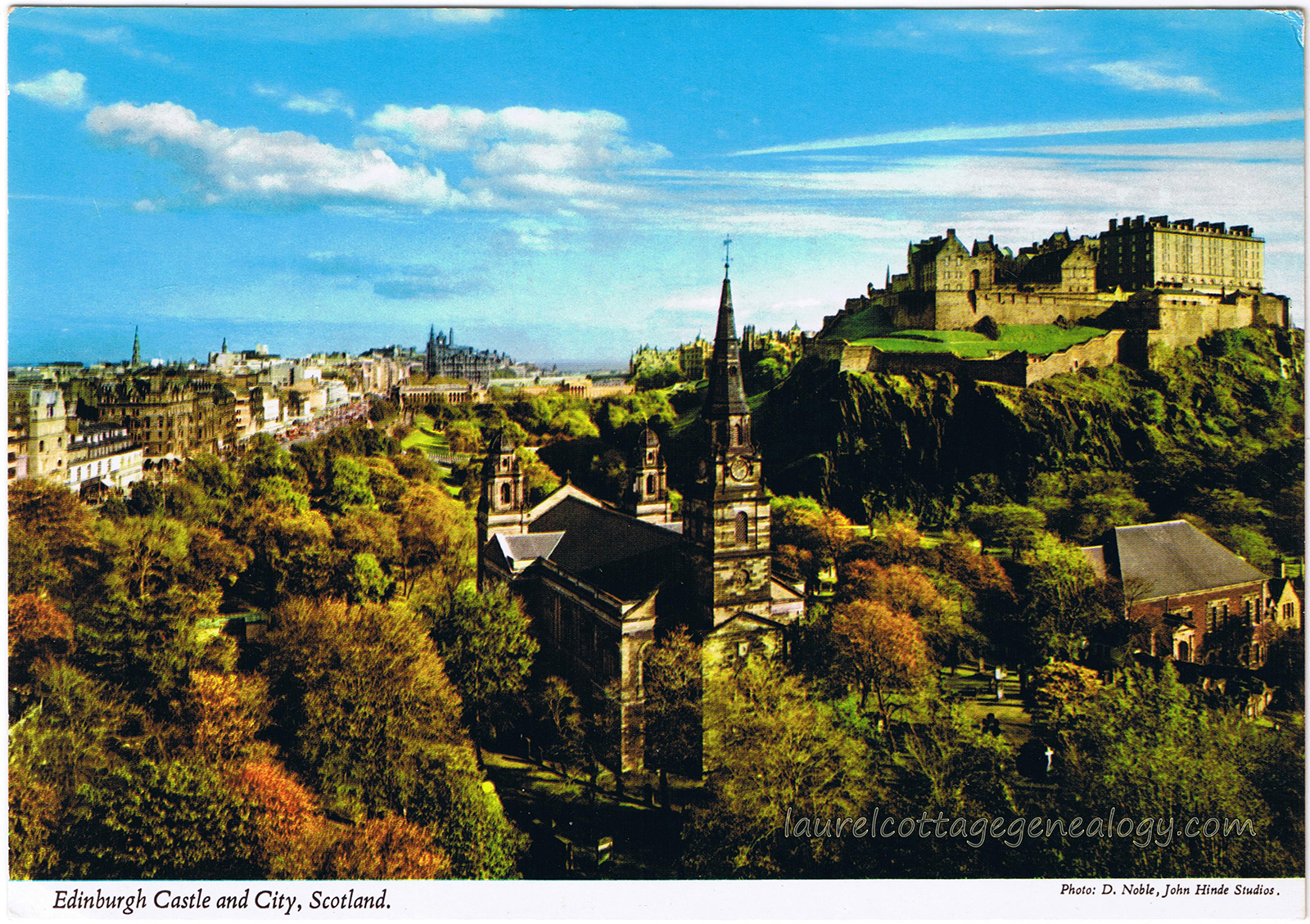
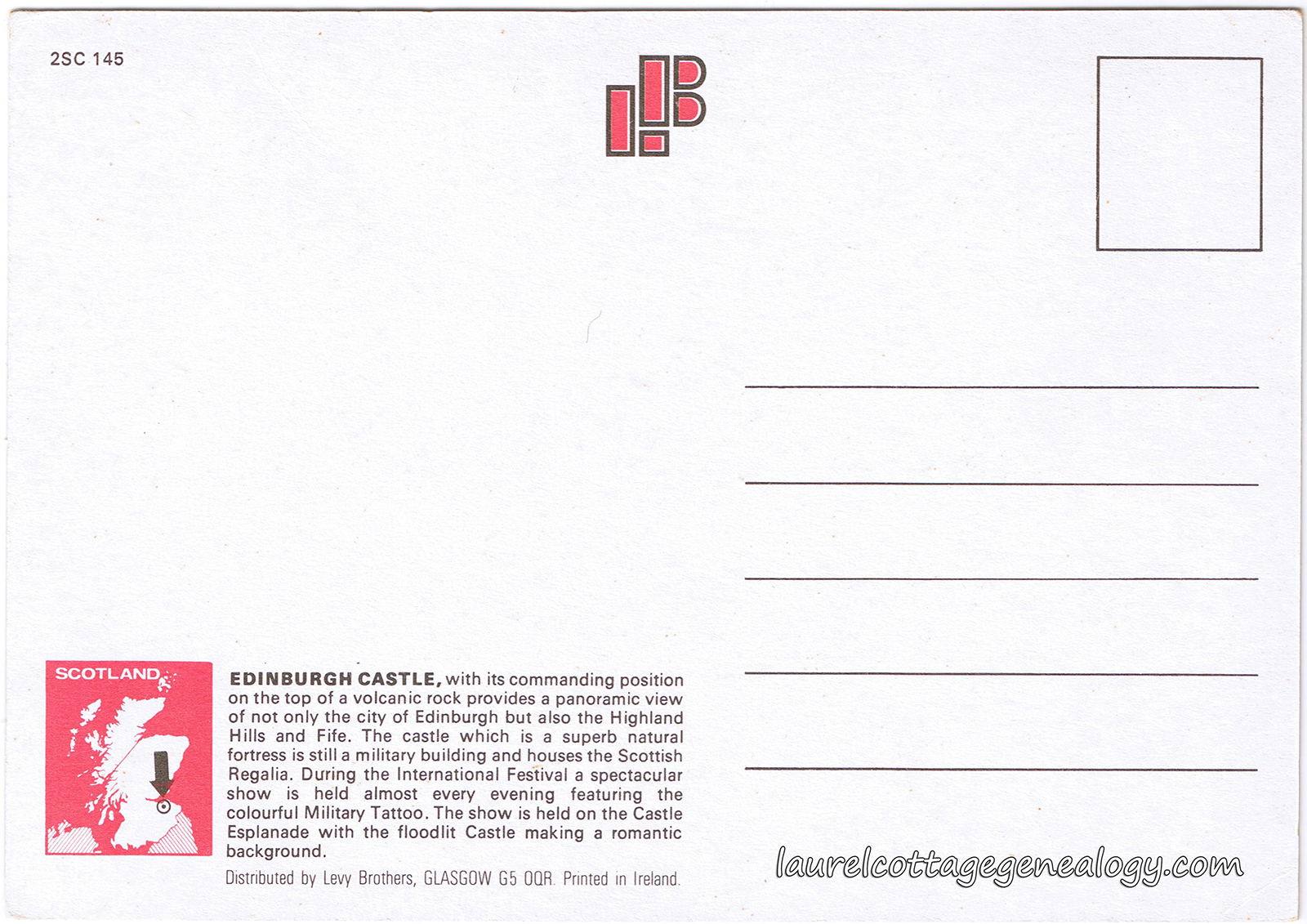
“Edinburgh Castle, with its commanding position on the top of a volcanic rock provides a panoramic view of not only the city of Edinburgh but also the Highland Hills and Fife. The castle which is a superb natural fortress is still a military building and houses the Scottish Regalia. During the International Festival a spectacular show is held almost every evening featuring the colourful Military Tattoo. The show is held on the Castle Esplanade with the floodlit Castle making a romantic background.”

I just came across this one (in keeping with the last post.) …What’s a military tattoo? The original definition of a military tattoo (from Wikipedia) was a military drum performance but later came to mean a military display. The word tattoo in this sense is from the Dutch phrase doe den tap doe which means “turn off the tap” as in beer tap. It was during the Thirty Years War in The Low Countries (the Netherlands and Belgium) when Dutch forces were garrisoned with mercenary troops (mostly Scottish, English, German and Swiss) that drummers from the garrison were sent out to the towns to let the barkeepers know when to stop serving beer so the soldiers would go home.

This postcard’s photo was produced by the studio of well-known British photographer John Linde (1916-1997) one of the most successful postcard publishers in the world. He, along with his wife, Jutta, set up a studio in Ireland in 1956, and went on to sell about 50 million postcards per year before he retired in the 1970s to concentrate on landscape painting. His works have traveled the world in art exhibits, have been compiled into books, and have been the subject of at least one t.v. show. This photo was taken by David Noble, a British photographer who, along with German photographers Elmar Ludvig and Edmund Nägele, worked for Hinde in the late 1960s to early ’70s.

Divided back, chrome, unused postcard. Distributed by Levy Brothers. Photo by David Noble, John Hinde Studios. Printed in Ireland. Series or number 2SC 145. Circa late 1960s – early 1970s.

Price:  $3.00

Sources:  http://en.wikipedia.org/wiki/Military_tattoo

http://en.wikipedia.org/wiki/John_Hinde_%28photographer%29

http://johnhindestudios.com/