Genealogy Services, Old Photos, Postcards, Trade Cards, Etc.

Posing In Peanut Town

Posing In Peanut Town pc1Posing In Peanut Town pc2

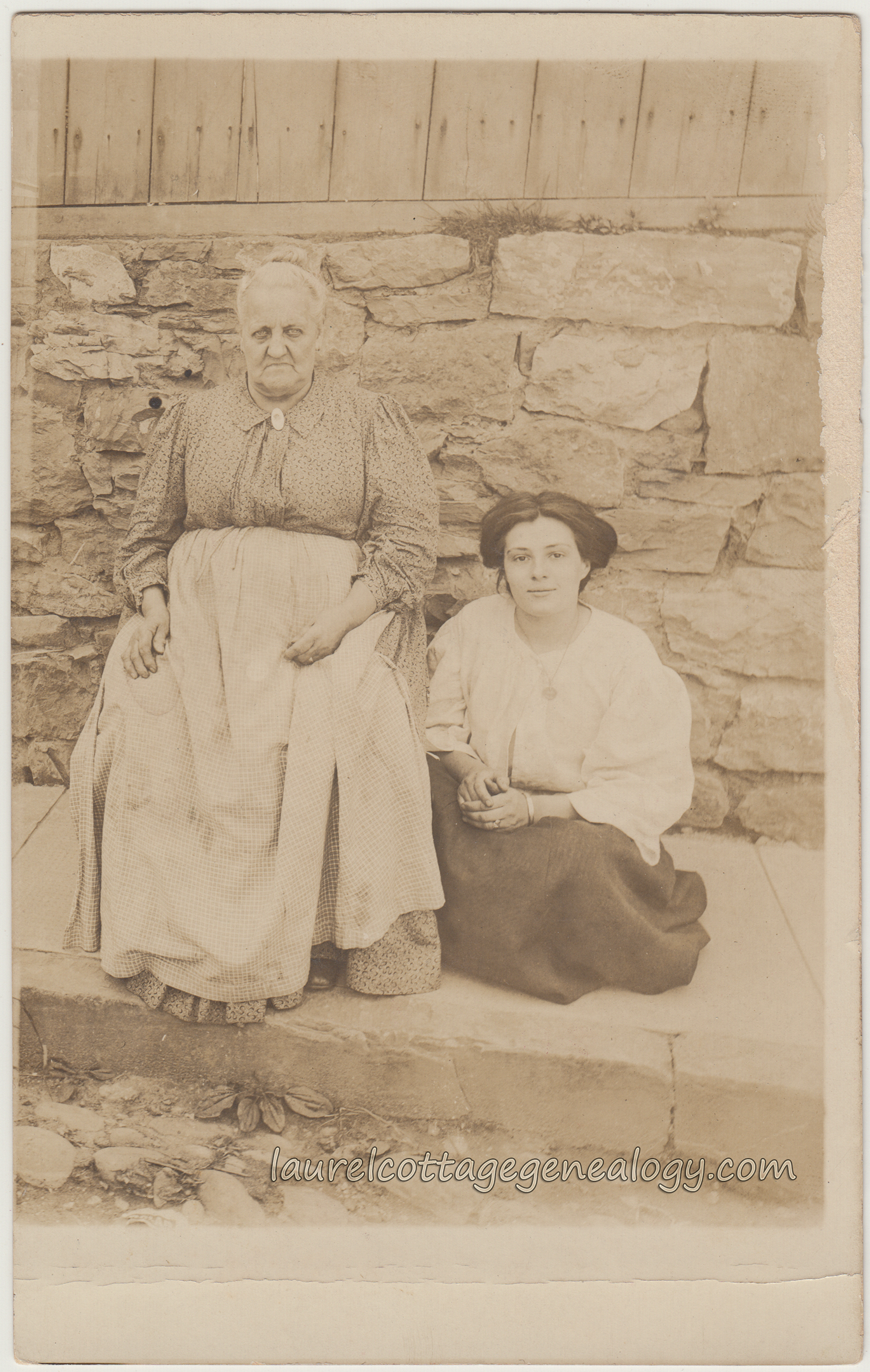
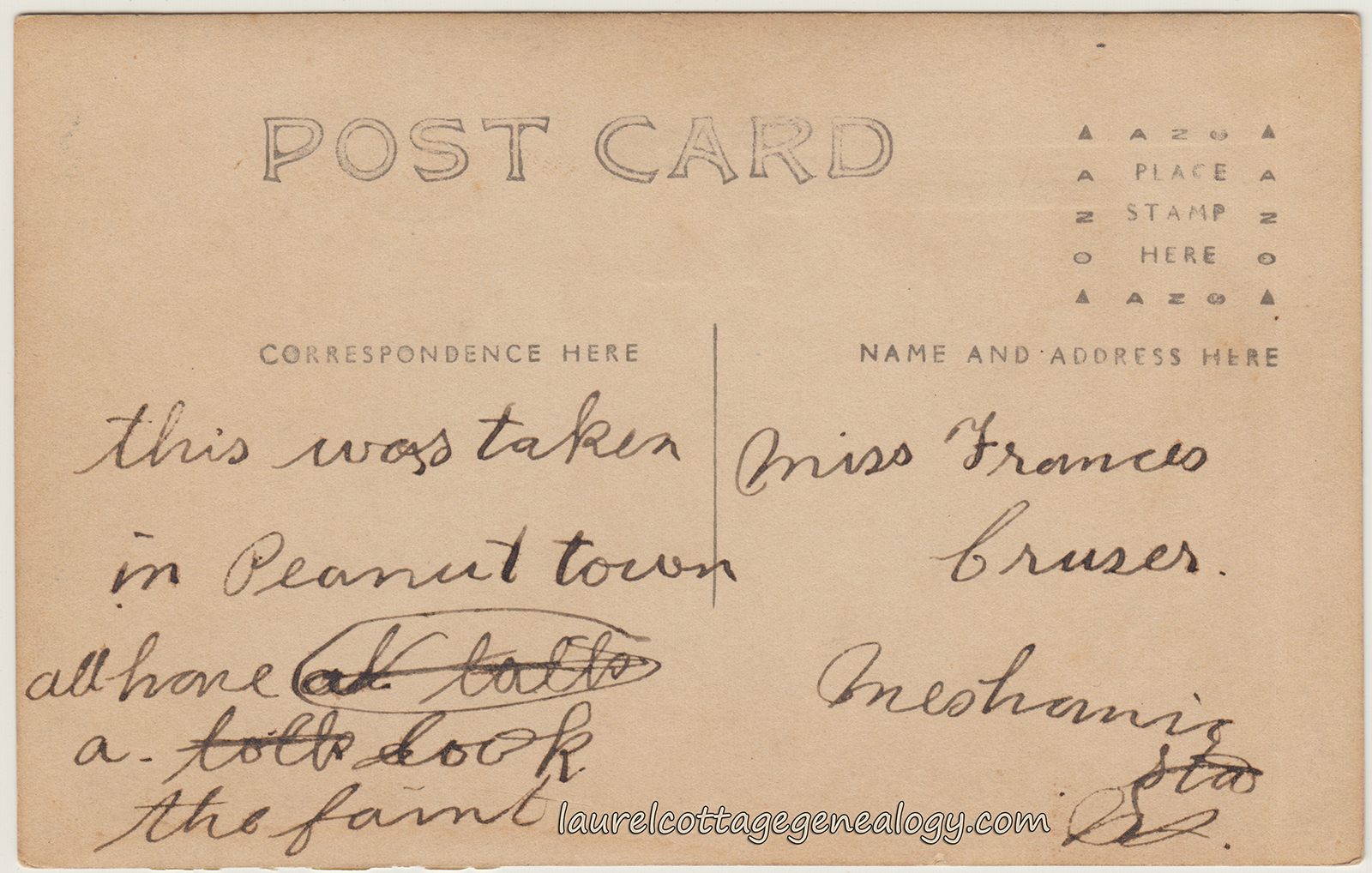
Real Photo Postcard with AZO stamp box (all four triangles pointing up) addressed to  “Miss Frances Cruser.  Neshanic Stas. NJ.”  The town name was confirmed after finding a Frances M. Cruser on the 1900 Federal Census taken in Branchburg, Somerset, New Jersey, and finding Neshanic Station on the map in the Branchburg area. This census shows parents Henry and Fredrika Cruser, born in Germany, Henry’s occupation is railroad worker; Frances M., single, born New Jersey, April 1878, occupation dressmaker; and Frances’ younger siblings Anna B., Henry Elmer and Lilly A. Cruser. The 1930 census shows Frances, married name Wilson, living with father, Henry in Branchburg. Frances’ spouse is not on this census, and it lists her age at first marriage as 30. If the census is correct then she would have married in about 1909, so taking this and the AZO stamp box into consideration, and the fact that it’s a divided back, we could approximately date this photo from about 1907 – 1909.

The message from the sender is a mystery though:  They wrote,  “this was taken in Peanut town”  but the next line is difficult to understand and also has crossed out words.  “All have a look the faint”  is my best guess at this point, which makes no sense whatsoever. (The photo is faint? The women feel faint? Good grief, this is a puzzle!)

The photo is great though, and shows an older woman, perhaps in her late 60s to early 80s. She must be sitting on a chair, as next to her, sitting on the sidewalk, is a very pretty young dark-haired woman. They both appear to be wearing wedding rings. One gets the impression that they are perhaps grandmother and granddaughter. The older woman wears a brooch, and the younger wears what may be a religious medal – if you look very closely, you can see the image of a figure, maybe a saint. The sidewalk they are posing on slopes up to our left, and the curb is fairly high. Behind them is a building or wall in stone with a wooden fence above it. The road showing at the bottom of the photo looks pretty rustic, a dirt road with lots of stones. A weed, perhaps plantain, is growing at the base of the curb, and it looks like a piece of paper with some large writing on it, perhaps a scrap of advertising, is at the bottom of the photo. The angle and the fact that the photo is faded at the bottom make the word too hard to read. (Drat!)

As to “Peanut Town” there is more than one possibility:  Of several nicknames for Allentown, PA, one of them is “Peanut City.” Another possibility is Suffolk, VA, officially called the “Peanut Capital of the World.” Both of these places show old early 1900 journal articles found online citing “Peanut Town.” Dothan, AL is also known as or self-proclaimed as the “Peanut Capital of the World.” Dothan has over 60 4-foot tall peanut characters around town – very cute! So anyway, it would be hard to pinpoint where this photo was taken. If betting, I would guess Allentown, PA. The Wiki article (listed below) on Pennsylvania city nicknames re “Peanut City” references peanut vendors lining Hamilton Street from the 1880s to the 1920s, singing jingles in Pennsylvania Dutch, and a personal account given in 1967, of a former newspaper editor, who had recalled that Saturday nights on Hamilton Street the boys and young men were out flirting with the girls and, “throwing the shells about with complete abandon”, so that the sidewalks the next morning were “not quite ankle deep”  with peanut shells.

Divided back, Real Photo Postcard, AZO stamp box with triangles pointing up. Unused with writing. Circa 1907 – 1909.

Price:  $15.00

Sources:  Year: 1900; Census Place: Branchburg, Somerset, New Jersey; Roll: 994; Page: 2A; Enumeration District: 0076; FHL microfilm: 1240994. (Ancestry.com)

Year: 1930; Census Place: Branchburg, Somerset, New Jersey; Roll: 1383; Page: 5B; Enumeration District: 0011; Image: 555.0; FHL microfilm: 2341118. (Ancestry.com)

http://en.wikipedia.org/wiki/List_of_city_nicknames_in_Pennsylvania

Kriebel, H.W. (Ed.). (1912) The Penn Germania:  A Popular History of German History and Ideals in the United States, Vol. 13. p. 477. (Google eBook)

Jacobs, H.L. “How the Question is Being Settled at Suffolk, Va.” The Clay-Worker, Vol 45-46. T. A. Randall & Co. (1906) p. 844.

http://dothandestinations.com/Attractions.html

http://en.wikipedia.org/wiki/History_of_Suffolk,_Virginia
A Riddle

A Riddle pc1A Riddle pc2

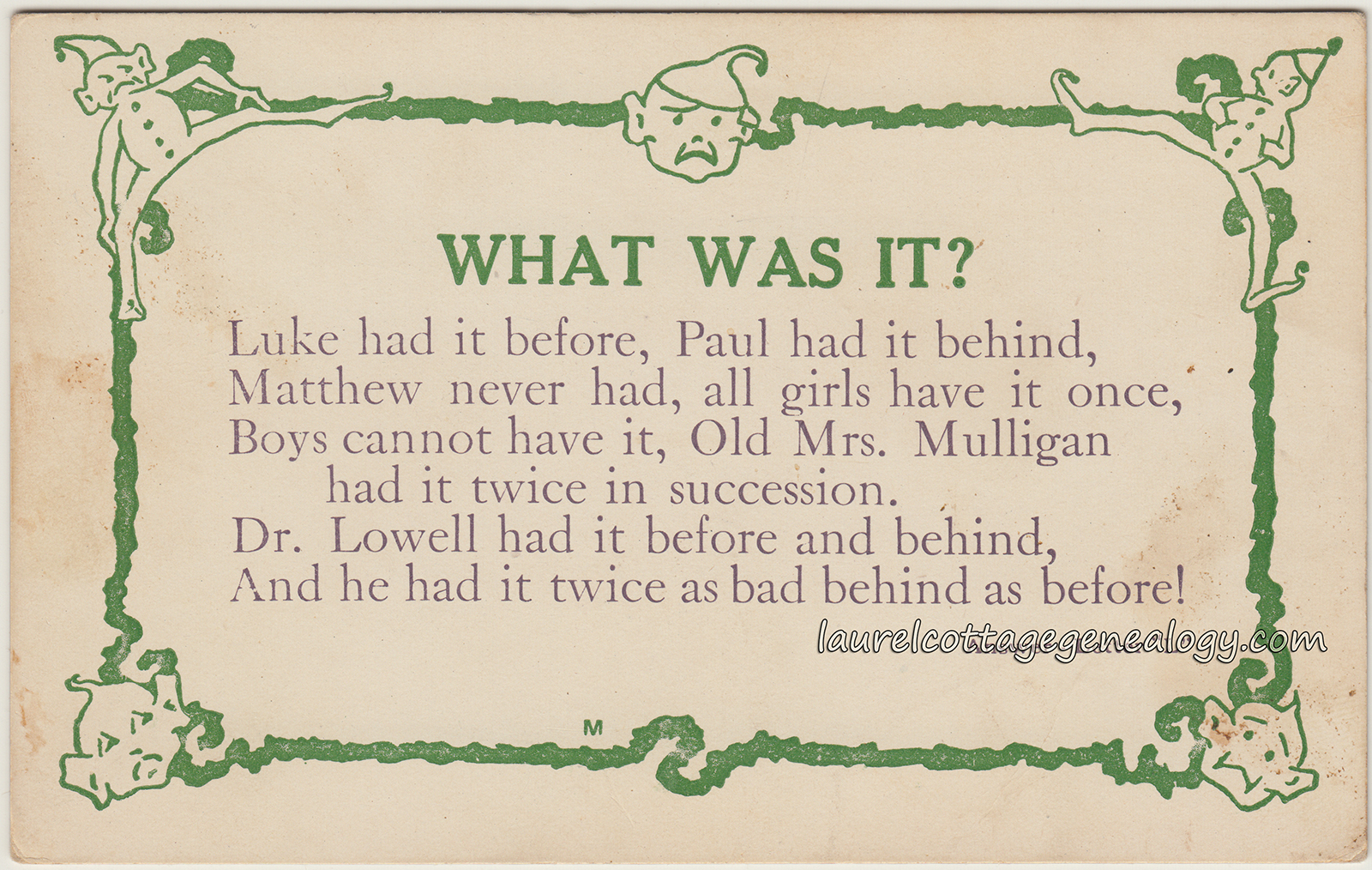
This postcard is on thicker paper, and it seems a good possibility that it could have come out of an arcade game. The front shows a very clever riddle, surrounded by elves, and is done in green on white. See if you can figure it out. The watermark for Laurel Cottage was placed over the answer, so you could have some fun with this, and the answer will appear below, upside-down. (No cheating, now.) The riddle reads:

“WHAT WAS IT?

Luke had it before,  Paul had it behind,

Matthew never had,  all girls have it once,

Boys cannot have it,  Old Mrs. Mulligan

had it twice in succession.

Dr. Lowell had it before and behind,

And he had it twice as bad behind as before!”

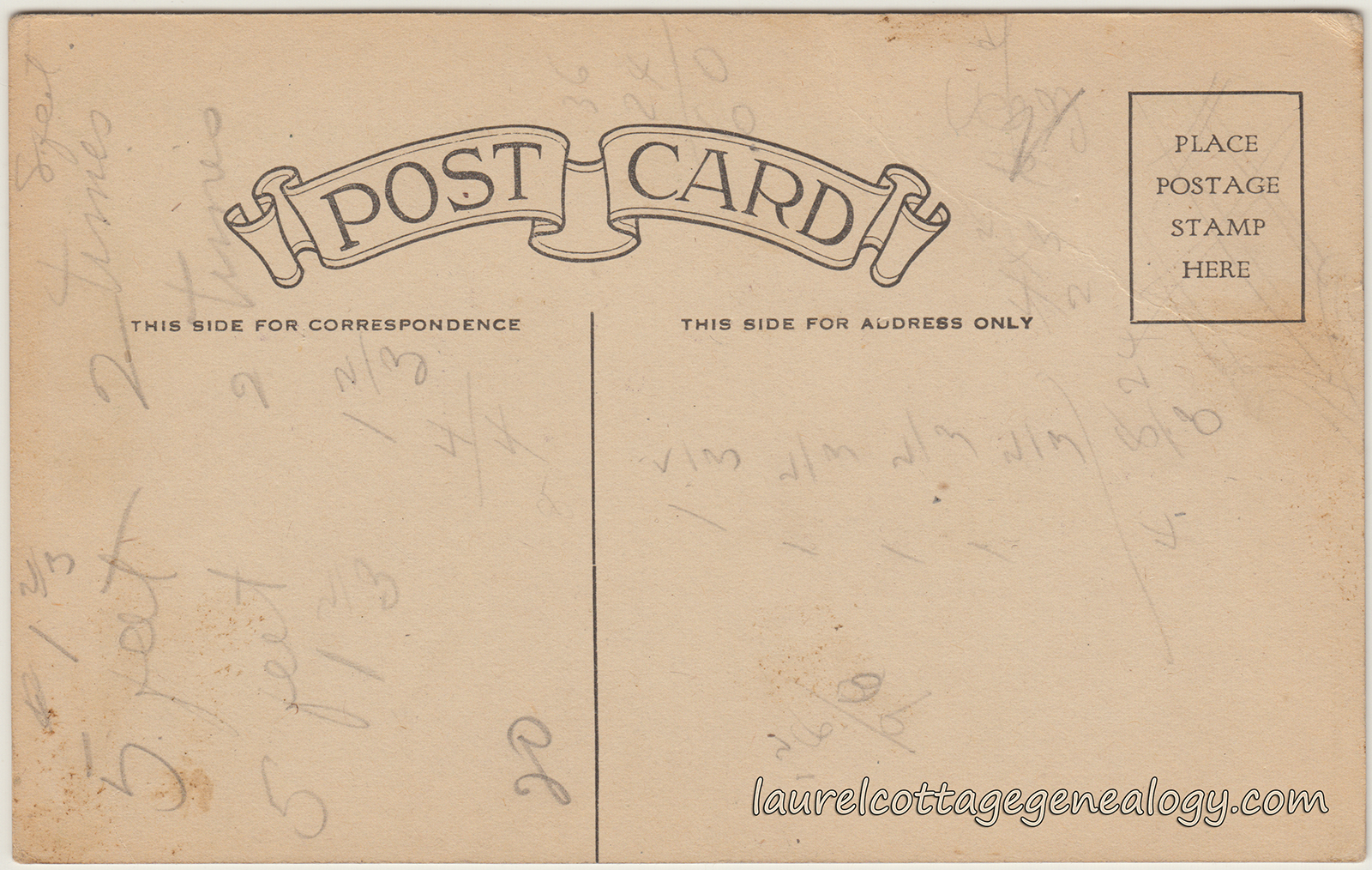
The date and publisher are unknown for this postcard. Perhaps the “M” that appears on the front, at the bottom of the card, is some type of identifying publisher or printer mark.  We can see from the writing on the back that this card must of have been used for scrap paper to record some measurements… It’s always neat to come across a design we haven’t seen yet for the postcard header, and this is a nice one. Not real fancy, but nice, with the words appearing on a banner-like design.

Divided back, unused with writing. Publisher unknown. Date circa 1910 – 1920.

Price:  $4.00

Riddle Answer

John K. Stevens Photographer Trade Card

Stevens The Photographer Trade Card t1

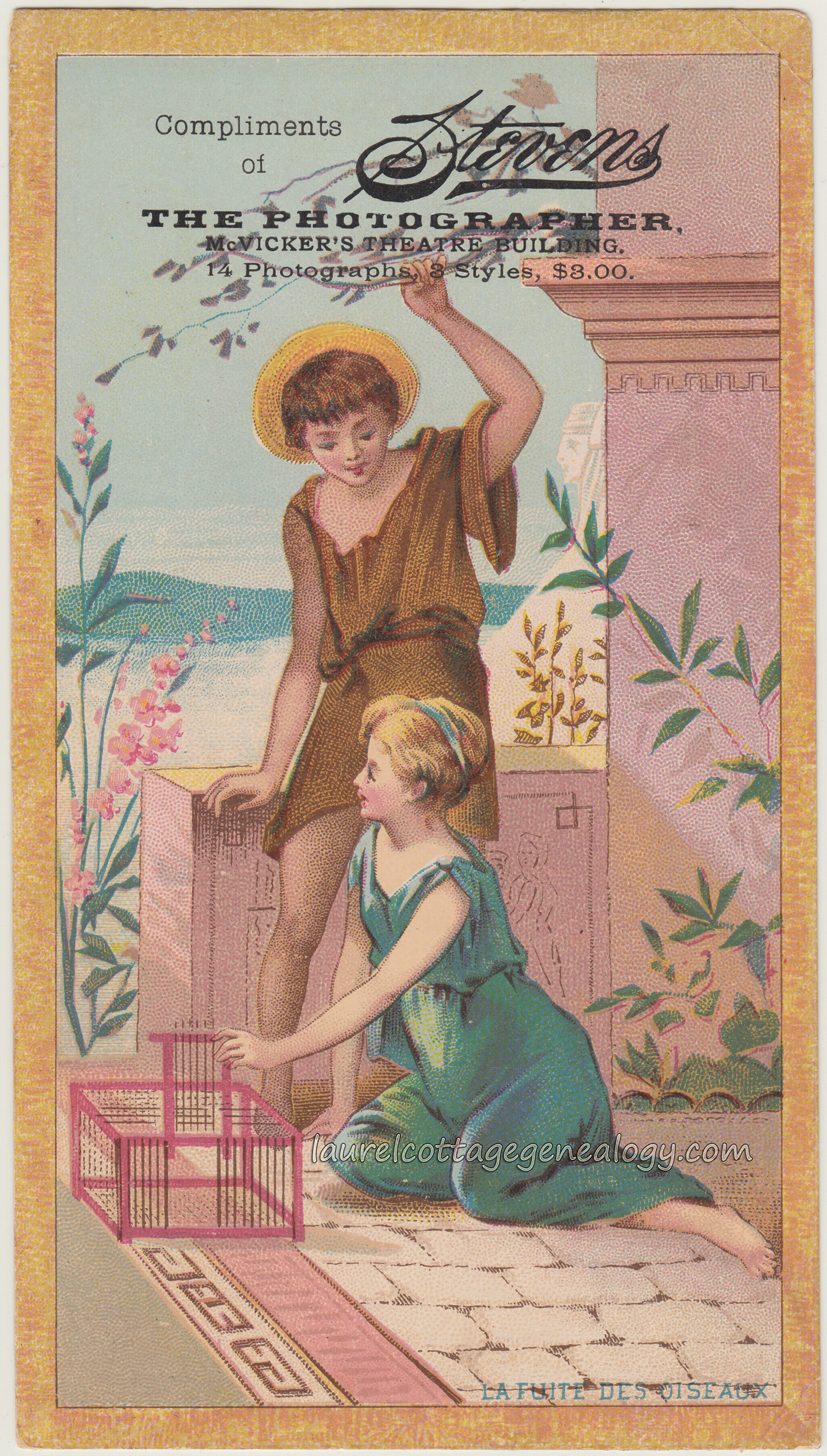
Trade card showing  “Stevens – The Photographer, McVicker’s Theatre Building, 14 Photographs, 3 Styles, $3.00.”  This advertising card, in colors of blue-green, pink, and brown with a gold-tone border is entitled,  “La Fuite des Oiseaux”  and shows a boy and girl, in flowing Grecian-style attire. We see the scene depicted here just after the young lady has released some birds (not shown) from their captivity while the young man looks on. Some short biographical info found about the photographer in question is as follows:

(See “Comments” for this post for more information and a question of possible middle name of Kelly for this photographer.)

John Kimbell Stevens, born July 4, 1838 in Buffalo, New York, son of Solomon Stevens and Clarissa Stone. On the 1870 Federal Census in Chicago with wife Loretta, and children, Lester W. and Mary G. 1870-1874 Chicago city directories address 163 S. Halstead, Chicago. 1878 city directory at 85 Madison. 1882 directory at 108 Dearborn and 1885 at 106 Dearborn. Son, Lester W. Stevens joined his father in the photography business in 1884, according to Lester’s biographical info as a member of the Elks. 1887-1889 at 55 McVicker Theater Bldg. John K. Stevens’ wife Loretta, sadly died in 1878 of consumption. He married a second time on October 25, 1881 to Addie B. Cater. John, Addie and their son Harry K. Stevens appear on the 1900 census in Chicago, with Addie’s mother Josephine Cater and sister, Clara J. Cater, and a domestic servant, Mary Blackman. An ad in the 1905 publication entitled To-morrow shows  “Gibson, Sykes & Fowler (successors to J. K. Stevens & Co.) Leading photographers, McVickers Theatre Bld. The Oldest and Best Known Studios in Chicago. Established Over Thirty-Five Years.” 

McVicker’s Theatre was located in Chicago, on Madison between State and Dearborn Streets. It was built in 1857 by James H. McVicker, Chicago actor and producer. There were five different buildings at this location, the last theater went by McVickers, without the apostrophe, and was demolished in 1985. The first building was destroyed in the Great Fire of 1871. The Booth Family of Shakespearean actors were known to have performed there, including the infamous John Wilkes Booth (about three years prior to his assassination of Abraham Lincoln.) Actress Sarah Bernhardt made her American debut at the McVicker’s in 1881, and comedian Eddie Foy also performed at the McVicker’s.

Trade Card, circa 1887 – 1905.

Size:  About 6 and 1/4 x 3 and 1/2″

Price:  $10.00

Sources:  Stevens, John Grier. The descendants of Samuel Stevens; with histories of allied families: A biographical and genealogical record. (1968)

Ancestry.com. Cook County, Illinois, Marriage and Death Indexes, 1833-1889

Year: 1870; Census Place: Chicago Ward 10, Cook, Illinois; Roll: M593_205; Page: 389B; Image: 82; Family History Library Film: 545704. (Ancestry.com)

Year: 1900; Census Place: Chicago Ward 12, Cook, Illinois; Roll: 258; Page: 1A; Enumeration District: 0332; FHL microfilm: 1240258. (Ancestry.com)

Ancestry.com. Cook County, Illinois, Marriages Index, 1871-1920 [database on-line]. Provo, UT, USA: Ancestry.com Operations, Inc., 2011.

Ellis, Charles Edward; An Authentic History of the Benevolent & Protective Order of Elks. Chicago:  Published by the author, 1910. Pg. 56. (Google eBook)

Ancestry.com. U.S. City Directories, 1821-1989 [database on-line]. Provo, UT, USA: Ancestry.com Operations, Inc., 2011.

To-Morrow:  A Monthly Handbook of the Changing Order. Published Chicago, Illinois, January 1905. Pg. 61. (Google eBook)

http://interactive.wttw.com/timemachine/mcvicker%E2%80%99s-theater

Fields, Armond; Eddie Foy, a biography of the early popular stage comedian. Jefferson, North Carolina:  McFarland and Co., Inc., 1999. (Google eBook)

Friendly Greetings

Friendly Greetings m1Friendly Greetings m2

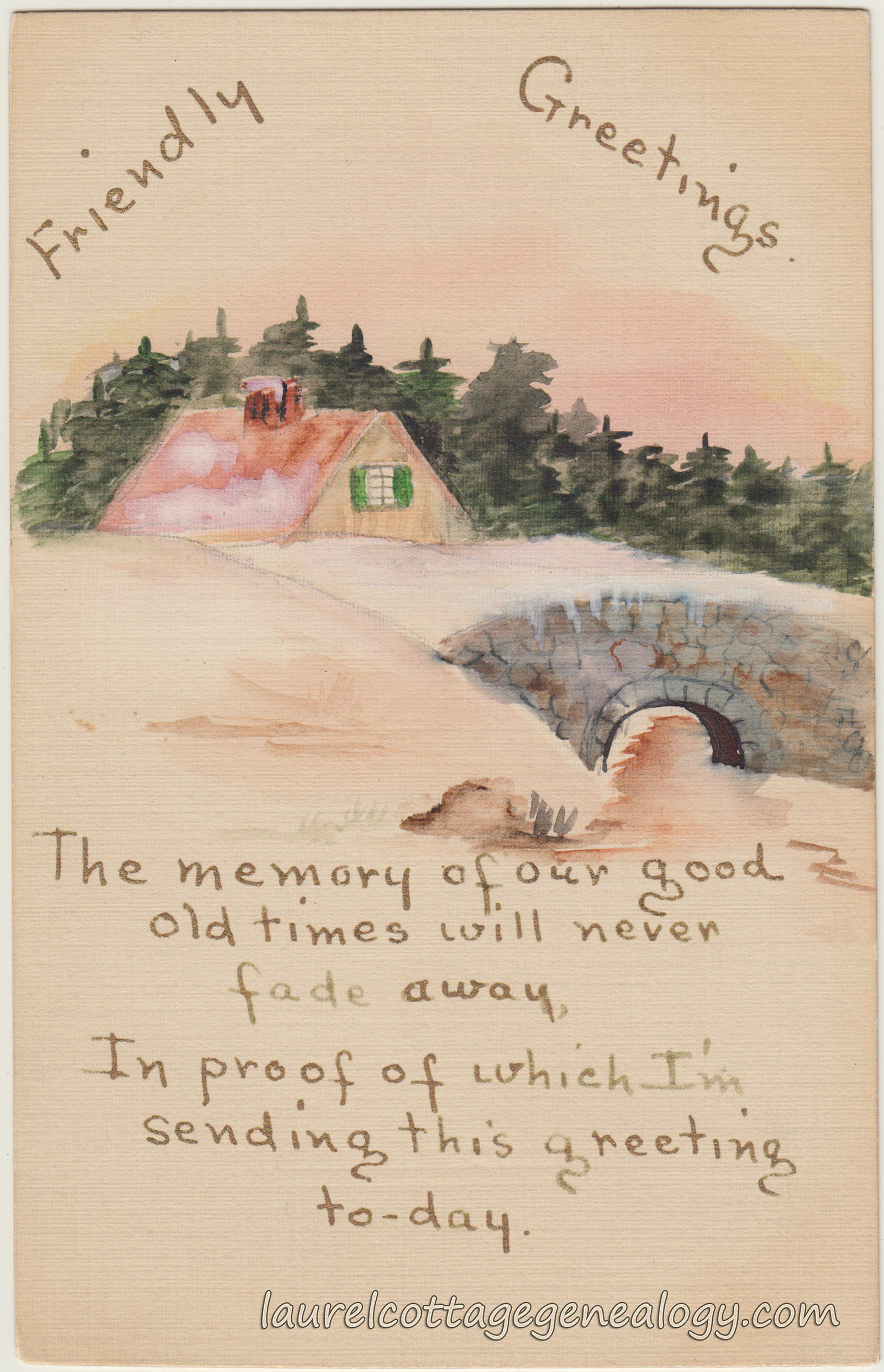
“The memory of our good old times will never fade away,

In proof of which I’m sending this greeting to-day.”

This is a beautiful card, on linen-type paper, showing  “Friendly Greetings”  at the top and the above short verse, both done in gold-tone. Whether the card is handmade or not is a good question; maybe not as the edges are also done in gold-tone, which might leave one with the impression that the card was professionally made and sold; but then again there is no publisher information, so the card could have even been created by the sender. In any case, the scene is beautifully done, and shows a small stone bridge in winter, with the top half of a house showing in the background, nestled cozily in front of some fir trees, at sunset or sunrise. The message on the back shows:

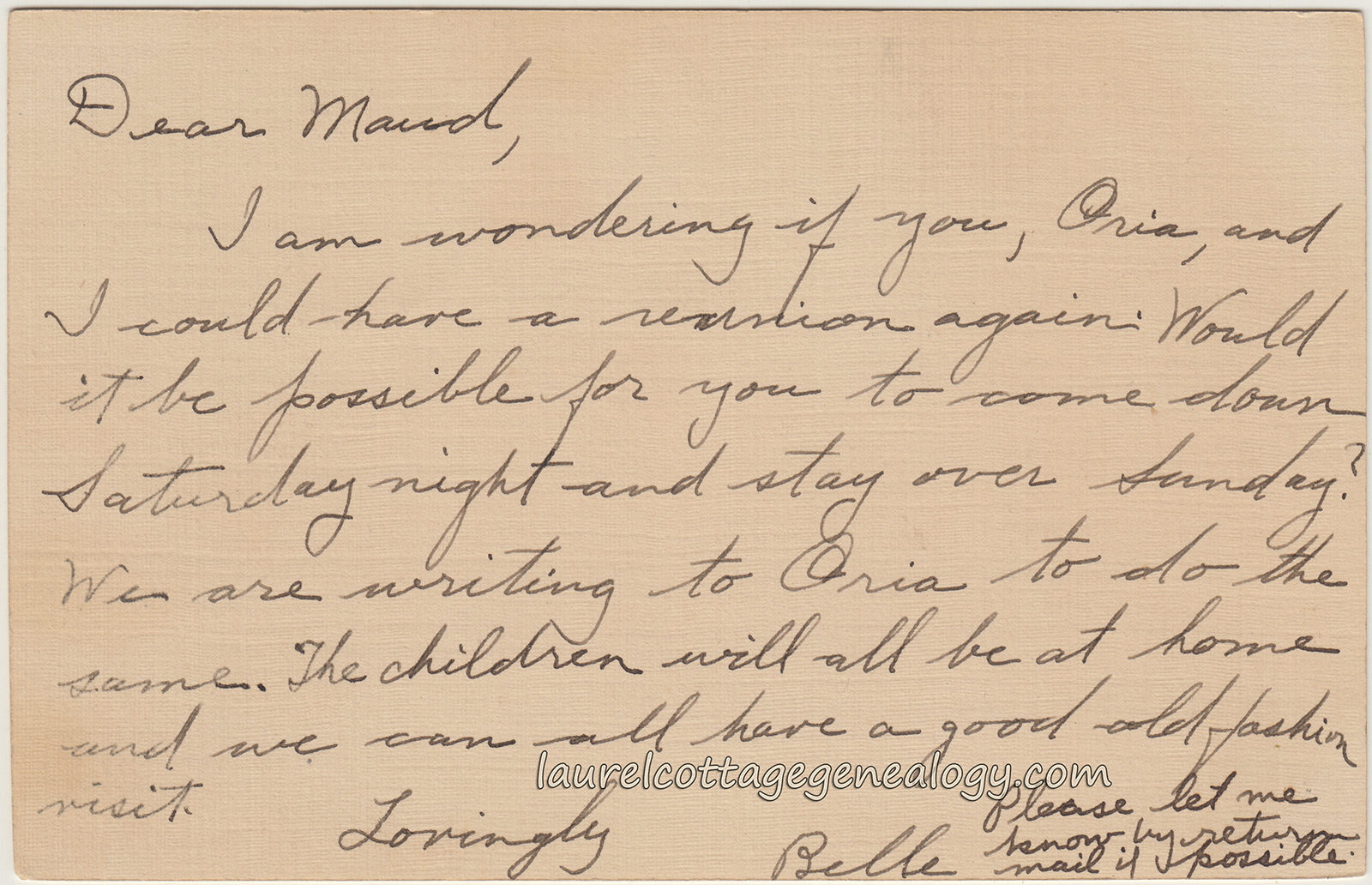
“Dear Maud, I am wondering if you, Oria, and I could have a reunion again. Would it be possible for you to come down Saturday night and stay over Sunday? We are writing to Oria to do the same. The children will all be at home and we can all have a good old fashion visit. Lovingly, Belle   Please let me know by return mail if possible.”

We can tell this is an older card by the spelling of “to-day” rather than today. A great website for etymology was found and is listed below. Etymology is the study of the origin of words and how their meanings have changed over time. The term in the spotlight here started off as “to day”, changed to “to-day”, then became the present “today.” The hyphenated term was used roughly up until the early 20th century, but we still sometimes see “to day” around this time, as well.

Greeting card, possibly hand-made. Circa early 1900s.

Price:  $15.00

Source:  http://www.etymonline.com/index.php?term=today

Happy Birthday To Aunty Hadley

Happy Birthday To Aunty Hadley pc1Happy Birthday To Aunty Hadley pc2

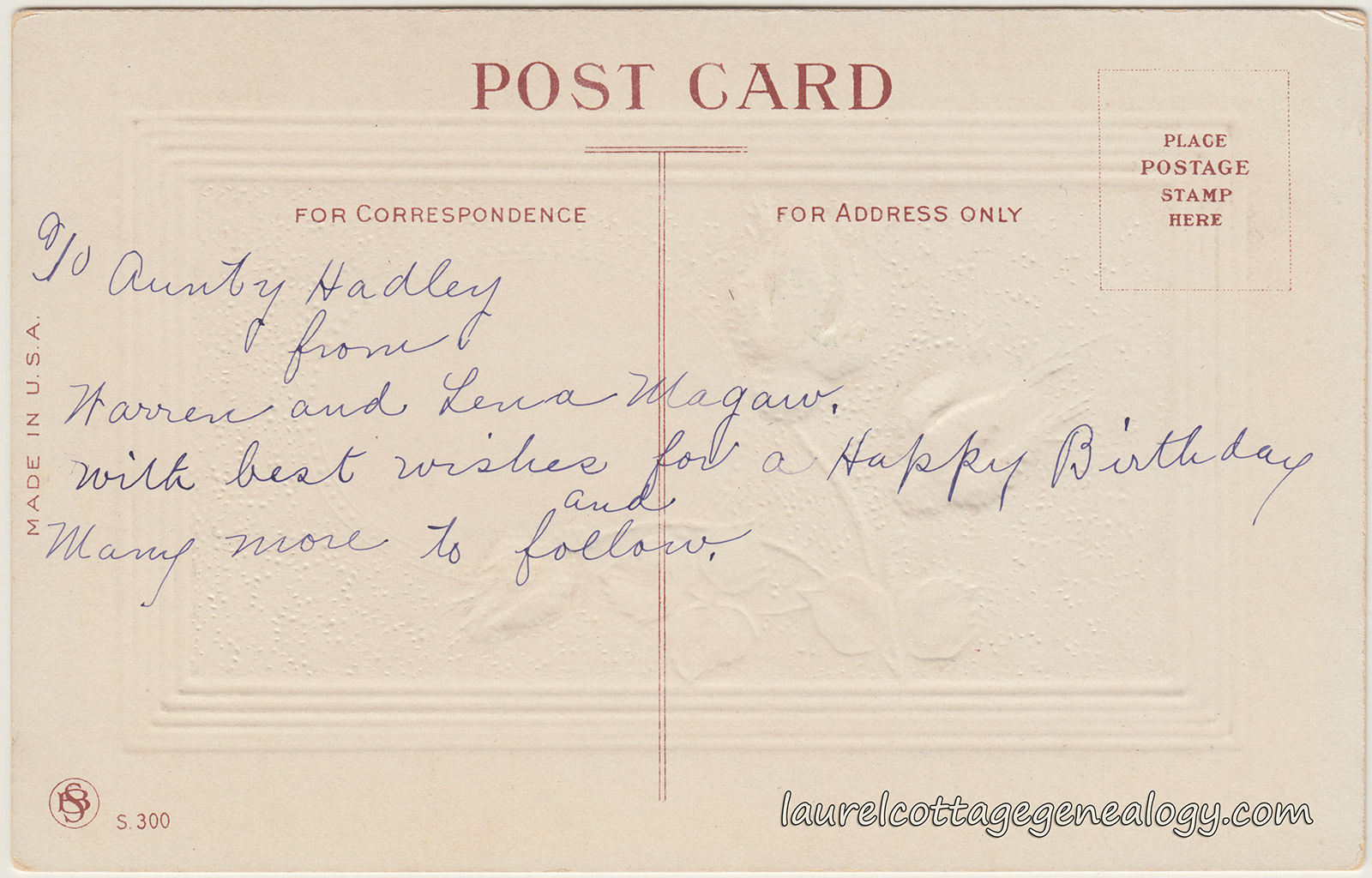
Warren and Lena Magaw are on the Lawrence, Kansas 1910 Federal Census, brother and sister, ages four and two, respectively. Their parents are W. C. and Emma Magaw (Cyrus Webster Magaw and Emma Henrietta Biery on an Ancestry.com family tree.)  I don’t see any other possibilities for the senders of this postcard, but who is Aunty Hadley? Hadley is definitely not a common girl’s name (but so cool) and one would assume that it’s the receiver’s first name, but both first and last names were checked as possibilities. Perhaps it was a middle name that she used that isn’t showing up in records, or a nickname for Harriet. Relatives and in-laws of the Magaws were checked.

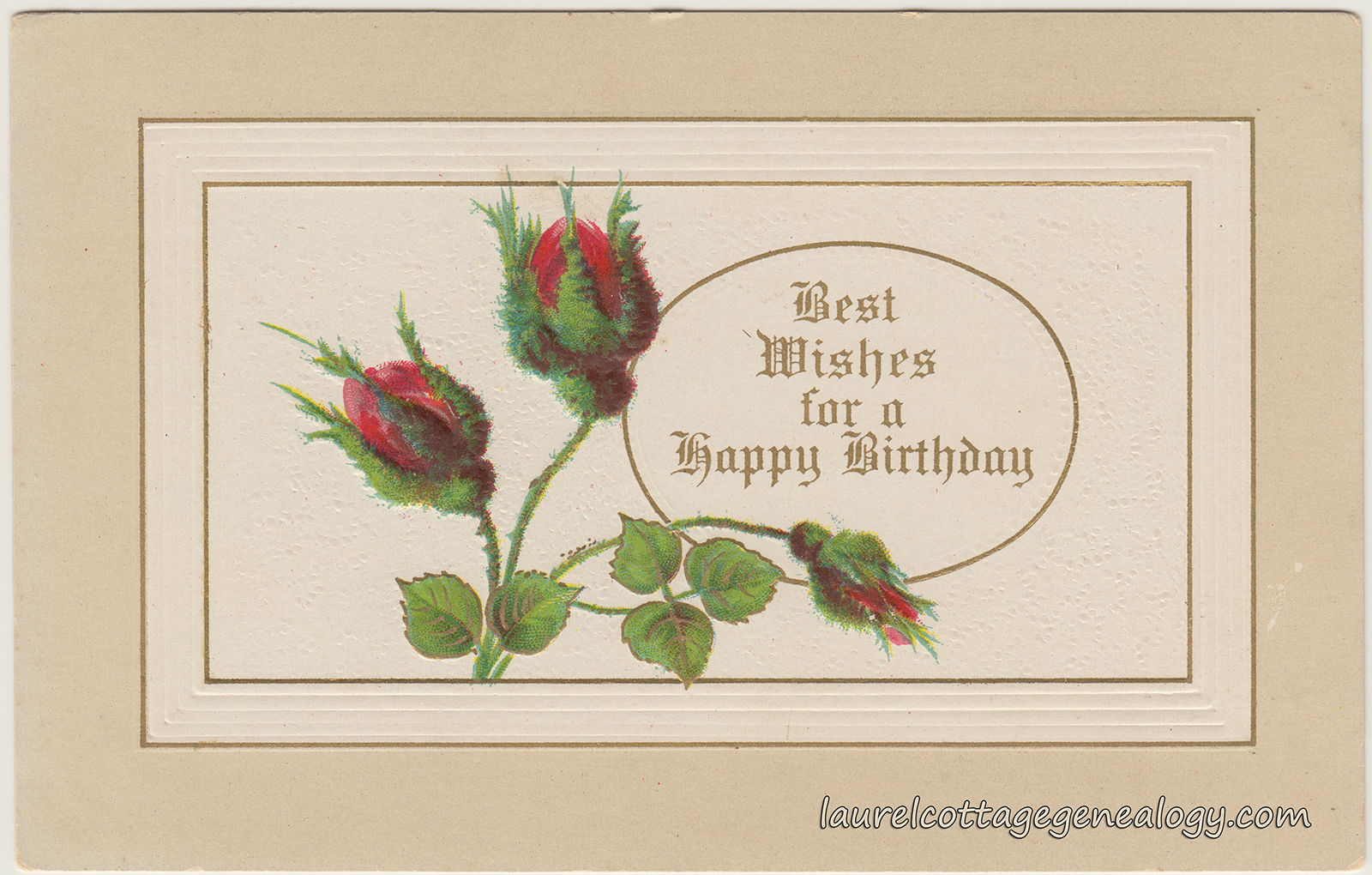
As to the design of the card, it shows a branch of a rosebush showing three red rosebuds, on a white background, with the caption in gold,  “Best Wishes for a Happy Birthday.”  The card is lightly embossed and has a wide tan border.

Divided back, lightly embossed, unused postcard with writing on the back. Publisher:  Samson Brothers. Series 300. Made in the U.S.A. Date:  Circa 1908 – 1919.

Source:  Year: 1910; Census Place: Lawrence, Cloud, Kansas; Roll: T624_435; Page: 1B; Enumeration District: 0024; FHL microfilm: 1374448. (Ancestry.com)

Bernie And Anna Brant

Bernie and Anna Brant pc1Bernie and Anna Brant pc2

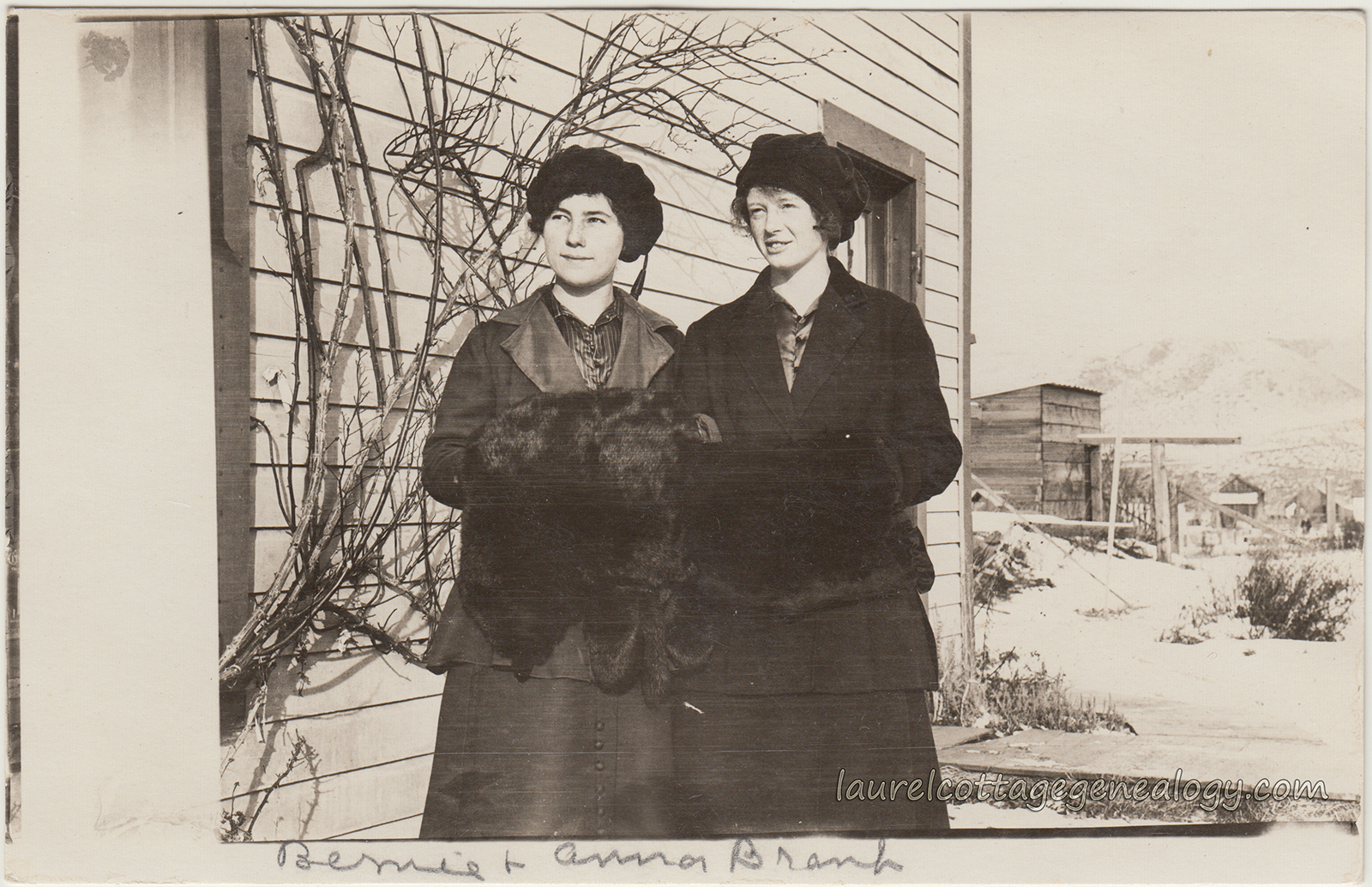
It is unknown whether these two women are related, but it would be a good guess that they are sisters. There are plenty of records showing up separately under the names of Bernice and Anna Brant in various states, but nothing that we can really pinpoint as a probable identification for sisters or family members. The photo may have been taken in one of the Western states; it has that High Desert look to it, with the scrubby terrain and the mountain showing faintly in the background. The two ladies are stylishly dressed for colder weather with tailored coats with large lapels, large fur muffs (we can see the animal head attached on the one on our left), and hats. It would seem that the weather would not have been too cold as their coats are open at the neck to reveal beautiful satiny blouses. The hat for the woman on the right, who we assume to be Anna, appears to be of a ribbed fabric, and for Bernice, is that a tassel that is showing at the back? Upon closer inspection, it does indeed seem to be.

As to the date of the postcard, the excellent and so helpful Playle website shows this exact style of Real Photo Postcard back and estimates the date to be from 1914 – 1917, but it’s always possible the printer was using up old stock, so the photo could be from a later date.

Real Photo Postcard, divided back, unused, with writing on the front. Printer unknown, circa 1914 – 1917.

Price:  $10.00

Source:  https://www.playle.com/realphoto/backun.php

Just A Few Lines From

Just A Few Lines From  pc1Just A Few Lines From  pc2

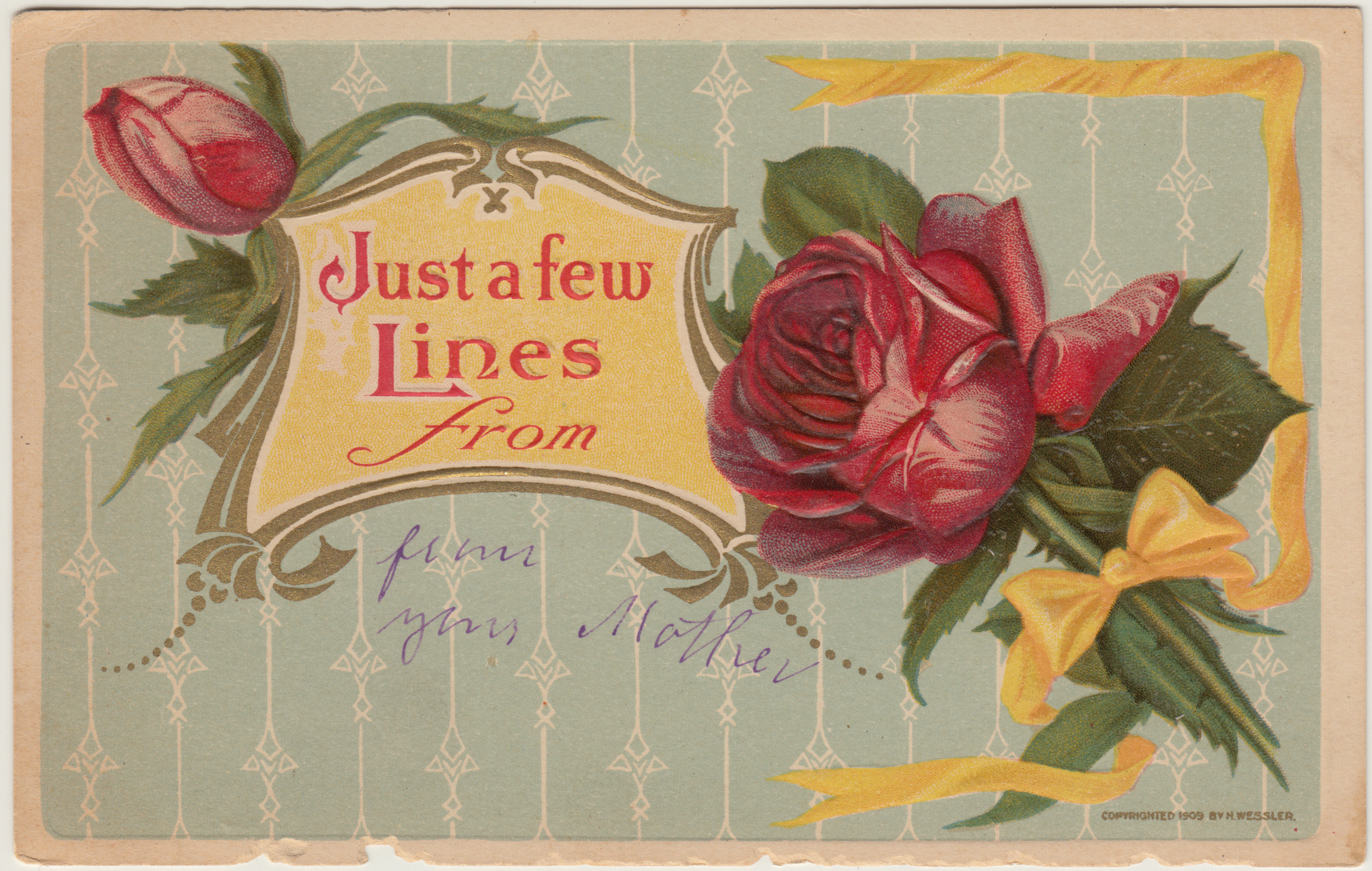
A nicely designed, embossed postcard showing a gold-toned design around the statement,  “Just a few Lines from.”  The card has two red roses, a yellow ribbon, and a striped background in light green and white that may remind you of wallpaper. Underneath the caption the sender wrote,  “from your Mother.” 

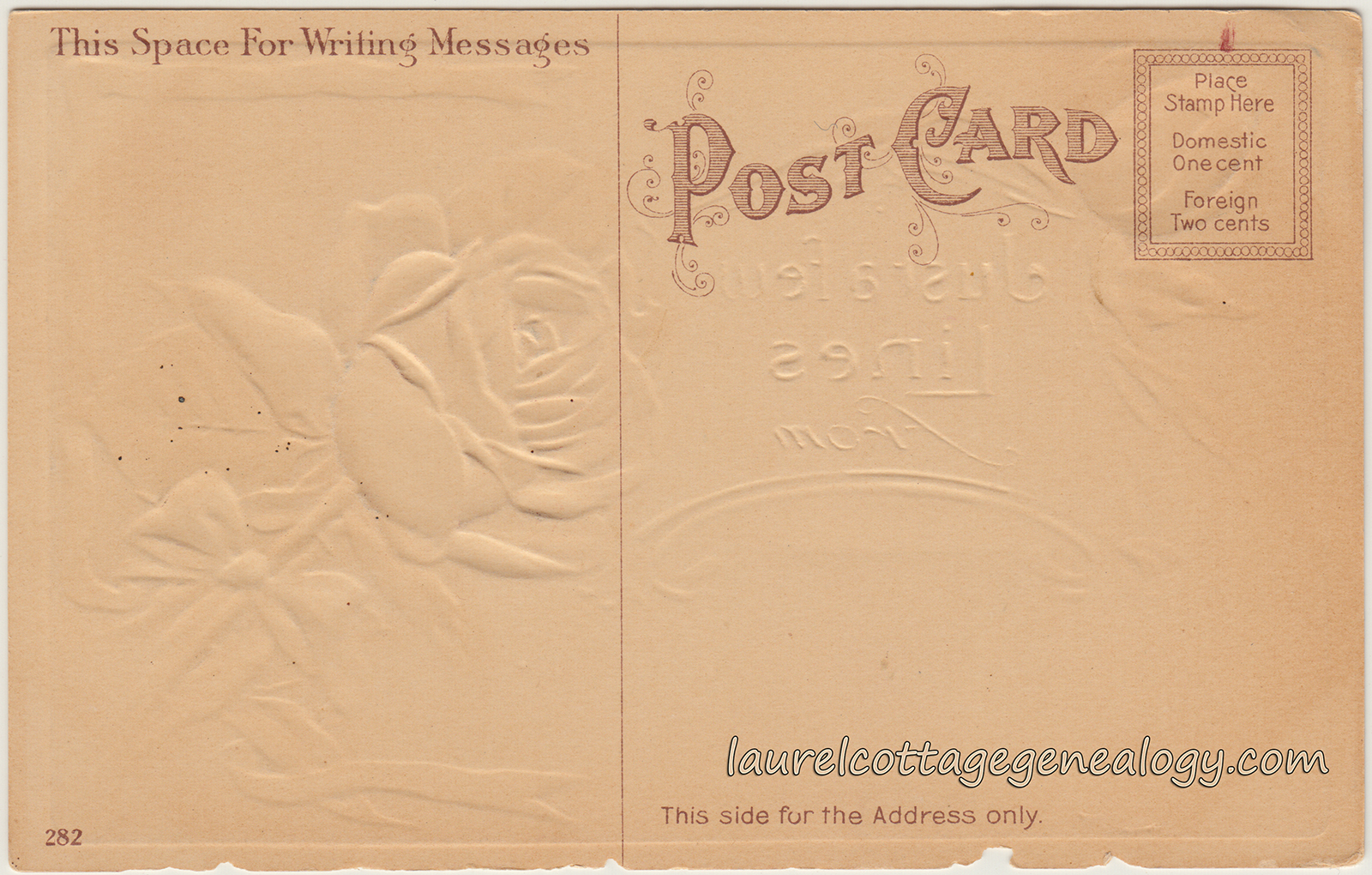
Divided back, embossed, unused postcard with writing on the front. Publisher:  H. Wessler. Copyright 1909.

Price:  $4.00

Bertha Edna (Vogt) Clevenger

Bertha Edna (Vogt) Clevenger pc1Bertha Edna (Vogt) Clevenger pc2

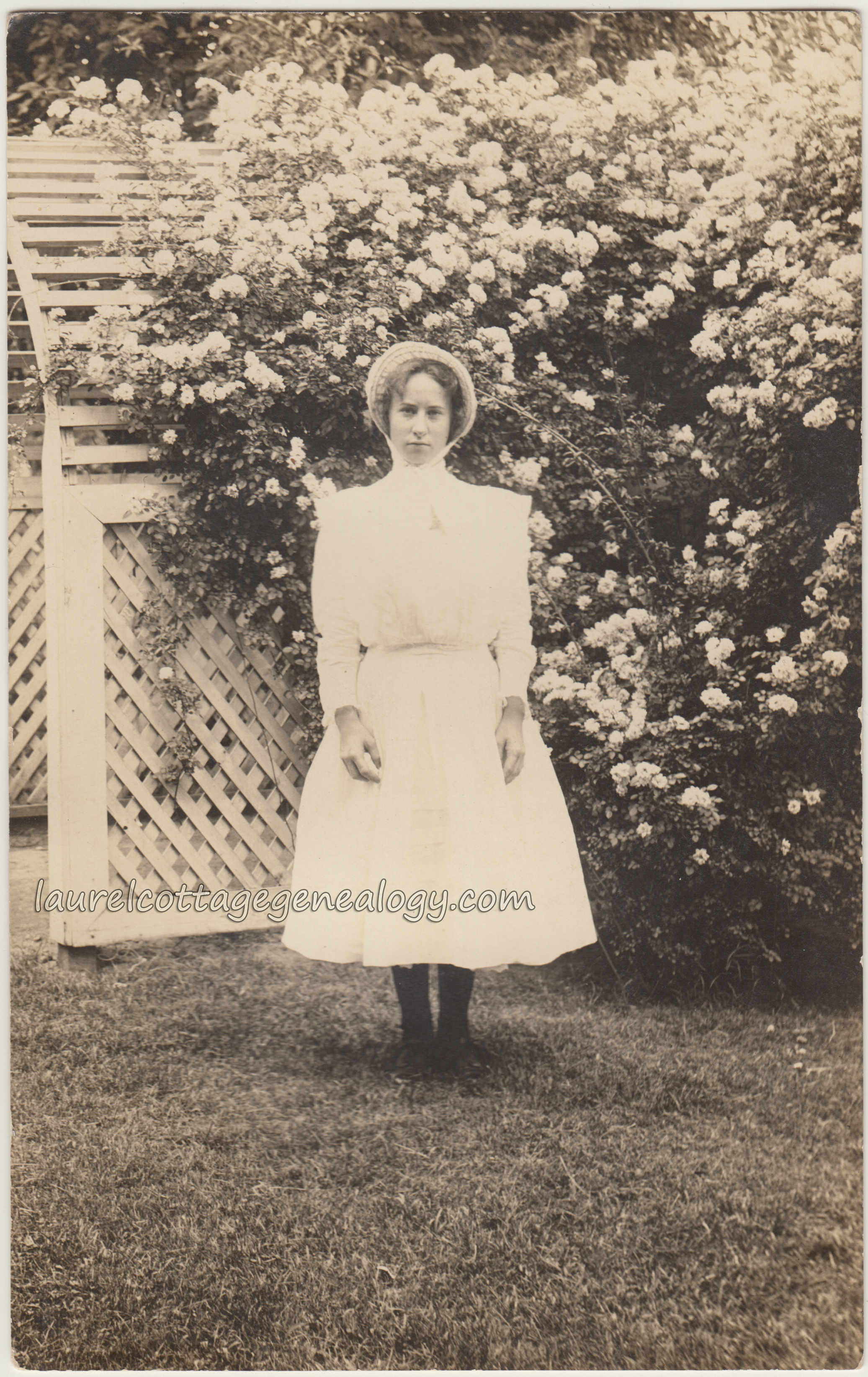
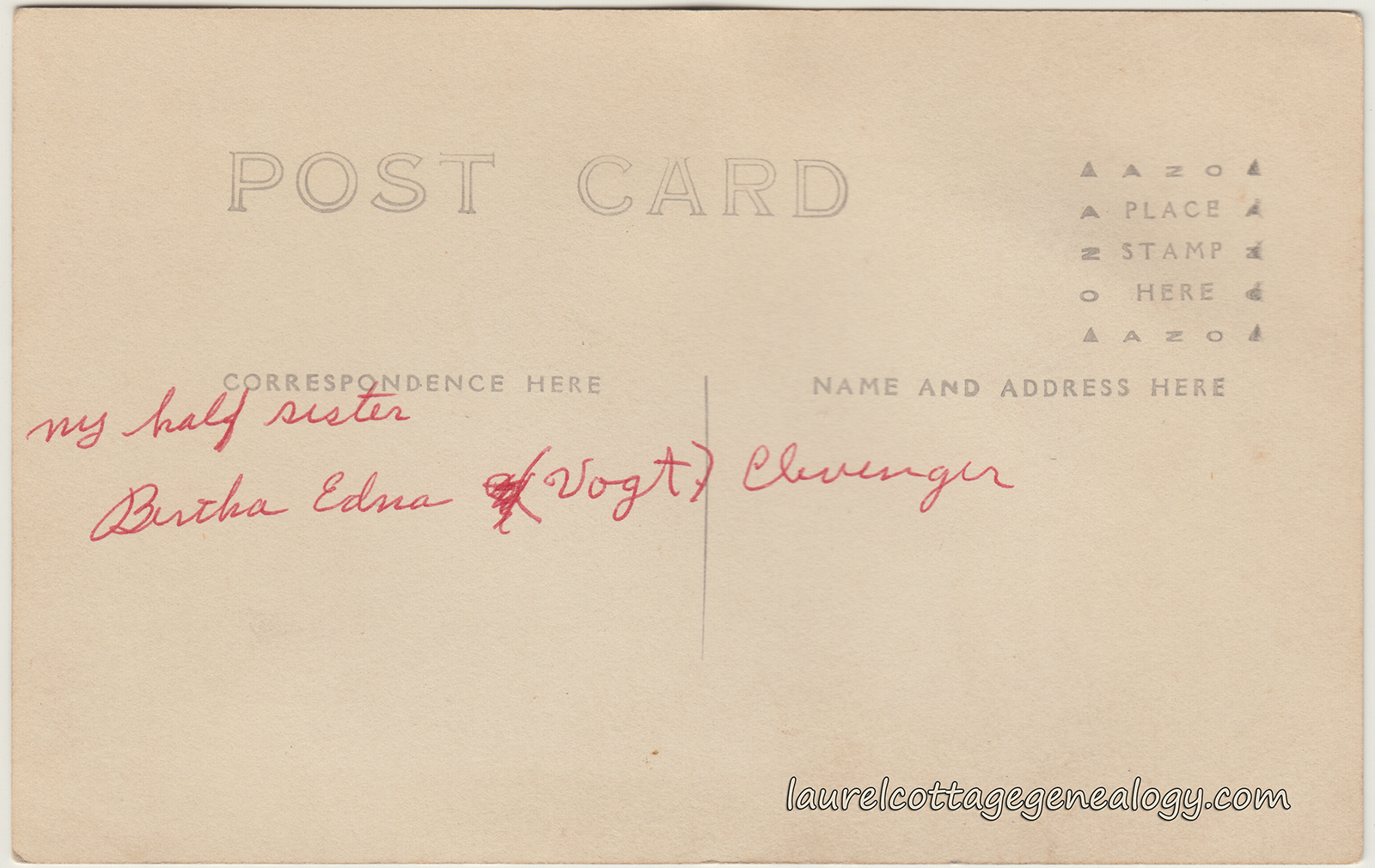
Real photo postcard with AZO stamp box (with all four triangles pointing upward) of a young woman who is identified on the back as,  “my half sister Bertha Edna (Vogt) Clevenger”, posing in a garden setting in front of a latticed arch, and what looks to be a well-established climbing rose. She wears a summery white or very pale colored dress, or perhaps a skirt and blouse, it is hard to tell, but with a high collar and a charming bonnet.

The Find A Grave website shows a Bertha Edna Clevenger, born October 30, 1901 and died June 1, 1977, and her husband is identified there as John Frank Clevenger, though his WWI and WWII draft registration cards show his full middle name as Franklin. Surprisingly, not much was found, as of the date of this post, for Bertha before she married John, and also nothing to identify her half-sibling. Records show that both Bertha and John were born in Tennessee. The 1930 Federal Census taken in Westmoreland Township, Imperial County, California, shows that Bertha was age 15, and John age 24, when they married, and show’s John’s occupation on the 1930 as Foreman for a vegetable ranch.

Divided back, Real Photo Postcard, unused with writing. AZO stamp box. Circa 1914 -1918.

Price:  $15.00

Sources:  Find A Grave Memorial# 112317084 (www.findagrave.com)

“United States World War I Draft Registration Cards, 1917-1918,” index and images, FamilySearch (https://familysearch.org/pal:/MM9.1.1/KZ6W-TFM : accessed 23 Apr 2014), John Franklin Clevenger, 1917-1918; citing Chattanooga City no 2, Tennessee, United States, NARA microfilm publication M1509, (Washington D.C.: National Archives and Records Administration, n.d); FHL microfilm 1852926.

“United States World War II Draft Registration Cards, 1942,” index and images, FamilySearch (https://familysearch.org/pal:/MM9.1.1/V485-XCT : accessed 23 Apr 2014), John Franklin Clevenger, 1942; citing ARC identifier 603155, National Archives and Records Administration, Washington D.C.; FHL microfilm 2416310.

“United States Census, 1900,” index and images, FamilySearch (https://familysearch.org/pal:/MM9.1.1/MSCY-LN1 : accessed 23 Apr 2014), John F Clevenger in household of Allen C Clevenger, Civil District 12 Rockwood town (pt.), Roane, Tennessee, United States; citing sheet 11B, family 219, NARA microfilm publication T623, FHL microfilm 1241593.

Year: 1930; Census Place: Westmoreland, Imperial, California; Roll: 119; Page: 30B; Enumeration District: 0051; Image: 973.0; FHL microfilm: 2339854. Year: 1940; Census Place: Westmorland, Imperial, California; Roll: T627_210; Page: 2A; Enumeration District: 13-46. (Ancestry.com)

Pickard’s Gentleman

Pickards Gentleman pc1Pickards Gentleman pc2

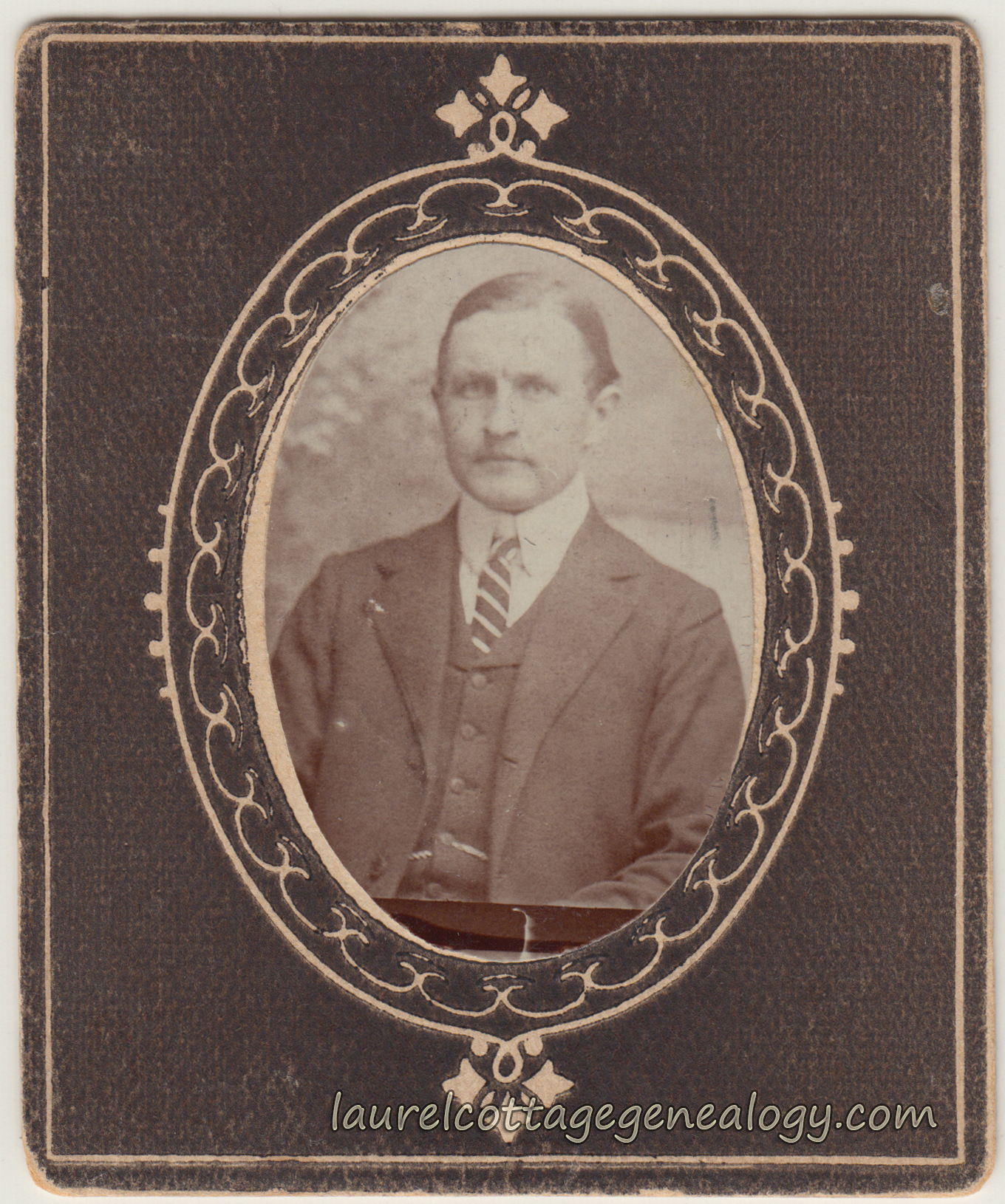
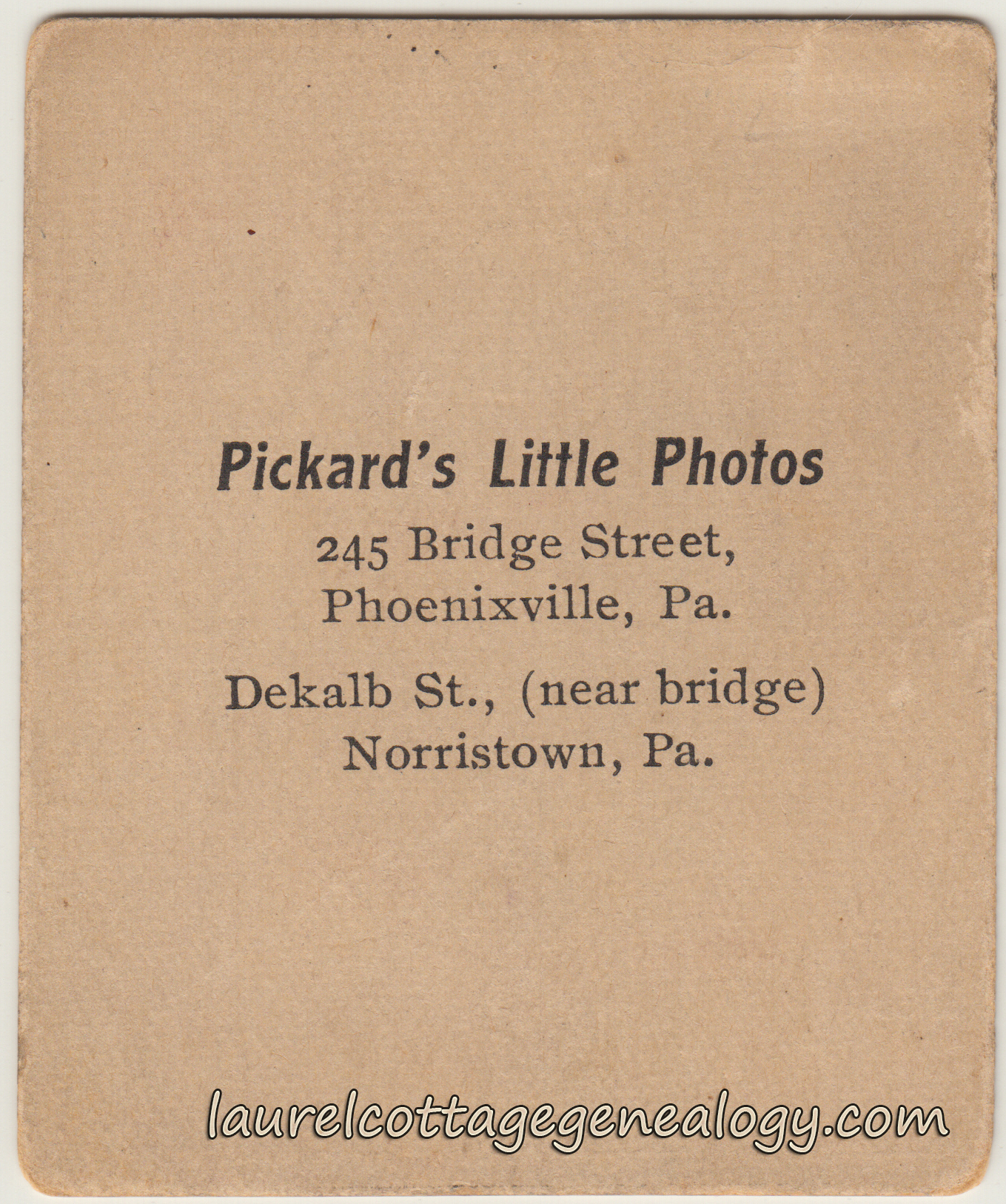
Mini photo of unknown gentleman taken by a studio shown on the back as Pickard’s Little Photos. The addresses given are 245 Bridge Street, Phoenixville, Pennsylvania and Dekalb Street (near the bridge) in Norristown, Pennsylvania. Although it appears that there is something underneath this photo (like a mystery photo – wouldn’t that be cool!) there really isn’t. The oval is one complete image that was glued on to the cardboard frame. It would seem that the part at the bottom must of been an error that occurred in the photo processing.

Surprisingly, nothing was found regarding this studio, nor the photographer, as of the date of this post, with the exception of another photo (on eBay) by the Pickard studio, showing the 245 Bridge Street address, with an estimated date from the 1890s. So, this is another for the mystery pile, and one to re-visit later, for more research.

As for the gentleman in the photo, he looks to be about in his late 20s – early 40s, is seated and wearing a suit coat with vest, a white shirt with high turned-down collar and striped tie. The photo is done in brown tones, with the cardboard frame in brown and a nice scroll work design in a cream color that frames the oval photo. The date is unknown, circa 1910s – early 1920s.

Size including cardboard frame:  About 2 and 1/2 x 2″

Price:  $7.00

Bunnies In The Backyard

Bunnies In The Backyard pc1Bunnies In The Backyard pc2

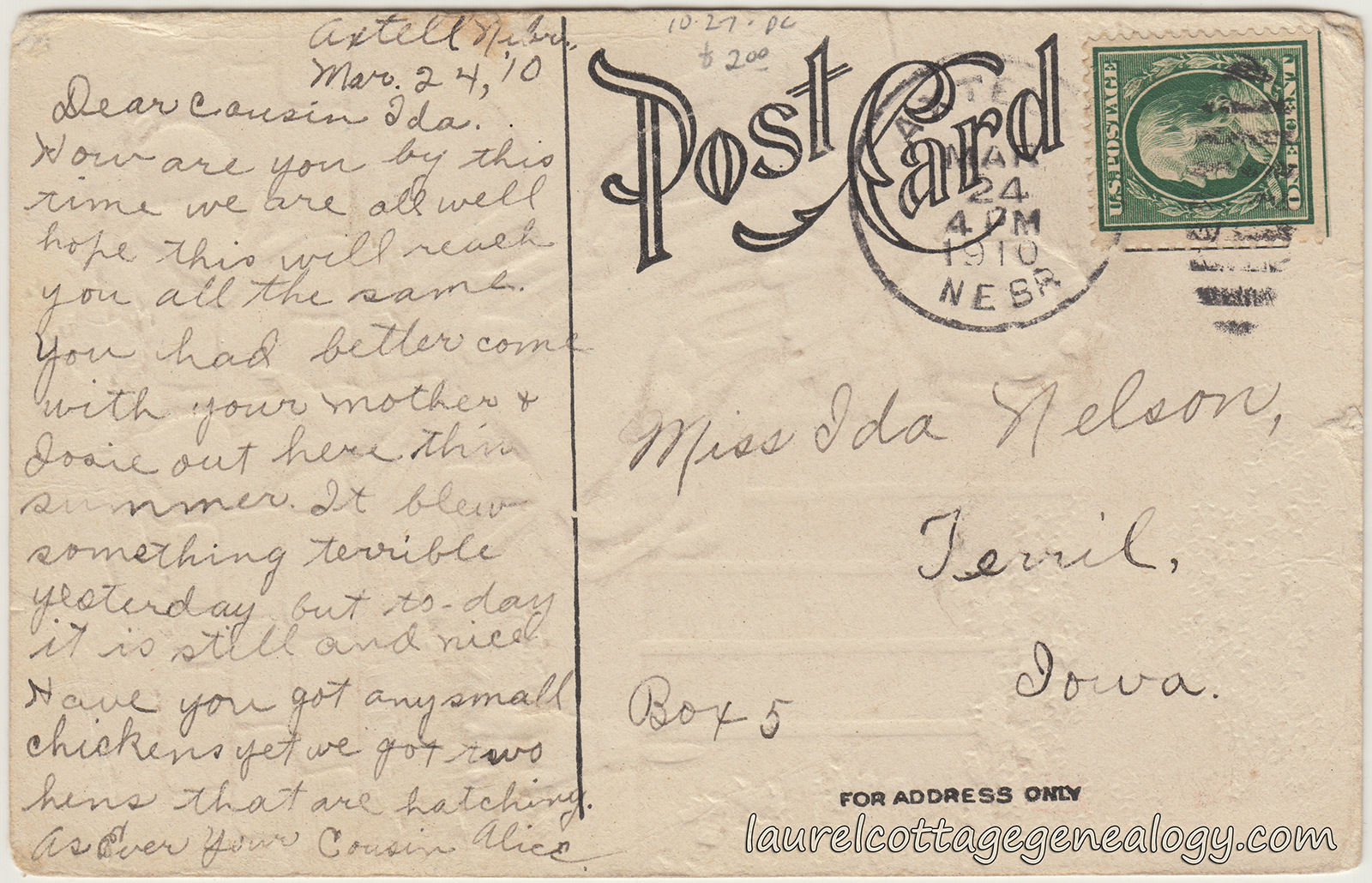
Divided back, lightly embossed, used postcard. Postmarked March 24, 1910 from Axtell, Nebraska. Publisher unknown.

Price:  $4.00

“Axtell Nebr., Mar. 24, ’10 – Dear cousin Ida. How are you by this time we are all well hope this will reach you all the same. You had better come with your mother and Josie out here this summer. It blew something terrible yesterday but to-day it is still and nice. Have you got any small chickens yet we got two hens that are hatching. As ever your Cousin Alice.”

Addressed to:  “Miss Ida Nelson, Terril, Iowa, Box 5”

Tea with kitty, breakfast with bunny….

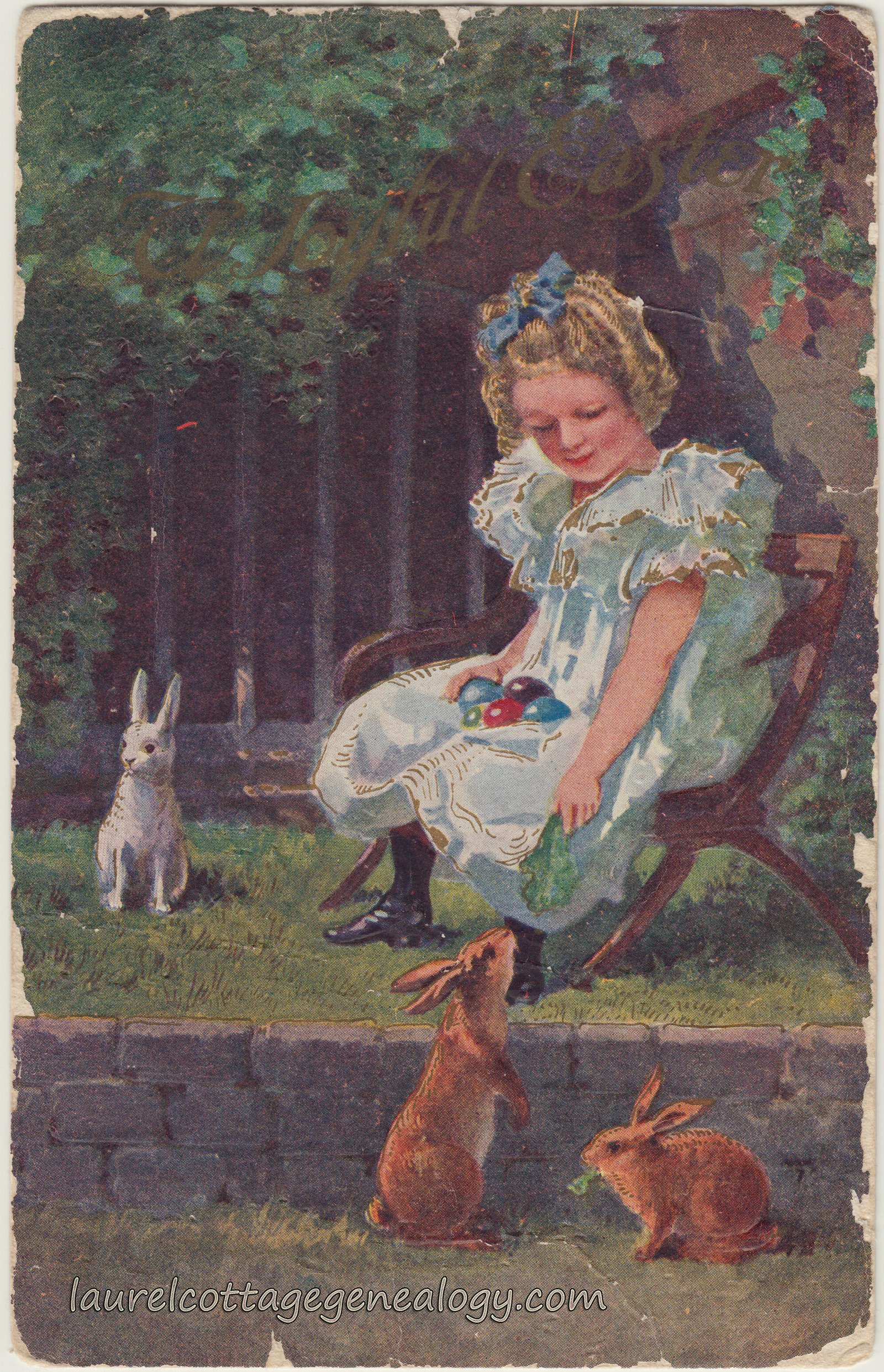
This is a great card for me, as it so reminds me of myself with our own bunny (as previously mentioned on a prior post.) After, what I’ve come to refer to as  “Tea With Kitty”  comes  Breakfast With Bunny.”  Breakfast with the bun takes place in the backyard, in a setting much like the one here, with a high fence, and greenery, and with me on the garden bench with my cereal, and the bun bun, just like on this card, to my left, with her varied plateful of kale, parsley, roses, dandelion leaves and flowers, etc. (Enough about me, but it is interesting to find the ones where art imitates life or there is some special connection.)

You might not notice at first, the caption in script at the top which says,  “A Joyful Easter.”  And just to describe the card, it shows two reddish brown bunnies and a white one (the lookout maybe, making sure everything is okay) in a garden setting. The brown bunnies are being fed some greens by a little girl in her Easter dress, who sits on a garden bench. She has gold ringlets, and holds Easter eggs in her lap.

The receiver of this card was not found in online records, though there are plenty of Nelsons in Dickenson County, and even in the town of Terril.