Genealogy Services, Old Photos, Postcards, Trade Cards, Etc.

Our New Church

Our New Church pc1Our New Church pc2

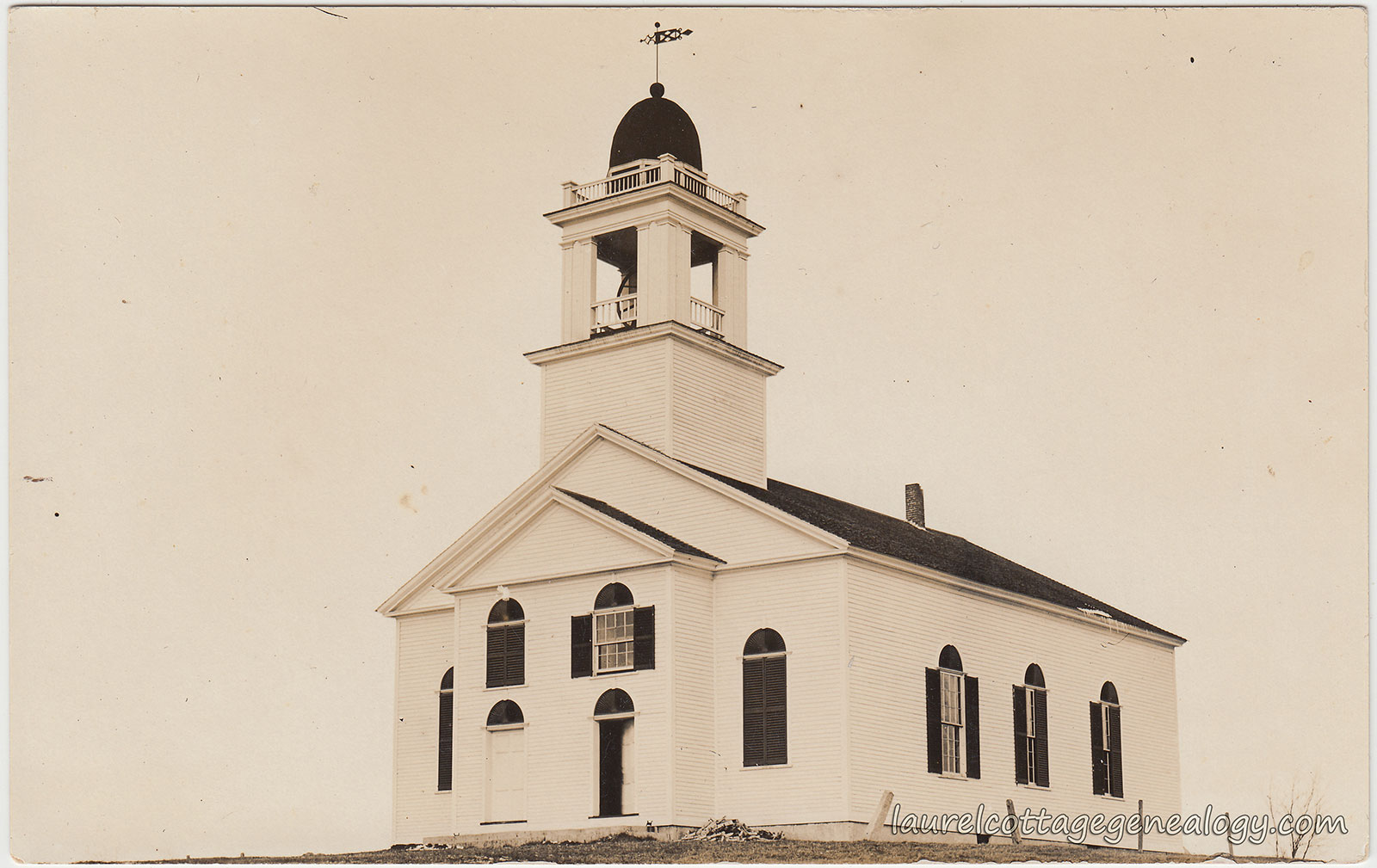
My guess is that this is a church, newly built. We see a small pile of scrap lumber on the ground, and obviously there are no trees or large bushes, other than what we can see on the right, and this looks like something originating from the other side of the small hill that the building sits on. The season is winter or early spring:  There are no leaves on that bush or small tree, and there are a few icicles hanging from the roof. I am no architect but have come to appreciate houses, churches etc. and their features, from pouring over online images and looking in the used book that I bought which identifies the different architectural styles of American homes. What I thought was a little unusual about this building is the fact that it has two separate front doors. I found what I believe to be the explanation for this from Frank D. Myers on his wonderful Lucas County, Iowa blog. In some churches, in days gone by, men and boys sat on one side and women and girls on the other, and they used separate doors. The other noticeable features about this structure are the widow’s walk, the cupola and the weather vane. One would assume there would be a bell in the tower but we can’t really see. It looks like what we do see is a spiral staircase leading up to the widow’s walk. So, was this church close to the sea, in order to watch for sailors on their return home? That would be a romantic thought, but perhaps it was to watch out for the parishioners or just a nice architectural feature that the congregation liked, or maybe it was even modeled after another church in the architect’s home town. Well, these types of suppositions could go on forever!

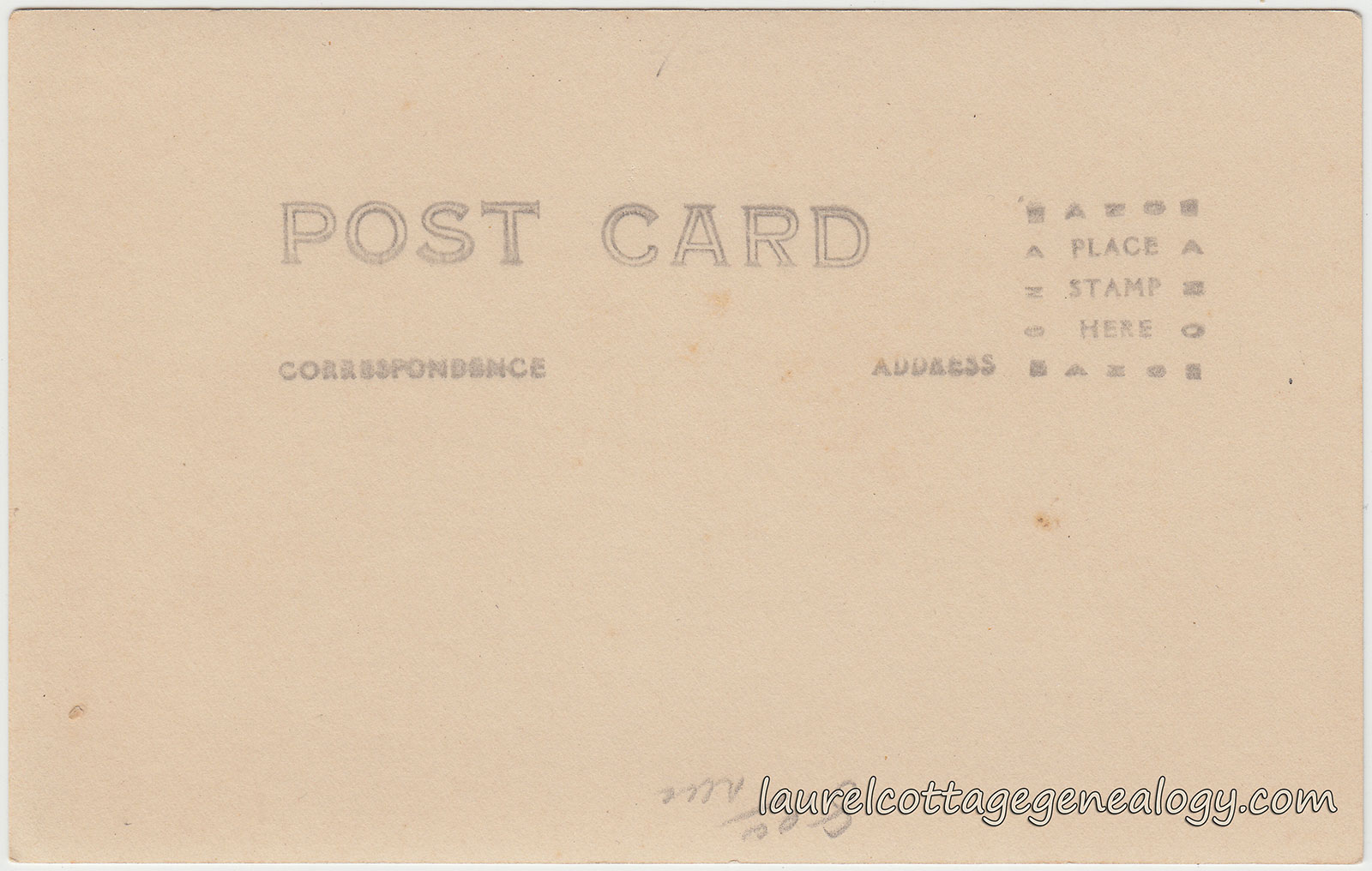
As far as the possible date of this postcard, per the excellent Playles.com website, this particular AZO stamp box has been found between dates of 1924 – 1949. If you notice the writing in pencil on the back that is just the price that was listed when I bought it. A little higher priced than normal if I payed that much (I forget) but these type of photos – a building standing alone, white background like a blank slate, the clarity of the photo, these type are impossible to resist.

Divided back, unused, Real Photo Postcard. AZO stamp box with squares in each corner and with the words “Place Stamp Here” in the center. Circa 1924 – 1949.

Price:  $15.00

Source:  Myers, Frank D. “World War II:  Lessons in their dying.”  Lucascountyan.blogspot.com. May 31, 2010. Web accessed January 17, 2015
A Dapper Gentleman

A Dapper Gentleman pc1A Dapper Gentleman pc2

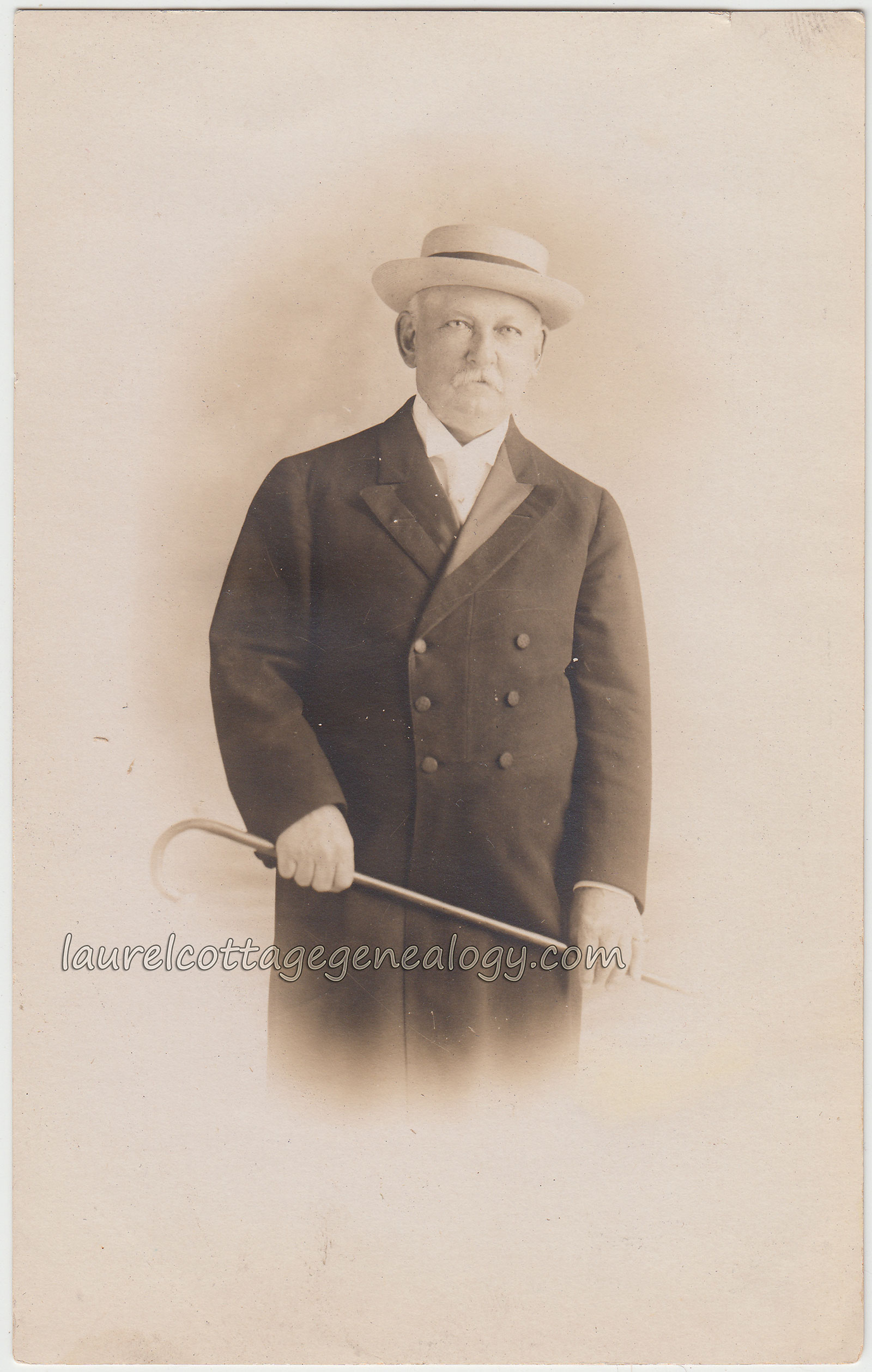
This man reminds me of Frank Morgan, the actor who played the Wizard of Oz. But he’s an unidentified gentleman, very dapper in his dark double-breasted coat, light-colored hat with upturned brim and dark hatband, carrying a cane. I would estimate him to be in his late 60s or early 70s. The AZO stamp box with all triangles pointing upward, and the fact that it’s a divided back postcard, suggest an approximate date of 1907 – 1918.

Divided back, Real Photo Postcard. Circa 1907 – 1918.

Price:  $7.00

Landseer Cards By Shober & Carqueville

Landseer c1Landseer c2Landseer c4


Landseer c3Landseer c5


Landseer c6

Trade cards, set of five. Circa 1885 – 1894. Shober & Carqueville Lithograph Co., Chicago Illinois.

Price for the set:  $15.00     Size:  About 2 and 3/4 x 4 and 1/4″

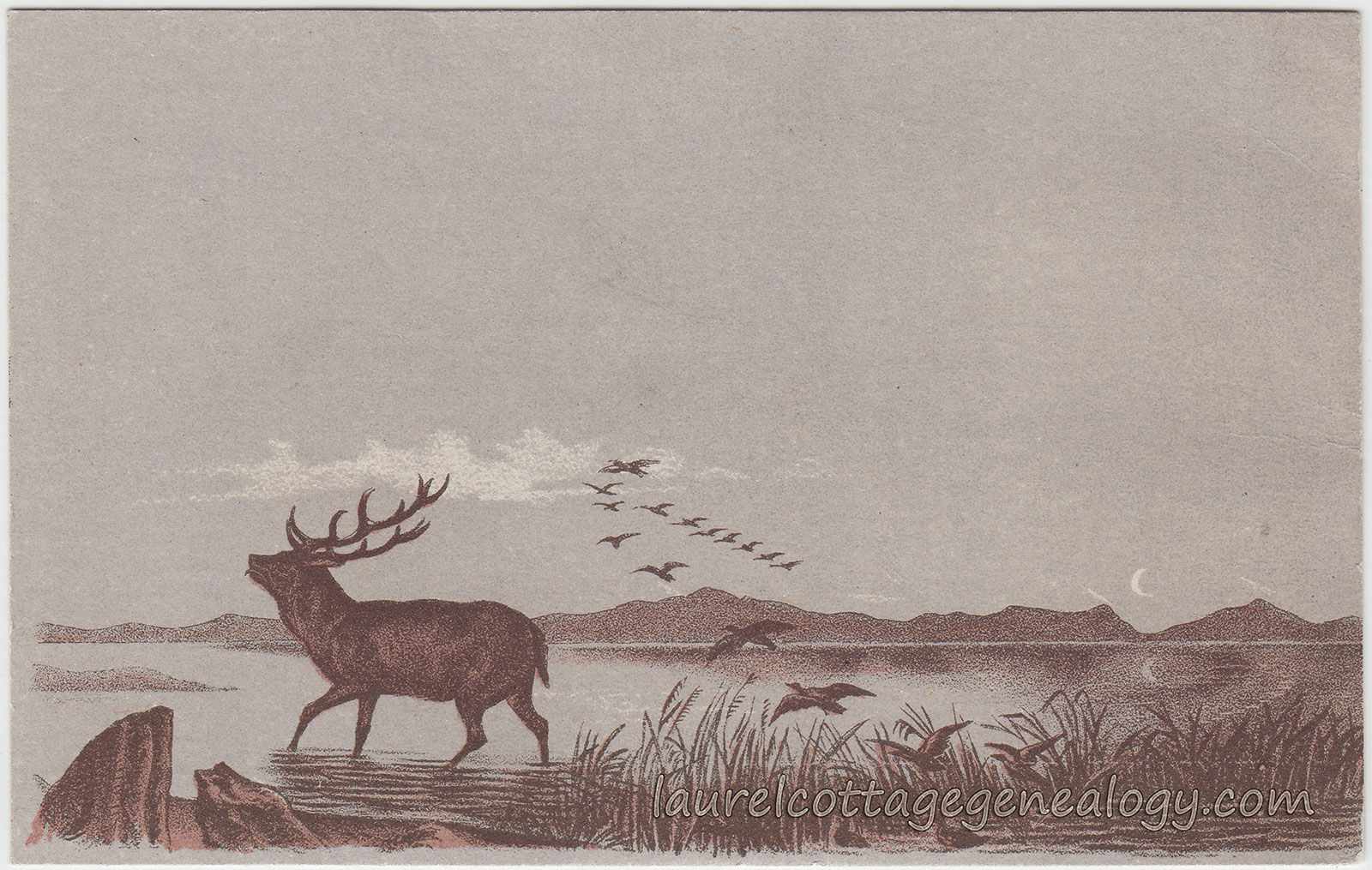
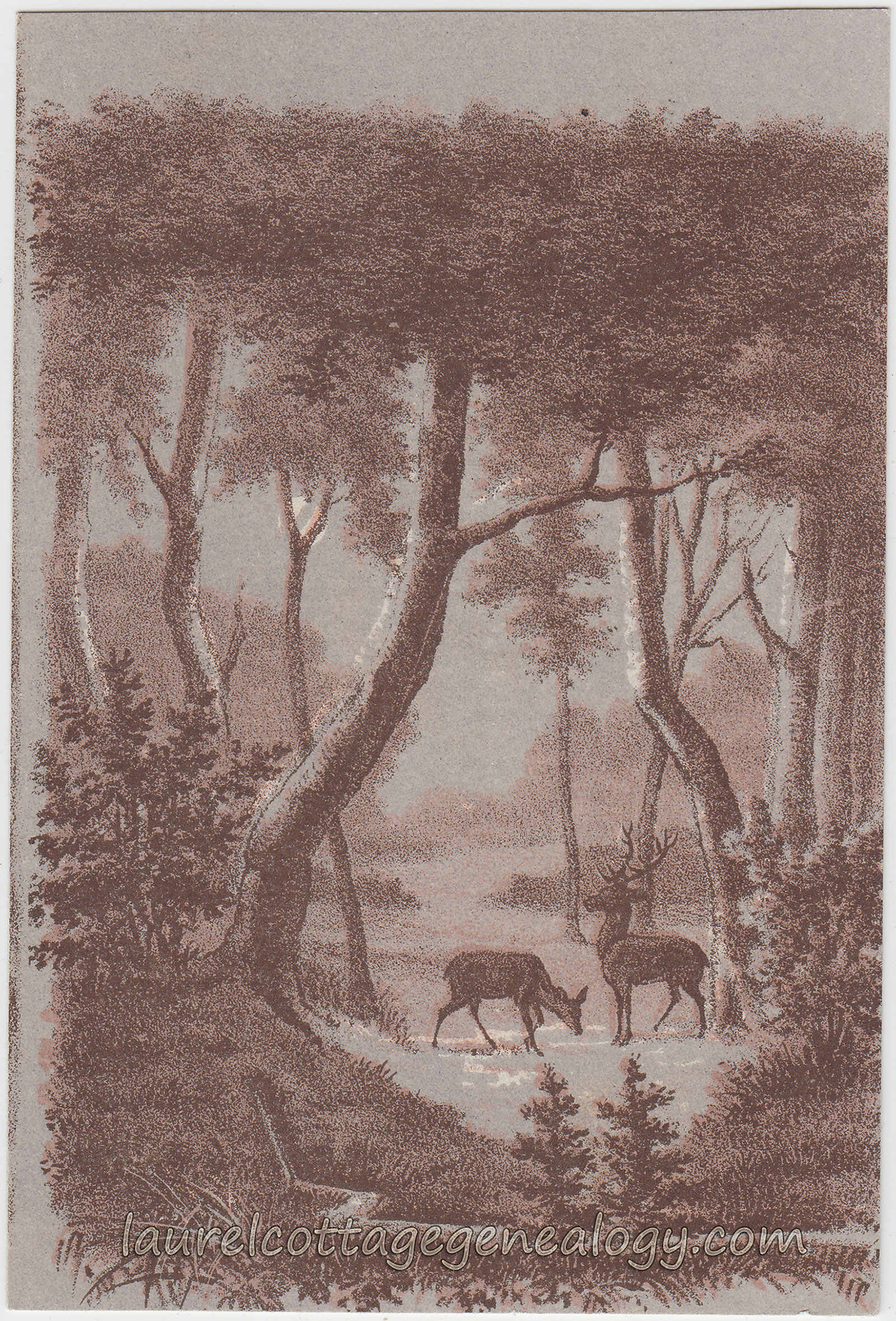
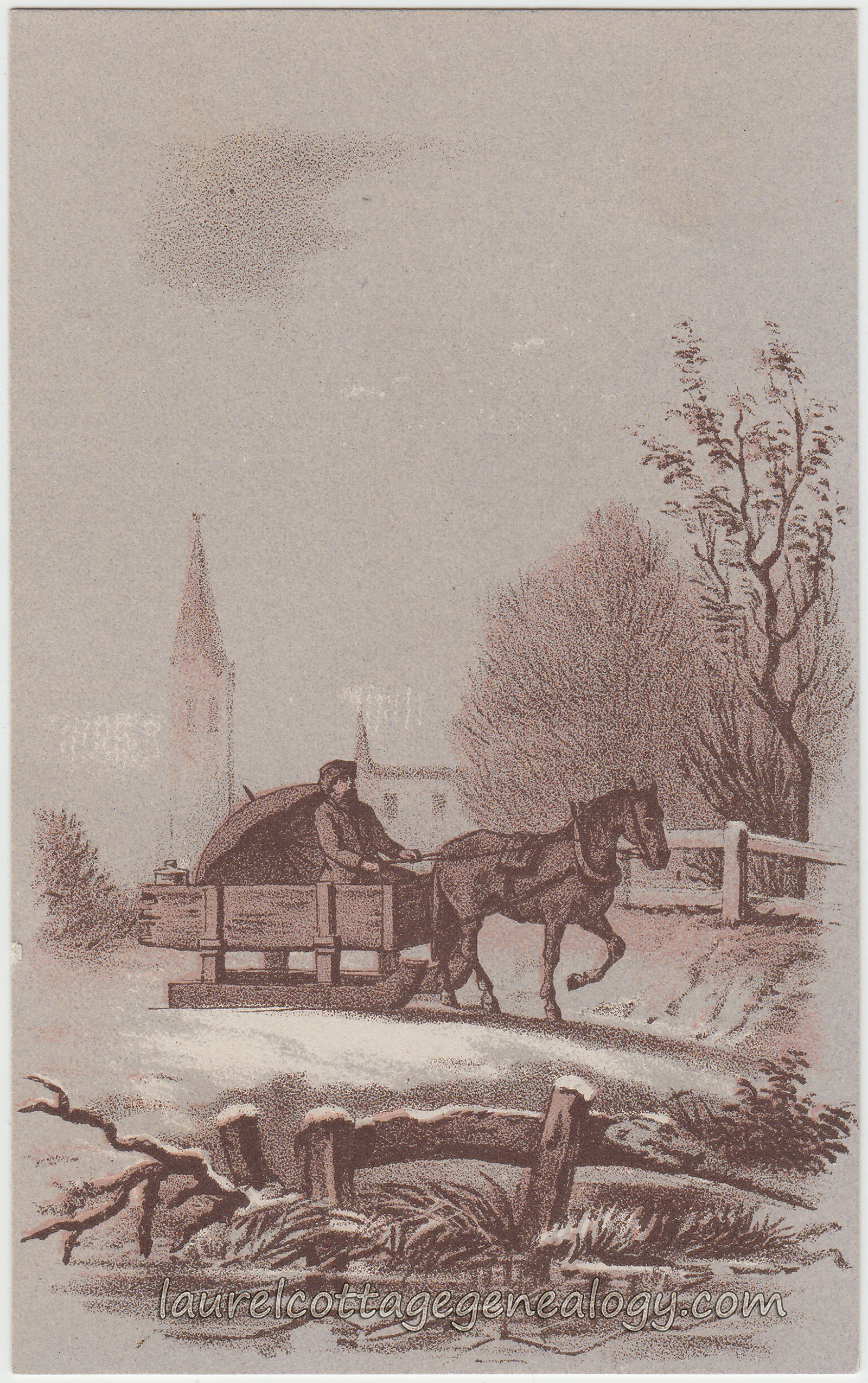
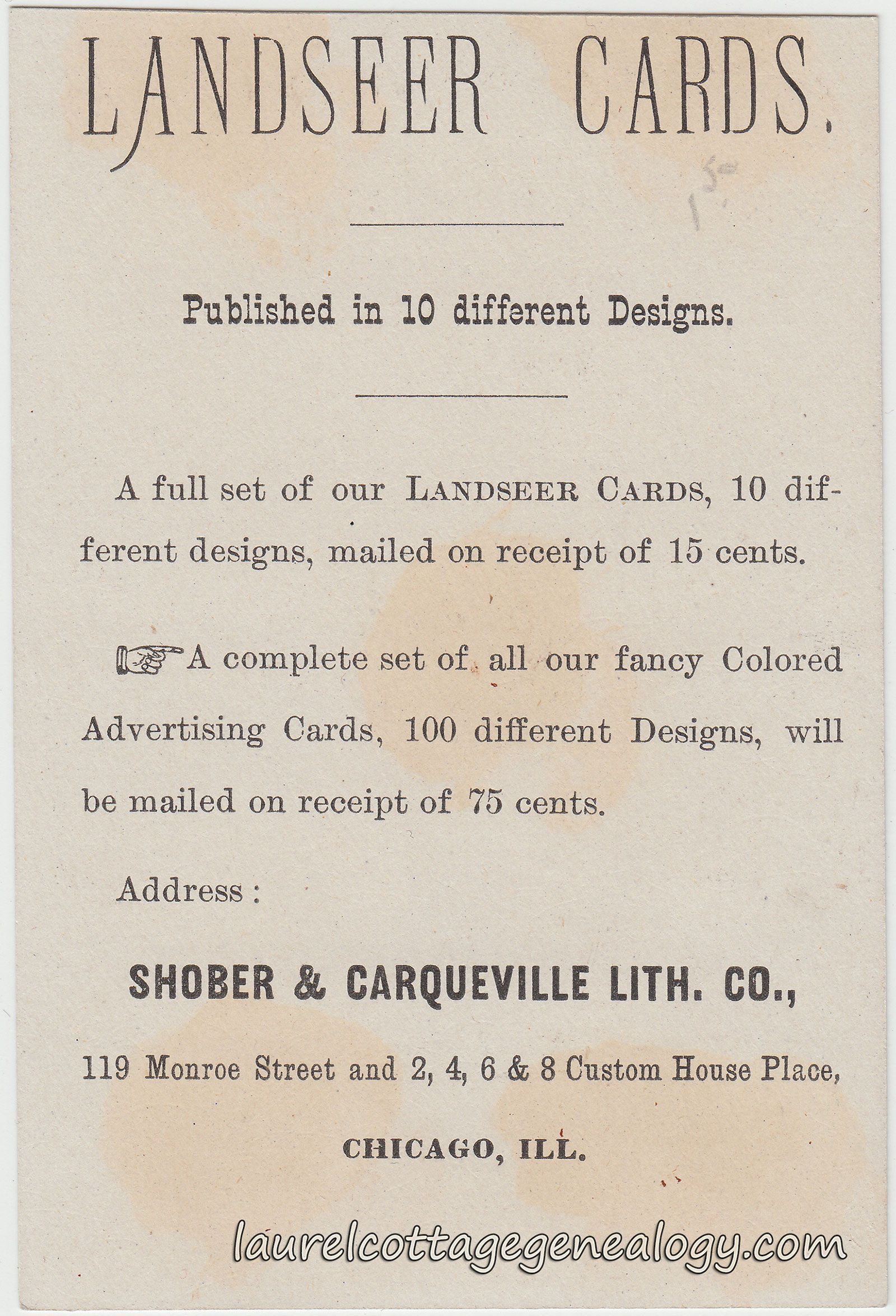
A set of five advertising cards put out by the Shober & Carqueville Lithograph Company of Chicago, showcasing at least one lithograph based on the artwork of London-born Sir Edwin Landseer (1802 – 1873.) Per a Wiki entry, there were fourteen Landseer children, seven of whom survived to adulthood, and all seven became artists. Edwin’s older brother Thomas (1793 or ’94 -1880) is known for having done engravings and etchings of Edwin’s work. The last image shown here, that of the man driving the horse-drawn sled, does not have any printing on the back, but all the others show the same identification as the image directly above. The top left of the majestic stag is easily verified as being from the famous oil painting by Edwin Landseer, which was done in 1851 and is called The Monarch of the Glen. (Yes, I know there was a British t.v. series, too, by this name!) If you’ve clicked on the link, you’ve found that this painting (not to mention the artist’s themselves) has had a rather fascinating story to tell. You’ll also immediately notice that the mountains and clouds in the original are missing from the trade card displayed here.

The Shober & Carqueville Lithograph Company was formed from the association of Charles Shober and Edward Carqueville. According to biographical info in volume 4 of Industrial Chicago, Carqueville was born in Posen, Prussia in 1841, coming to Chicago in 1857. He began working for Keen & Shober, where he learned the art of lithography. In 1865 he formed the Chicago Lithograph Company which operated till it was destroyed by the Great Fire of 1871. Afterwords the Charles Shober & Company was formed, with Carqueville as a partner. This name later changed to the Shober Lithograph Company, and then to the Shober & Carqueville Lithograph Company. The latter name was supposedly in place by at least 1894, when it was mentioned as the “current” name for said company in the aforementioned Industrial Chicago publication, but we see this company name as early as 1885 per Chicago city directories. From online records we see that Edward Carqueville had a number of sons to carry on the business and it appears (from the city directories again) that the company was being passed down around 1896 or so, with the 1896 directory for Edward showing the business name of Carqueville Lithograph Company, and evidence of one or more of his sons appearing in business with him. Edward Carqueville died in March of 1898.

Sources:  The Monarch of the Glen. n.d. http://en.wikipedia.org/wiki/The_Monarch_of_the_Glen_%28painting%29 (accessed January 15, 2015).

Edwin Henry Landseer. n.d. http://en.wikipedia.org/wiki/Edwin_Henry_Landseer (accessed January 15, 2015).

Thomas Landseer. n.d. http://en.wikipedia.org/wiki/Thomas_Landseer (accessed January 15, 2015).

Industrial Chicago: The Commercial Interests, Vol. 4. Chicago:  The Goodspeed Publishing Company, 1894. p. 487. (Google eBook)

Edward Carqueville. Find A Grave Memorial# 119060120. (Findagrave.com)

The Lakeside Annual Directory of the City of Chicago,1885. Chicago:  The Chicago Directory Co. p. 292. Ancestry.com. U.S. City Directories, 1821-1989.

The Lakeside Annual Directory of the City of Chicago,1896. Chicago:  The Chicago Directory Co. p. 385. Ancestry.com. U.S. City Directories, 1821-1989

Hotel Tuller & Grand Circus Park

Hotel Tuller and Grand Circus Park pc1Hotel Tuller and Grand Circus Park pc2

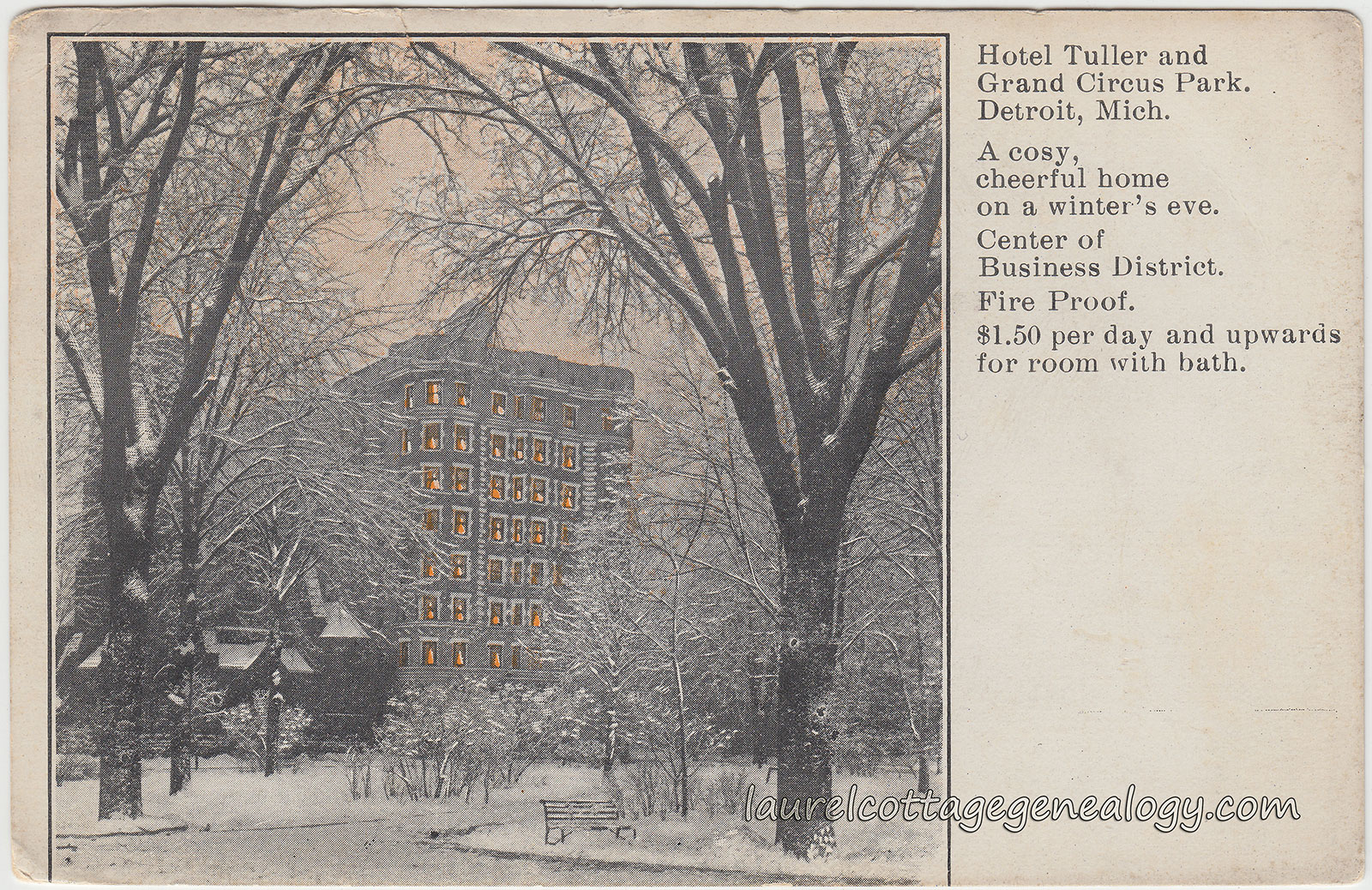
“Hotel Tuller and Grand Circus Park. Detroit, Mich. A cosy, cheerful home on a winter’s eve. Center of Business District. Fire Proof. $1.50 per day and upwards for room with bath.”

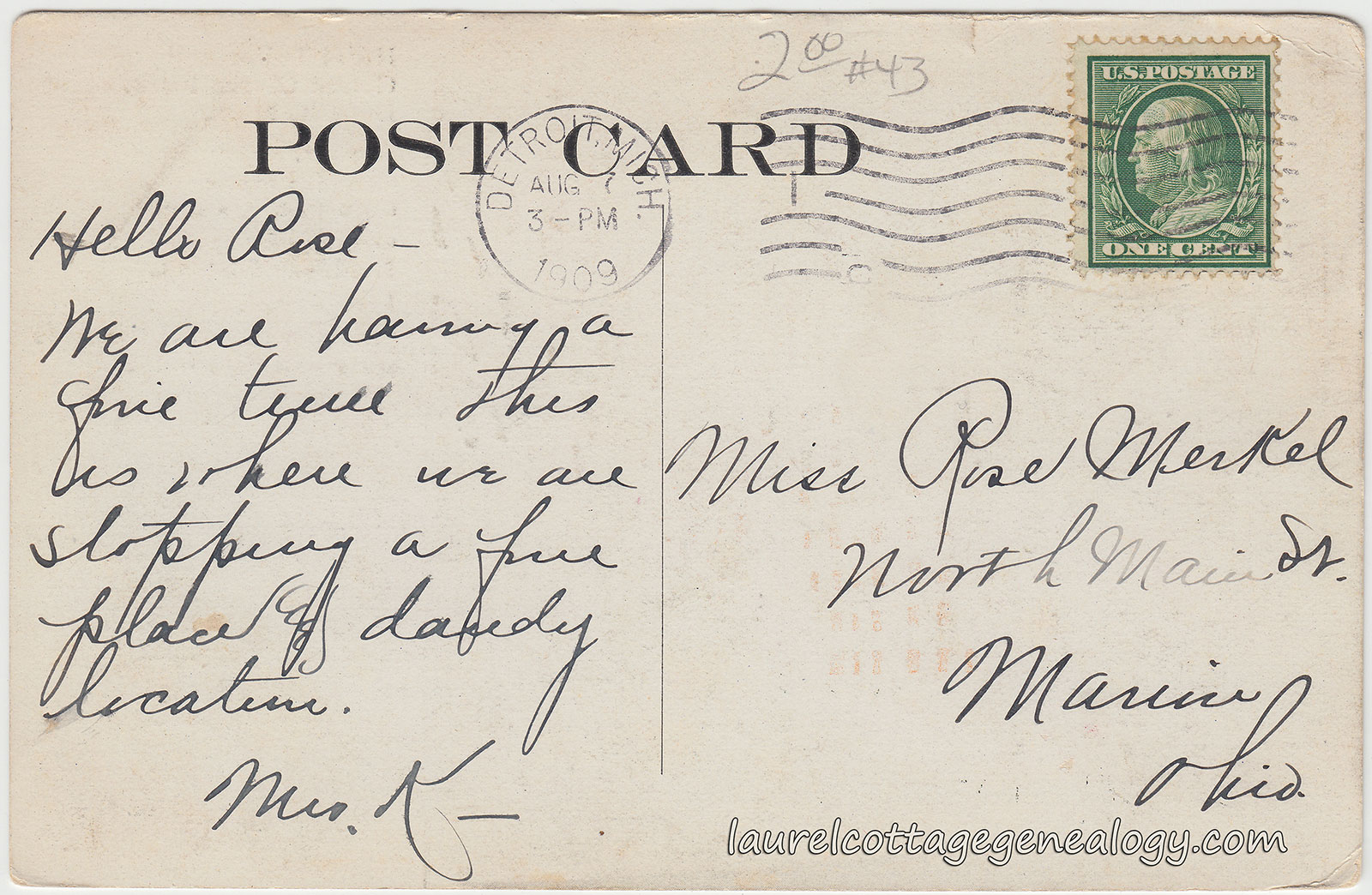
That’s the caption for the above tinted postcard photo. Fireproof would have been a big draw in the early 1900s, and we notice a different spelling for cozy than we use today. The card was addressed to:   “Miss Rose Merkel, North Main St. Marion, Ohio.”

The sender wrote:   “Hello Rose – We are having a fine time. This is where we are stopping a fine place and dandy location. Mrs. K -”
It’s kind of funny that this winter postcard was sent in August.

Rose is Rose C. Merkle, a dressmaker and long-time North Main Sreet resident. (It looks like the postcard sender, Mrs. K., had misspelled Rose’s last name.) According to the 1909 city directory Rose was boarding at 536 N. Main; later she moved to a home on 464 N. Main. The interesting thing about the 1917 city directory is that it lists Rose’s business name as “Merkle Sisters” (dressmakers) and lets us know that she and sister Minnie M. Merkle were in business together. The 1910 Federal Census for Marion shows the sisters, Wilhelmina, age 39, younger sister Rose, age 38; siblings Bertha L., age 32, saleslady; and Otto F., age 28, plumber. Head of household is widowed mother Carolina Merkle, age 64, born in Germany. The children were all born in Ohio. Next door is another Merkle family, most likely related.

Divided back, used postcard. Postmarked August 7, 1909 from Detroit, Michigan. Publisher unknown.

Price:  $7.00

Sources:  R. L. Polk & Co.’s Marion City and County Directory for 1909-1910, Vol. 9. p. 259. (Ancestry.com. U.S. City Directories, 1821-1989.)

R. L. Polk & Co.’s Marion City and County Directory, 1917-1918, Vol. 13. p 297. (Ancestry.com. U.S. City Directories, 1821-1989.)

Year: 1930; Census Place: Marion, Marion, Ohio; Roll: 1847; Page: 1A; Enumeration District: 0012; Image: 650.0; FHL microfilm: 2341581 (Ancestry.com)

Herzliche Neujahrsgrüße!

Herzliche Neujahrsgrüße pc1Herzliche Neujahrsgrüße pc2

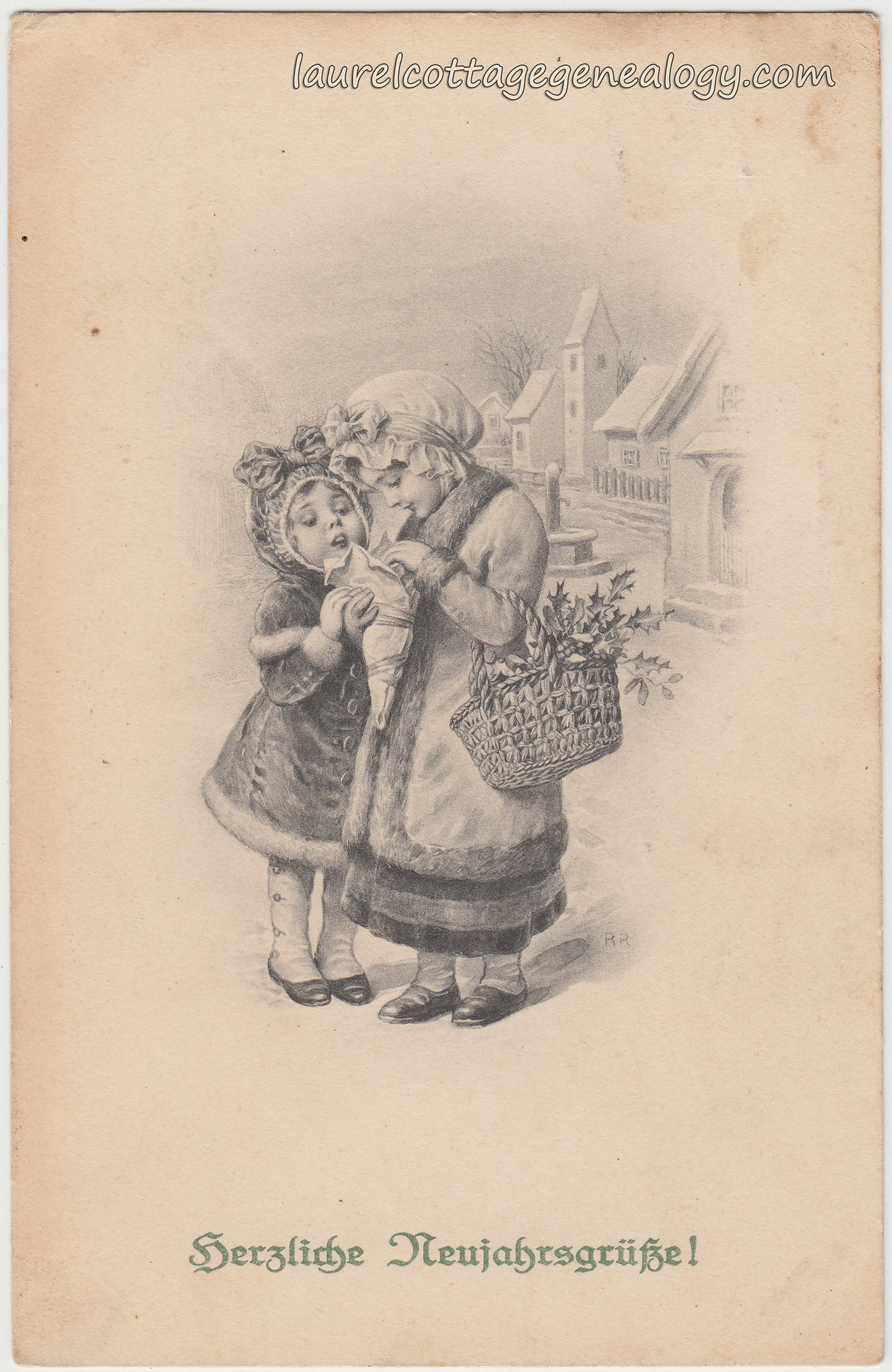
Here’s a 1920 postcard whose caption translates as “Warm New Year Greetings!” It shows an illustration of two adorable little girls, dressed for winter; the older girl carries a basket of holly on one arm. We see part of a town in the background – note the water pump. Have they just come from the local bakery? They’ve stopped on their journey to peer at the cone-shaped paper-wrapped package that the older girl is holding. Would this have been a traditional German New Year’s treat? Perhaps someone can enlighten us on this point!  This artwork was signed with only the initials, “R.R.”

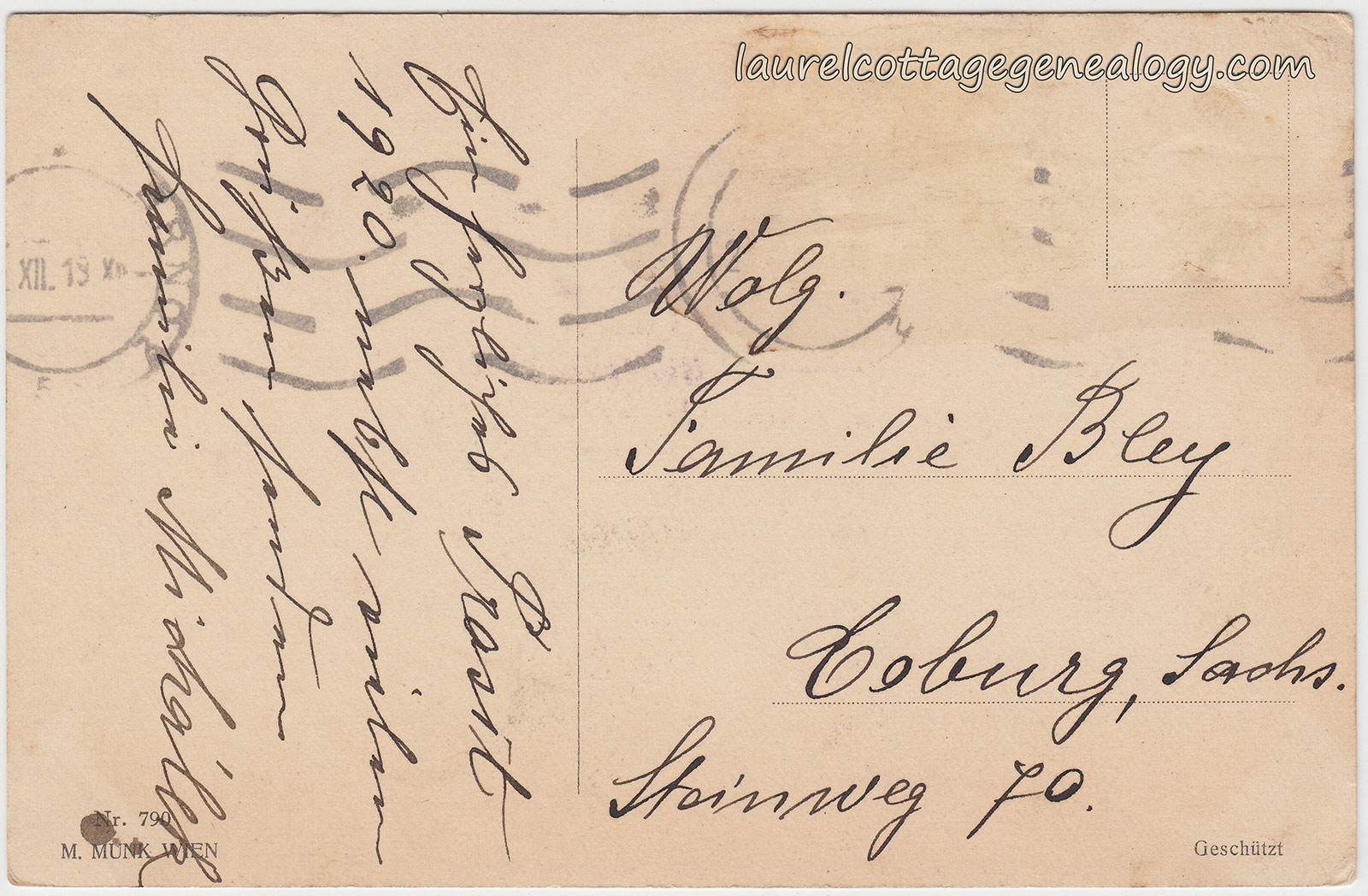
The back of the card was addressed to:  “Wolg. Familie Bley, Coburg, Sasch. Steinweg FO[?].”  Steinweg I believe is the street the Bley family was living on in the town of Coburg. The sender’s message is hard to determine, though. I’m not sure if it was written in German or possibly Czech? It appears to be signed,  “familie Michálek”  or Mihálek?

Publisher M. Munk is possibly Max Munk or Marcus Munk; both first names are showing up on other websites. This will take some additional research. For now, this web author is off to make some German pastries, having been inspired by this postcard!

Divided back, artist-signed, used postcard. Circa 1920. Artist’s initials:  “R.R.”  Publisher:  M. Munk, Wien, (M. Munk, Vienna) number 790. Geschützt. (Protected or copyrighted.)

Price:  $15.00

Dr. W. Derby’s Croup Mixture

Dr W Derbys Croup Mixture pc1Dr W Derbys Croup Mixture pc2

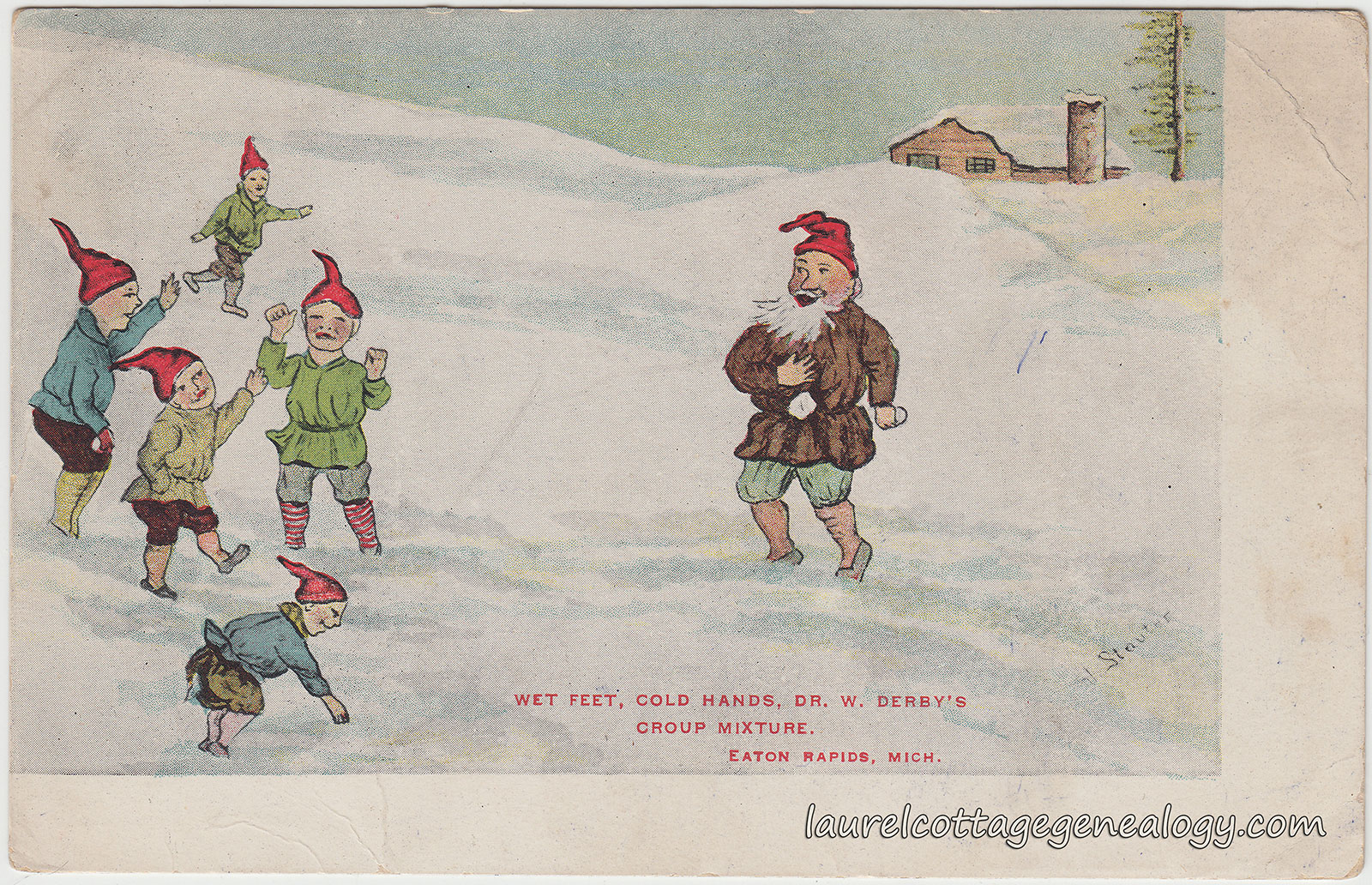
Undivided back, unused, artist-signed postcard. Circa 1906. Artist:  Stauter. Publisher unknown.

Price:  $20.00

“Wet feet, cold hands, Dr. W. Derby’s Croup Mixture, Eaton Rapids, Mich.”
is printed at the bottom of this artist-signed postcard showing merriment in winter – elves throwing snowballs.

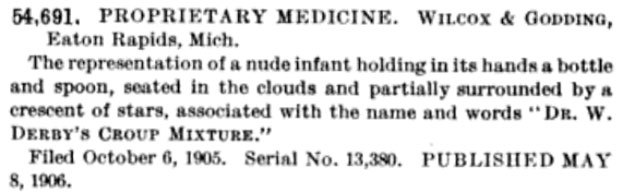
I was searching for a Dr. W. Derby in Eaton Rapids around 1900 without finding an entry. Then after finding the below patent information, wondered if Dr. Derby was a fictional name; however the 1870 Federal Census taken in Eaton Rapids shows Willougby Derby, physician and surgeon, born in New York, about 1829; his wife Hattie, born in Michigan about 1839; living with them are Annie Pomeroy, invalid, and Adelbert Garfield, domestic servant. By the 1880 census, Hattie is widowed, and the 1900 shows Hattie working as a milliner, but several doors down from her on this census is Frank Godding, born Michigan, July 1863; his wife Emma, born Michigan April 1866. Frank Godding’s occupation is Pharmacist. Their son Dan is eight years old. George Wilcox is Frank Godding’s likely partner. He appears on the 1900 as a commercial traveler (drugs), born Illinois, August 1861; his wife is Katherine, born Michigan, September 1866; their daughter Florence is five years old. So, perhaps Dr. Willoughby Derby developed the croup mixture or possibly it was named in honor of him.

Wilcox & Godding

The lower right corner of this charming postcard shows the artist’s signature, which appears to be J.? Stauter. We’ll add this to the mystery category, as the full name of the artist is unknown.

Sources:  The Official Gazette of the United States Patent Office, Volume 122, Issues 8-9. 1906. p. 3005. Web accessed January 10, 2015. (Google eBook)

Year: 1870; Census Place: Eaton Rapids, Eaton, Michigan; Roll: M593_670; Page: 231A; Image: 465; Family History Library Film: 552169. (Ancestry.com)

Year: 1900; Census Place: Eaton Rapids, Eaton, Michigan; Roll: 709; Page: 7B; Enumeration District: 0069; FHL microfilm: 1240709. (Ancestry.com)

Year: 1900; Census Place: Eaton Rapids, Eaton, Michigan; Roll: 709; Page: 14A; Enumeration District: 0069; FHL microfilm: 1240709. (Ancestry.com)

New Year Moon

New Year Moon pc1New Year Moon pc2

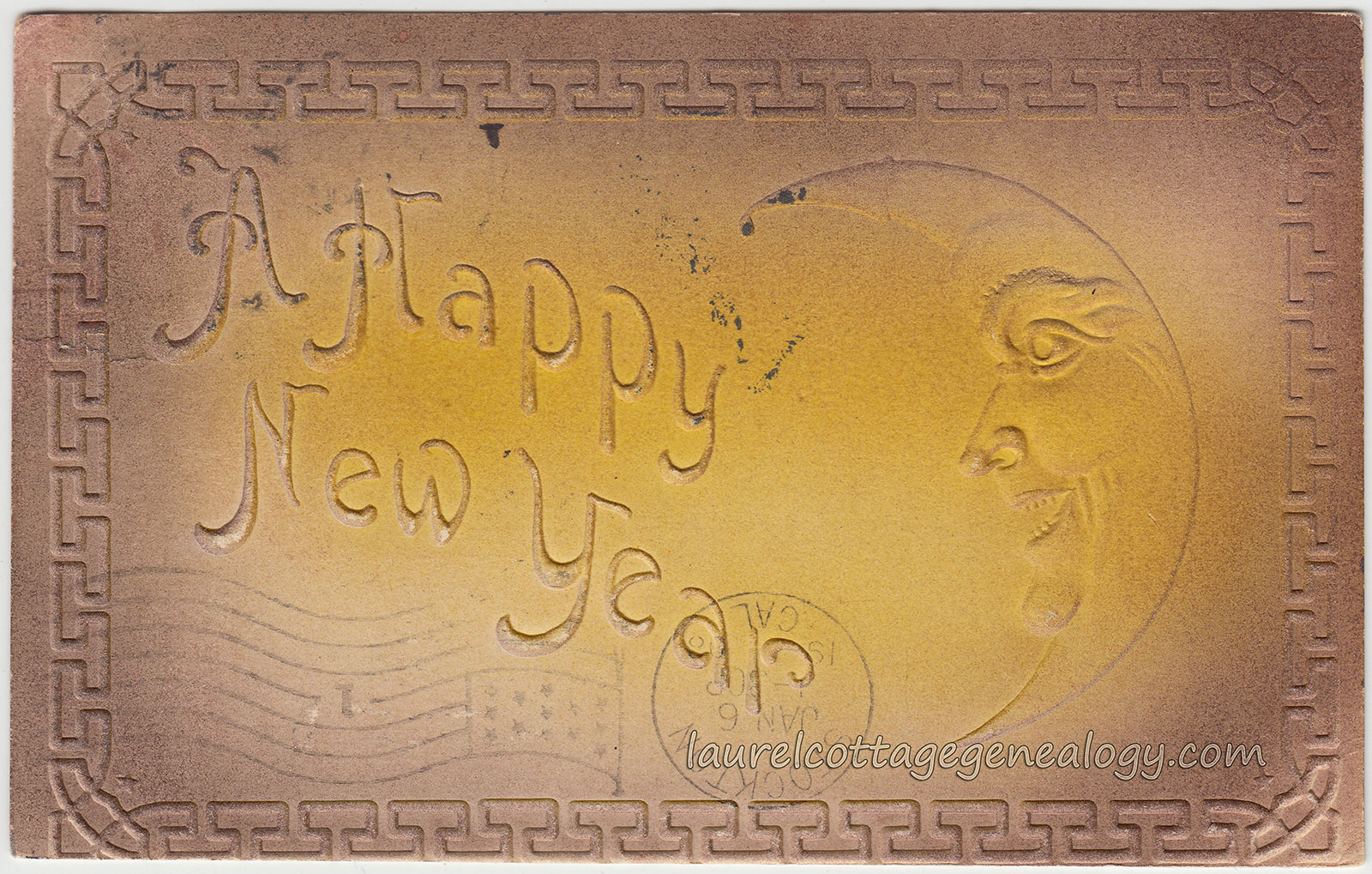
Divided back, embossed, used postcard. Outgoing postmark January 5, 1908 from Red Bluff, California. Incoming postmark January 6, 1908 in Stockton, California. Publisher:  The International Postal Card Company, Chicago.

Price:  $10.00

Running a little behind with getting posts up, so here’s another for the new year; heavily embossed with  “A Happy New Year,”  a very expressive crescent moon, and a nice geometric-style border. The sender wrote:

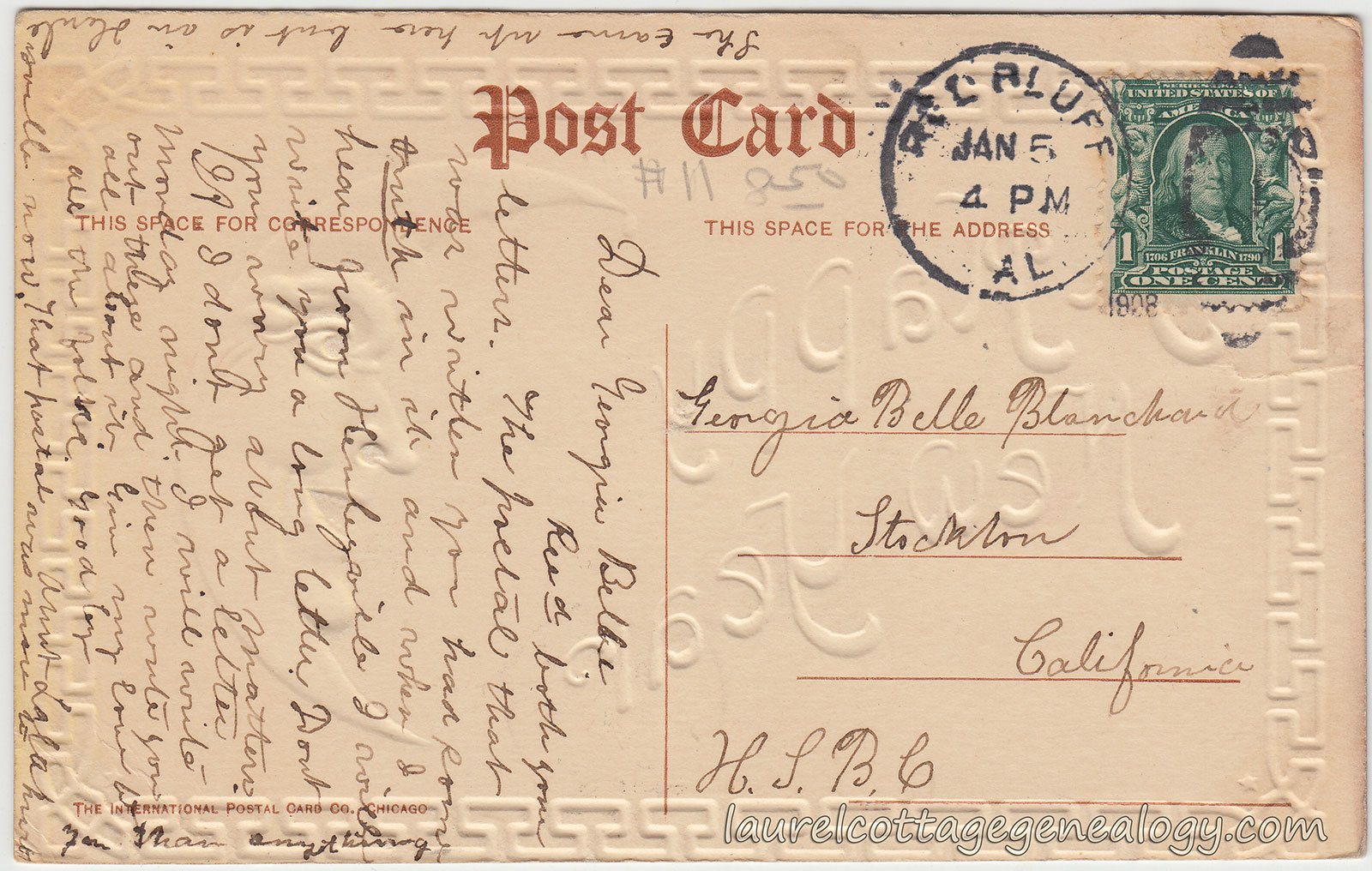
“Dear Georgia Belle. Recd both your letters. The postal that was written you had some truth in it and when I hear from Henleyville I will write you a long letter. Dont you worry about matters. If I dont get a letter Monday night I will write out there and then write you all about it. Give my love to all the folks. Good by, Aunt Lala.   That postal was more to hurt you than anything. She came up here but is in Henleyville now.”

The card is addressed to:  “Georgia Belle Blanchard, Stockton, California, H.S.B.C.”

Well, here’s a postcard message with some drama behind it! We hope that everything got sorted out and, most of all, that all hurt feelings were mended.

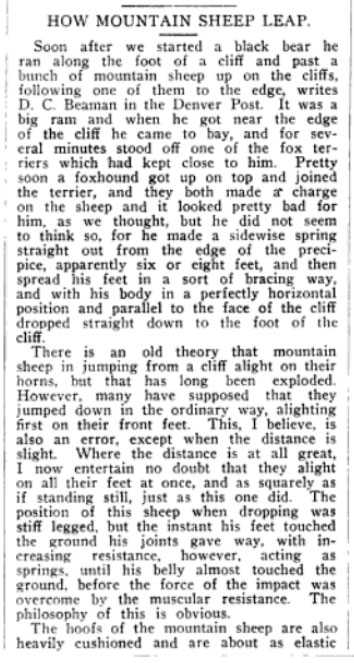
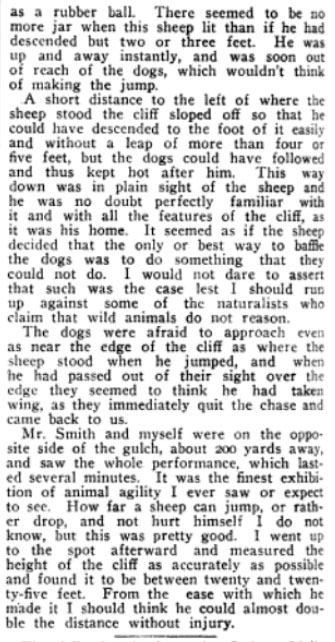
Henleyville is located in Tehama County, about 20 miles southwest of Red Bluff, but a quick online search is not showing any facts regarding current population. Around the time this postcard was written, it looks like the land supported the raising of poultry and sheep, according to a couple of old journals from 1903 and 1907. I couldn’t resist displaying this 1907 article (The American Sheep-Breeder and
Wool-Grower, Volume 27
)  by D.C. Beaman which was originally published in the Denver Post. It’s an eye witness account of a BIG LEAP.

Sheep1Sheep2

Now on to the addressee of this postcard:  A record of California births shows Georgia Belle Blanchard, born December 12, 1888 in Tehama County. Her parents are listed as Albert Simon Blanchard and Mary Catherine Burress. The 1900 Federal Census taken in Corning, Tehama County, shows Albert, born Maine, July 1849, occupation Farmer; his wife Mary K., born Missouri, January 1856; their daughters Nannie L. born December 1885, Laura[?] born July 1887, and Georgia Belle, confirming the birth record date here on this census. The Blanchard daughters were all born in California. Also in the household are Hugh Delaney, John Benson (both doing farm labor) and Jackson LeClair, machinist for the railroad. A little further up the page is an entry for another Blanchard family, that of Simon, wife Lura A. (the possible sender of our postcard?) and their children, Judson B., Lura B., Marie and Albert L. Blanchard.

On a last note, what is the “H.S.B.C.” in the postcard address? Wondering if this could stand for Humphreys Stockton Business College, which doesn’t seem to have been the official name of said college but Georgia Belle does show up in a number of city directories as Bookkeeper. Or if it was H.L.B.C. still nothing definite shows up online. Hmmm, a mystery.

Sources:  The American Sheep-Breeder and
Wool-Grower, Volume 27.
January 15, 1907. p. 568. Web accessed January 8, 2015. (Google eBook)

California, Births and Christenings, 1812-1988. Salt Lake City, Utah: FamilySearch, 2013. (Ancestry.com)

Year: 1900; Census Place: Corning, Tehama, California; Roll: 115; Page: 3B; Enumeration District: 0180; FHL microfilm: 1240115. (Ancestry.com)

Humphreys College. n.d. http://en.wikipedia.org/wiki/Humphreys_College (accessed January 9, 2015).

Publishers Ernest Nister And E.P. Dutton & Co.

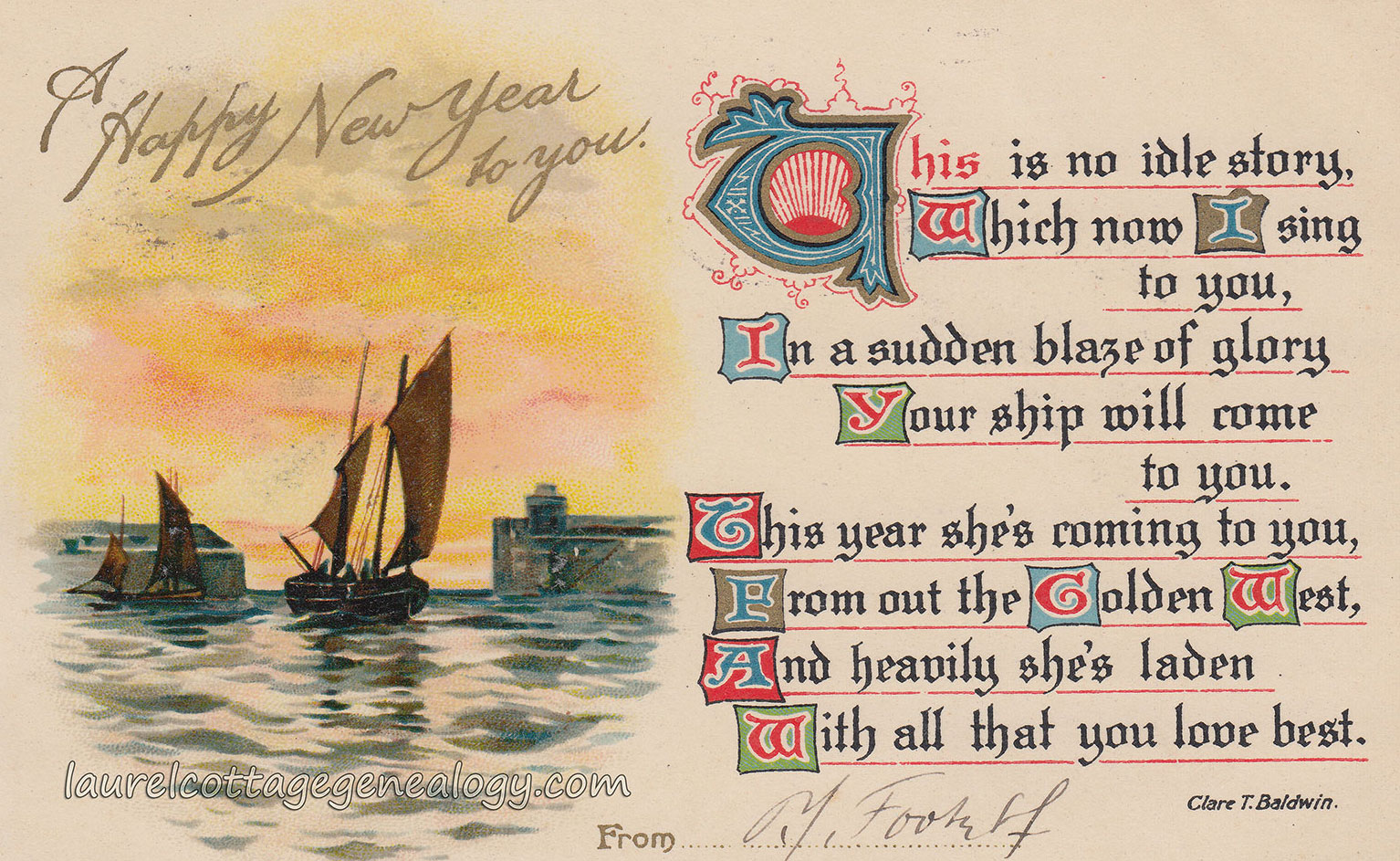
Crop of No Idle Story

Co Publishers E Nister and E P Dutton

The above are crops from the prior posting of the 1907 postcard under the title of No Idle Story. (Just click on the images to enlarge.) It shows the publisher info of Ernest Nister of London and E.P. Dutton & Co. of New York. These are two very well-known and researched names in the world of antique and vintage ephemera, so we won’t go into great detail. Briefly, Ernest Nister was a German born printer and publisher known for his superior quality children’s books in the late 19th and early 20th centuries, and known for his innovations in the pop-up and moveable picture book genre. Nister started in Nuremburg, Germany and branched out to London and New York. E. P. Dutton & Co. was an American book publishing company founded by bookseller Edward Payson Dutton in Boston in 1852. (Wondering briefly if there was any connection to Edward Payson Butler, photographer, or just coincidence.) Dutton began publishing in 1864 and then relocated to New York in 1869. His company became one of the leading U.S. publishers and worked with many famous authors. In 1986 the company was acquired by The Penguin Group. Dutton was known as both distributor for Nister, and later as co-publisher. Many collectables in the form of books, calendars, holiday cards, postcards from either/or and both companies in tandem, can be found online.

Sources:  “Ernest Nister.” From  “A Brief History of Moveable Books.” UNT Libraries. Web accessed January 3, 2015. [http://www.library.unt.edu/rarebooks/exhibits/popup2/nister.htm]

“E. P. Dutton & Company, Inc. Records.” Syracuse University Libraries Finding Aids. Web accessed January 3, 2015. [http://library.syr.edu/digital/guides/e/ep_dutton.htm]

“Publisher – Ernest Nister/E.P. Dutton” Oct. 20, 2014. Vintage Valentine Museum. Web accessed January 3, 2015. [http://www.vintagevalentinemuseum.com/2014/10/publisher-ernest-nistere-p-dutton.html]

“Dutton.” Penguin.com. Web accessed January 3, 2015. [http://www.penguin.com/meet/publishers/dutton/]

No Idle Story

No Idle Story pc1No Idle Story pc2

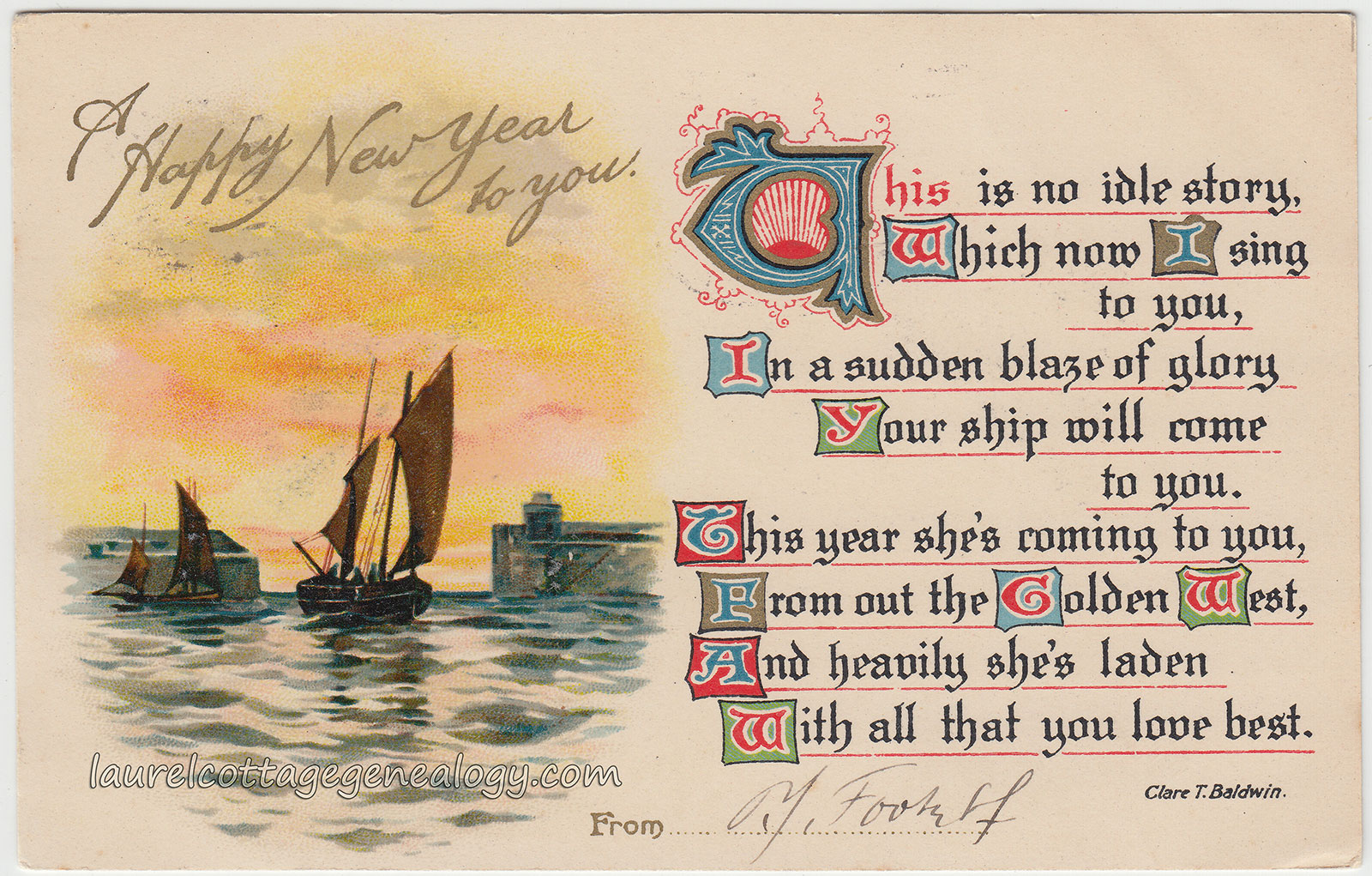
“This is no idle story,

Which now I sing to you,

In a sudden blaze of glory

Your ship will come to you.

This year she’s coming to you,

From out the Golden West,

And heavily she’s laden

With all that you love best.”

What a beauty! A 1907 postcard in great condition showing a gorgeous print of a painted scene of a couple of sailboats coming in to the harbor at sunset or sunrise, and above this in gold-tone  “A Happy New Year to you!”  On the right is the above verse in Old English style print; note the sun and rays inside the capital “T.” It’s not often that the verse shows the author, but this one lets us assume that it was Clare T. Baldwin who penned the lovely New Year’s wish. On the other hand, this could have been the artist (or artist and poet), based on some family tree research.

Inquiries are currently being made as to the identity of the author. There is an Emily T. Baldwin, born New York, about 1865, who shows up as a single woman, living with family, occupation Artist, in the 1910 Federal Census taken in Richmond, New York. This person is a possibility, based on an Ancestry.com private family tree for Emily Clarissia “Clare” T. Baldwin. The 1900 census for Richmond shows this same person under Clare T. Baldwin, artist, living with her family.

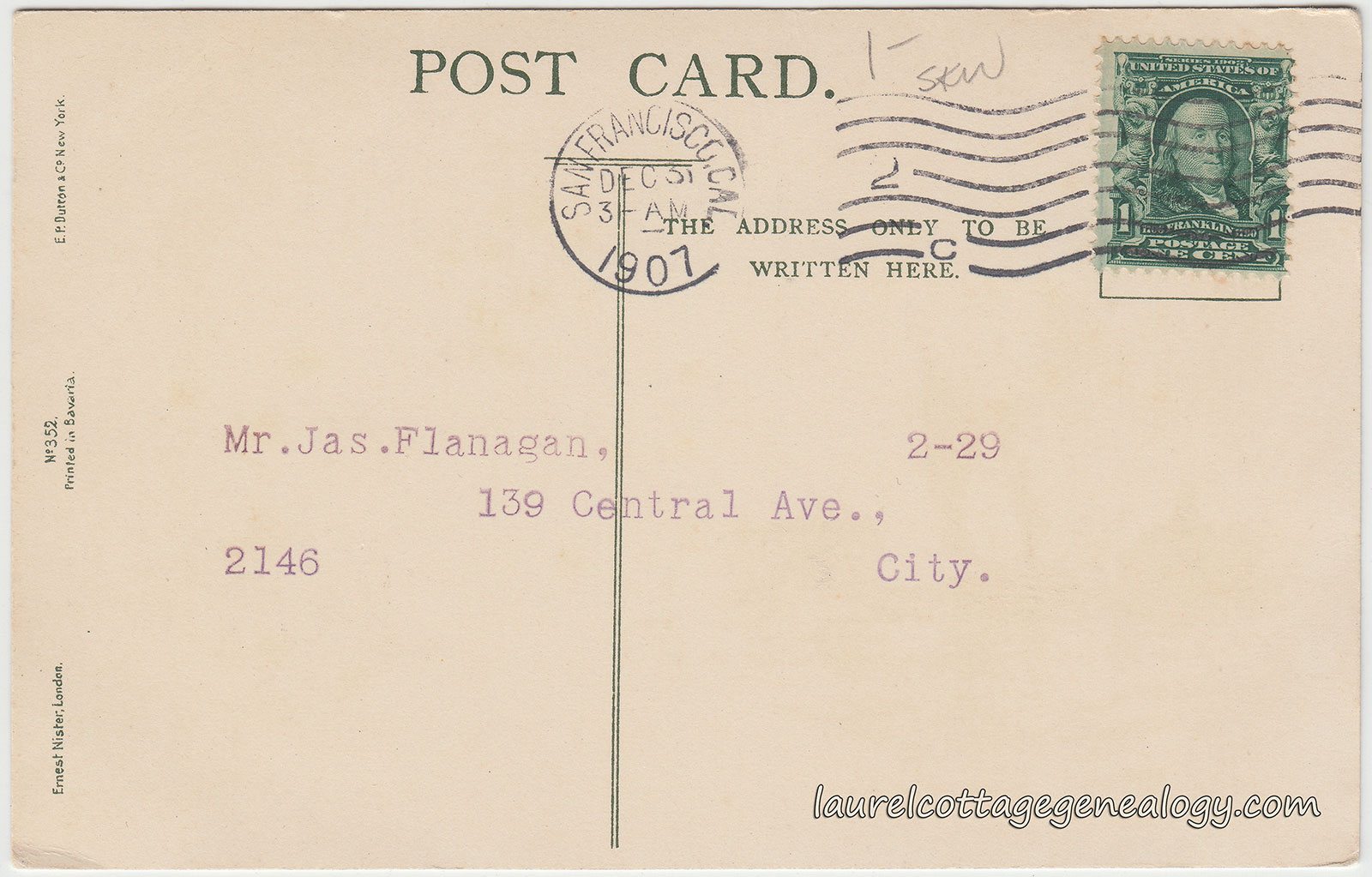
The sender’s signature is pretty hard to figure, but there is no doubt about the addressee, since it was typed, which is unusual. The card is addressed to:

“Mr. Jas. Flanagan, 2-29. 139 Central Ave., 2146. City.”  James Flanagan was much easier to locate. He is listed at 139 Central Ave on the 1910 census for San Fransisco which shows he was born Ireland, about 1856, occupation Buyer for a dry goods (company presumably); his wife Letitia R., born California, about 1871; and his daughter Letitia A., born California about 1894. Living with the Flanagans is lodger Margaret McCabe.

As far as the publisher information, the back of the card shows two names:  Ernest Nister of London and E.P. Dutton & Co. of New York. As it turns out these are two very well-known and researched names in the world of antique and vintage ephemera. Briefly, Ernest Nister was a German born printer and publisher known for his superior quality children’s books in the late 19th century and early 20th century, and known for his innovations in the pop-up and moveable picture book genre. Nister started in Nuremburg, Germany and branched out to London and New York. E. P. Dutton & Co. was an American book publishing company founded by bookseller Edward Payson Dutton in Boston in 1852. Dutton began publishing in 1864 and then relocated to New York in 1869. His company became one of the leading U.S. publishers and worked with many famous authors. In 1986 the company was acquired by The Penguin Group. Dutton was known as both distributor for Nister, and later as co-publisher. Many collectables in the form of books, calendars, holiday cards, postcards of either/or and both companies in tandem, can be found online. This particular example that we have for sale here was repeated in at least a couple of other designs that can be found online – in other words with the same general design of a verse in very fancy Old English style lettering and with a place at the bottom for the sender to sign his name.

Divided back, used postcard. Postmarked December 31, 1907 from San Francisco, California. Publishers:  Ernest Nister, London and E.P. Dutton & Co., New York. Printed in Bavaria. No. 352.

Price:  $25.00

Sources:  “United States Census, 1900,” index and images, FamilySearch (https://familysearch.org/pal:/MM9.1.1/MSLY-2J9 : accessed 3 January 2015), Cloe T Baldwin in household of James G Baldwin, Borough of Richmond New York City Ward 4, Richmond, New York, United States; citing sheet 4B, family 88, NARA microfilm publication T623, National Archives and Records Administration, Washington, D.C.; FHL microfilm 1,241,154.

Year: 1910; Census Place: San Francisco Assembly District 37, San Francisco, California; Roll: T624_99; Page: 4A; Enumeration District: 0173; FHL microfilm: 1374112

“Ernest Nister.” From  “A Brief History of Moveable Books.” UNT Libraries. Web accessed January 3, 2015. [http://www.library.unt.edu/rarebooks/exhibits/popup2/nister.htm]

“E. P. Dutton & Company, Inc. Records.” Syracuse University Libraries Finding Aids. Web accessed January 3, 2015. [http://library.syr.edu/digital/guides/e/ep_dutton.htm]

“Publisher – Ernest Nister/E.P. Dutton” Oct. 20, 2014. Vintage Valentine Museum. Web accessed January 3, 2015. [http://www.vintagevalentinemuseum.com/2014/10/publisher-ernest-nistere-p-dutton.html]

“Dutton.” Penguin.com. Web accessed January 3, 2015. [http://www.penguin.com/meet/publishers/dutton/]

Ring In The New

Ring In The New pc1Ring In The New pc2

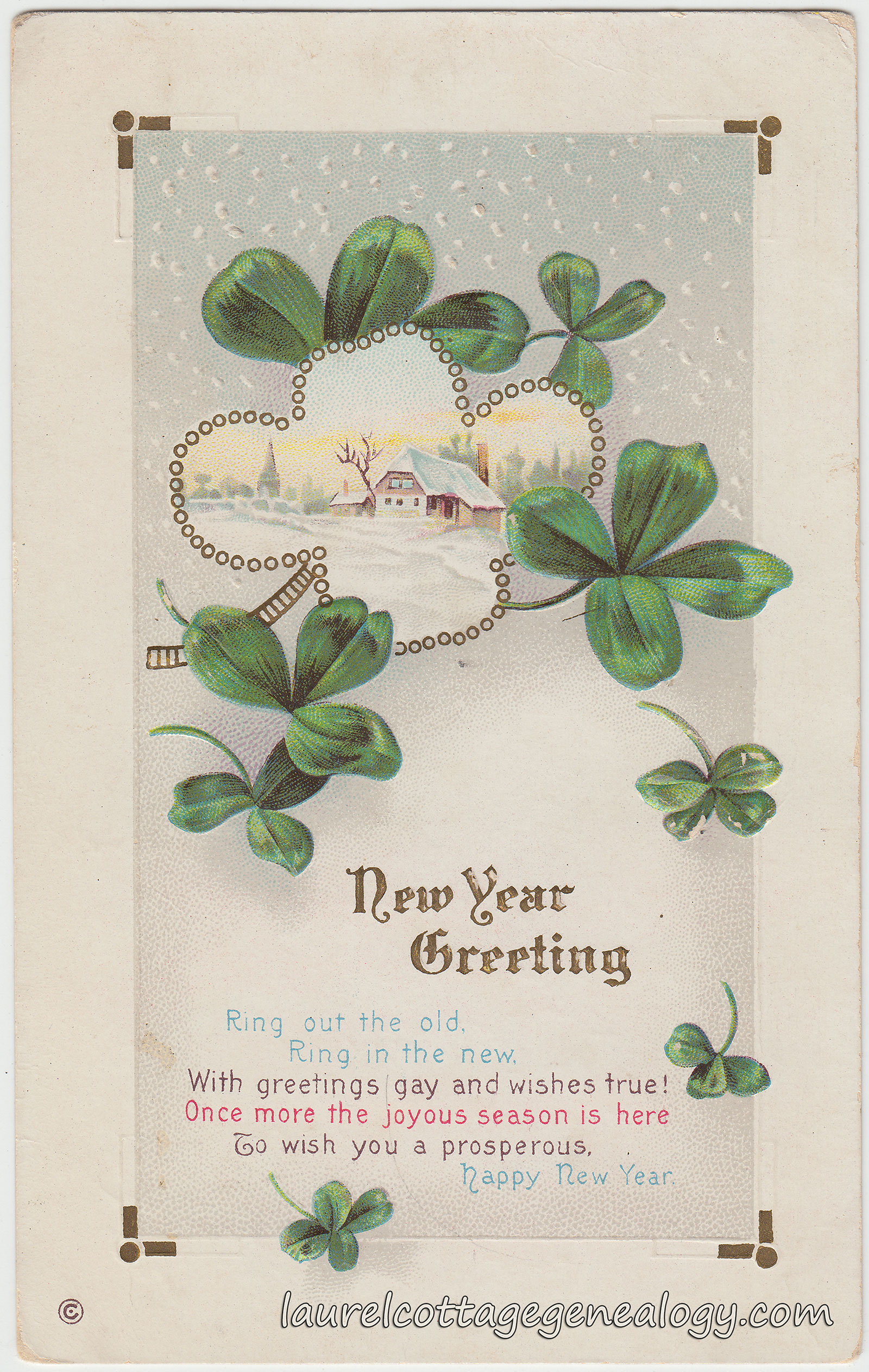
“Ring out the old

Ring in the new,

With greetings gay and wishes true!

Once more the joyous season is here

To wish you a prosperous,

Happy New Year.”

Here’s a lovely card in the Lena Davis Collection, showing the above wish, and a cozy home in winter scene, flocked by three and four-leaf clovers. (A touch of realism there, since four-leaf clovers are harder to find.)

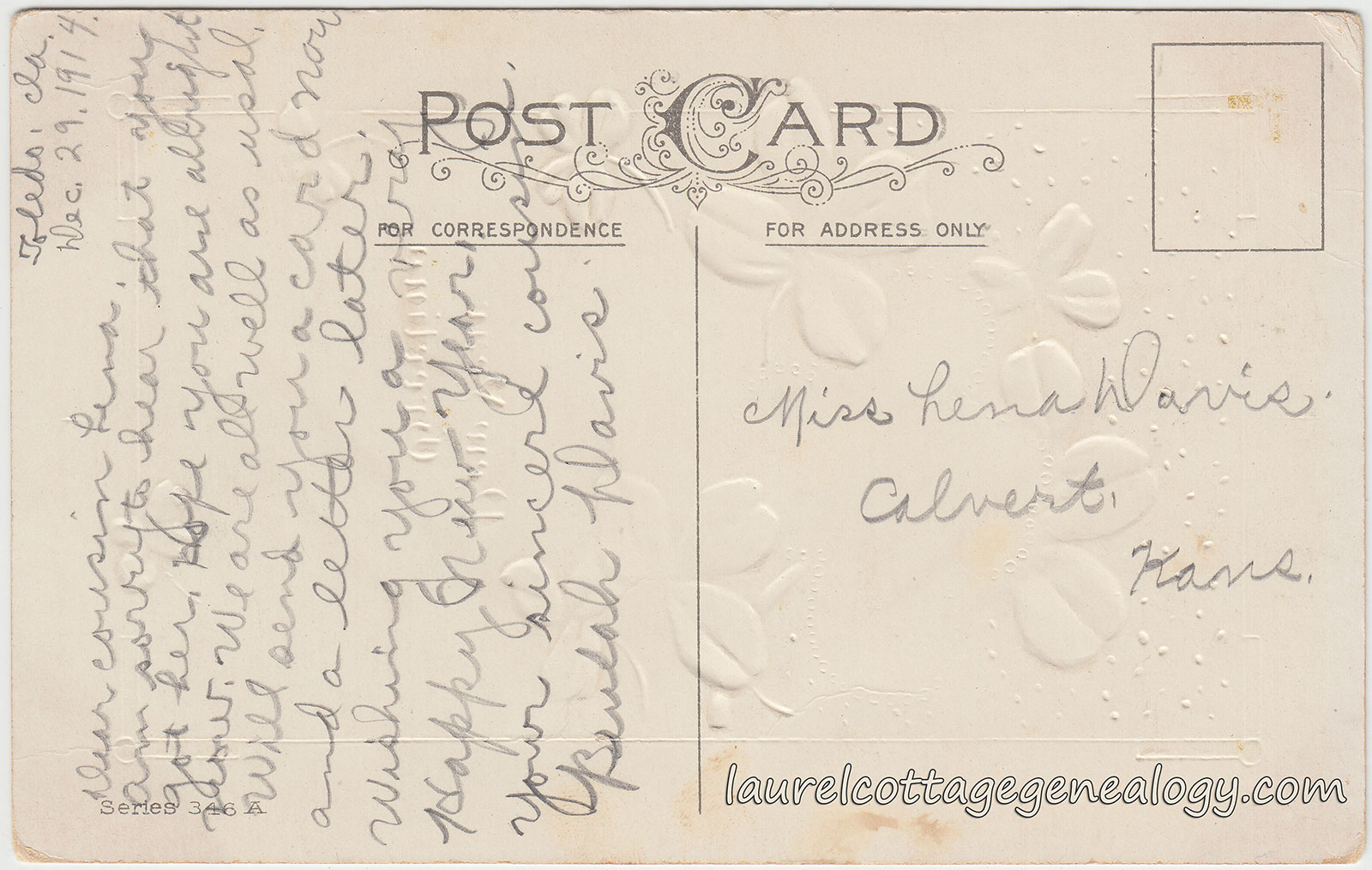
The card is addressed to:  “Miss Lena Davis. Calvert, Kans.”  and the sender wrote,

“Toledo, Ia. Dec. 29, 1914. Dear cousin Lena. Am sorry to hear that you got her.[hurt] Hope you are allright now. We are all well as usal. Will send you a card now and letter later. Wishing you a very Happy New Year. Your sincere cousin. Beulah Davis.”

Divided back, embossed, unused postcard with writing. Dated by the sender December 29, 1914. Publisher unknown. Series 346A.

Price:  $5.00