Genealogy Services, Old Photos, Postcards, Trade Cards, Etc.

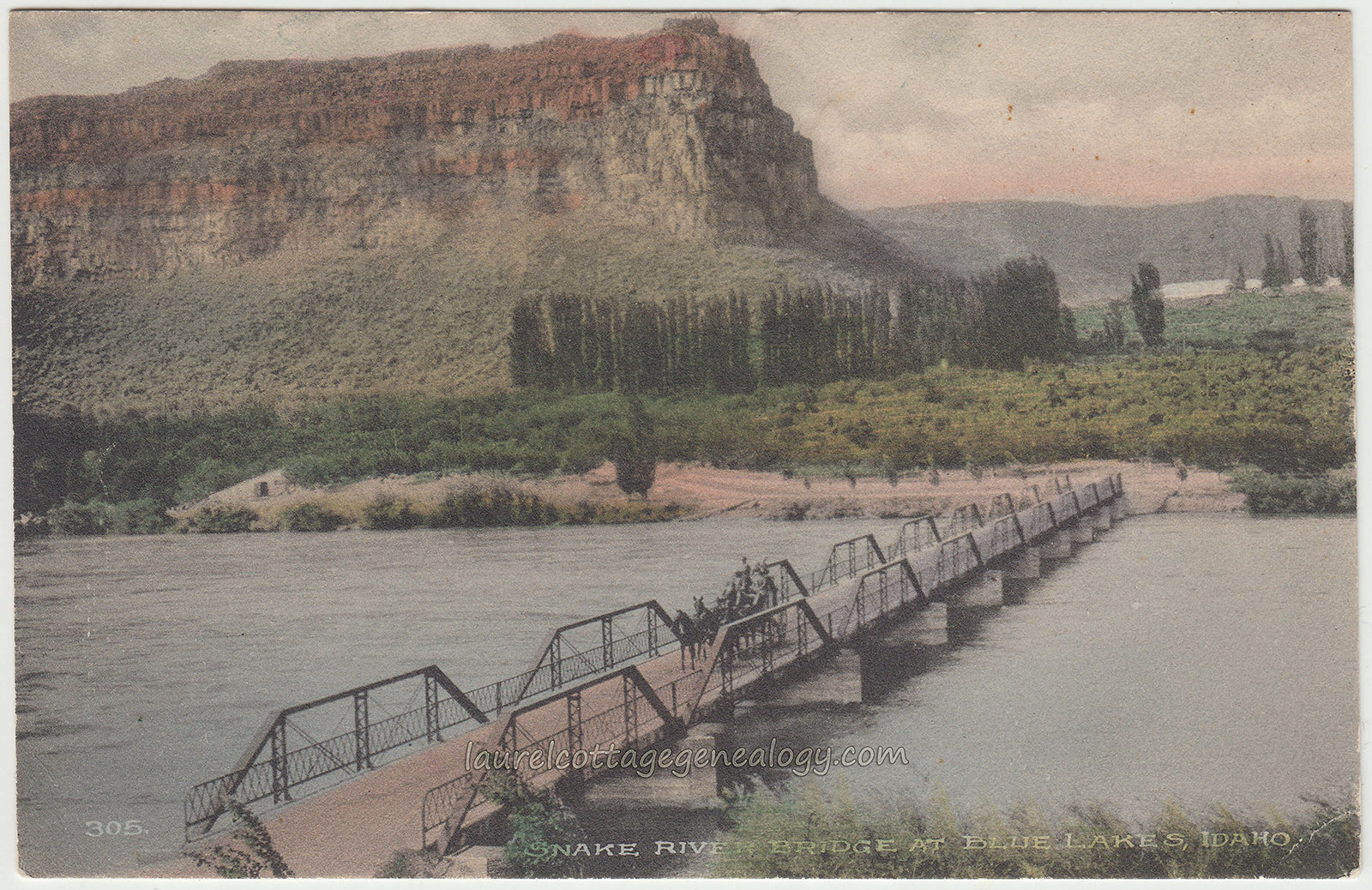
Snake River Bridge At Blue Lakes, Idaho

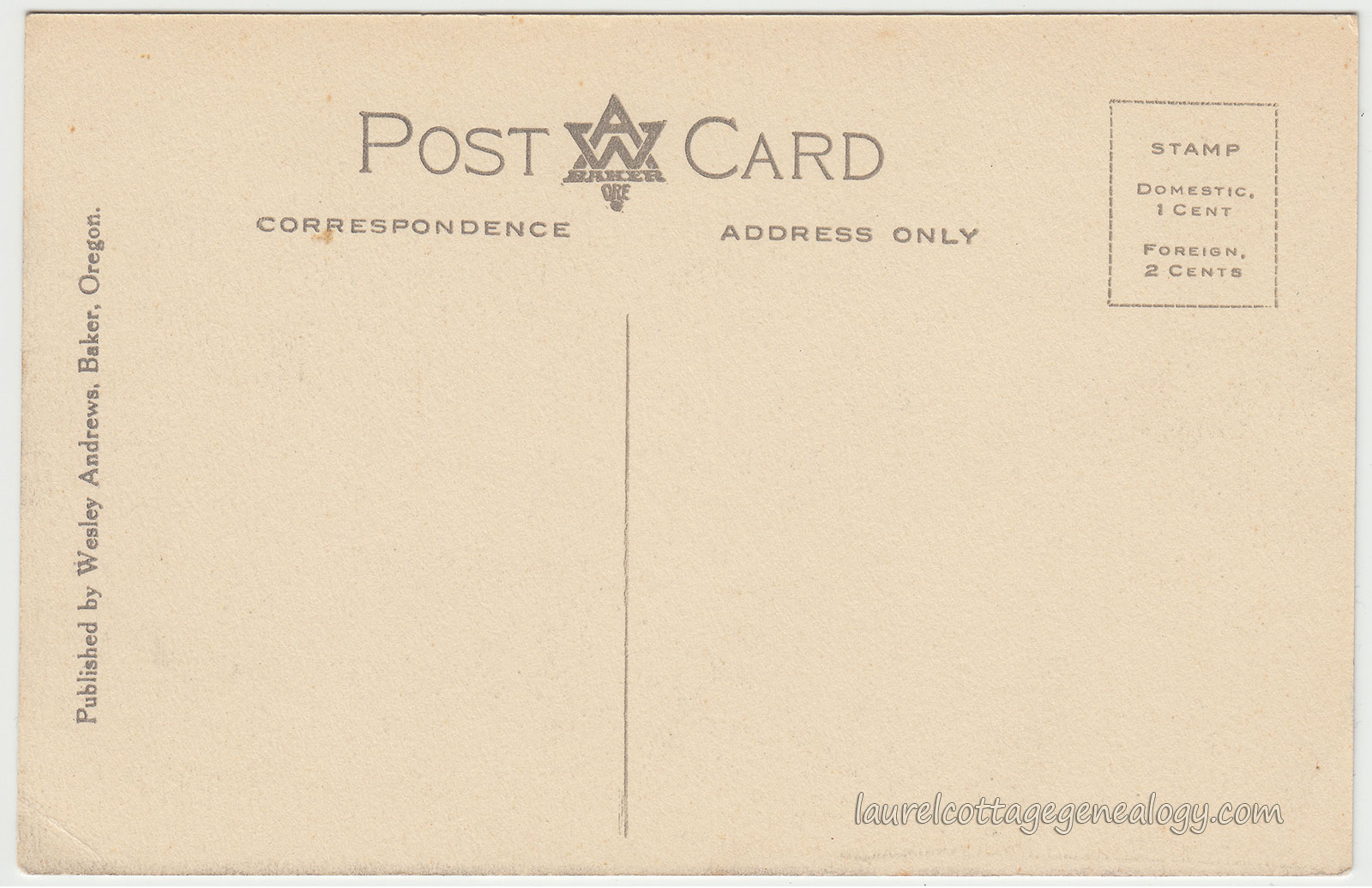
Divided back, unused postcard, circa 1911 – 1915. Publisher:  Wesley Andrews, Baker, Oregon. Series or number 305.

Price:  $12.00

 I. B. Perrine’s Blue Lakes Bridge

Started in 1910 and completed in 1911, is the steel bridge seen in this postcard, spanning the Snake River at Blue Lakes. It replaced I. B. Perrine’s ferry and was known as I. B. Perrine’s Blue Lakes Bridge or Perrine’s Bridge, and was a toll bridge until Perrine’s building costs were recovered. It was closed to the public in 1921. Ira Burton Perrine was a renowned fruit rancher and is credited as having founded Twin Falls, Idaho.

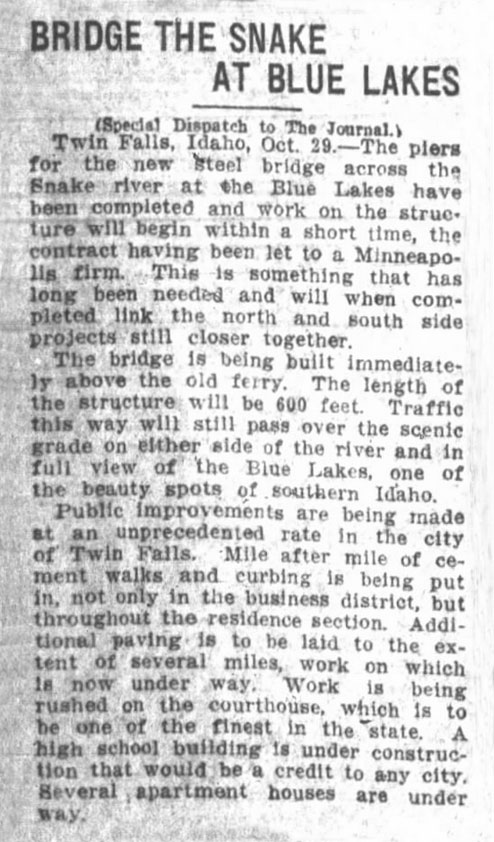
Below, a clipping from The Oregon Daily Journal, October 1910, informs readers that the piers for the new bridge were completed, and the work on the structure would soon be undertaken by a Minneapolis company. According to the article, the bridge’s length was going to measure 600 feet.
Watermelon in the desert and where was Blue Lakes?

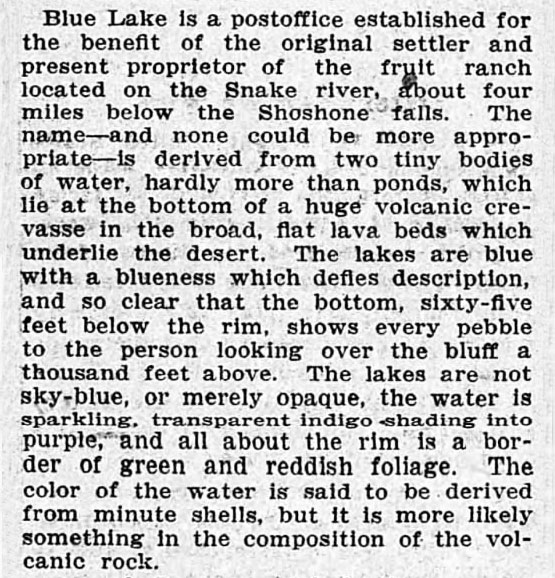
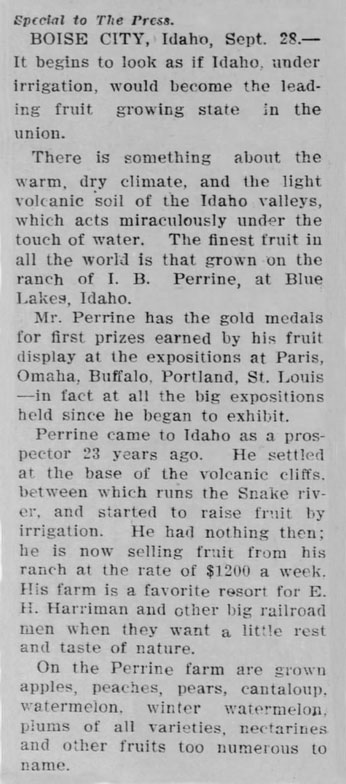
Below, two newspaper clippings:   On the left, a partial clip from The Evansville Press, September 1906, on Perrine’s mineral-rich fruit ranch where fruits too numerous to mention were grown in the volcanic soil. On the right, a partial article from The Minneapolis Journal, September 1903, and the best description found online of Blue Lakes. According to the unknown journalist, Blue Lake was not a town, but a post office established for the fruit farmer, whose ranch was referred to as Blue Lakes, located about four miles below the Shoshone Falls on the Snake River, north of the city of Twin Falls, and who’s name derives from the two almost pond-size bodies of water, so poetically described below, as “….blue with a blueness that defies description…….the water is sparkling, transparent indigo shading into purple….”  And the million-dollar question in 2017:  Are the lakes still there? (Hopefully someone will comment and let us know.)
Sources:  “Bridge The Snake At Blue Lakes.” The Oregon Daily Journal (Portland, OR). October 30, 1910. Sunday, p. 5. (Newspapers.com)

Matthews, Mychel. “Hidden History:  First Perrine Bridge.” MVMagicValley.com. July 7, 2016. (Web accessed November 18, 2017).

I. B. Perrine. n.d. https://en.wikipedia.org/wiki/I._B._Perrine (accessed November 18, 2017).

Gardner, Gilson. “Romance Of An Idaho Eden.” The Evansville Press. (Evansville, IN). September 28, 1906. Friday, p. 4. (Newspapers.com).

“An Idaho Romance.” The Minneapolis Journal. September 26, 1903. Saturday, p. 5. (Newspapers.com).
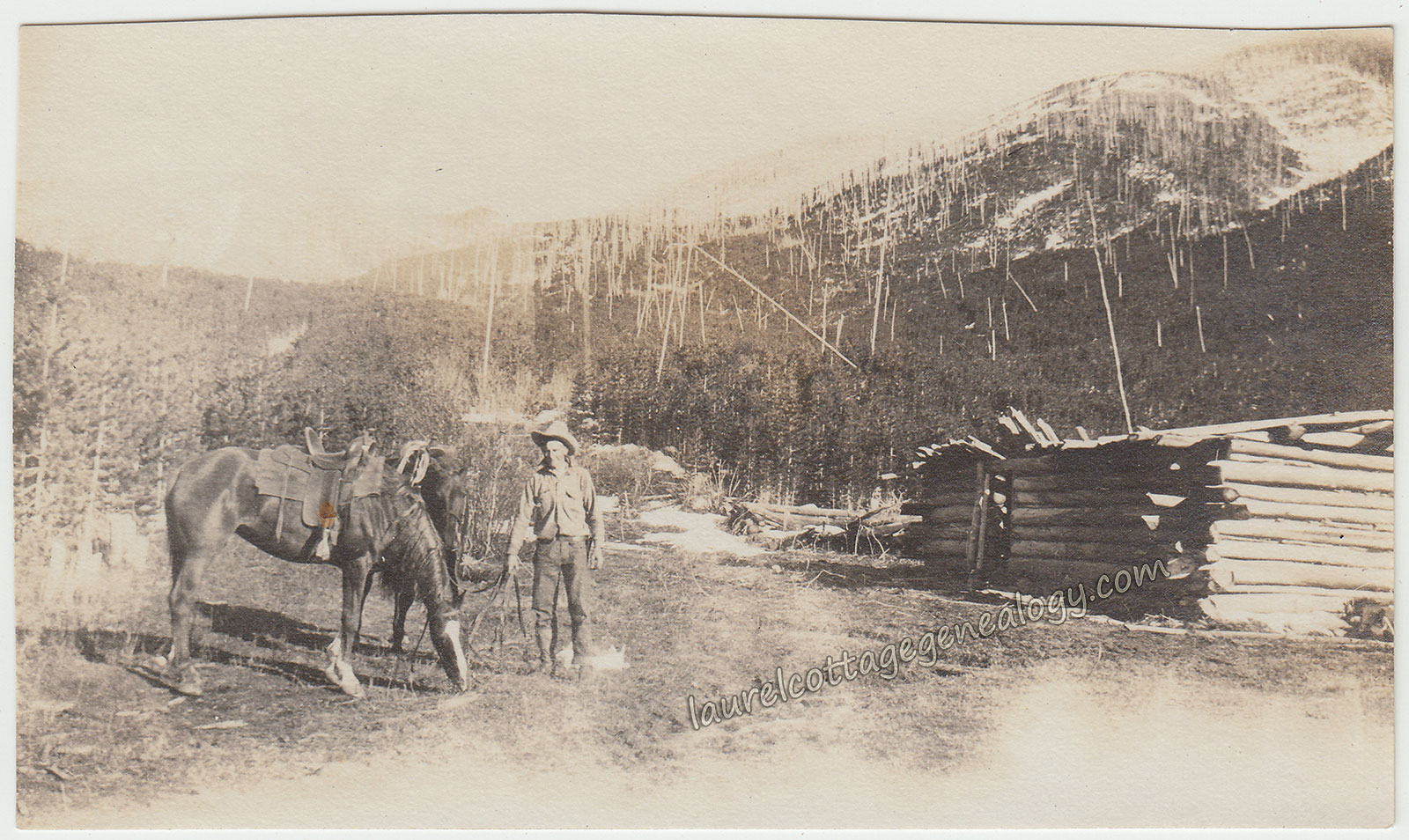
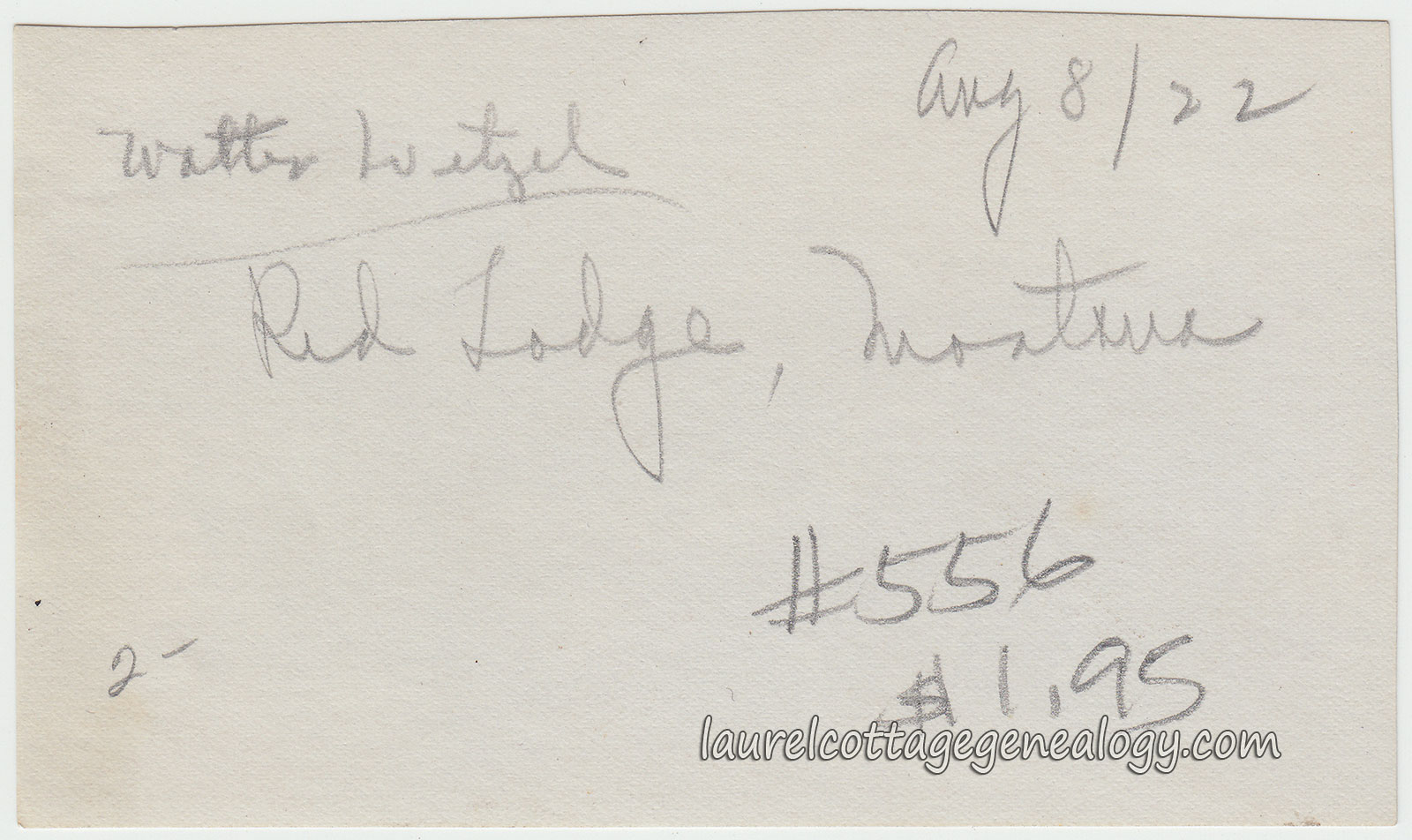
Walter Wetzel, Red Lodge, Montana, 1922

Old photo. August 8, 1922, Red Lodge, Carbon County, Montana.

Price:  $15.00       Size:  4 and 1/8 x 2 and 3/8″

Here’s a beautiful photo of a man in jeans and cowboy hat, standing, holding the reins of two horses. On the back we have the i.d. showing,  “Aug 8/22. Walter Wetzel. Red Lodge, Montana.”  To our right, in the photo, is a rudimentary-looking log cabin (no windows) and in the background, snow covered mountains of the (assuming) Beartooth Mountain Range. In searching records for a Walter Wetzel that might fit this photo we find a Walter W. Wetzel (1902 – 1953) a well-known forester, who married Elva Ellis. A newspaper clipping from 1927 that announced the couple’s marriage license, stated Elva was a resident of Red Lodge. But how old is the man in the photo? My first impression was of someone about age fifty, albeit a very fit age fifty. But he could certainly be much younger. It’s hard to tell because of the lighting and the distance the photo was taken from.

At The Rodeo

Vintage photo, white border, circa 1950s.

Price:  $3.00         Size:  About 3 and 1/2 x 2 and 1/2″

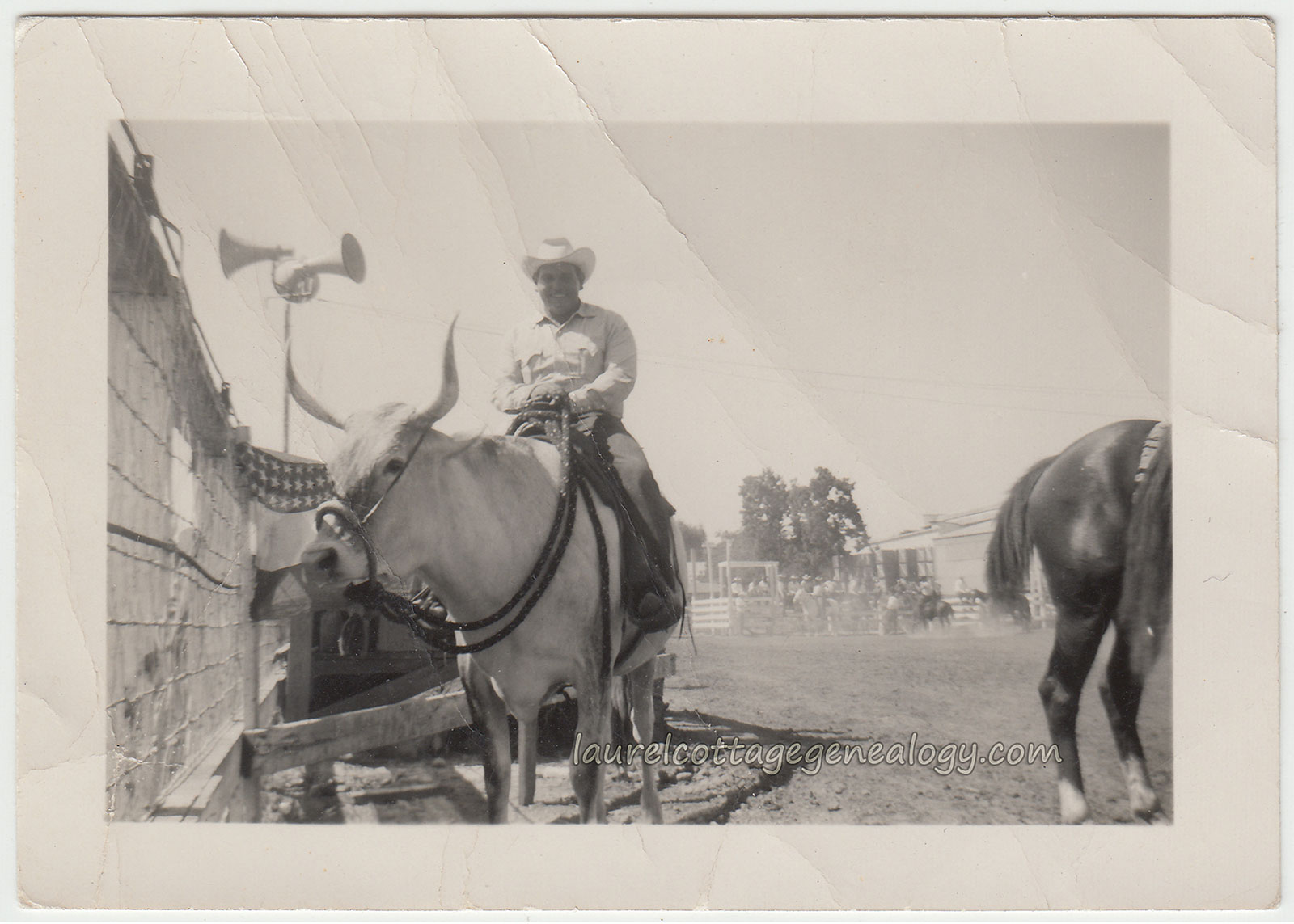
A great vintage snapshot:  a cowboy, or maybe vaquero would be more appropriate, riding a saddled bull or steer, posing for the camera, with a great smile. Looks like this was taken at a rodeo or rodeo fairgrounds due to the loudspeaker behind the bovine and rider. Hopefully someone will fill us in on the breed of the animal.

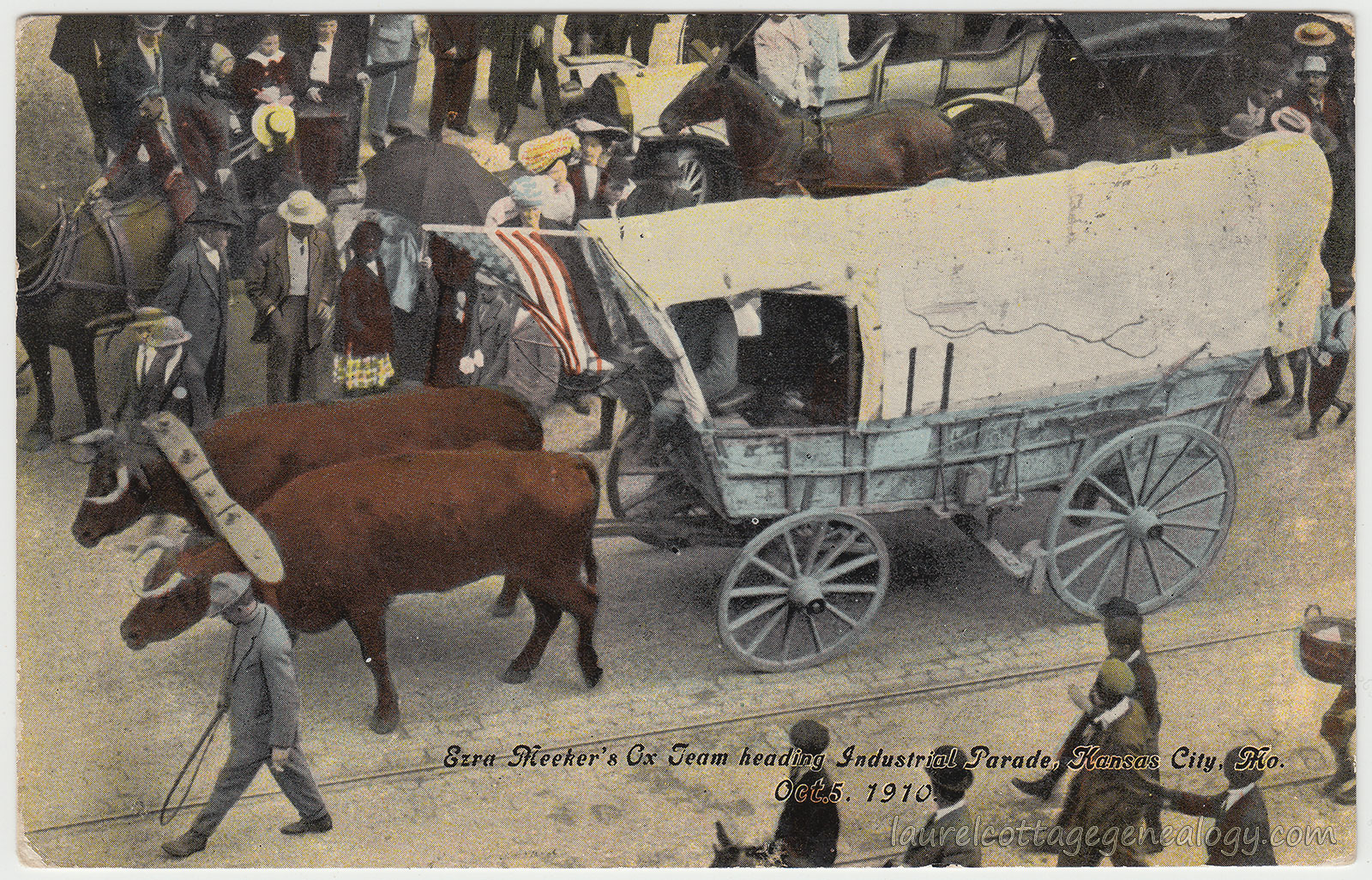
Ezra Meeker’s Ox Team, 1910

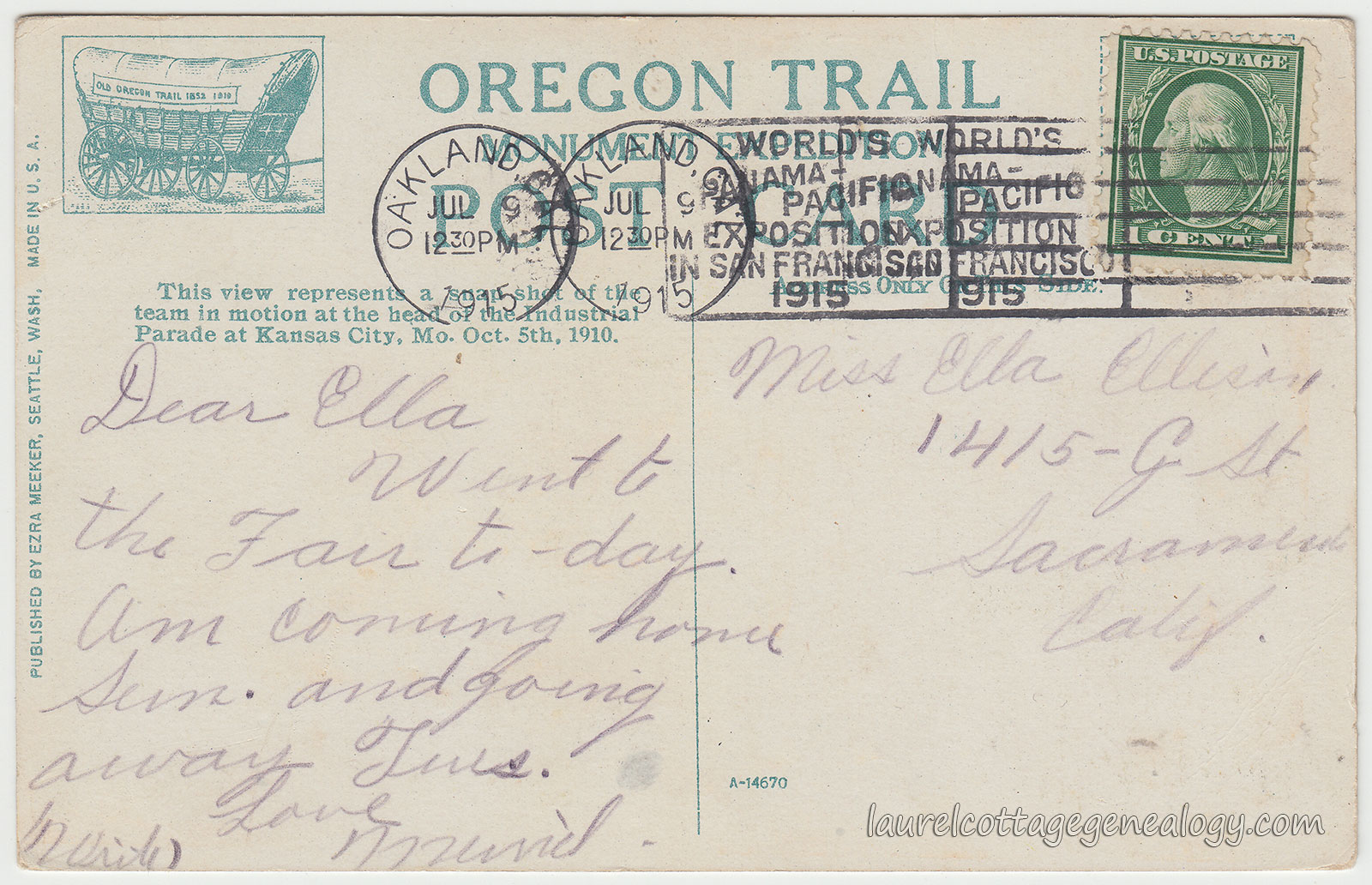
Divided back, used postcard. Postmarked July 9, 1915 from Oakland, California. Publisher:  Ezra Meeker, Seattle, Washington. Number or series: A-14670.

Price:  $5.00

“This view represents a snap shot of the team in motion at the head of the Industrial Parade, Kansas City, Mo., Oct. 5th, 1910.”

Ezra Meeker (1830 – 1928) was a pioneer from Iowa, who traveled the Oregon Trail, and who worked later to memorialize it. He was also an author, served as Puyallup, Washington’s first mayor and its first postmaster, was one time known as the “Hop King of the World” and was also the publisher of this postcard.

Addressed to:   “Miss Ella Ellison, 1415 – G St., Sacramento, Calif.”

“Dear Ella, Went to the Fair to-day. Am coming home Sun. and going away Tues. (write) Muriel.”

Straight and to the point, the comings and goings of Ella’s friend, Muriel in July 1915. Love the order to “(write)”. This is one of many in the Alice Ellison Collection.

Source:  Ezra Meeker. n.d. https://en.wikipedia.org/wiki/Ezra_Meeker (accessed November 12, 2017).

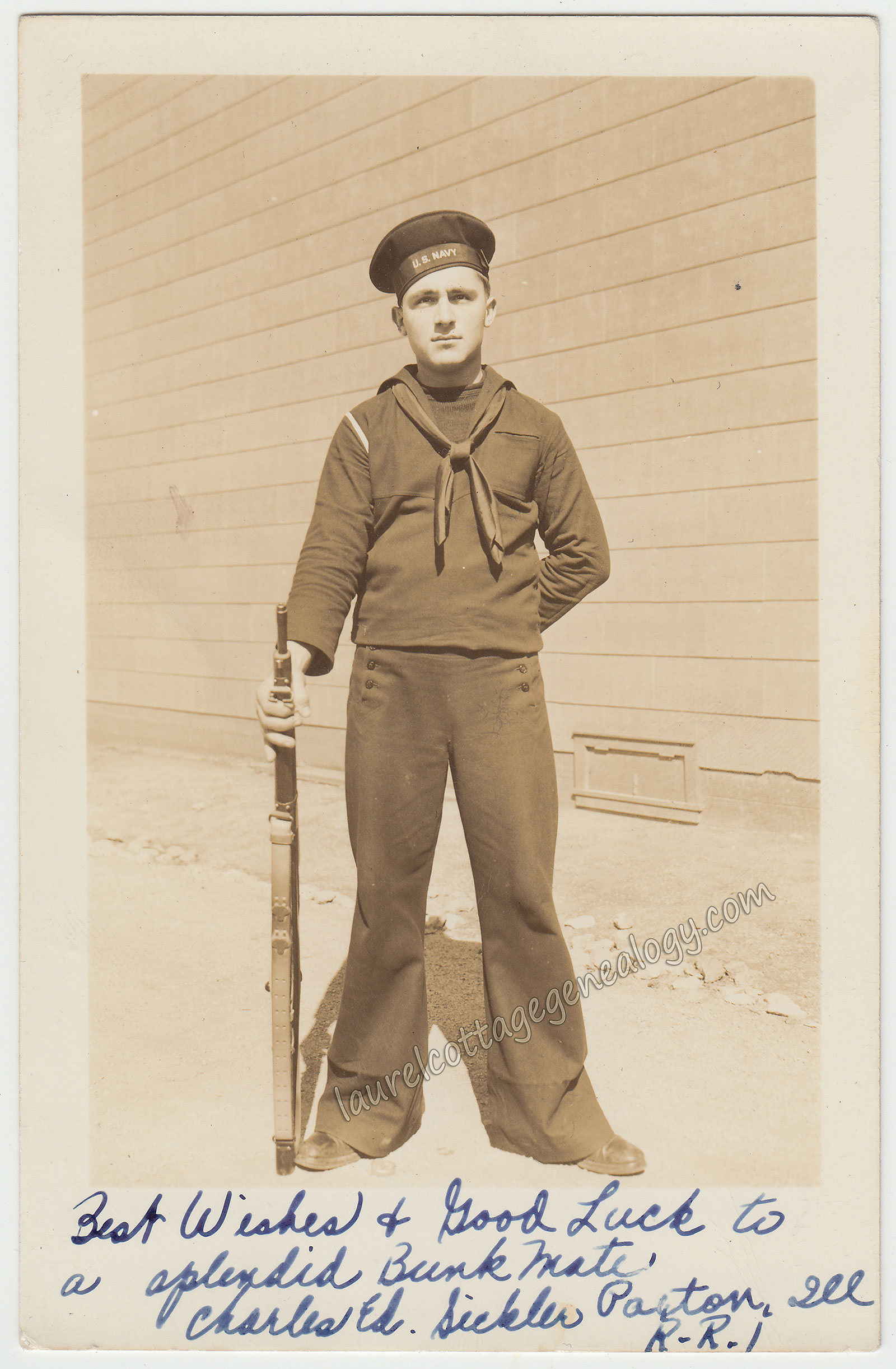
A U. S. Navy Man, WWI

Real Photo Postcard, unused with writing. Circa 1914 – 1918. EKC stamp box.

Price:  $10.00

For Veteran’s Day….

“Best Wishes & Good Luck to a splendid Bunk Mate, Charles Ed. Sickler. Paxton, Ill. R-R-I.”

Most likely we’re looking at Charles Ed. Sickler in the photo (at least one presumes!) as it sounds like this writer of best wishes was giving this remembrance of himself, along with his mailing address, to his buddy, “the splendid Bunk Mate.” A cool guy, Charles, you can read his perhaps dry sense of humor in the card. The RR1 would be Rural Route 1. But no confirmation was found for him in census, military or city directory records, and that is surprising.

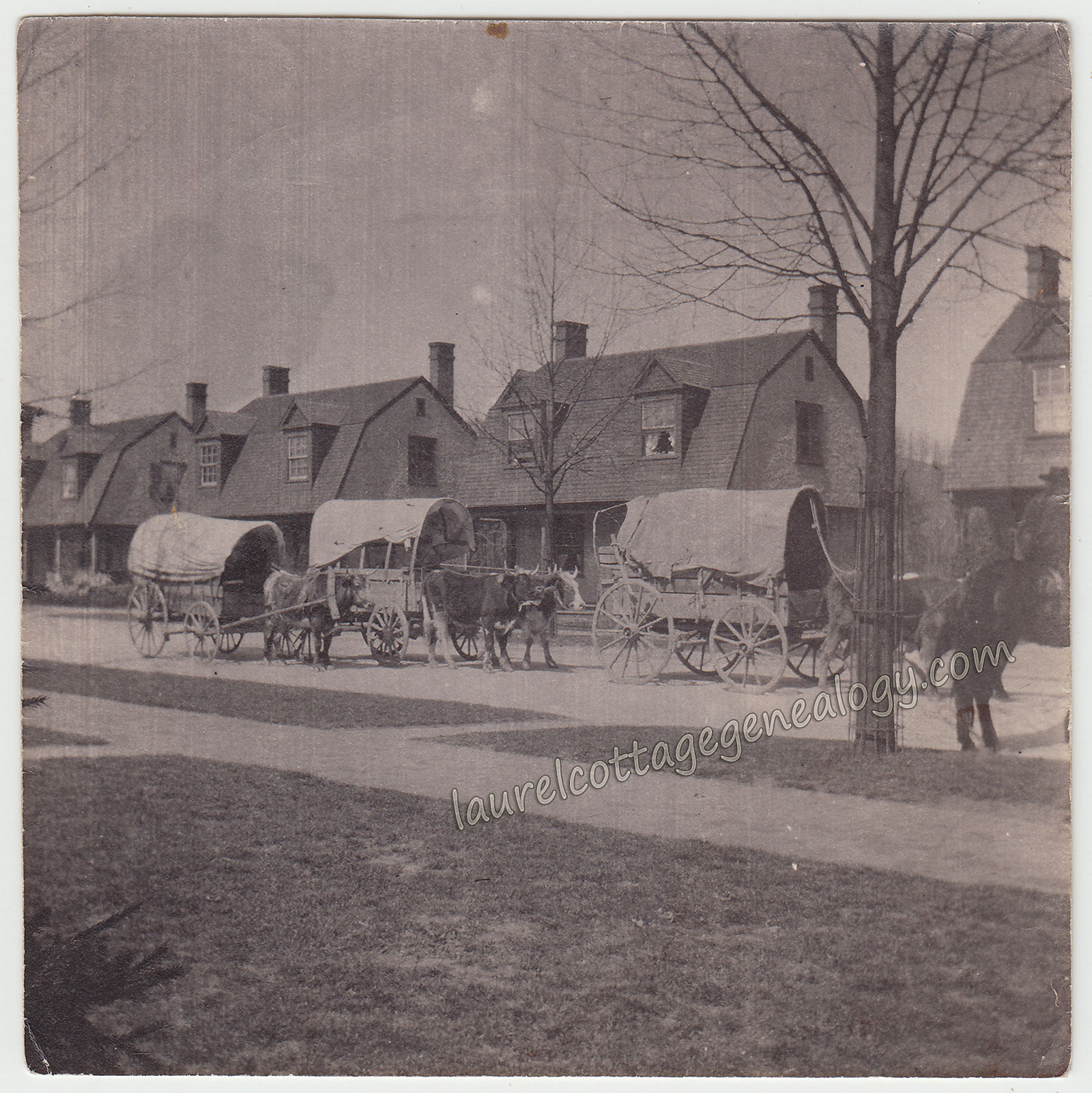
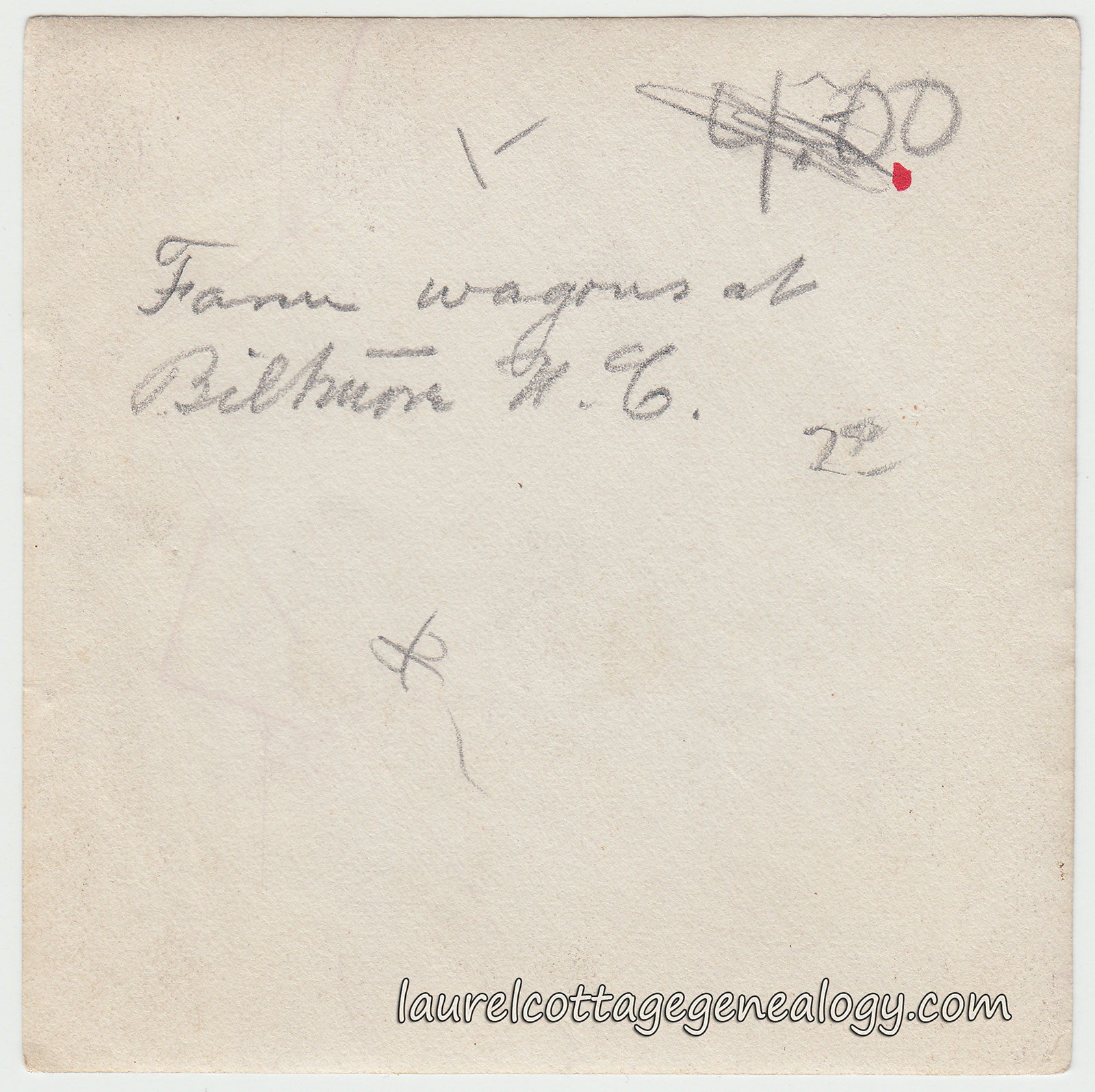
Farm Wagons At Biltmore Village, North Carolina

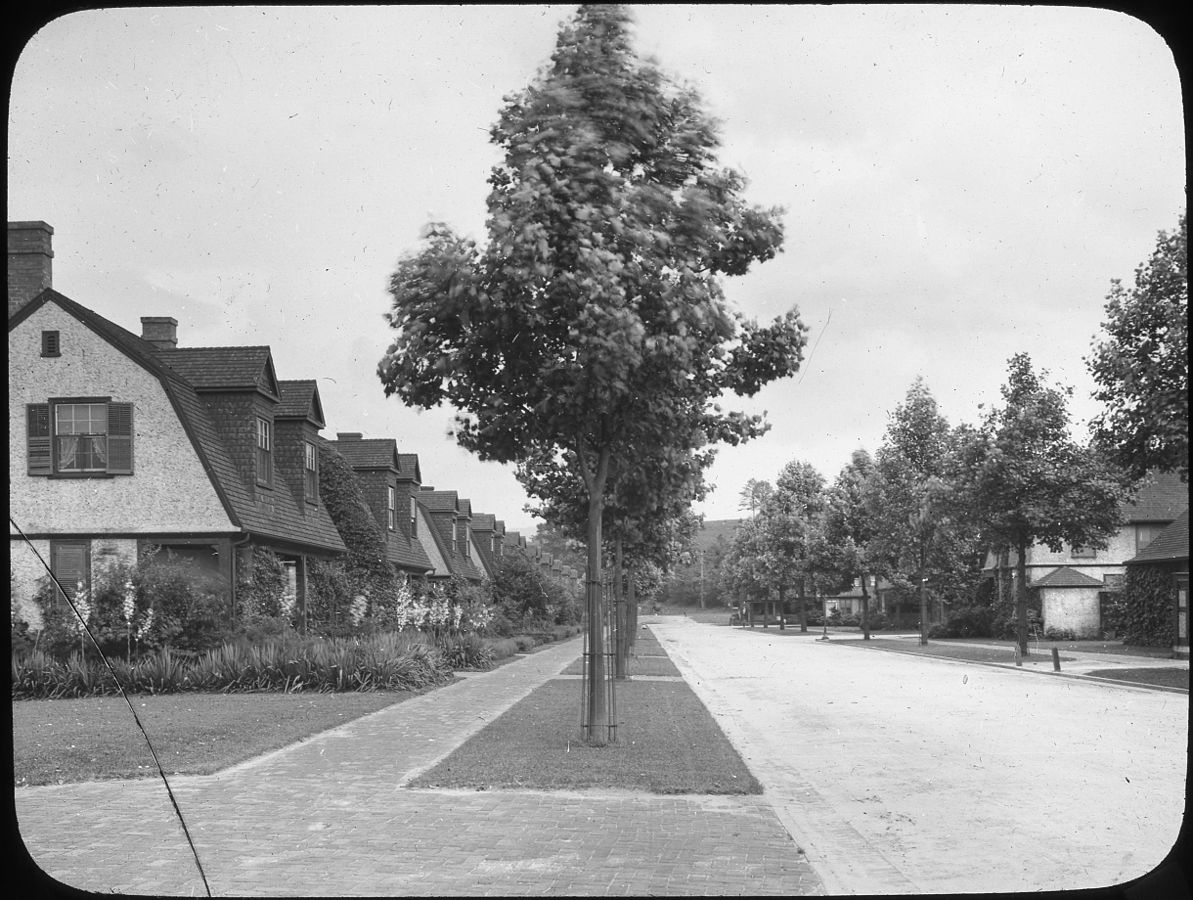
Old photo, Biltmore Village, NC. Circa 1905 – 1910.

Price:  $20.00        Size:  3 and 1/4 x 3 and 1/4″

At first glance, one might think this photo was taken on a special occasion, because of the striking contrast between the line of three oxen-driven covered wagons and the row of Dutch Colonial Revival style homes and manicured lawns in the suburban-looking setting. But rather than some type of commemorative event, it may have just been a “working day” wagons-carrying-supplies scene in Biltmore Village, NC. Note the partial glimpse of horse and rider on our right. And with scrutiny one can make out the vague image in the middle vehicle of a driver wearing a hat.

The book, Around Biltmore Village, (see p. 38) by Bill Alexander provides a couple of photos of this same street, Brook St., circa 1906 and 1909. Those are Linden trees in the images (and we hope they’re still there.) The rental houses in the village were referred to as “cottages” which seems unusual but then decidedly not…..when viewed in relation to the Biltmore Estate mansion built by George W. Vanderbilt, II. The village was a planned community for the estate workers, and was also designed to be an aesthetically pleasing entrance to the estate, modeled to have the feel of an English village. Biltmore Village was formerly known as Best but also referred to as Ashville Junction and Swannanoa Bridge. Today, Biltmore Village is a part of the city of Ashville, and is a popular shopping, dining, art, spa and historical destination. Below, another photo (Wikepidia Commons) from around the same time period.

Sources:  Alexander, Bill. Around Biltmore Village. Charleston:  Arcadia Publishing, 2008. Web accessed November 11, 2017.

Biltmore Estate. n.d. https://en.wikipedia.org/wiki/Biltmore_Estate (accessed November 11, 2017).

File:Biltmore, NC-Lindon Trees (5167651749).jpg. Original Collection: Arthur Peck Collection, P99, Item Number: P099_C_278. (accessed November 11, 2017).

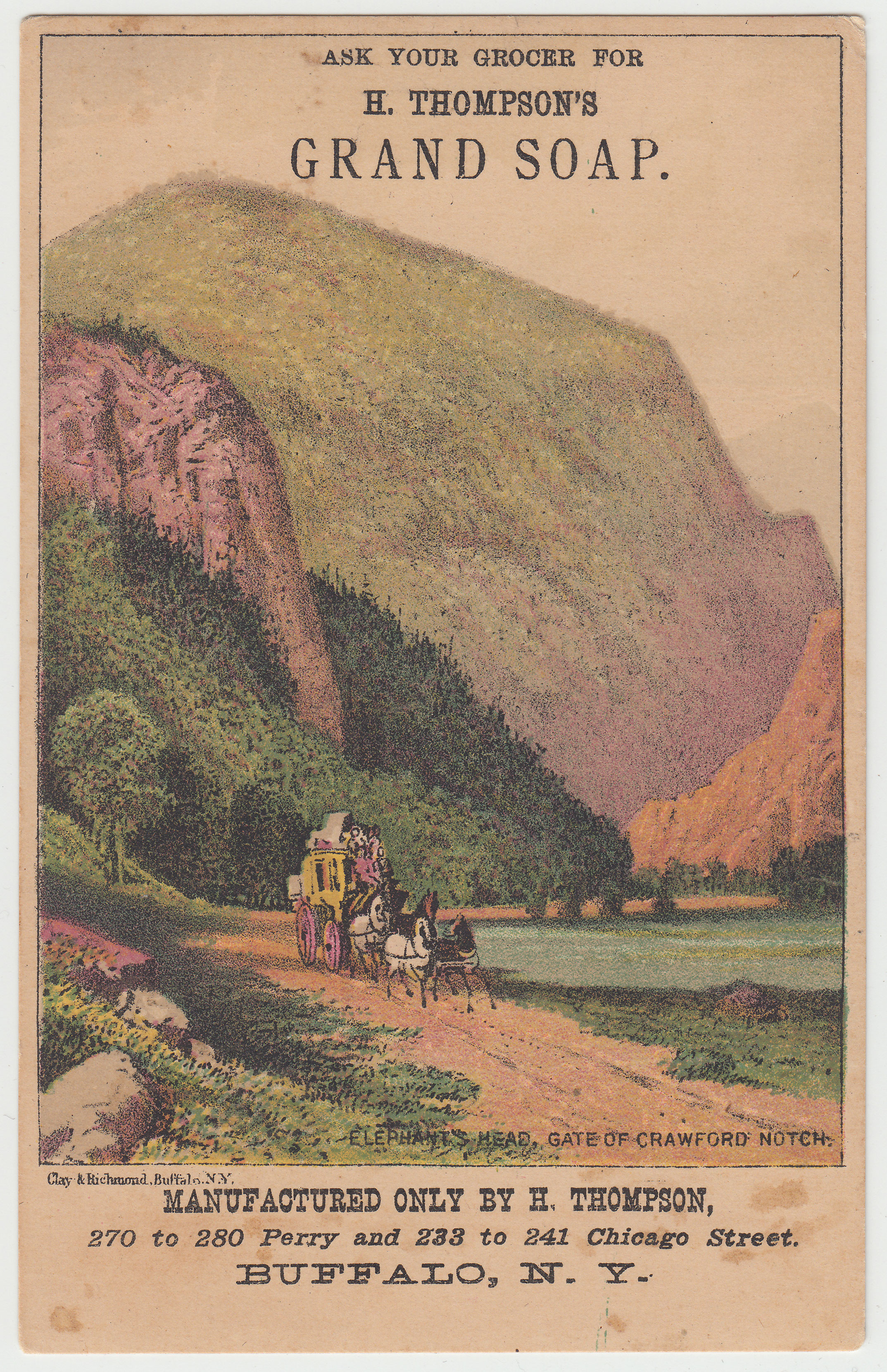
Elephant’s Head and Gate of Crawford Notch

Trade Card for H. Thompson’s Grand Soap, Buffalo, NY. Circa 1879 – 1886. Lithographer:  Clay & Richmond, Buffalo, NY.

Price:  $12.00           Size:  About 3 and 3/8 x 5 and 3/8″

Another H. Thompson’s Grand Soap trade card, this one showing the rock formation, Elephant’s Head, the gate of Crawford Notch, in the White Mountains, New Hampshire, and a stage coach continuing on its way, after coming through the pass. (We’re using this card to segue from trade cards, in general, to a short upcoming Western theme.) But, anyway, she’s a beauty, a little soiled, but there don’t seem to be too many H. Thompson’s out there currently. This one might have been one of a series of well-known locations as there’s another card that can be found for the soap manufacturer (at Hagley Digital Archives) of Monument Rock, Echo Canyon. Curiously, “Grand” the brand name of soap, is not turning up in online searches, so exactly when Grand Soap was introduced and how long it was manufactured is unknown.

Clay & Richmond, lithographers, Buffalo.

As for the printer, they are Clay & Richmond. Per the 1879 Buffalo City Directory, the firm was Hugh M. Clay, W. E. Richmond and Henry A. Richmond. 1878 shows Clay and Co. (Hugh Clay and W. E. Richmond). Prior to 1878 Clay had been part of Clay, Cosack & Co. And we see Clay & Richmond listed in city directories as late as 1886 (Clay with H. A. Richmond). C & R’s location was in the Coit block, W. Swan, corner of Pearl. To do the company justice more research would be needed so we’ll just put up this quick offering for now. Our card is the second one we have, the first being Queen Anne Soap, Detroit Soap Co.

Sources:  Crawford Notch. n.d. https://en.wikipedia.org/wiki/Crawford_Notch (accessed November 10, 2017).

The Courier Co.’s Buffalo City Directories, 1877 – 1886. Ancestry.com. U.S. City Directories, 1822-1995.

H. Thompson’s Grand Soap

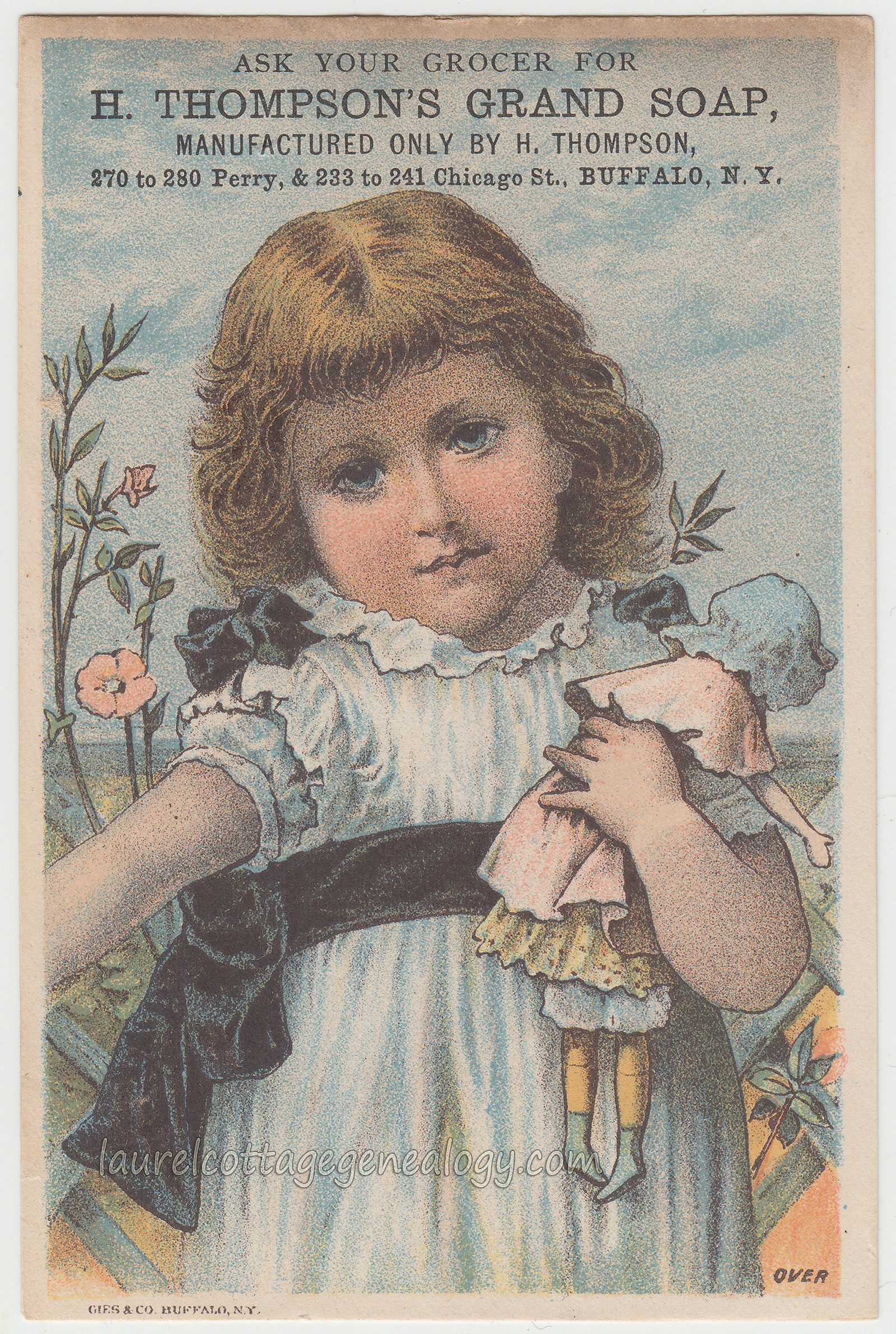
Trade Card for H. Thompson’s Grand Soap, Buffalo, NY. Lithographer:  Gies & Co., Buffalo, NY. Circa 1874 – 1890s.

Price:  $15.00           Size:  3 and 1/16 x 4 and 11/16″

“Ask your grocer for H. Thompson’s Grand Soap, Manufactured only by H. Thompson, 270 to 280 Perry, & 233 to 241 Chicago St., Buffalo, N.Y.”

Here’s a gorgeous card in peach and blue of a little girl holding her doll, and standing in front of a wooden trellis upon which a flowering vine is supported. Though the card says “over” at the bottom right, there is nothing on the reverse. This is another card by Gies & Co.

Hugh Thompson, soap and candle manufacturer

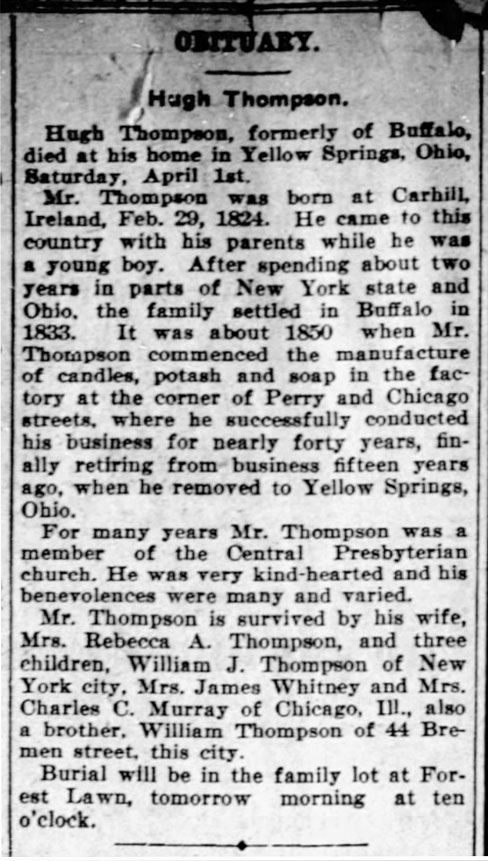
According to his obituary appearing in the Buffalo Commercial, “Mr. Thompson was born in Carhill, Ireland, February 29, 1824. He came to this country with his parents as a young boy. After spending about two years in parts of New York state and Ohio, the family settled in Buffalo in 1833.”

Hugh Thompson manufactured soap and candles (and was a dealer in soap making supplies) at the corner of Perry and Chicago streets in Buffalo for around thirty-seven years. He and his wife, Rebecca (Bell) Thompson, also native of Ireland, had four children, Mary, William, Louisa and Clara, all born in New York. Hugh died April 1, 1905 at his home in Yellow Springs, Ohio.

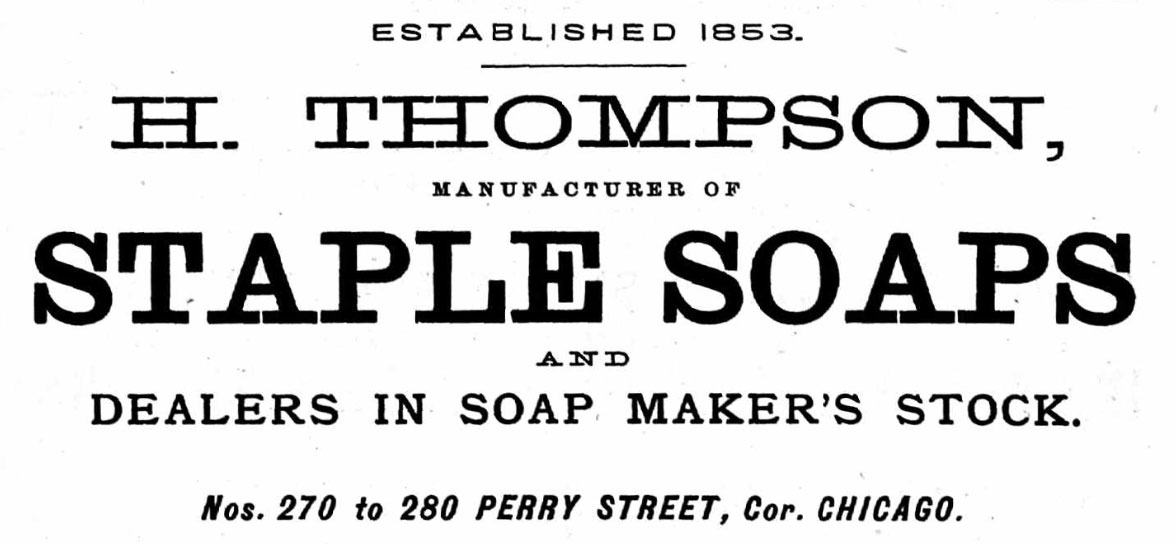
Per the below 1881 Buffalo city directory ad, the business was established in 1853:

A kind-hearted man

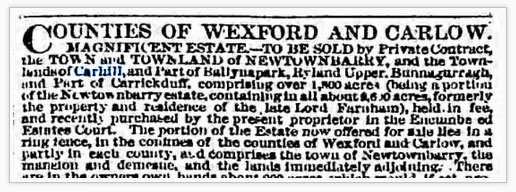
Where was Carhill, Ireland? It’s not found on a present-day map, but may have been the same “townsland” mentioned in The Guardian (London, England) news clipping from 1858, shown below:

Sources:   The Courier Co.’s Buffalo City Directory, 1881. pp. 173, 656. Ancestry.com. U.S. City Directories, 1822-1995. (Ancestry.com).

“Obituary. Hugh Thompson.” The Buffalo Commercial, April 3, 1905. Monday, p. 5. (Newspapers.com).
Year: 1880; Census Place: Buffalo, Erie, New York; Roll: 828; Family History Film: 1254828; Page: 8C; Enumeration District: 119. (Ancestry.com).

Hugh Thompson. Memorial # 75112709. Findagrave.com.

“Counties Of Wexford And Carlow.” The Guardian, (London, England) June 8, 1858. Tuesday, p. 1. (Newspapers.com).

Donaldson Brothers Lithographers, Five Points, Manhattan, NY

See the prior post and our B. J. Stone trade card.

Donaldson Bros, circa 1872 – 1891

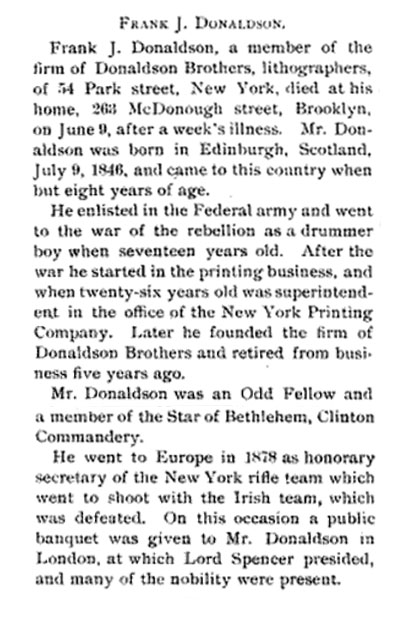
Donaldson Brothers was a very successful lithography and printing company which ran from about 1872 to 1891 before being consolidated with the American Lithographic Company. According to Frank’s obit appearing in the weekly publication American Stationers, it was Frank who founded Donaldson Bros., and this may be correct, but we wouldn’t want to assume, since this is a statement from one source. Our short write-up on this litho firm is just skimming the surface with a few details, as in-depth would be quite time-consuming. In any case, the firm was Frank J., George W., John L. and Robert M.,  all born in Edinburgh, Scotland of parents John Donaldson and Barbara Hume (Montgomery) Donaldson. The family emigrated to the U.S. in 1856. The 1860 Federal Census finds the family living in Brooklyn, NY. The 1878 New York City directory shows all four brothers as lithographers at the address of 2 Mission Place, New York, which was in the Five Points neighborhood in Lower Manhattan.

Below, Frank J. Donaldson’s obituary appearing in American Stationer, June 1896.

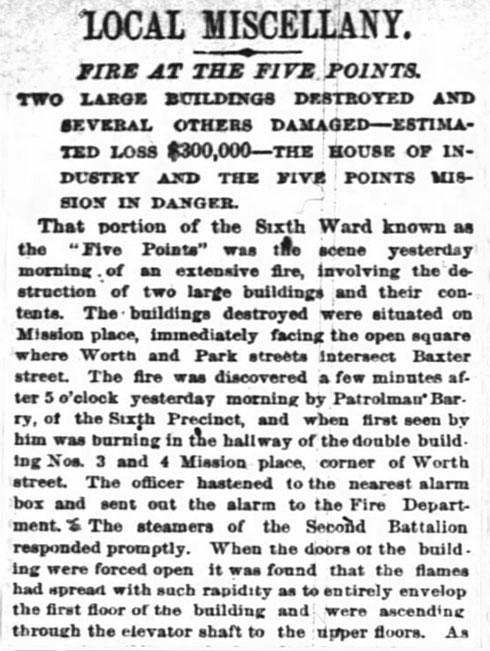
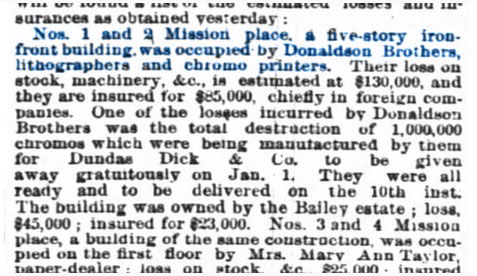
Below, a couple of clips from a lengthy article from the New York Times on the fire in Five Points that took place December 9, 1875, from which, of course, the company rebuilt (with improvements).

Sources:  Donaldson Brothers 1872 – 1891 “D – Publishers.” MetroPostcard. (accessed November 4, 2017).

Trow’s New York City Directory, 1878. Vol. 91, p. 356. (Ancestry.com).

Year: 1880; Census Place: Cranford, Union, New Jersey; Roll: 800; Family History Film: 1254800; Page: 201B; Enumeration District: 171. (Ancestry.com).

Sons of the American Revolution Membership Applications, 1889-1970. Louisville, Kentucky: National Society of the Sons of the American Revolution. Microfilm, 508 rolls. (Ancestry.com).

George William Donaldson. Find A Grave Memorial# 63258205. Findagrave.com.

American Stationer, Vol. 39. Number 24, June 11, 1896. p. 1012. (Google.com.)

“Fire at the Five Points.” New York Times, December 10, 1875. Friday, p. 8. (Newspapers.com).

A Pleasant Reflection

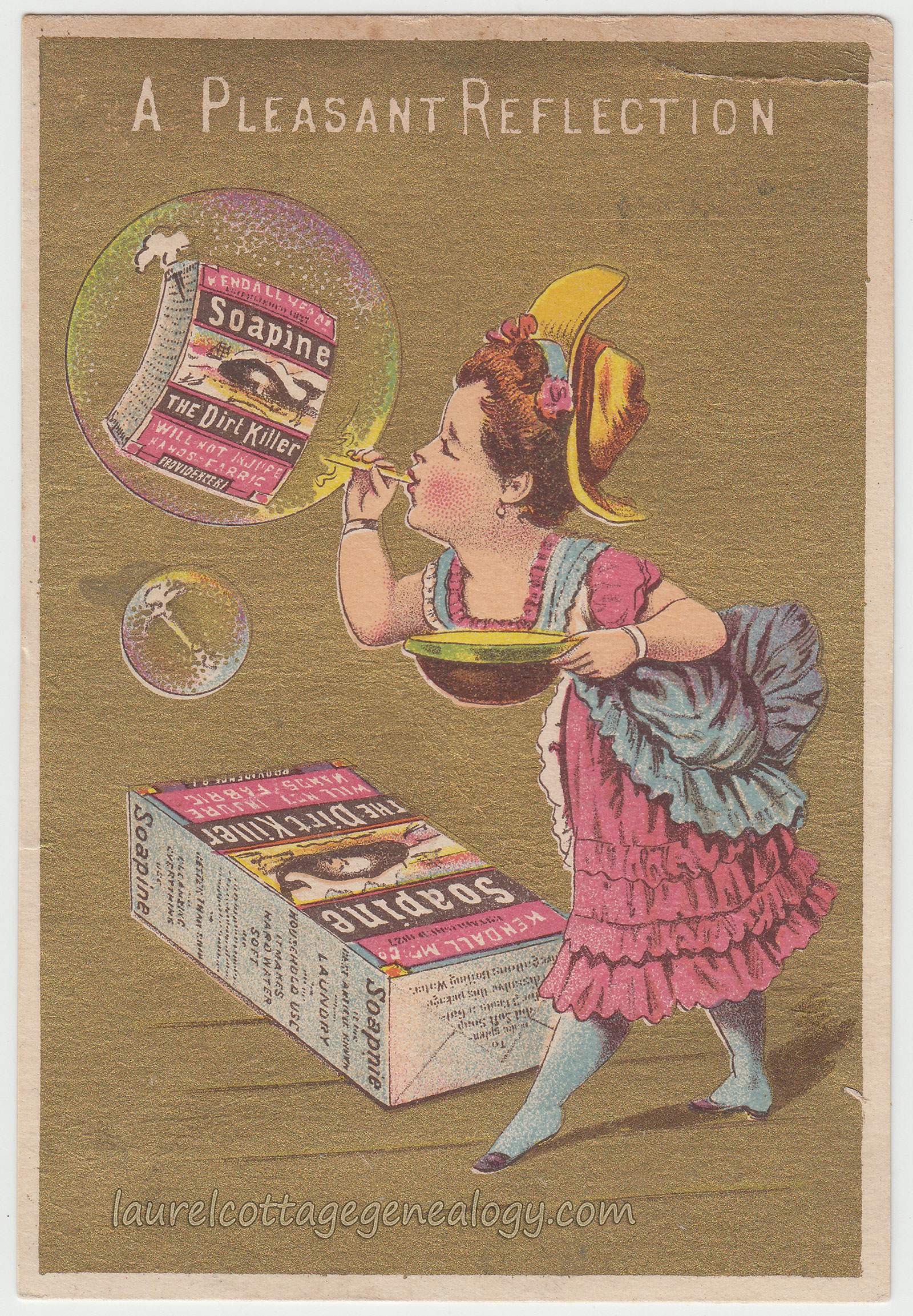
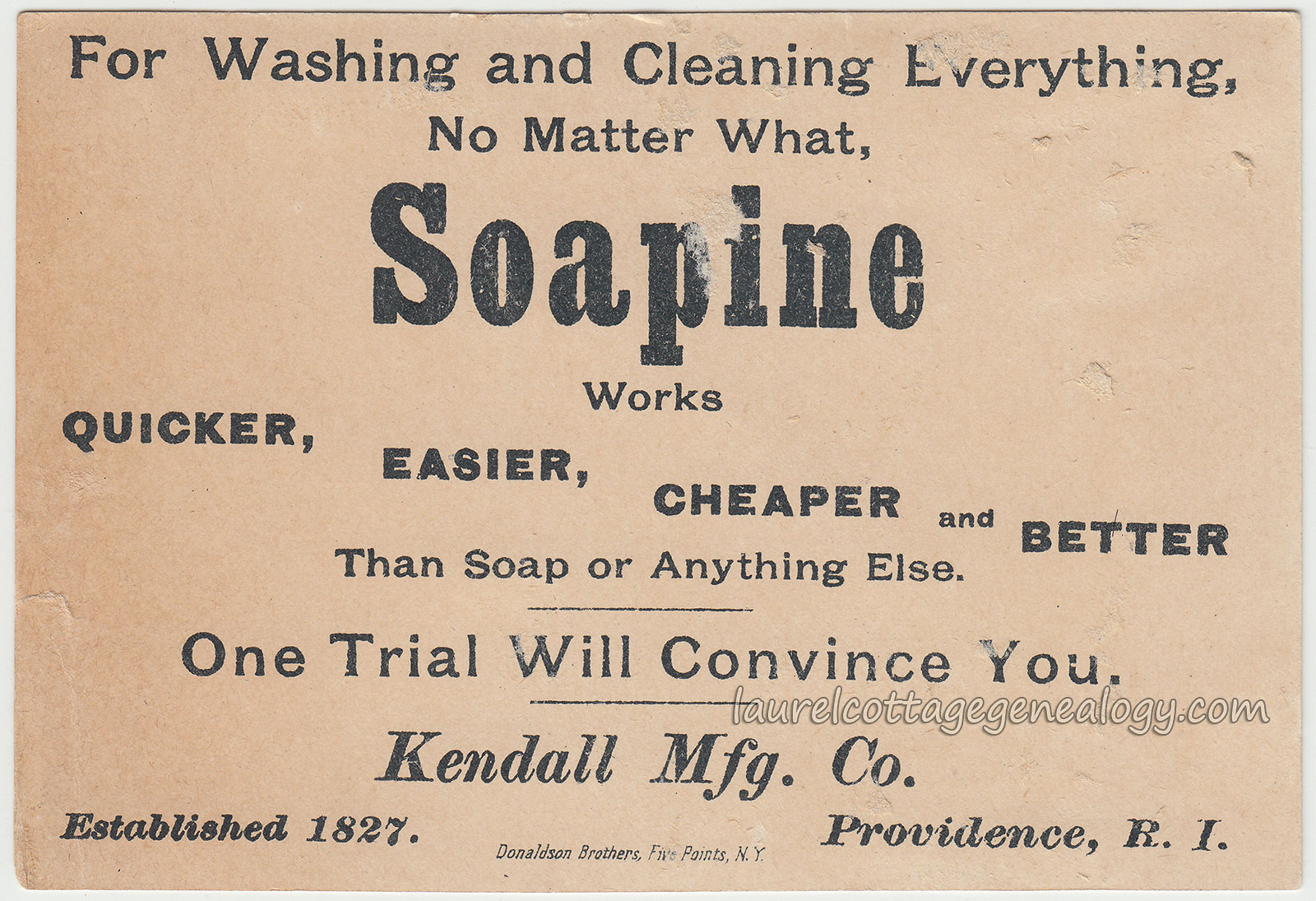
Trade card, Soapine. Kendall Mfg. Co. Donaldson Bros. Lithographers, circa 1870s – 1890s.

Price:  $7.00          Size:  2 and 15/16 x 4 and 1/4″

Kendall Manufacturing Co.’s Soapine, had a very long run, from 1827 to the late 1950s;  here is yet another example of the Victorian Era advertising for the product, one of many that can be found online. The card’s condition is not great, note the crease and there’s a small tear in the top right and a little of the wording torn off of the back, but still it’s a beautiful and imaginative design:  A Tahitian-haired little lady in pink and blue (and love that yellow hat) somehow, lol, blowing a bubble that has the Soapine box inside. Note the iridescence to the bubbles, the lady’s shadow, and the wood flooring. (It always seems like in noticing the details we’re transported back in time; we imagine a sense of the artist’s thought process…..adding in the lady’s bracelets….)

Donaldson Bros., Five Points, N. Y.

Our trade card is the second one we have for Donaldson Brothers, of Five Points, NY. See also B.J. Stone Trade Card, New Haven, CT. And per MetroPostcard, Donaldson Bros. was Frank J., George W., John L. and Robert M. Donaldson, and operated from about 1872 – 1891 before being consolidated with the American Lithographic Company. The 1878 New York City directory shows all four brothers as lithographers, at the address of 4 Mission Place. Five Points was a neighborhood in Lower Manhattan, NY.

Sources:  Donaldson Brothers 1872 – 1891 “D – Publishers.” MetroPostcard. (accessed November 4, 2017).

Trow’s New York City Directory, 1878. Vol. 91, p. 356. (Ancestry.com).

Five Points, Manhattan. n.d. https://en.wikipedia.org/wiki/Five_Points,_Manhattan (accessed November 5, 2017).