Genealogy Services, Old Photos, Postcards, Trade Cards, Etc.

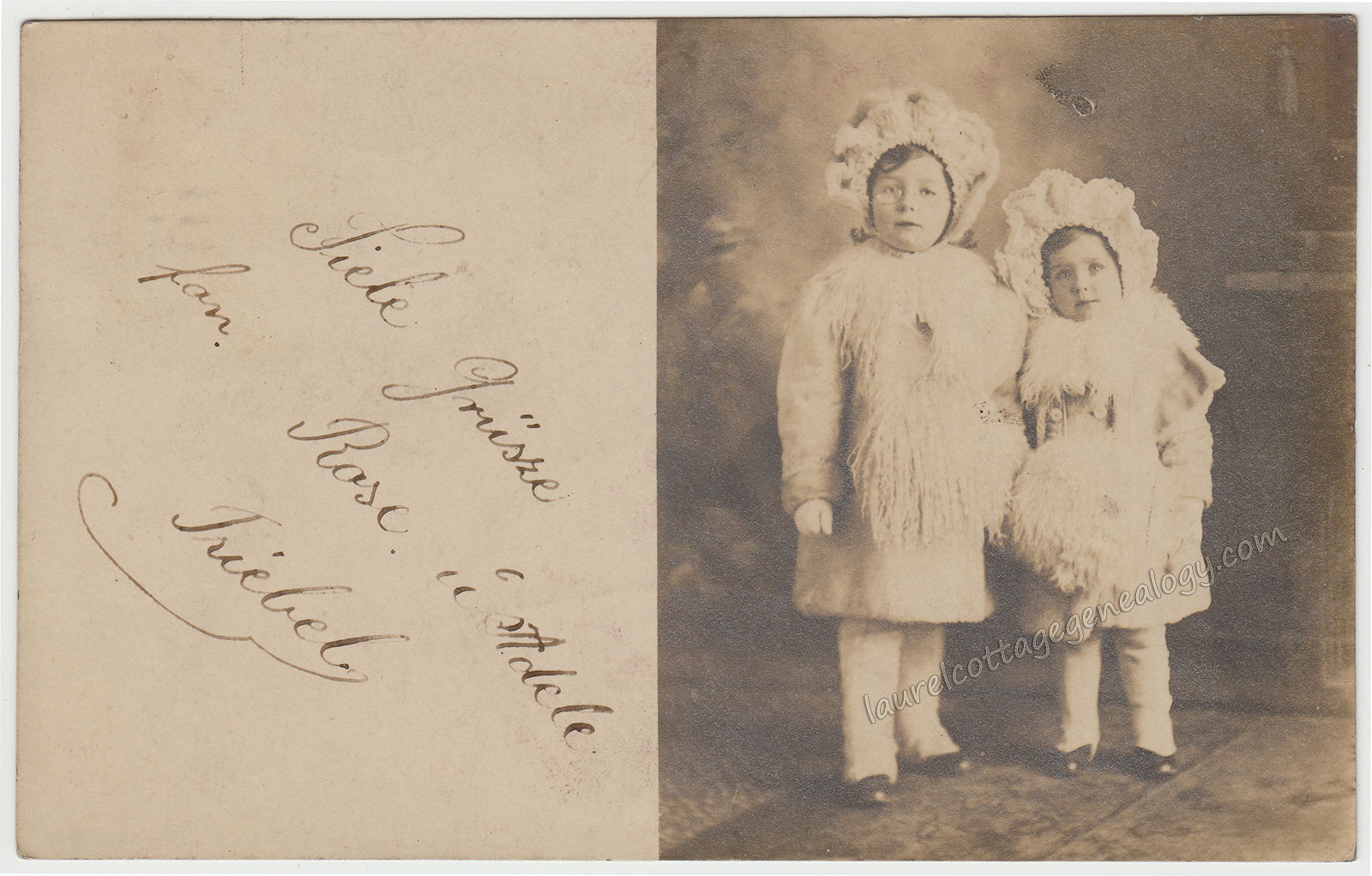
Rose and Adele Triebel, Milwaukee, Wisconsin, 1909

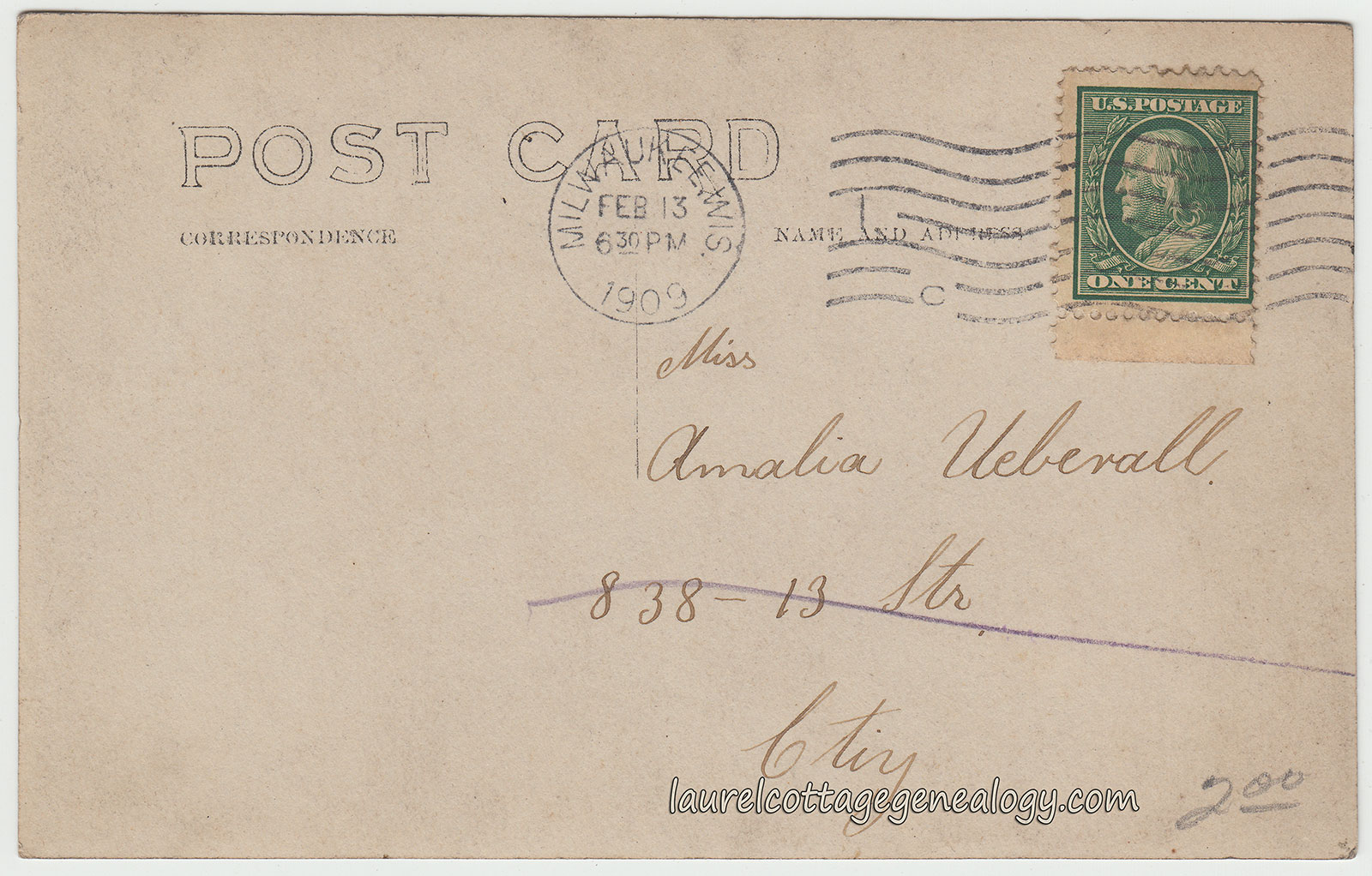
Divided back, Real Photo Postcard. Postmarked February 13, 1909, Milwaukee, Wisconsin.

Price:  $15.00

Addressed to:   “Miss Amalie Ueberall, 838 – 13 Str., City.”  (The “city” in the address is Milwaukee.)

The sender wrote in German:  “Fiele Grüsse fon Rose und Adele Triebel.”  and she must have been substituting the letter “f” for the letter “v” unless maybe this was an old-fashioned spelling. Otherwise it would be written as:

“Viele Grüsse von Rose und Adele Triebel,”  translating as “Kind regards from Rose and Adele Triebel.”  And the Triebel sisters couldn’t be any cuter in their rather unusual-looking winter outfits!

The Triebel Family was found on the 1920 Federal Census for Milwaukee:  Charles, born in Germany, about 1878; his wife Marie, born Germany about 1887; and their daughters Rose and Della, born Wisconsin, about 1905 and 1906, respectively. Charles was working as a machinist for a cab company, and the family lived at 773 47th St.

Source:  Year: 1920; Census Place: Milwaukee Ward 22, Milwaukee, Wisconsin; Roll: T625_2005; Page: 22B; Enumeration District: 272. (Ancestry.com)

Braunlage, Germany, January 1928

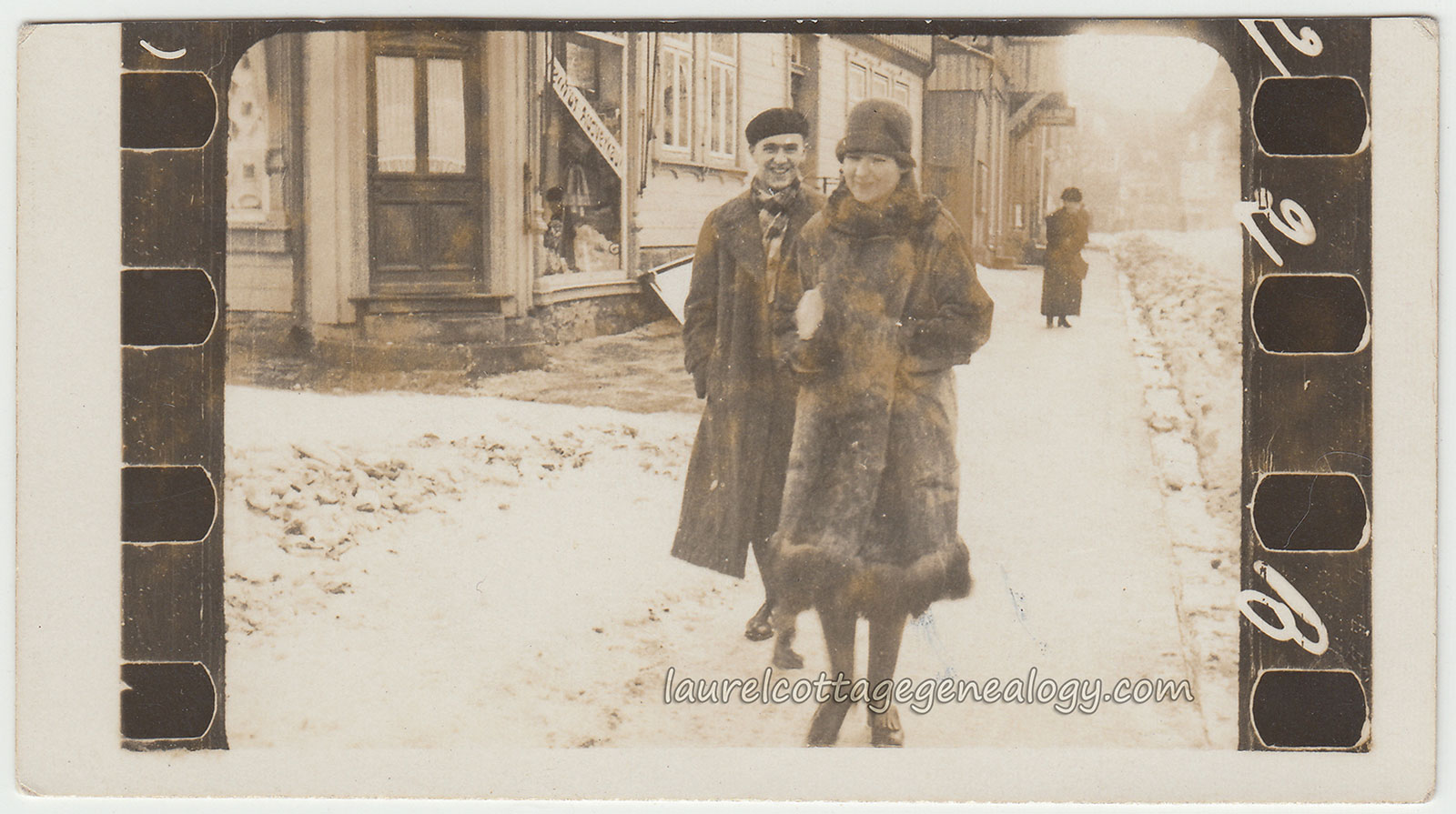
Old photo taken in Braunlage, Germany, January 1928.

Price:  $8.00         Size:  About 3 and 5/8 x 2″

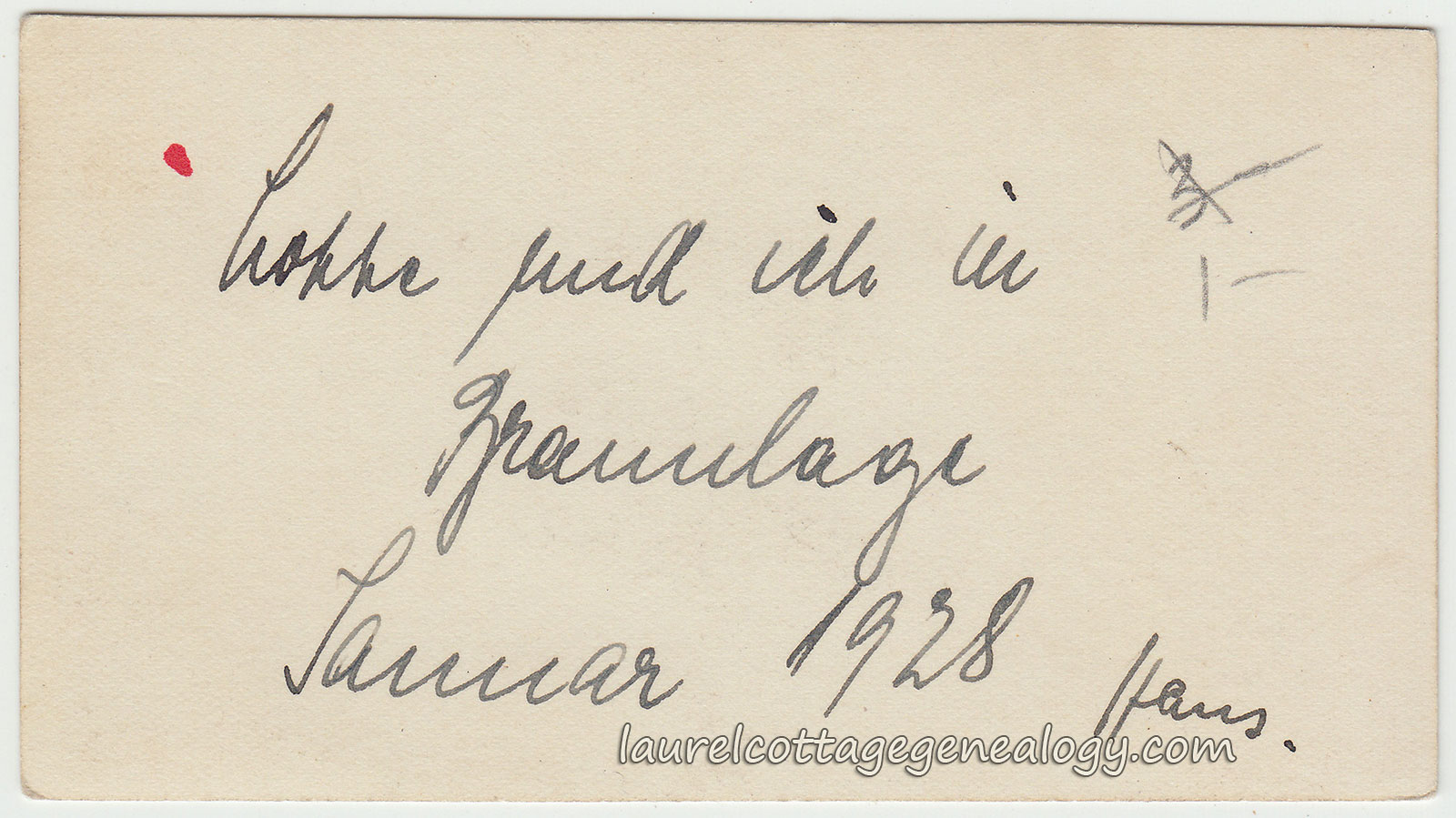
The back of this photo is written in German. Thank you to our informed reader (see comment) for figuring out the name of the woman in the photo!

Lotte und ich in Braunlage, Januar 1928….Hans.” [?]  That appears to be the man’s name “Hans” at the bottom right, so translating as:   “Me and Lotte in Braunlage, January 1928.”

And, it’s a beautiful moment captured in time:  a smiling young man whose gaze has met the camera, in beret, plaid scarf and open overcoat and an equally stylish young woman, her smile and gaze caught looking downward, in cloche hat and fur trimmed coat. They’re walking down a snow-lined street in the town of Braunlage.

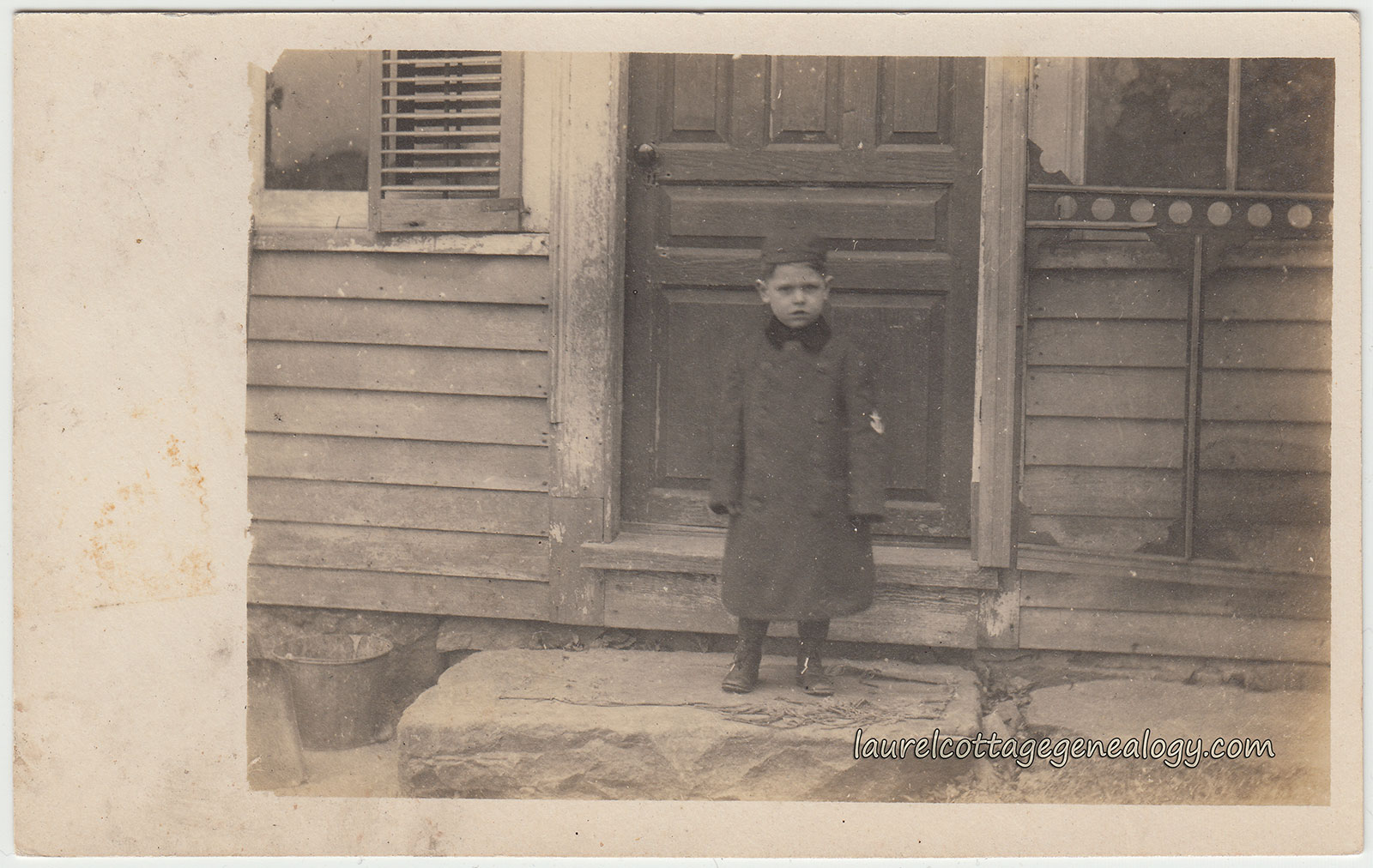
Boy On Front Stoop

Divided back, unused, Real Photo Postcard. VELOX stamp box. Circa 1907 – 1917.

Price:  $5.00

A door stoop seems to have been a great place to have a photo taken, and likely we have more of these type already posted, but it would be fun to view them all together. So we’ll make a separate category, thereby creating (yet another – always a good thing) point of interest to look for in our travels to paper fairs and the like. 🙂 The details in the photo, as always, are fun to pick out:  In this one we notice the very worn mat the little boy is standing on, which is atop the stone stoop which looks hand-chiseled; and the bucket on our left; the beautiful circles pattern in the screen door which is swung wide open on our right; and the nice double-breasted coat the boy wears with an anchor on the left sleeve.

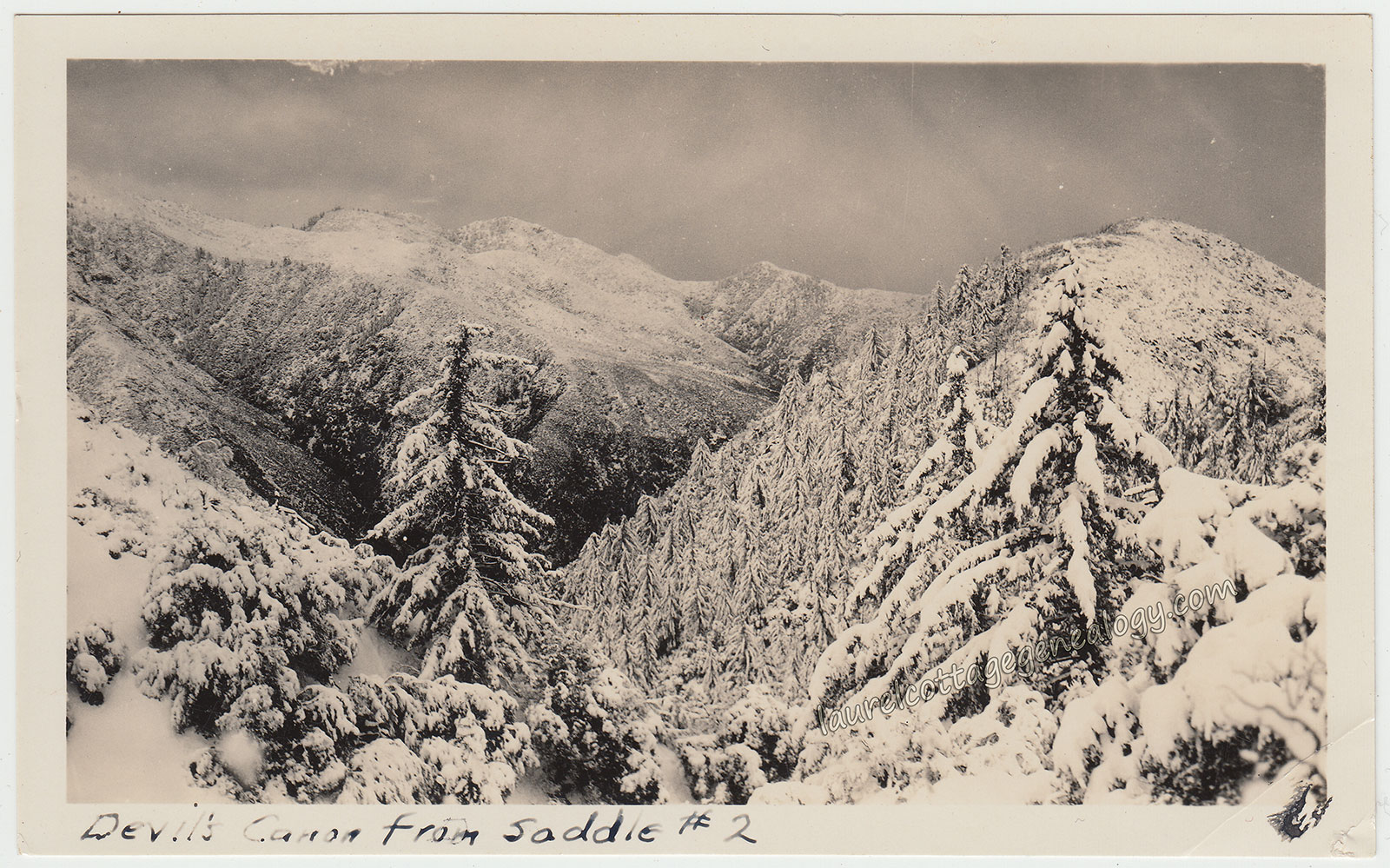
Devil’s Canyon From Saddle #2

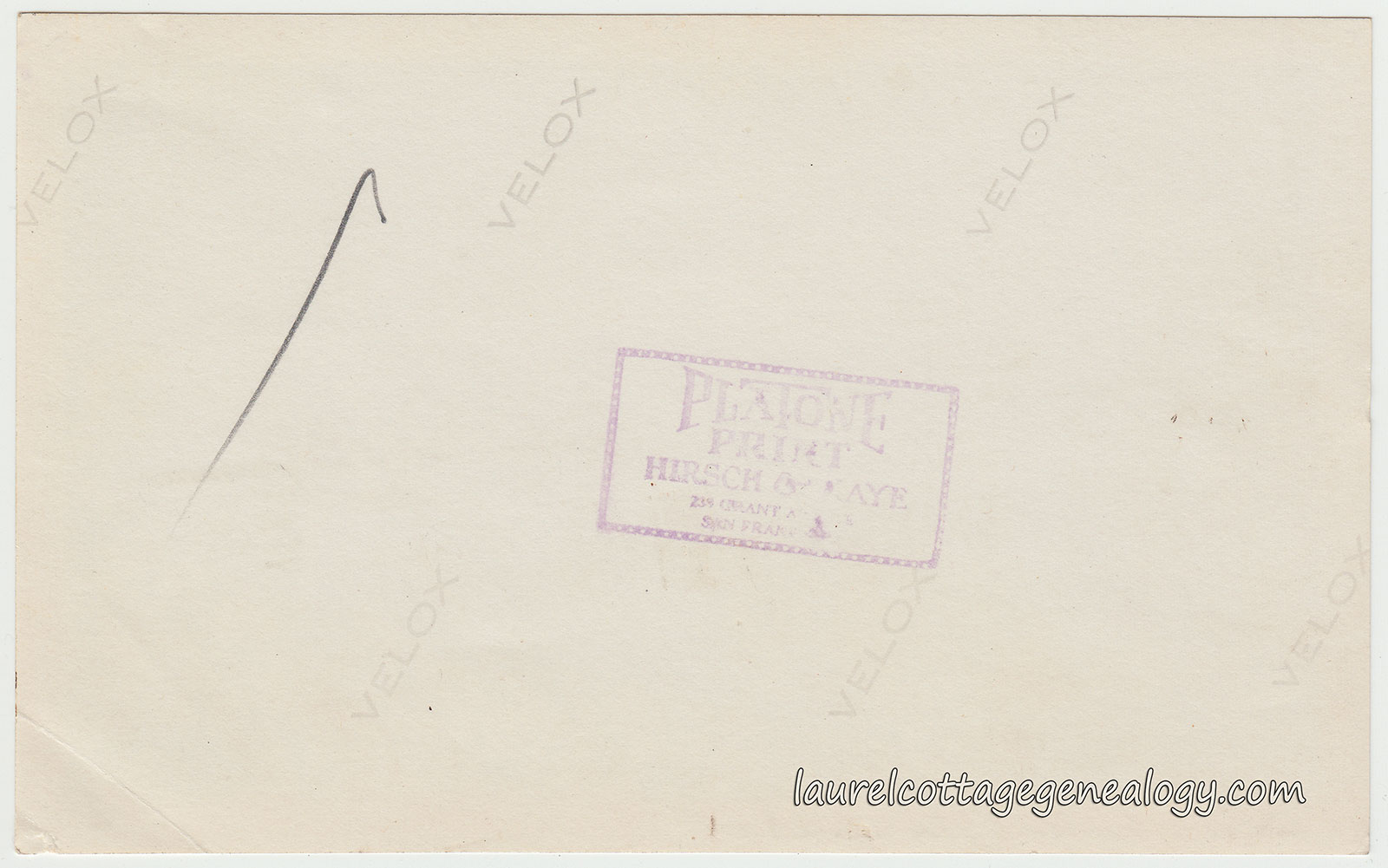
Photo, white border, circa 1920s – 1930s. Photo developer:  Hirsch & Kaye, San Francisco, California. Velox photo paper.

Price:  $12.00

The location of this beautiful winter mountain scene is a bit of a mystery. There is, not surprisingly, more than one Devil’s Canyon, or Cañon as it was meant to be spelled in the description on the front. The Spanish spelling was common until more recent decades, just as the word “today” was formerly seen as “to-day” and “puerto” was formerly written as “porto.” But what a breathtaking scene….just imagine yourself in the picture, taking big gulps of the crisp, clean air!

Definitions for the geographic term “saddle” vary somewhat, for details see Wiki’s Saddle (landform).

For guesses for the location of the photo, our best is the San Gabriel Mountains in Angeles National Forest.

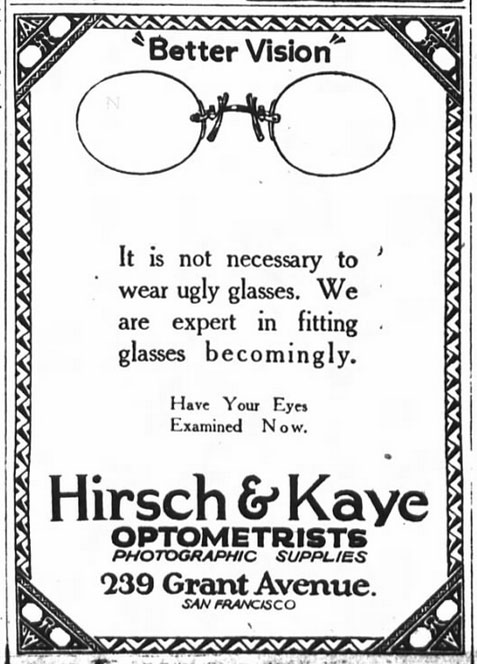
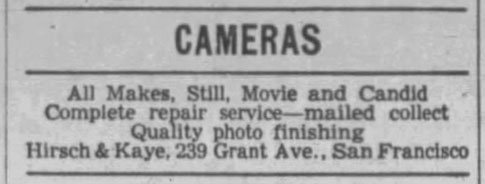
The back is stamped:   “PlaTone Print. Hirsch & Kaye. 239 Grant Avenue, San Francisco.”  A city directory ad for the firm of Hirsch & Kaye was found as early as 1922, at this address. Directories and newspaper ads show that they were in the optometry, photo supply and photo and film developing business.

Below, the obituary of Alphonse Hirsch, pioneer optometrist, that appeared in the Santa Cruz Evening News, September 1923. Per the obit, son, Alphonse, Jr., was associated with the firm, Hirsch & Kaye:

Below, a Hirsch & Kaye ad, from the San Francisco Chronicle, September 24, 1923:

A 1938 ad from Santa Clarita’s The Signal:

Sources:  Saddle (landform). n.d. https://en.wikipedia.org/wiki/Saddle_(landform) (accessed December 15, 2017).

San Gabriel Mountains. n.d. https://en.wikipedia.org/wiki/San_Gabriel_Mountains (accessed December 15, 2017).

H. S. Crocker Co., Inc.’s Crocker – Langley San Francisco City Directory, 1922. p. 1956. Ancestry.com. U.S. City Directories, 1822-1995.   photo supplies

R. L. Polk & Co.’s Crocker – Langley San Francisco City Directory, 1941. p. 1687. Ancestry.com. U.S. City Directories, 1822-1995.  optometrists

“Death Claims Alphonse Hirsch.” Santa Cruz Evening News (Santa Cruz, CA) September 7, 1923. Friday, p. 8. (Newspapers.com).

“Better Vision.” San Francisco Chronicle, September 24, 1923. Monday, p. 2. (Newspapers.com).

“Cameras.” The Signal (Santa Clarita, CA) July 21, 1938. Thursday, p. 6. (Newspapers.com).

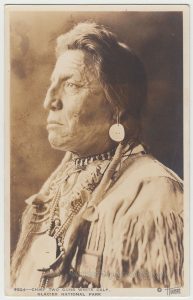
Two Guns White Calf

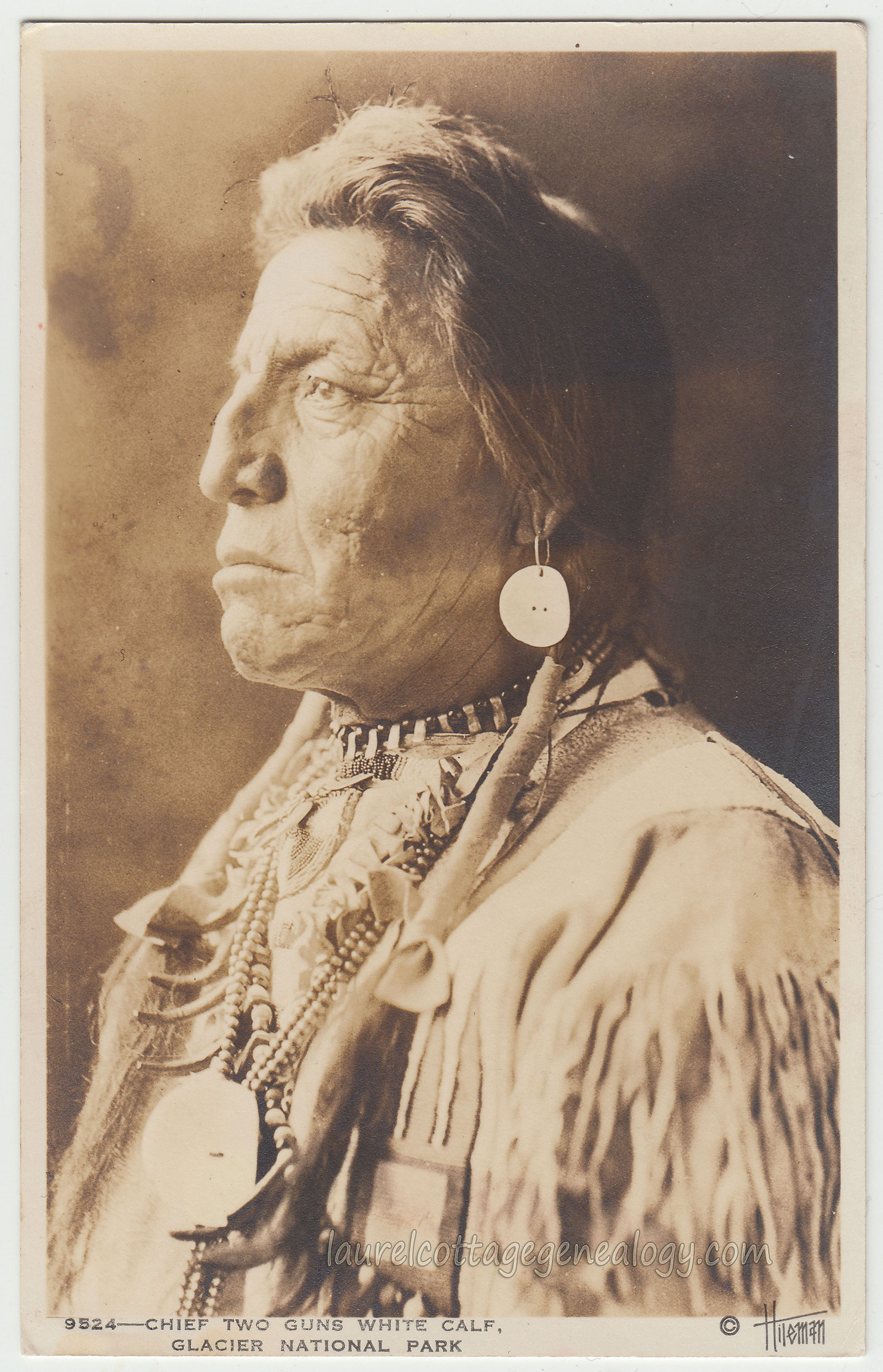
Divided back, Real Photo Postcard, unused. Copyright Hileman. Photographer:  Tomar Jacob Hileman. NOKO stamp box.

Price:  $10.00

John Two Guns White Calf (1872 – 1934) was the son of White Calf; the father is said to have been the last of the Pikuni (a.k.a. Piikáni, Peigan, Piegan) Blackfoot chiefs and, as such, was involved in the sale of Blackfeet land that would become part of Montana’s Glacier National Park. Son, John “Two Guns,” and some of the other members of the park area Blackfoot tribe, became known as “the Glacier Park Indians” through their work for the Great Northern Railway via its campaign to promote the park (thus promoting the railway and its related business properties.)  Through his travels and also his work as a greeter at the park, Two Guns White Calf became one of the most recognizable American Indians of his time; this was due in part to an advertising opportunity that had fallen into the lap of the railroad:  the noted similarity between Two Guns and the Indian on the Buffalo nickel. It’s a great story, but not one that is based in fact, and that’s part of the fascination in both past and present:  how the story came about and that the point of view is still propagating today.

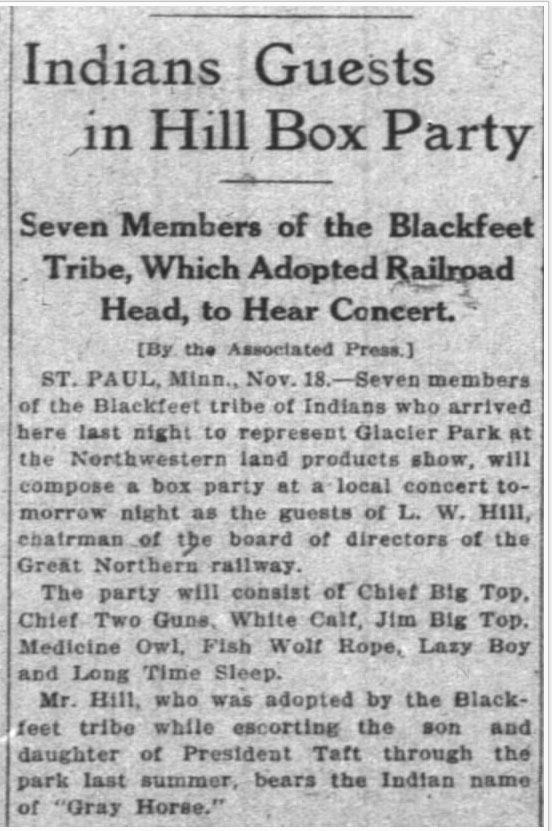
Below, an early news clippings found in the Inter-Ocean (Chicago, Illinois) November 1912:
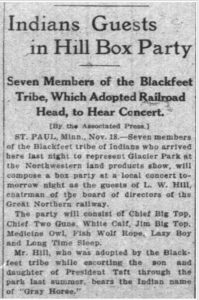
 

A skillfully orchestrated hoax

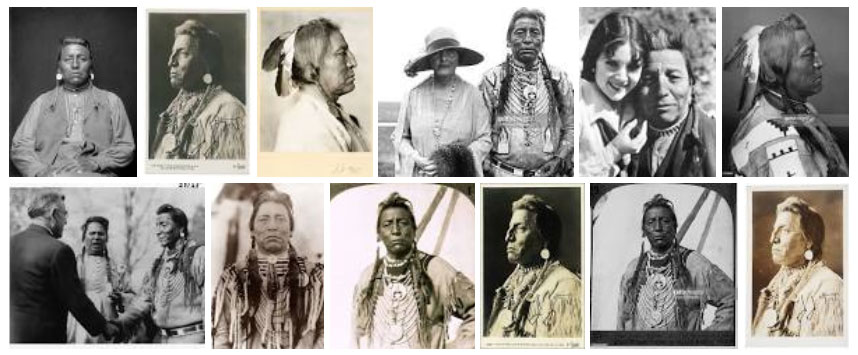
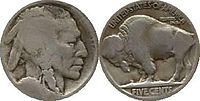
Pull up numerous historical newspaper articles on Two Guns and you can find phrases like “image is on” and “posed for” in relation to the coin, and true, Two Guns’ profile is remarkably similar to the image on the nickel……but absolutely not when looking at the shape of the nose. Two Guns’ nose was quite distinctive. (I’ve borrowed this word from someone and don’t remember quite where.) It juts downward at the bump (not the technical term, I know), as you can see in the postcard, even though his image there is not in perfect profile. Comparing his profile with that of the nickel image should lead anyone new to the topic to immediate skepticism and to dig in to further research, if needed. But, how did the story get started in the first place? See an explanation by journalist and author Ray Djuff, in an article that appeared in Coins Magazine, February 27, 2013:  “The Big Nickel Lie; Two Guns’ Famed Mug Not Used,” and see the newspaper articles appearing further below, for a little additional background.

Production of the Buffalo nickel ran from 1913 – 1938.
Below, some images of Two Guns containing some better profile shots from a Google search:
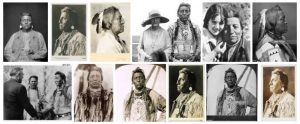
A composite

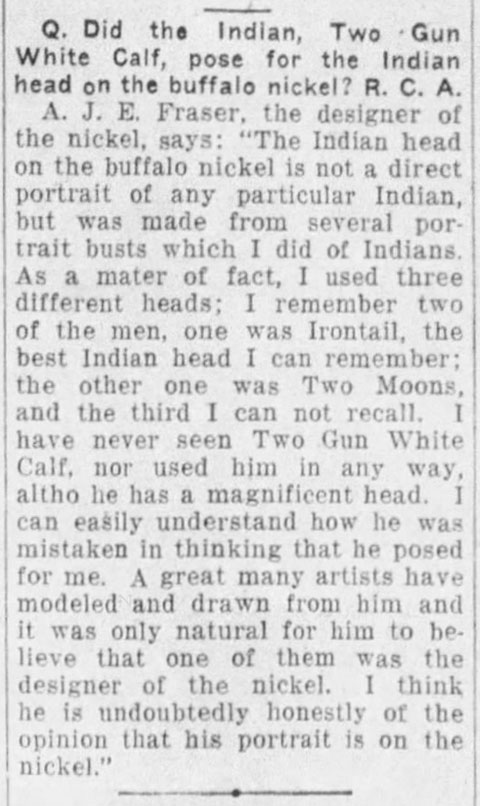
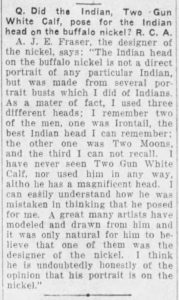
The nickel’s sculptor, James Earle Fraser, also famous as the artist who sculpted “The End of the Trail,” clearly stated that the Indian on the nickel was not one man but a composite; naming Chief Iron Tail of the Ogalala Sioux and Chief Two Moons of the Northern Cheyenne, and a third and maybe fourth that he couldn’t remember. He also stated that Two Guns was not one of the models, nor had he ever met him, but it seems the statement about the unremembered other name or names is one reason the legend has lingered.

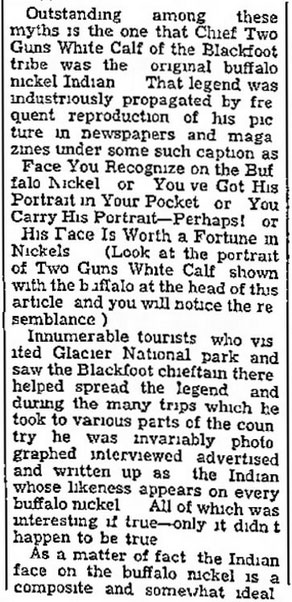
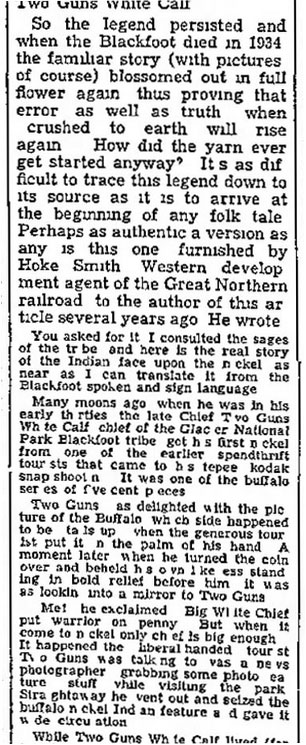
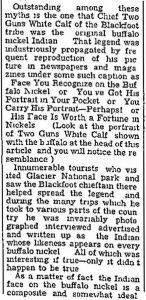
Below left, one of the quotes from Fraser, appearing December 1935 in Davenport, Iowa’s Quad-City Times. Below center and right, two excerpts from journalist Elmo Scott Watson, appearing in a March 1938 article in The Times-Independent (Moab, Utah). The clip on the right includes a quote from “…Hoke Smith Western development agent of the Great Northern Railroad…” (See the Ray Djuff link above on “Hoke” Smith).
Many roads to travel

The life of Two Guns would make for a great book (and one may already be in the works). In general, it’s difficult, if not impossible, to do justice to anyone really, in a (somewhat) short blog-type entry, but especially so in the case of Two Guns, because of his “association with” the Buffalo nickel, and because there is so much more to explore in context with the times:  to name just a few topics, the Great Northern Railway history, publicity and the American Indian, see for instance, Two Guns’ mention in authors LaPier and Beck’s City Indian:  Native American Activism in Chicago, 1893 – 1934, the history of the nickel itself, with the public reportedly clamoring to know the name of the Indian on the coin when it came out. (FYI, there was an original version of the coin, and then a “do-over” because portions of the design, specifically the “five cents,” was thought to be too indistinct; there’s the fact that not everyone loved the design of the buffalo, as some thought the animal had a forlorn, hang-dog kind of look, though if one took that view, it could be seen as historically fitting because of the buffalo’s slaughter in the wake of “progress;” and comically, in one newspaper journalist’s opinion, if you viewed the buffalo on an angle it looked like the face of a man.) Another aspect to explore in the life of Two Guns is his own stated belief that it was his visage on the coin. (He was not the only Indian claiming that it was their own likeness, of course, so there’s another major road, highway really, to explore.) But one wonders, not meaning to offend any of his descendants, if Two Guns really thought so, or if he might have privately viewed it as a “useful open-ended possibility” in any dealings he might have with the U.S. government in relation to the rights of the Blackfeet. That’s only my uneducated thought and one not necessarily adopted, and to be thorough, the history of the beliefs and ideology of the Blackfeet might also be explored. And because we’d like to know more about the man himself, to touch on the subject of family life, it was remarked in a newspaper article that he and his wife had a tender relationship when he cancelled an appearance at a New York reception to stay with her on a day that she didn’t feel well. By the way, a wonderful interview by Two Guns’ wife, who was described as “vivacious and loquacious,” can be read of her thoughts in 1913 on the modern women of New York. In answer to the reporter’s questions, she found New York women pretty, at the same time wondering at their restrictive clothing, fashion v. freedom and energy flow, noting how the “hobble skirt” that was currently in vogue, reminded her of how “when we want to keep our ponies from running off we hobble them,” and spoke in general, about the importance for women of having fresh air, un-restrictive clothing, work, and not necessarily marriage, but friendship.

Modern joys and pitfalls

The succession over the years of the many newspaper articles alone on Two Guns White Calf and the nickel is thought-provoking, not only in transporting us back to the past, seeing the similarities in reporting today v. then, getting a feel for how a myth evolved, but also in highlighting (once again) the wonder and pitfalls of the fast-paced world we now live in:  Don’t happen to have a Buffalo nickel stashed away in a drawer? Online, and bingo, there it is, and you don’t even need a magnifying glass to get a good view. But the pitfall:  with such instant information at our fingertips via the internet, it’s only natural that we’ve come to expect quick answers. I totally get this. Research is painstaking. I have boxes of photos, postcards, etc. waiting to go up on this website. (Rubbing hands together in anticipation.) Beauties, each a doorway into another dimension, and that feeling that there is never enough time. So, especially in Two Guns’ case, if one were doing a quickie post but sincerely wanting to check some sources like old newspaper articles, one could be forgiven (always, who’s perfect?) in posting misinformation or at the very least putting up a more limited view of a multi-level topic. It’s a great example of how a quickie look at something can lead us down the primrose path resulting in unknowingly becoming both victim and propagator in the “wrong info begets wrong info” trap. Even with pretty extensive research, there are dangers; for example, any archivist or genealogist will tell you that all sources need to be explored (though we can’t always know what “all” is) as it’s sometimes that one census record that one didn’t bother to hunt down, or that one whatever, that turns out to be a game-changer, as in:  “Oh, a prior marriage….so such-and-such was not the maiden name,” or “OMG, this person was adopted.” But jumping down from this soapbox, my short-ish post on Two Guns is obviously not the biggest picture either, but rather just a part of a many-faceted likely as-yet-undiscovered whole.

In closing, we love the tongue-in-cheek expression, “Don’t let the facts get in the way of a good story” and variations thereof (He never lets the facts….) but in the case of John Two Guns White Calf, the truth makes a better story than the myth. We hope the book gets written.

Sources:  Piegan Blackfeet. n.d. https://en.wikipedia.org/wiki/Piegan_Blackfeet (accessed December 11, 2017).

John Two Guns White Calf. May 21, 2012. nativeheritageproject.com. (accessed November 25, 20017).

“Did the Indian, Two Gun White Calf, pose for the Indian head on the buffalo nickel?” Quad-City Times (Davenport, Iowa). December 10, 1935. Tuesday, p. 12. (Newspapers.com).

Buffalo nickel. n.d. https://en.wikipedia.org/wiki/Buffalo_nickel (accessed November 25, 2017).

“Images of Two Guns White Calf.” Google.com. Accessed December 14, 2017.

“Indian Guests in Hill Box Party.” The Inter-Ocean. (Chicago, Illinois). November 19, 1912. Tuesday, p. 12.

James Earle Fraser (sculptor). n.d. https://en.wikipedia.org/wiki/James_Earle_Fraser_(sculptor). (accessed December 12, 2017).

Djuff, Ray. “The Big Nickel Lie; Two Guns’ Famed Mug Not Used.” February 27, 2013. Coins Magazine. (accessed at NumisMaster.com. November 25, 2017).

LaPier, Rosalyn R.Beck, David R. M. City Indian:  Native American Activism in Chicago, 1893 – 1934. University of Nebraska Press. May 31, 2015.

“Buffalo Nickel Now Creating A Lot Of Trouble.” The Lima Daily News (Lima, Ohio). January 26, 1914. Monday, p. 4. (Newspapers.com).

“The New Five-Cent Piece. Indian and Buffalo Design Defended by an Admirer.” The New York Times. March 5, 1913. Wednesday, p. 16. (Newspapers.com)

Marshall, Marguerite Mooers. ” ‘New York Women Heap Nice to Look At,’ Mrs. Two Guns White Calf Explains.” The Arkansas Gazette. (Little Rock, Arkansas). March 31, 1913. Monday, p. 7. (Newspapers.com)

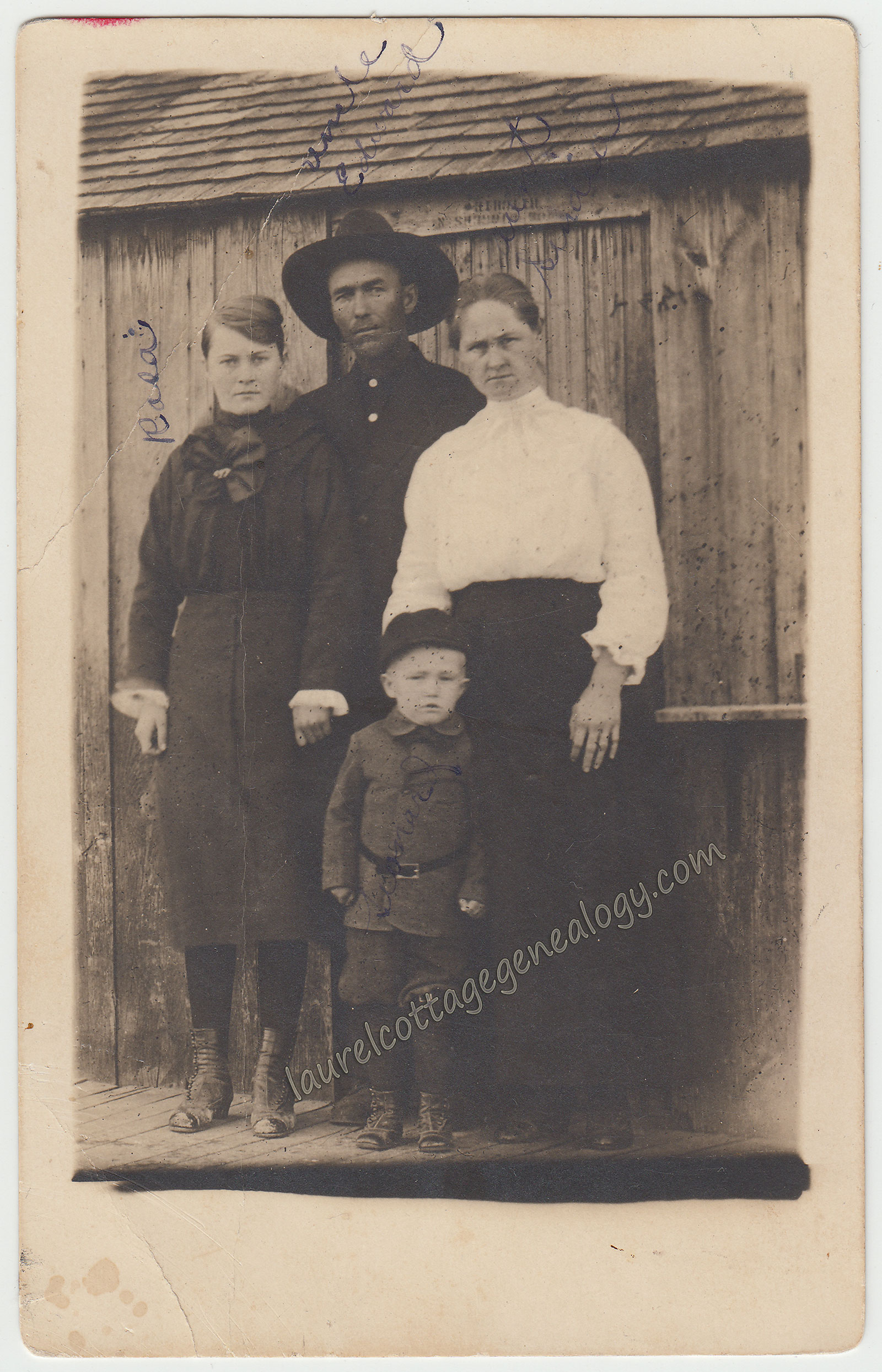
The Brooks Family of Newburg, Oklahoma, Circa 1916

Divided back, Real Photo Postcard, unused. Circa 1916. AZO stamp box.

Price:  $15.00

Benjamin Edward Brooks, his wife Loucinda (Oden) Brooks and their children Rosa and Leonard.

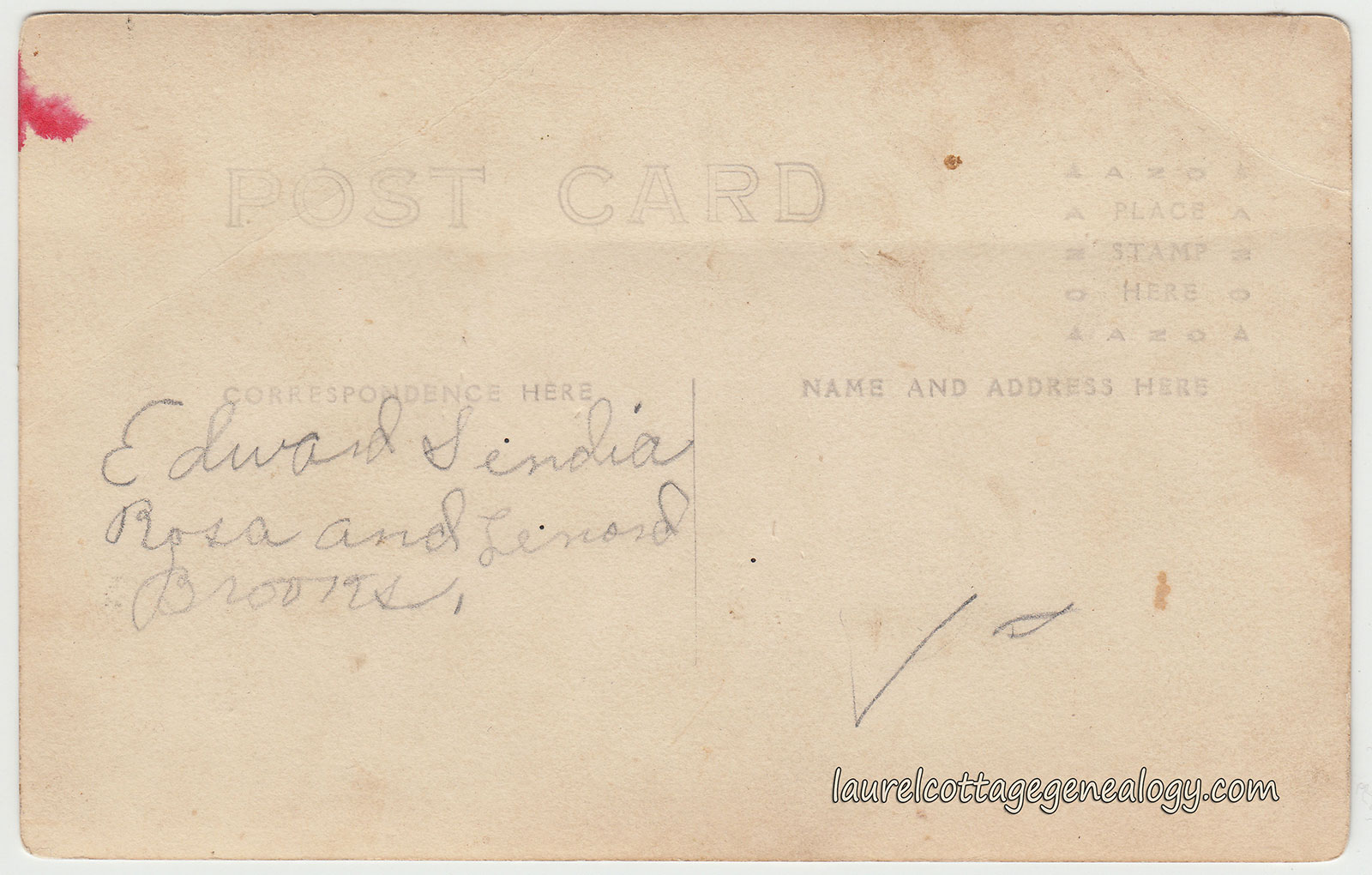
Benjamin was born in Arkansas, September 3, 1878, per his WWII Draft Registration, or 1879, according to his gravestone. He married Loucinda Oden, August 30, 1900. The marriage record lists both as residents of Gerty, Indian Territory, Oklahoma. The groom was age 21 and the bride age 14. Benjamin, according to this postcard, seems to have gone by his middle name. You can see the writing on the front, left to right, of  “Rosa, Uncle Edward, Leonard, Aunt Sendia.”  And, if you look closely, you’ll notice stenciling on the wood above the cabin door. It’s pretty difficult to make out, but it looks like it includes some numbers, so maybe it was some type of i.d. for the lumber company. The 1920 and ’30 Federal Census’ shows the family living in Newburg, OK. Per cemetery records, Rosa Mae Brooks was born May 6, 1902 and Leonard O. Brooks, September 9, 1912.

Sources:  Year: 1920; Census Place: Newburg, Hughes, Oklahoma; Roll: T625_1465; Page: 1A; Enumeration District: 72. (Ancestry.com)

Year: 1930; Census Place: Hinton, Caddo, Oklahoma; Roll: 1895; Page: 5A; Enumeration District: 0034; FHL microfilm: 2341629. (Ancestry.com)

The National Archives at St. Louis; St. Louis, Missouri; World War II Draft Cards (4th Registration) for the State of Oklahoma; Record Group Title: Records of the Selective Service System, 1926-1975; Record Group Number: 147.

“Oklahoma, County Marriages, 1890-1995”, database with images, FamilySearch (https://familysearch.org/ark:/61903/1:1:QVP6-LM7V : 4 November 2017), Edward Brooks and Loucinda Oden, 1900.

“Rosa Mae Dilbeck.” Find A Grave memorial #128124881. (Findagrave.com).

“Leonard O. Brooks.” Find A Grave memorial #14574732. (Findagrave.com).

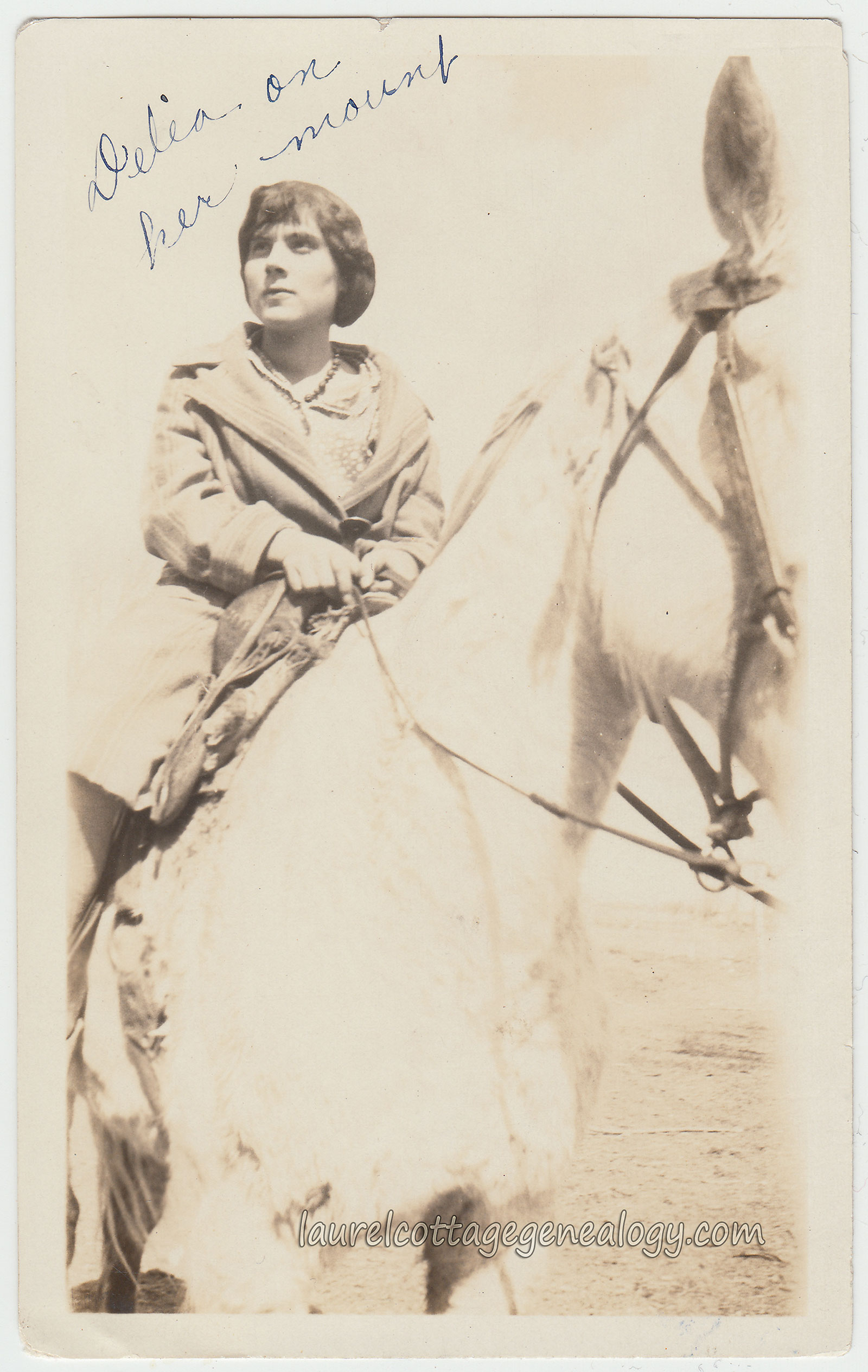
Mrs. Delia Hoak, Idaho, Circa 1930

Two old photos, circa 1925 – 1935.

Price for the pair:  $15.00           Size for photo on left: 2 and 5/8 x 4 and 3/8″

Size for photo on right:  3 and 1/8 x 5″

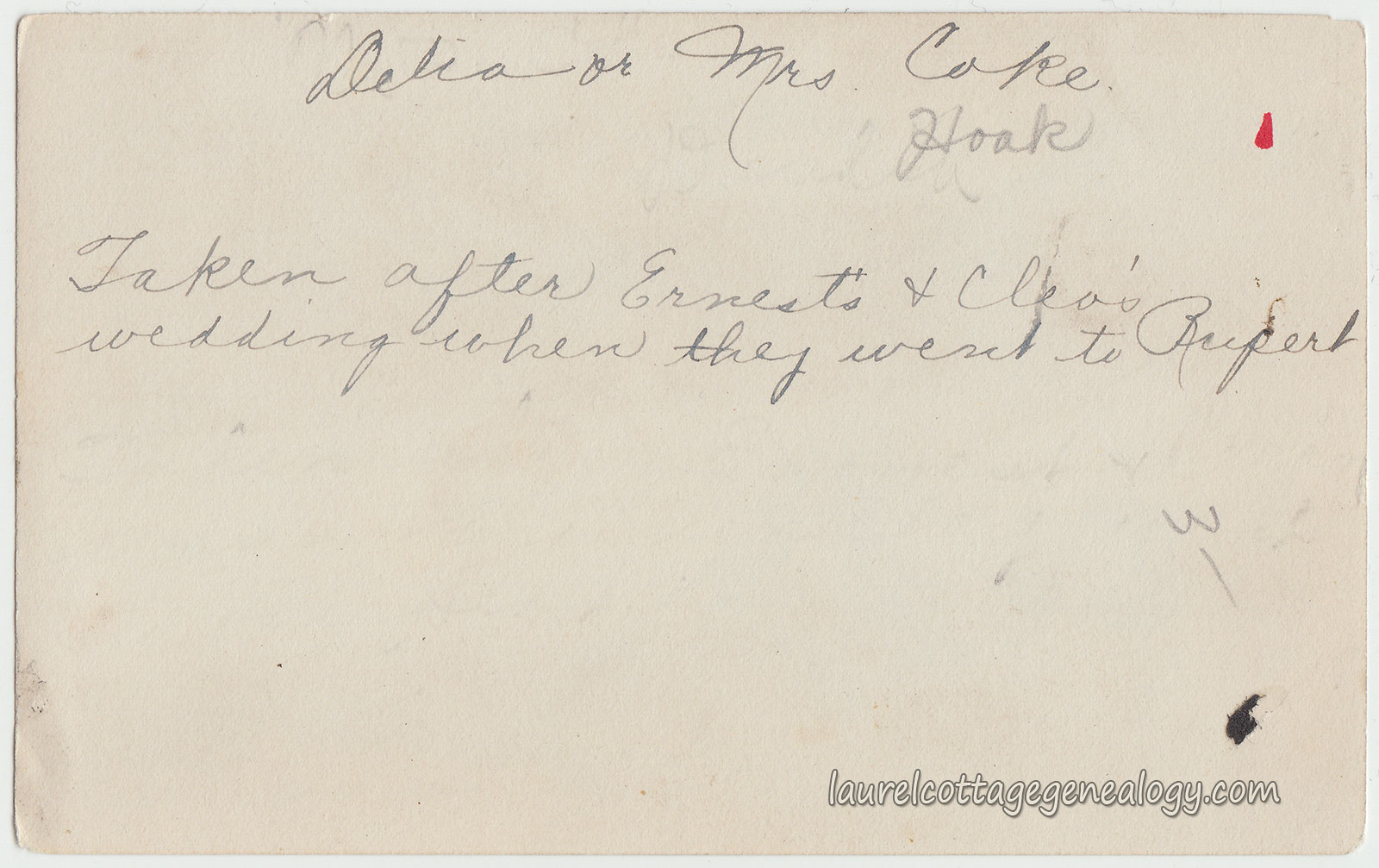
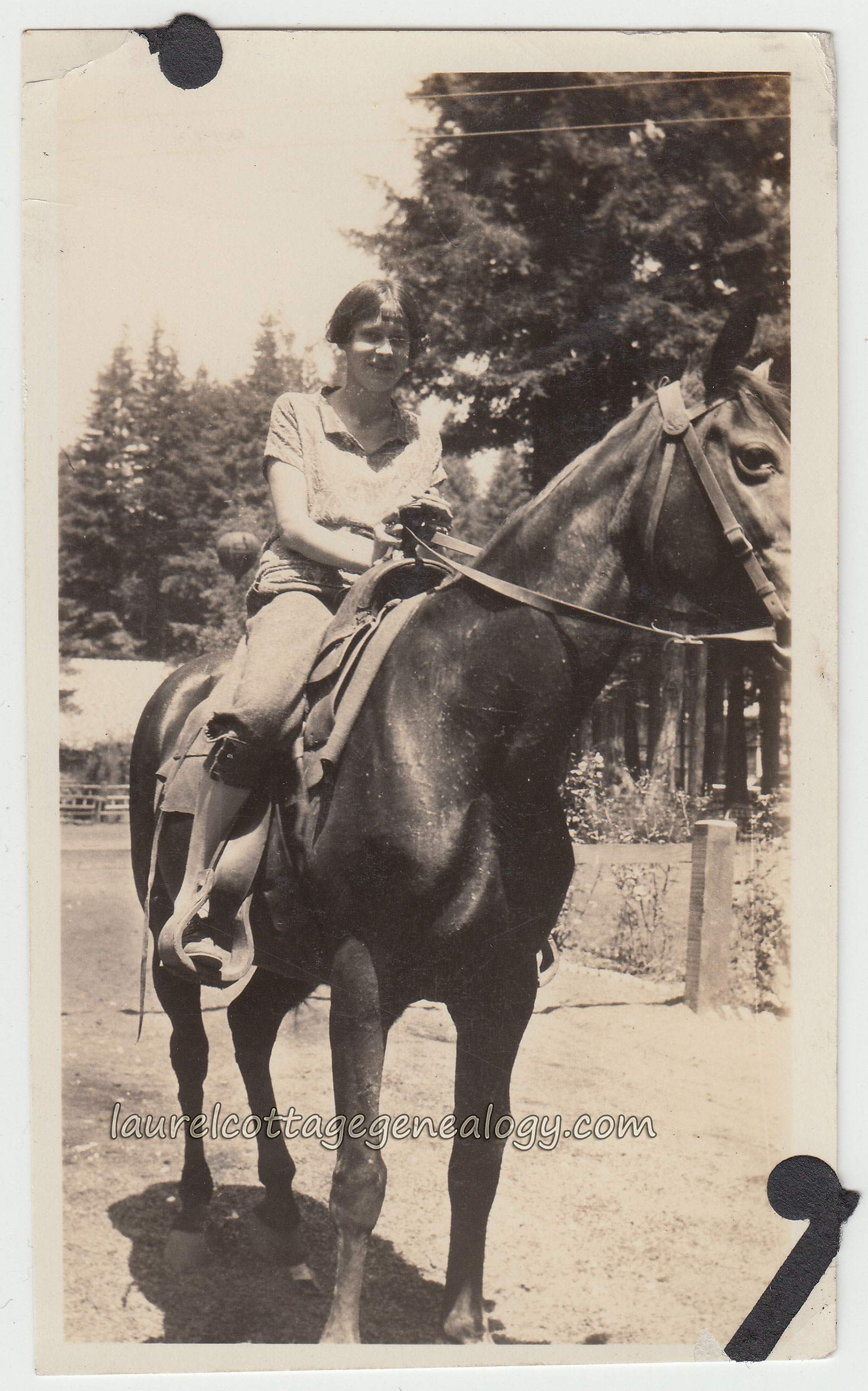
“Delia on her mount…..Taken after Ernest’s & Cleo’s wedding when they went to Rupert.”

Most likely these are photos of Delia Olive Bull, born September 12, 1909 in Rupert, Idaho, daughter of Walter A. Bull and Victoria Virginia Howell. Delia married John William Hoak October 25, 1926 in Minidoka County, Idaho. Though the back of the photo on our right shows “Delia or Mrs. Coke,” no matches were found, so the correction in pencil to “Hoak” would be correct. The photo on the left might have been taken before Delia married, as she looks younger in that snapshot. The 1930 Federal Census for Boise shows John, Delia and their two young sons, Willis and Kenneth.

As for the newlyweds, Cleo and Ernest, there are a few possible couples that fit the time period with these given names, in Idaho.

Sources:  Idaho State Department of Health; Boise, Idaho; Idaho Birth and Stillbirth Index, 1913-1964. (Ancestry.com).

Upper Snake River Family History Center and Ricks College; Rexburg, Idaho; Idaho Marriages, 1842-1996. (Ancestry.com).

Year: 1930; Census Place: Boise, Ada, Idaho; Roll: 395; Page: 2A; Enumeration District: 0012; FHL microfilm: 2340130. (Ancestry.com).

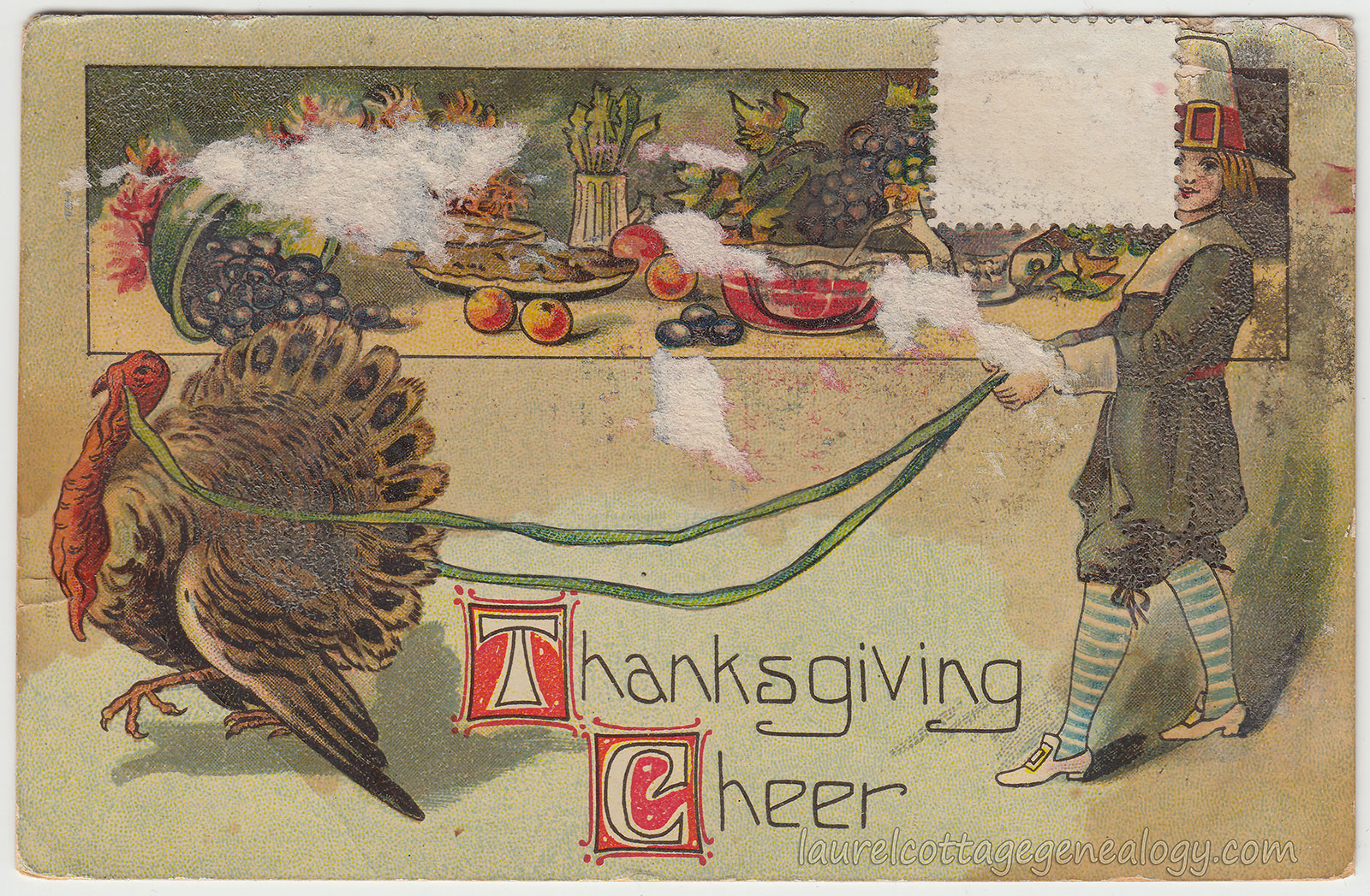
Thanksgiving Cheer

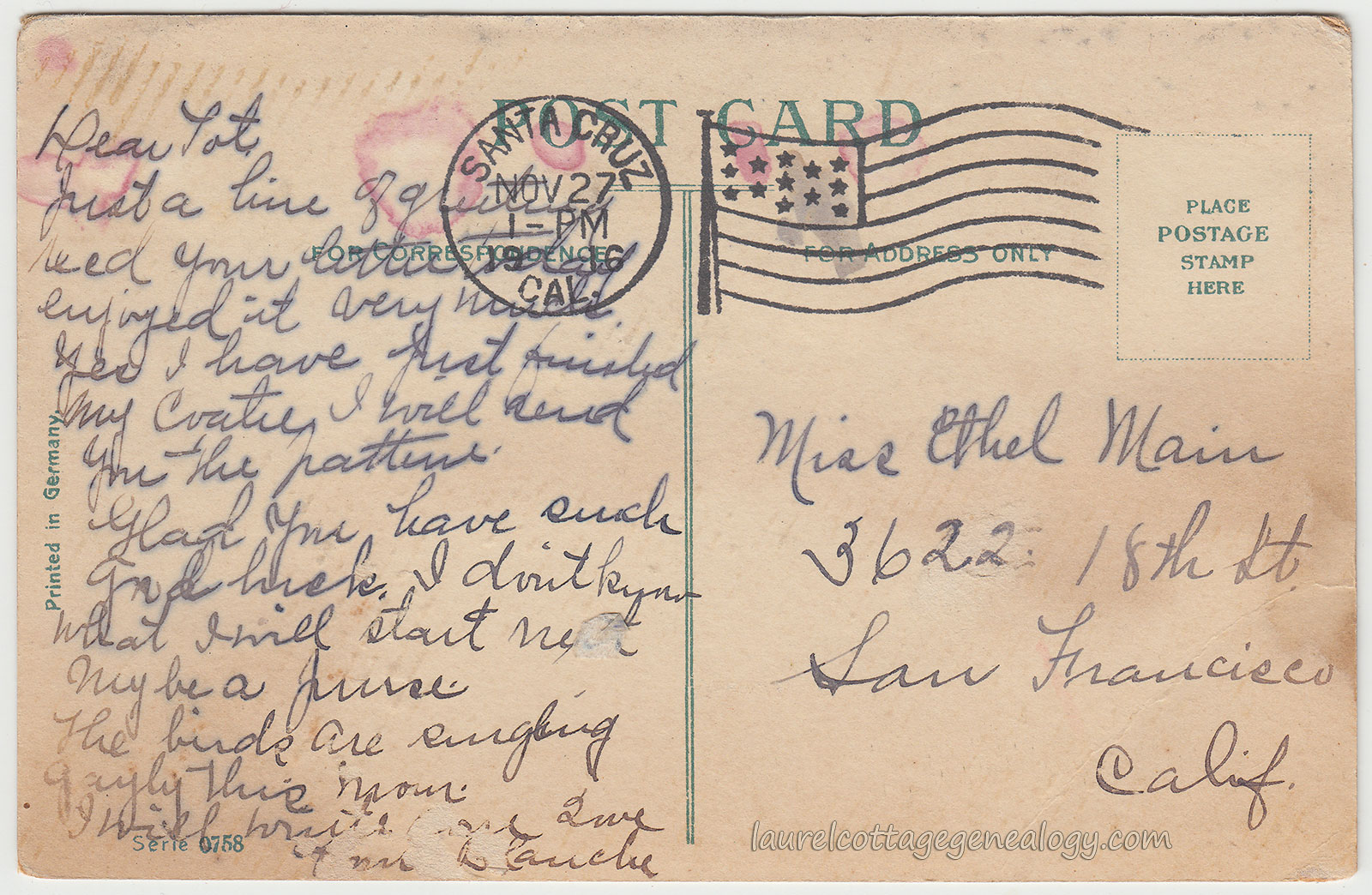
Divided back, used postcard. Postmarked November 27, 1916 from Santa Cruz, California. Printed in Germany. Series 0758.

This poor card is really beat up, but it’s the only one we have at the moment, for the holiday, so Happy Thanksgiving! And it’s another in the Ethel Main Collection. Ethel’s nickname was “Tottie.” The sender wrote:

“Dear Tot, Just a line of greeting, recd your letter today, enjoyed it very much. Yes I have just finished my [?] I will send you the pattern. Glad you have such good luck. I don’t know what I will start next. Maybe a purse. The birds are singing gayly this morn. I will write……..Blanche.”

Addressed to:

“Miss Ethel Main, 3622 18th St., San Francisco, Calif.”

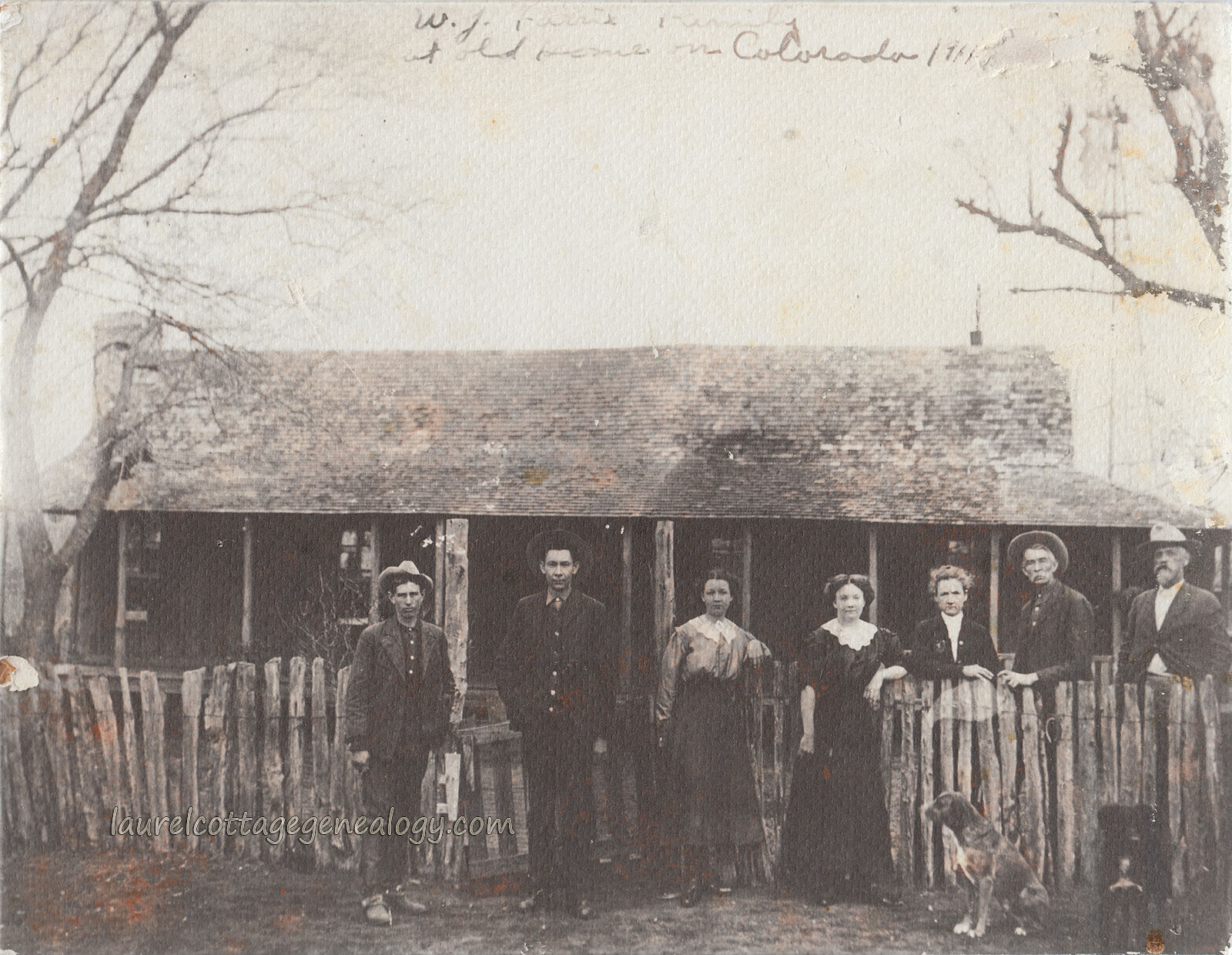
W. J. & Family At Old Home On Colorado

Photo from 1911 printed to canvas on wooden board and frame

Price:  $20.00        Size:  10 x 7 and 3/4″    

Condition:  Some scratches, markings and canvas tears

Surname mystery

This was an unusual find at, it was either an antique store or a thrift store. (Yikes, I guess this means I have to start writing them all down.) So, it was somebody’s cool idea to take an old family photo (their family or one they just found and liked) and have the image transferred to a canvas (or canvas-like) type of surface. It was then glued onto a thin board on a wooden frame, so that it could go up on that person’s wall. (Now it’s on mine.) It’s the fourth for me, of those that are not family but have become family. A couple have names but nobody’s claimed them yet, another has no name, and then there’s this one:  What in the world is this family’s surname? Ferris, Harris, Ferix misspelled as Farrix (can’t find surname Farrix). Even with a magnifying glass, and in the sunlight, it’s hard to say. The location could be almost anywhere, too, since it appears to say “on Colorado” rather than in Colorado or on the Colorado, as in River. Well, but whoever they are, they’re a beautiful group of seven people and two dogs (didn’t the dogs do well to not move too much while the photo was being taken? 🙂 ) Love that wooden fence, and the porch running the length of the house. The home seems to have been pretty big, and it’s rustic-looking. Was it originally a log cabin? We can’t see the details. You’ll notice a windmill behind the house on the right. But, it really strikes me with an impression so significant, a feeling that we could wave to the family and they’d wave back across this current span (insignificant, really) of six and one hundred (going old-school here) years.

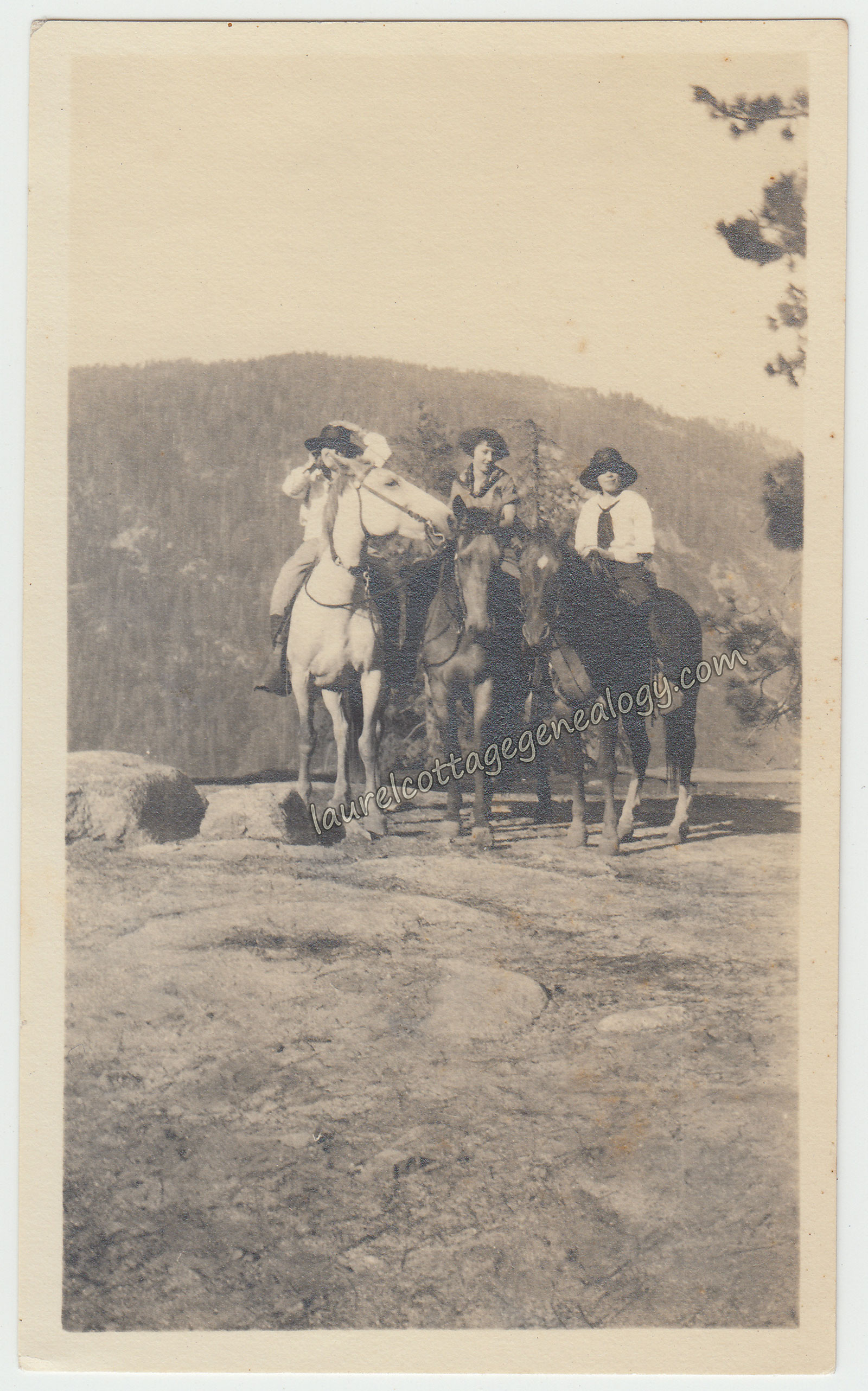
Our Horseback Adventure

Old photo, white border. September 1922.

Price:  $15.00            Size:  About 2 and 1/2  4 and 1/4″

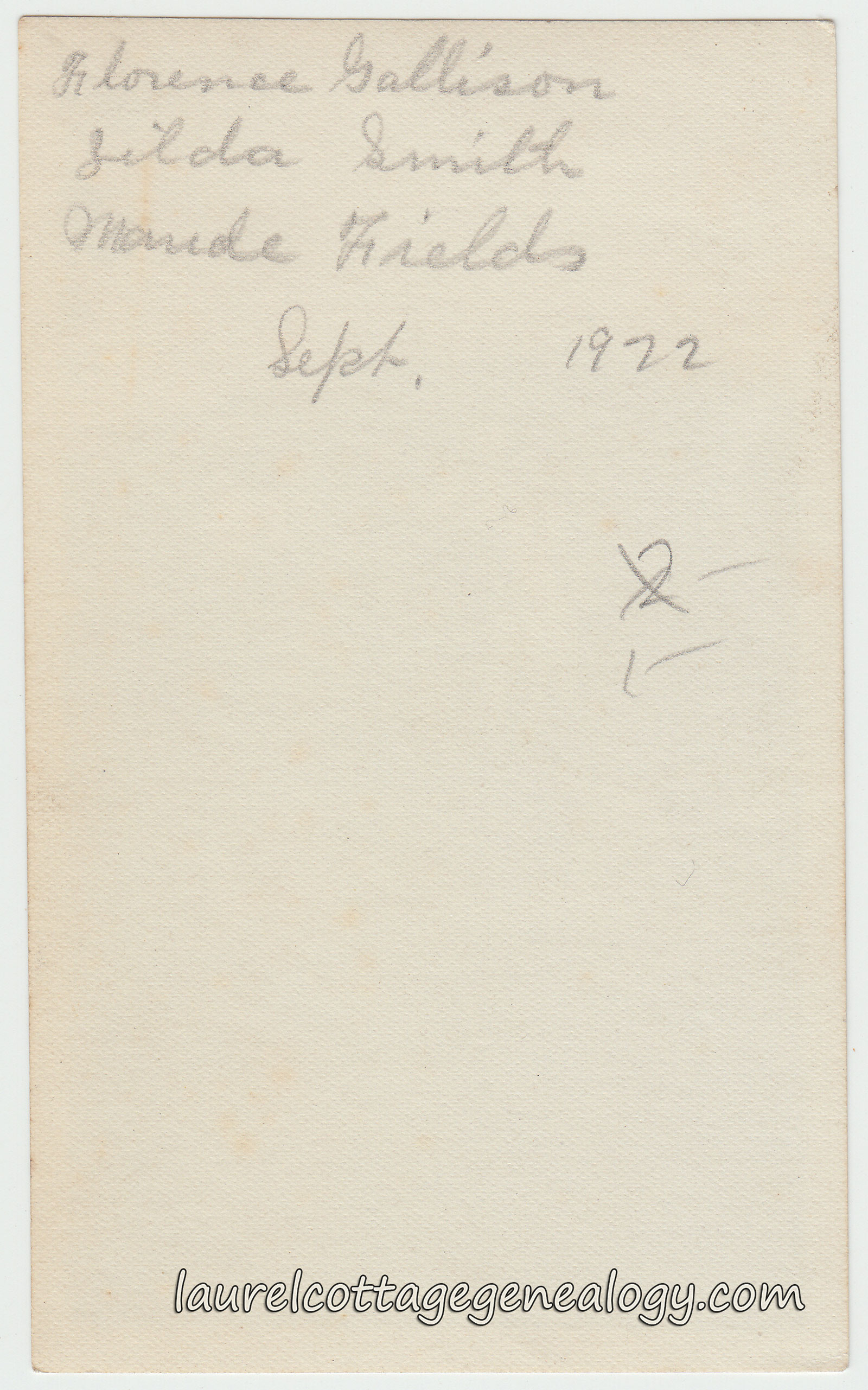
A great remembrance of a wonderful day:  Three friends, identified on the back as Florence Gallison, Zilda Smith and Maude Fields, September 1922. The three cowgirls at heart are posed on horseback in front of a scenic view in, it’s a safe bet to say the Sierras, maybe in or near the Stanislaus National Forest, or Yosemite National Park. Reason being is that the three were only found in reasonable proximity, living in the Central Valley of California: Florence and Maude in Turlock and Zilda in Stockton.

Note: There were two Florence Gallison’s in the area, but Florence G. Gallison was ruled out as she was a Gallison by marriage, and was not married until after 1922.

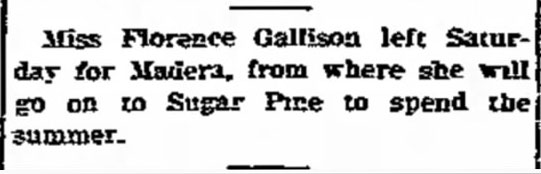
Below, a short news blip that appeared in the Modesto Evening News, June 17, 1914, informing that Florence (she would have been about fourteen) was spending the summer in Sugar Pine, California (near the south entrance to Yosemite National Park.)

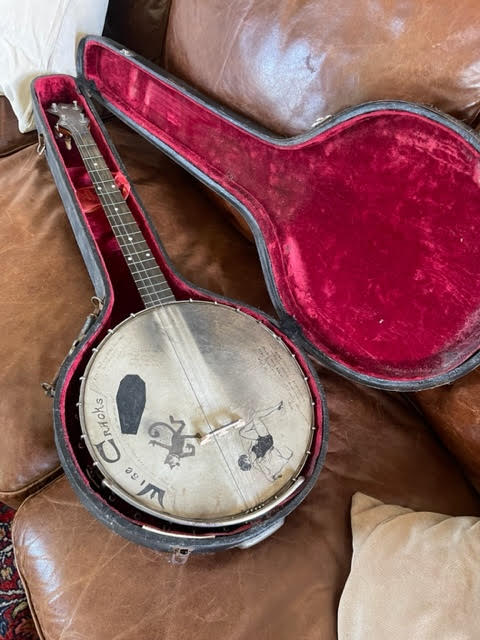
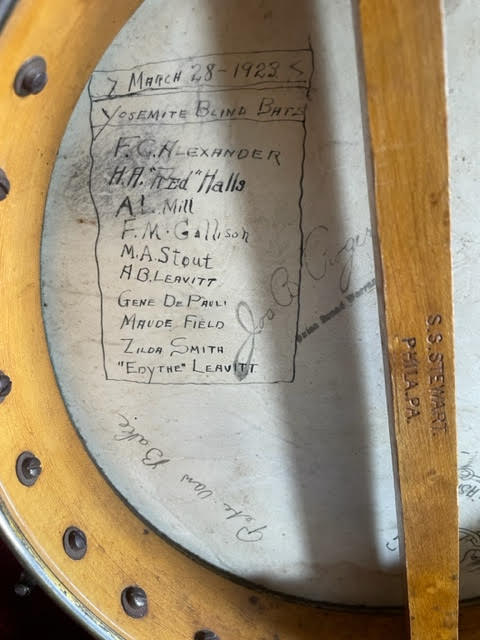
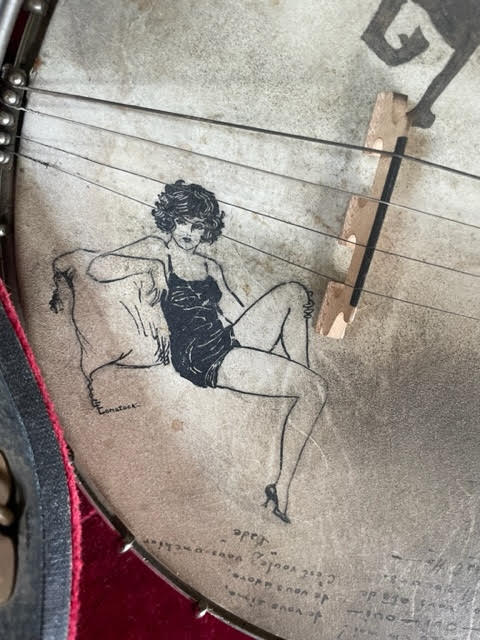
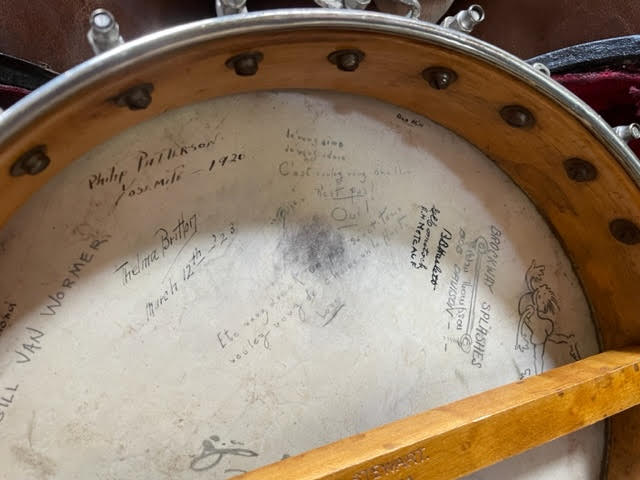
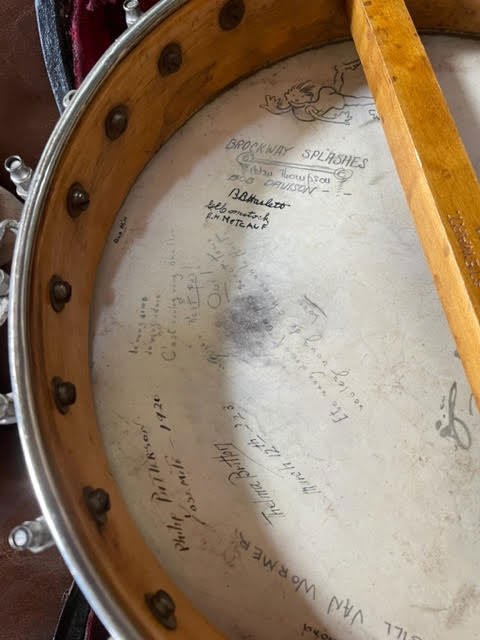
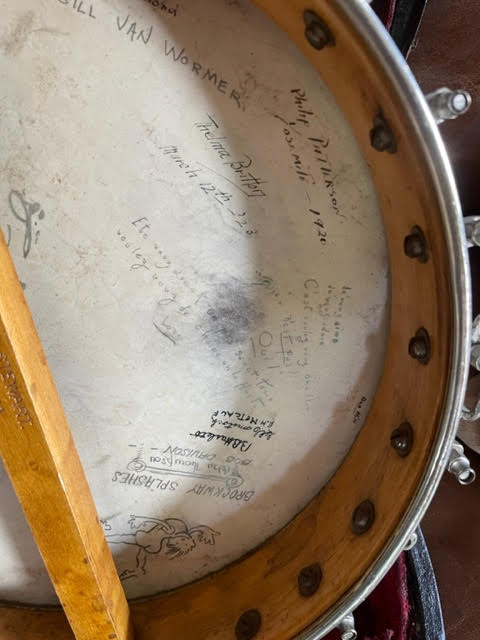
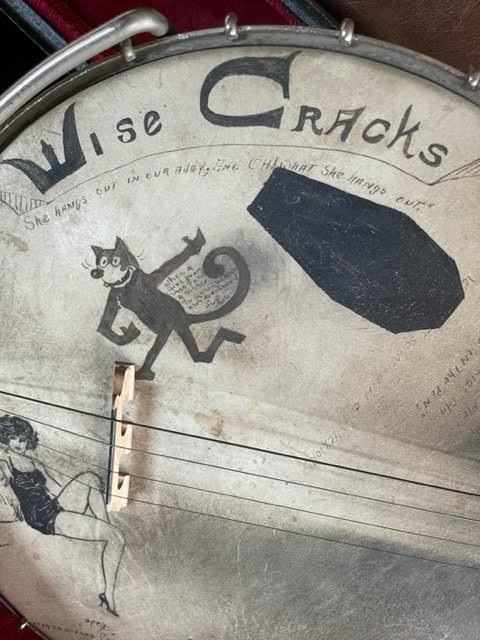
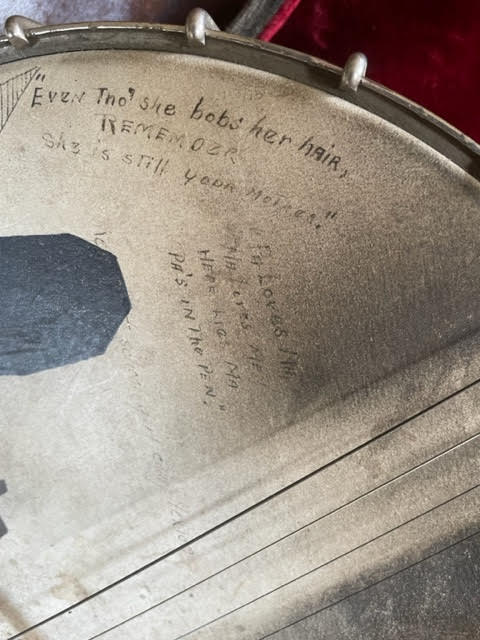
UPDATE re a banjo:  Please be sure to read the comment below from Jay, who so kindly provided the color photos. As you will note from one of the photos, our three horseback adventurers were part of a musical endeavor called the Yosemite Blind Bats. As of March 28, 1923, the band members were:

F. C. Alexander; H. A. “Red” Halls; A. I. or A. L. Mill; F. M. Gallison; M. A. Stout; A. B. Leavitt; Gene DePaul or Depauli; Maude Field; Zilda Smith; “Edythe” Leavitt.

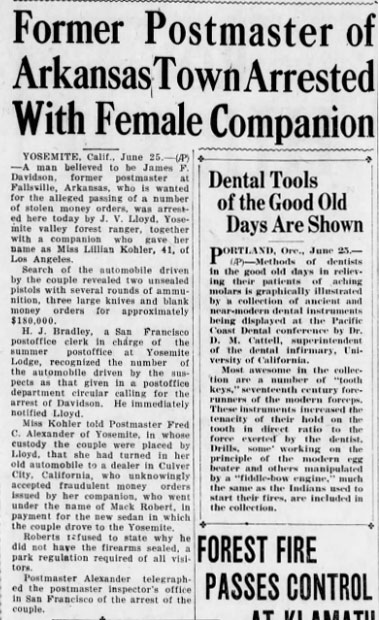
From our research, F. C. Alexander was Fred Colville Alexander, born Kentucky 1885. A. B. Leavitt was Amy Belle Leavitt, born San Francisco, California, April 1897. Fred and Amy married in September 1923. They were both residents of Yosemite at the time. From Fred’s WWI Draft Registration Card in 1918, his occupation was property clerk and storekeeper at Yosemite National Park, and interestingly from a musical standpoint, deaf in his right ear. By at least 1926 he was postmaster at Yosemite. (Scroll to the bottom of the page for a clip from the Santa Cruz Evening News.)

“Edythe” Leavitt was Amy Belle’s sister. Spelled Edith in records, we love the hinting toward some type of running joke re the quotation marks. She was born in California, about 1901.

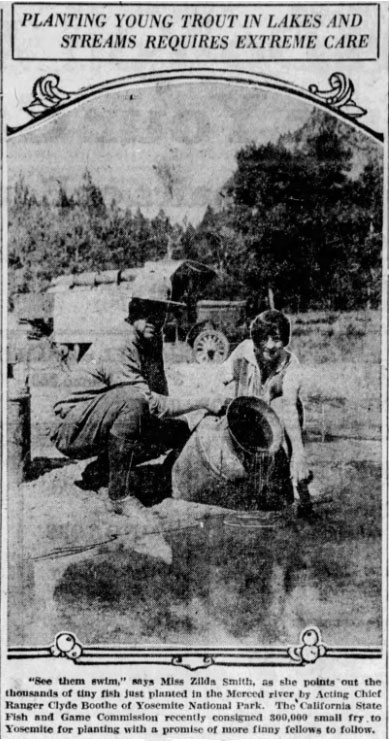
And, rather grainy, but still a nice find – a photo of Zilda Smith that appeared in the Stockton Evening and Sunday Record, July 1924:

Other readable names from the banjo photos are:  Pete Van Bake; Thelma Britton; Philip Patterson; [?] Van Wormer; Bob Davison; B. B. Harlett; E. M.[?] Metcalf; G. E. Comstock; [?] Thompson; The Brockway Splashes. (Brockway is an unincorporated community on the north shore of Lake Tahoe, at the California-Nevada border.)

Photos from Jay:

Below, Postmaster, Fred Alexander of Yosemite is involved in the arrest/custody of two n’er do wells:

Sources:  Florence Gallison. Year: 1920; Census Place: Turlock, Stanislaus, California; Roll: T625_152; Pages: 1B; Enumeration District: 188. (Ancestry.com).

Maude Fields. Year: 1920; Census Place: Turlock, Stanislaus, California; Roll: T625_152; Page: 2B; Enumeration District: 184. (Ancestry.com).

Zilda Smith. R. L. Polk and Co.’s Stockton City and San Joaquin County Directory, 1925. Vol. 18, p. 59. Ancestry.com. U.S. City Directories, 1822-1995.

Modesto Evening News, June 17, 1914. Wednesday, p. 7. (Newspapers.com)
Ancestry.com. California, U.S., Marriage Records from Select Counties, 1850-1941.

Year: 1910; Census Place: Stockton Ward 4, San Joaquin, California; Roll: T624_103; Page: 1a; Enumeration District: 0144; FHL microfilm: 1374116. (Ancestry.com).

“Planting Young Trout in Lakes and Streams Requires Extreme Care.” Stockton Evening and Sunday Record, July 26, 1924. Saturday, p. 29. (Newspapers.com)
“Former Postmaster of Arkansas Town Arrested With Female Companion.” Santa Cruz Evening News, June 25, 1926. Friday, p. 1. (Newspapers.com)