Genealogy Services, Old Photos, Postcards, Trade Cards, Etc.

The Arcade

The Arcade pc1The Arcade pc2

With wonderful memories of summer

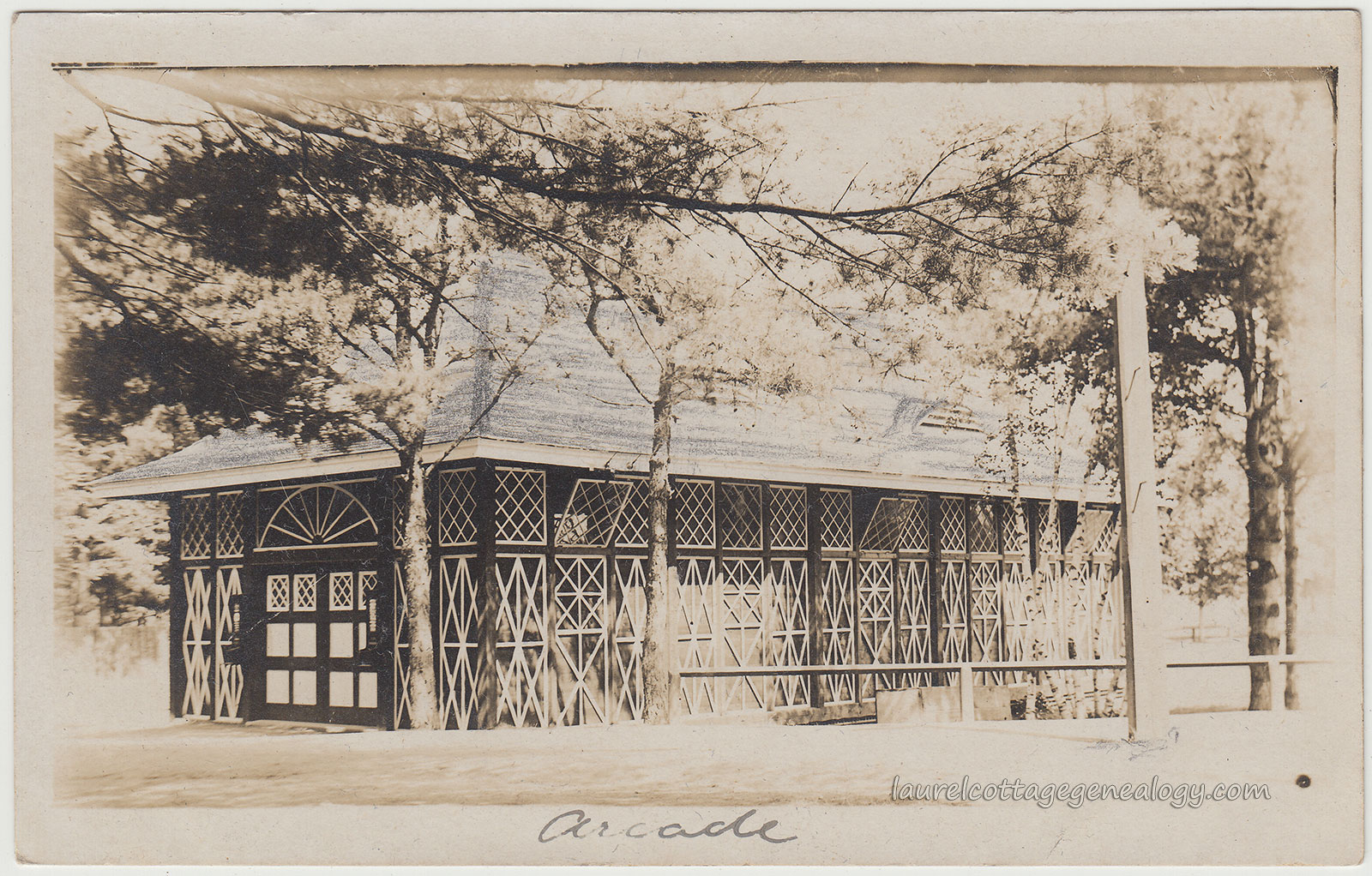
This one was going to be put up directly after the recent Coney Island post, but something got lost in translation, lost in the shuffle, there was some interruption to the thought process or just brain fade maybe 😉 But it’s a beauty, isn’t it? A little sad perhaps, with that end of summer feel to it. On the other hand, maybe the arcade is happy to have a well-deserved rest and some peace and quiet. In any case, the building has a half-timbered style facade (around it’s entirety we assume) diamond-pattern window panes above, and a large, fan-style window over the double doors. What exactly did the arcade house during the season?

Well, what exactly is an arcade?

The word arcade comes from the Latin “arcus” which means arc or bow. And the definition generally describes a covered passageway that houses shops, with arches along both sides. But in modern times we probably think of a game arcade or a cantina housing food concession stands and perhaps souvenirs. If you look closely you can see two wooden oblong objects, each ending in a box shape that juts out, one attached at each side of the double doors. What were these used for – to contain the list of tenants that rented the selling space every year?

A definite artist

It’s also interesting that someone, with a quite steady hand, filled in the roof with pencil, taking care to outline the roof vent, and even drawing in a little something to show grass or weeds at the base of the utility pole.

The birch

As to the location, there is a small stand of birches to the left of the pole, indicating that this photo was probably taken in one of the northern U.S. states, as birches are prevalent in the Northern Hemisphere of the planet. They are considered a “pioneer” species that show up after a forest is clear-cut or after a fire.

Divided back, Real Photo Postcard, unused. Cyko stamp box. Circa 1907 – 1920s.

Price:  $15.00

Sources:  arcade. [http://www.vocabulary.com/dictionary/arcade] Accessed September 9,  2015.

Where do birch trees grow? [http://www.ask.com/home-garden/birch-trees-grow-fc33b08d46570b5f] Accessed September 9, 2015.

Real Photo Postcard Stamp Boxes. Playle.com. [http://www.playle.com/realphoto/photoc.php] Accessed September 9, 2015.

The Tree Spirit

The Tree Spirit pc1The Tree Spirit pc2

This postcard is signed by artist E. Weaver. Biographical information was not found online but Sherry Arent Cawley, in Berrien County, author of one of the Postcard History Series put out by Arcadia Publishing, describes the artist as  “…a very prolific American postcard artist at the turn of the century through the 1930s. His designs, in sets of 8 to 32 are whimsical and humorous with many drawn in a simplified Art Nouveau style.”

Indeed, prolific is the word, as numerous cards can be found currently for sale, and in browsing through, it appears the artist used a different color scheme for each series; this above was one of a set in green and black, and shows the lovely poem,

“True Friendship

True friendship is a golden link

Which none should seek to sever

And mine will last, I truly think,

Forever and forever.”

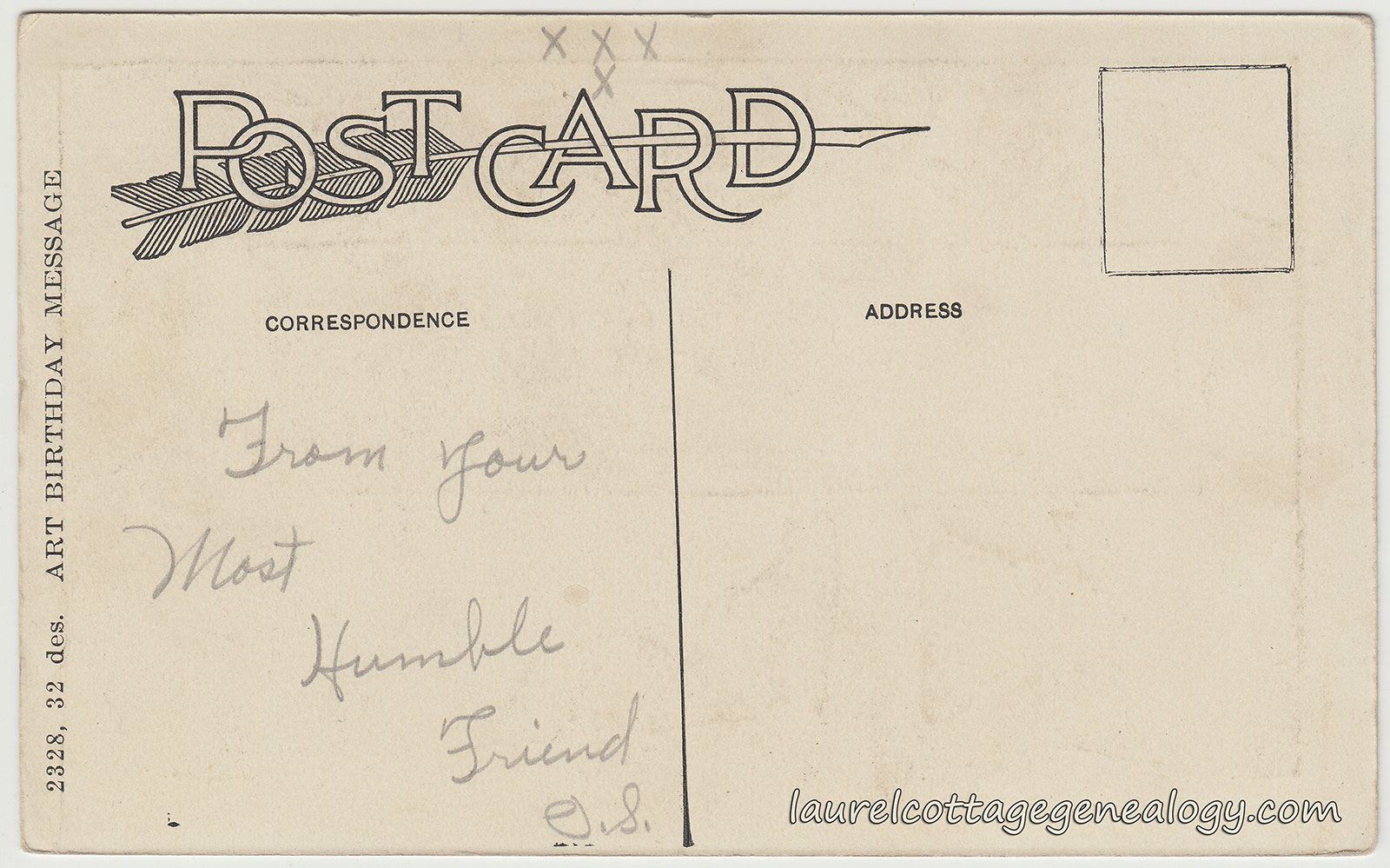
The back is signed,  “From Your Most Humble Friend, O.S.”  and at the top,  “x x x”.  Another in the series was found currently on eBay dated by the sender in 1922.

Divided back, unused with writing. Publisher unknown, series or number 2328, 32 designs. “Art Birthday Message.” Circa 1922.

Price:  $5.00

Source:  Cawley, Sherry A. Berrien County (Postcard History Series). Charleston:  Arcadia. Author copyright year 2000. p. 30. (Google eBook).

Five Friends

Five Friends pc1Five Friends pc2

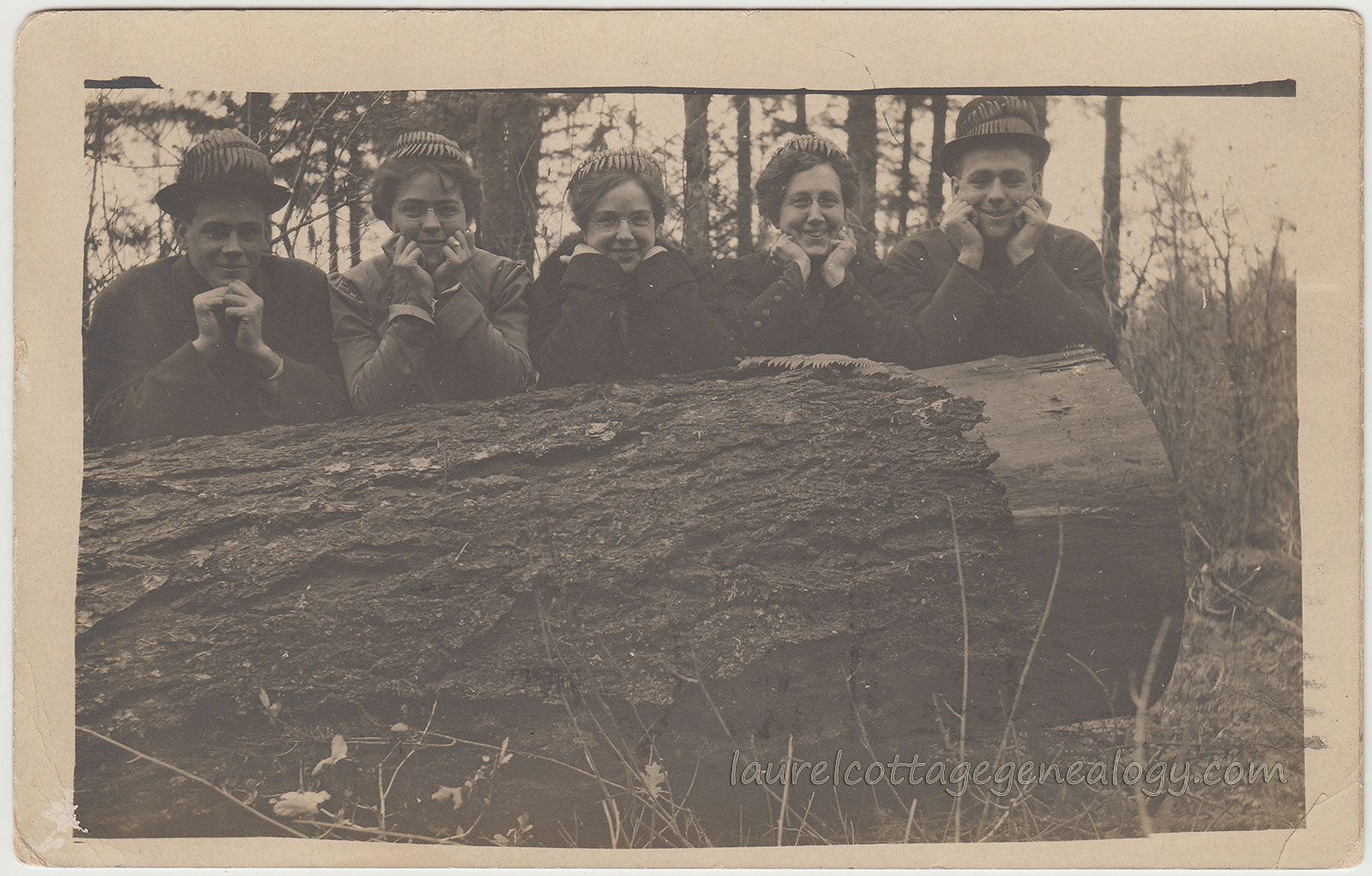
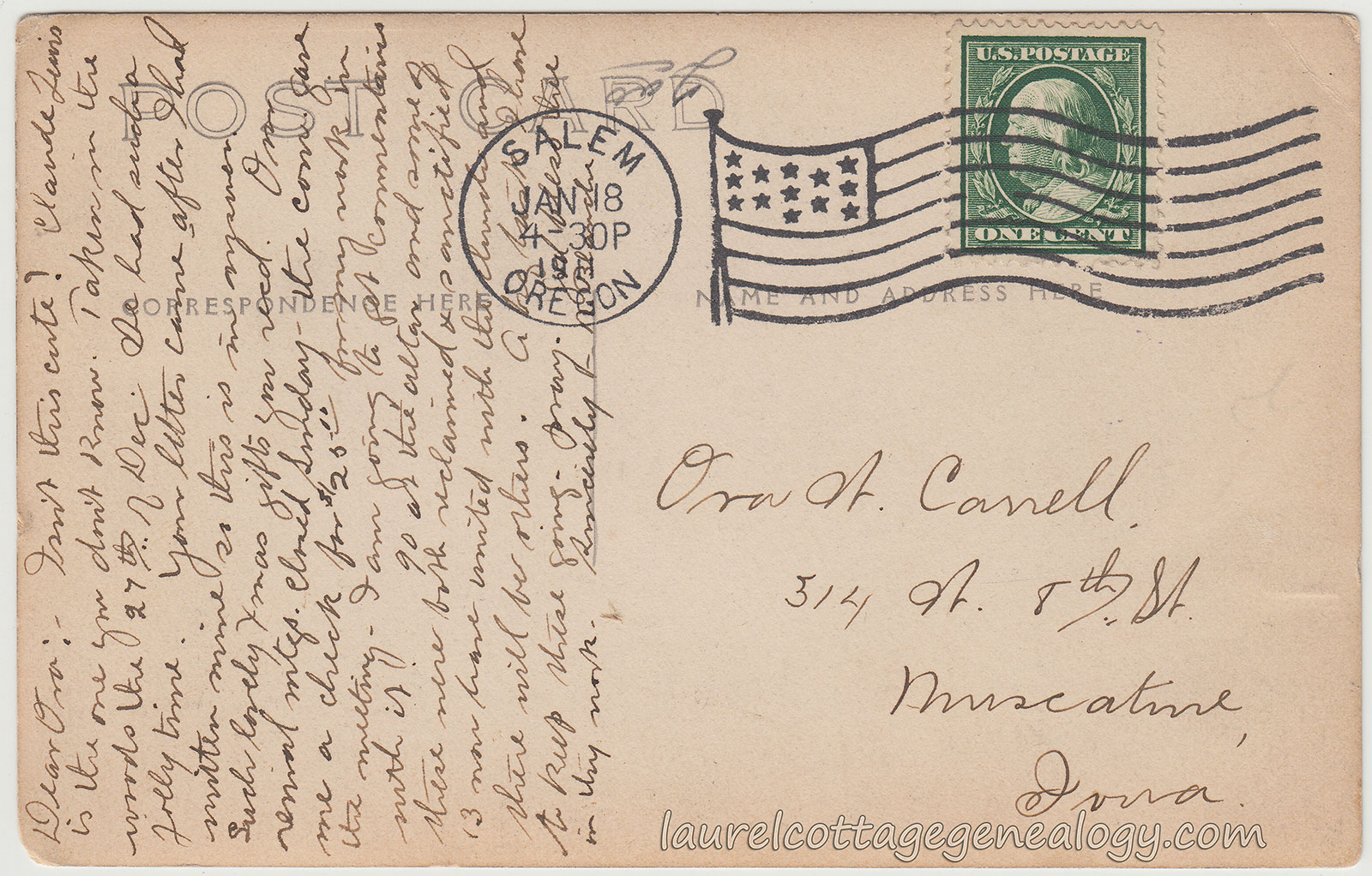
Addressed to:   “Ora W. Carrell. 514 W. 8th St., Muscatine, Iowa.”

“Dear Ora: – Isn’t this cute! Claude Lewis is the one you don’t know. Taken in the woods the 27th of Dec. I had such a jolly time. Your letter came after I had written mine so this is in answer. Such lovely Xmas gifts you recd. Our[?] revival mtgs. closed Sunday – the com. gave me a check for $25.00 for my work in the meeting – I am going to get commentaries..?..? 90 at the alter and some of these were both reclaimed & sanctified, 13 now have united with the church and there will be others. A big task[?] I have to keep these going. pray. God bless thee in thy work. Sincerely – N.[?] Blanche.”

This photo really is cute. Adorable! Enlarge to see the special “headgear” they are all wearing! The fellows look like they could be related – wonder which one is Claude Lewis? And the ladies – the two on the left look like they could be sisters, or like our title says, they could all simply be five friends.

As to further i.d. – There are several possibilities for Claude Lewis; and for the sender N[?] Blanche we’d really need more information; but Ora W. Carrell is likely the same person found on the 1910 Federal Census under O. W. Carrell, showing born in Iowa about 1886, single, rooming in the household of Webster A. and Tracy M. Allman, and who’s occupation is listed as Gospel Minister. The address in Muscatine is 308 5th St., just several blocks away from the address given on the card.

Divided back, used postcard. Postmarked January 18, 1911 from Salem, Oregon.

Price:  $20.00

Source:  Year: 1910; Census Place: Muscatine Ward 2, Muscatine, Iowa; Roll: T624_415; Page: 5B; Enumeration District: 0109; FHL microfilm: 1374428. (Ancestry.com)

River Logging Stereograph

River Logging Stereoscope Card

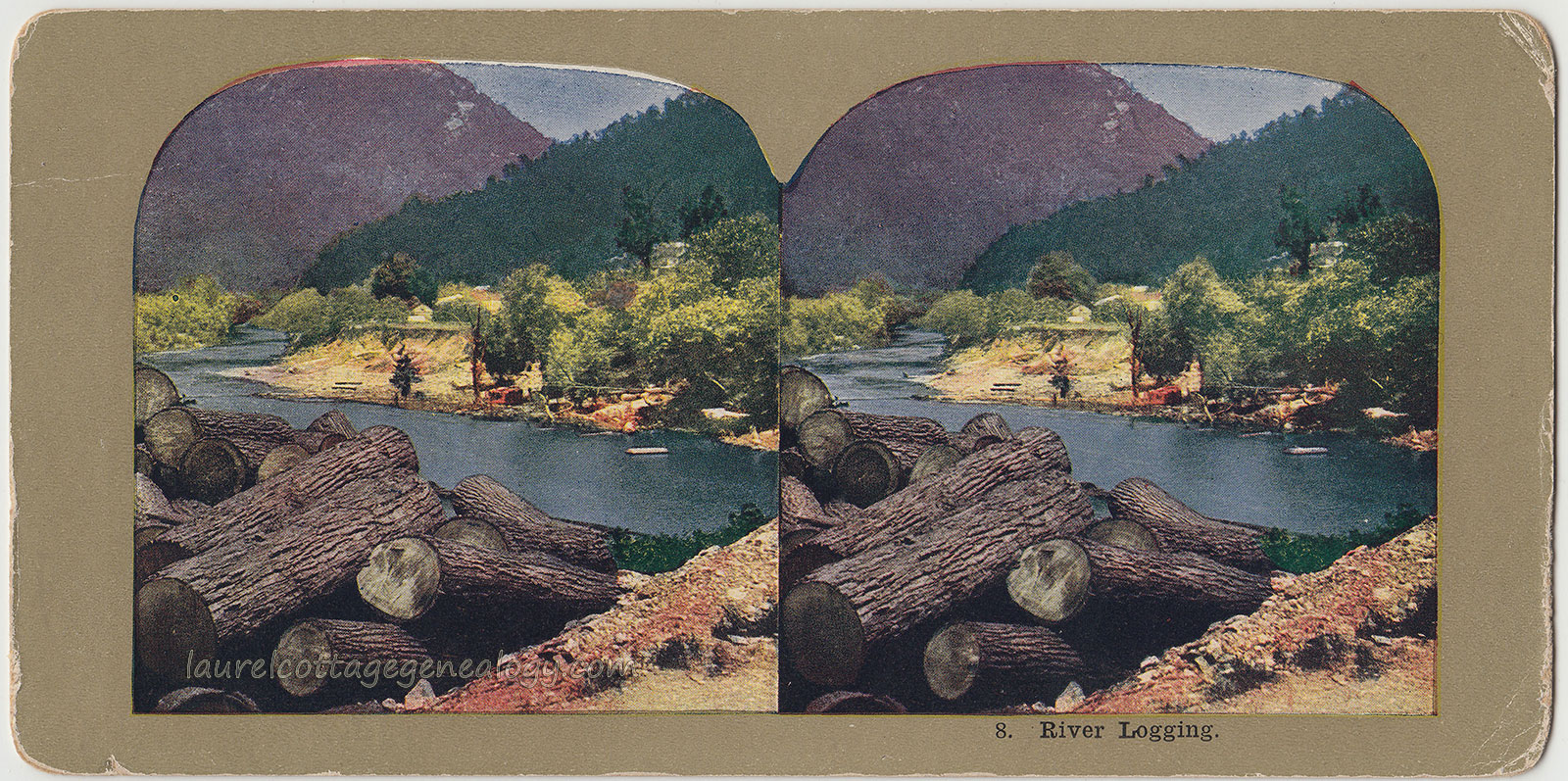
Stereograph, colored scene of Northwest river logging. Circa 1910s.

 Price:  $5.00        Size:  7 x 3 and 1/2″

This card, showing what is most likely a Pacific Northwest river logging scene, was found in an antique store in Dearborn, Michigan. What is significant about it is that it solves a minor mystery on another post (The Conversation)  as a partial, pretty beat-up looking stereograph (also called stereogram, stereoptican, or stereo view) showing the same scene of the girl on the pony and the boy, the mountains in the background, etc. was found in a drawer next to this one above. And actually, the torn card was meant to be picked up along with a bunch of other stuff, but somehow got missed. Next time I am in the area I will check to see if it is still in that drawer, just for fun.

An Ogden Nash Poem

An Ogden Nash Poem pc1An Ogden Nash Poem pc2

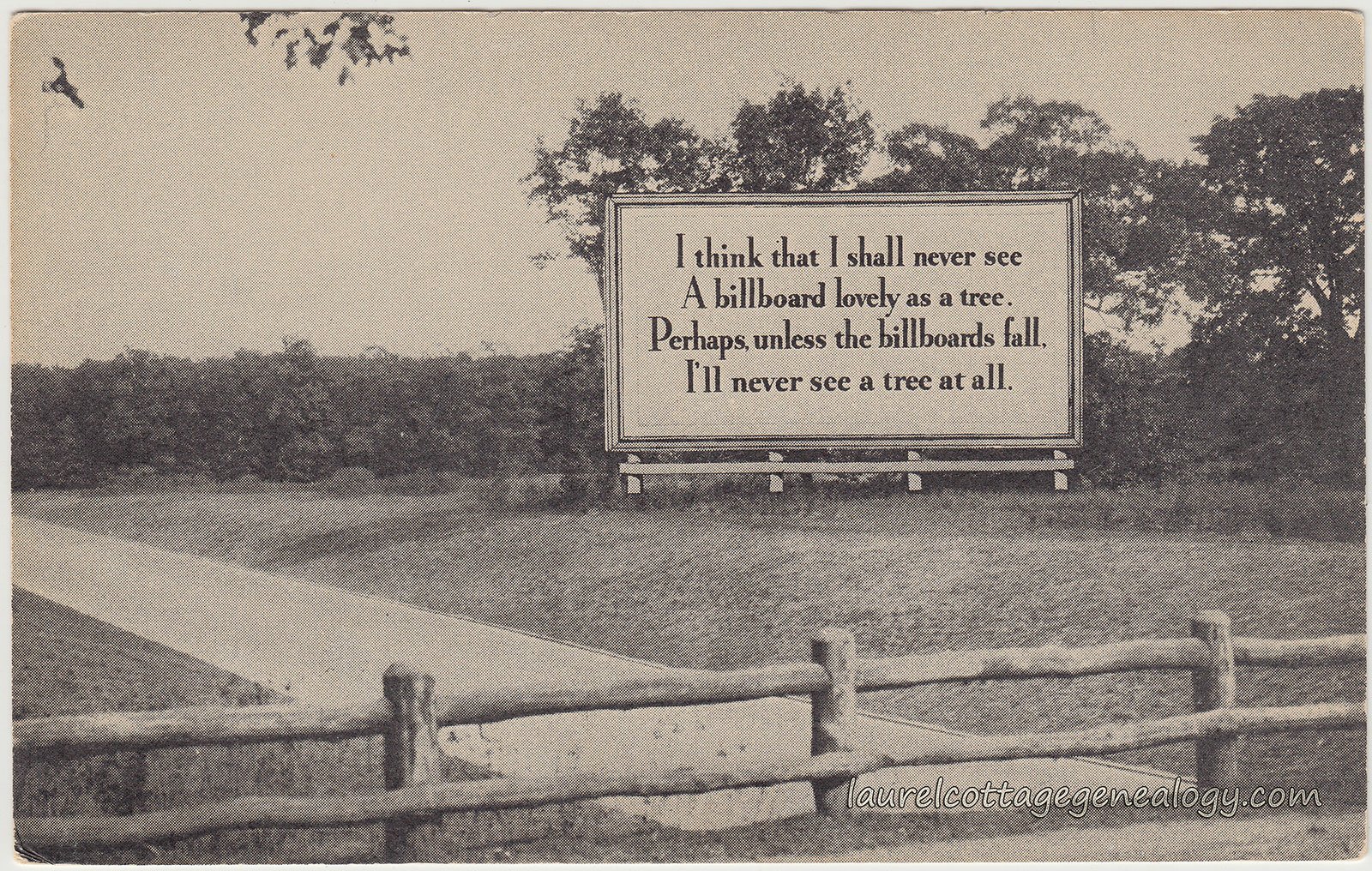
I think that I shall never see

A billboard lovely as a tree.

Perhaps, unless the billboards fall,

I’ll never see a tree at all.

This postcard, with it’s wonderful poem by Ogden Nash (1902 – 1971) was copyrighted in 1933. And it’s really interesting to see the contrast between the mainstream then and now, on the subject of trees and the environment.

Here we are in 2015, thinking globally and avoiding buying products (just as one example) that contain palm oil derivatives, the manufacture of which is contributing to the destruction of our rainforest. You may be very surprised at some of the food and other items that often have these palm oil products in them. Check out this link to the World Wildlife Fund for more.

Divided back, unused postcard. Publisher unknown. Circa 1933.

Price:  $3.00

Sources:  Ogden Nash. n.d. https://en.wikipedia.org/wiki/Ogden_Nash. (accessed August 30, 2015).

Which Everyday Products Contain Palm Oil? (World Wildlife Fund). Accessed August 30, 2015.

“The Raggedy Man”

The Raggedy Man pc1The Raggedy Man pc2

Poetry at Our House

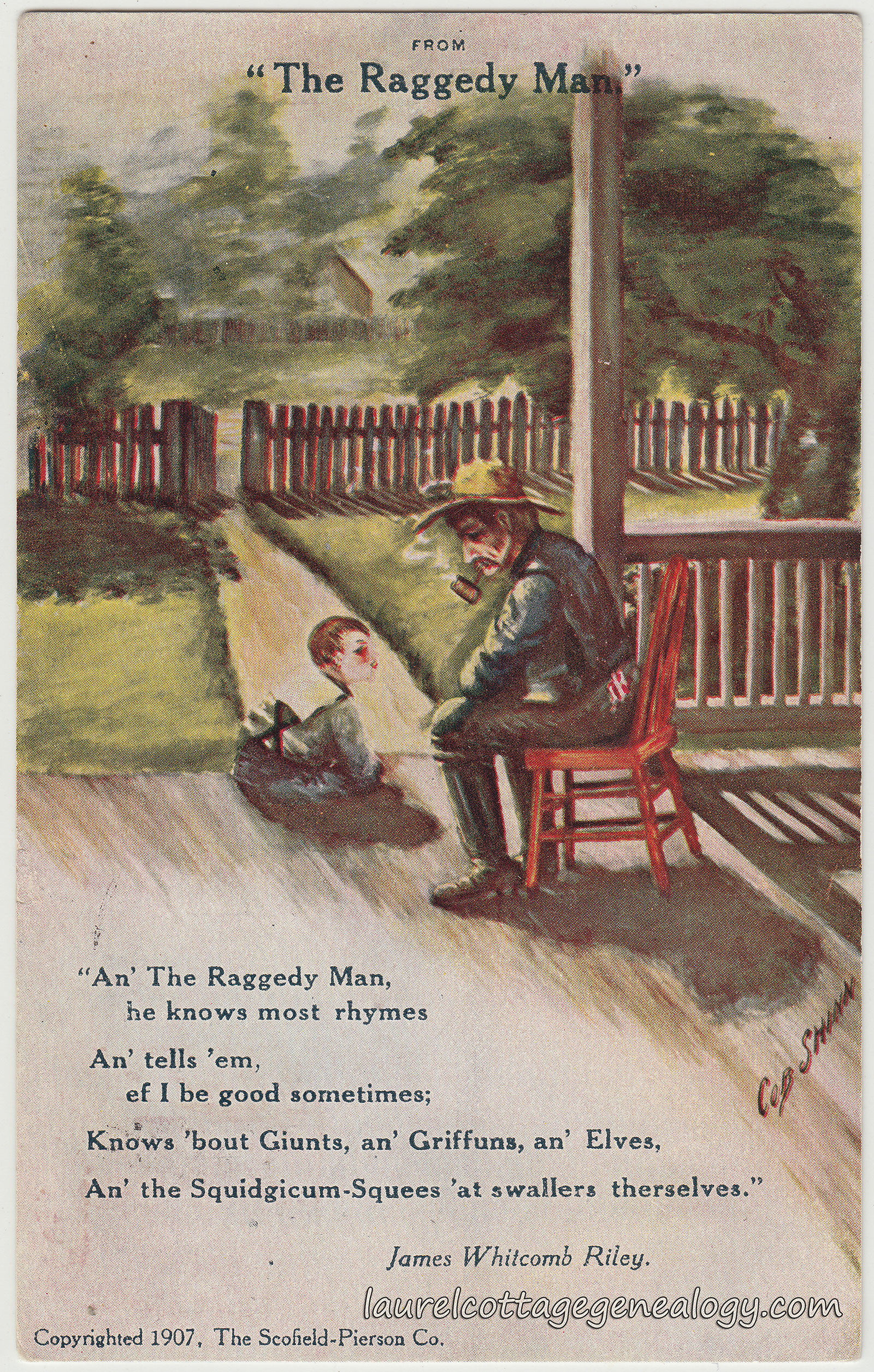
I like to tie one post in with the next, and the tie-in on this one is maybe a stretch, but the Coney Island post reminds me of the Dog Days of summer, as does this postcard. The partial poem seen here is a childhood memory:  we had a book on the shelf at home, was it The Children’s Book of Poetry? No, maybe Poetry at Our House? But it had this poem, “The Raggedy Man”, as well as James Whitcomb Riley’s other very well-known poem, “Little Orphant Annie.” My sisters (and brothers?) used to read out loud from the poetry book, and the lines I remember best, are, “…The Raggedy Man! He works fer Pa….” and then from Little Orphant Annie, “…an the Gobble-uns ‘ll git you ef you Don’t Watch Out!”  Which at four years old scared me a little (I’d find myself later glancing up at the ceiling, pondering) but that I loved to hear. If these poems were a part of your childhood, too, no doubt all will come back in a rush, when you read them in their entirety. (There are a couple of typos in the poems; don’t mind them.) Notice the similarity between the illustration on this postcard and the one for “The Raggedy Man” (in the link) which was done by artist Will Vawter. It would not be a surprise if the postcard artist, Cob Shinn, had been inspired by Vawter’s image, as we’ve previously noticed evidence of this kind of thing within the world of old postcards.

Cob Shinn or Cobb X. Shinn?

According to an online compilation of the Jay Small Postcard Collection, Ca. 1907 – Ca. 1940s, Conrad “Cobb” Shinn (1887 – 1951) began doing art for postcards around 1907, which is the date the Scofield-Pierson Co. copyrighted the card, so it would seem that “Cob Shinn” was the earlier signature the artist used. The same shorter signature appears under another postcard by Shinn of an illustration of James Whitcomb Riley himself, with the same Scofield-Pierson copyright, which can be found for sale online at the moment. The Scofield-Pierson Co. shows up under the heading of “stationers” rather than publisher, though they could have been both. The publisher name on our postcard here appears on the back as Import Postcard Co. (And see our other Cobb Shinn postcard, This Tin Lizzy Makes Some Feed!)

To Mamie from Elsie

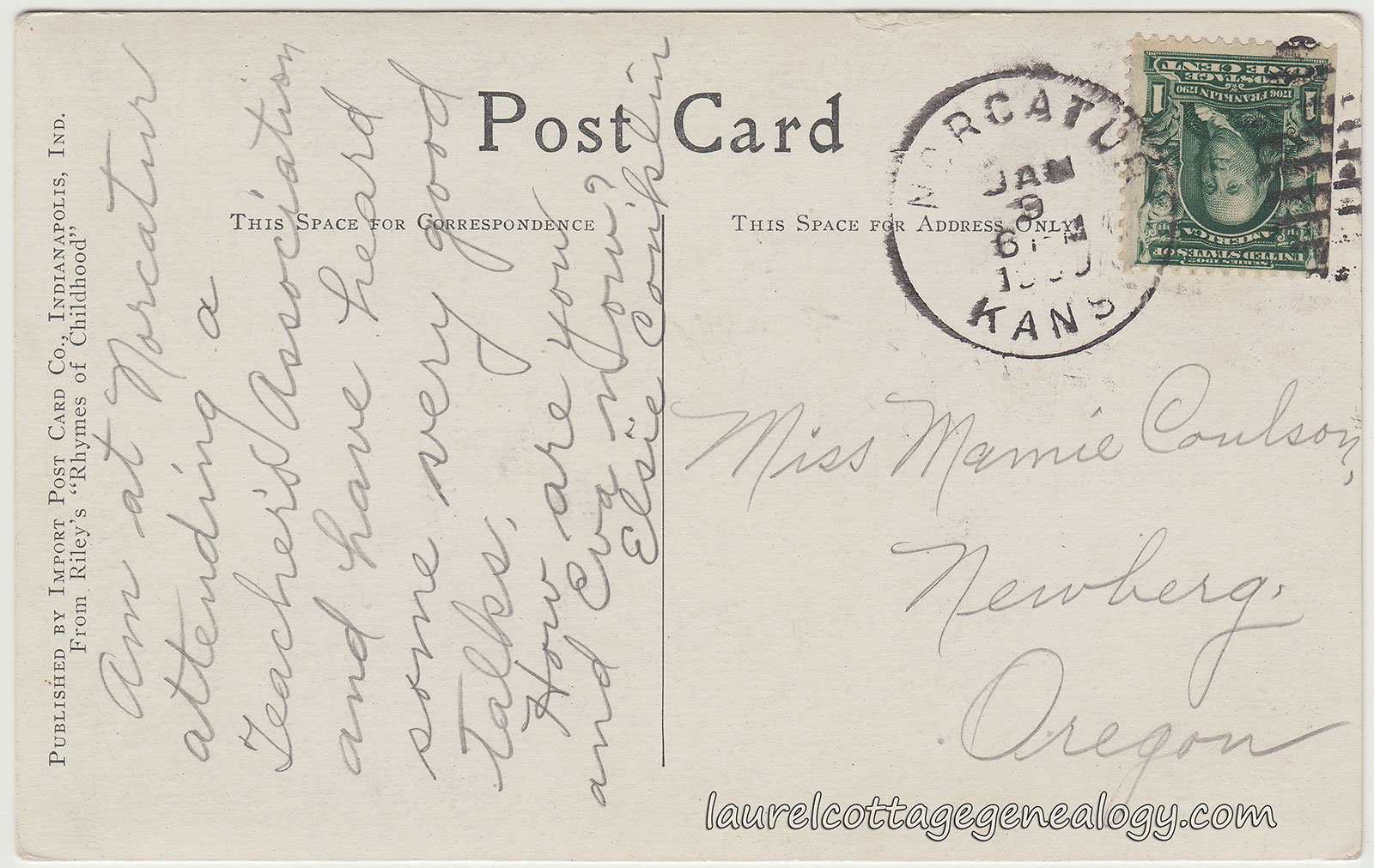
On to the particulars on the back…the addressee is:   “Miss Mamie Coulson, Newberg, Oregon.”  The sender wrote:

“Am at Norcatur attending a Teacher’s Association and have heard some very good talks. How are you and Eva now? Elsie Conklin.”

The 1910 Federal Census taken in Scotts Mills, Oregon, shows:  Jesse E. and Harriet B. Coulson, born Iowa, 1856 and 1855 respectively, Jesse’s occupation is Orchardist; daughters Mamie A. Coulson, born 1892, and Ethel A. Cox, born 1880, and their cousin, Eva B. Frazier, born 1890, the latter three all born in Kansas. A few quick searches for Elsie show too many possibilities, and would require a more detailed look.

Divided back, used postcard. Postmarked January 9, 1909[?] from Norcatur, Kansas. Design copyrighted 1907 by the Scofield-Pierson Co. Publisher:  Import Post Card Co., Indianapolis, Indiana. From Riley’s “Rhymes of Childhood.”

Price:  $15.00

Sources:  James Whitcomb Riley. n.d. https://en.wikipedia.org/wiki/James_Whitcomb_Riley. (accessed August 27, 2015).

Riley’s Children’s Poetry. James Whitcomb Riley.com. (accessed August 29, 2015).

Jay Small Postcard Collection, Ca. 1907 – Ca. 1940s. Indianapolis Historical Society. http://www.indianahistory.org/ (accessed August 29, 2015).

The Youngest Stationer? The American Stationer, Vol. 74, July 1913. p. 21. Accessed August 29, 2015. (Google eBook.)

Year: 1910; Census Place: Scotts Mills, Marion, Oregon; Roll: T624_1284; Page: 4A; Enumeration District: 0228; FHL microfilm: 1375297. (Ancestry.com)

Walter Kellington, Coney Island, 1908

Walter Kellington Coney Island 1908 pc1Walter Kellington Coney Island 1908 pc2

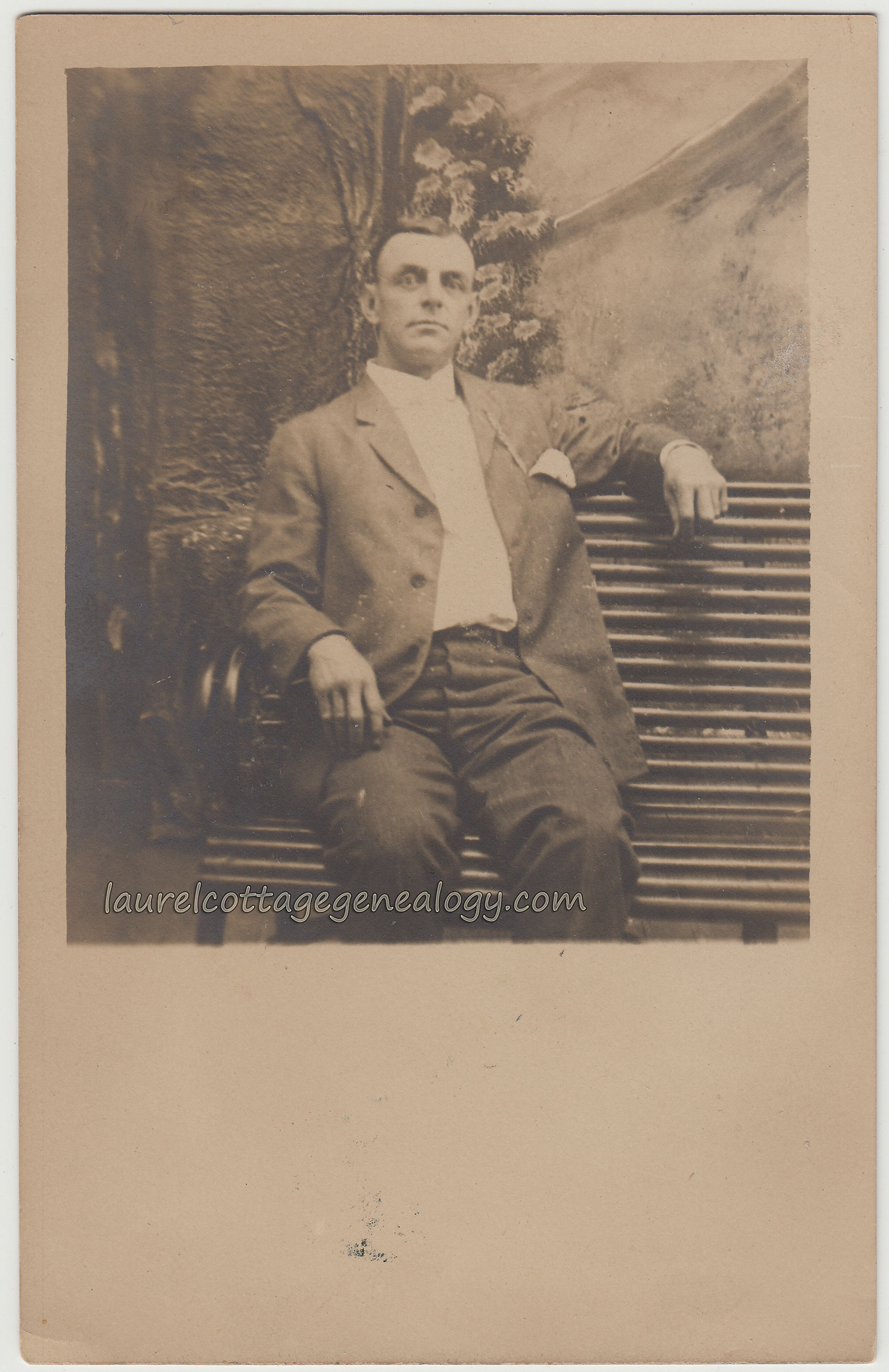
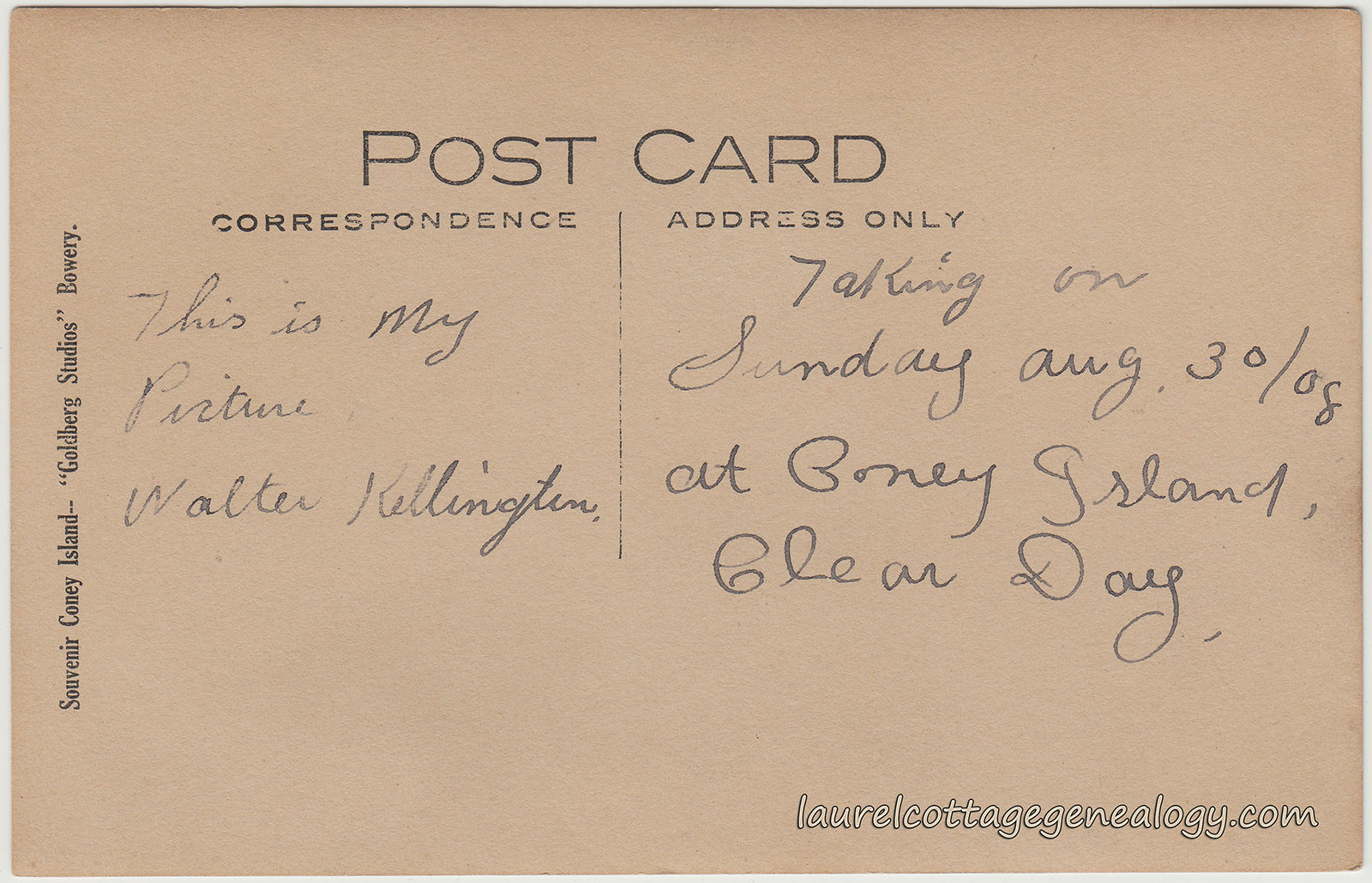
Walter, casually reclining for the camera, wrote,  “This is my Picture – Walter Kellington. Taking on Sunday Aug. 30/08 at Coney Island. Clear Day.”

This is very possibly the Walter E. Kellington that appears on a number of U.S. census records, as born about 1871 in New York, married to Ada Stillwagon (in 1895) and with daughter Gladys, born in NY about 1902 (from the 1920 census the family is living on Linden St. in Brooklyn, and Walter’s occupation is Printer in the newspaper industry.)

There is a Walter Kellington who shows up in the 1908 and ’09 city directories in Newark, occupation Feeder, who may or may not be the same person. The third possibility, that of Walter R. Kellington, born about 1891, doesn’t seem to fit, since we’d assume his birth year to be too late to fit the person in the photo, the 1891 person having moved to Chicago by 1900 also, so we’re left with the strong impression that the Walter Kellington born 1871, is correct.

Divided back, Real Photo Postcard, unused with writing. Souvenir Coney Island, Goldberg Studios, Bowery.

Price:  $15.00

Sources:  Year: 1920; Census Place: Brooklyn Assembly District 20, Kings, New York; Roll: T625_1176; Page: 5B; Enumeration District: 1264; Image: 409. (Ancestry.com)

Ancestry.com. New York, New York, Marriage Index 1866-1937

Minnehaha Falls Lithograph

Minnehaha Falls Litho tc1

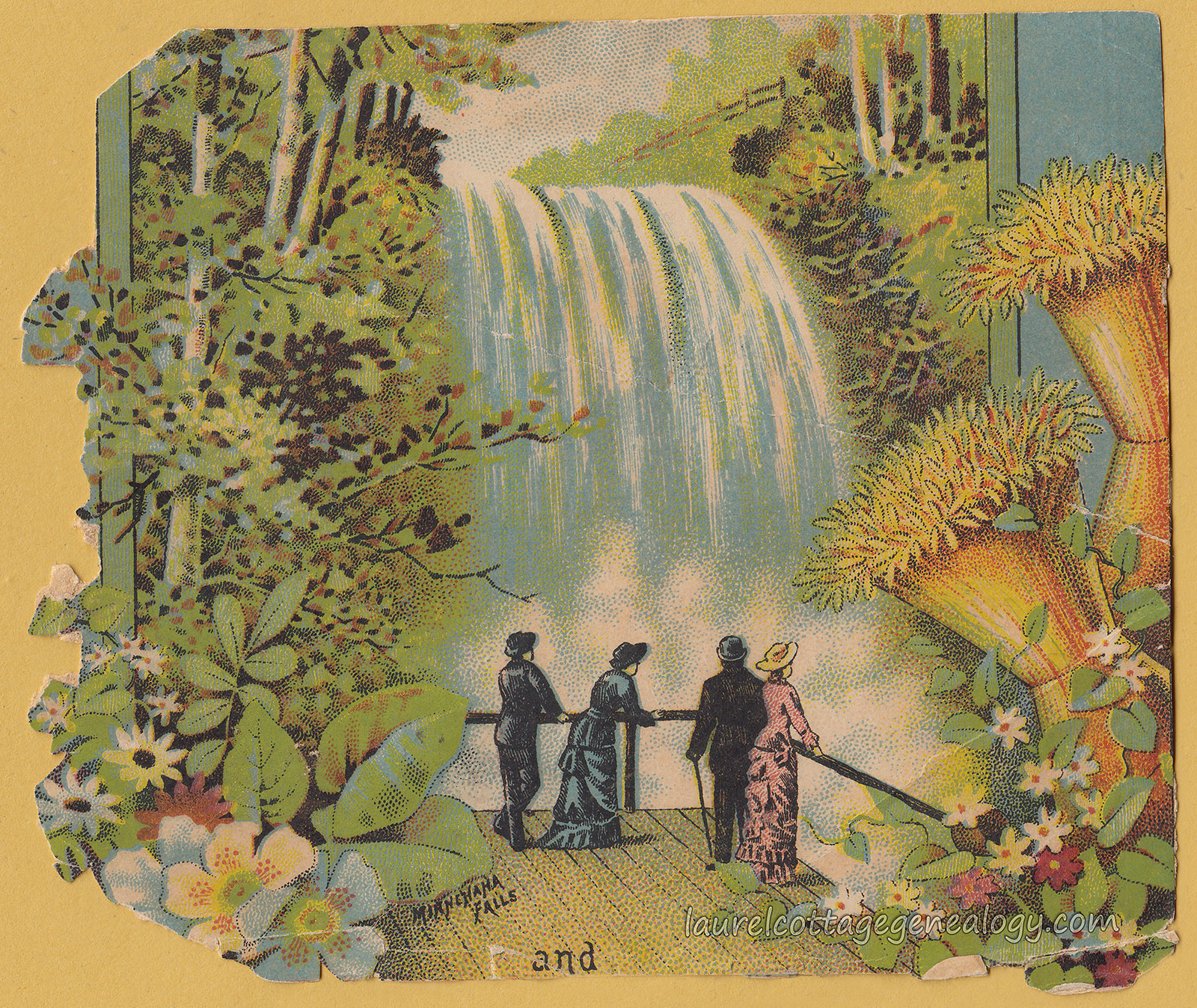
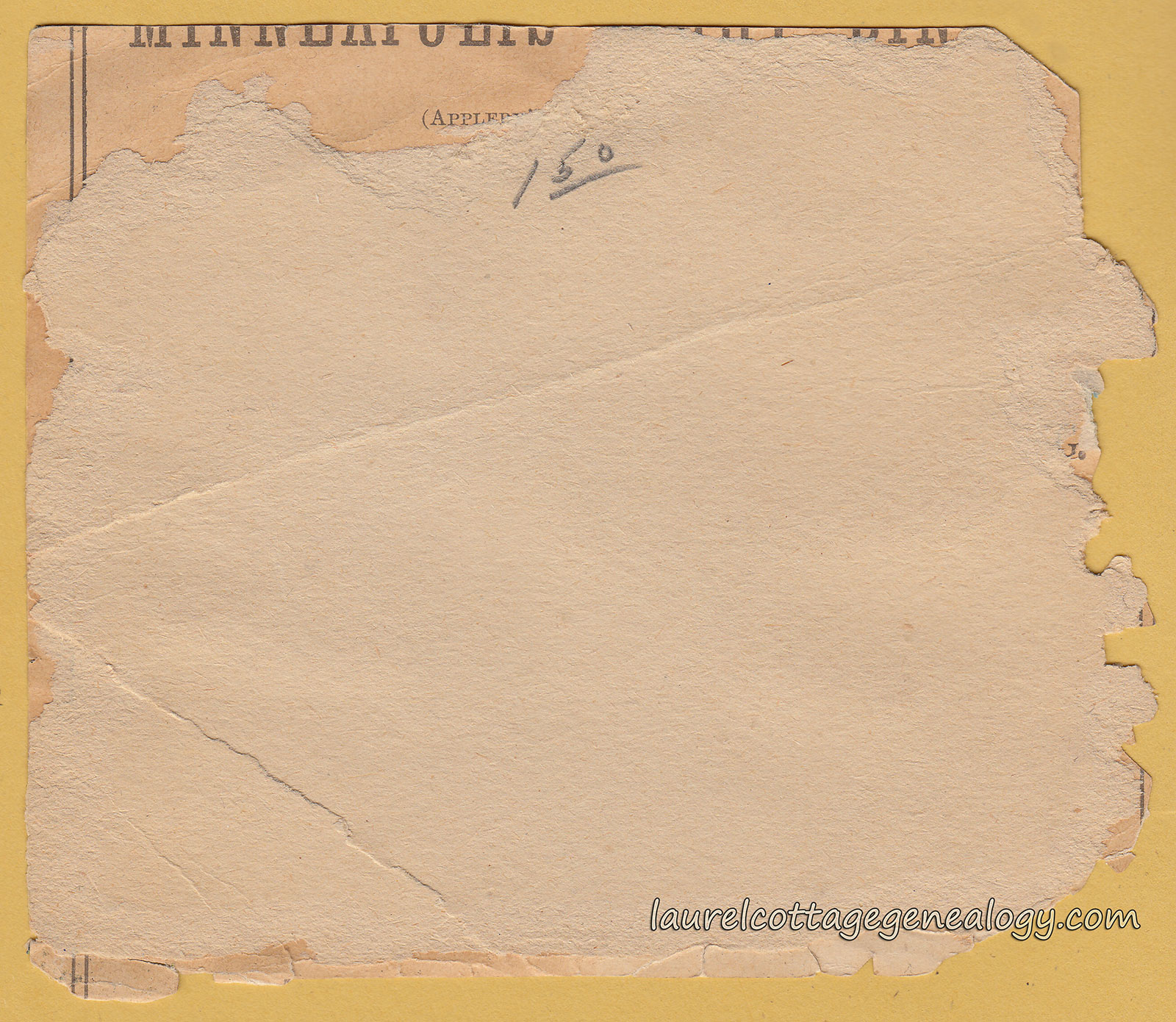
This is possibly part of an old advertisement or trade card. It had been trimmed and glued to a piece of paper. The gold border is not part of the original, but was just for scanning purposes. We can see that it says “Minnehaha Falls and” so some other wording was cut off. But what a fanciful picture: (I swear I’m picking up the lingo of the Regency Era.) The plant life framing the scene being so much larger than the people viewing the falls, especially the sheaves of wheat-looking objects on the right. If this image looks familiar to anyone, the back might help, with the lower half (ish) of a line of print, and centered underneath that in parentheses, the word Appleby’s?.

Minnehaha Falls Litho tc2

Partial trade card or advertising. Circa 1890s.

Price:  $5.00

Horse Shoe Falls, Niagara, Canada

Horse Shoe Falls Niagara Canada pc1Horse Shoe Falls Niagara Canada pc2

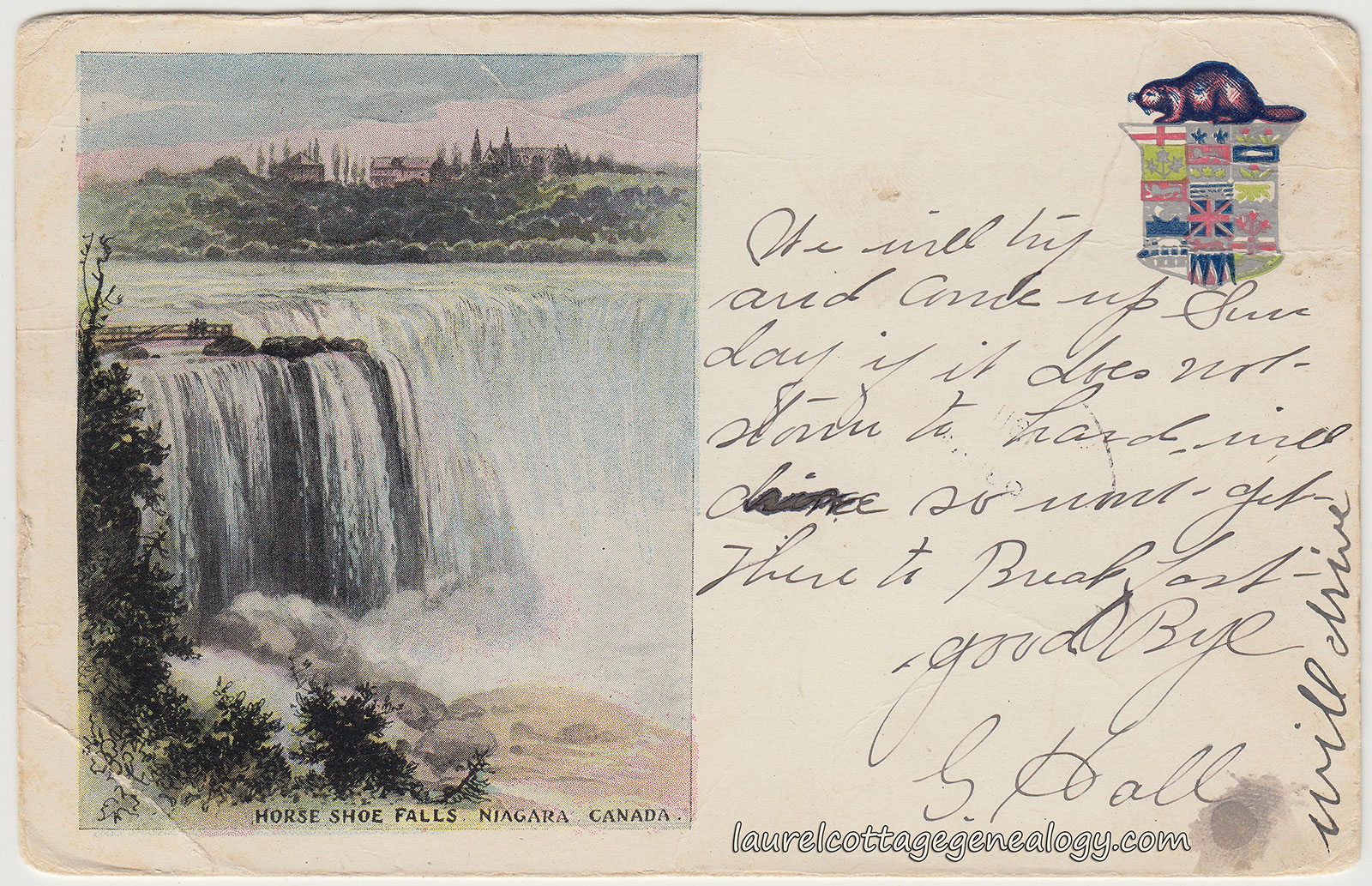
“We will try and come up Sunday if it does not storm to hard. So won’t get there to Breakfast – good Bye. G[?] Hall.  will drive”

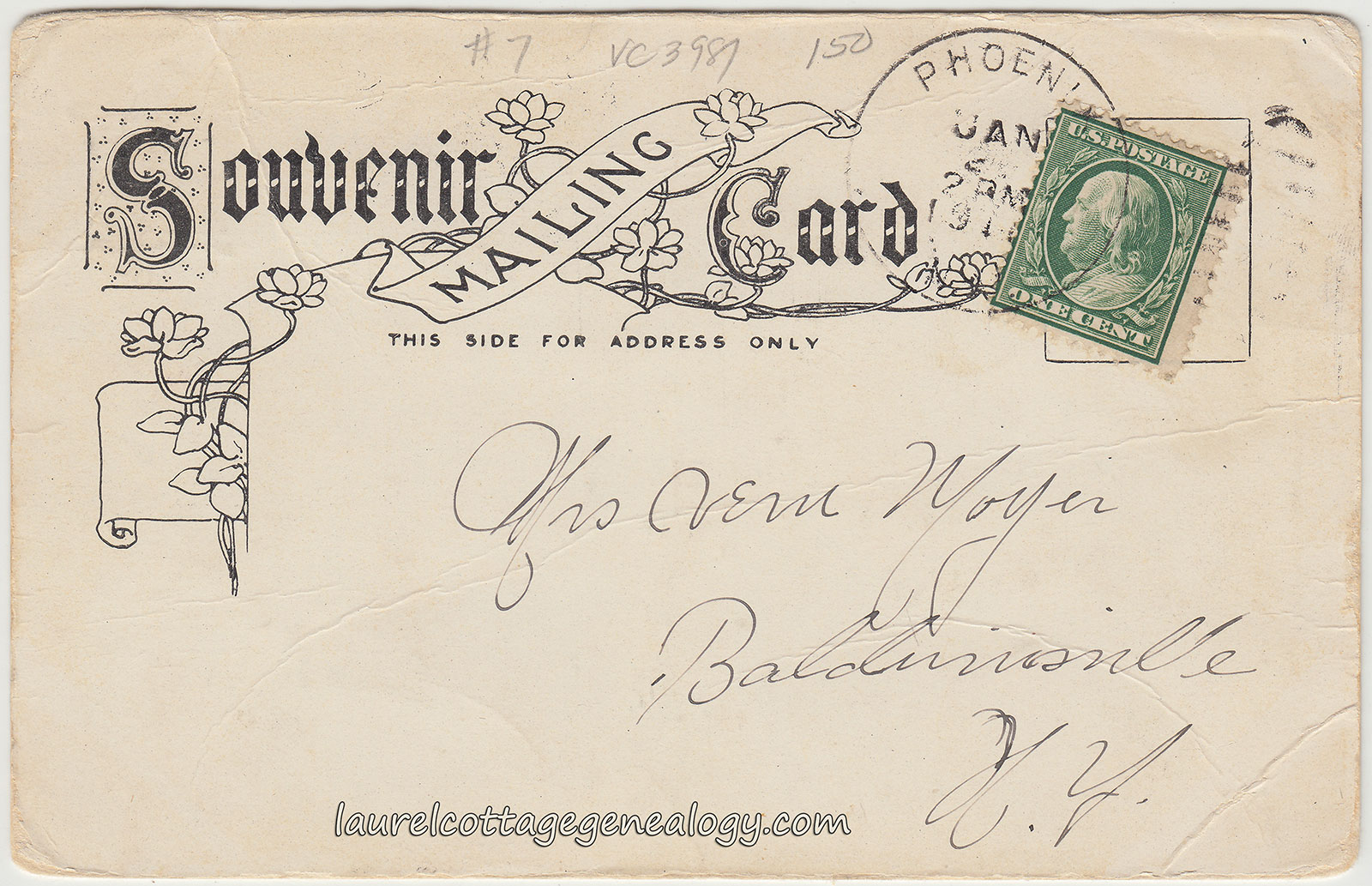
Addressed to:   “Mrs. Vern Moyer, Baldwinsville, N.Y.”

Dating the postcard

The postmark on this card looks like it might be 1910, so it seems the sender used an old pre-divided back era card. In Canada, the divided back started in December of 1903. A similar card, with the same beautiful back header design, was found online postmarked 1904. So, perhaps the one we have here was made in the United States, and since it depicts the Canadian side of Niagara, the producer included one of the Canadian emblems with flags and beaver, or maybe it was made in Canada for U.S. use.

Phoenix?

Phoenix, per the postmark, is six or seven miles northeast of Baldwinsville, New York. And about four miles northeast of Baldwinsville, is the town of Lysander. The 1910 Federal Census for Lysander, Onondaga County has Vernon Moyer and his wife Stella. Both are about age 32 (born about 1878) and both born in New York. They are farming. No other matches were found in the area, so Stella is likely the addressee for this postcard.

Undivided Back, used postcard. Postmarked January 1910 or ’11? from Phoenix, New York. Souvenir mailing card. Publisher unknown.

Price:  $10.00

Sources:  A Brief History of the Postcard. http://www.hamiltonpostcards.com/pages/postcardhistory.html. (accessed August 23, 2015).

Year: 1910; Census Place: Lysander, Onondaga, New York; Roll: T624_1054; Page: 12A; Enumeration District: 0063; FHL microfilm: 1375067. (Ancestry.com)

The Dam, Eaton Rapids, Michigan

The Dam Eaton Rapids Michigan pc1The Dam Eaton Rapids Michigan pc2

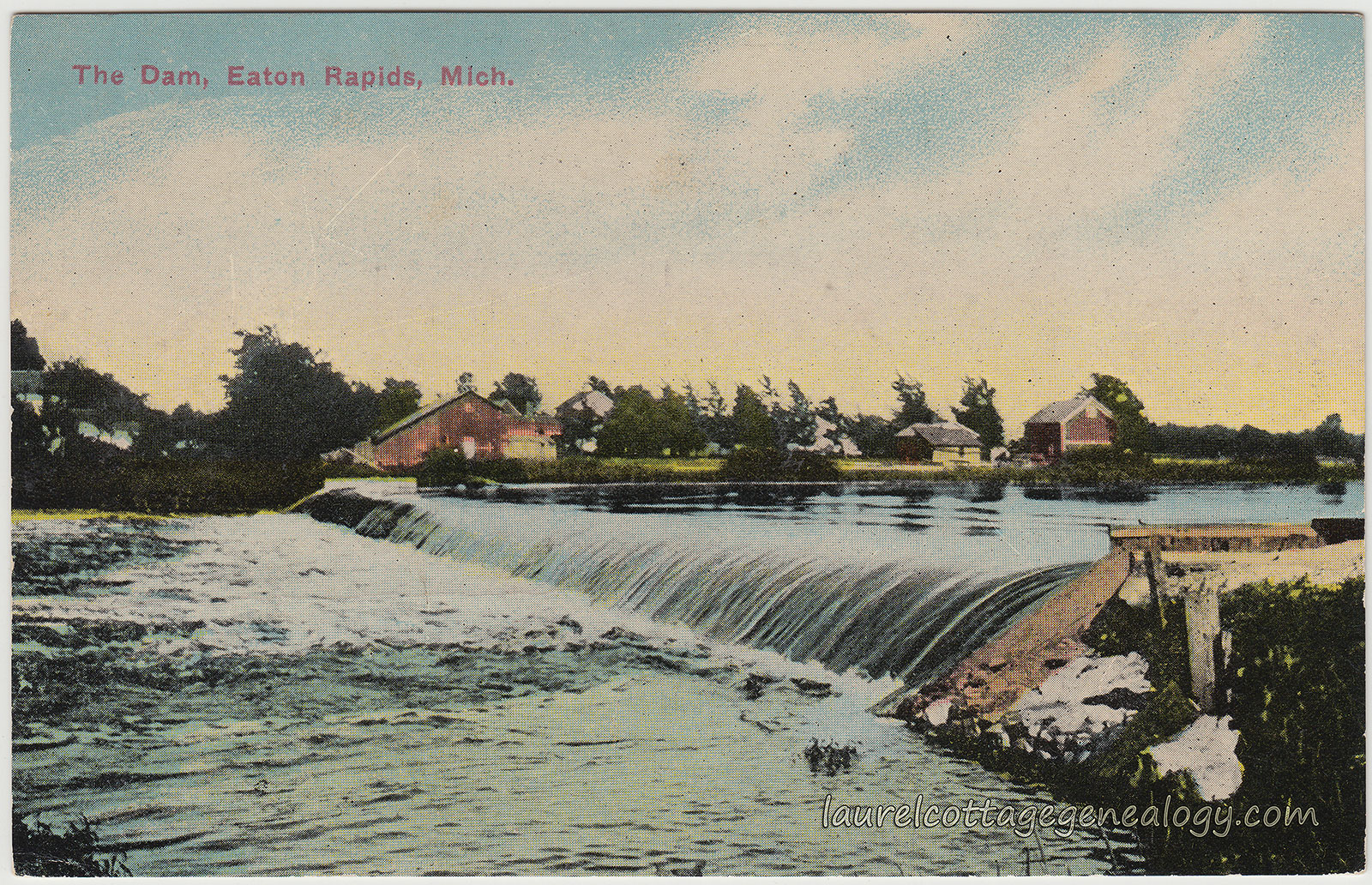
Wow, I’m a Michigander but didn’t know this until now:  Eaton Rapids is known as the Island City – it’s downtown is surrounded by water – the Grand River and the Grand’s Spring Brook tributary. The city has fourteen bridges and an island park, and holds an annual Dam Festival in June. Historically, it was known as “The Saratoga of the West.” See the Eaton Rapids Area Historical Society for lots more.

Some baseball trivia:  The Davidson Mill was established around 1921 in Eaton Rapids by Philadelphia-born John B. Davidson, Sr. This mill supplied 95% of the wool yarn for major league baseball, as well as high-grade yarns for other purposes. (per Wikipedia).

Related Eaton Rapids posts at Laurel Cottage:  G. Meachum Millinery and Dr. W. Derby’s Croup Mixture. There’s a millinery connection in this second link also. Hmmm, coincidence, or might it help to solve the Meachum mystery? (See EARHS’s Facebook page re G. Meachum.)

As to the age of this postcard on the dam, a semi-educated guess would be around 1910 – 1915 or so. The publisher E. C. Kropp went under the name of Kropp prior to 1907, but this fact doesn’t help us, as this is a Divided Back, so we already know this card was from at least 1907. The E.C. Kropp Co. sold it’s business to L.L. Cook in 1956.

Divided back, unused postcard. Publisher:  E.C. Kropp Co., Milwaukee. Circa 1910 – 1915.

Price:  $6.00

Sources:   Eaton Rapids Area Historical Society. (accessed August 23, 2015.)

Ogg, Aaron. (2012, July 16). Eaton Rapids is ‘Island City’ surrounded by Grand River and Spring Brook tributary. The Grand Rapids Press. (www.mlive.com).

Eaton Rapids, Michigan. n.d. https://en.wikipedia.org/wiki/Eaton_Rapids,_Michigan. (accessed August 23, 2015).

E.C. Kropp Co. 1907 – 1956. Metropostcard.com. Accessed August 23  2015.