Genealogy Services, Old Photos, Postcards, Trade Cards, Etc.

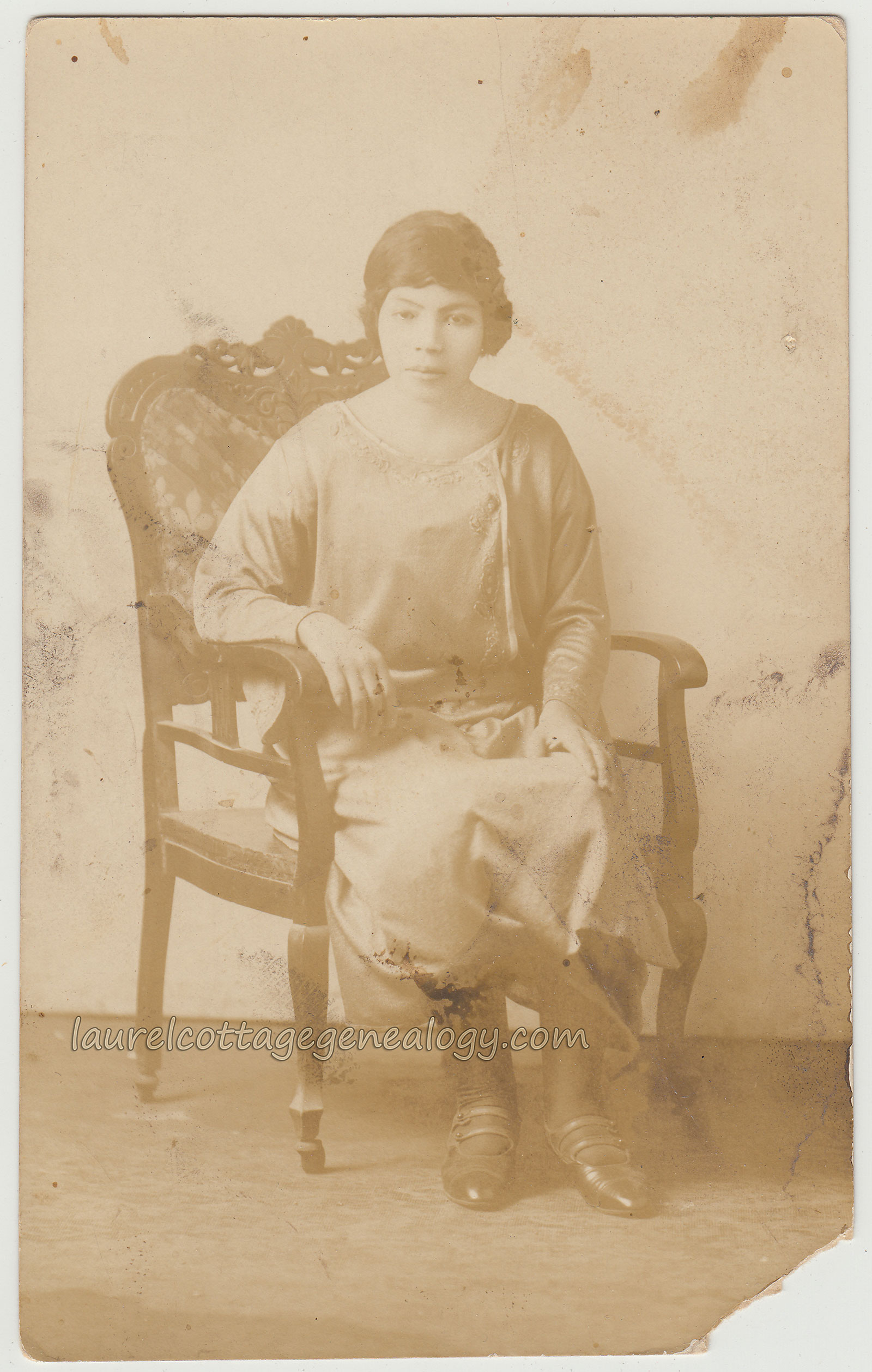
Marsiana Michîl, December 1923

Marsiana Michil December 1923 pc1Marsiana Michil December 1923 pc2

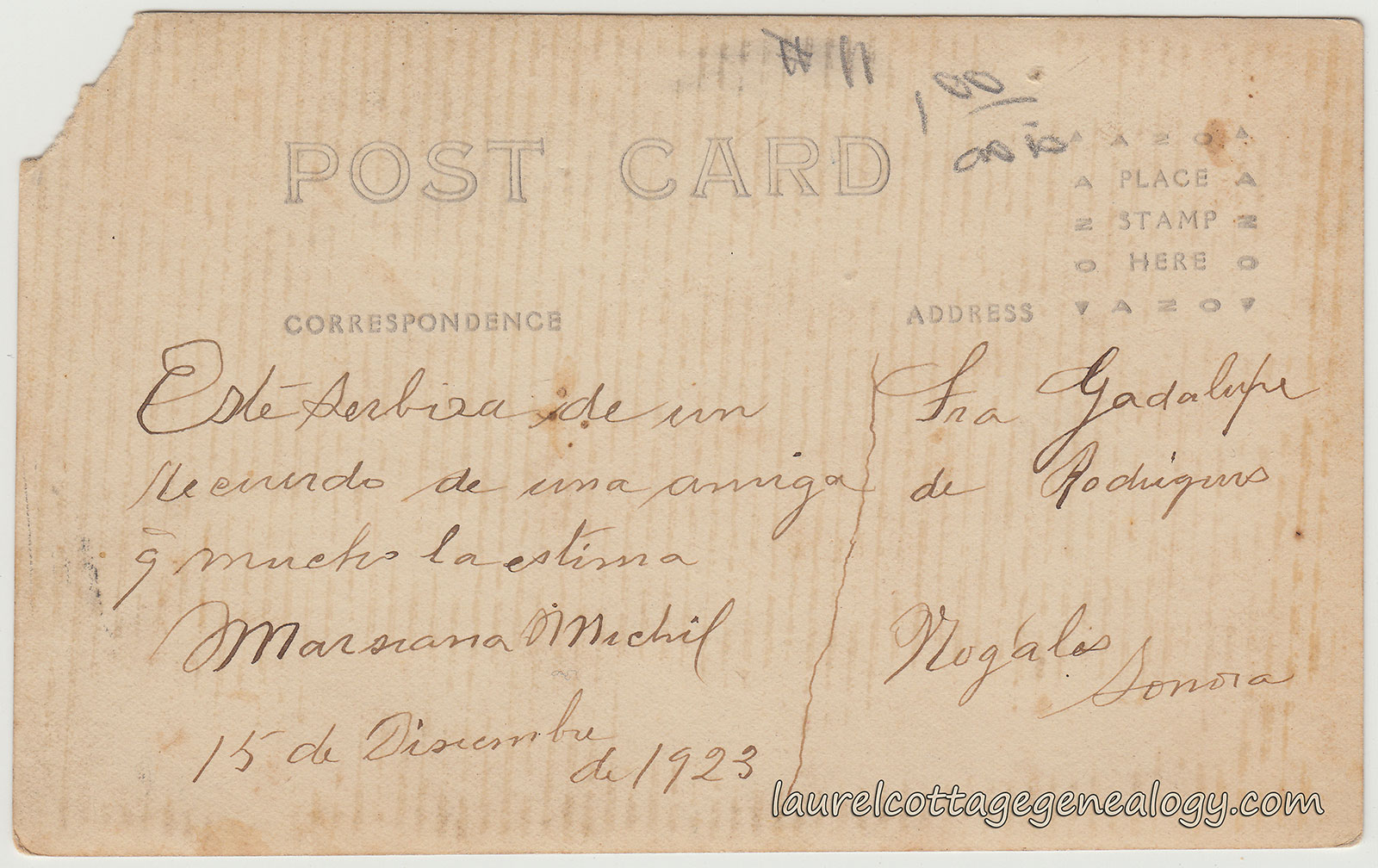
A Real Photo Postcard of a pretty young woman who looks to be in her early twenties, in a photo of the same era, early 1920s that is, wearing the unmistakable drop-waist dress –   too bad we can’t know the color, and note the beautiful bead work or sequins at the cuffs, neckline and at the vertical overlay flap (there must be a term for this part but I’ll be darned if I could find it) and and wearing double-strap shoes with button closures. The message on the back is:

“Este serbia [servia?] de un recuerdo de una amiga y mucho la estima, Marsiana Michîl   15 de Disiembre de 1923.”

Translated as:   “This serves as a memory of a friend, with much esteem, Marsiana  Michîl, December 15, 1923.”

Addressed to:   “Fra Gadalupe de Rodrigues     Nogales  Sonora.”

The above is most likely:   “Francisca Guadalupe de Rodrigues”  and the city of Nogales is located in the Mexican state of Sonora, and is on the border of Arizona.

Divided back, Real Photo Postcard, unused with writing. Dated December 15, 1923. AZO stamp box.

Price:  $4.00

Rosa Arce, Ensenada, August 28, 1916

Rosa Arce August 28 1916 pc1Rosa Arce August 28 1916 pc2

Divided back, Real Photo Postcard, unused with writing. Dated August 28, 1916. AZO stamp box.

Availability status:  SOLD

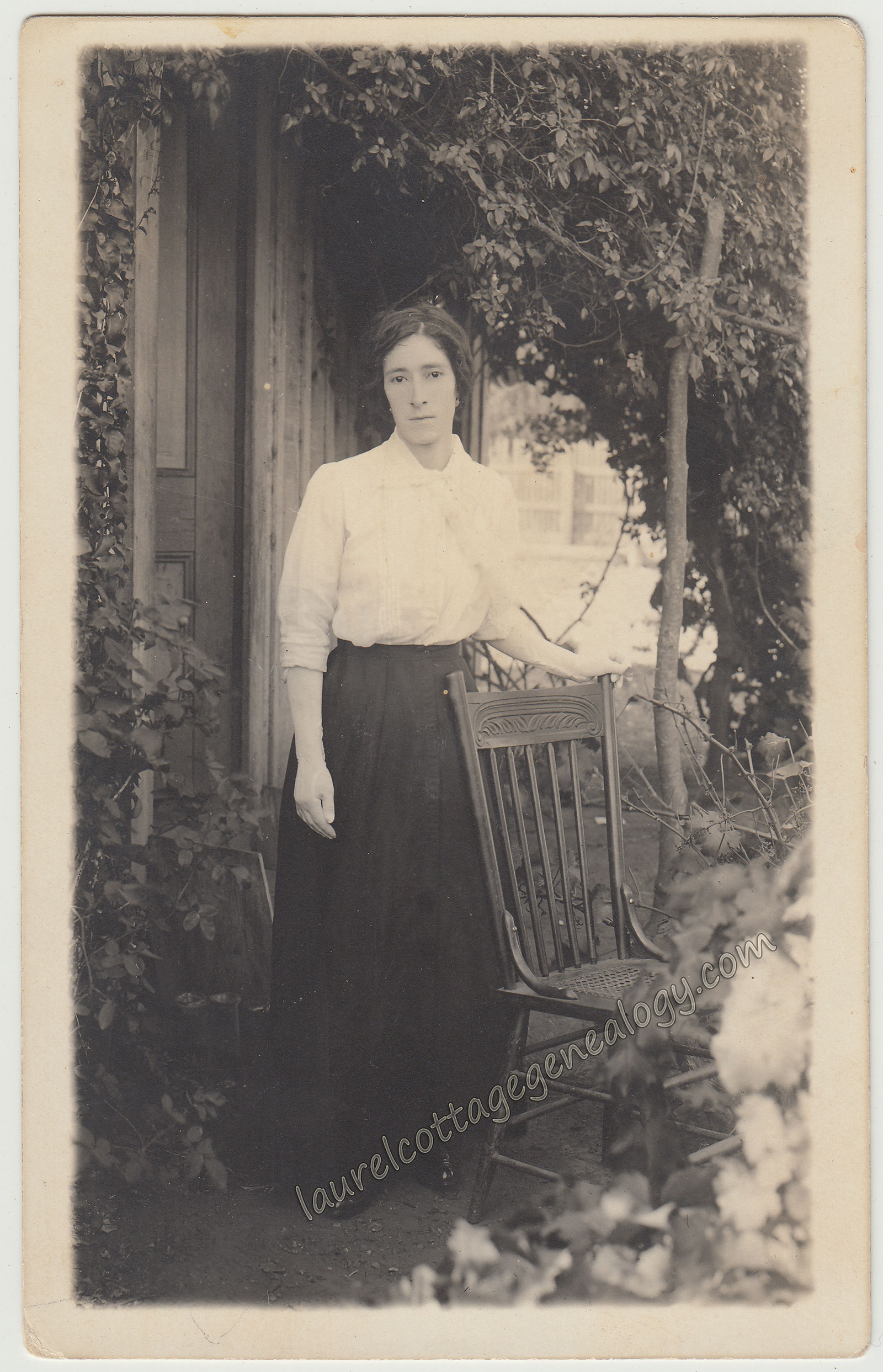
This Real Photo Postcard from 1916 shows a graceful young woman, standing on a porch, her hand resting on the back of a wooden chair. The composition is wonderful:  the door slightly ajar, the arbor effect of the vines, the roses in the right-hand corner, the glimpse to the street in the background. The woman has a narrow, oval-shaped face, is dressed in a long dark skirt, white blouse with lace collar, and if you look closely you’ll notice she’s wearing long gloves of a very thin material. She writes:

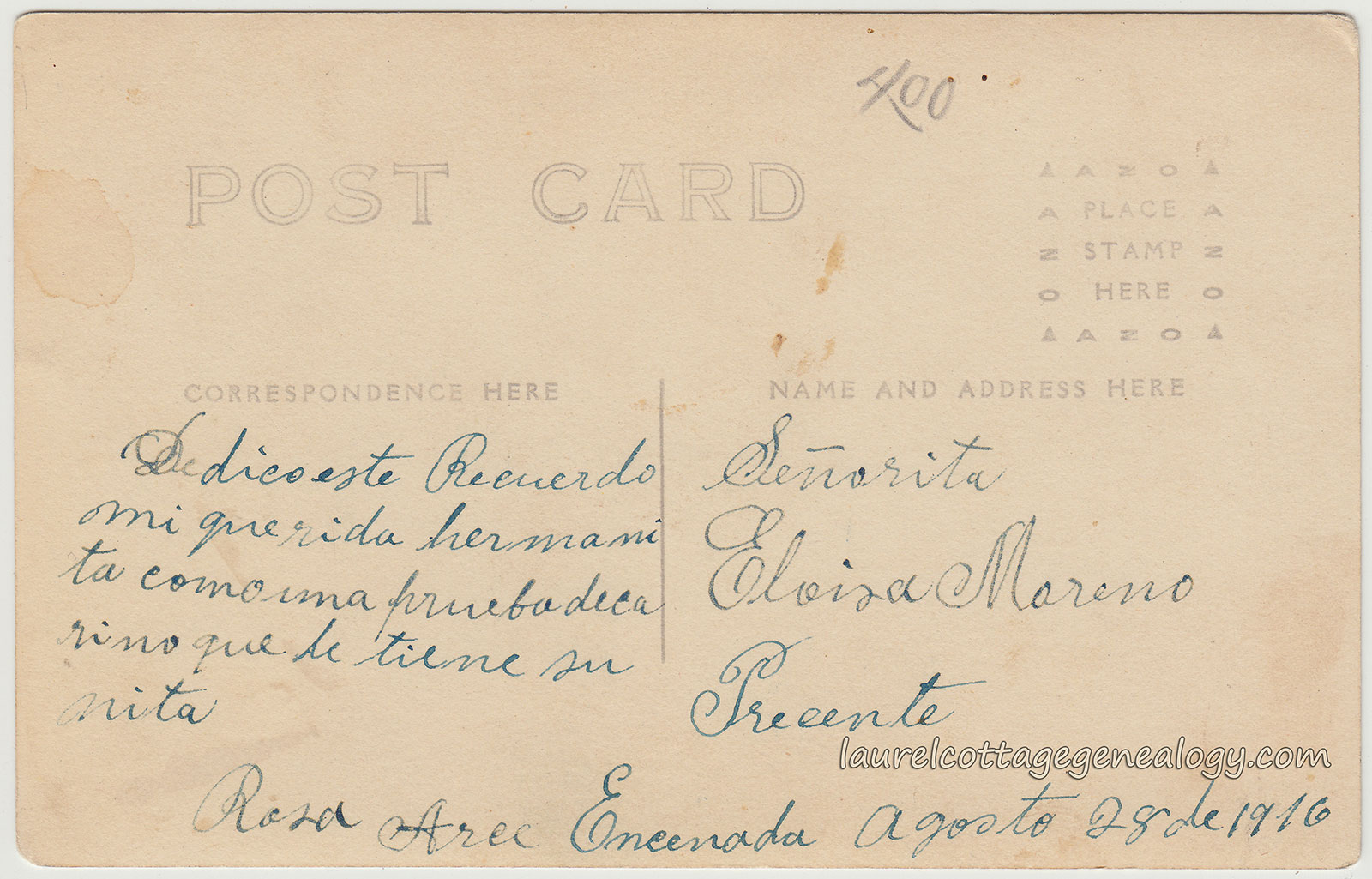
“Dedico este Recuerdo mi querida hermani tu como una prueba de cariño que le tiene su nita,    Rosa Arce   Encenada   Agosto 28 de 1916.”

It seems “hermani” should be hermana (sister) and possibly  “nita” should be nieta (granddaughter). “Encenada” is Ensenada, so the photo was probably taken in Ensenada, Baja California, Mexico, however there is a small town in New Mexico by this name and also a neighborhood in Guánica, Puerto Rico called Ensenada. I’m not understanding the full context with the reference at the end to su nieta (his/her granddaughter) however I believe the first part translates as:

“This memory is dedicated to you my dear sister as proof of my affection…” 

Addressed to:   “Señorita Eloisa Moreno.”   (The word appearing underneath the name is a mystery at the moment.)

Cuernavaca Market Scene

Cuernavaca Market Scene pc1Cuernavaca Market Scene pc2

Divided back, used postcard. Circa 1949. Artist unknown. Publisher:  Fischgrund, Mexico (Eugenio Fischgrund). Printed in Mexico. Printer:  F. Sanchez H. y Cia, México, D.F. (Mexico City).

Price:  $20.00

Color! If you’ve been looking at the last number of black and white posts, this is a heavenly change (adore those black and white ones though!)

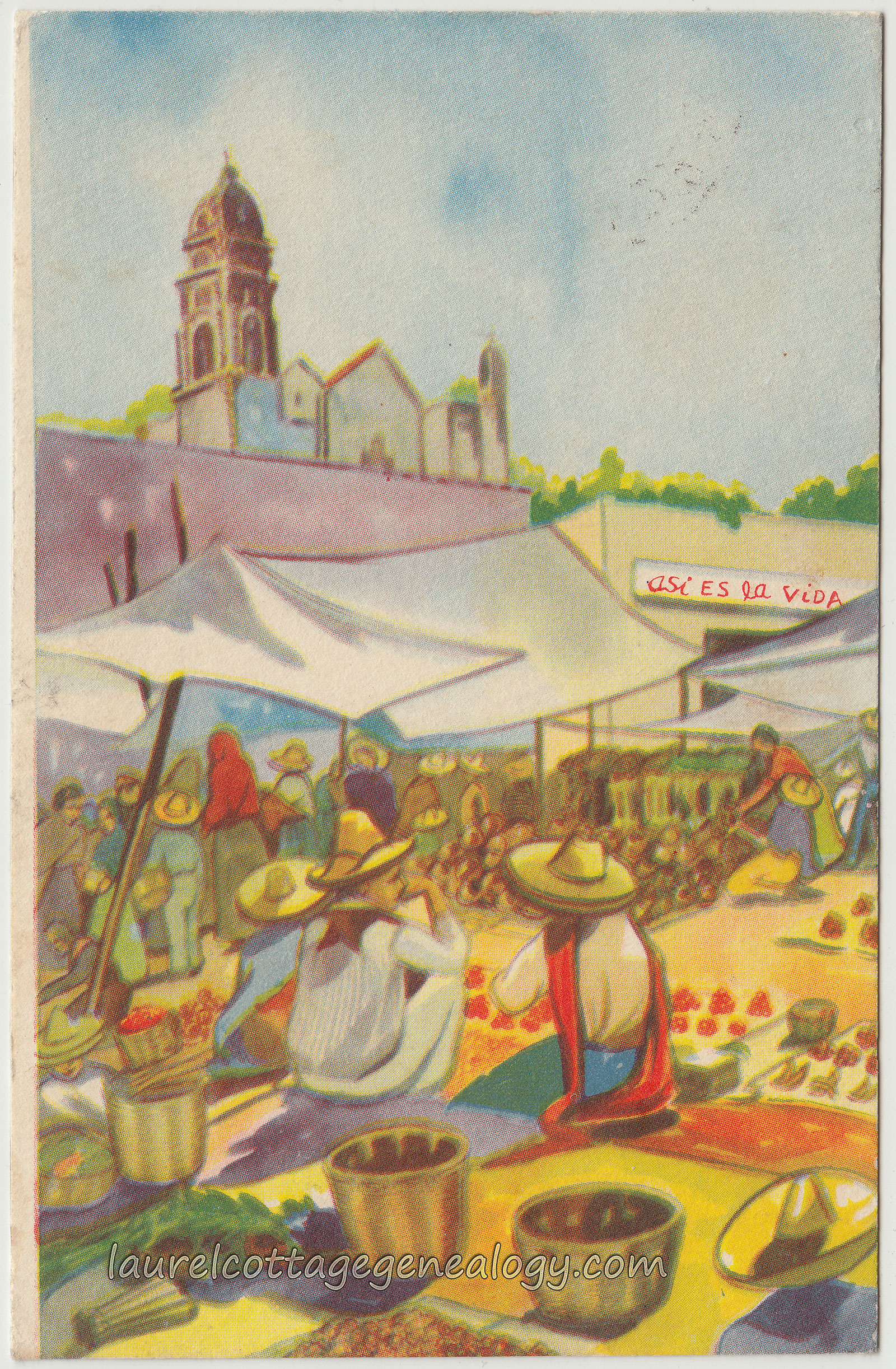
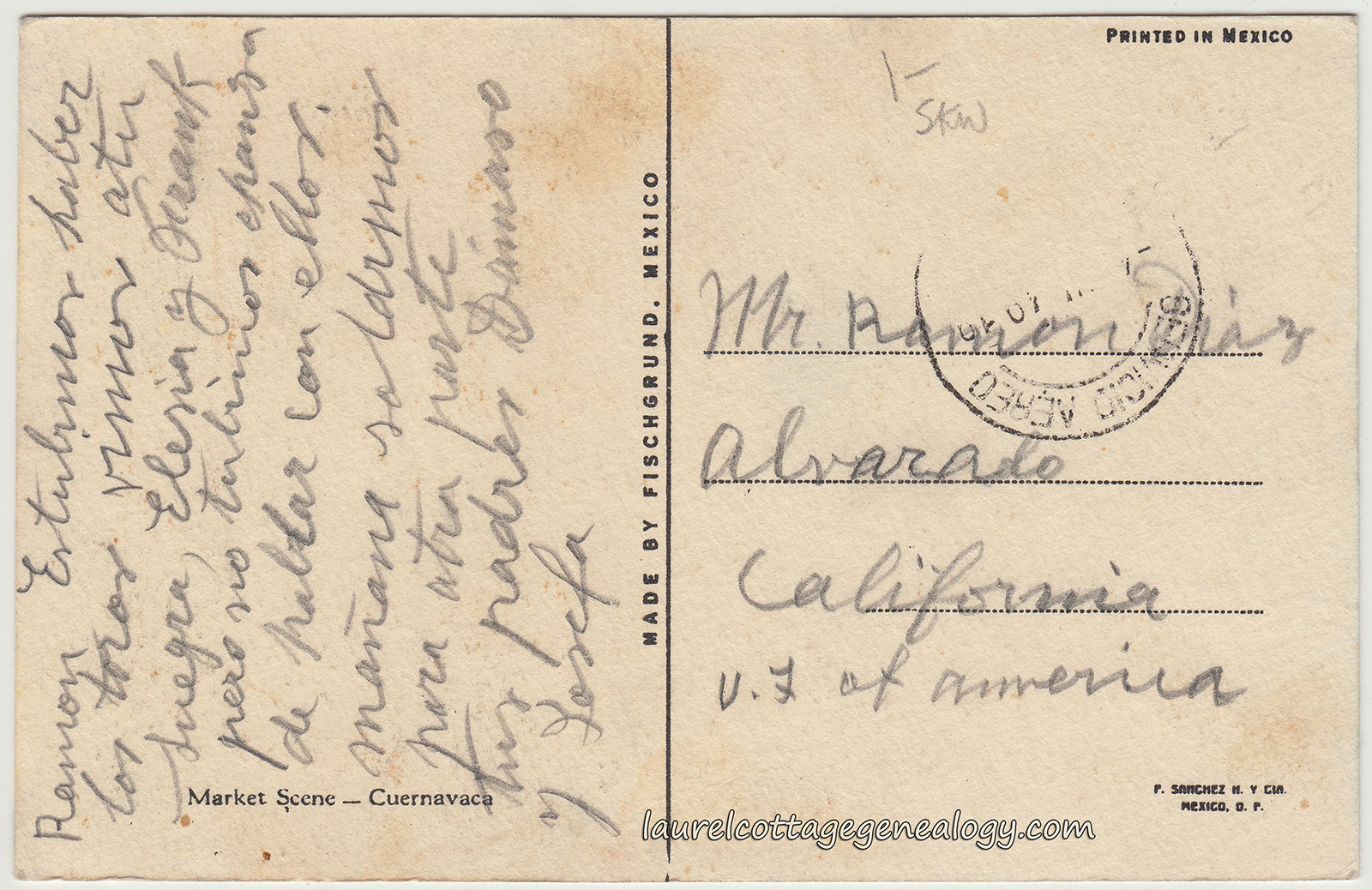
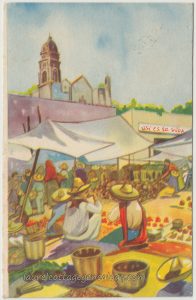
A postcard, circa 1949, from an unknown artist’s painting, showing a market scene in the city of Cuernavaca, Mexico. Cuernavaca is the capital of the Mexican state, Morelos, and located south of Mexico City. That looks like a depiction of the Cathedral of the Assumption of Mary (Catedral de la Asunción de María) in the background. And closer in the scene we see part of a building bearing the sign  “Así es la Vida”  translated as “such is life.”  Maybe a restaurant or a bar? (There is a Phoenix AZ restaurant by this name.) The senders wrote:

“Ramon, Estubimos (estuvimos) haber los toros vimos a tu suegra, Elisia y Frank pero no tubimos (tuvimos) chansa de hablar con ellos. Mañana saldremos para otra parte. tus padres Dámaso y Josefa.”

Translation:   “We saw the bulls and were with your mother-in-law, Elisia and Frank but we did not have a chance to talk with them. We’re leaving tomorrow, your parents Dámaso and Josefa.”

Addressed to:   “Mr. Ramon Diaz, Alvarado, California, U. F. of America.”

I think the senders were saying “United Federation” of America and obviously meant U. S. of A. As for the postmark, that looks like 49 for year 1949.

The town of Alvarado was located in Alvarado County and does not exist in present-day, it was annexed to Union City in 1959.

The 1930 U. S. Federal Census finds the Diaz family living in Washington Township, Alameda County, California:  Damaso Diaz, born Spain about 1888, occupation meat salesman; his wife Josephine, born Spain about 1886; son Segundo, born Hawaii about 1914; son Cipriano, born California about 1915; daughter Mary, born California about 1916; and our postcard addressee, Raymond, born California about 1920.

The 1940 Federal Census for the family was found also (spelled Dias), showing that by  now Damaso is the owner of a grocery and meat market, daughter Mary is married to Frank Vargas, Segundo is a delivery man for his dad, Cipriano Diaz and Frank Vargas are salt workers, and Raymond is helping his dad at the store.

Looking a little further we find Raymond was born in 1919, served in WWII, enlisted as a private and was promoted to sergeant, and (assuming he was married once) he married Beatrice (maiden name unknown) sometime between 1942 – 1949. In ’42 his occupation was welder. In 1959 he and his wife were living in Union City and he was working as a barber. He died in 1995 and is buried in the San Joaquin National Cemetery in Santa Nella. (Funny, I’ve driven by this cemetery a number of times when we lived in the Central Valley.)

I’m struck again by the feeling that these postcards, photos, trade cards etc. are like doorways (chuckling but serious) containing glimpses of so many connected stories:  This particular Diaz family has origins in Spain, they were in Hawaii when their oldest son was born, but put they down roots in California. The parents vacationed near Mexico City. The now defunct town of Alvarado was known for sugar beets. The postcard publisher lived in Mexico but was born in what is now the Czech Republic (we’ll have to get a post up on him later) and we could go on and on.

Sources:  Alvarado, California. n.d. https://en.wikipedia.org/wiki/Alvarado,_California (accessed April 30, 2016).

Year: 1930; Census Place: Washington, Alameda, California; Roll: 112; Page: 4A; Enumeration District: 0343; Image: 189.0; FHL microfilm: 2339847. (Ancestry.com)

“United States Census, 1940,” database with images, FamilySearch (https://familysearch.org/ark:/61903/1:1:K9QW-WDS : accessed 30 April 2016), Raymond Dias in household of Damaso Dias, Washington Judicial Township, Alameda, California, United States; citing enumeration district (ED) 1-178, sheet 4B, family 99, NARA digital publication T627 (Washington, D.C.: National Archives and Records Administration, 2012), roll 191.

National Archives and Records Administration. U.S. World War II Army Enlistment Records, 1938-1946. (Ancestry.com)

Original data: Find A Grave. Find A Grave. Memorial #580002. http://www.findagrave.com/cgi-bin/fg.cgi.

Polk’s San Leandro (Alameda County) City Directory 1959. p. 263. (Ancestry.com. U.S. City Directories, 1822-1995)
Silver Parcel-Gilt Ewer

Silver Parcel Gilt Ewer pc1Silver Parcel Gilt Ewer pc2

Divided back, unused postcard. Circa 1930s – 1950s.

Price:  $10.00

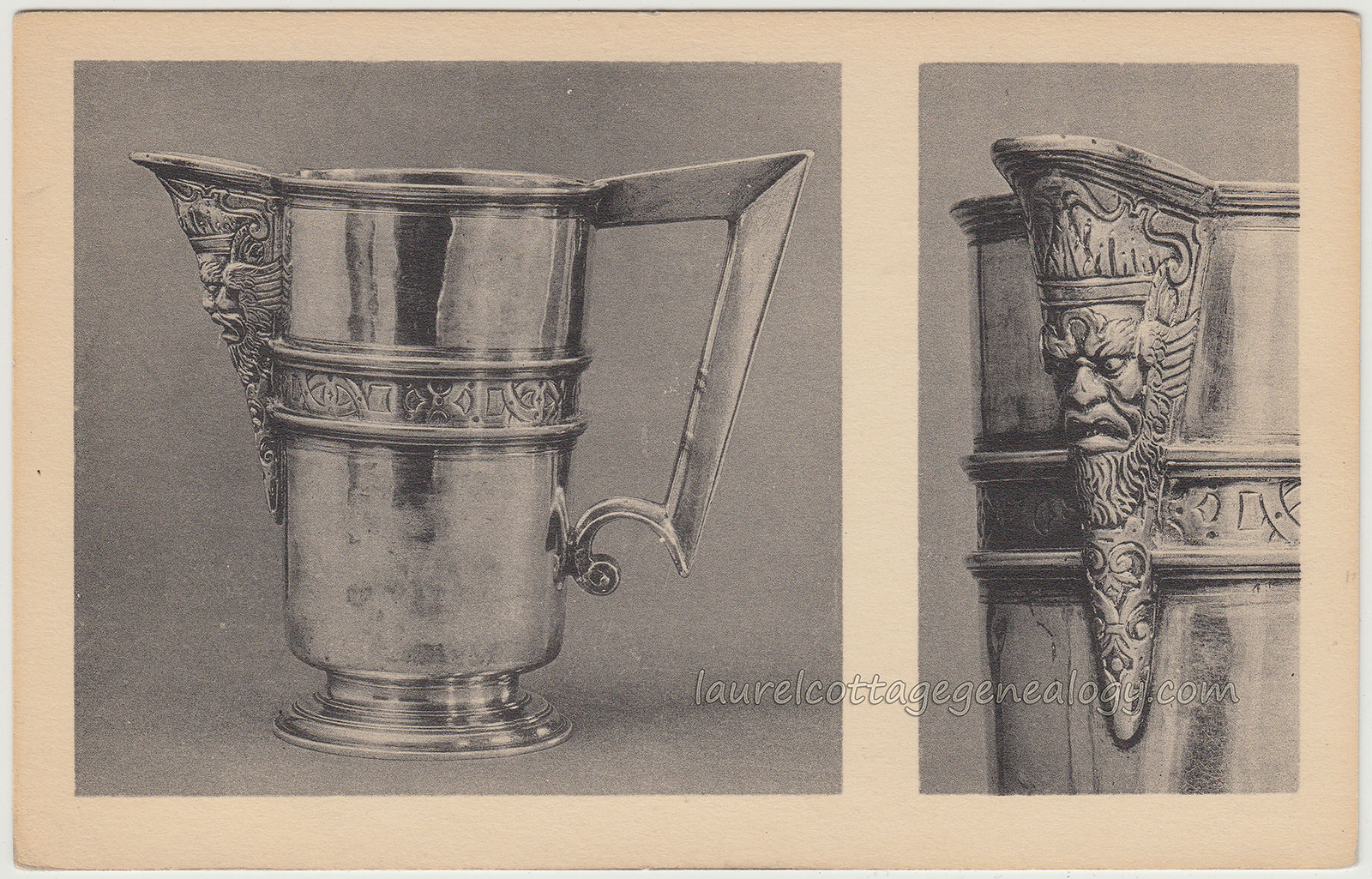
“Ewer R3043 Silver parcel-gilt. End of 16th century. Hispanic Society of America, New York.”

Various definitions of ewer are:  a pitcher with a wide spout; a vase-like pitcher, often decorated; a vessel that has a spout and a handle, especially a tall slender vessel with a base. The America’s Cup is a good example of a ewer, which this late 1500s pitcher does not in any way resemble (!) The date of the card is unknown, maybe 1930s – ’50s, and no duplicates show up online at the moment. See the Hispanic Society of America website for more information about them. But we wonder what the story is behind the face…

Another TJ Tourist RPPC

Another TJ Tourist RPPC pc1Another TJ Tourist RPPC pc2

Divided back, unused with writing, Real Photo Postcard. Circa late 1940s or 1950s.

Price:  $7.00

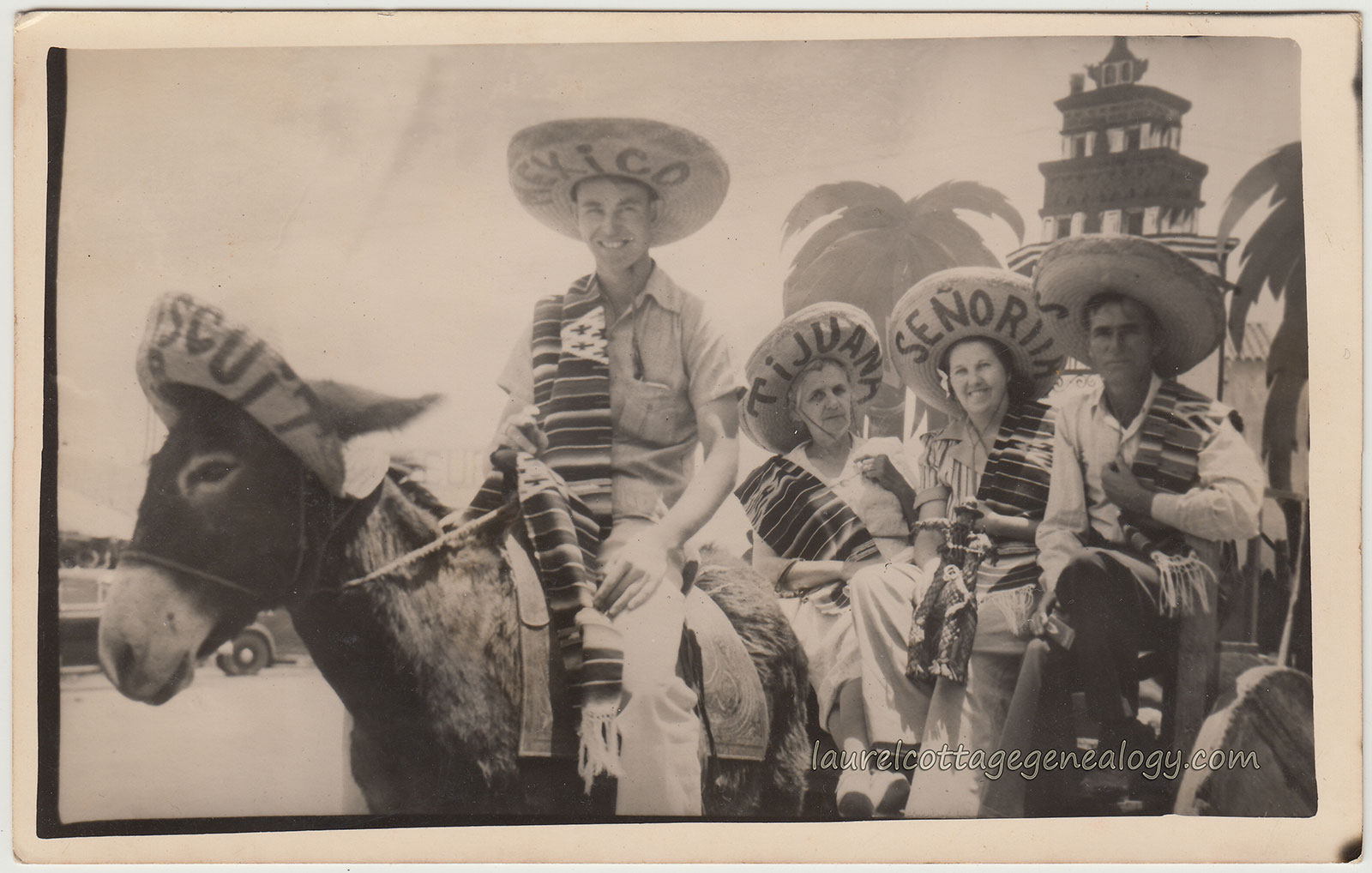
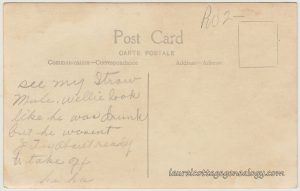
“See my Straw Mule. Wellie look like he was drunk but he wasn’t. J.T. is about ready to take off. ha ha.”

A group of four tourists in sombreros and serapes, the one gentleman is astride a donkey (no stripes this time) wearing a sombrero. I don’t get the reference to the straw mule. Maybe somebody out there does and can comment. The younger woman holds a woven straw doll, though. Click on the image to enlarge. And how do you like the use of “wellie” for “well he” or is Wellie a nickname for either of the guys in the photo?

Tourists In Tijuana, 1955

Tourists In Tijuana 1955 pc1Tourists In Tijuana 1955 pc2

Divided back, unused, Real Photo Postcard. Circa 1955. Kodak Paper stamp box.

Price:  $7.00

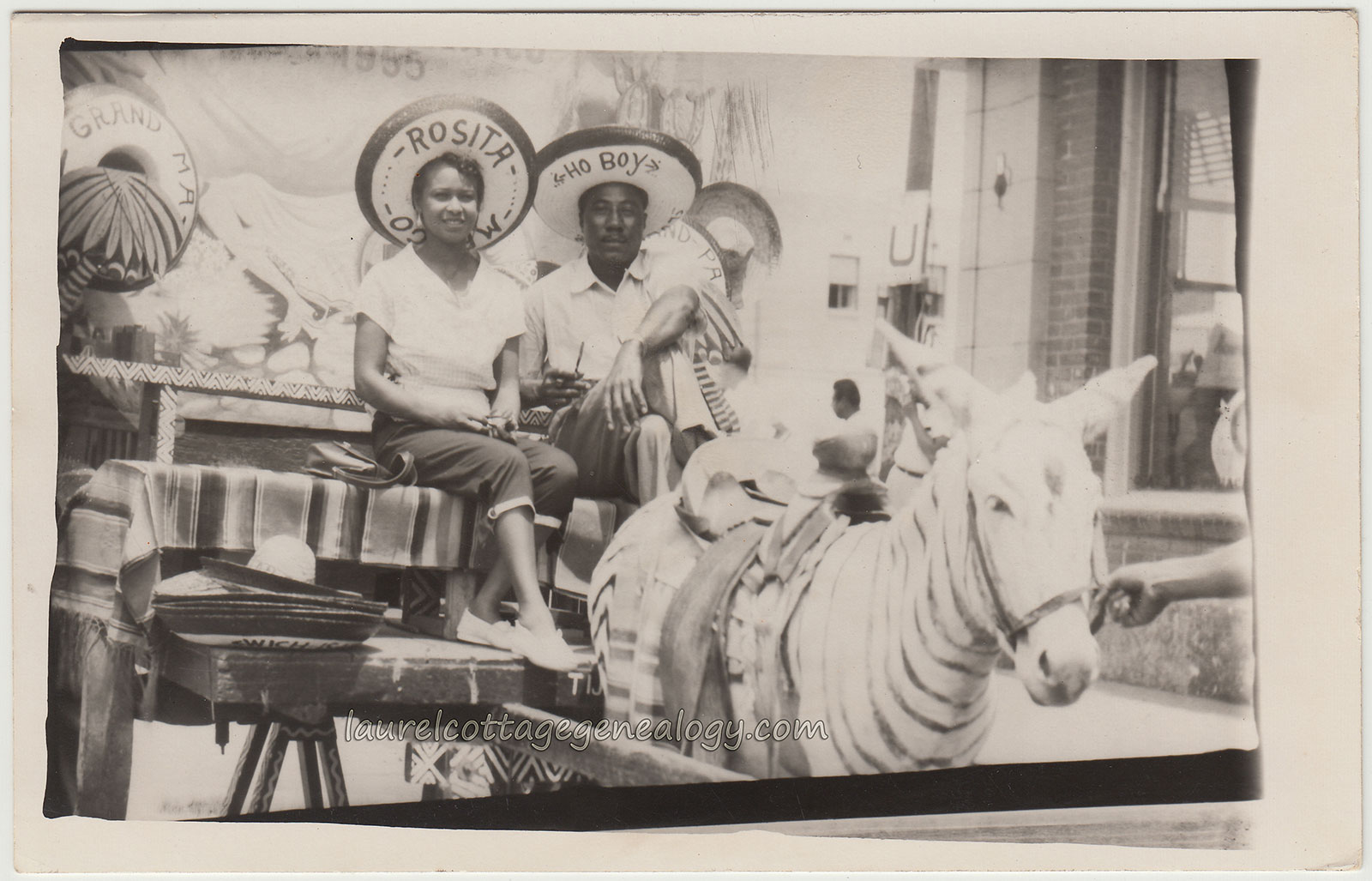
An African-American couple (presuming couple and presuming they’re from the U.S.) posing for a photo wearing tourist sombreros, seated on a platform behind a “Tijuana Zebra.” That’s a depiction of the Legend of Popocatépetl and Iztaccíhuatl as the photographer’s backdrop, and at the top of the backdrop we can see “1955” and what looks like the suggestion of “Mexico” to the right of the year. The photo does seem unmistakably 1950’s with those pedal pushers the beautiful young woman is wearing. Just behind the donkey we can see the start of the word “Tijuana” that’s painted on the platform.

Sources:  Tijuana Zebra. n.d. https://en.wikipedia.org/wiki/Tijuana_Zebra. (accessed April 22, 2016).

Popocatépetl and Iztaccíhuatl. n.d. https://en.wikipedia.org/wiki/Popocat%C3%A9petl_and_Iztacc%C3%ADhuatl. (accessed April 22, 2016).

Salinas River Flooding, Circa 1900s

Salinas River Flooding 1900s - 1910s p1

Copy of old photo originally taken circa 1900s. Unknown photographer.

Price:  $15.00          Size:  10 x 8″

The first in a series of (mostly) copies of old photos of Salinas, California and environs:

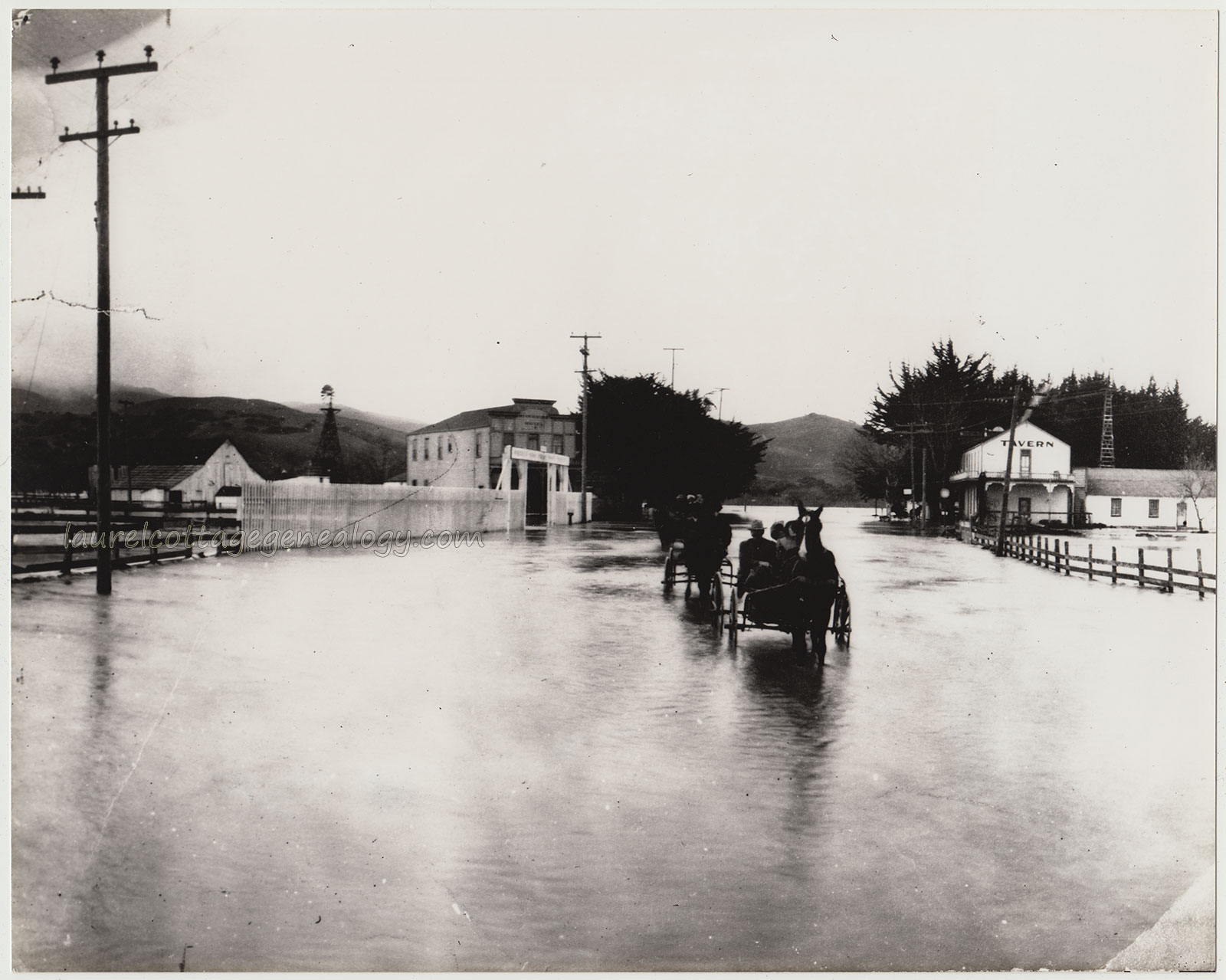
This one was labelled on the plastic sleeve as  “Salinas River, Flooded, 1900s.”  It shows two horse and buggy sets and a third horse-drawn vehicle, maybe a wagon, it’s hard to tell. In any case, all three are being driven up a wide, flooded dirt road, traveling toward the photographer. The lighting doesn’t let us pick out too many details for drivers and passengers. And the photo’s exact location is unknown at the moment, but within the scene we find a couple of great clues:  In addition to some farm buildings, a weather vane and a utility pole, we see a couple of two-story wooden buildings – the one on our right, shows “Tavern” painted on the side, (see the horse standing in front?) and the one on our left appears to say “Riverside Hotel.” Hats off to you if you can make out the sign above the entrance way (Pederson?) In the far distance is part of the mountain range that surrounds the Salinas Valley. All in all, a great photo….but we’ll keep looking for that hotel.

Update:  Be sure to read the comment from Nick dated October 8, 2018 and click on the Google map view he included. The location of our photo appears to have been the small community of Hilltown, south of Salinas.

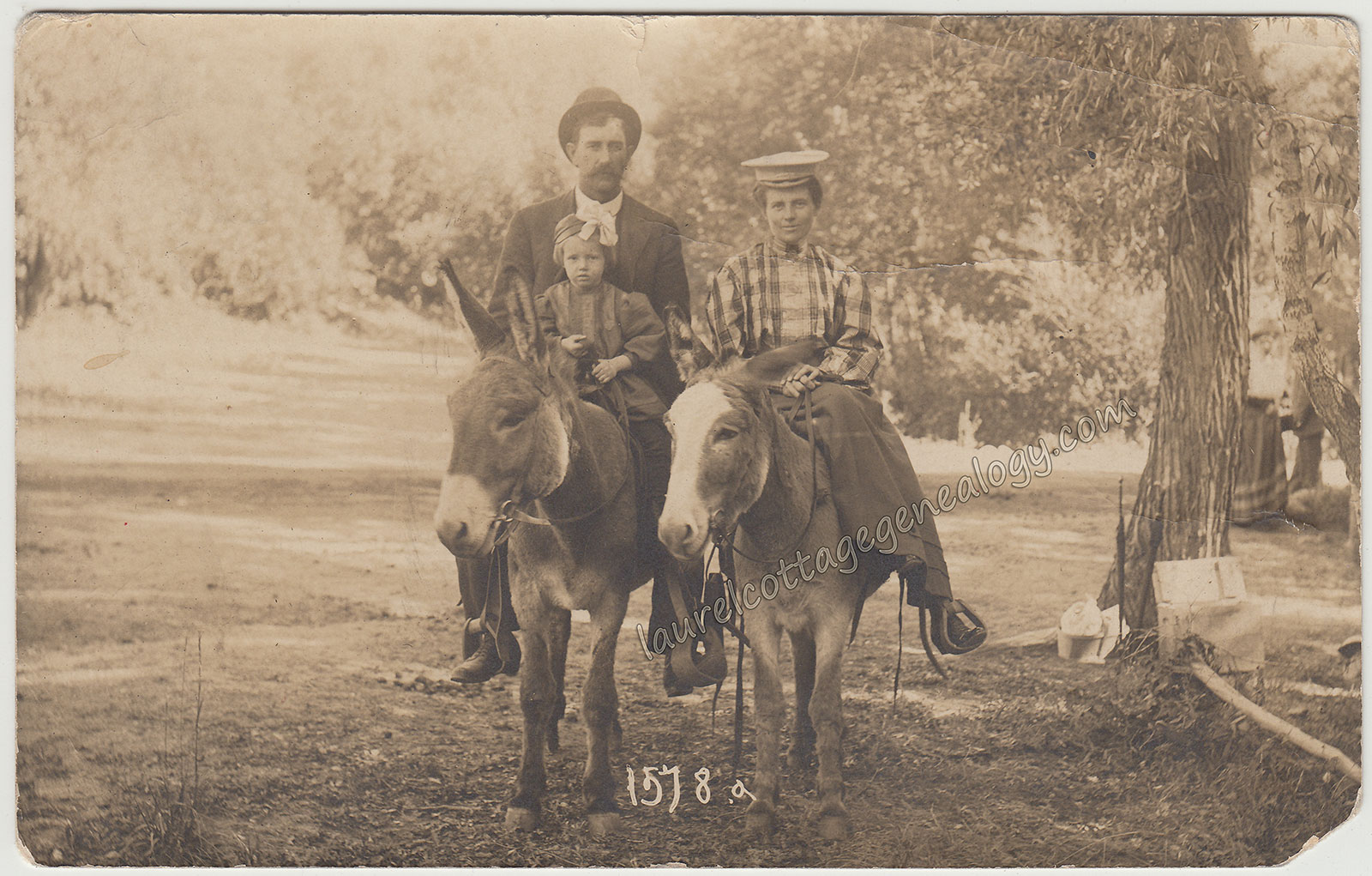
The Lehmann Family With Ikey And Buster

Buster And Ikey And Family pc1Buster And Ikey And Family

At first, we were just willing to place a heavy bet on the identity of the people in this Real Photo Postcard, but then after a little more research….

John M. Lehman or Lehmann, born Illinois about 1868; his wife Malvina V. (Allen) born Kansas about 1875 and most likely their oldest daughter, Florence, born Kansas about 1905; rather than younger daughter, Neva, born Kansas about 1909; and of course, the donkeys, Ikey and Buster.

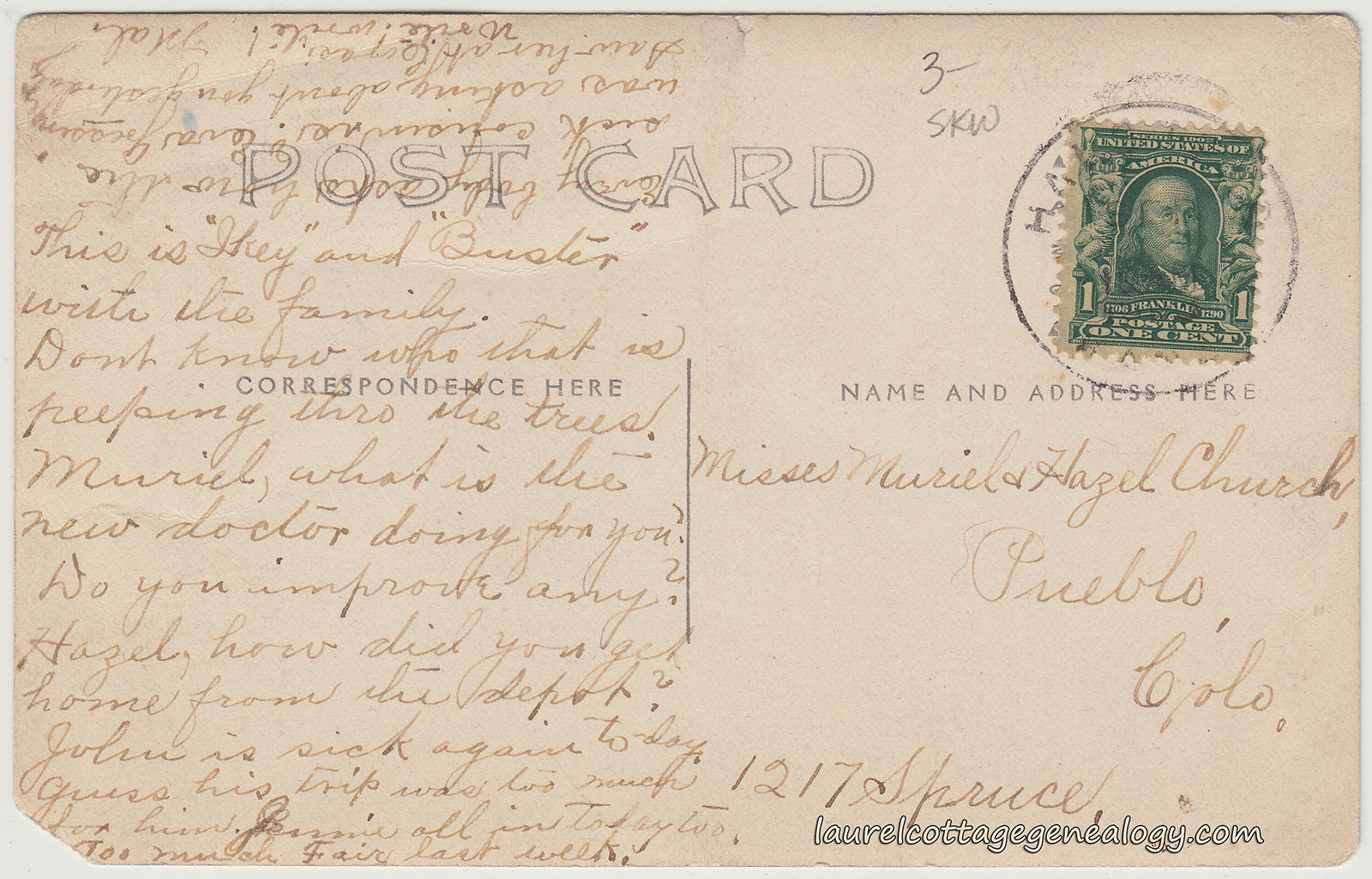
The sender signs the letter “Mal” and she mentions John, and as for the child’s name mentioned, it looks more like Jennie or Jessie that a possible Flossie or Florrie but maybe whatever is indicated there was Florence’s pet name. By 1920, the family is living in Burrton, Kansas, which is about eleven miles northwest of Halstead.

Eva Gressinger, mentioned below, was the first key to solving the postcard’s mysteries:  Eva’s name turns up in Halstead, Harvey County, Kansas on the 1910 Federal Census, which confirmed the cancellation place for the postcard. The sender writes:

“This is ‘Ikey’ and ‘Buster’ with the family. Dont know who that is peeping thro the trees. Muriel, what is the new doctor doing for you? Hazel, how did you get home from the depot? John is sick again to-day. Guess his trip was too much for him. [ ? ] all in today too. Too much Fair last week. ‘Every body’ asks ‘how the sick cousin is.’ Eva Gressinger was asking about you yesterday. Saw her at [ ? ]. Write! write!   Mal.”

Addressed to:  “Misses Muriel & Hazel Church, Pueblo, Colo. 1217 Spruce.”

Eureka:  Postcard i.d. confirmed!

As for the cousins, Muriel and Hazel, they are two of the children of Russel Jobe Church and Viola Castillo Stout. The “cousin” relationship is confirmed with Viola – she shows up on Ancestry trees as a relative of Malvina. So, for sure, in the photo, this is John and Malvina Lehman and likely Florence (and of course Ikey and Buster).  🙂

Divided back, used, Real Photo Postcard. Postmarked September (year unreadable). Circa 1908, from Halstead, Kansas. AZO stamp box visible underneath the stamp.

Price:  $20.00

Sources:  Year: 1910; Census Place: Halstead, Harvey, Kansas; Roll: T624_441; Page: 12A; Enumeration District: 0035; FHL microfilm: 1374454. (Ancestry.com)

Year: 1910; Census Place: Halstead, Harvey, Kansas; Roll: T624_441; Page: 8B; Enumeration District: 0035; FHL microfilm: 1374454. (Ancestry.)

Year: 1920; Census Place: Burrton, Harvey, Kansas; Roll: T625_534; Page: 3B; Enumeration District: 44; Image: 123. (Ancestry.com)

Year: 1900; Census Place: Pueblo, Pueblo, Colorado; Roll: 128; Page: 13B; Enumeration District: 0094; FHL microfilm: 1240128. (Ancestry.com)

Cutting Wheat

Cutting Wheat p1

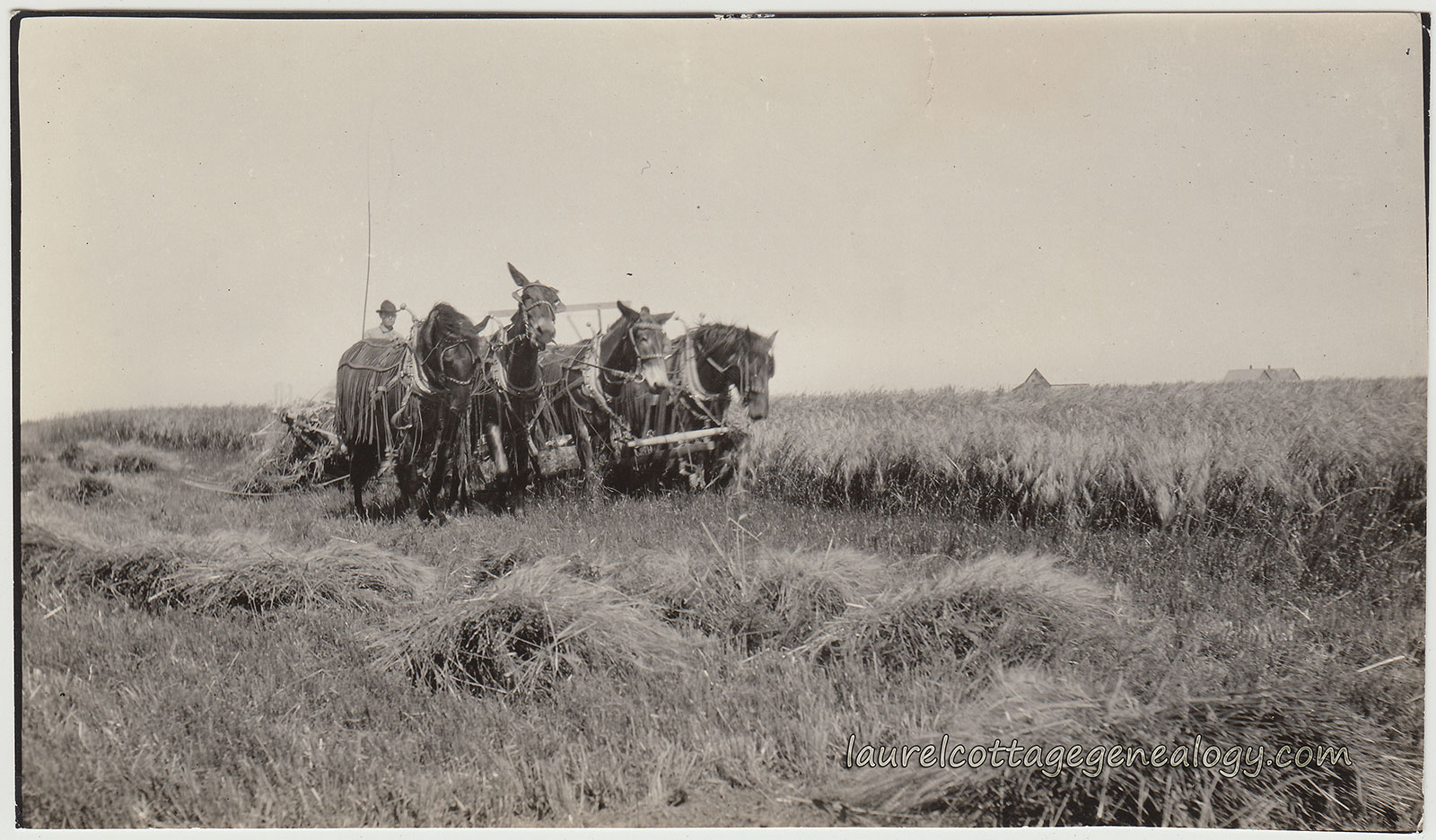
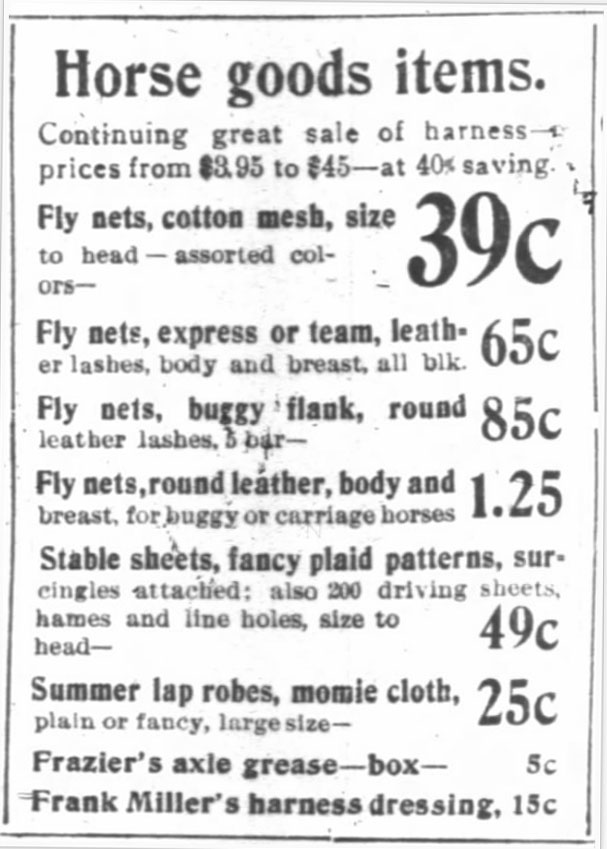
An old photo, circa 1900s to 1920s, of a farmer behind a team of four (hard-working!) horses pulling a grain cutter-binder machine. That’s a riding crop the farmer is holding. And that looks like a lot of heavy equipment the horses are strapped into, but the fringed-type back covers are fly nets, to help keep the flies off of the sweating horses. From the 1901 newspaper ad below, it appears that the leather strips in the netting were called lashes.

Horse Goods Items Ad

Here’s a YouTube video of a tractor-pulled McCormick Deering Antique Wheat Binder in action. The machine cuts the grain, gathers it, and binds the bundles with twine, leaving the bundles to be picked up later to be taken off for the threshing process.

Price:  $10.00

Size:  About 5 and 1/2 x 3 and 1/4″     Condition:  Good except there is a small tear at the top.

Sources:  “Horse goods items.” Chicago Daily Tribune. June 30, 1901. Sunday, p. 49. (Newspapers.com)

Taylor, C. [ctaylor9919]. (July 3, 2009). McCormick Deering Antique Wheat Binder. [Video File]. Retrieved from https://www.youtube.com/watch?v=ubG4YVzyzOE.

Little Girl And Big Horse, Defiance, Iowa

Little Girl And Big Horse Defiance Iowa pc1Little Girl And Big Horse Defiance Iowa pc2

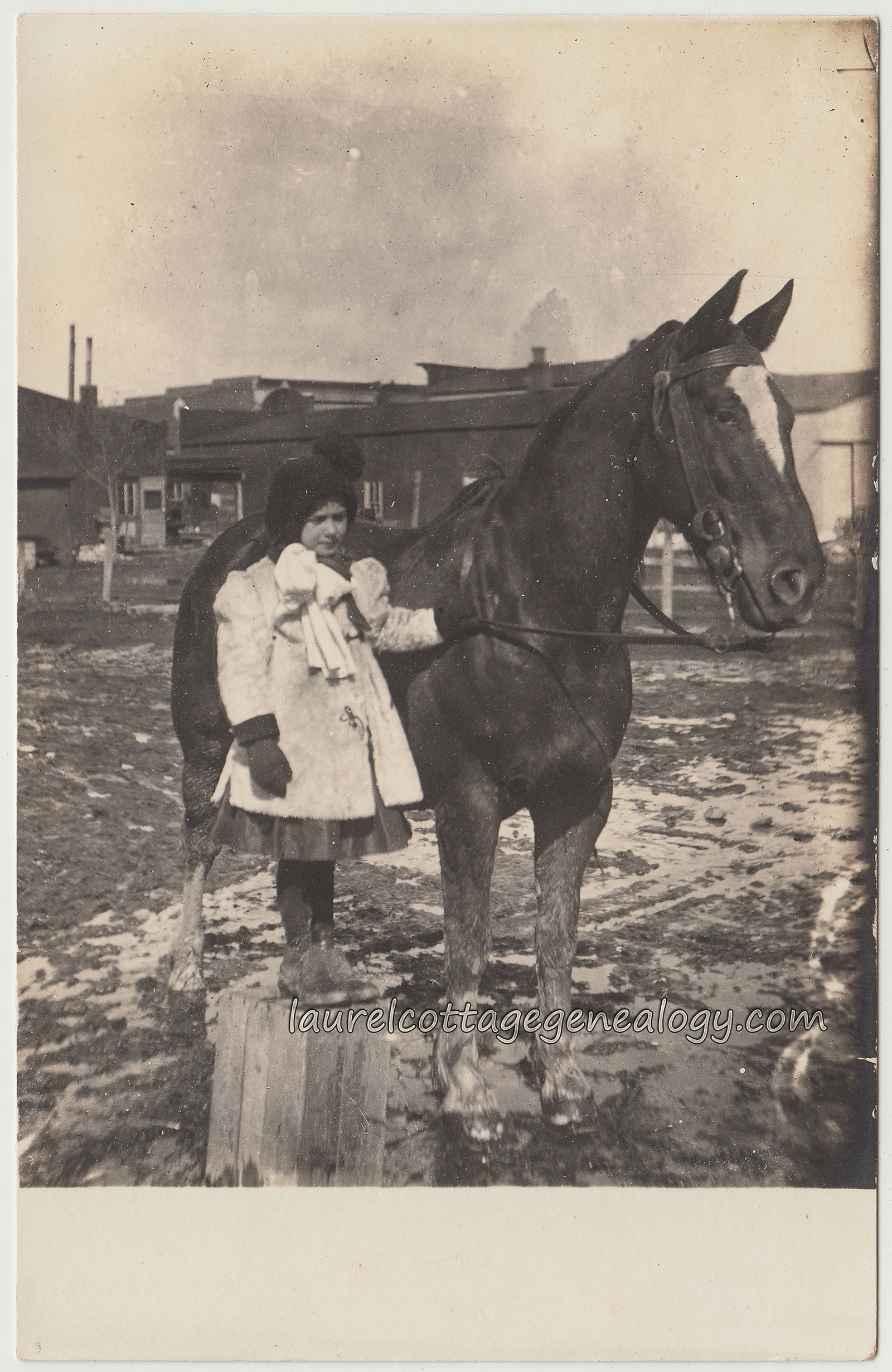
Oh! I hadn’t realized I had two by this photographer. Excellent! It’s a great one of a pretty girl (gazing downward) in coat, gloves and hat (how do you like that big pom pom, not to mention the big bow outside the coat?) She’s standing on a wooden mounting block, next to a beautiful horse (that sweet expression!), and she’s holding onto the reigns with one hand. It’s maybe late winter, early spring, the ground is wet and muddy. We see a conglomeration of buildings in the background. It’s not very affluent-looking, maybe these are farm buildings, but then it looks like we might have a main city street running behind them. For some reason I think England when I look at this photo. Don’t know why. The photo artist’s stamp on the back shows:

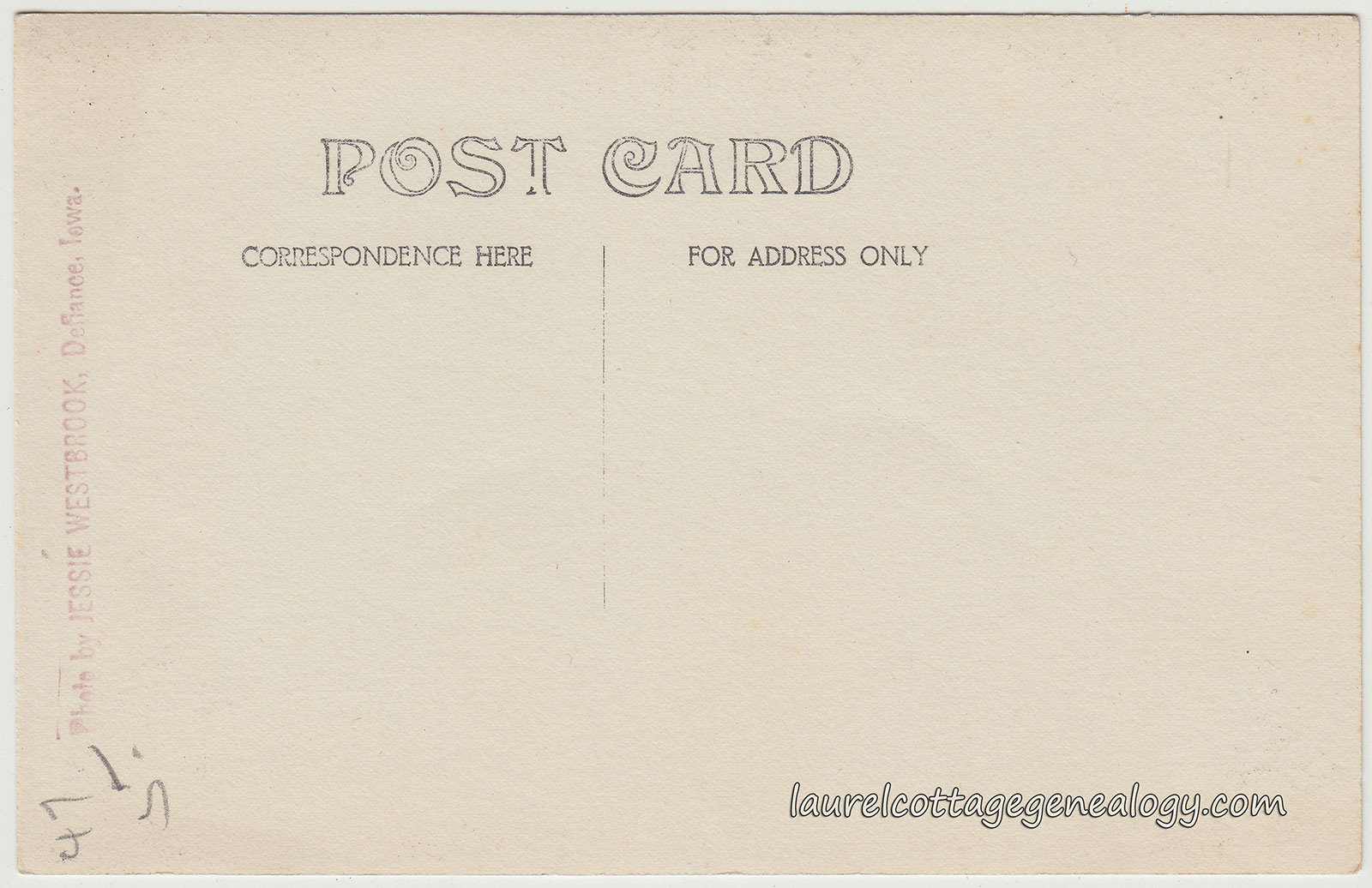
“Photo By Jessie Westbrook, Defiance, Iowa.”

See the prior post for more on Miss Jessie Westbrook.

Divided back, unused Real Photo Postcard. Photographer:  Jessie Westbrook. Circa 1914 – 1917.

Price:  $15.00