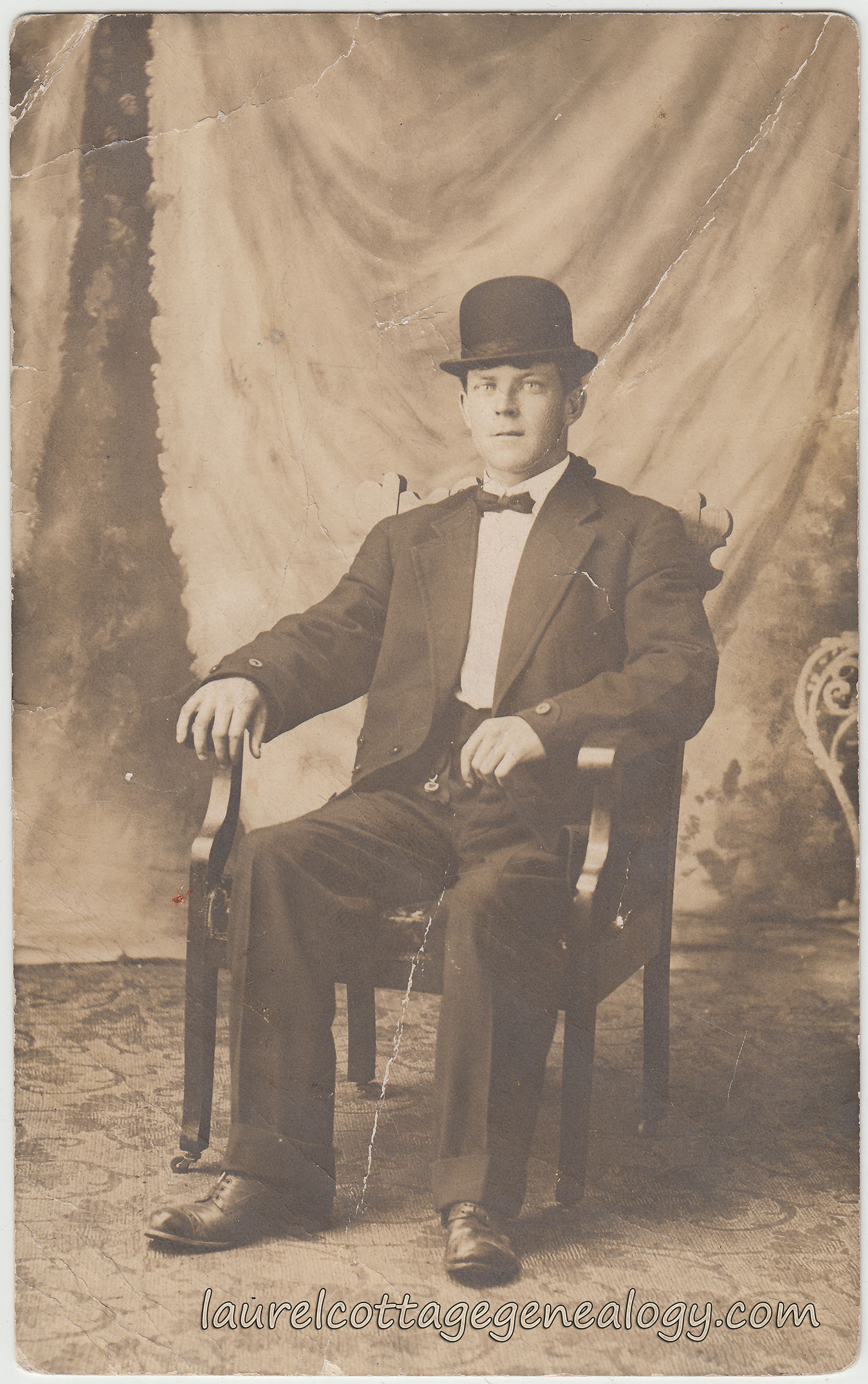
A great RPPC of a young man, probably in his twenties, seated in a wooden chair, posing for this photo. He wears a suit with bow tie and a derby, a.k.a. bowler.
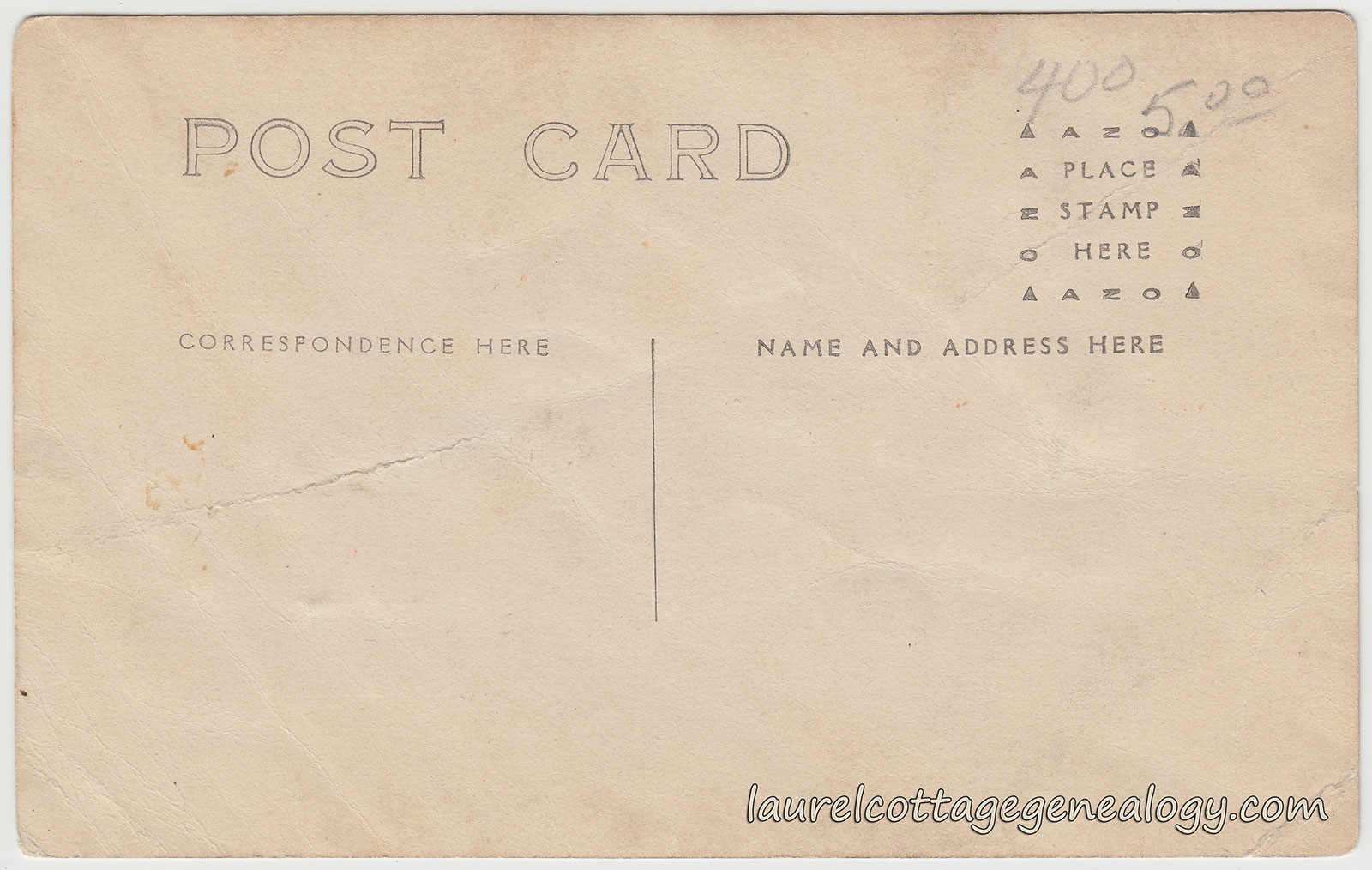
Divided back, unused Real Photo Postcard. AZO stamp box. Circa 1907 – 1918.
Price: $5.00
A great RPPC of a young man, probably in his twenties, seated in a wooden chair, posing for this photo. He wears a suit with bow tie and a derby, a.k.a. bowler.
Divided back, unused Real Photo Postcard. AZO stamp box. Circa 1907 – 1918.
Price: $5.00
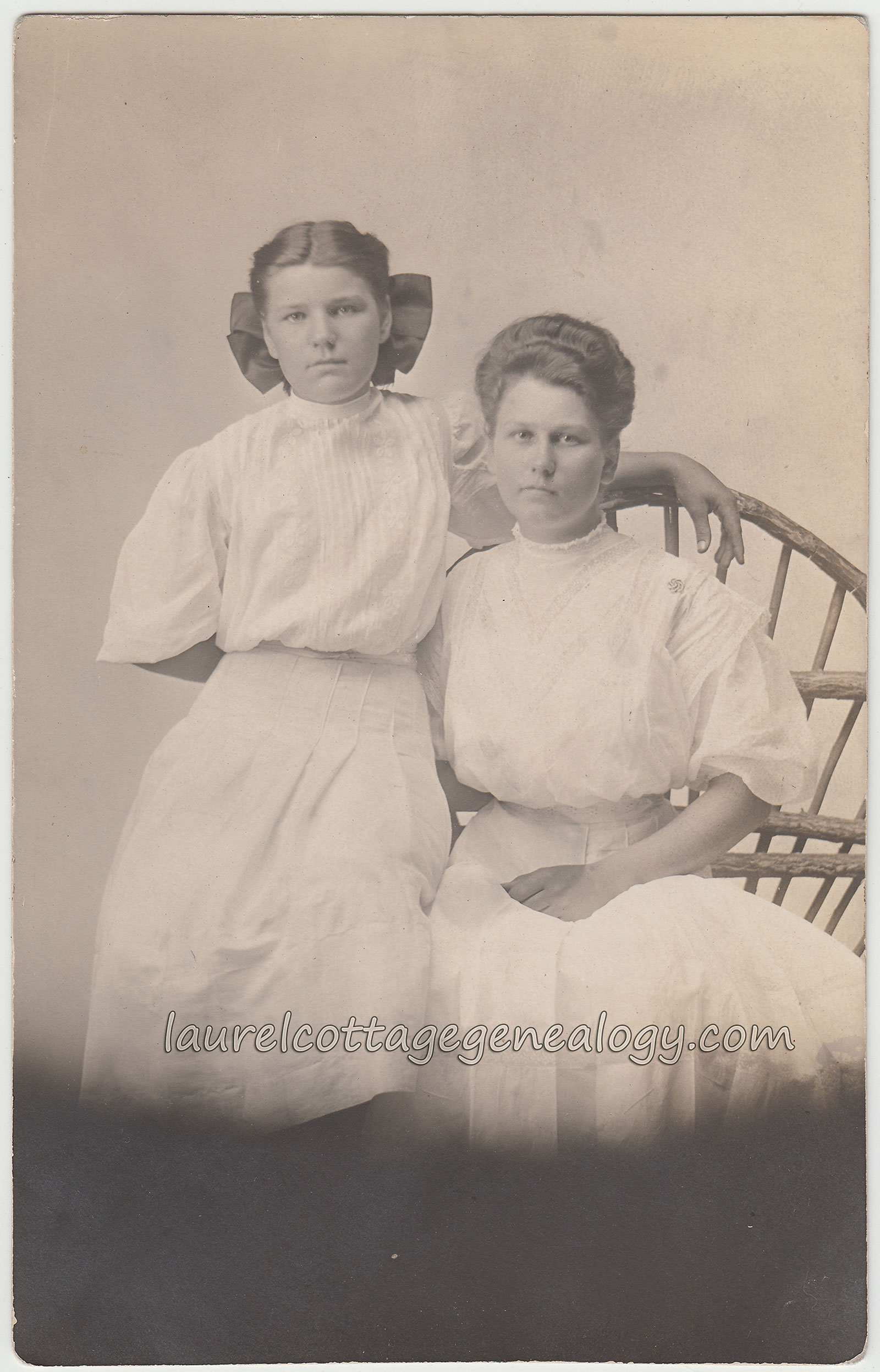
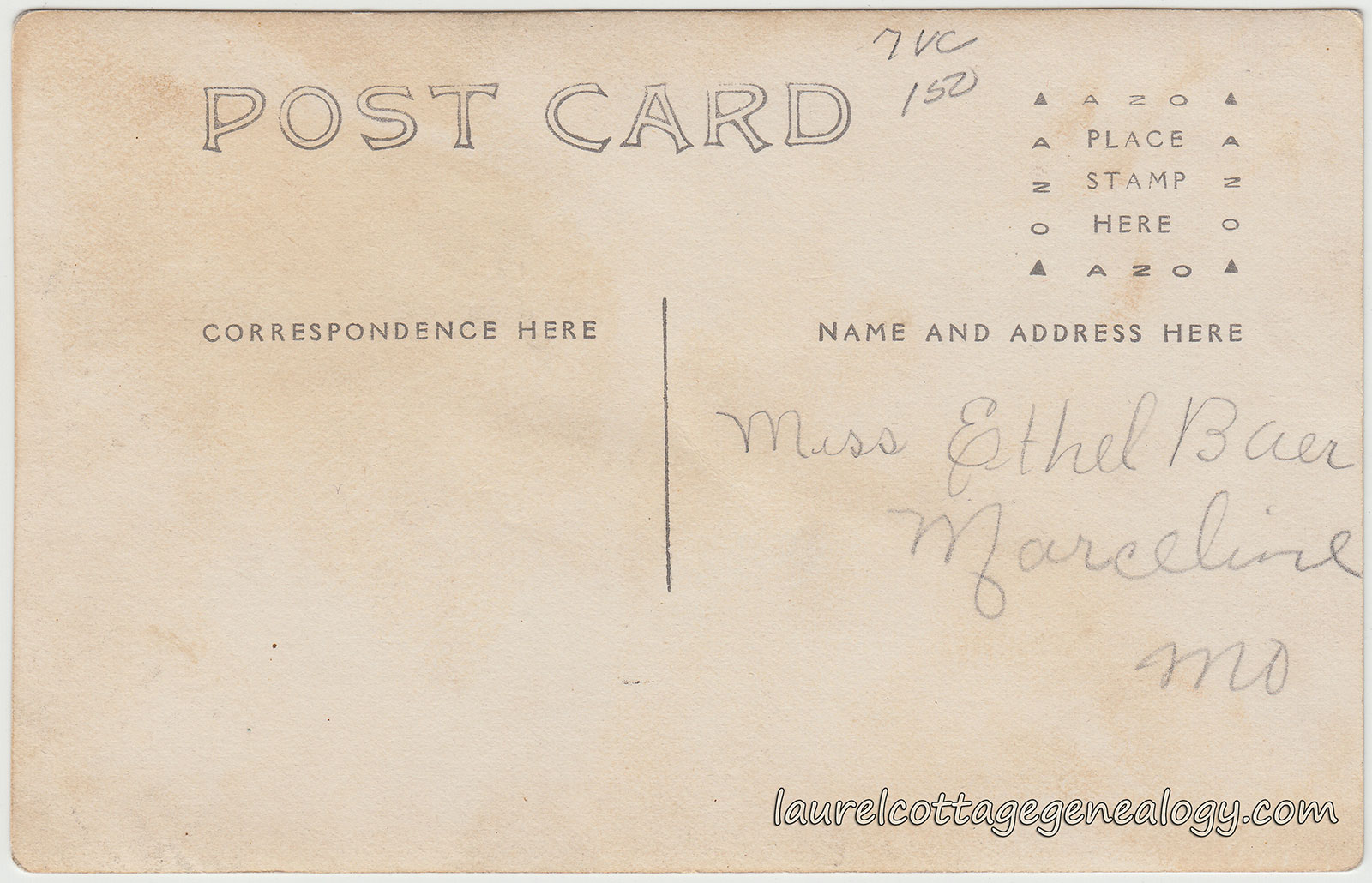
Too bad there are no names on this Real Photo Postcard to identify these two young ladies, who are most likely sisters. The card was not postmarked, but was addressed to: “Miss Ethel Baer, Marceline MO.” And it’s a lovely photo, despite the bottom part not coming out (a camera problem or in the developing process?) The girls are dressed very much alike in white skirts and and beautiful white blouses that have band type collars, and elbow-length blouse-y sleeves. (Enlarge the image to see the pattern details.) The older girl is seated on a twig chair (of the rustic type that may have been made from willow branches or some other type of wood) while her younger sister is seated next to her on the chair edge, and with her arm draped over the back.
The 1910 Federal Census for Marceline, Missouri shows Ethel, about sixteen, with her parents and siblings. The household is: Abraham L. Baer, occupation farmer, born about 1864; his wife Kisia, born about 1874; Ethel, born about 1894; James, born about 1896; Minnie, born about 1898, and Bud L., born about 1904. Abraham is a native of Pennsylvania, while Kisia and the children are natives of Missouri. There were no other records found for the Baer family with a Marceline address (without searching in great detail) and it appears that the family may have moved later on to San Bernardino, California. So, this postcard is most likely from about 1910.
Divided back, unused with writing, Real Photo Postcard. AZO stamp box. Circa 1910.
Price: $5.00
Source: Year: 1910; Census Place: Marceline, Linn, Missouri; Roll: T624_795; Page: 5A; Enumeration District: 0084; FHL microfilm: 1374808. (Ancestry.com)
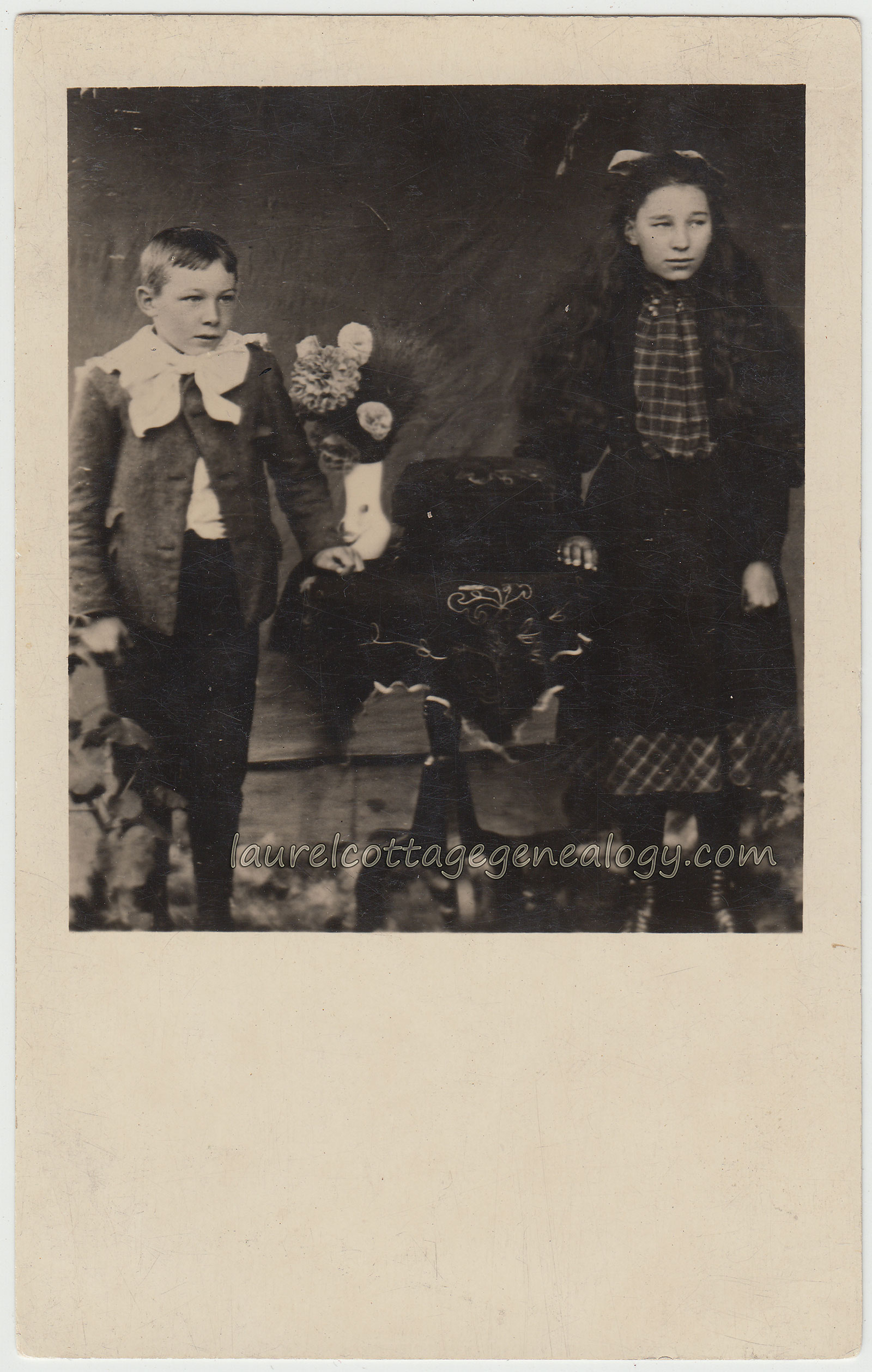
Divided back, unused, Real Photo Postcard. AZO stamp box. Circa 1910s.
Price: $4.00
This Real Photo Postcard shows a boy and girl, who must be brother and sister. The boy looks to be around nine or ten, and the girl around twelve or thirteen. They are posed standing on each side of a small pedestal type wooden table with tablecloth, which holds a vase of flowers and something else – a little too dark to discern, maybe a box or a cloth-covered book. But it’s the vase that we might feel drawn to, because it looks like it was made to resemble the face of a dog. (I thought bunny at first till I looked closer.) And it’s the unexpected ideas that come up that can be funny or charming…whichever figurative path you’re led down when you look at something. So, besides noticing right off, the expressions and resemblance to each other of the kids and their beautiful clothing (so elaborate by today’s standards) what strikes me the most is the strong feeling of seeing three “characters” posing for this photo. 😉
As for the date of the postcard: In general, the AZO stamp box with two triangles up and two down, falls under the broad range of about 1910 – 1930, but I would estimate it to be probably from the 1910s. (And can’t help but put this one in the “Dogs” category!)

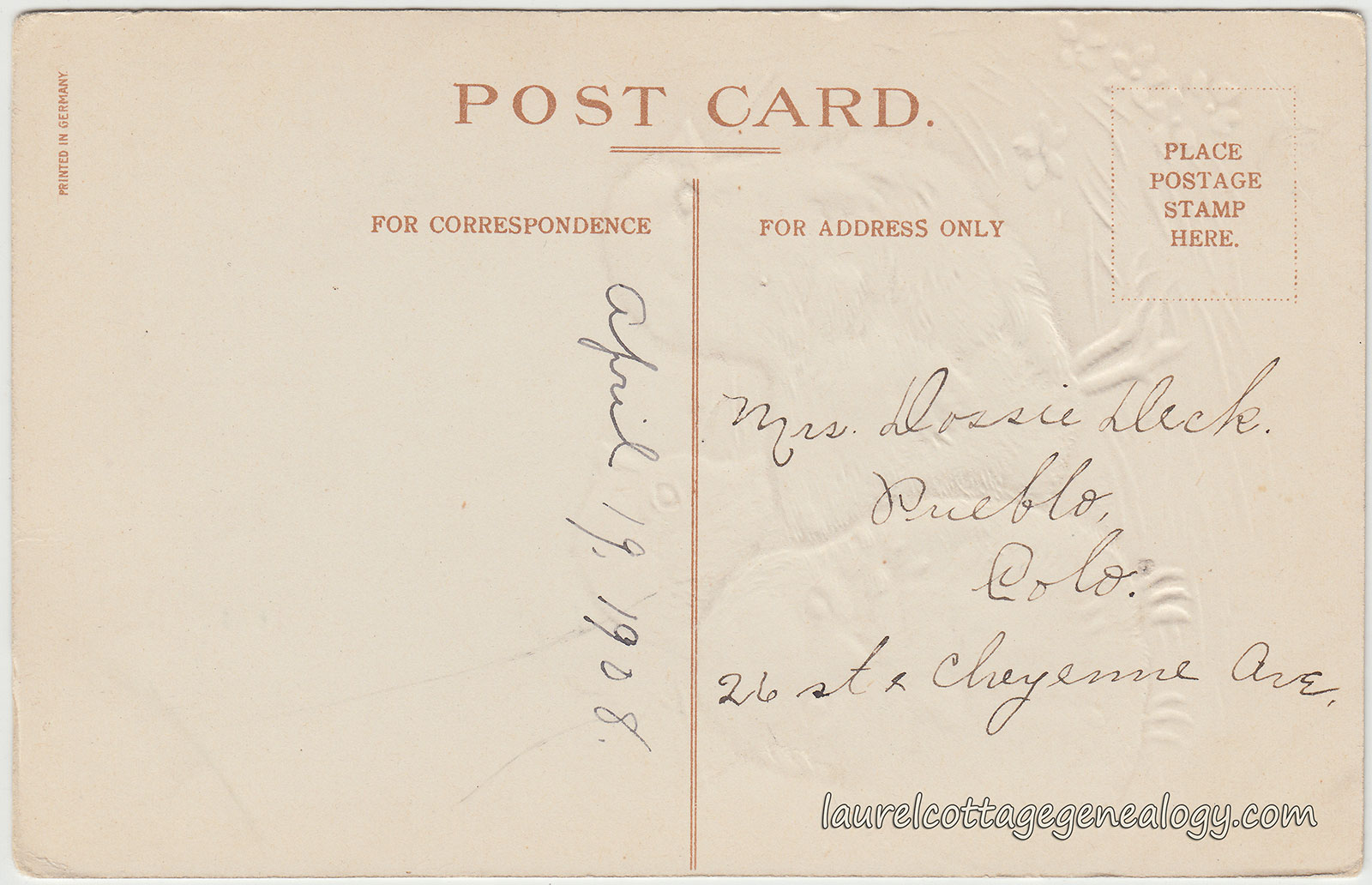
Divided back, embossed, unused with writing. Publisher unknown. Printed in Germany.
Price: $4.00
One last Easter card for the season…showing three adorable chicks – two yellow and one black, on a bed of grass and flowers, beneath a blue sky. This is yet another from the Alice Ellison Collection. Addressed to: “Mrs. Dossie Deck, Pueblo, Colo. 26 st. & Cheyenne Ave.” The sender was Alpha Lunsford, and she dated the postcard April 19, 1908.
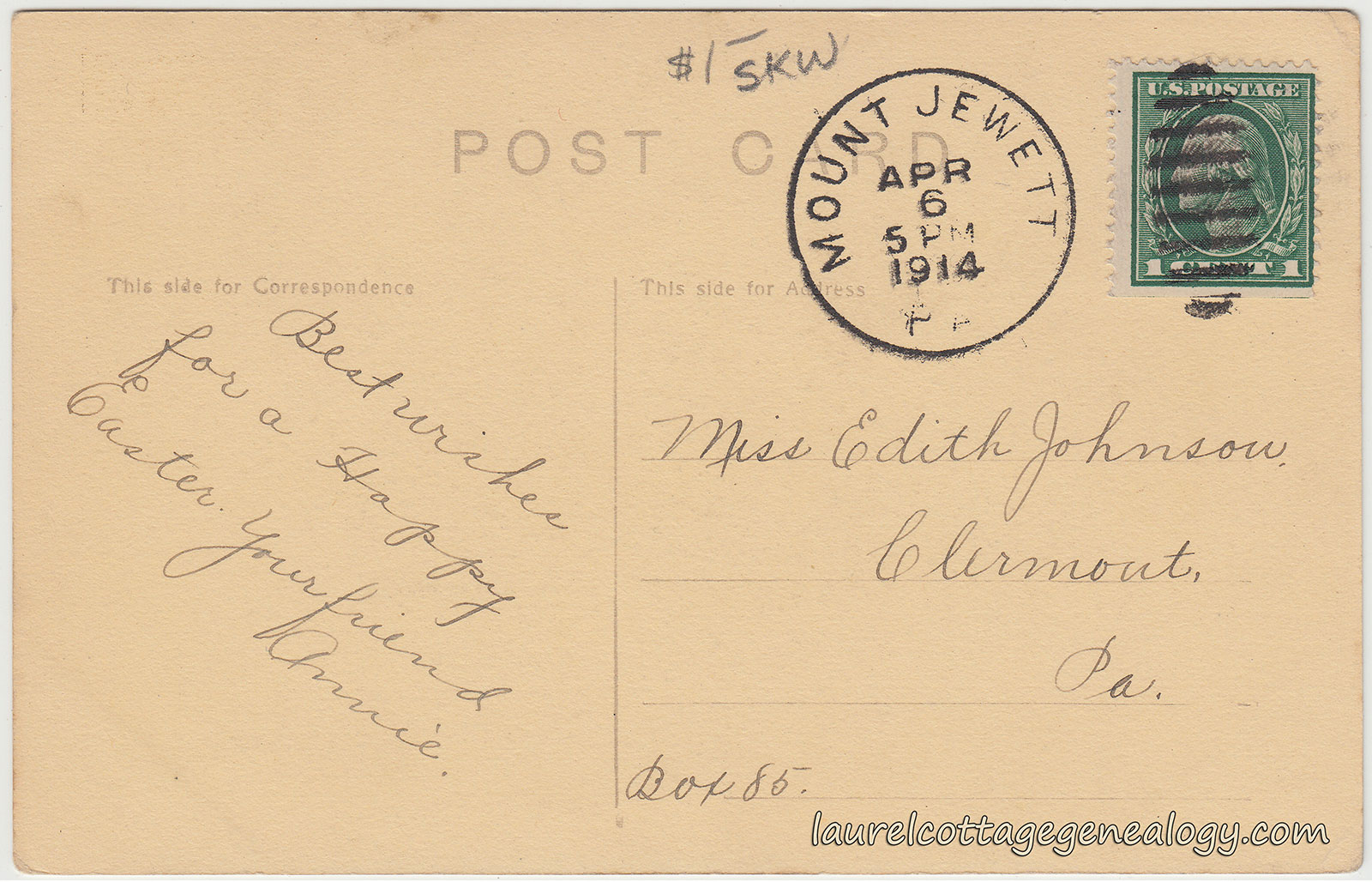
Divided back, used postcard. Postmarked April 6, 1914 from Mount Jewett, Pennsylvania.
Price: $10.00
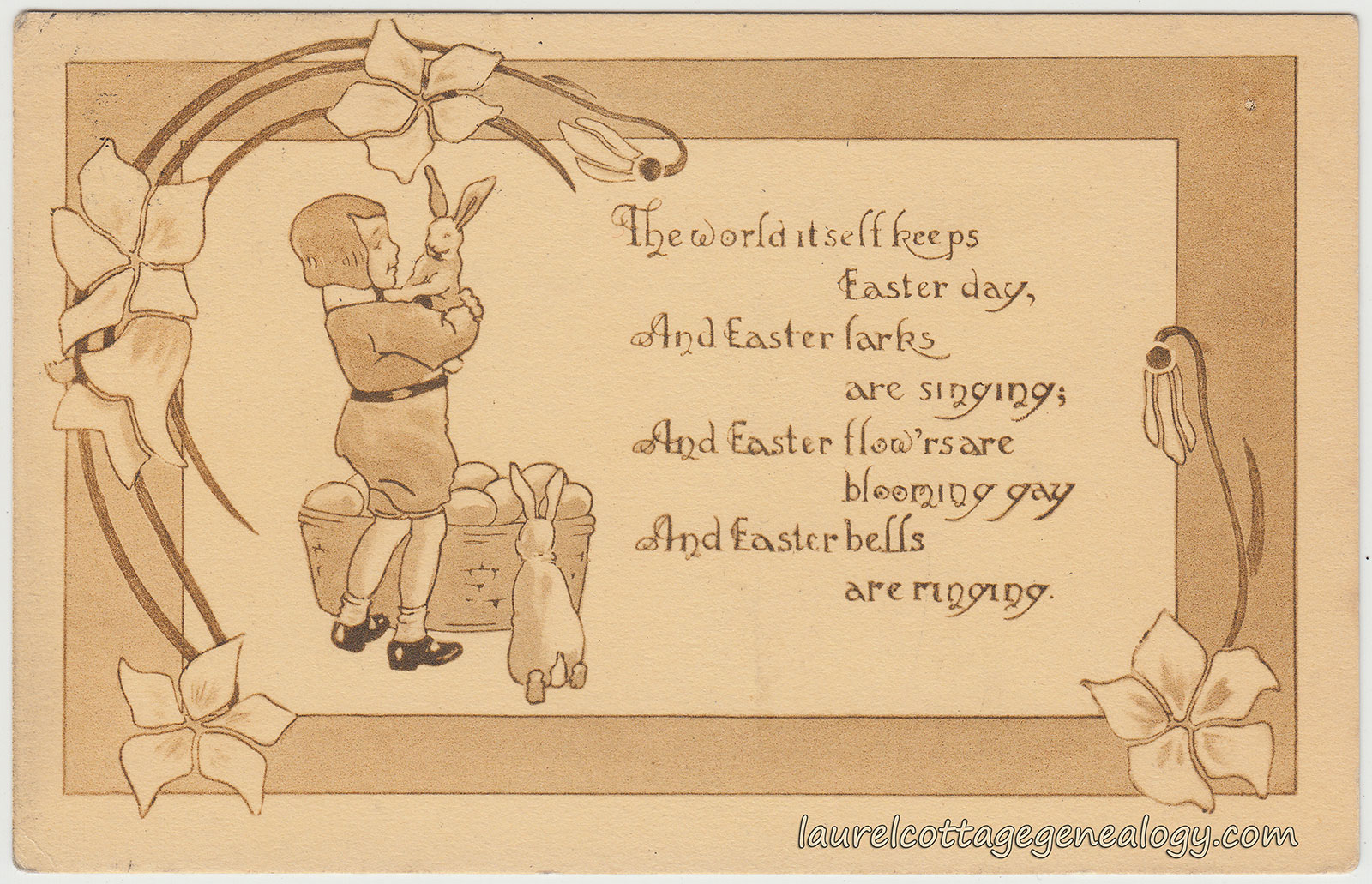
“The world itself keeps Easter day,
And Easter larks are singing;
And Easter flow’rs are blooming gay
And Easter bells are ringing.”
That’s a lovely poem for Easter, but what I love most about this postcard is the illustration: There’s a big basket of eggs (quite large eggs) two bunnies and a little boy. I love the expression on the boy’s face as he holds the one bunny in his arms (and the bun’s expression, too) while the one on the ground gazes at the basket of eggs. Flowers on each side of the card frame the scene somewhat, and have a little bit of a flow-y Art Nouveau look to them.
The sender wrote: “Best wishes for a Happy Easter. Your friend Annie.” The card is addressed to:
“Miss Edith Johnson, Clermont, PA. Box 85.”
The village of Clermont is a “blink and you’ll miss it” location, according to Neil Anderson’s blog, Neil’s Neck of the Woods. “It sits a few miles south from Pennsylvania’s scenic Route 6 as it intersects county Route 146.” (I was happy to find this description as Clermont was not showing up on my Google map search.) And here’s another great website regarding Clermont at Smethport History.
UPDATE: Thank you to Judy, one of our informed readers, who states, “Edith Johnson was the post mistress in Clermont, PA.”
Sources: Anderson, Neil. “The Village of Clermont,” Neil’s Neck of the Woods. Web accessed April 5, 2015.
Historic Clermont, Pennsylvania, Virtual Tour. Smethport History. Web accessed April 5, 2015.
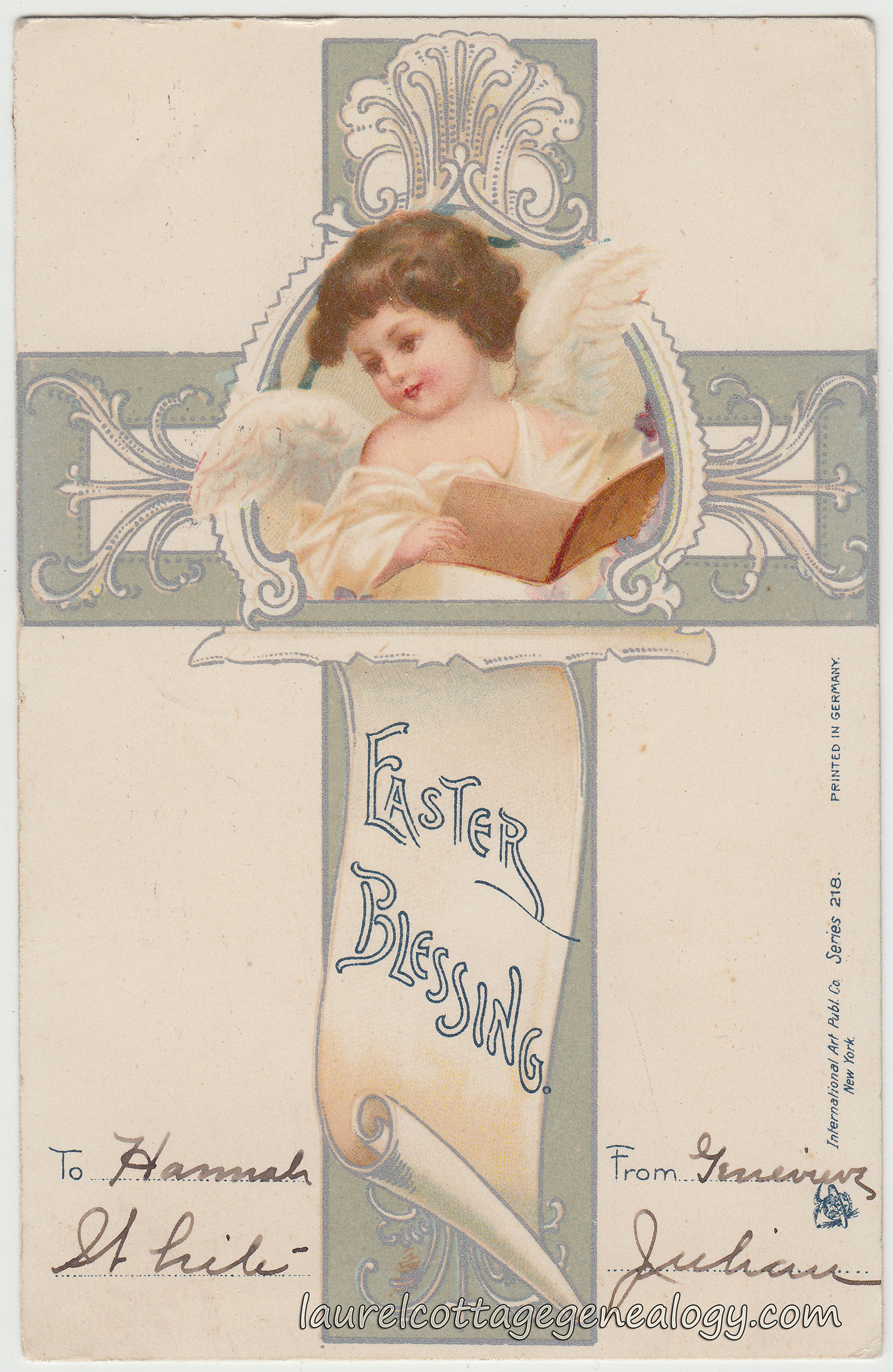
Here’s another beautiful Easter card; this one showing a dark-haired angel holding a book, and gazing down to her right. She is situated in the center of a silver cross with ornate scroll work and the unfurled message, “Easter Blessing.” The publisher included a space for “To” and “From” to be written in by the sender. So, it was Hannah White that sent this card to Genevieve Julian.
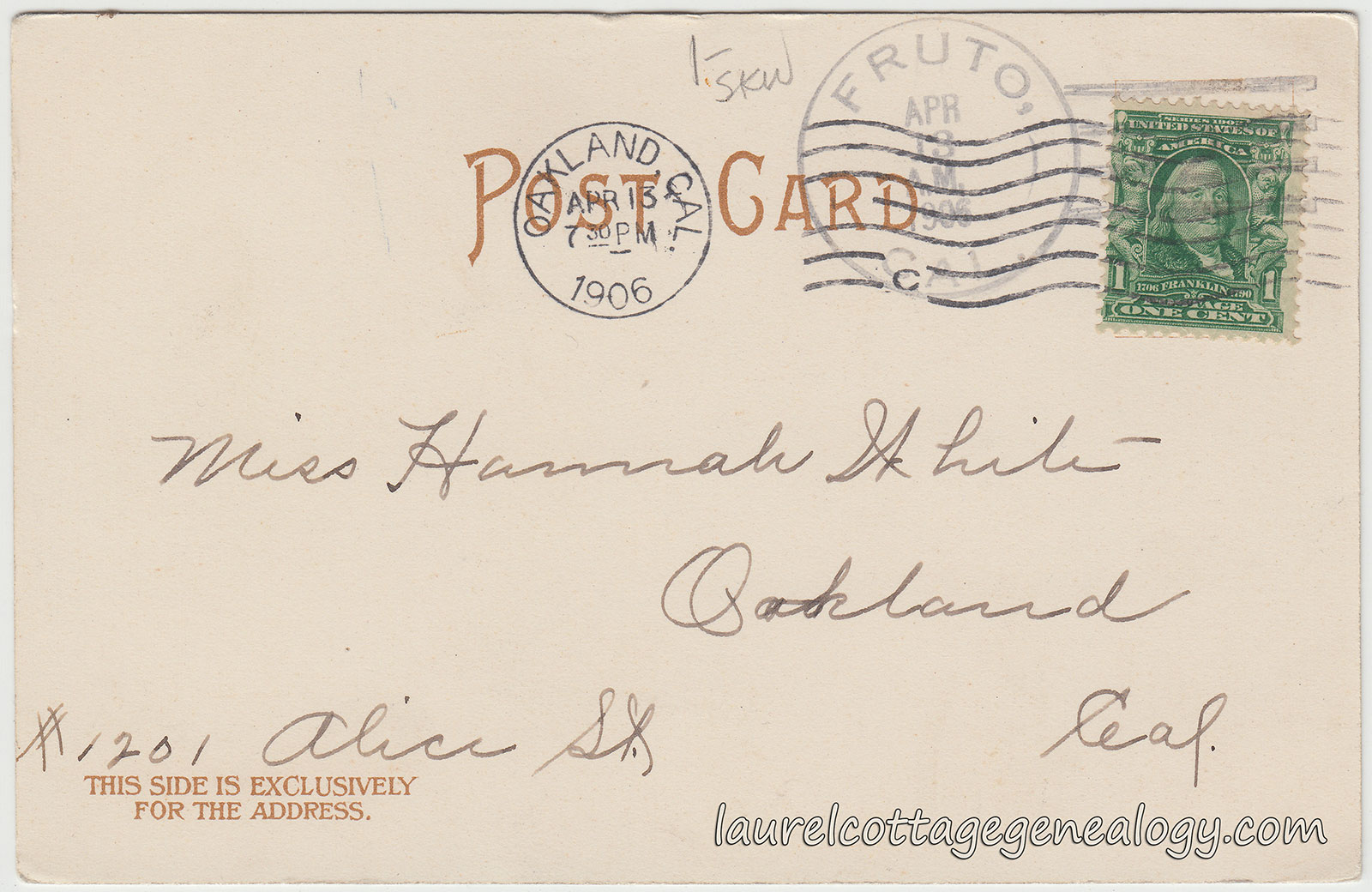
The card was addressed, “Miss Hannah White, Oakland Cal. # 1201 Alice St.”
The outgoing postal mark shows Fruto, Cal. Fruto is an unincorporated community in Glenn County; about 14 miles northwest of the city of Willows.
There is a “Jenevieve” Julian, born July 1875 in California, appearing on the 1900 Federal Census for Glenn County, CA. This record shows she was married to Lee Julian, and they were staying with his brother, William Julian. So, Genevieve would have been about age 30 when she sent this postcard to Hannah…As for Hannah, she does show up on the 1906 city directory at 1201 Alice Street, but no census records were found with the same address.
Undivided back, used postcard. Postmarked April 13, 1906 from Oakland, California. Publisher: International Art Publishing Co., New York. Series 218. Printed in Germany.
Price: $10.00
Sources: Fruto. n.d. http://en.wikipedia.org/wiki/Fruto,_California. (accessed April 5. 2015).
Year: 1900; Census Place: Township 3, Glenn, California; Roll: 86; Page: 5B; Enumeration District: 0015; FHL microfilm: 1240086. (Ancestry.com)
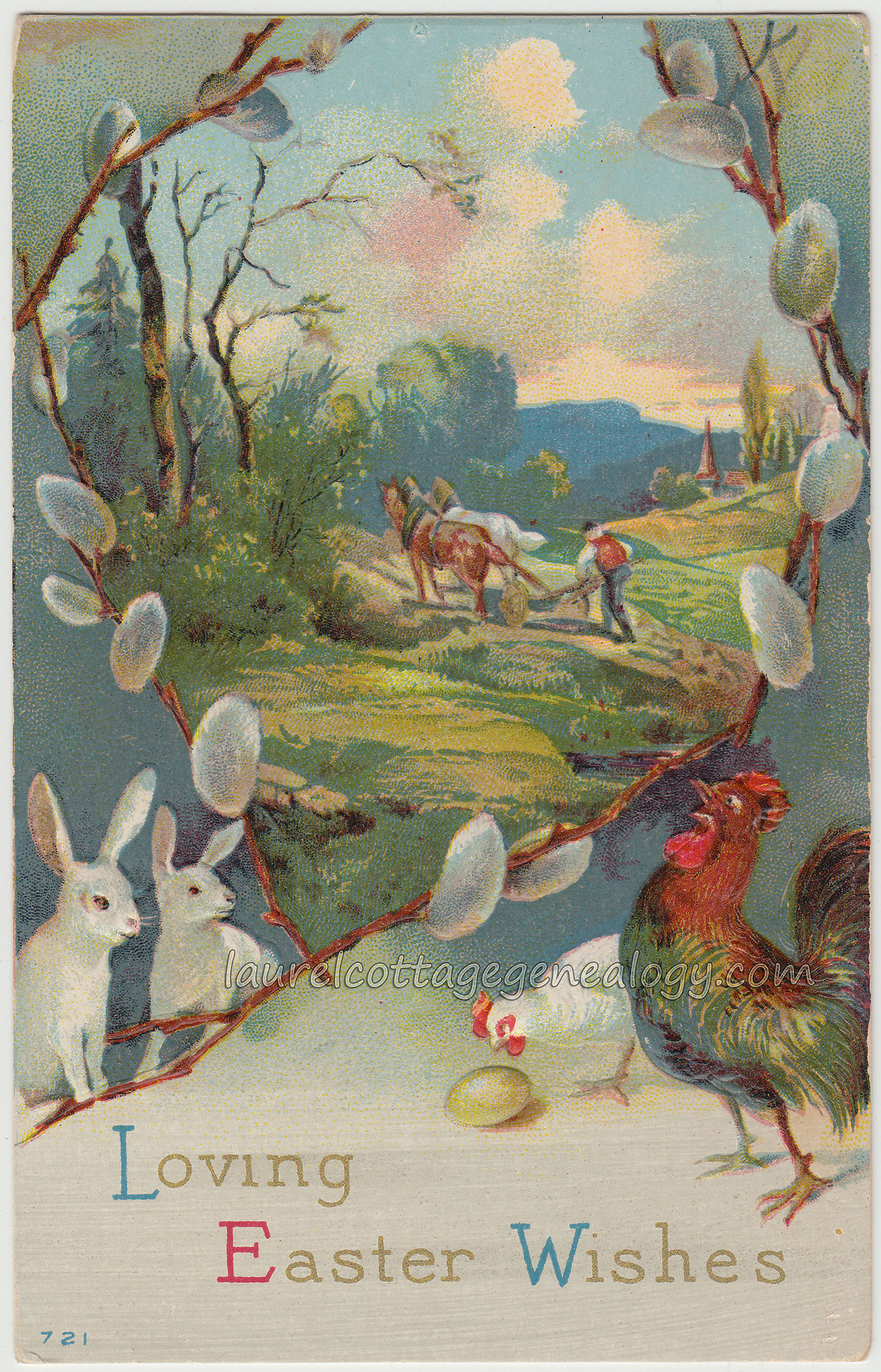
Here’s a gorgeous Easter postcard showing two bunnies, a rooster, and a hen inspecting a golden egg – underneath a farm scene: farmer and horses plowing a field on a beautiful day. You can see a church steeple in the distance. This rural scene is framed by a couple of pussy willow branches. What a very clever and lovely design, and the colors are just beautiful!
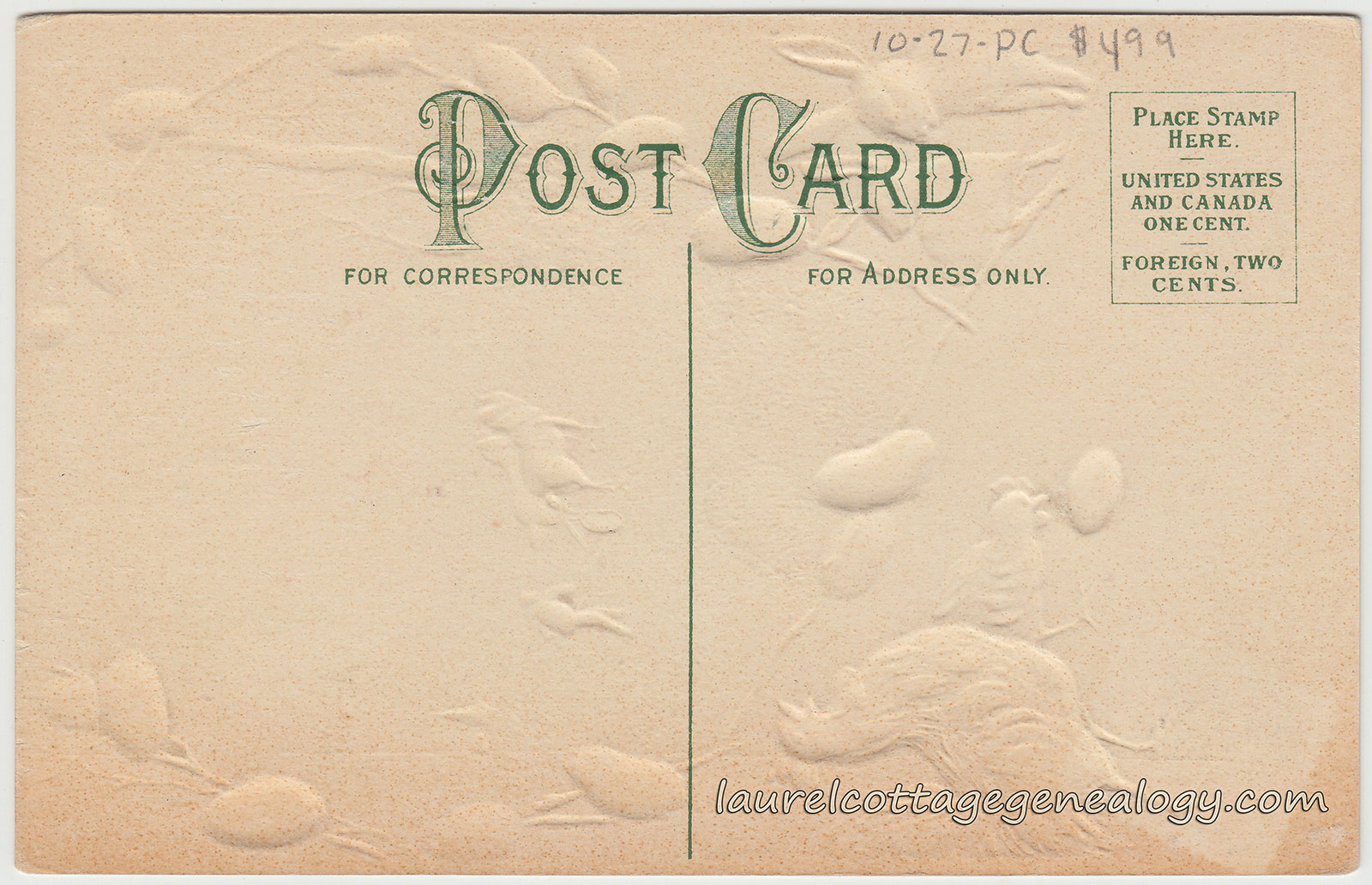
Divided back, embossed, unused postcard. Publisher unknown. Series or number 721. Circa 1907 – 1910s.
Price: $12.00
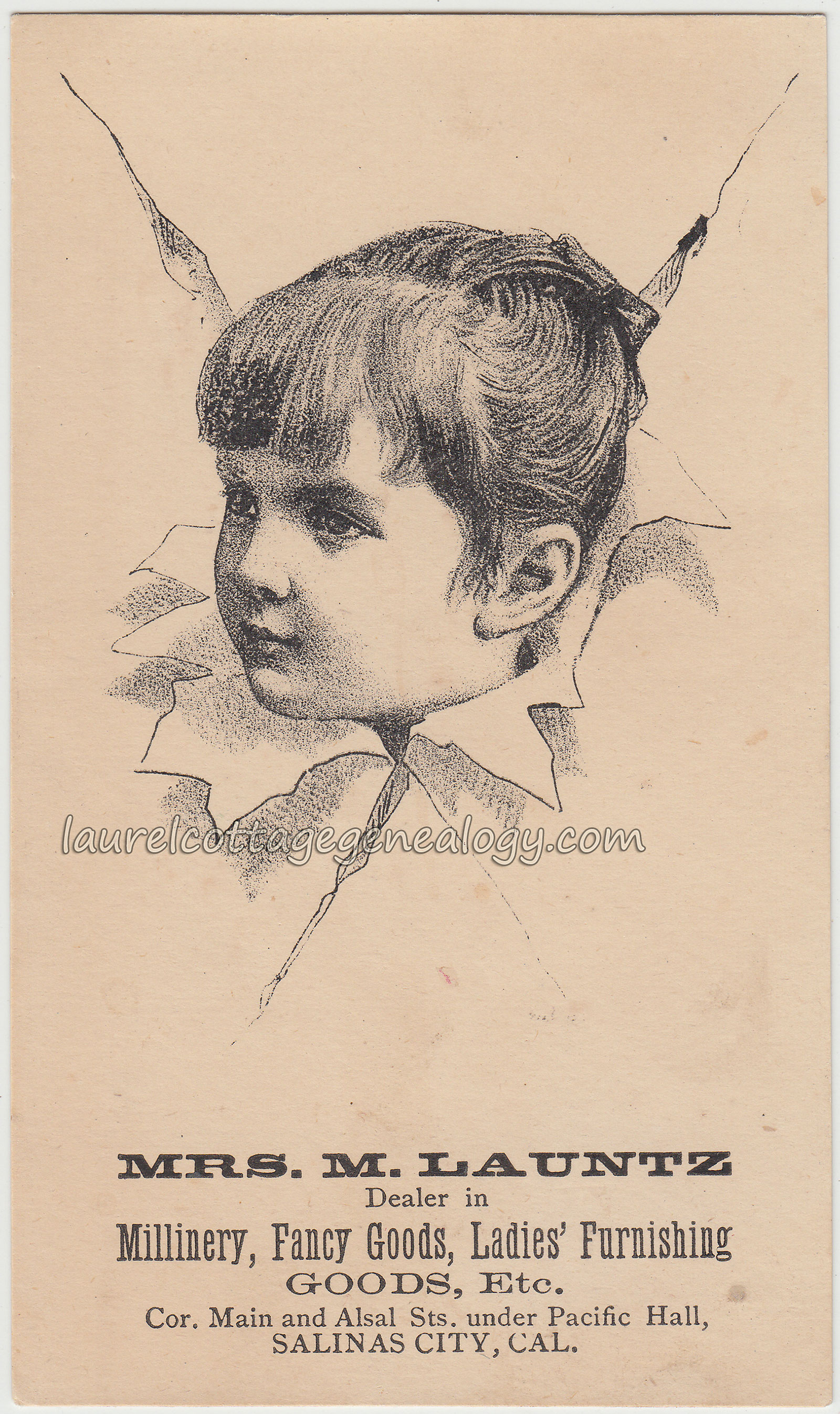
Antique trade card, circa 1890 – 1891. Size: About 2 and 5/8 x 4 and 1/2″
Price: $15.00
This trade card is the first in a new category that we’re labeling “Breakthroughs” (for lack of a better term.) I’ve asked around at ephemera trade shows and antique stores, but so far, no one recognizes this type as belonging under a certain title. They show variations on people and animals “breaking through” the envelope or paper – sort of a “here I am, coming to you in the mail” type of thing. They seem to have been quite popular, and can be seen on trade cards like this one, and on old postcards or cards in general. We have a number of them here at Laurel Cottage that we’ll be posting. On a similar note, check out an earlier offering entitled, “Into The Envelope” that has rather a “pre-breakthrough” theme, and another related one, “A Token Of Love.”
Anyway, this one shows a charming drawing of a little girl’s face, in semi-profile, advertising Mrs. Launtz’s millinery:
“Mrs. M. Launtz. Dealer in Millinery, Fancy Goods, Ladies’ Furnishing Goods, Etc. Cor. Main and Alsal Sts., under Pacific Hall, Salinas City, Cal.”
That’s the corner of Main and Alisal. The San Jose (includes Monterey County) city directory for 1890 – 1891 shows this proprietress as living at this same address. M. Launtz was not found in other online records, though likely she would have been found on the 1890 Federal Census if most of that had not been destroyed by fire in 1921. But what was Pacific Hall? I took a trip down to Old Town and inquired with the very knowledgeable Trish, at Destination Salinas. I found out that whichever building that had housed Mrs. M’s millinery in 1890 and ’91, no longer exists. (Damaged in the 1906 San Francisco earthquake? This is just speculation.) But per Trish, early Salinas fraternal organizations had dance halls, and these halls were located on the second, rather than ground, floor. So, one possibility is that Pacific Hall was one such fraternal upstairs dance hall, with Mrs. M. Launtz’s millinery located just below.
More from the 1890 – 1891 city directory
Going page by page through the same 1890 – ’91 city directory lent a little more info: Mrs. M. Launtz had two single ladies working for her as milliners – Miss Emma Benjamin and Miss Emma Gibson, address given as corner of Main and Alisal (however it is unclear whether this was the girls’ residence also, or just M. Launtz’s.)
An entry under “Baptist Church” gave the address as corner of Main and Alisal.
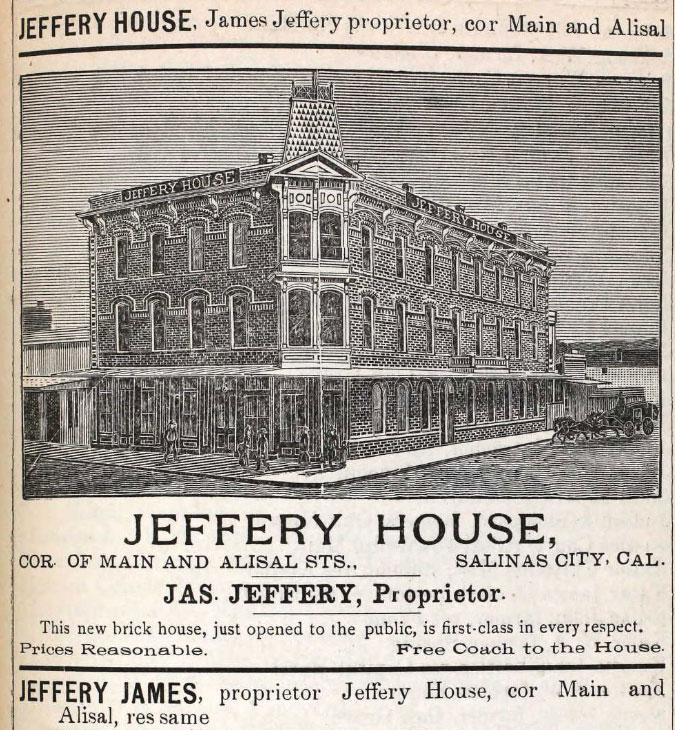
The Jeffery House, illustrated below, showed up for various residents as both a business and residence address. One would think that if Mrs. M. and the others at Main and Alisal were located at the Jefferey House, that the listings would be stated as such. So, it would seem like the millinery was not in this building, but of course, we can’t be sure.
One more very interesting tidbit from the directory was listed under “Agricultural Hall” corner of Main and Alisal. Hmmm, Pacific Hall and Agricultural Hall…intriguing!
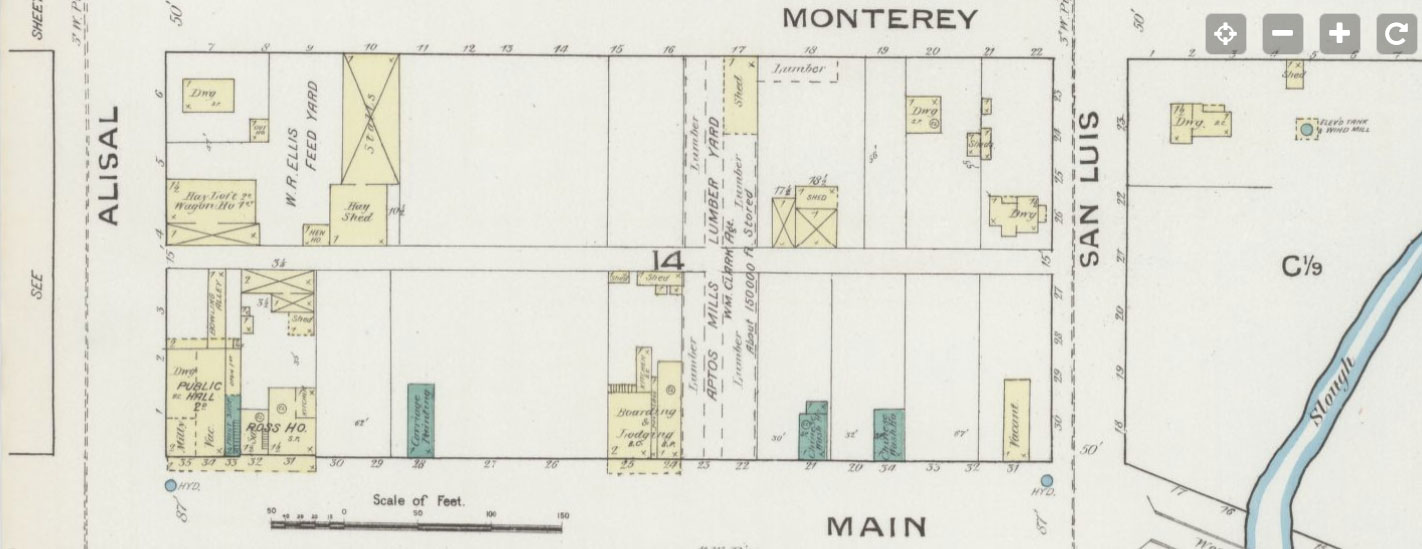
UPDATE: Per an informed reader (thanks, Joe!) the Launtz millinery (today’s address 301 Main St. in the Bank Building) shows up on a wonderful map, dated August 1886, entitled the Sanborn Fire Insurance Map, online at Library of Congress. Excerpt below, page 6 of 8. Millinery is abbreviated “Milly” (bottom left). The Sanborn Abbreviation Glossary has a full list of interesting (and logical for fire insurance) entries, such as B.C. for brick chimney, S.P. for stove pipe and Shooks meaning dismantled wooden box parts.
Sources: San Jose City Directory, Including Santa Clara, Santa Cruz and Monterey Counties, 1890-1891. pp. 760-761, 769, 773-774, 776. Publisher: F. M. Husted, San Francisco. Web accessed April 4, 2015. (Ancestry.com. U.S. City Directories, 1821-1989)
Sullivan, Trish. Per web author’s visit to Destination Salinas, 222 Main St., Salinas, CA. April 4, 2015.
Jeffery House/Salinas. TC-303489; K-62. Token Catalog. Web accessed April 5, 2015.
Image 6 of Sanborn Fire Insurance Map, August 1886. www.loc.gov. Accessed January 8, 2022.
Glossary of Abbreviations and Obscure Terminology in Sanborn Fire Insurance Atlases. Compiled by California State University, Northridge (CSUN) Map Library. library.duke.edu. Accessed January 8, 2022.
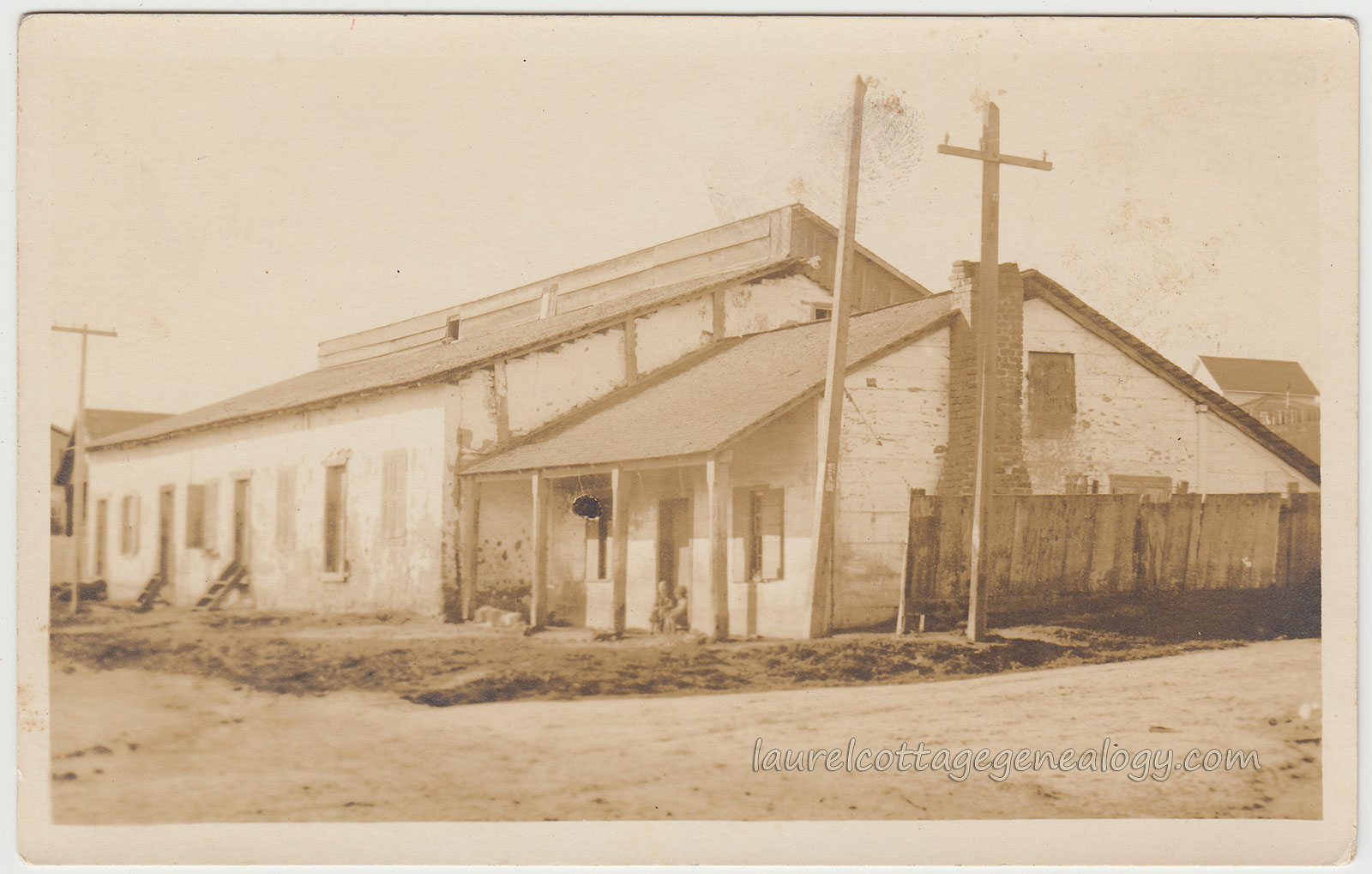
Continuing with our short Central Coast, CA theme, here’s a Real Photo Postcard of the Jenny Lind Theatre in Monterey; recognized as the first building in California to offer dramatic entertainment for the public.
It was built in 1846 – 1847 by Jack Swan, a sailor of Scottish descent. Swan had first arrived in 1843 on the Mexican brig Soledad, but did not settle yet due to lack of work. He went back to sea, this time on the Mexican schooner, California, and was employed as a cook, but things apparently worked out for the best (historically speaking) when Jack either left or was asked to vacate his cook position, and ended up again in Monterey. He then enterprisingly set up a small bakery, with his pies becoming a favorite item, and timing playing a part, with an influx of new people coming to the area. With his bakery sales he purchased land, (located present-day at the southwest corner of Pacific and Scott Streets) having first built a small house, and adding to it an adobe structure, to be used as a boarding house for itinerant sailors. In 1850, the location began it’s life as a theater, when U. S. Army officers from Colonel Stevenson’s 1st New York Volunteers began putting on plays, in order to make money. (Can’t you just picture this idea forming with the guys over a few pints of ale?) Jack built a small stage with candles for stage lights, and whale oil lamps for lighting. Benches were provided for seating, and red and blue curtains were fashioned from blankets. Tickets sold for $5.00, with receipts totaling $500.00 for the first night. The theater later was used as a lodging house for whalers, but unfortunately fell into disrepair after Jack Swan’s death in 1896. See California Dept. of Parks and Recreation for the building’s current status.
As to the date of the postcard: The AZO stamp box with two triangles up and two down, can be generally estimated from 1910 – 1930, but I’m guessing this postcard to be from the 1910s. It was found along with the prior postcard which is postmarked 1908. And it’s always possible the original photo could have been taken earlier. The black spot in the center seems to have been something that happened in the original or when the postcard was printed, as the surface of the card is smooth. Note the two people sitting at the entrance to the door.
Real Photo Postcard, unused. AZO stamp box. Circa 1910s.
Price: $10.00
Sources: Guide to the California First Theatre Collection. Online Archive of California. Web accessed April 4, 2015. [http://www.oac.cdlib.org/findaid/ark:/13030/kt058002d9/]
California’s First Theatre. California Department of Parks and Recreation. Web accessed April 4, 2015. [http://www.parks.ca.gov/?page_id=959]
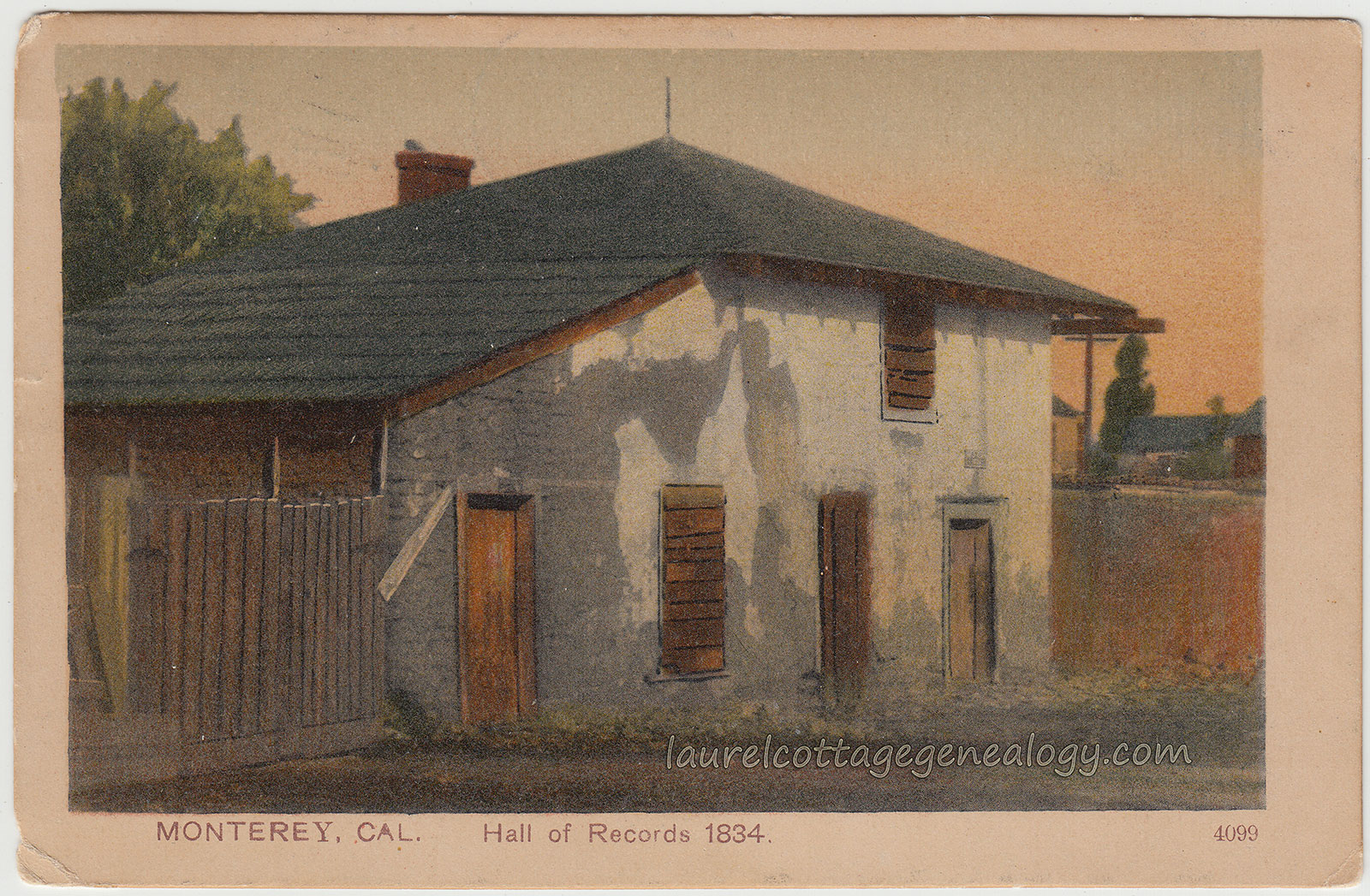
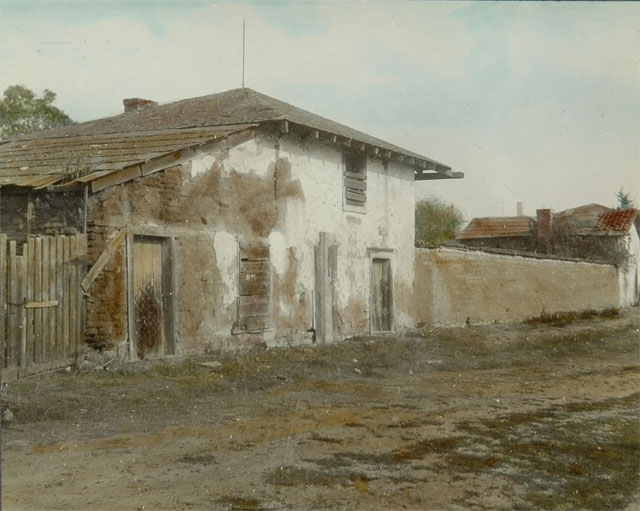
This circa 1908 postcard shows an old adobe structure, built around 1834 or 1835, called the House of the Four Winds, or La Casa de los Cuatro Vientos. It was so named because it was the first house in Monterey with a weathervane on it’s roof. It served as a residence for Mexican Governor Alvarado, and later was designated as the Hall of Records. It is now privately owned by the Monterey Civic Club; it’s street address is 540 Calle Principal. Below is a very similar image, courtesy of eHumanity, from a lantern slide. The postcard may have been based on this image and altered somewhat or taken from a later photo.
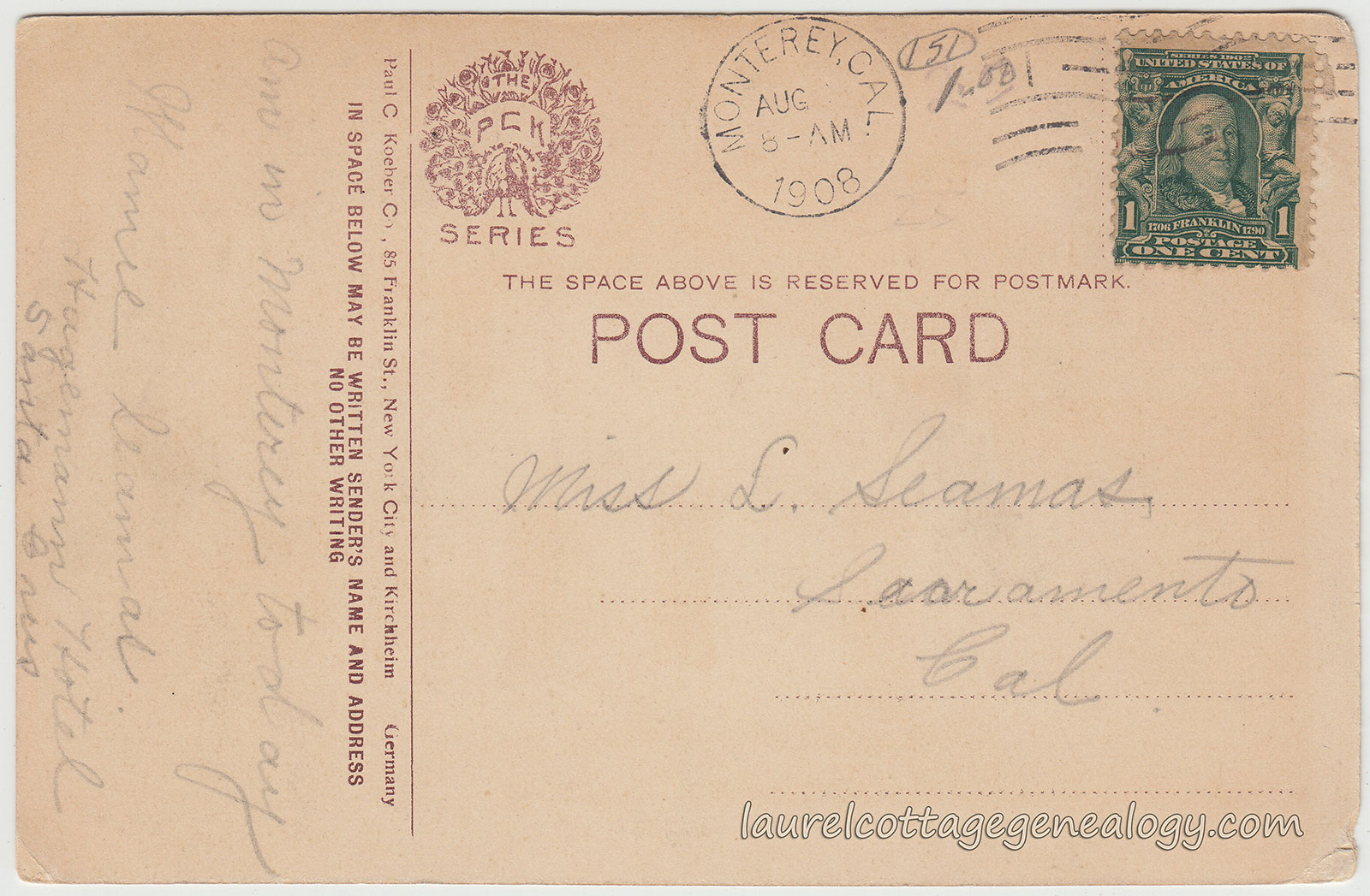
The sender addressed the card: “Miss L. Seamas, Sacramento Cal”
and wrote,
“Am in Monterey today. Mamie Seamas. Hagemann Hotel. Santa Crus”
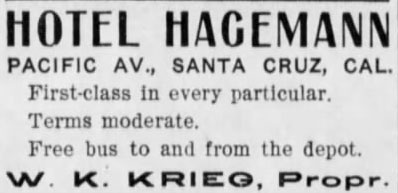
Not much was found regarding Mamie or L. Seamus (without looking too extensively) but a 1910 ad was found for the Hagemann Hotel in Santa Cruz. Besides being the proprietor of the hotel, W. K. Krieg, was listed as secretary for the Santa Cruz Brewery Company in the 1910 city directory.
Divided back, used postcard. Postmarked August 1908 from Monterey, California. Publisher: Paul C. Koeber Co., 85 Franklin St., New York City and Kirchheim, Germany. “The PCK Series.” Number or series 4099.
Price: $10.00
Sources: House of the Four Winds. Historic Monterey. Web accessed April 3, 2015. [http://www.historicmonterey.org/hb/house_of_four_winds.html]
About Lantern Slides. University of South Florida Libraries. Web accessed April 3, 2015. [http://www.lib.usf.edu/special-collections/arts/about-lantern-slides/]
Hagemann Hotel advertised in the Santa Cruz Sentinel. 20 May 1910, Friday, p. 7. (Newspapers.com) Web accessed April 3, 2015.
Santa Cruz County Directory, 1910 – 1911. p. 78. Ancestry.com. U.S. City Directories, 1821-1989.
© 2026 Laurel Cottage Genealogy All Rights Reserved. Proudly powered by WordPress.