Genealogy Services, Old Photos, Postcards, Trade Cards, Etc.

Cay Ricker, Mobile, Alabama

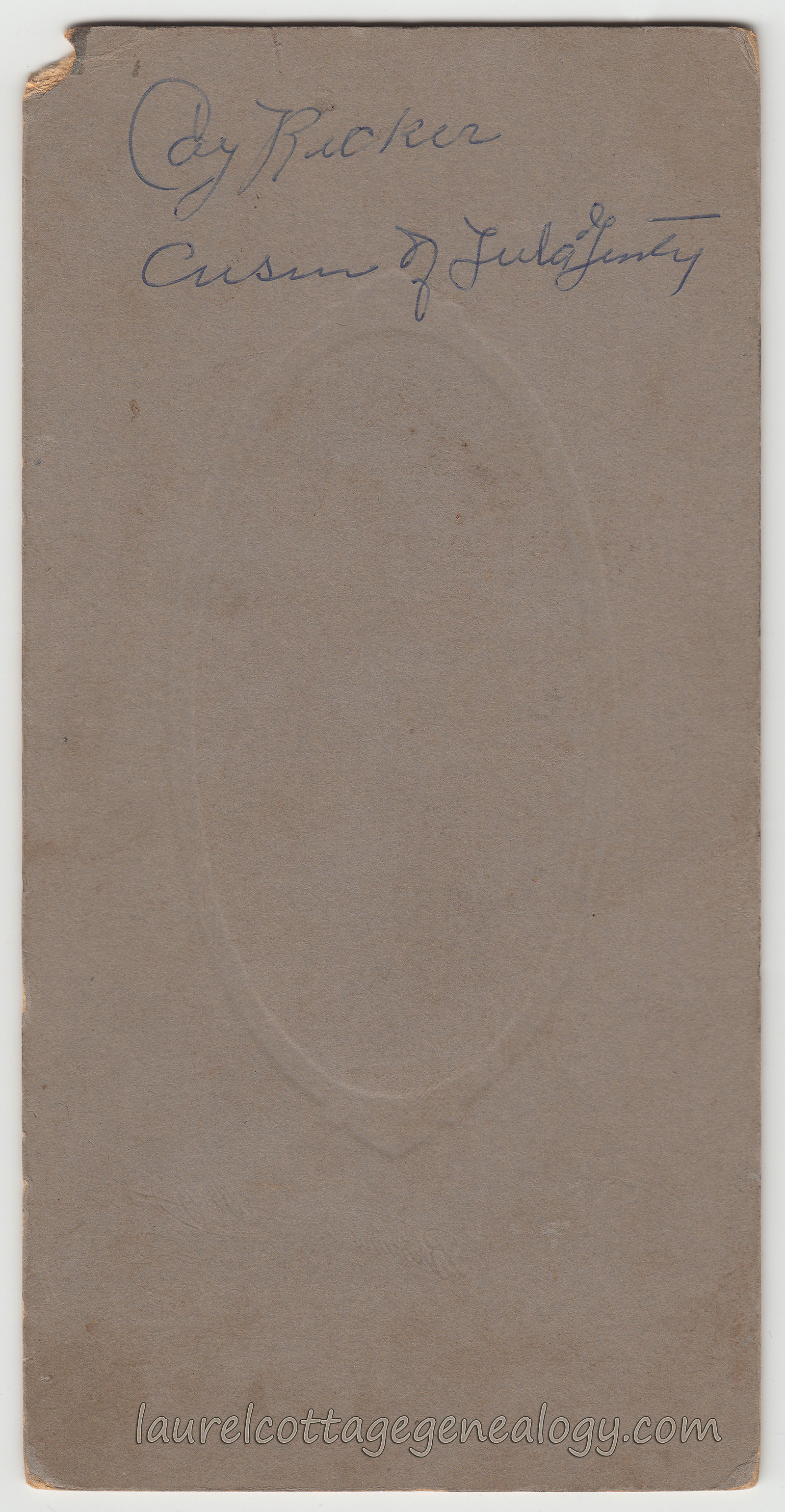
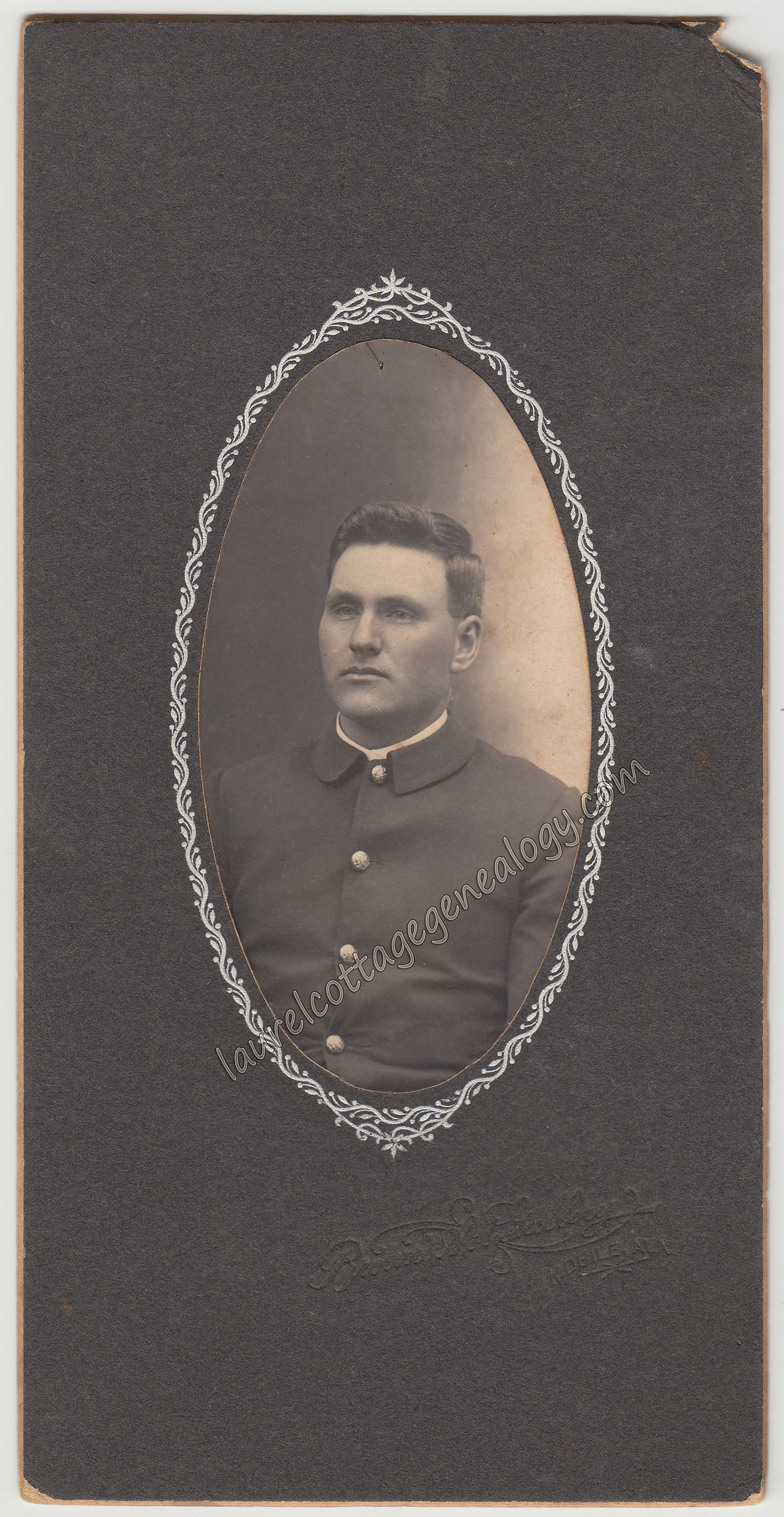
Oval photo of Cay Ricker. Circa 1908 – 1909. Brown’s Art Studio. Mobile, Alabama.

Price:  $15.00          Size including cardboard matting:  About 3 and 1/2 x 7″

An oval portrait of a handsome young man, identified on the back as ,  “Cay Ricker, cousin of Lula Gentry.”   His jacket has a military look to it. (This seemed a natural segue from the prior post. 😉 ) The photography studio name and location is embossed on the front of the frame:  Brown’s Art Studio.

Brown’s Art Studio was found in city directories in 1908 at 21 N. Conception. The 1909 shows this address under photographer name J. F. Brown.

Cay’s ancestry is more of a puzzle, but his cousin Lula is possibly the Sarah Lula Ricker who married Starling R. Gentry (parents of Carrie Gentry, the little girl in the next post). Cay, if we’re reading it correctly from the back of the photo, could be a middle name (very common in the Southern states) or a nickname.

Sources:  Delchamps’ Greater Mobile City Directory, 1908. p. 938. Ancestry.com. U.S. City Directories, 1822-1995.

Delchamps’ Greater Mobile City Directory, 1909. p. 981. Ancestry.com. U.S. City Directories, 1822-1995.

Somebody’s Angel

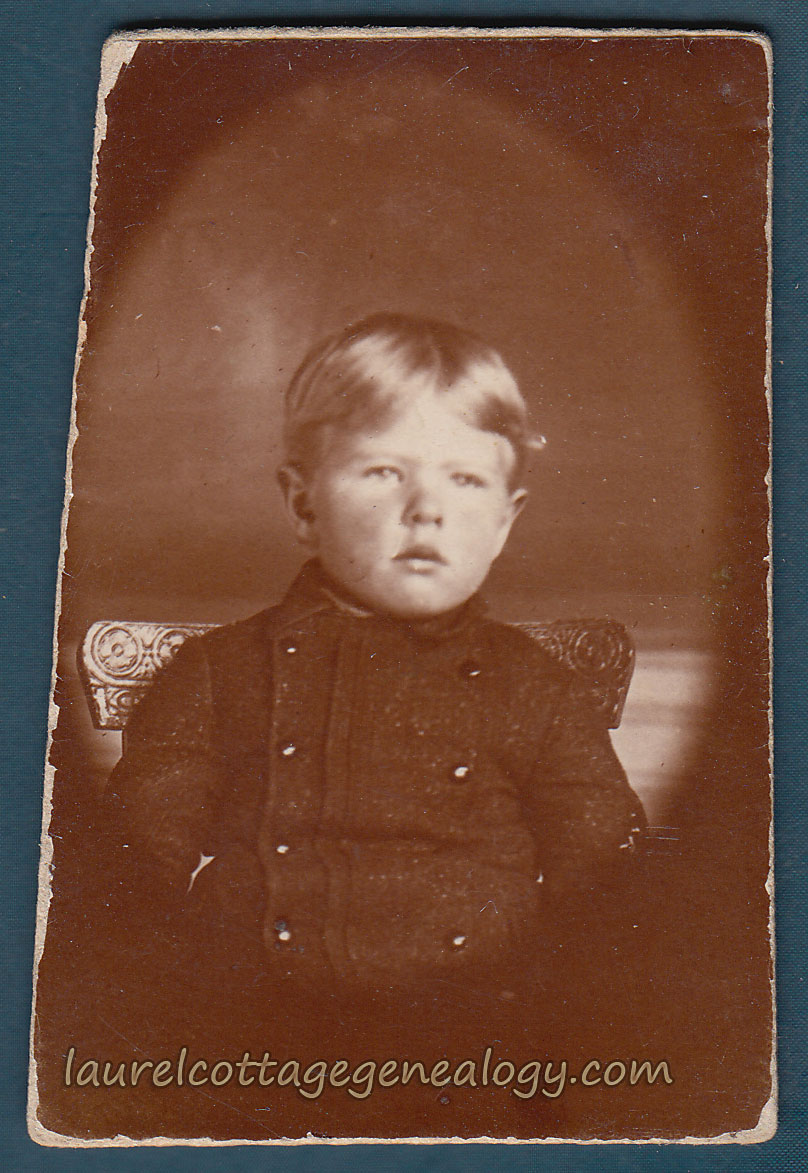
Mini-photo, Fort Dodge, Iowa. Circa 1906.

Price:  $10.00          Size:  About 1 and 1/4 x 1 and 3/4″

Shades of decades past…

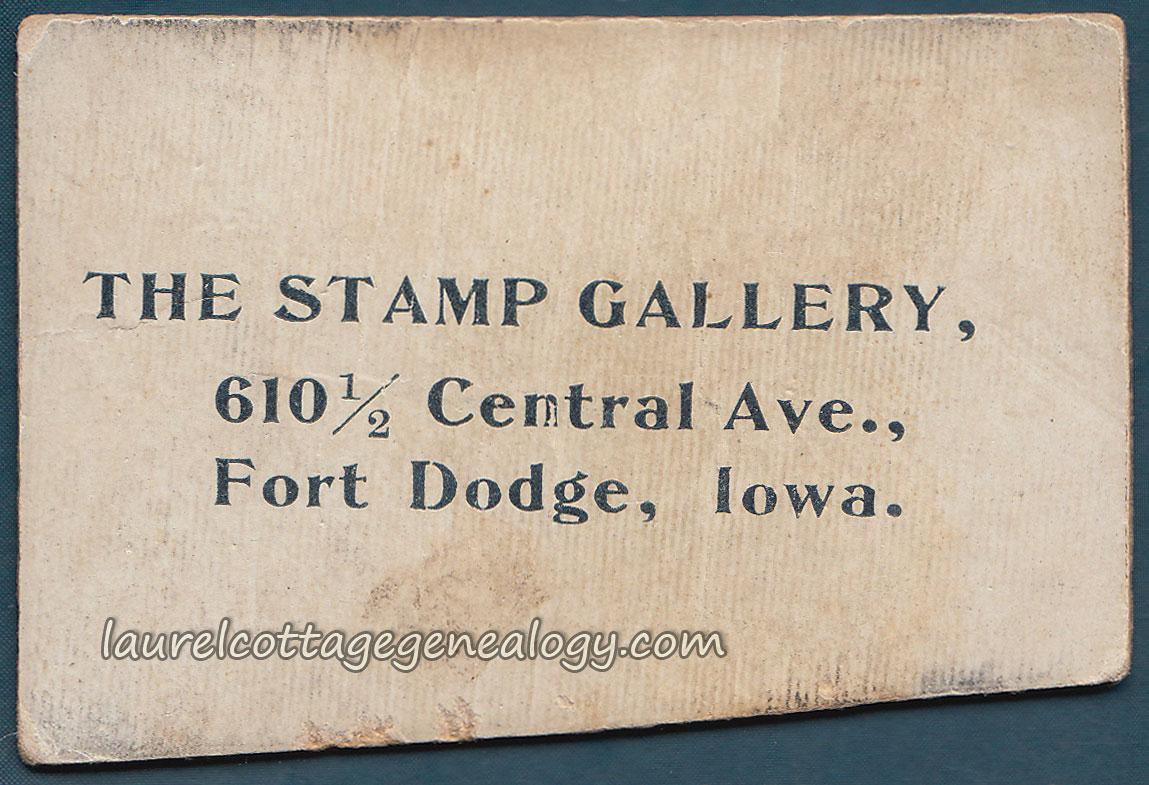
Here’s a miniature photo of an unknown little boy, with blonde hair and an angel face, about five years old. He’s seated in a child’s wooden chair (with carved backrest) and is wearing a dark, double-breasted jacket. For me, the jacket has sort of a military appearance, and reminds me of Civil War days, though, of course, this would have been taken decades later. Photo by:  The Stamp Gallery, 610 1/2 Central Ave., Fort Dodge, Iowa.

The Stamp Gallery, evidently short, but sweet

The business name, The Stamp Gallery, was not found in any online searches. It’s a nice name, though, The Stamp Gallery, and one presumes it would be in reference to the small size of the images produced. (We have some others that are actually closer to postage stamp size. See the category, Mini Photos.) But though we didn’t find the company name, we did find a photographer name at this 610 1/2 Central Avenue, in 1906, that of May E. Hodge. Later that same year, November 29th to be precise, May (Mary Elizabeth) Hodge marries Manning T. McKenzie. So, most likely, the gallery was not in business very long, but, to me, that makes this little photo rather precious.

Five years earlier, siblings on the 1904 directory

May E. Hodge, manager for O. S. Hodge, boards 721 E. Locust St., 1904 Fort Dodge city directory. Listed in the next entry on the same page is:

Oramel S. Hodge, photographer, 221 1/2 Locust and 200 E. Locust, residence 709 E. Locust.

To find the relationship between the two, we went back to the 1880 Federal Census for Indianola, IA, showing Mary Hodge, born Iowa, about 1873, younger sister of Oramel S. Hodge, born Iowa, about 1870. Their parents are J. D. and Emily (Hinckley) Hodge, and siblings on the 1880 are Luvilla and Eliza.

Sources:  R. L. Polk & Co.’s Fort Dodge City Directory, 1906. p. 110. Ancestry.com. U.S. City Directories, 1822-1995.

R. L. Polk & Co.’s Fort Dodge City Directory, 1904. p. 478. Ancestry.com. U.S. City Directories, 1822-1995.

Year: 1880; Census Place: Indianola, Warren, Iowa; Roll: 368; Family History Film: 1254368; Page: 377A; Enumeration District: 232. (Ancestry.com)

Ancestry.com. Iowa, Select Marriages Index, 1758-1996.

George Gordon Bemis

Set of three:  Two photos size:  About 2 and 1/2 x 3 and 1/4″  and 2 x 6″ and calling card.

Price:  $18.00

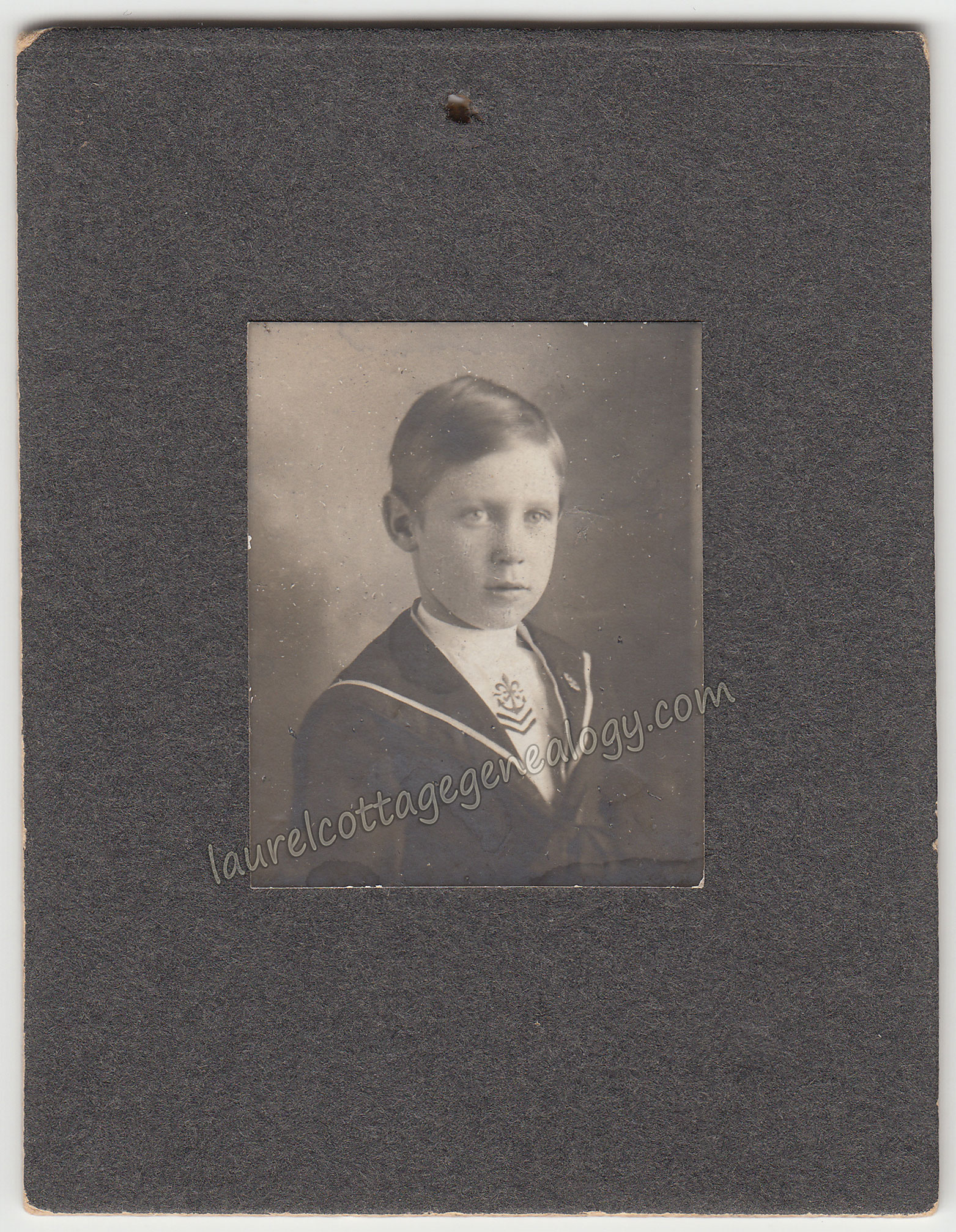
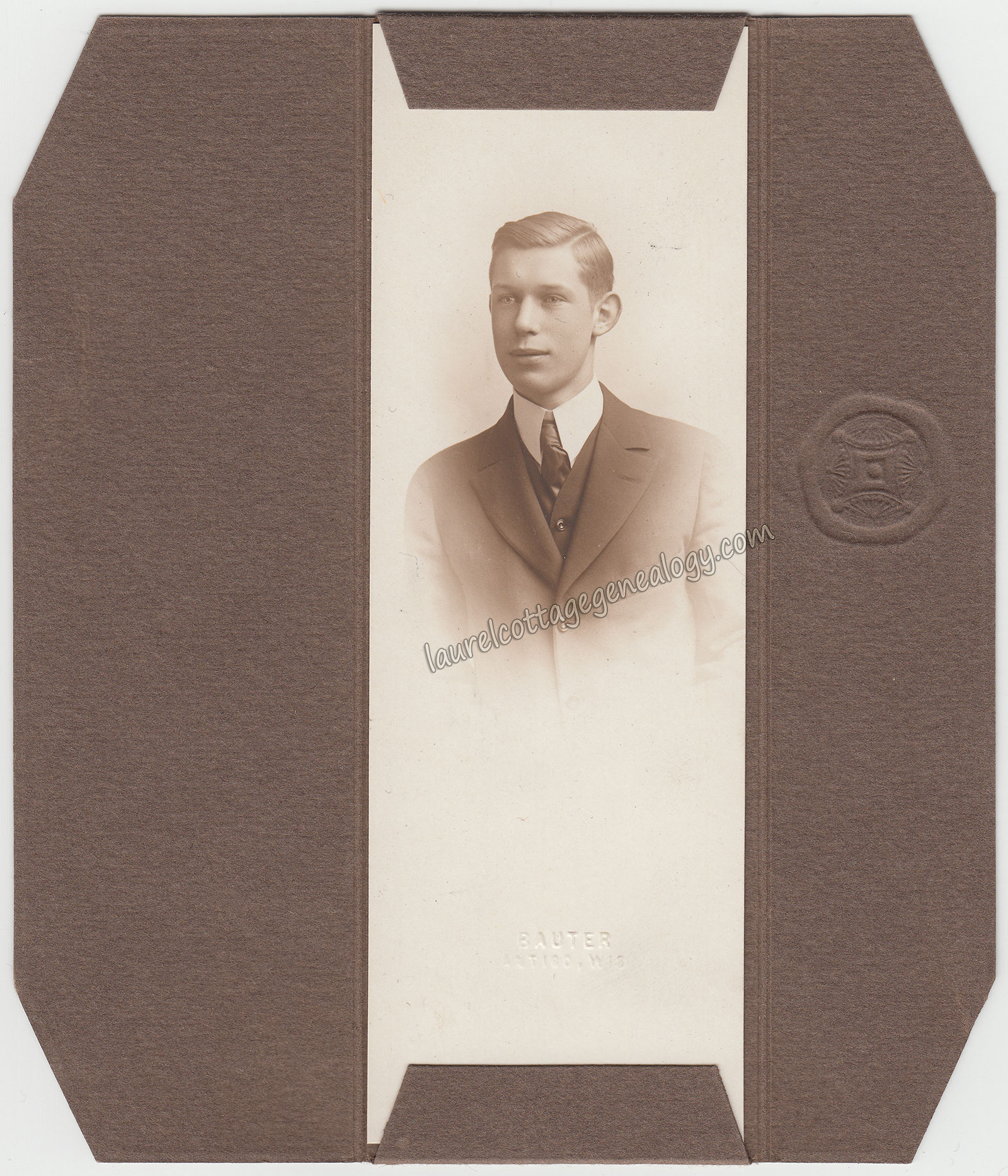
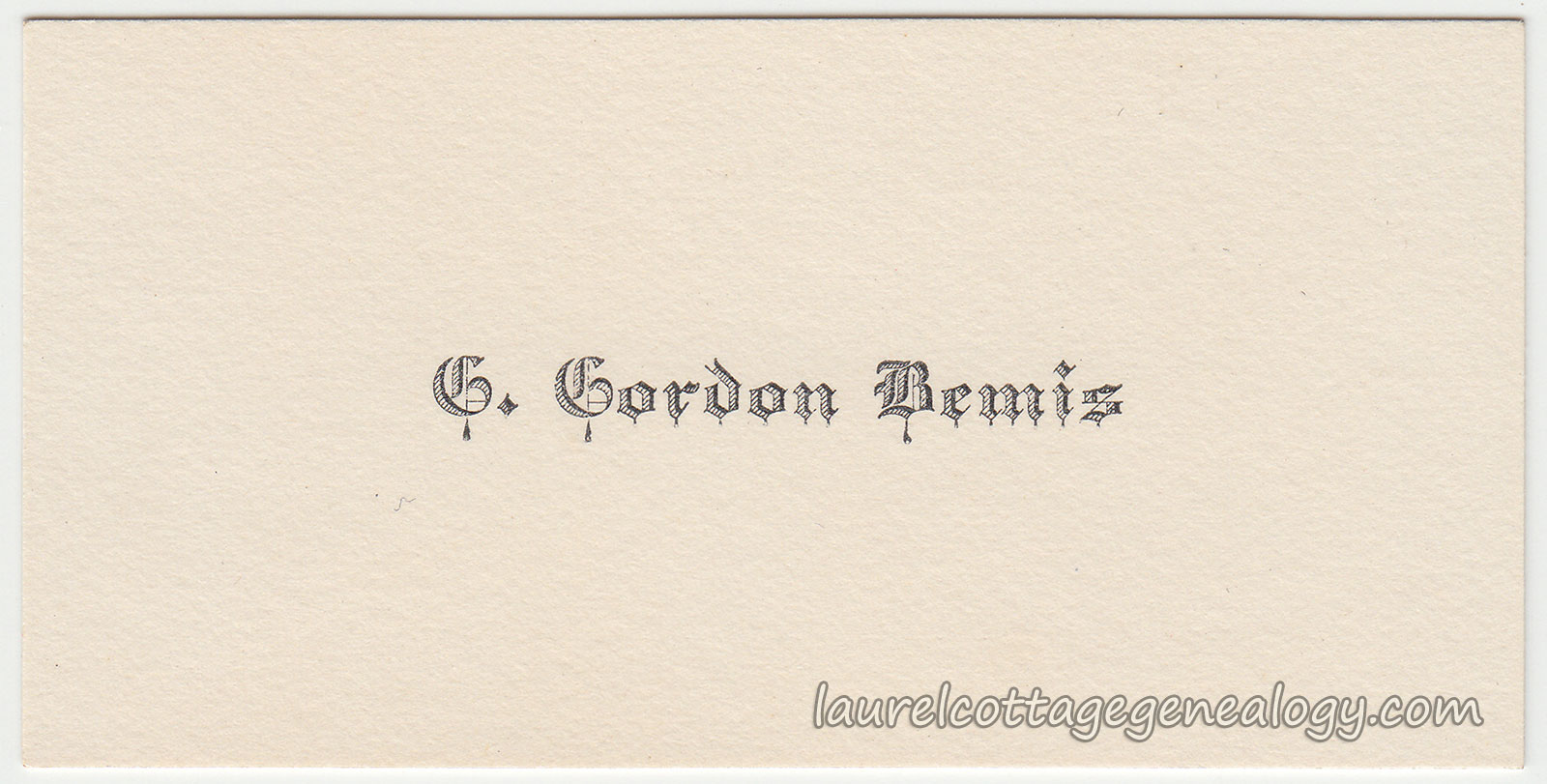
Three wonderful finds from Hollister, California:  Formal photography of George Gordon Bemis, as a boy in a sailor suit (name written in pencil on the back) and as a young man in a photo taken by the Bauter photography studio in Antigo, Wisconsin, and lastly, his calling card, showing “G. Gordon Bemis.”

Much can be found online for George Gordon Bemis, born December 2, 1896 in Antigo, Wisconsin, including photos from college yearbooks, WWI Draft registration, census records and a detailed obituary on Find A Grave. The obit states he had married Mary Ross, they had one son, George, Jr., who like his father, became a doctor. G. Gordon Bemis graduated from Harvard with a degree in medicine in 1925. He died in the Bronx, New York October 31, 1982. Backtracking to 1910, the Federal Census taken in Antigo, Wisconsin, shows Gordon with his parents, George M. and Matie E., and sisters Grace M. and Mildred H. His father’s occupation is listed here as timber inspector.

As for the photography studio, we see that it had belonged to photographer Fred W. Bauter, listed on the 1920 census in Antigo, born about 1870. We’ll see if we can find more details for Fred Bauter in an upcoming post.

Sources:  Year: 1910; Census Place: Antigo Ward 1, Langlade, Wisconsin; Roll: T624_1718; Page: 7A; Enumeration District: 0039; FHL microfilm: 1375731. (Ancestry.com)

Fred W. Bauter. Year: 1920; Census Place: Antigo Ward 2, Langlade, Wisconsin; Roll: T625_1993; Page: 2A; Enumeration District: 109

Registration State: Wisconsin; Registration County: Dane; Roll: 1674749. Ancestry.com. U.S., World War I Draft Registration Cards, 1917-1918.

Find A Grave Memorial# 114936131. Findagrave.com. (accessed August 28, 2017).

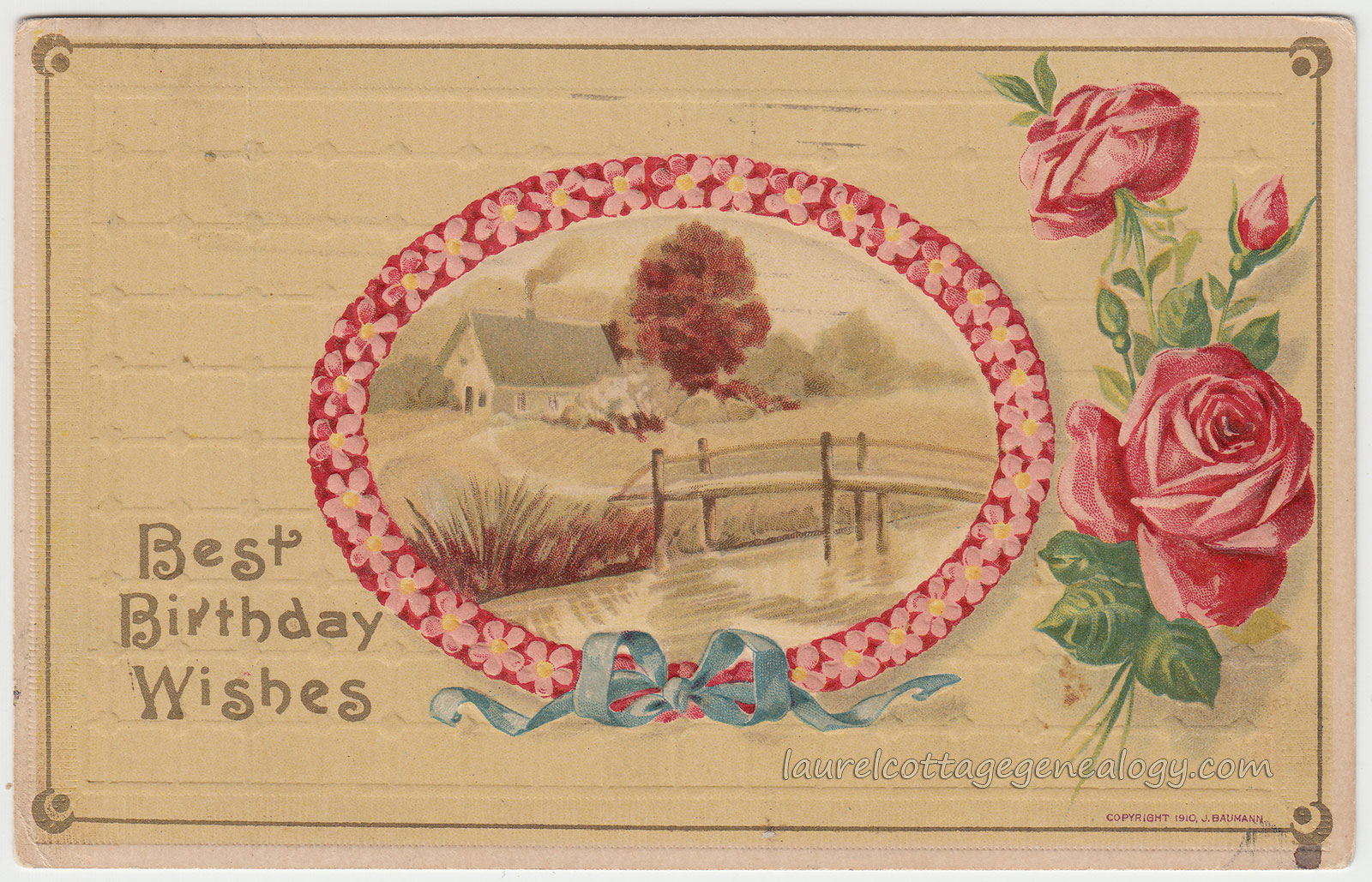
Best Birthday Wishes, 1910

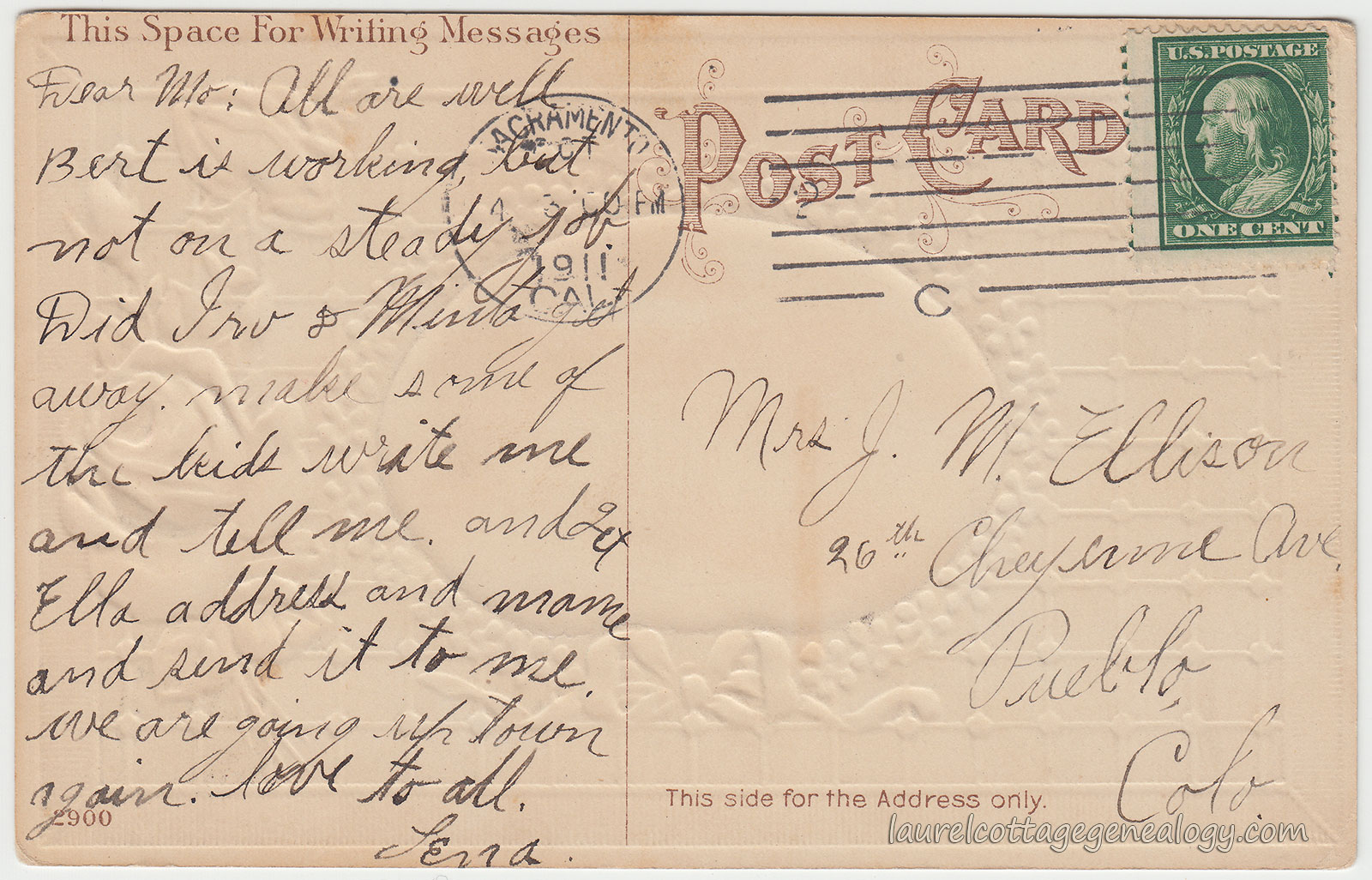
Divided back, embossed, used postcard. Postmarked October 1911 from Sacramento, California. Copyright 1910, J. Baumann. Series or number 2900.

Price:  $2.00

Pink roses and a muted country scene in a pink flowered border – another in our ongoing Alice Ellison Collection. The sender wrote:

“Dear Ma:  All are well. Bert is working, but not on a steady job. Did Irv & Minta get away. make some of the kids write me and tell me. and get Ella address and name and send it to me. we are going up town again. love to all. Lena.”

Addressed to:  “Mrs. J. M. Ellison. 26th Cheyenne Ave. Pueblo, Colo.”

As to the publisher, the first name and location for J. Baumann is unknown. We don’t see a huge amount of cards for him online; the time frame found is 1910 – 1912.

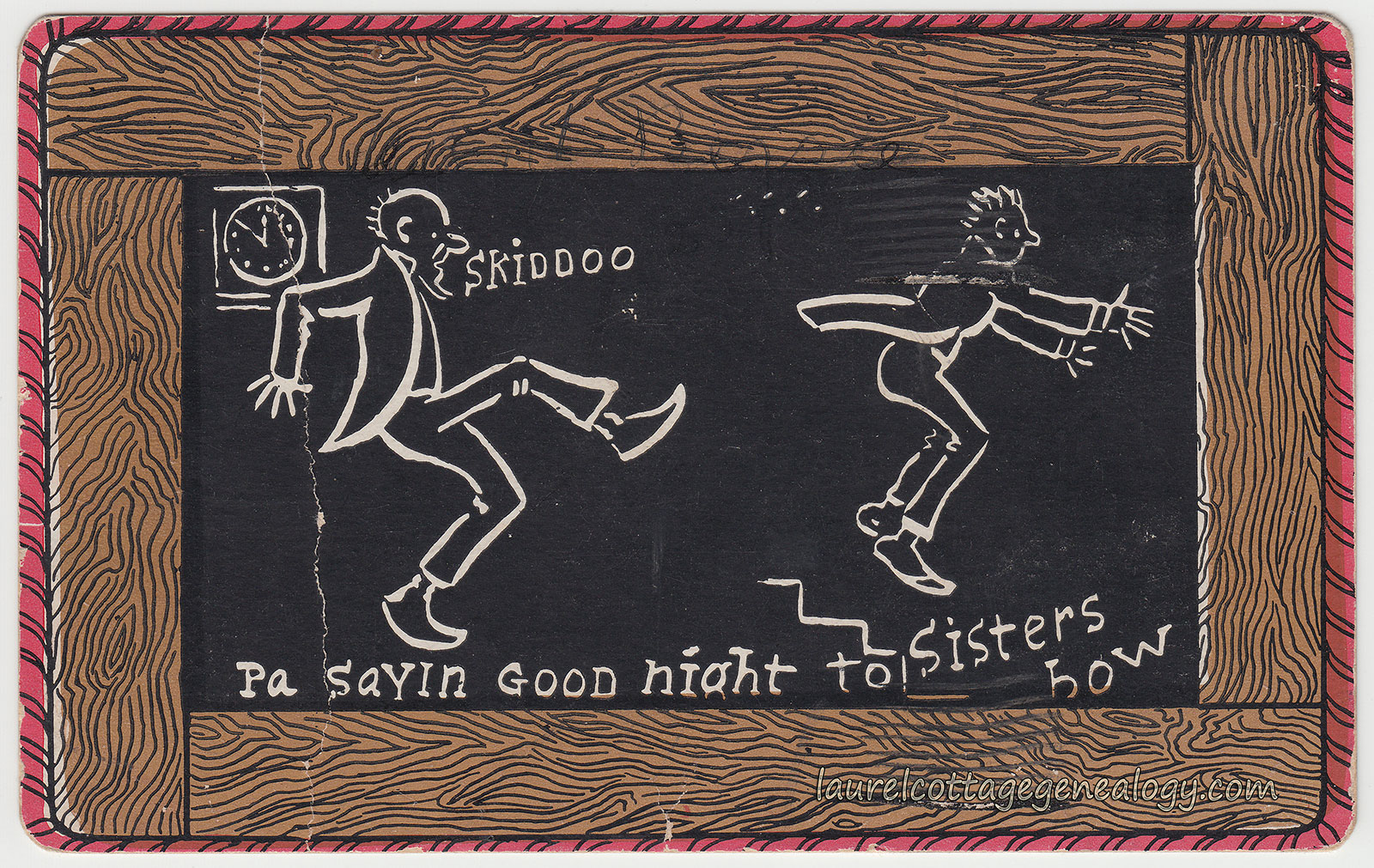
Pa Sayin Good Night

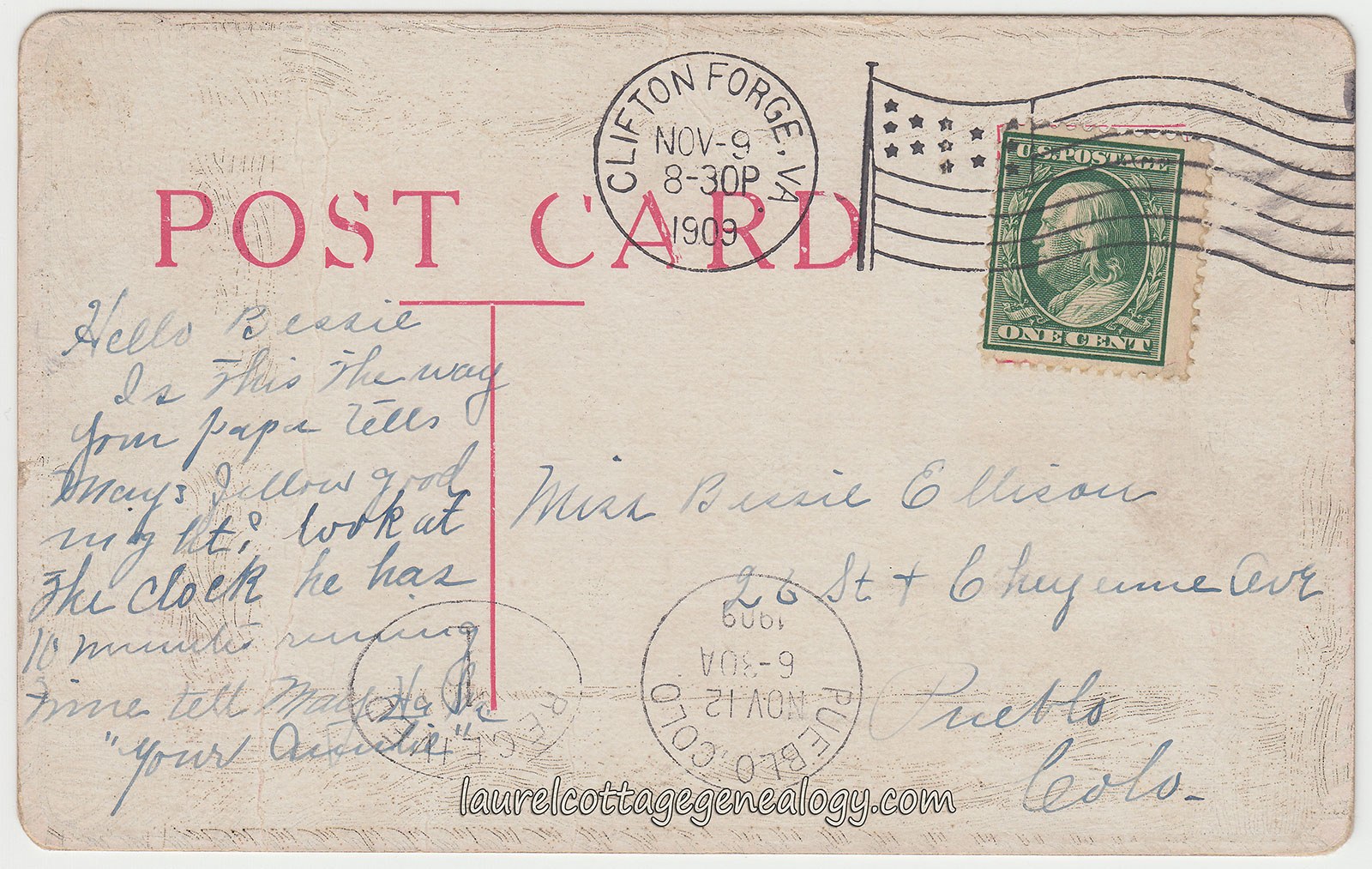
Divided back, used postcard. Postmarked from Clifton Forge, Virginia, November 9, 1909. Incoming postmark, November 12, 1909 in Pueblo, Colorado.

Price:  $3.00

One from our Alice Ellison Collection….a funny postcard fashioned as a chalkboard drawing.

“Skidooo….Pa Sayin Good Night to Sisters Bow.”

“Hello Bessie. Is this the way your papa tells May’s fellow good night? Look at the clock he has 10 minutes running time. Tell May Ha Ha. “your Auntie.”

Addressed to:

“Miss Bessie Ellison, 26 St & Cheyenne Ave, Pueblo, Colo.”

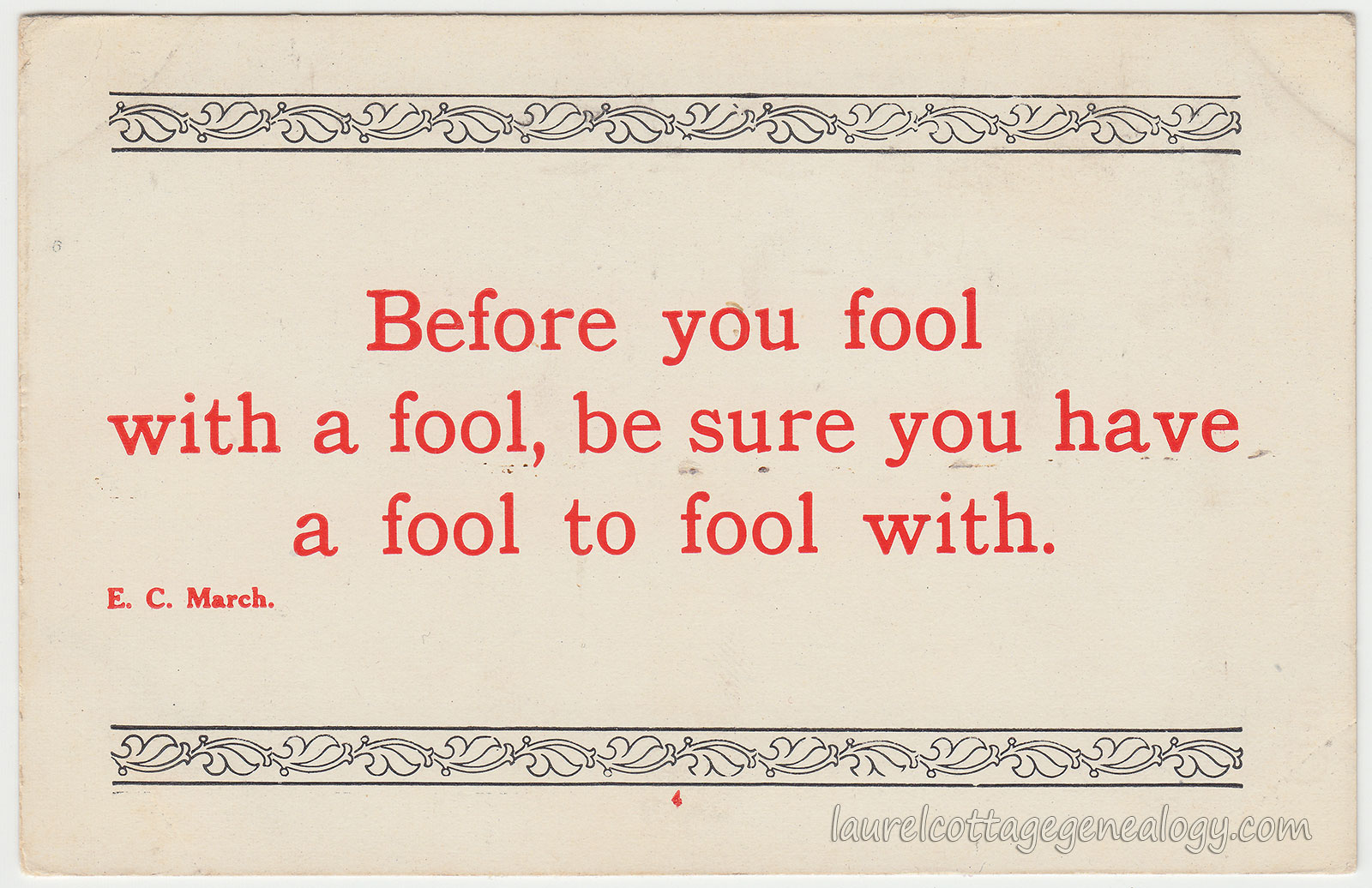
Before You Fool With A Fool

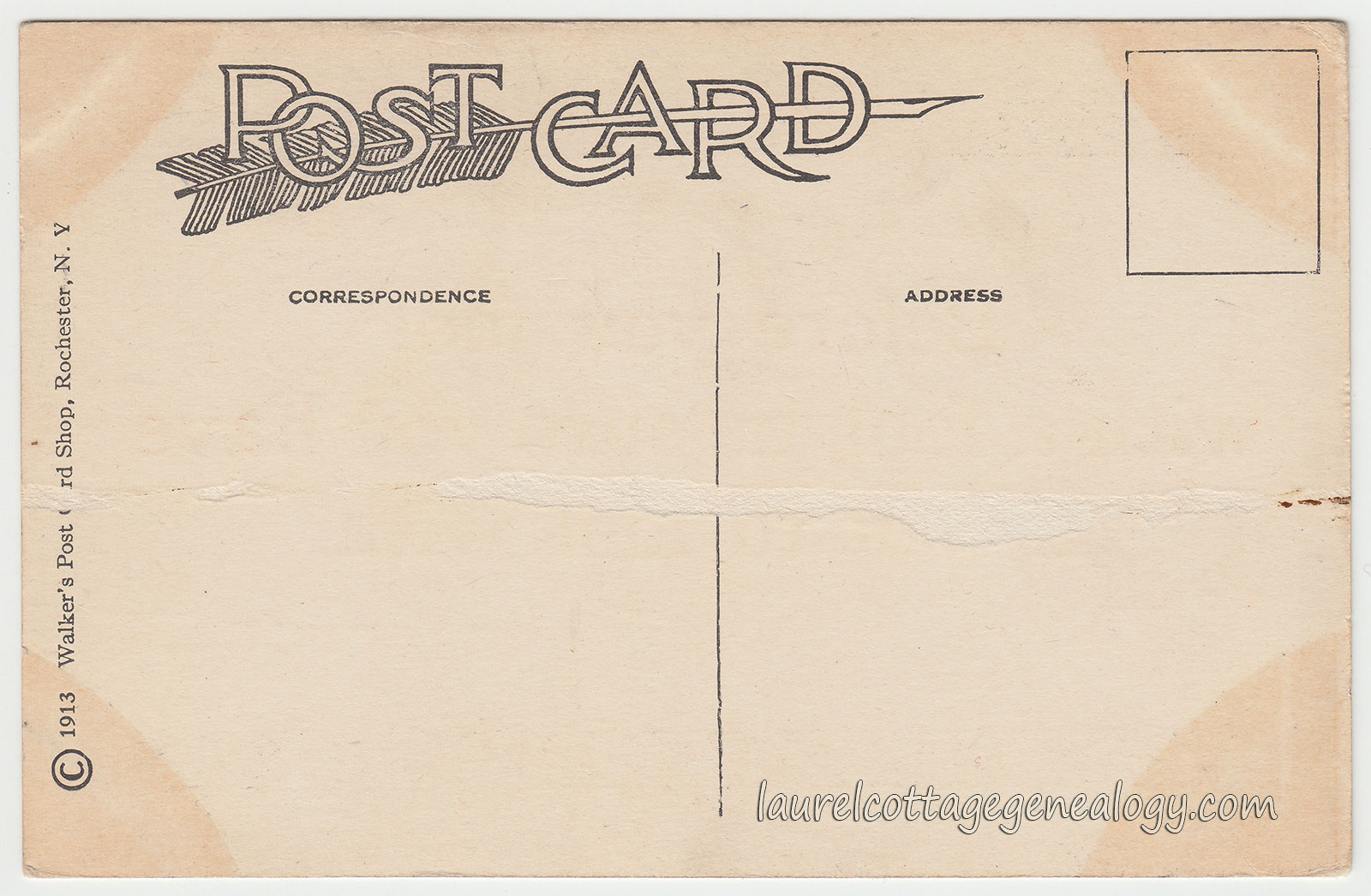
Divided back, unused postcard. Copyright 1913, Walker’s Post Card Shop. Rochester, New York.

Price:  $5.00

Words of wisdom from E. C. March:

“Before you fool with a fool, be sure you have a fool to fool with.”

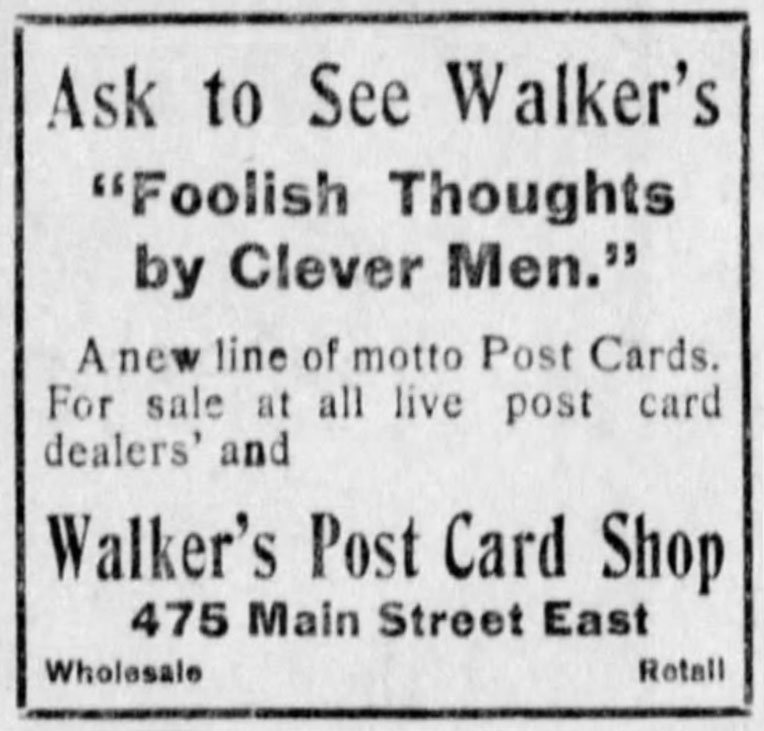
The name E. C. March sounds like someone we ought to know, or maybe someone we’ve heard of in passing, a writer, humorist, poet….and perchance they were, but no references were found for them. So, possibly this wise person was just someone that had worked for Walker’s Post Card Shop. The shop, according to ads found in Rochester’s  Democrat and Chronicle, was a wholesale and retail venue for postcards, which also offered letters, folders, tags, seals and calendars. They were first located at 475 Main Street East, but by December 20, 1914, had moved to 30 Main Street East, across from the Hippodrome.

Below, from Rochester, New York’s Democrat and Chronicle, August 21, 1909:

Sources:  “Ask to see Walker’s ‘Foolish Thoughts by Clever Men.’ ”  Democrat and Chronicle, August 21, 1909. Sunday, p. 18. (Newspapers.com)

“Walker’s Post Card Shop.” Democrat and Chronicle, December 20, 1914. Sunday, p. 26. (Newspapers.com)

Celluloid Collars And Cuffs Frog and Gnome

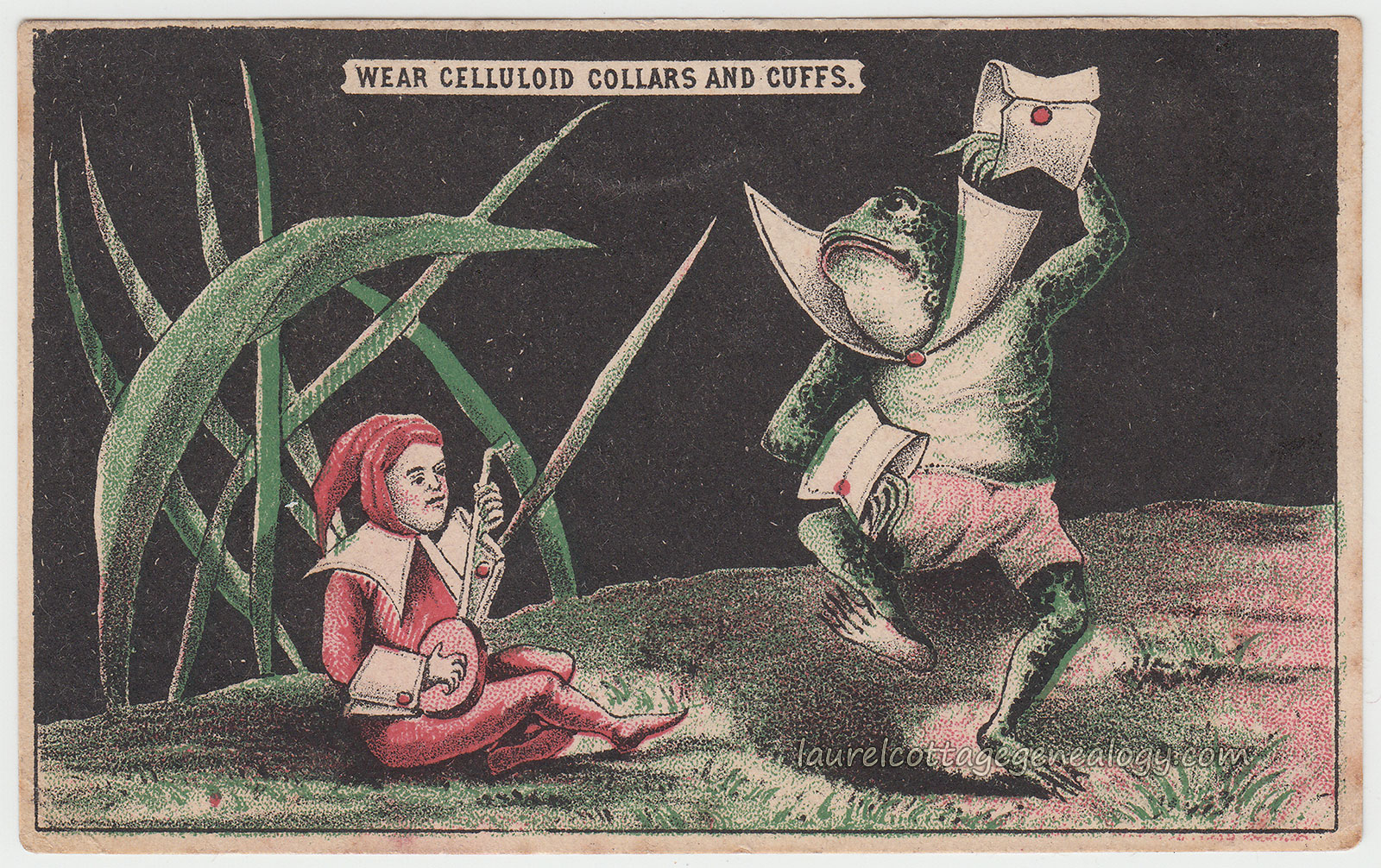
Trade Card for Celluloid Collars and Cuffs. Circa 1878 – 1880s.

Price:  $7.00          Size:  About 4 x 2 and 1/2″

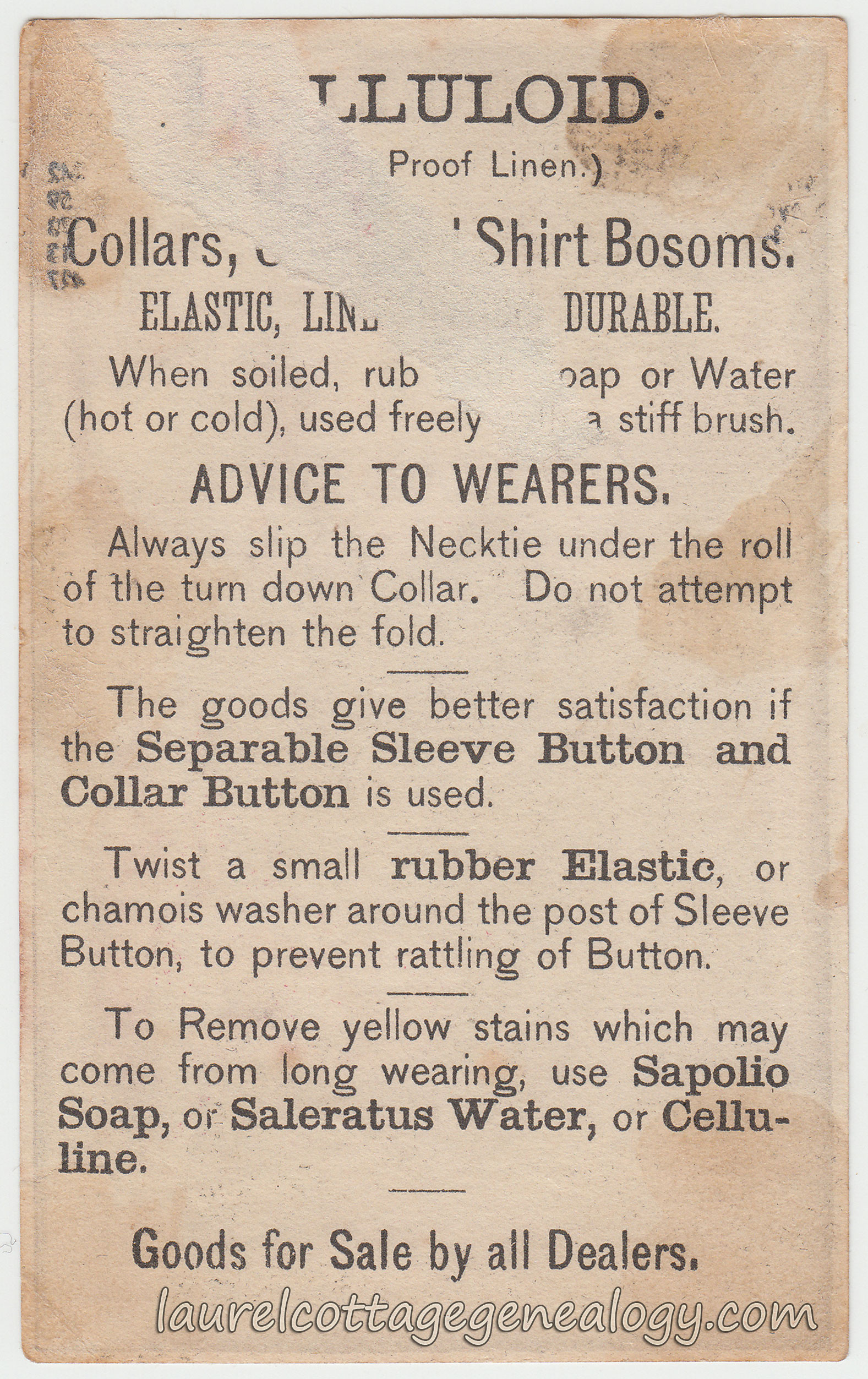
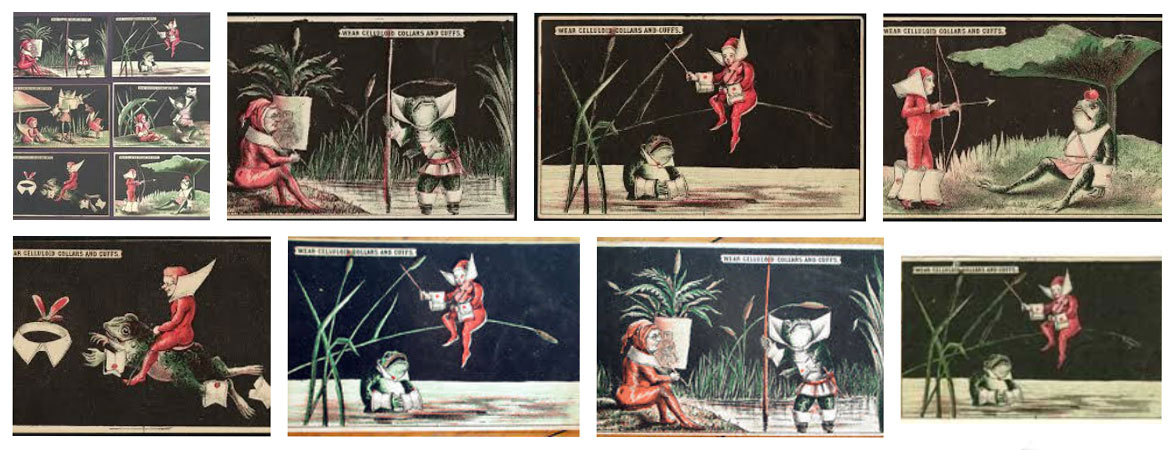
Frog and gnome-like (for lack of a better description, I know, where’s the beard? Maybe a young gnome 😉 ) character advertising Celluloid collars, cuffs and shirt bosoms. This trade card was one of a set of six. Very charming, especially when viewing the whole series. Here’s a crop from a Google image search showing the others:

Our frog and gnome card is the second one we have for Celluloid collars and cuffs. See also, B. J. Stone Trade Card, New Haven, CT.

A trade name

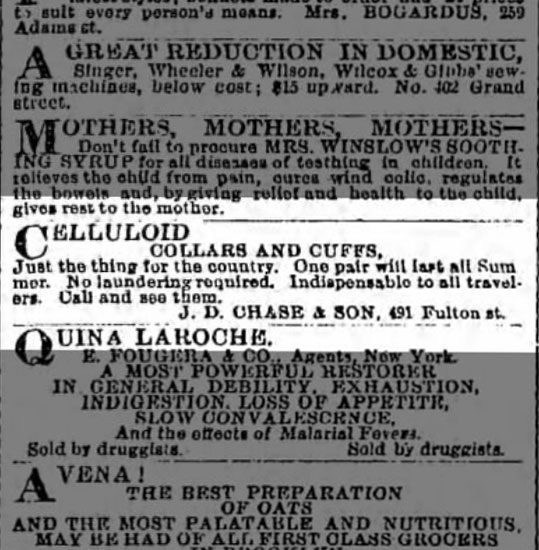
The term Celluloid was a trade name registered in the United States in 1873, and was used in a variety of applications, including hairbrushes, toys, billiard balls, ping-pong balls and the film industry. See the Encyclopedia Britannica’s article:  “Celluloid:  Synthetic Plastic.”  The collars and cuffs were linen, covered with celluloid on the front and back to make them waterproof, thus drastically cutting the high cost of cleaning, and letting the wearer sidestep the “wilted look” in hot weather. Below, the earliest advertisement we found, which appeared in The Brooklyn Daily Eagle (June 13, 1878).

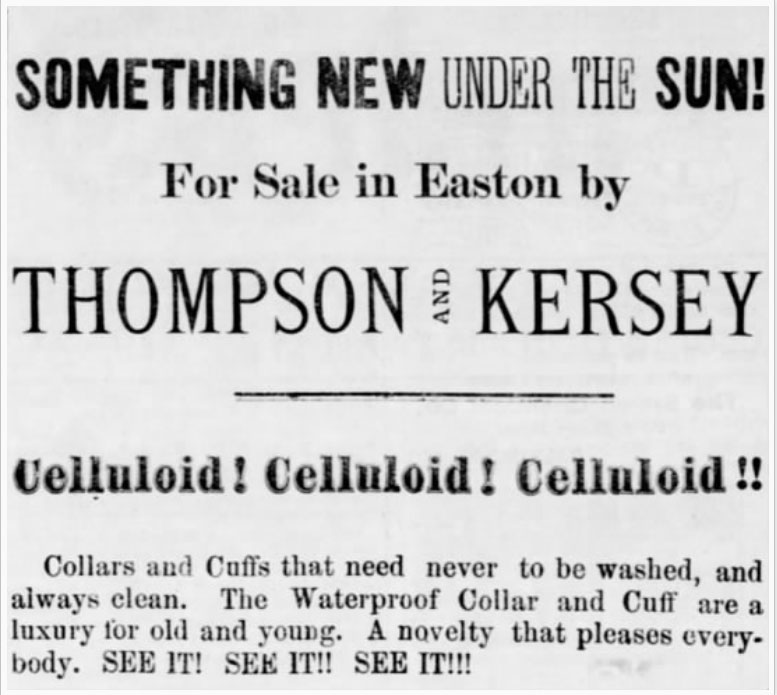
Another early-ish ad below, this one from The Star Democrat, February 24, 1880 indicating Celluloid collars and cuffs had newly arrived to Easton, Maryland.

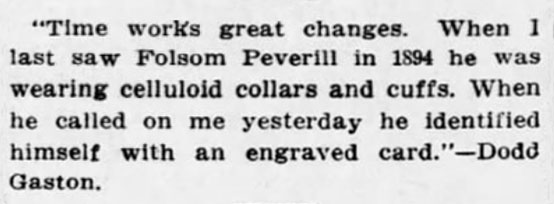
And, hundreds of thousands of ads and related articles can be found late 1870s – 1910s and beyond, but at some point Celluloid collars and cuffs started to fall out of favor. When is a good question, but probably at least by the mid-1890s. Their use came to be associated with outmoded fashion, and a need for thriftiness. (The history of celluloid is book subject matter and much too detailed to research here.) Below, a short glimpse from 1910, into the life of a chap called Folsom Peverill (possibly a made-up name) that appeared in the The Topeka Daily Capital.

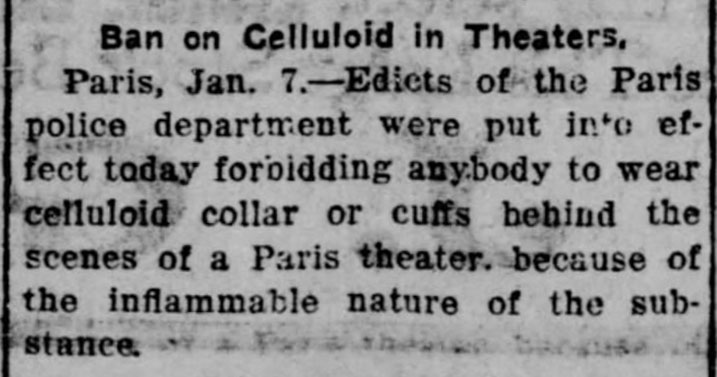
Last, but certainly not least, there were reports of high flammability, accidents where people were injured or even killed, in wearing Celluloid covered items or using objects made from the material (like hair combs). Some attribute some of these stories to urban myth, however, certainly there were instances of factory fires, which were always a threat, in general. Below, a report, from 1910, that lends credibility to the reports of the dangers of wearing Celluloid covered items. This ad was run in a number of U.S. papers, including The Sedalia Democrat.

Sources:  “Wear celluloid collars and cuffs trade cards frog” Google image search. Google.com. (accessed August 24, 2017).

“Celluloid:  Synthetic Plastic.” Encyclopedia Britannica. (accessed August 24, 2017).

“Celluloid Collars and Cuffs.” The Brooklyn Daily Eagle (Brooklyn, NY). June 13, 1878. Thursday, p. 1. (Newspapers.com).

“Something New Under the Sun!” The Star Democrat (Easton, MD). February 24, 1880. Tuesday, p. 3. (Newspapers.com).

“Time works great changes.”  The Topeka Daily Capital (Topeka, KS). June 16, 1910. Thursday, p. 4. (Newspapers.com).

“Ban on Celluloid in Theaters.”  The Sedalia Democrat (Sedalia, MO). January 7, 1910. Friday, p. 9. (Newspapers.com).

The Latest Fashion

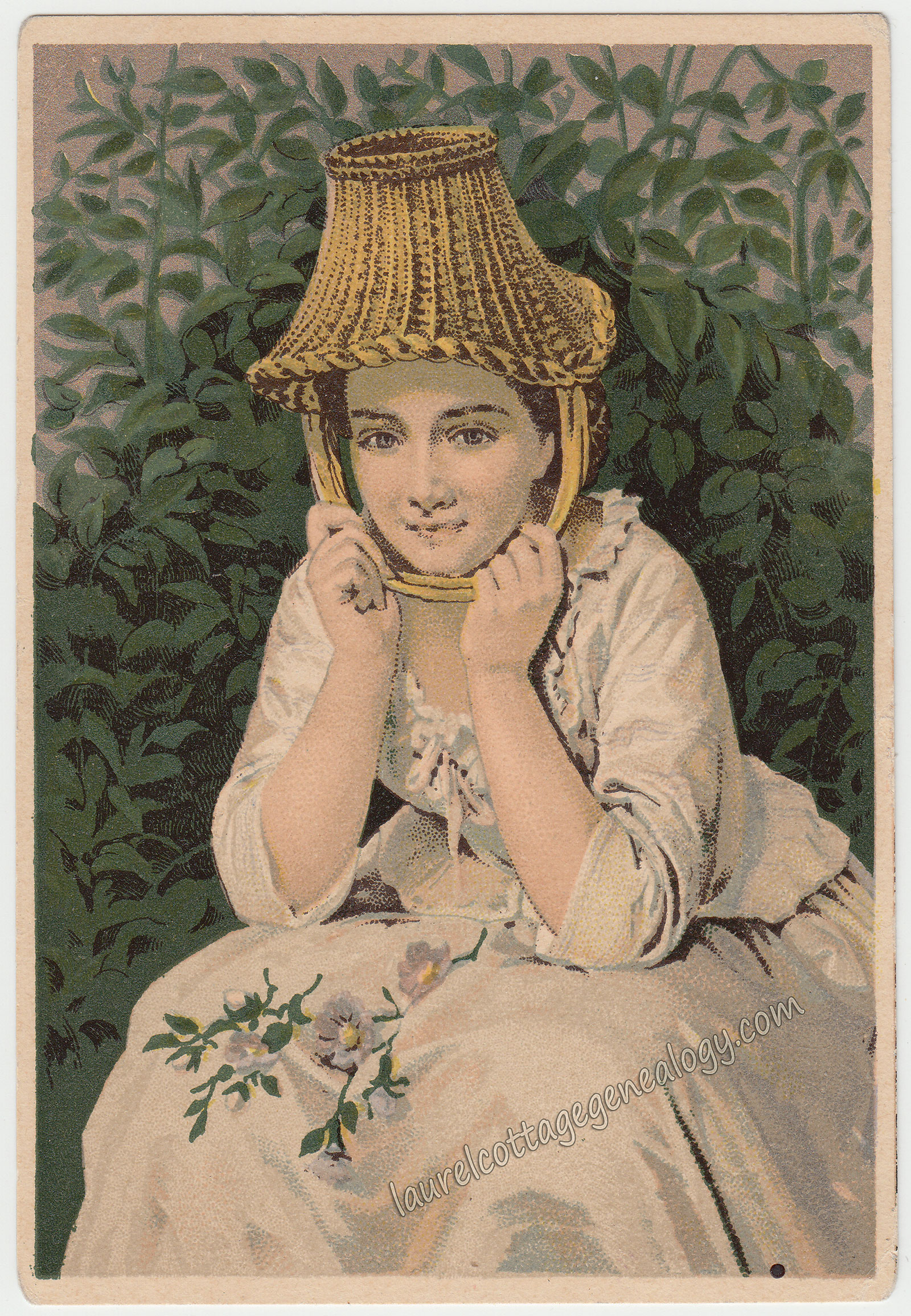
Trade Card, circa 1872 – 1883 from P. A. Kearney, San Francisco.

Price:  $15.00         Size:   About 3 and 1/4 x 4 and 3/4″

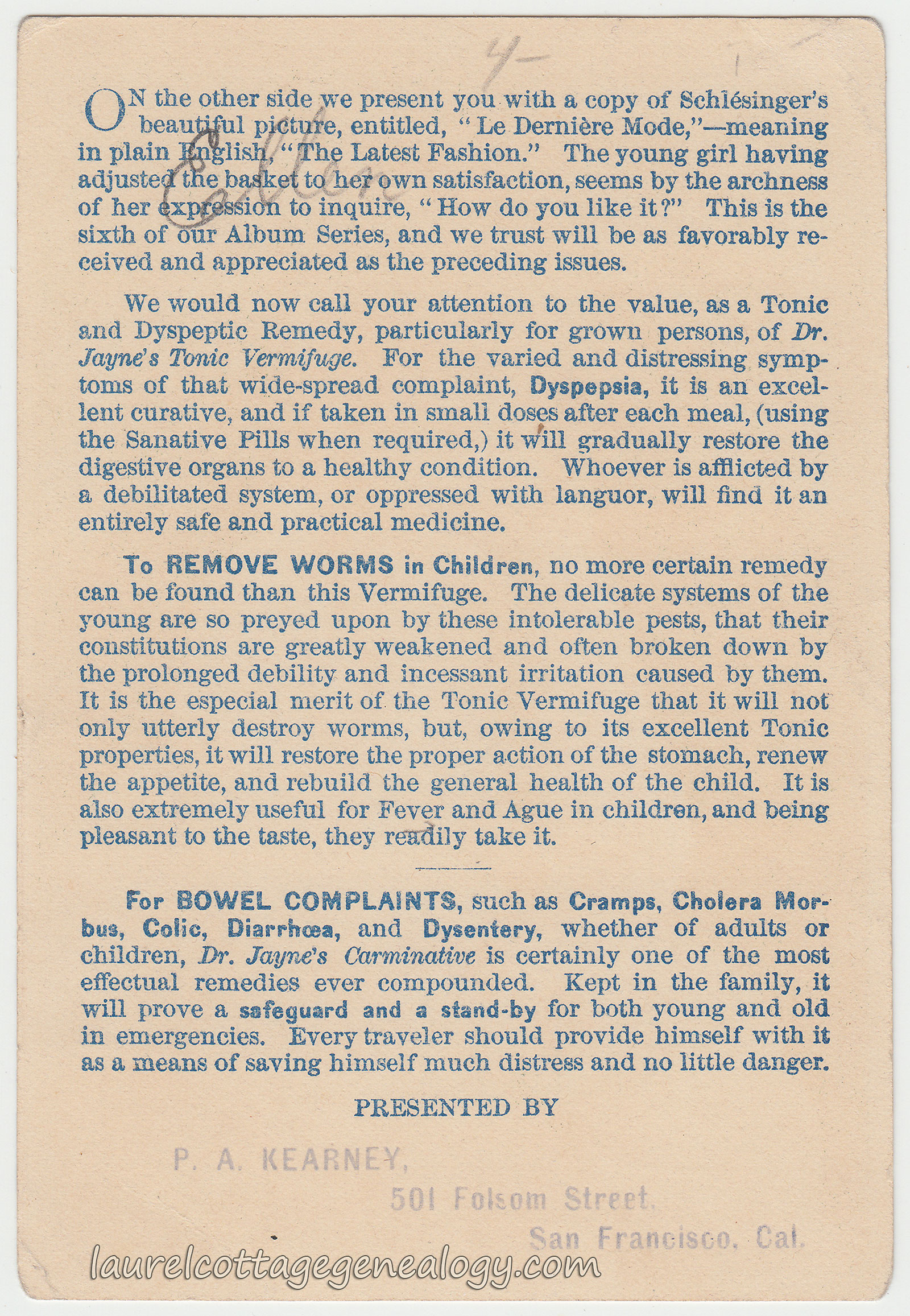
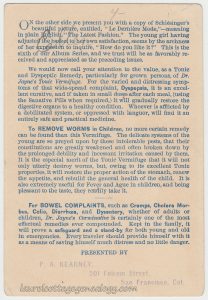
A trade card advertising Dr. Jayne’s Tonic Vermifuge and Dr. Jayne’s Carminative, as offered by druggist, P. A. Kearney, of 501 Folsom St., San Francisco. The first paragraph describes the eye-catching front of the card as:

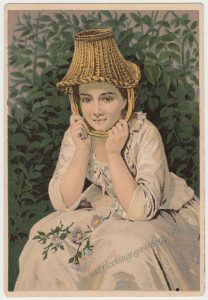
“On the other side we present you with a copy of Schlésinger’s beautiful picture, entitled, ‘Le Dernière Mode,’ – meaning in plain English, ‘The Latest Fashion.’ The young girl having adjusted the basket to her own satisfaction, seems by the archness of her expression to inquire, ‘How do you like it?’ This is the sixth of our Album Series, and we trust will be as favorably received and appreciated as the preceding issues.” 

Rendition of or inspiration for….

The artist referenced above Henri-Guillaume Schlesinger (1814 – 1893) was born in Germany (Heinrich Wilhelm Schlesinger) and became a nationalized citizen of France. He was both prolific and popular, and gained the French Legion of Honor medal in 1866.

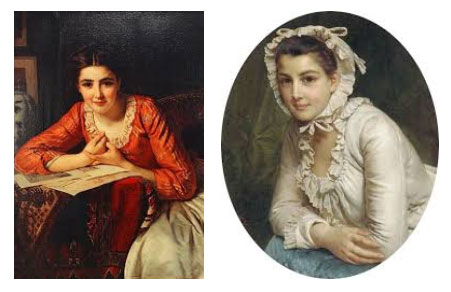
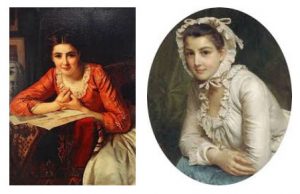
But we didn’t find any Schlesinger paintings of a young woman with an overturned basket on her head. Indeed! Would one imagine that he even might have created one? (Not to say that he might not have had a fine sense of humor, or a whimsical side….) What’s more likely, is that our trade card artist’s inspiration came from Schlesinger’s “Portrait of a Young Woman,” (below, center) also listed under the title “The Young Beauty” an oil on canvas done in 1873.  (And we’ve included two other examples of Schlesinger’s work, just in wondering whether Schlesinger had used the same model for all three.)
Trendy

Trade cards and post cards were often fashioned on subjects that were currently or recently in the public eye:  art, music, fashion, movies, politics, “running jokes” etc. I’m reminded of a few postings put up earlier here at Laurel Cottage….the first two regarding fashion and hats and the second, a prime example regarding a card and its likely source(s) of inspiration. (The “from whence it came” kind of thing.)

How The Fashions Came

Trimmed Garbage Pail

By The Sad Sea Waves

Kearney not Kearny

Peter A. Kearney, druggist, appears at the address on the trade card, 501 Folsom Street, in the 1880 San Francisco city directory. The address was both his office and residence at this time. More searches reveal that Peter Alfred Kearney was born in New York City in 1848, started in the medical field as a druggist around 1869, graduated from Cooper Medical College in 1884, and married Mary Whitbeck in 1891. As far as the date for our trade card, the 1872 city directory shows Peter A. Kearney, druggist at the southwest corner of First and Folsom. This may have been the 501 Folsom address. By 1880 – 1883 he is listed in the city directory at the actual address 501 Folsom, so the 1880 – 1883 might be an even better time estimate for our trade card. (Lastly, I had gone running to look up a map re Kearney and San Francisco but our Kearney is with a different spelling and no relation to the well-known Kearny St. in that city; just FYI, in case the name made you wonder for a sec.)

_________________________________________________________________________

Sources:  Henri-Guillaume Schlesinger (1814 – 1893) Galerie Ary Jan. (www.galeriearyjan.com). Accessed 08/19/2017.

“Henri-Guillaume Schlesinger Auction Price Results.”  (invaluable.com). Accessed 08/19/2017.

“images of paintings by Henri-Guillaume Schlesinger.” Google.com search. Accessed August 19, 2017.

National Archives and Records Administration (NARA); Washington D.C.; NARA Series: Passport Applications, 1795-1905; Roll #: 326; Volume #: Roll 326 – 01 May 1889-07 May 1889. (Ancestry.com).

Henry G. Langley’s San Francisco Directory, 1869. p. 345.  Ancestry.com. U.S. City Directories, 1822-1995.

Henry G. Langley’s San Francisco Directory, 1872. p. 361.  Ancestry.com. U.S. City Directories, 1822-1995.

Langley’s San Francisco Directory, 1880. p. 495. Ancestry.com. U.S. City Directories, 1822-1995.

The San Francisco Directory, 1883. p. 608.  Ancestry.com. U.S. City Directories, 1822-1995.

Pacific Medical and Surgical Journal and Western Lancet. January 1886, Vol. XXIX. p. 223. (elane.stanford.edu).

Marriage records, select counties and years. California State Archives, Sacramento, California. (Ancestry.com)

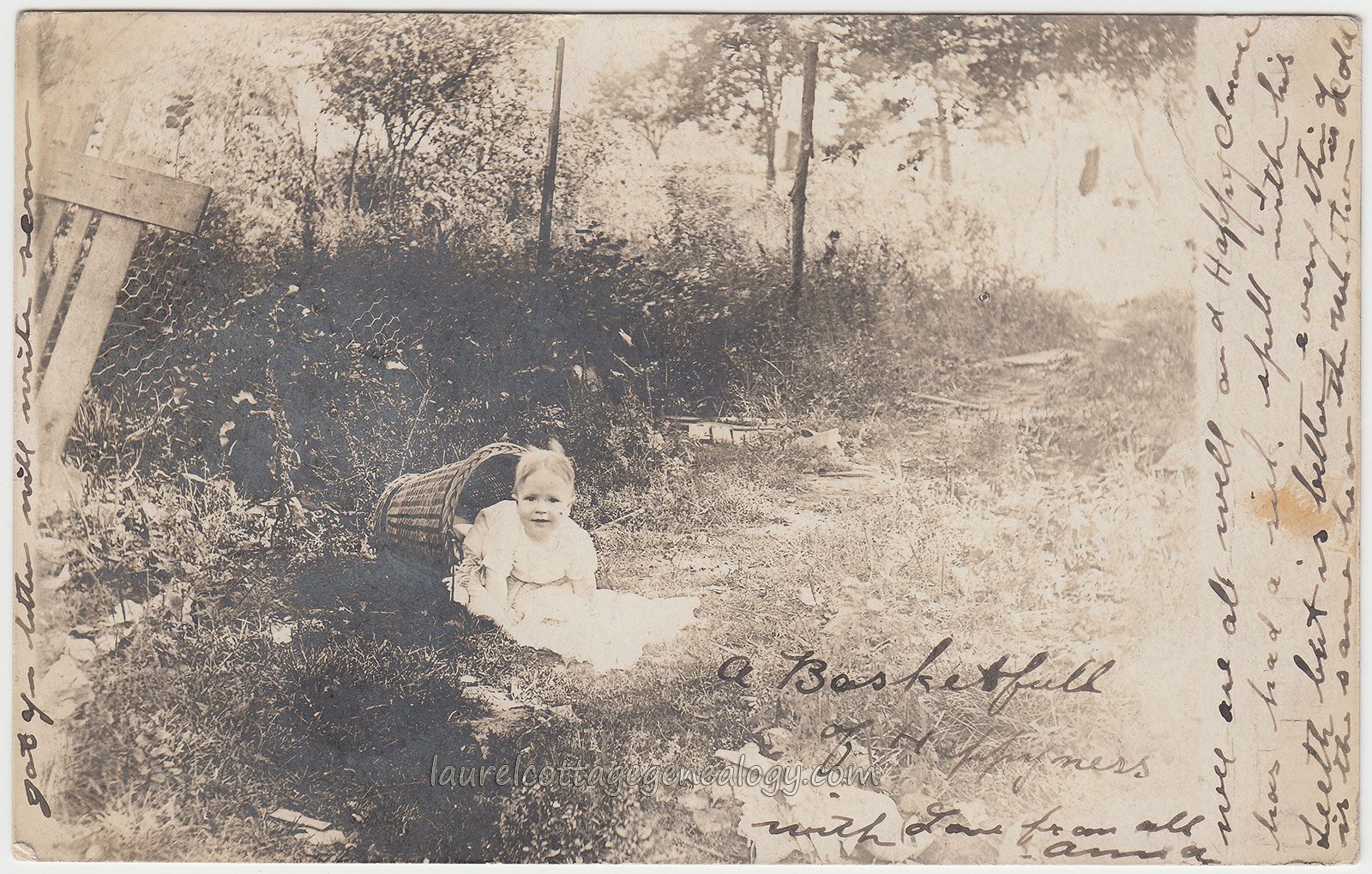
A Basketful Of Happiness

Divided back, used postcard. Postmarked September 23, 1907 from LaSalle, New York.

Price:  $12.00

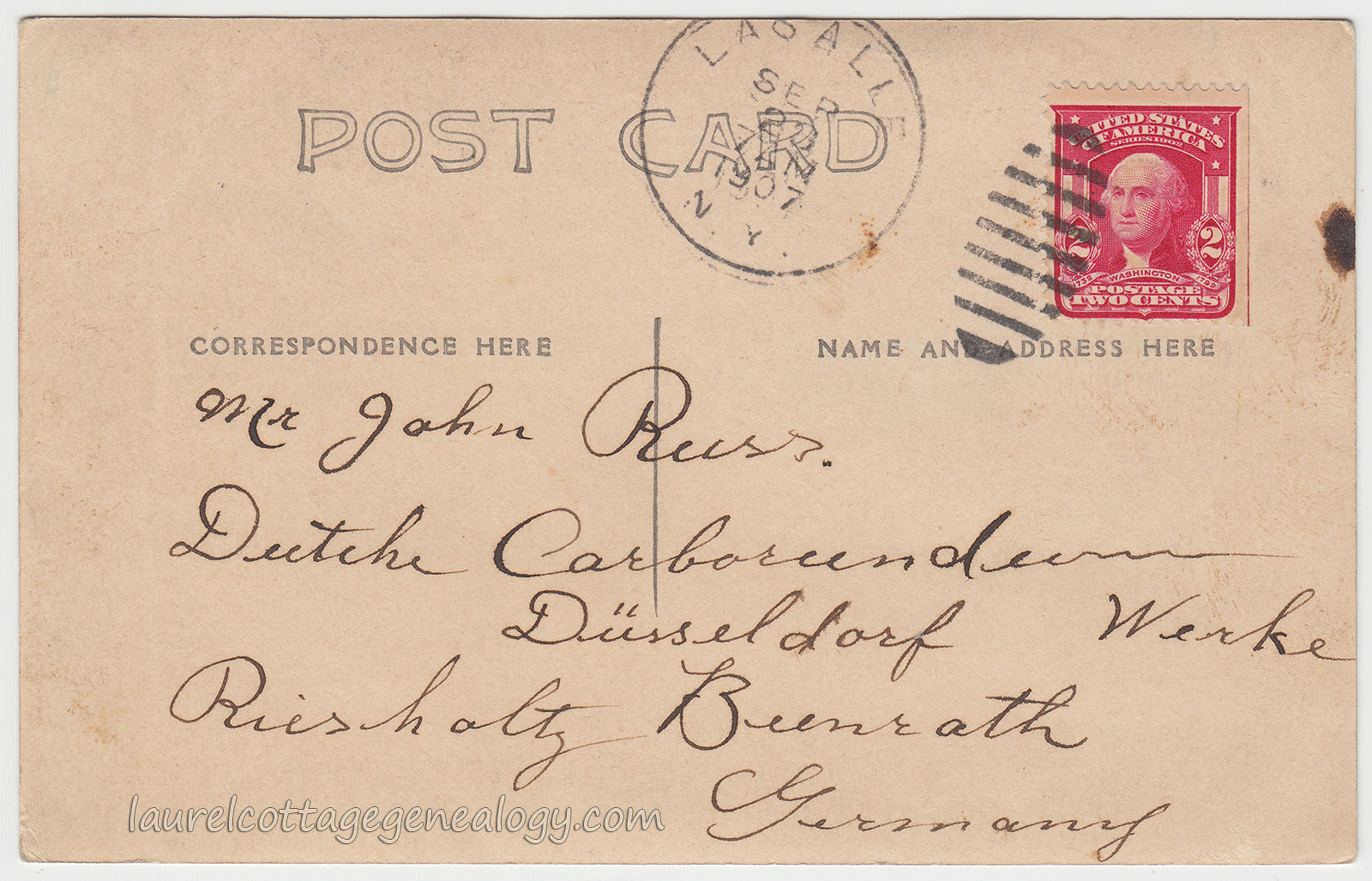
This postcard is a good clue for anyone searching for more on the John Jacob Russ who is the addressee on the card or more on the history of the Carborundum Company of Niagara Falls, NY. It’s addressed:

“Mr. John Russ. Dutch Carborundum. Dusseldorf Werke. Reishotz Beenrath. Germany”

The card is sent from Anna, and she could be John’s sister. John’s parents (and Anna’s) are proving rather time-consuming to locate. (There’s an Anna Salzmann (wife of Louis Salzmann) in Niagara Falls in 1910 who has a son named Clarence. Could this be Clarence on the postcard? Could be but let’s not say for sure. A very adorable image though, and Anna writes:

“A Basketfull of Happyness with Love from all. Anna. we’re all well and Happy. Clarence has had a sick spell with his teeth but is better. everything is the same here the weather is cold. got your letter will write soon.”

From his passport application dated February 23, 1907, John J. Russ was born in Niagara Falls, NY on December 17, 1874. His father was a naturalized U.S. citizen. He is accompanied by his wife Friedericke, and children Lillian, Clara and Frederick. John is a foreman for the Carborundum Company of Niagara Falls, NY.

John’s WWI Draft Registration in 1918 shows he is a department superintendent with Carborundum, and lives in LaSalle, New York. There’s no official city or town of LaSalle, NY on the map today. Per a Wiki entry, the city of Niagara Falls annexed the village of LaSalle from the town of Niagara in 1927 (The city of Niagara Falls and the town of Niagara are next to each other.)

Sources:   “Corborundum. Our History.” carbo.com. Accessed August 13, 2017.

National Archives and Records Administration (NARA); Washington D.C.; NARA Series: Passport Applications, January 2, 1906 – March 31, 1925; Roll #: 29; Volume #: Roll 0029 – Certificates: 26301-27000, 12 Feb 1907-04 Mar 1907. (Ancestry.com)
Registration State: New York; Registration County: Niagara; Roll: 1818603; Draft Board: 2. Ancestry.com. U.S., World War I Draft Registration Cards, 1917-1918.

Niagara Falls, New York. n.d. https://en.wikipedia.org/wiki/Niagara_Falls,_New_York (accessed August 13, 2017).

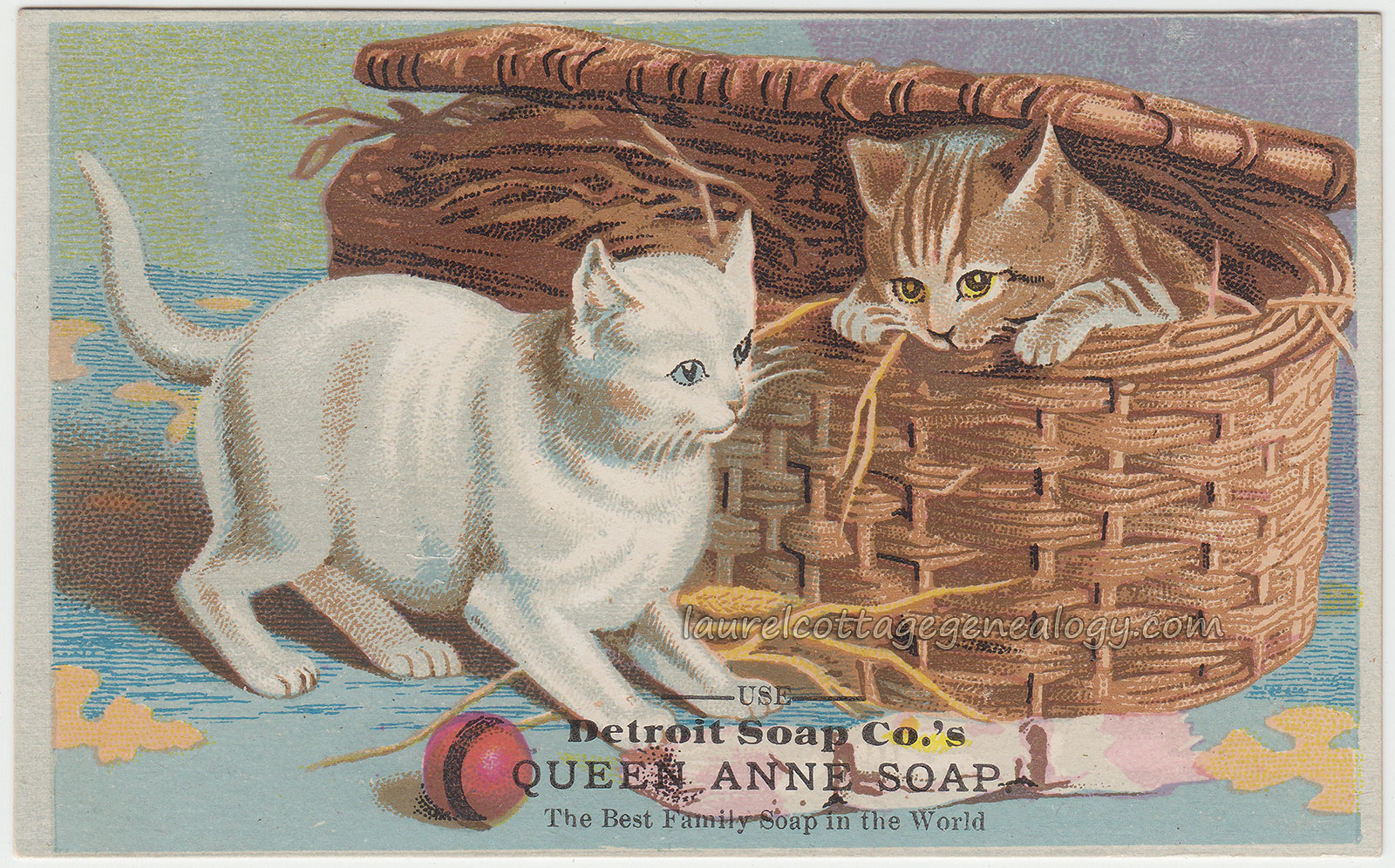
Queen Anne Soap, Kitties And Basket

Trade Card. Detroit Soap Company. Circa 1871 – 1890s.

Price:  $7.00       Size:  4 and 9/16 x 2 and 13/16″

“Use Detroit Soap Co.’s Queen Anne Soap. The Best Family Soap in the World.”

This is the third trade card that we’ve found so far, for Queen Anne’s Soap and the Detroit Soap Company. See the prior post for the second.