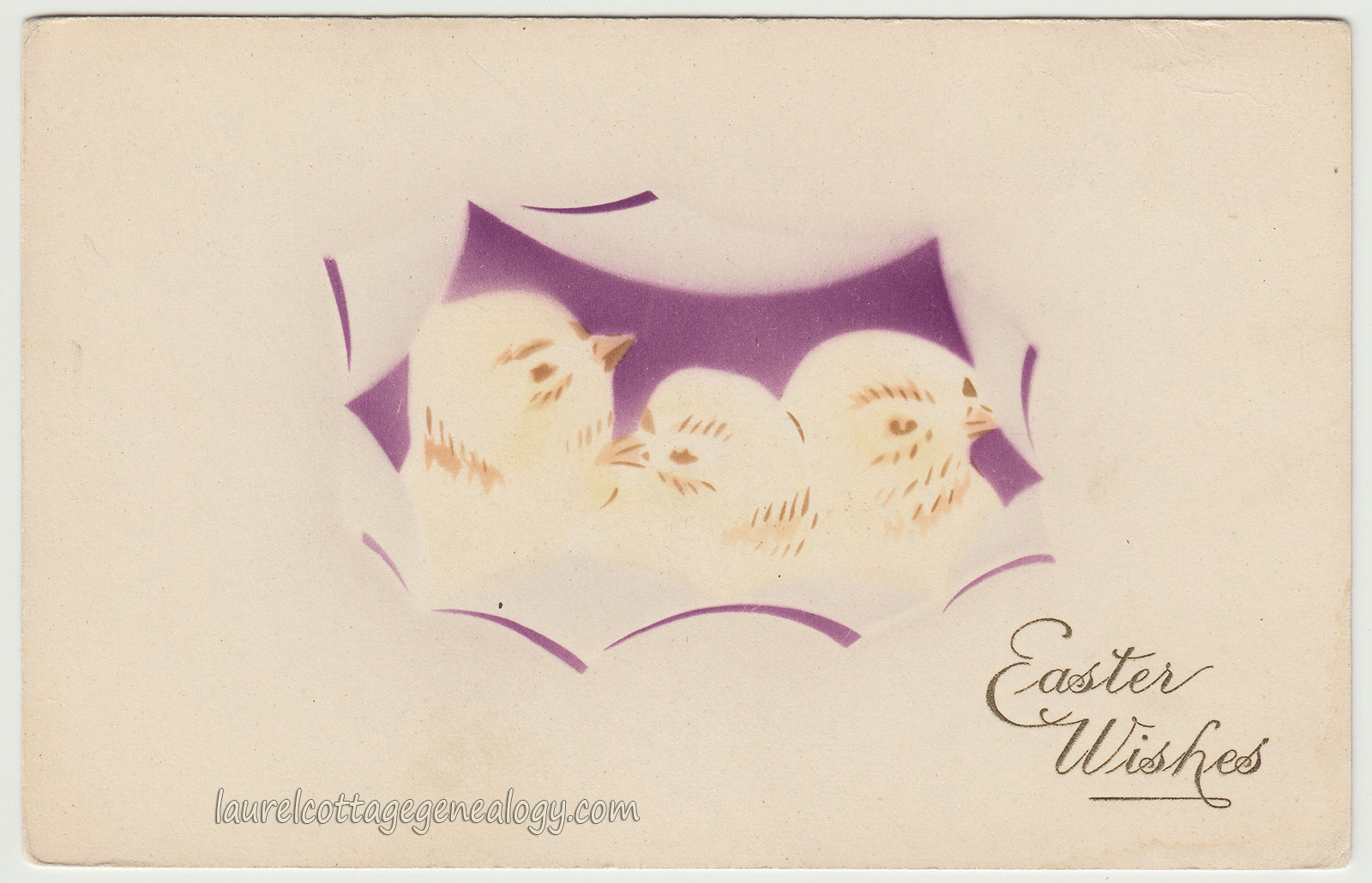
Divided back, unused postcard. Printed in Germany. Circa 1907 – 1914.
Price: $3.00
Easter Wishes…..sort of a minimalist card – an artist’s view of three chicks appearing within layers of white and purple, as in from a basket….but without the basket.

Divided back, unused postcard. Printed in Germany. Circa 1907 – 1914.
Price: $3.00
Easter Wishes…..sort of a minimalist card – an artist’s view of three chicks appearing within layers of white and purple, as in from a basket….but without the basket.
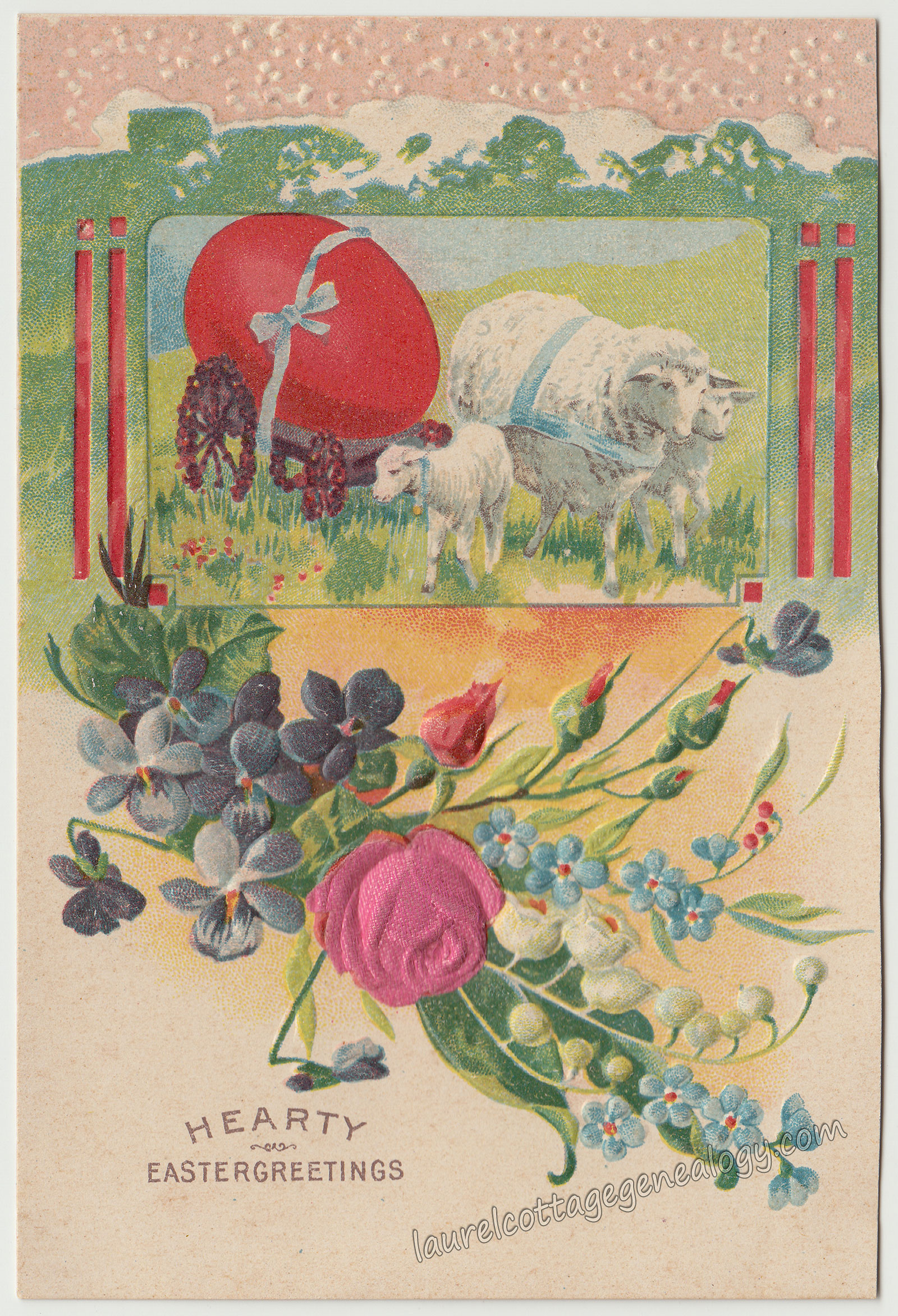
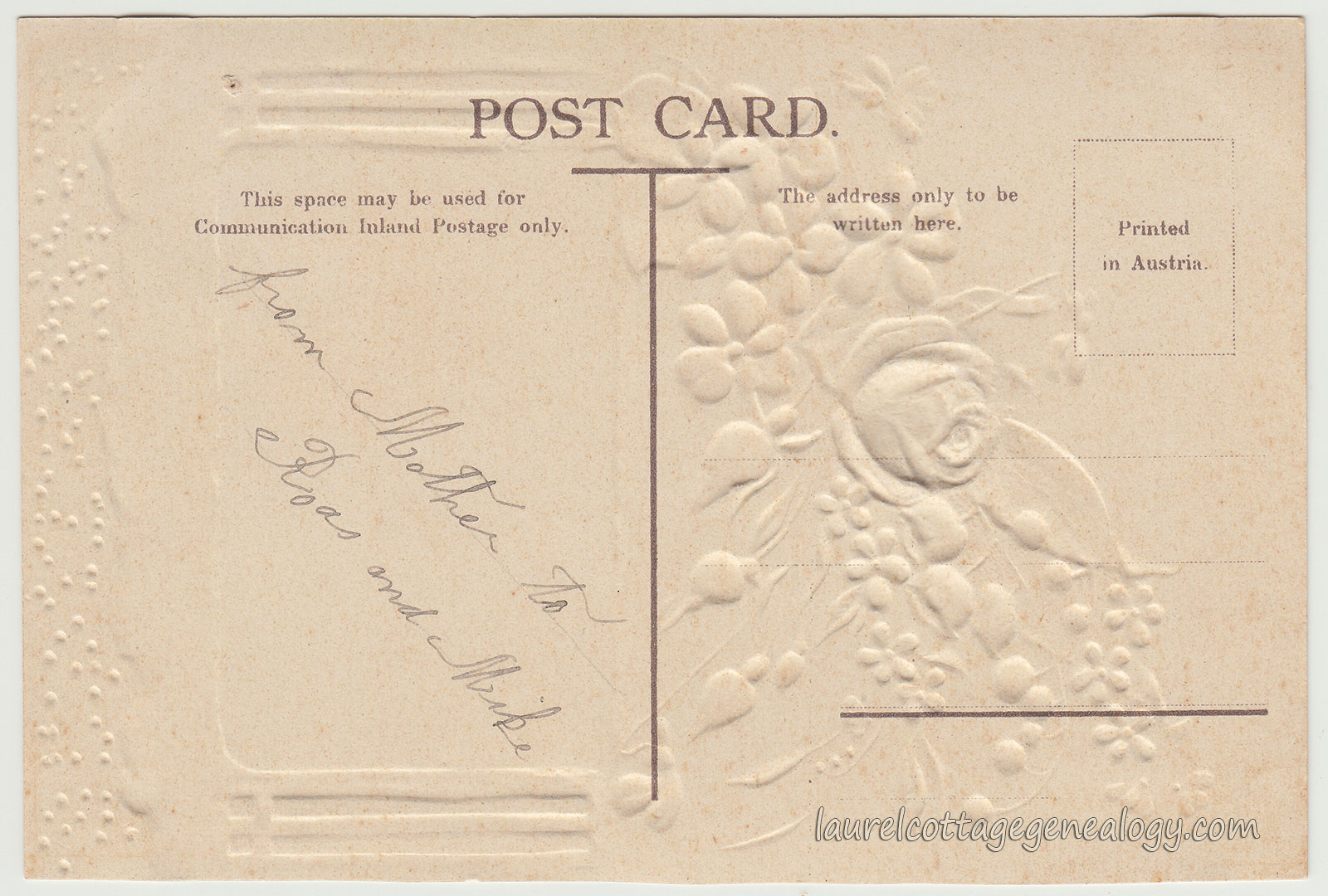
Divided back, embossed, unused postcard. Printed in Austria. Circa late 1900s – early to mid-1910s.
Price: $5.00
Hearty Easter Greetings
A sheep pulling a cart (note the wheels are made of or covered in flowers) holding a large red Easter egg. Underneath is a beautiful embossed spray of violets, roses, forget-me-nots and lilies of the valley, and in the background green snow-topped mountains and embossed snow falling in a pink (!) sky. The age of this card is just an estimate, guessing it might be pre-WWI. And the recipients of the postcard, Roas? and Mike. Guessing Roas might have been short for Rosalinda (with odd spelling). Notice how two lines were drawn with a straight edge for the sender to write on. (These details seem to transport us back to the moment it was being written!)
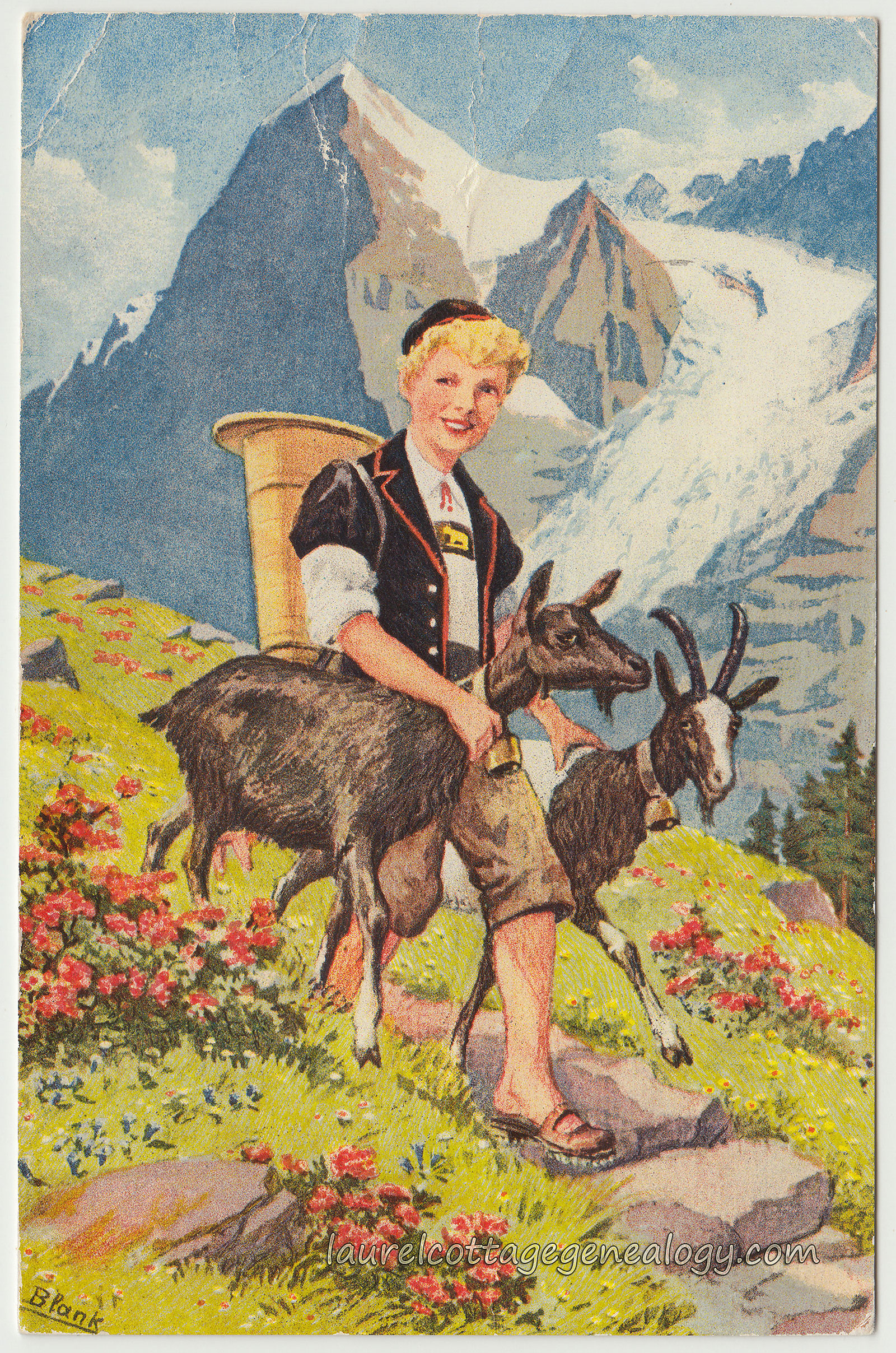
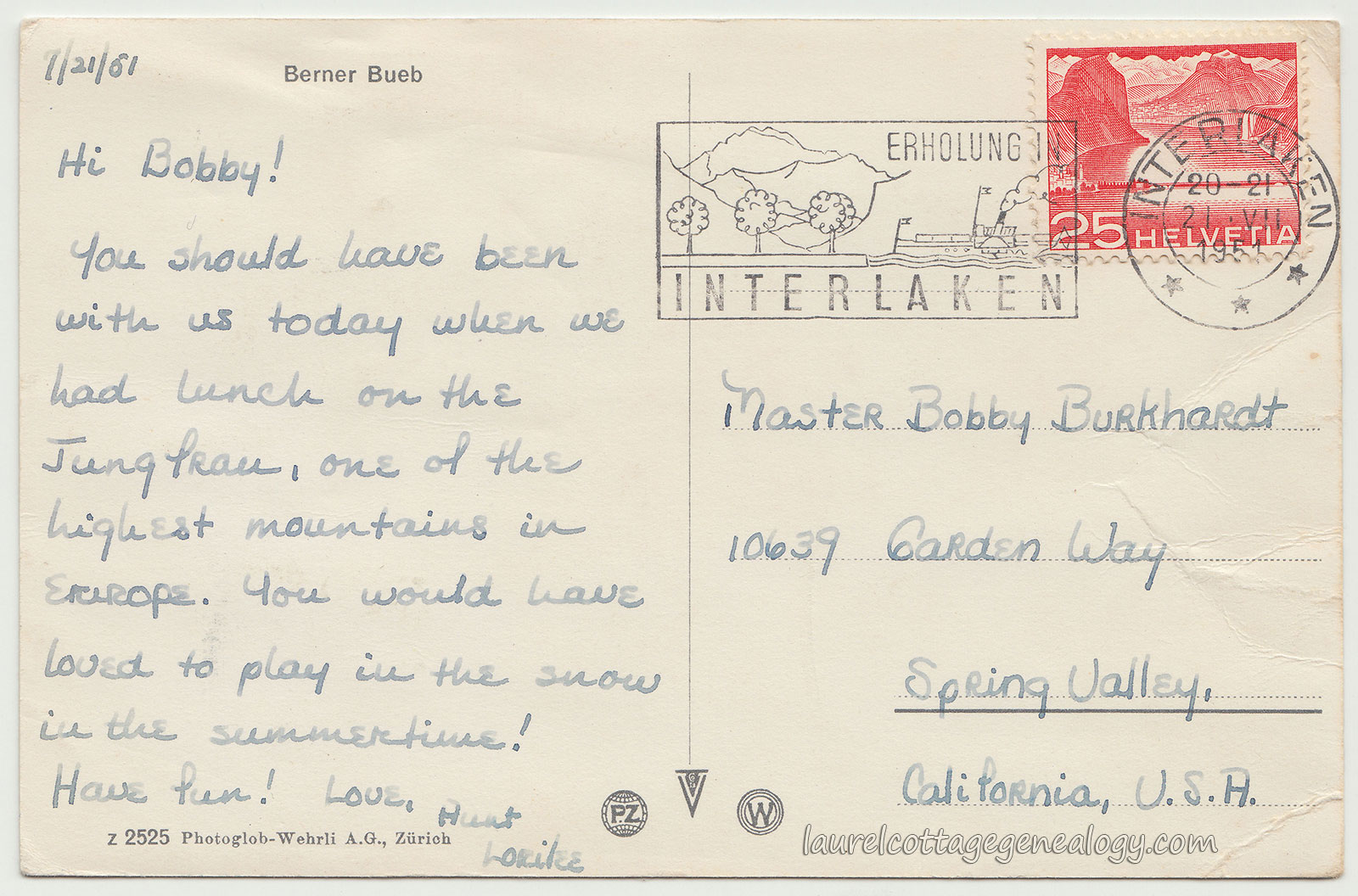
Divided back, used postcard. Postmarked July 21, 1951, Interlaken, Switzerland. Publisher: Photoglob-Wehrli A. G., Zurich. Number or series z 2525.
Price: $6.00
Berner Bueb
“07/21/51 Hi Bobby! You should have been with us today when we had lunch on the Jungfrau, one of the highest mountains in Europe. You would have loved to play in the snow in the summertime! Have fun! Love, Aunt Lorilee.”
Addressed to: “Master Bobby Burkhardt, 10629 Garden Way, Spring Valley, California, U.S.A.”
The Jungfrau is in the Bernese Alps in Switzerland. The postcard caption “Berner Bueb” might be translated as Bernese boy. You can find numerous Swiss postcards with “Berner Bueb” and “Berner Bueb und Meitschi” (Bernese boy and girl, we’re guessing.) This postcard appears to be an artist-signed card per the front lower left corner which shows “Blank.” Checking in Ancestry.com Blank shows as a German and Swiss surname. According to another postcard site, this card was produced at least as early as 1946.
Sources: Jungfrau. n.d. https://en.wikipedia.org/wiki/Jungfrau (accessed April 20, 2019).
“Ziege Kuenstlerkarte Blank Berner Bueb Kat. Tiere.” https://oldthing.de/Ziege-Kuenstlerkarte-Blank-Berner-Bueb-Kat-Tiere-0024001456. (accessed April 20, 2019).
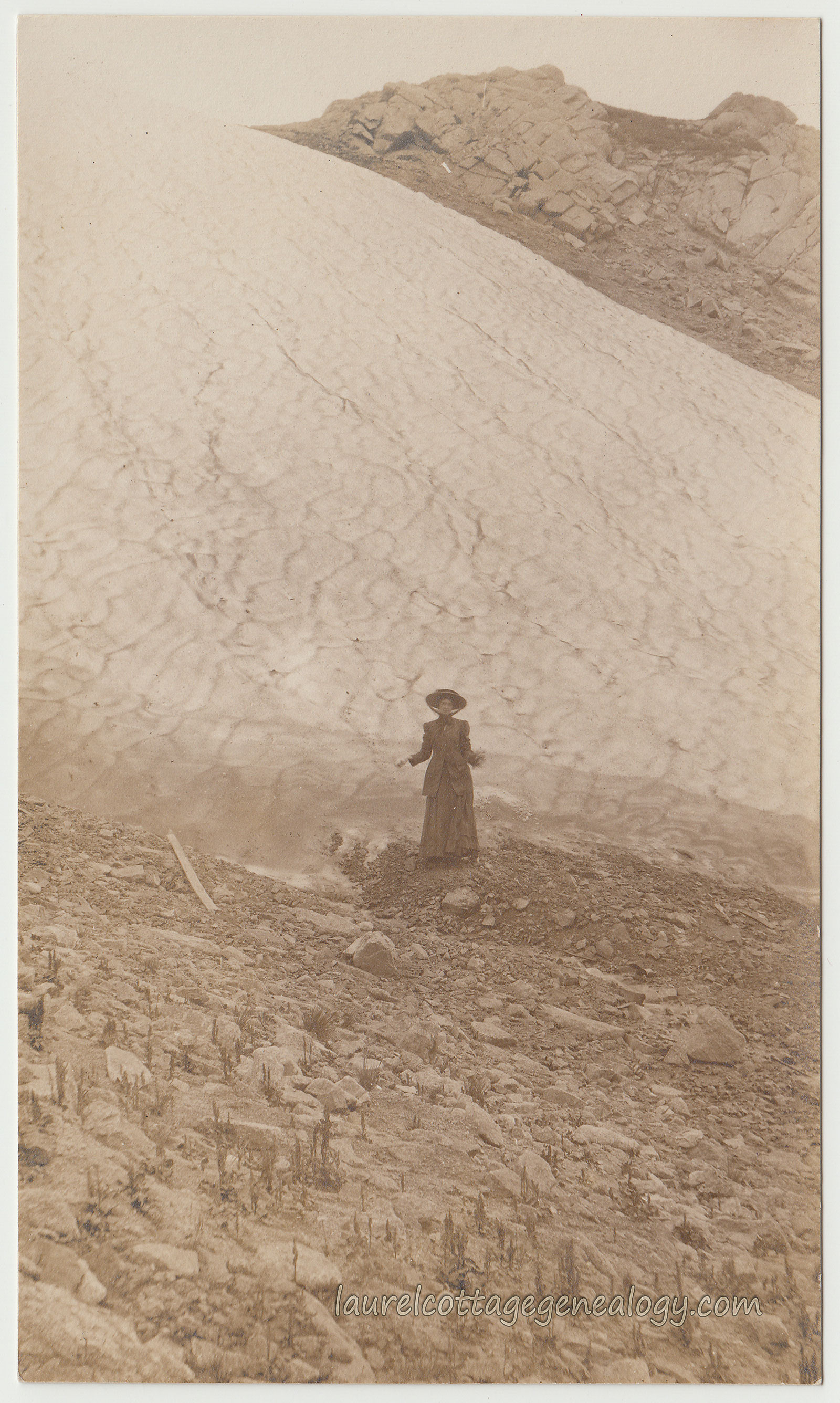
Real Photo Postcard, circa 1907 – 1915
Price: $15.00 Size: 3 and 3/16 x 5 and 3/8″
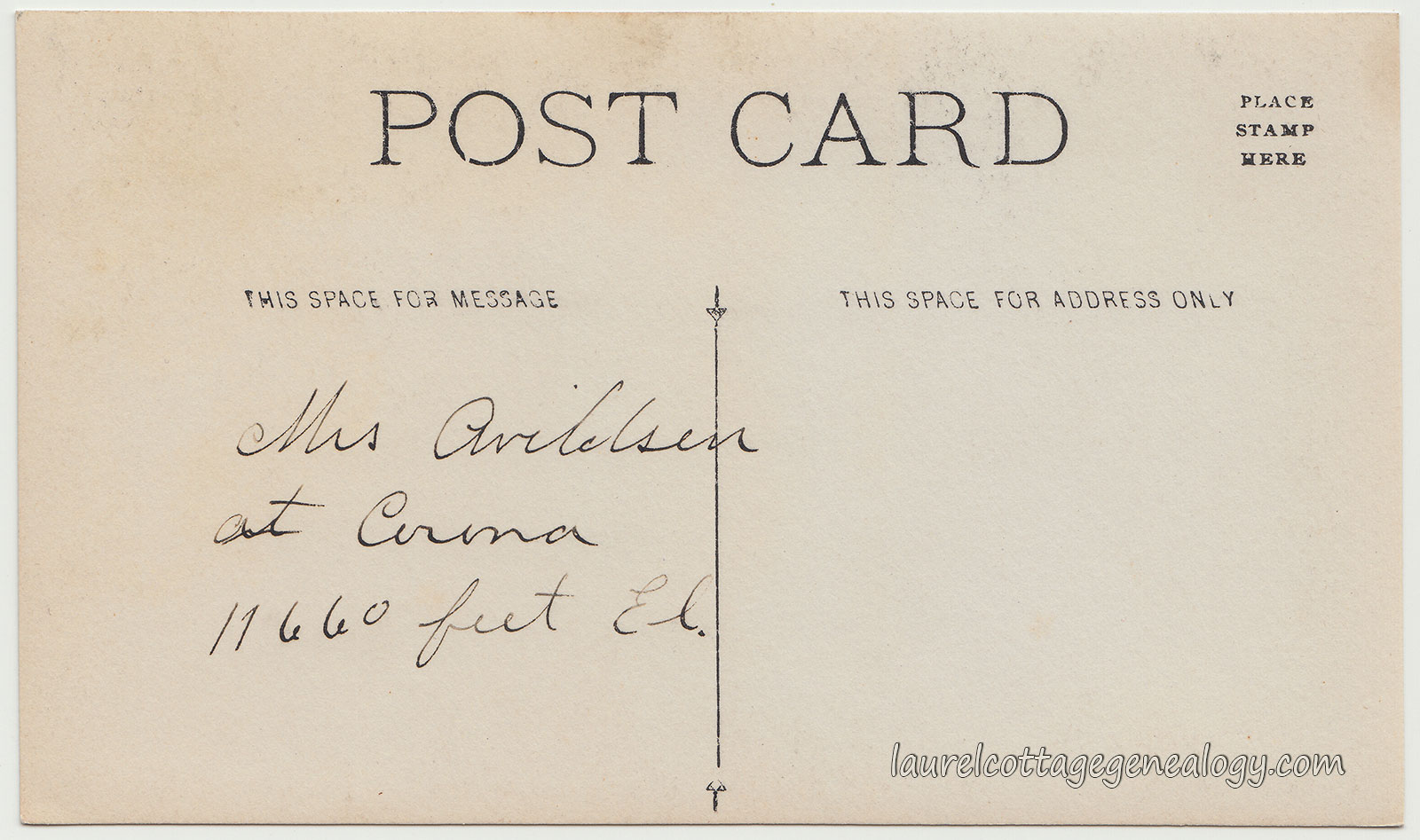
“Mrs. Avildsen at Corona 11660 feet El.”
The location for this one was a mystery, until we (thankfully) received the comment from one of our readers. So, this has to be Rollins Pass which was sometimes called Corona Pass, and is located in the Southern Rocky Mountains.
Postcard publisher unknown, so far
The postcard publisher or printer is another mystery. I’m not seeing this particular style of Real Photo Postcard back on any other site or in Walter Corson’s Publisher’s Trademarks Identified. Also, the size is a little smaller that the average RPPC (and the bottom doesn’t seem to have been cropped). If the card was produced in the U.S. the postal regulations didn’t allow for the divided back until December 1907.
Source: Rollins Pass. n.d. https://en.wikipedia.org/wiki/Rollins_Pass#Summer_and_early_autumn (accessed February 15, 2021).
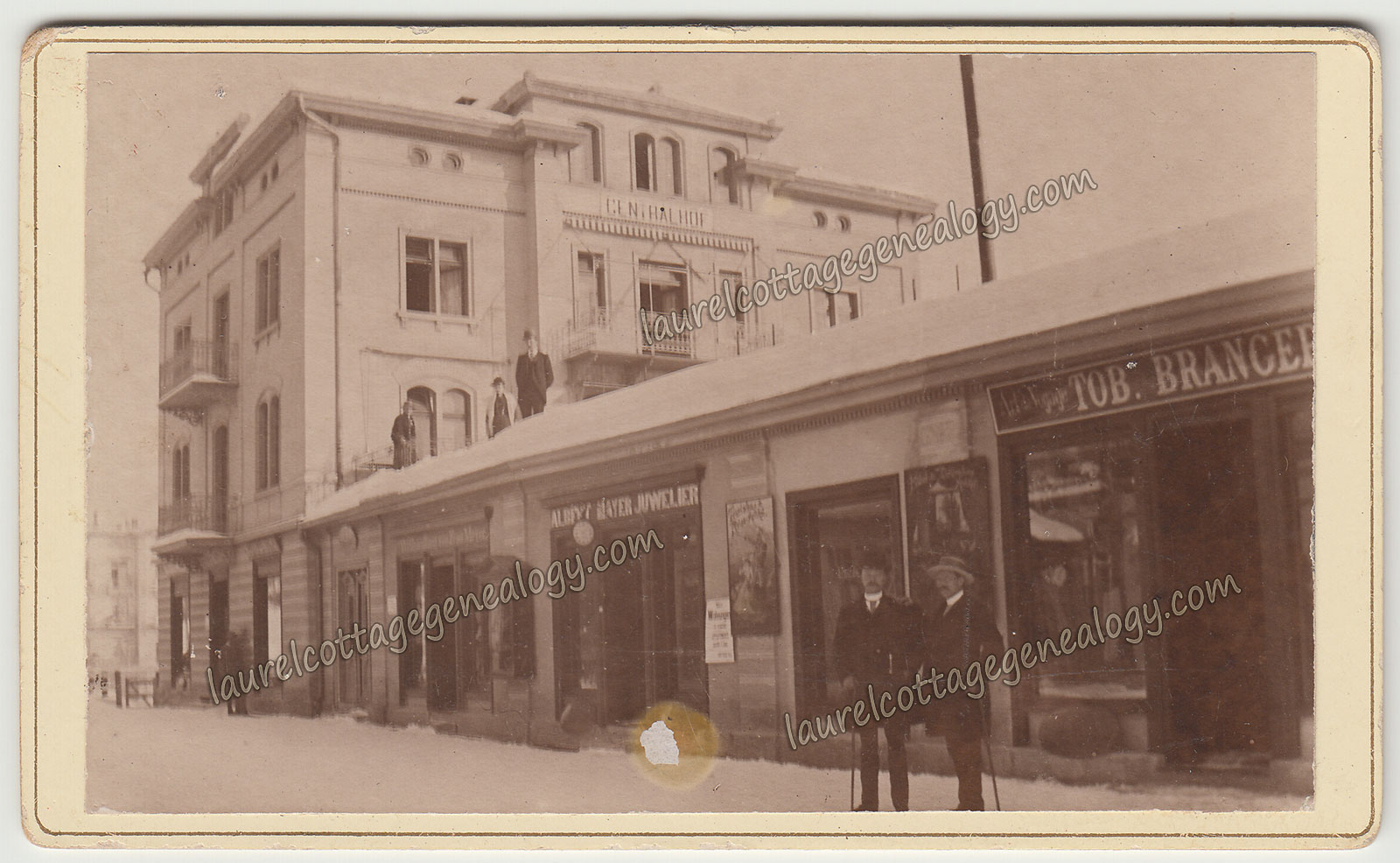
Carte-de-visite. Circa 1890s. Davos, Switzerland
Availability Status: SOLD Size: 4 and 1/16 x 2 and 7/16″
Circa 1890’s, Davos, Switzerland….
Here’s a carte-de-visite found at an antique shop on the Central Coast of California. And, it’s always a thrill to get a photo scanned to the computer (mentally rubbing hands together in anticipation of being hit with the wow factor, or the “hmmmmm factor”, which is just as good, or better, the intrigue, you know….which can then lead us to the wow factor. 😉 ) But, it can’t be stretching the point to say that each item anyone finds (or has, or looks at, or whatever) whether it’s a postcard, a photo, a trade card, a calling card, or some other enchanting piece of ephemera, likewise a piece of furniture, jewelry, etc., is like a key just waiting to open, or re-open, multiple doorways. Come to think about it everything has a history, even a scrap of paper lying on the ground outside….The contemplation of the history of everything is mind-blowing, which leads one to thinking about the inter-connectedness of everything and everyone, no doorways now, just like a billion times a billion, or better, infinity times infinity of criss-crossed links, well….really just oneness. (Is this how enlightenment happens for some, the contemplation of a piece of dust or a scrap of paper?)
Alpine air and wonderful shops
Davos, Switzerland, circa 1890s: A street scene showing the Centralhof, (Central court) which is the tall building, (guessing this might have been an apartment building or hotel) and attached to the Centralhof a line of single-story shops; of these, the two store names that we can discern are, on the left, Albert Mayer Juwelier (Jewelry store) and on the right Tob. Branger. Click the image to enlarge and note at the top of the Branger window, there’s a phrase of some sort, the second word appears to be Voyage. The first word appears to start with an “A” so, maybe it was the poetic, l’Art du Voyage: It turns out that Tobias (pronounced TOE-be-us) Branger and brother Johannes owned a shop specializing in, “…sporting equipment and ‘travelling utensils.’ ”
All who wander…..
A little research explodes into lots of (snow-covered) paths to wander down…..Wow! Tobias Branger, thought to be the first professional ski instructor in the Alps…..he and brother Johannes teaching author Arthur Conan Doyle to ski….the history of Alpine skiing…..Doyle’s contribution to Davos as a winter sports destination….Davos’ history as a health resort for tuberculosis sufferers….the life of Louisa Doyle, Conan’s first wife…..Tobias’ “Norwegian snowshoes” (were they in the shop window at the time of the carte-de-visite photo?)….Alpine skiing with one pole….night skiing to avoid ridicule (I’m picturing the Brangers and other pioneers hanging out with today’s winter X sports pioneers and contributors – kindred spirits, for sure.) Wonderful articles online abound – see the links further below. And a question: Is that Tobias and Johannes Branger posing outside their shop in the photo? A definite maybe. And though Tobias Branger and Conan Doyle are said to have looked remarkably alike, of the two, it would seem to be Tobias (on our left) in the image. See the comparison photos in In the Tracks of Sherlock Holmes, first link below.
Location confirmation
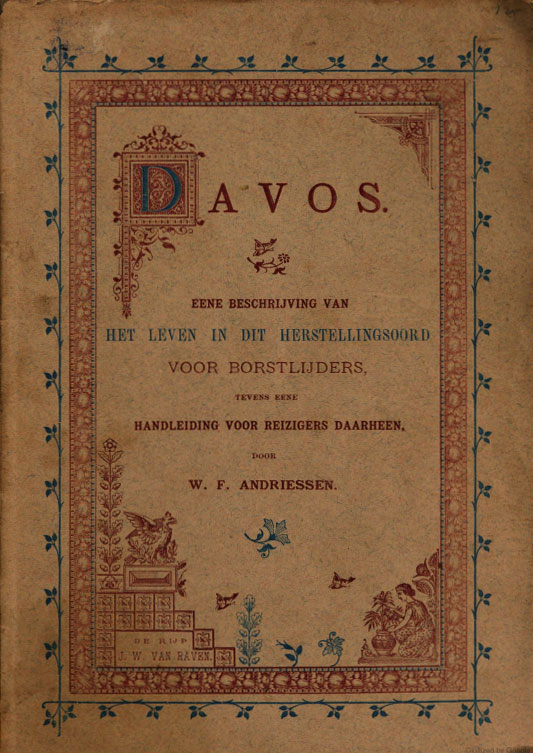
Backtracking a little, not being certain, at first, that the scene on our card was really Davos, we found mention of jeweler Albert Mayer, in the Dutch publication shown below, which is a guide for the treatment center for lung ailments and a travel guide. Description of some of the shops lists Mayer’s as having “the finest gold works, watches and rings,” and just to mention a couple more, a store selling Swiss wood carvings and (one can picture how the author of this booklet was charmed at finding) a flower shop with [Google translation from Dutch] “the most robust little bouquets, even in winter when the trampled snow outside the shops is at least two feet high.”
In the Tracks of Sherlock Holmes
Davos – the pioneer: Winter tourism in the Alps
The Davos sledge: A classic among sports equipment
Teller of Tales: The Life of Arthur Conan Doyle
More musings on the carte details….
Was there some occasion for this photograph, or was it just the occasion of a photographer taking a photo circa 1890s? Note the three people on the second story outdoor courtyard area of the Centralhof building, two ladies on the left and a man on the right. (This from inspection under a magnifying glass – feeling a little Sherlock Holmes-y, for sure….) Other details to note are the duffel-looking bags (maybe mail bags) in front of both Albert Mayer’s and the Brangers’ shop; the poster advertisement – a mustachioed man with epaulets pointing in the distance and young woman just below him, it’s maybe a company name advertised there (almost readable) ; the iron balconies of the Centralhof building; the beautiful horizontal stripe effect of the mason work on the shop fronts….
Sources: Stashower, Daniel. Teller of Tales: The Life of Arthur Conan Doyle. Henry Holt & Co., 1999. Google Books accessed March 31, 2013.
Davos – the pioneer: Winter tourism in the Alps. (www.davos.ch.) Accessed March 31, 2019.
The Davos sledge: A classic among sports equipment. (www.davos.ch.) Accessed March 31, 2019.
Louisa Hawkins. The Arthur Conan Doyle Encyclopedia. (www.arthur-conan-doyle.com) Accessed March 31, 2019.
Huntford, Roland. Two Planks and a Passion: The Dramatic History of Skiing. Continuum UK, 2008. Google Books accessed March 31, 2013.
Rosenblatt, Albert and Julia. “In the Tracks of Sherlock Holmes.” Skiing. February 1982. pp. 74-78. Google Books accessed March 31, 2013.
Andriessen, Willem Frederik. Davos: eene beschrijving van het leven in dit herstellingsoord voor borstlijders. Van Raven, 1888. p. 56. Google Books accessed March 31, 2013.
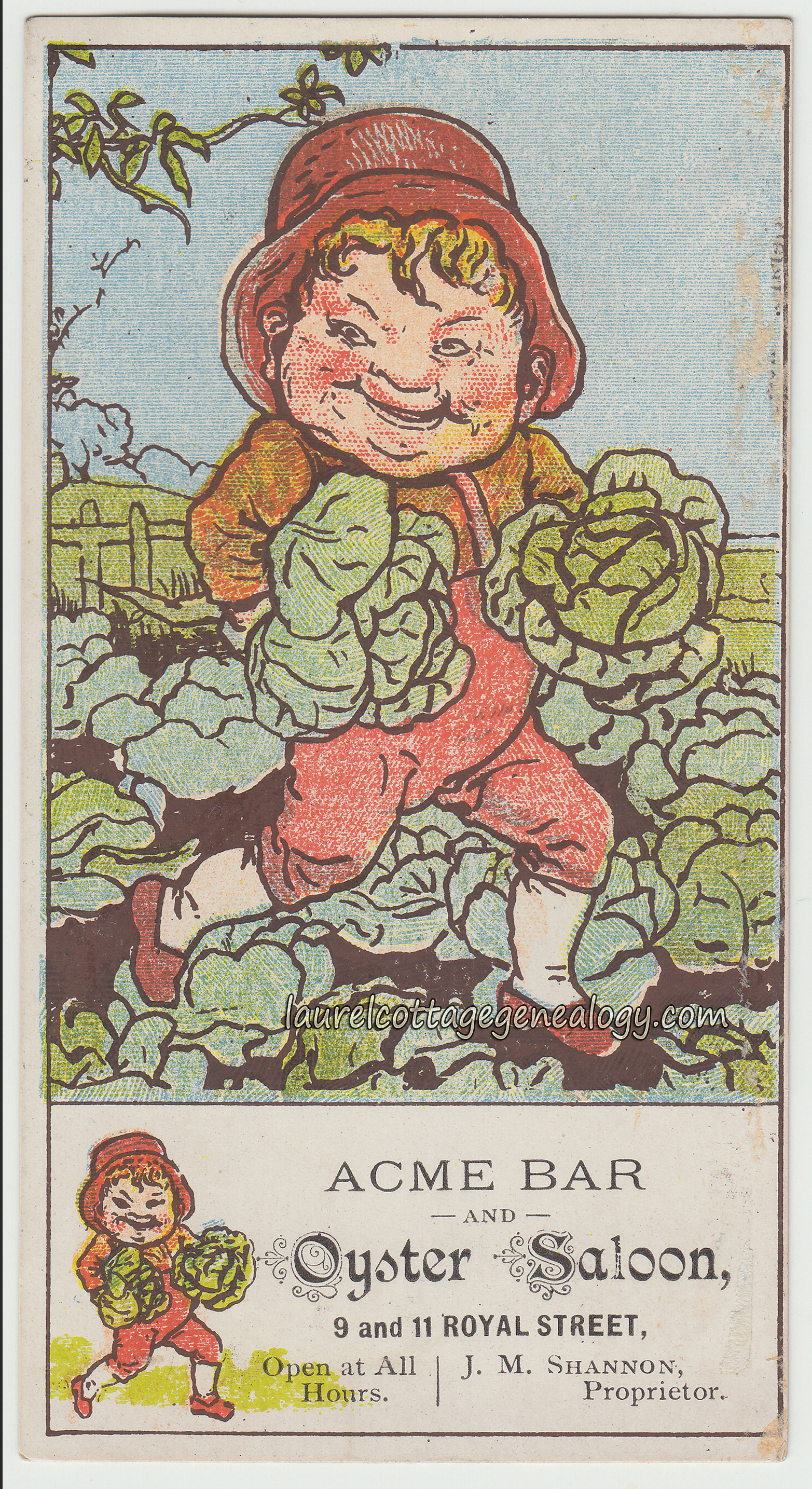
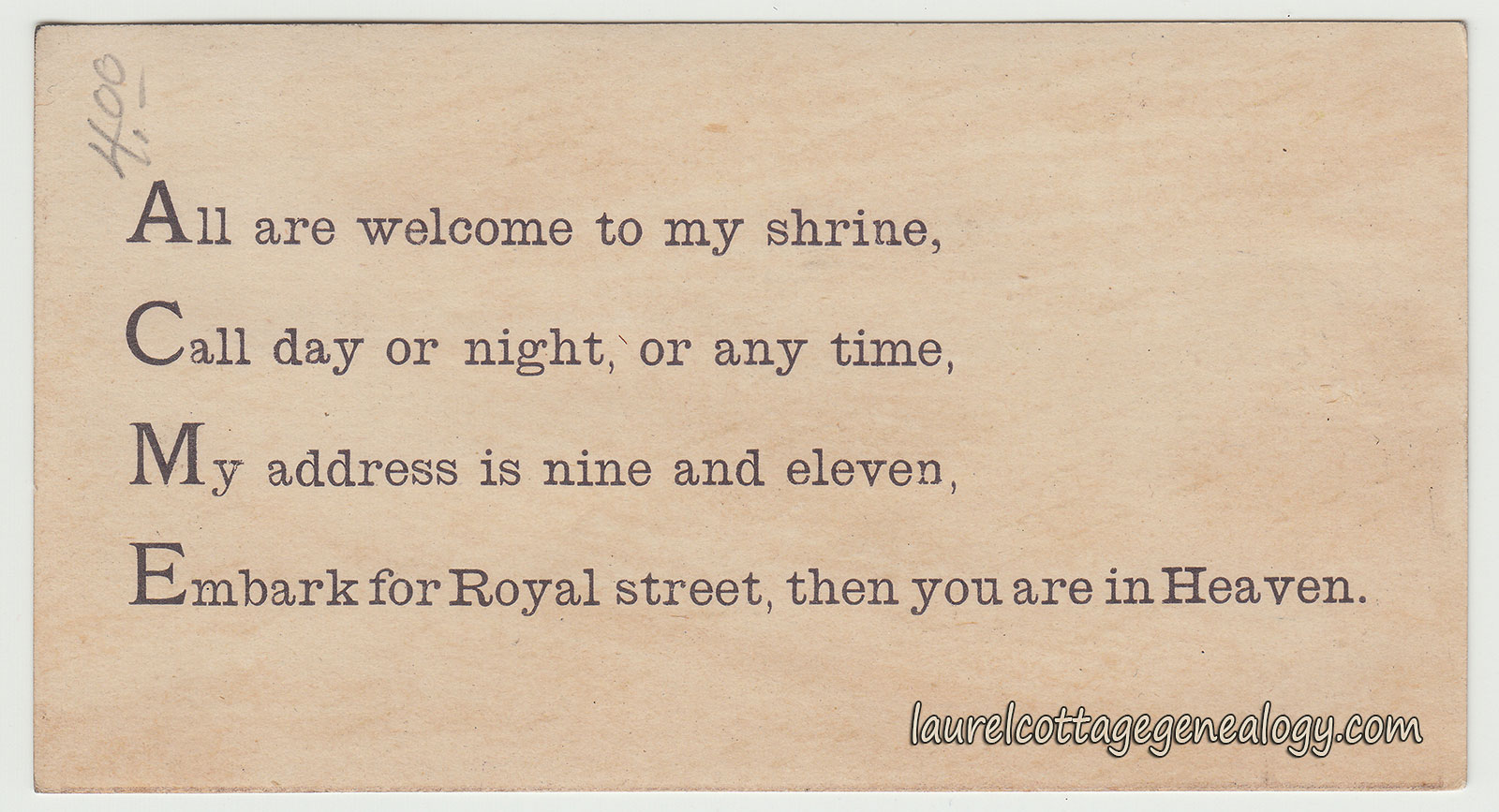
Trade card, circa 1882 – 1883, New Orleans, Louisiana.
Price: $15.00 Size: 2 and 1/2 x 4 and 5/8″
Acme Bar and Oyster Saloon. 9 and 11 Royal Street, Open at All Hours. J. M. Shannon, Proprietor.
“All are welcome to my shrine,
Call day or night, or any time,
My address is nine and eleven,
Embark for Royal street, then you are in Heaven.”
I’ve been away from posting new items a ridiculously long time, too much of the regular job rolling around upstairs and the laundry and dishes and gardening, etc. threatening to overtake, as usual. Or, at least that’s how it’s seemed. But back now, so here’s a leprechaun in a cabbage patch for St. Patrick’s Day, put out by J. M. Shannon, proprietor of the Acme Bar and Oyster Saloon. Oysters were big back in the day! My own great-grandmother, Sarah Durning, worked for a short time at the W. H. Dewey Ice Cream and Oyster House in Detroit, so we believe, from a city directory entry in 1880. Anyway, that’s nothing to do with J. M. Shannon’s Acme, but just mentioning, because Sarah was of Irish descent, like Shannon must have been. Notice how the first letters of the verse above spells ACME. Clever!
So, where was the Acme Bar and Oyster Saloon? New Orleans and that’s a fact. There’s an Acme Oyster House in the French Quarter, present-day, established 1910, and one would think there might be a connection, at least as inspiration, since as we found out from newspaper clippings, the 19th-century Acme business had been a popular one of pretty long-standing, though it had changed ownership multiple times.
Appearing in the St. Tammany Farmer, April 21, 1883:
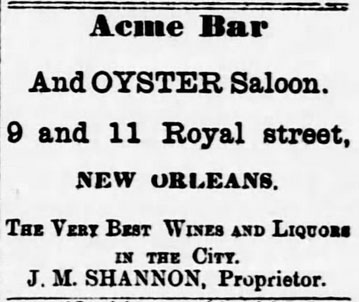
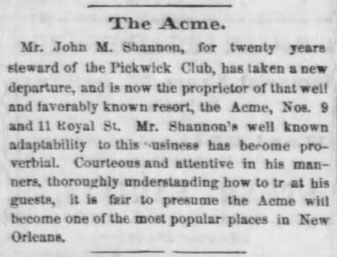
Below, two clippings from Commercial Bulletin, Price-Current and Shipping List. July 5, and July 12, 1882:
John M. Shannon, prior steward of the Pickwick Club
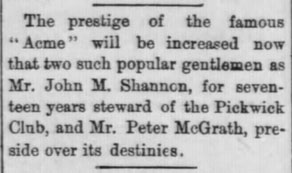
John Shannon, along with Peter McGrath to be more precise
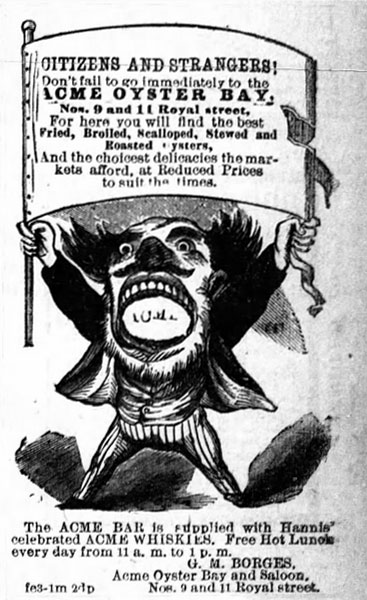
Prior to Shannon in 1882-’83 we find the Acme Saloon, aka Acme Oyster Bay and Saloon under Gerome M. Borges, proprietor, circa 1876 – 1878, per city directories. This gem of an ad below is clipped from The New Orleans Daily Democrat, February 13, 1877:
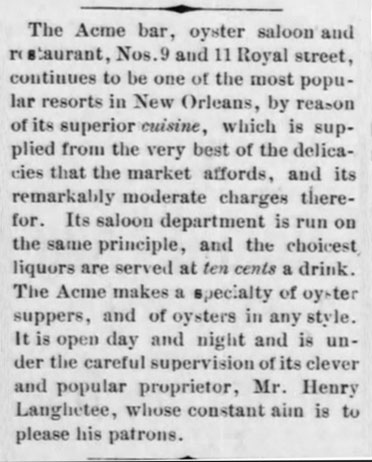
Appearing in the Louisiana Review, September 11, 1889, the Acme was owned by Henry Langhetee:
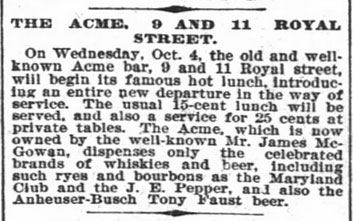
By at least October 1893, the Acme had changed ownership again, this time to James McGowan, well-known in the New Orleans, according to the clipping below:
Sources: “Acme Bar.” St. Tammany Farmer, April 21, 1883. Saturday, p. 3. (Newspapers.com).
“The Acme.” Commercial Bulletin, Price-Current and Shipping List. July 5, 1882. Wednesday, p. 2. (Newspapers.com).
“The prestige….” Commercial Bulletin, Price-Current and Shipping List. July 12, 1882. Wednesday, p. 2. (Newspapers.com).
L. Sourds & Co.’s New Orleans City Directory, 1878. Page 97. Ancestry.com. U.S. City Directories, 1822-1995.
“Citizens and Strangers!” The New Orleans Daily Democrat, February 13, 1877. Tuesday, p. 4. (Newspapers.com).
“The Acme bar, oyster saloon and restaurant.” Louisiana Review, September 11, 1889. Wednesday, p. 6. (Newspapers.com).
“The Acme, 9 and 11 Royal Street.” The Times-Picayune, October 2, 1893. Monday, p. 8. (Newspapers.com).
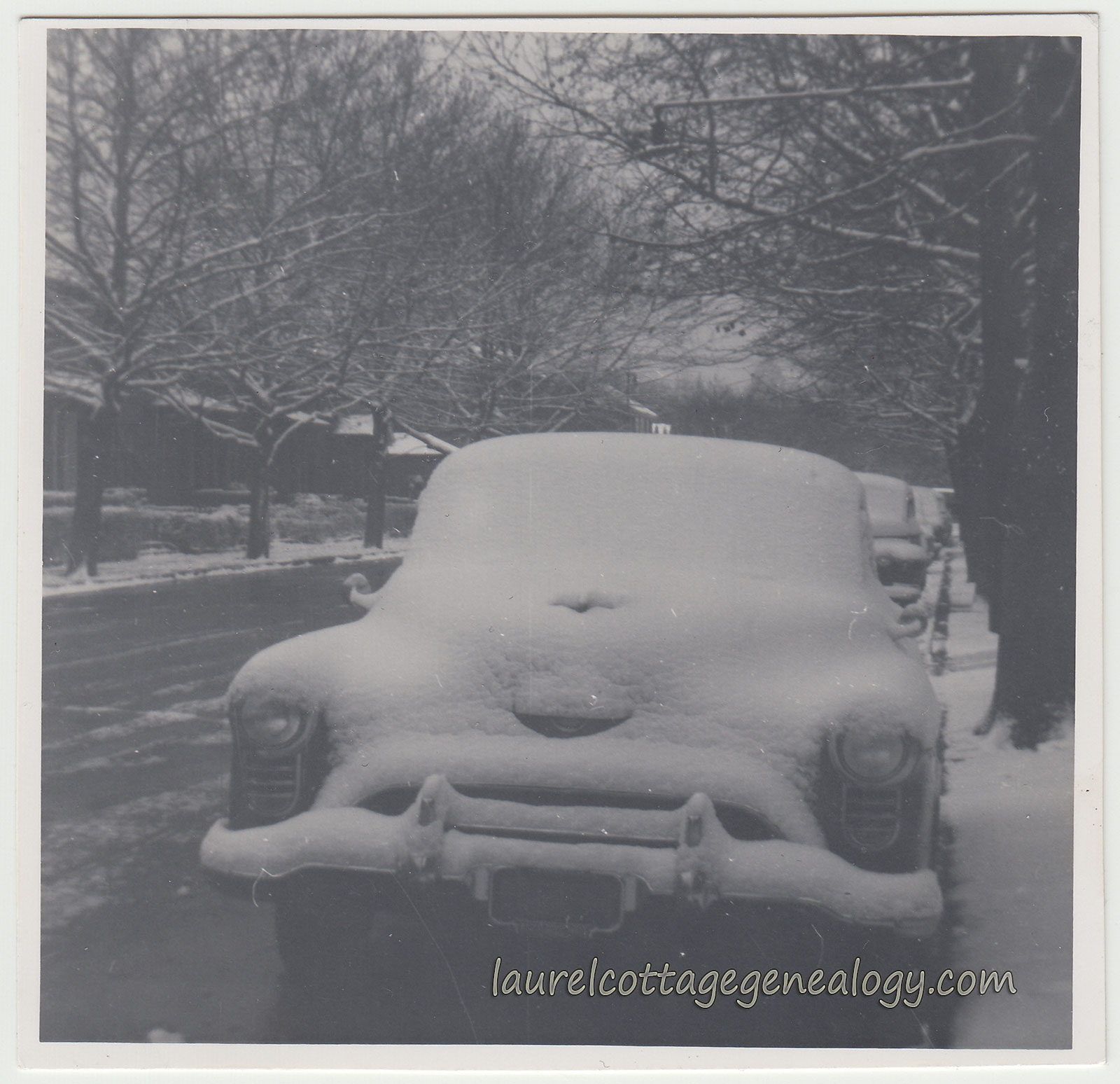
Old photograph, 1949 – 1950s.
Price: $3.00 Size: 3 and 3/16 x 3 and 1/16″
This is definitely an Oldsmobile, maybe a 1949 or ’50 Series 76 or a 1951 Oldsmobile 88. The styles were very similar for those three years, but it’s not the ’52 due to the front bumper re-design at that time.
This image brings back lots of memories! Michigan, a wet cold, pushing off mountains of snow from the car, getting snow under your sleeves, scraping at the ice on the windshield while waiting for the car to heat up….the scraper was either the short one with the pale yellow handle (but the scraper part was the color of an icicle) or the long one with the brush along one end (the brush didn’t do well with heavy inches, thus you resorted to using your arm.) The fun sometimes, riding with Dad while he let the car slide a little on the ice, on purpose. The not-so-fun part of getting stuck – it was especially tricky going around the “islands” but an old rug under that spinning tire worked good (if you’d remembered to put one in the back seat). And there was the camaraderie of neighbors helping each other, the Good Samaritan coming along and pushing while you finessed the gas pedal…..and then what stands out for me (some pride here) as the ultimate winter driving experience – the city didn’t have the money to plow our residential streets, so we were forced to learn (knowledge is power) how to share that one and only set of tire tracks (that had been carved out previously by prior vehicles) when meeting an oncoming car. A beautiful thing – you and the other driver – the recognition, the skill (when there was a lot of snow) and the feeling of unity/harmony/good will/accomplishment, relief if the snow was really deep (you’d gotten by each other unstuck and unscathed) and that little bit of pride – who needs snowplows?
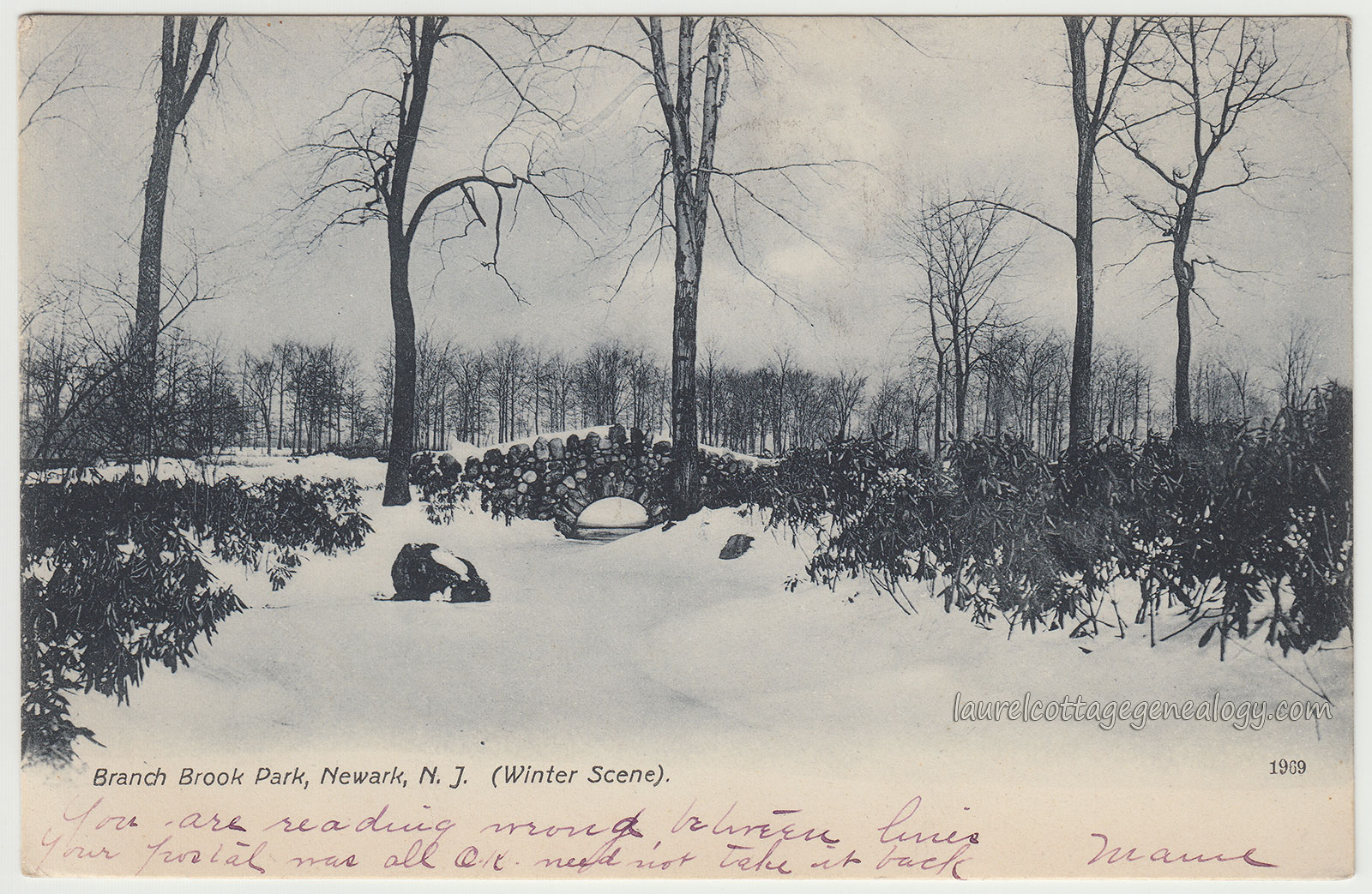
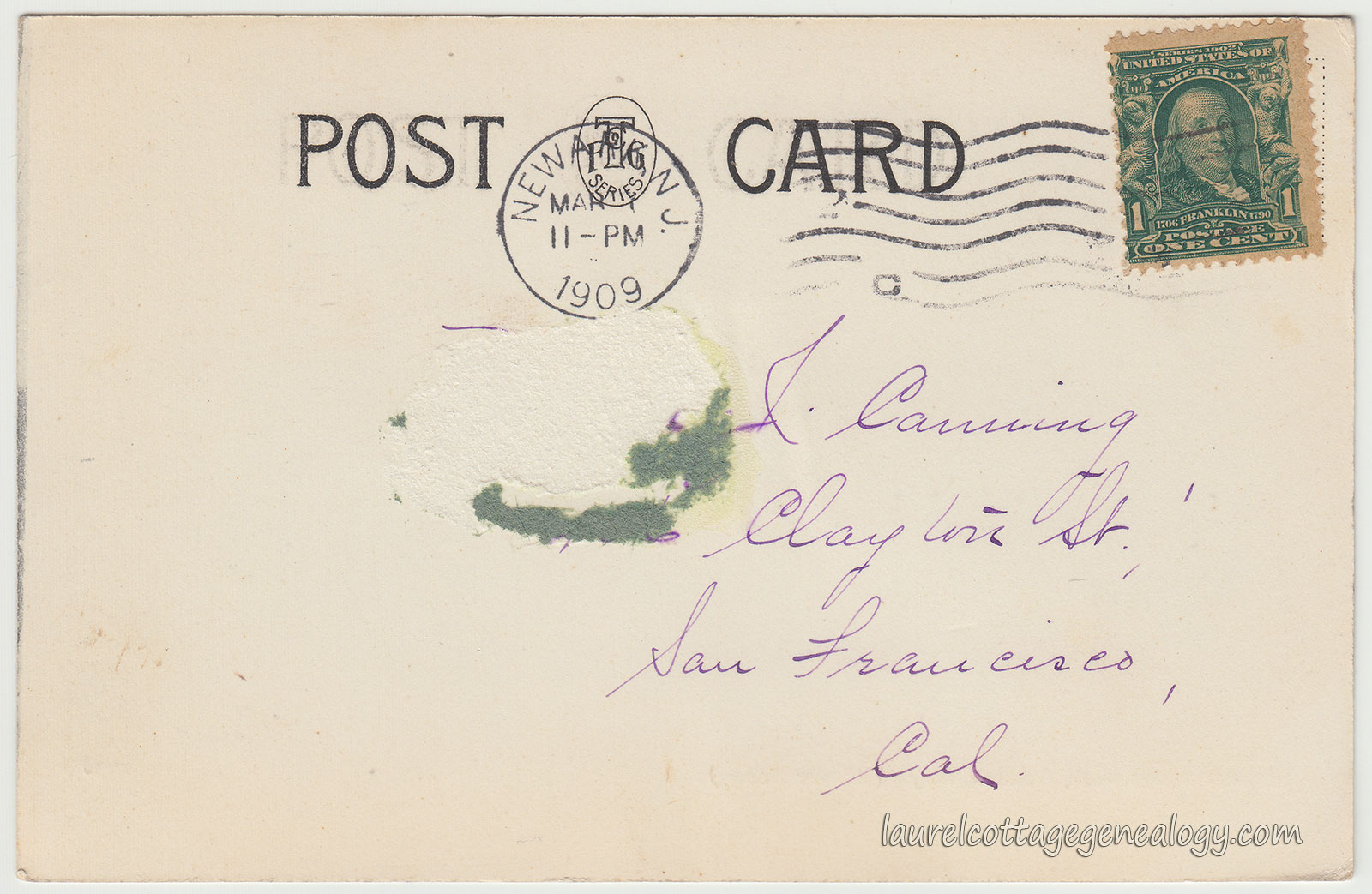
Undivided back postcard. Series or number 1969. Postmarked March 7, 1909.
Price: $5.00
Branch Brook Park is known for its Cherry Blossom Festival and was the first county park in the United States.
Though the postmark is dated 1909, this card would have been produced prior to the change in U.S. postal regulations in December 1907, which saw the advent of the Divided Back cards.
On the reverse, part of the address is unreadable, looks like this postcard was once glued in an album or just had something stuck on the back. But….mystery solved: We actually have another Canning postcard with the full name on it. So, our card above would have been addressed to either (or both) Mr. M. J. Canning (Montgomery J. Canning) or Mrs. M. J. Canning (Louise Canning). The address from the 1909 city directory was 406 Clayton St., San Francisco, California.
See Surprise Us – Write for more on the Cannings.
Reading wrong between the lines….
Straight to the point with a rather catchy phrase, the sender (Mame?) wrote: “You are reading wrong between lines. Your postal was all O.K. need not take it back. Mame”
Sources: Branch Brook Park. n.d. https://en.wikipedia.org/wiki/Branch_Brook_Park (accessed January 13, 2019).
Crocker-Langley’s San Francisco Directory for 1909, p. 362. Ancestry.com. U.S. City Directories, 1822-1995.
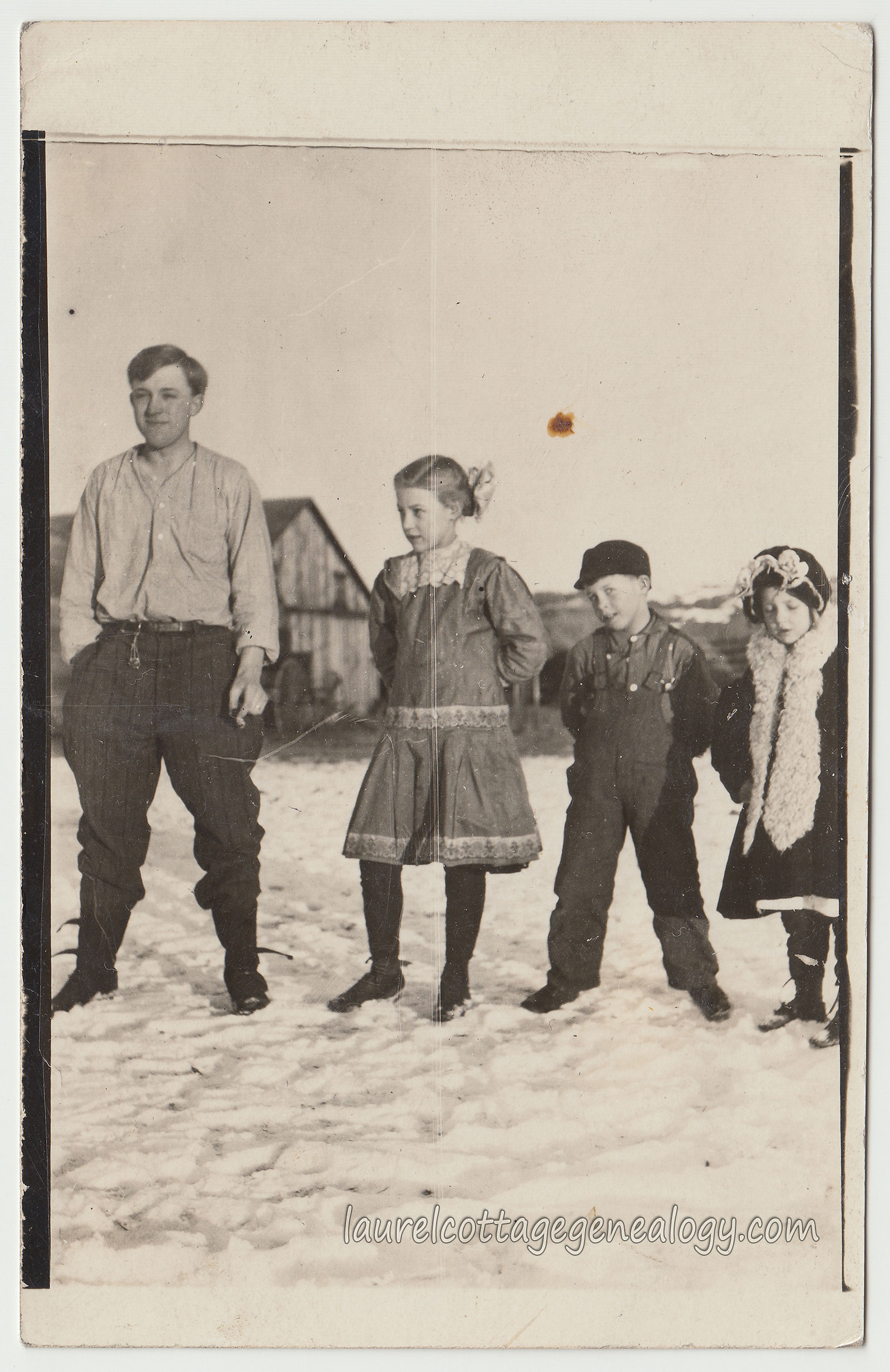
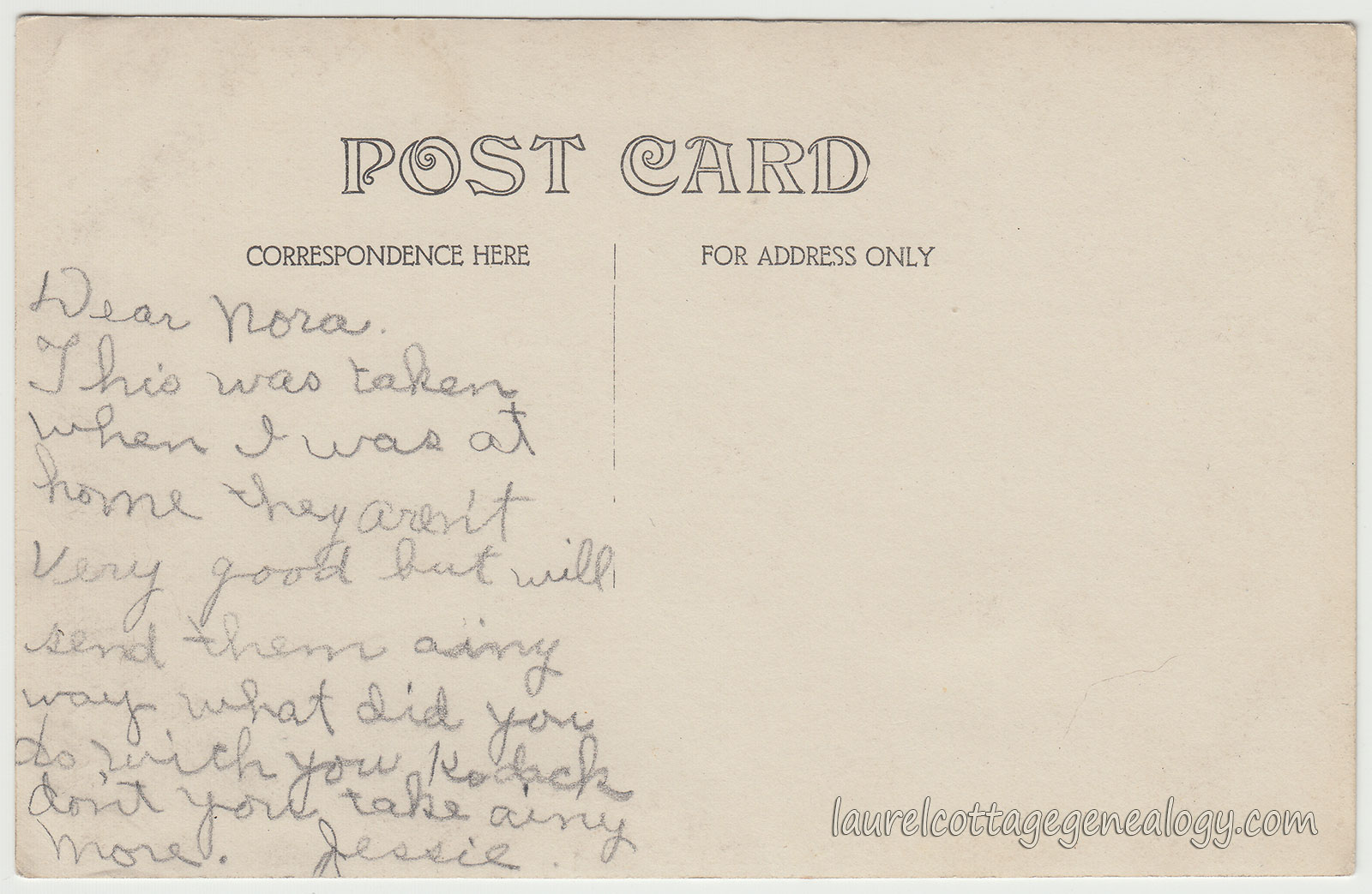
Divided back, Real Photo Postcard. Unused, circa 1910s.
Price: $6.00
“Dear Nora. This was taken when I was at home. They aren’t very good but will send them any way, what did you do with you Kodack, don’t you take any more. Jessie”
Sounds like Jessie had more postcards or photos that she had sent to Nora, and funny, but oftentimes we see the sender leaving off question marks in their message. In this case, Nora was asking what Jessie had done with her Kodak camera, isn’t she taking any more photos? No last name or location for this image, but it’s so charming. Wintertime or maybe early spring on the farm: Posing for the shot, three beautiful children, and a handsome young man, (who looks to be about sixteen, I thought, but click to enlarge, and you’ll notice it looks like he wears a wedding ring.) I love it when everyone in a photo is looking in different directions.
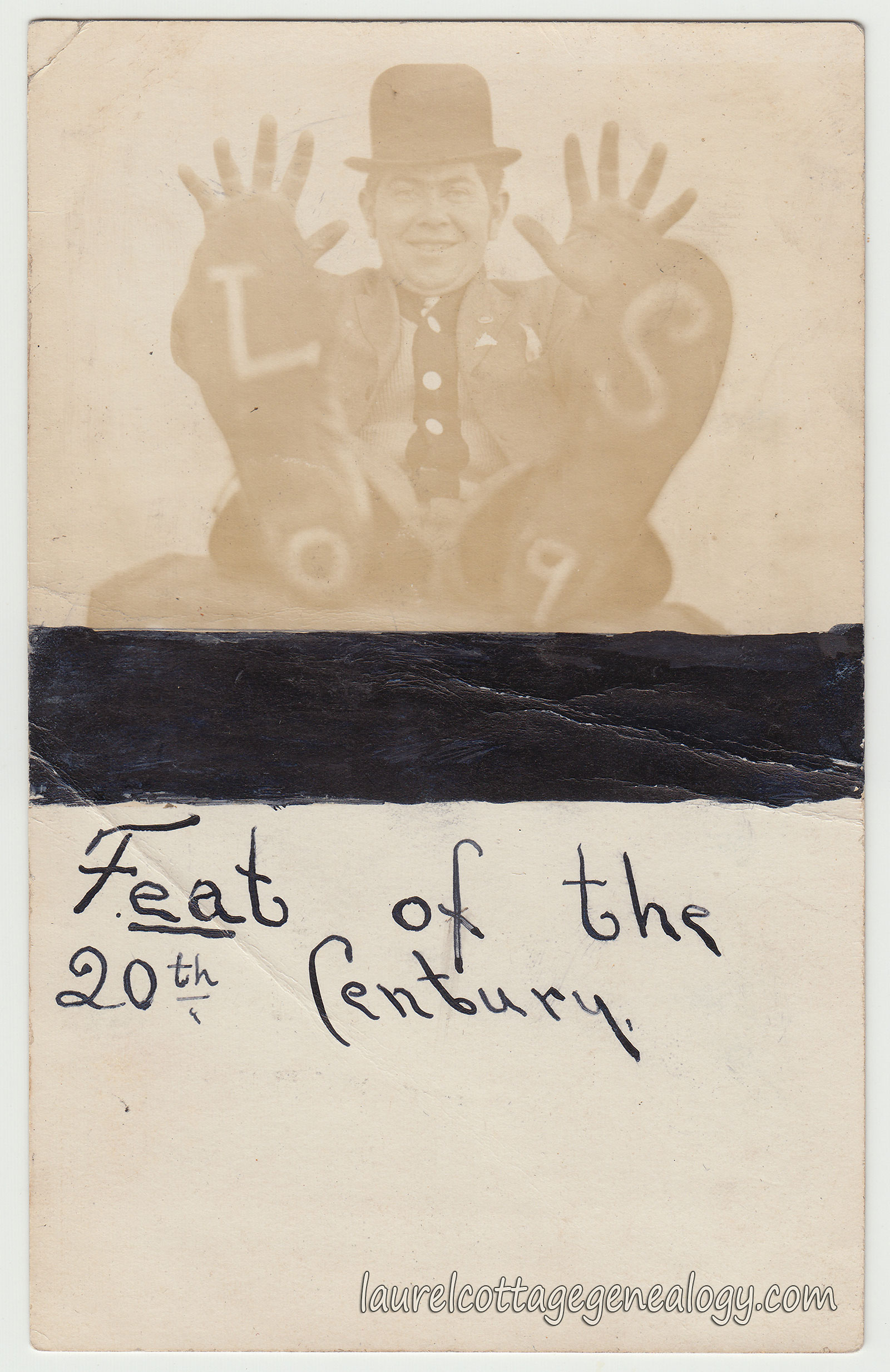
Divided back, used Real Photo Postcard. Velox stamp box. 1909.
Price: $12.00
A young gentleman in a suit jacket, button down sweater and derby hat displays his sense of humor. The letters “L” and “S” on the soles of his shoes are maybe his initials, and the 09 is likely for the year 1909. And it’s the way the shot was taken that makes his shoes appear so large. This would be a great card to include in a book on humor in postcards or something similar, especially because it was “homemade” so to speak. That is, an original idea, produced with instructions for the printing company. The blacked-out part was probably to cover the rest of the photo, which whatever it showed, must have detracted from the overall effect; if you click to enlarge you can see a little bit of the brown background at the bottom of the heavy black stripe in a couple of places.
© 2026 Laurel Cottage Genealogy All Rights Reserved. Proudly powered by WordPress.