Genealogy Services, Old Photos, Postcards, Trade Cards, Etc.

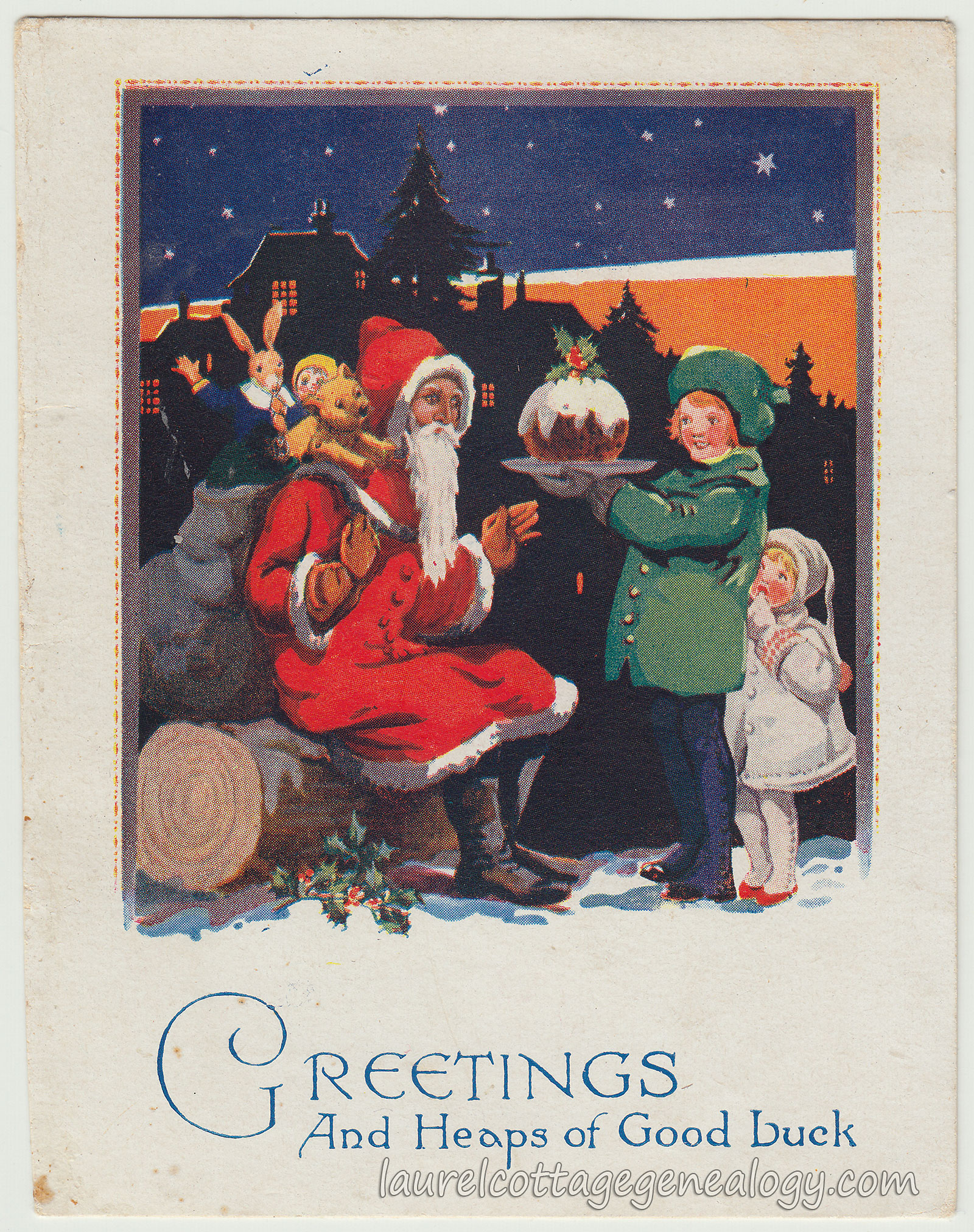
Greetings And Heaps Of Good Luck

Christmas card, publisher and date unknown. Circa 1900s – 1930s.

Price:  $4.00       Size:  About 3 and 1/4 x 4 and 1/4″

In looking up Christmas pudding images we linked to a lovely website (one of many, for sure, but we stopped at the one) with a recipe, and discovered an unlooked-for but welcome answer to the full meaning behind the title of the card:  A silver coin or trinket was traditionally baked into the dessert and whoever found it was supposed to be granted good luck. How nice that the children are offering the dessert to Santa (a skinny Santa, at that). And he must be taking a break from deliveries, as he still has toys spilling out of his very full bag of goodies. Back to the pudding – not a pudding in the American sense, but in the British use of the word (a dish, either savory or sweet, that’s steamed or boiled in something). In this case, a steamed cake made weeks ahead with dried fruit and spices…..then topped with brandy and set aflame (remember the scene in Dickens’ A Christmas Carol?) then topped off with cream sauce and garnished with holly.

Sources:   “Traditional British Christmas Pudding (a Make Ahead, Fruit and Brandy Filled, Steamed Dessert).” December 3, 2016. (www.christinascucina.com).

Nelson, Libby. “British desserts, explained for Americans confused by the Great British Baking Show.” November 29, 2015. (www.vox.com).
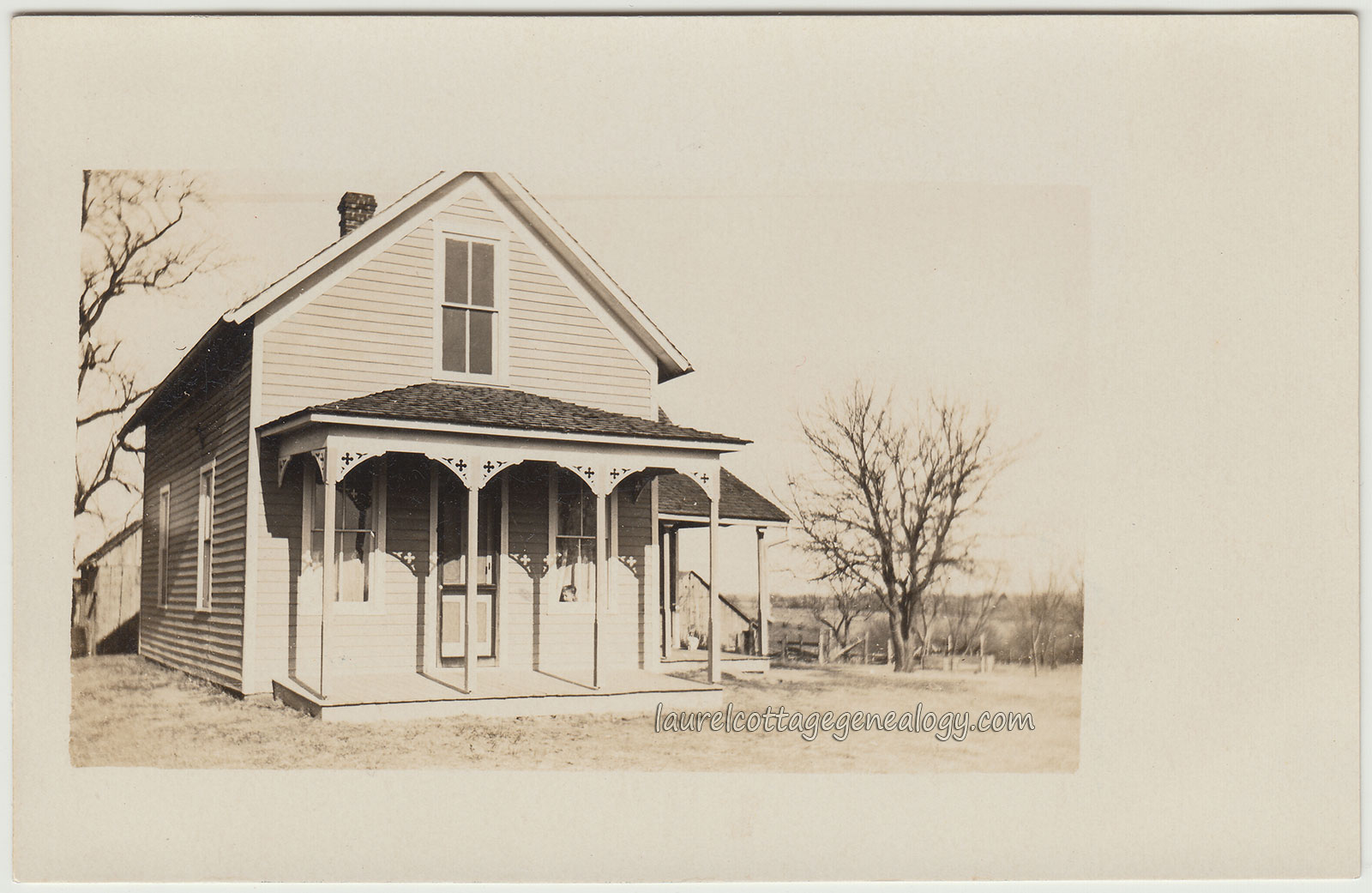
A Folk Victorian Home, About 1910

Divided back, Real Photo Postcard. Unused. KRUXO stamp box. Circa 1908 – 1910.

Price:  $10.00

Someone correct me if I’m wrong, but I believe this house style is Folk Victorian. Two such features are the lace-like decorative spandrels (side-brackets) that help form the archways on the front porch and porch posts that are either turned spindles, or in this case, square with chamfered (beveled) corners. Enlarge the image twice to see the detailing. The thing that seemed weird at first, to me anyway, is that each porch support appears to rest on a short and very narrow piece. Seems like that would be the opposite of what any builder would want to do. However, I’ve been informed that those narrow pieces are likely steel secured from below and going up into each post. The advantage is that rain won’t collect as in a wood-on-wood situation, won’t pool underneath and rot the deck and won’t wick up to create rot in the wooden posts . Smart builder and/or designer!

Other details: We see part of a barn on our right, behind the house, and part of maybe an outbuilding on our left. And….not really noticeable at first, there’s a little boy in one of the windows! Too bad there is no identifying information on the back of the card, but it’s such a nice house, looking brand new, and so charming, almost like a doll house that was just set down on someone’s farmland.

The estimate of the postcard date was determined from scrutiny of the KRUXO stamp box examples online at Playle.com. (Two examples are really similar but I think ours is like the one Playle’s has dated 1908 to 1910.)

Sources:  McAlester, Virginia, and Lee McAlester. A Field Guide to American Houses. 1984. New York:  Alfred A. Knopf, 1990. Print.

Real Photo Postcard Stamp Boxes. K-L. Playle.com. (accessed December 12, 2020).

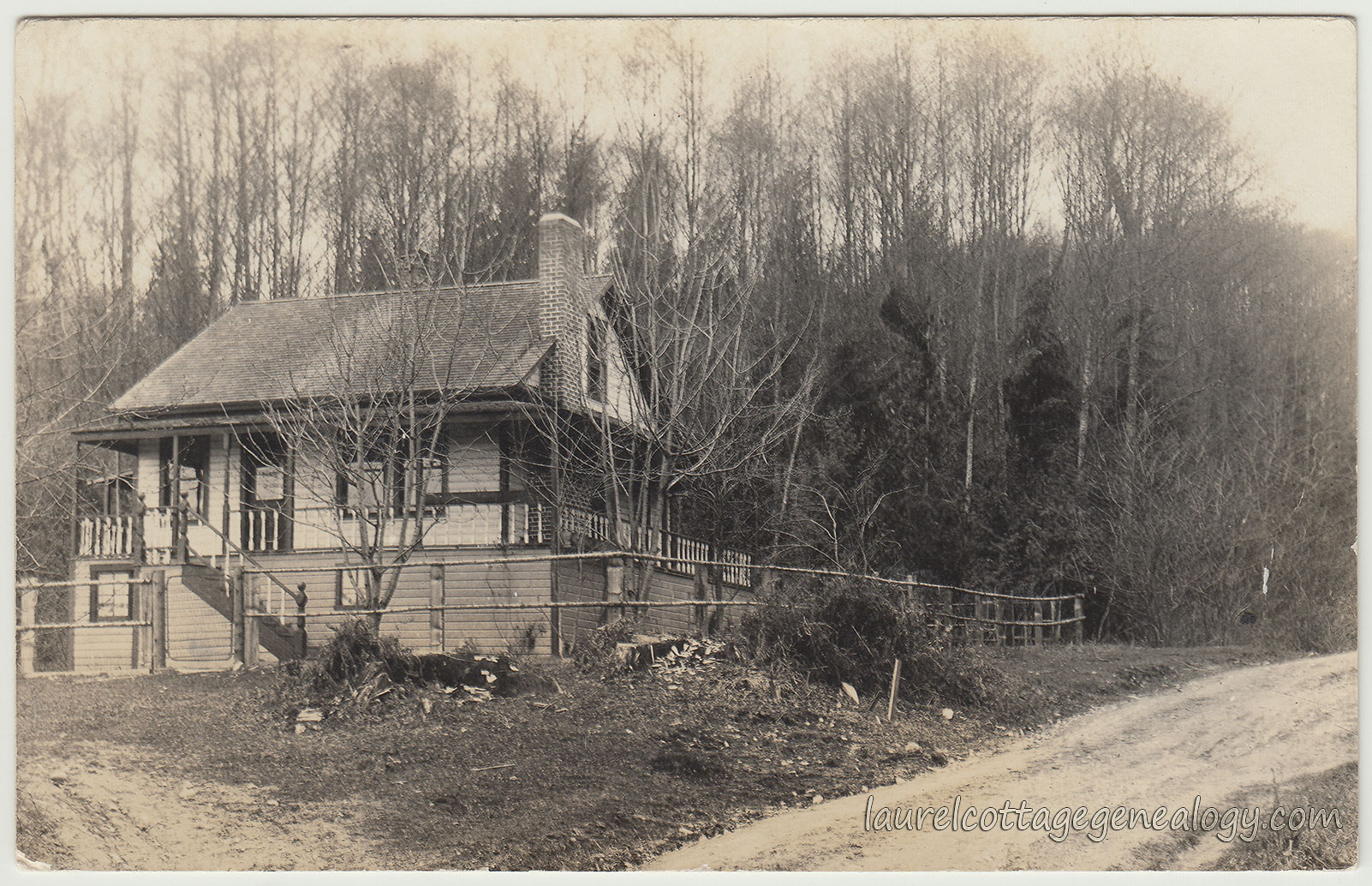
Fannie and Walter’s House

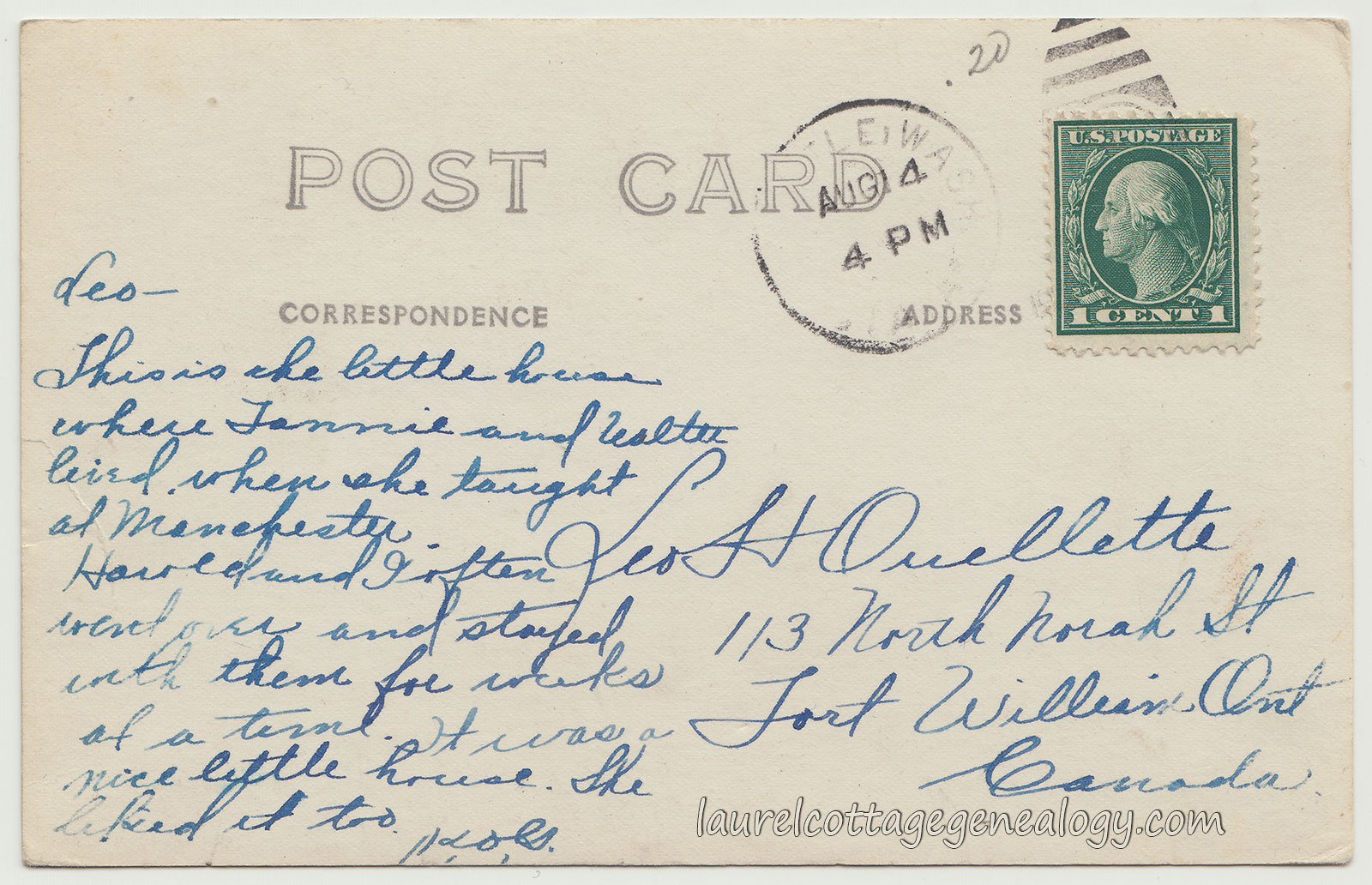
Divided back, Real Photo Postcard. Postmarked August 4th from Seattle Washington. Year not readable. Circa 1910s – 1926.

Price:  $7.00

Addressed to:   “Leo H. Ouellette. 113 North Norah St. Fort William Ont. Canada.”

“Leo – This is the little house where Fannie and Walter lived when she taught at Manchester. Harold and I often went over and stayed with them for weeks at at time. It was a nice little house. She liked it too. [signature not readable] ”

A very nice little house, indeed, and with a wrap-around porch! No luck in finding out the surname of Fannie (or Frances) and Walter, though. And we’re not sure if Manchester was the name of a school or a town, but either way, no definite results were found. If a town, then likely it’s the Manchester that’s west of Seattle, across Puget Sound. And though this photo was postmarked in August, it must have been taken in winter – note the bare deciduous trees.

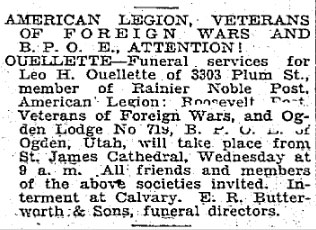
The address of Leo Ouellette, 113 Norah St. N., appears to be an empty lot today, in what was formerly Fort William, now the city of Thunder Bay. Leo’s obit appears below. He was born April 16, 1893 in Duluth, Minnesota, father’s name Henry, and died January 23, 1927 in Seattle. His WWI Draft Registration Card, dated Jun 5, 1917, shows he was, at that time, single, living in Evanston, Wyoming and employed as a brakeman for the Union Pacific Railroad. His prior service was two months in the National Guard in Colorado. (B. P. O. E. in the notice below, stands for Benevolent and Protective Order of Elks.)

Sources:  Fort William, Ontario. n.d. https://en.wikipedia.org/wiki/Fort_William,_Ontario (accessed December 12, 2020).

Microfilm. Washington State Archives, Olympia, Washington. Ancestry.com. Washington, U.S., Death Records, 1883-1960.

Registration State: Wyoming; Registration County: Sweetwater County. Ancestry.com. U.S., World War I Draft Registration Cards, 1917-1918.

Seattle Daily Times, January 25, 1927. Tuesday, p. 21. (genealogybank.com).

Near Hornbrook, California, 1910

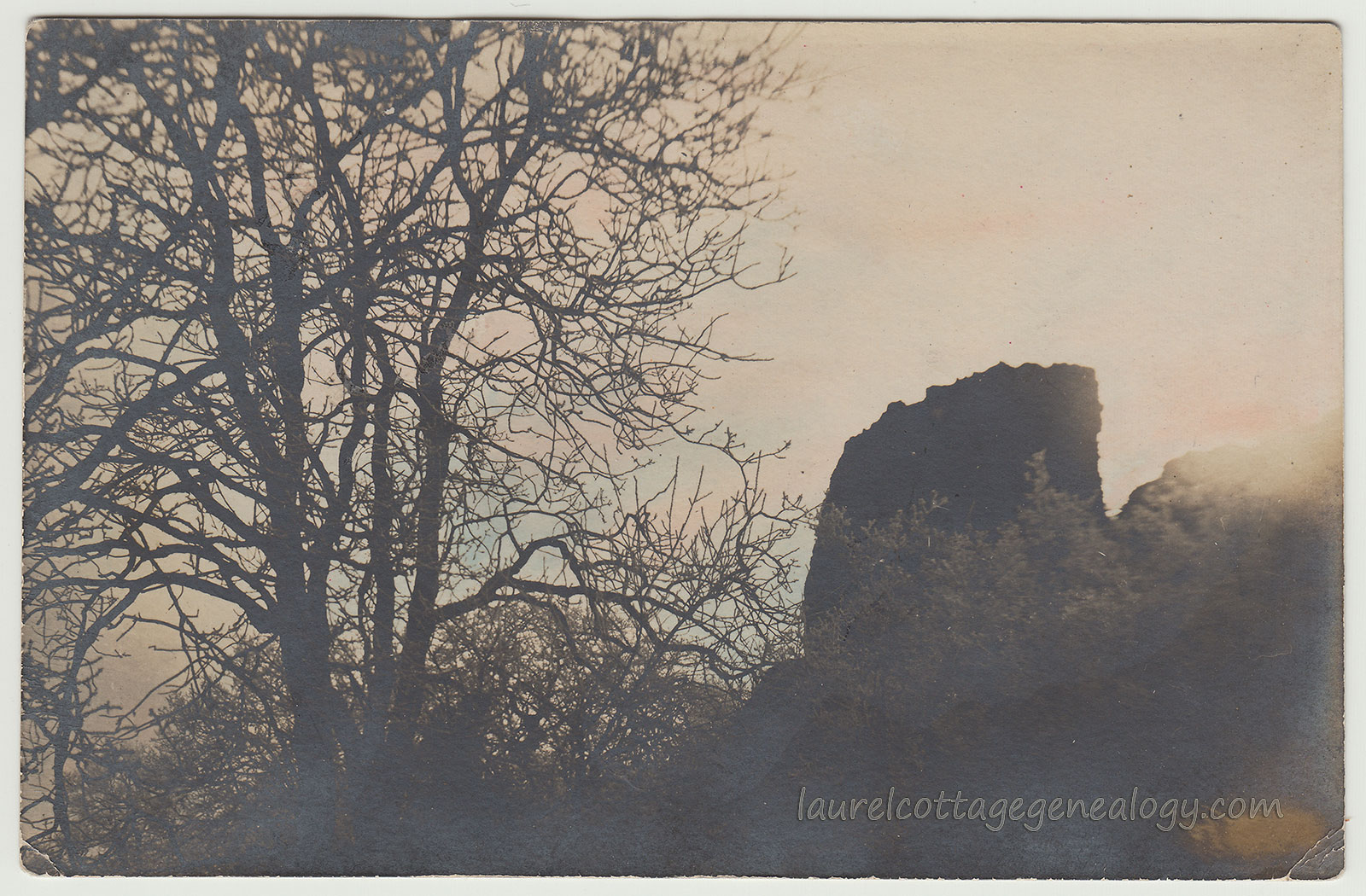
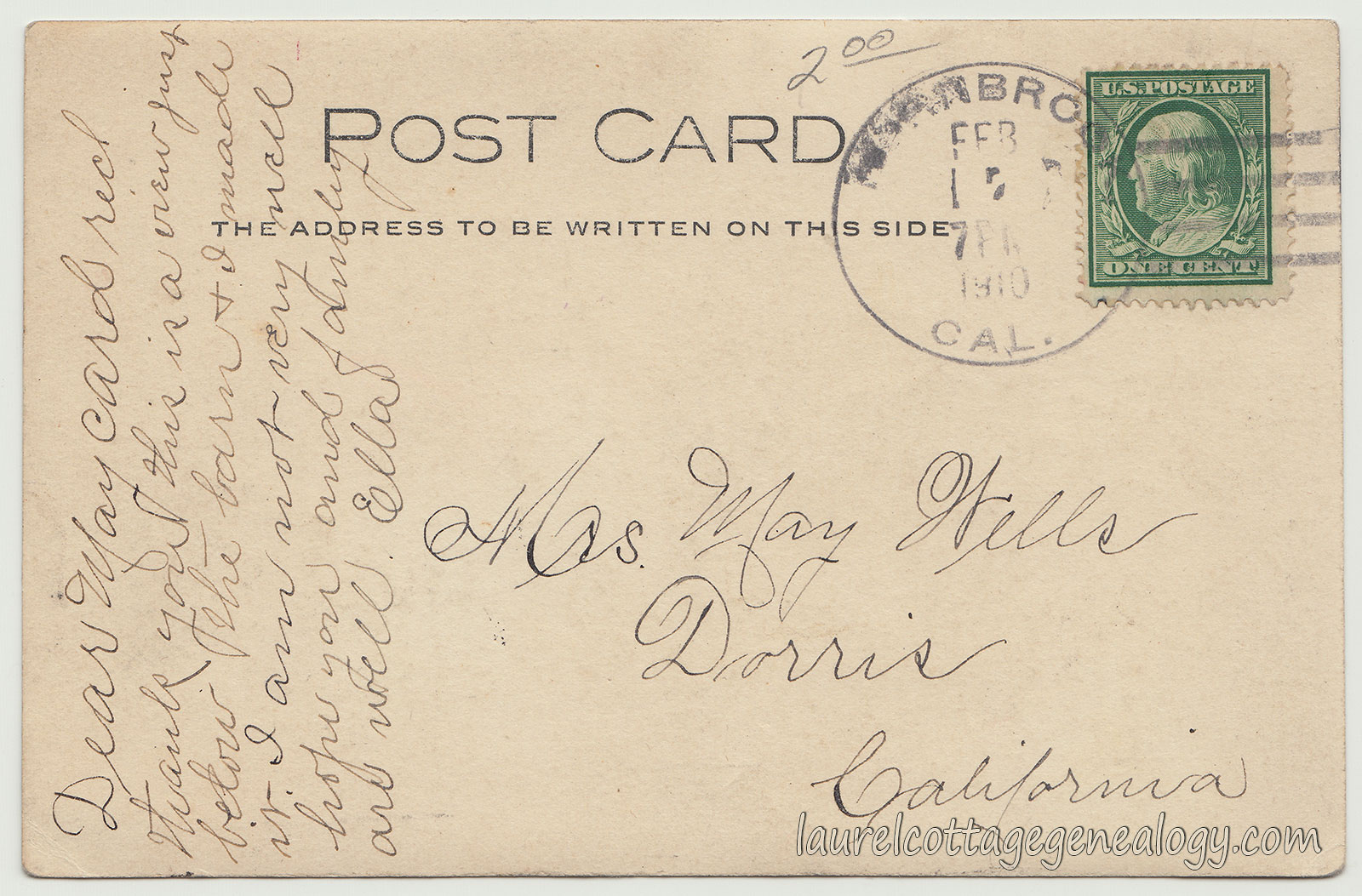
Real Photo Postcard. Postmarked February 17, 1910 from Hornbrook, CA.

Price:  $8.00

Addressed to:   “Mrs. May Wells. Dorris, California”

The sender wrote:   “Dear May card red thank you. this is a view just below the barn & I made it. I am not very well hope you and family are well. Ella”

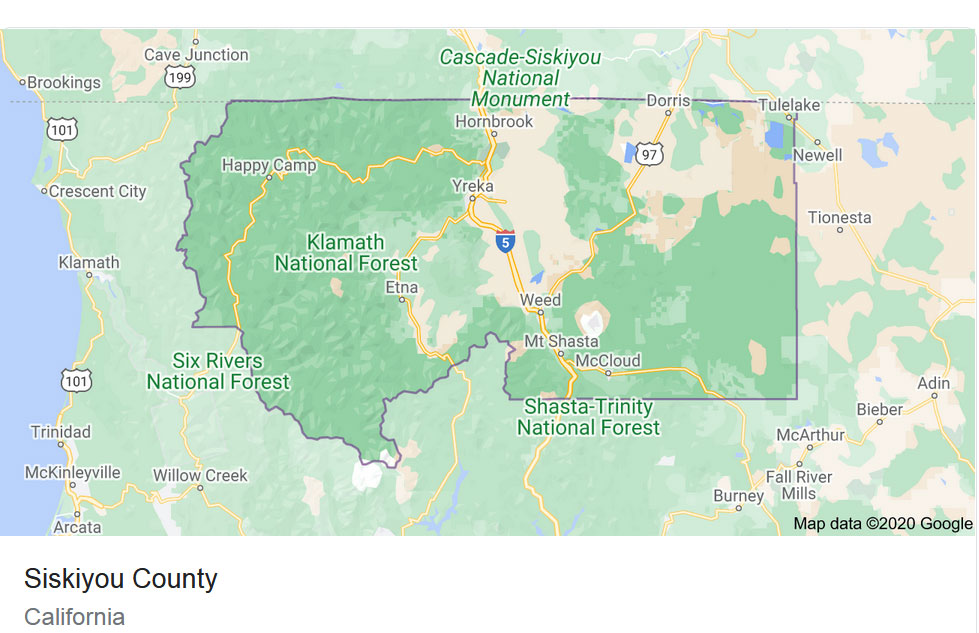
Gosh, we hope Ella felt better very soon after she wrote the above! She did a good job with the photo. And it’s nice to have the approximate location of this scene, (from the postmark) but I would have picked this card up regardless. Something about the silhouette of a tree always grabs me, and I’m forever taking similar shots only to look at them afterward and think that the photo didn’t do them justice, but still. And how can it when we live in 3-D but our photography is not? Anyway, both Hornbrook and Dorris are located up by the Oregon border in Siskiyou County, map below. If you’re like me, you’ve done a double-take on the county shape, it looks a little like Montana with a much larger “Idaho” on the left in lighter green.

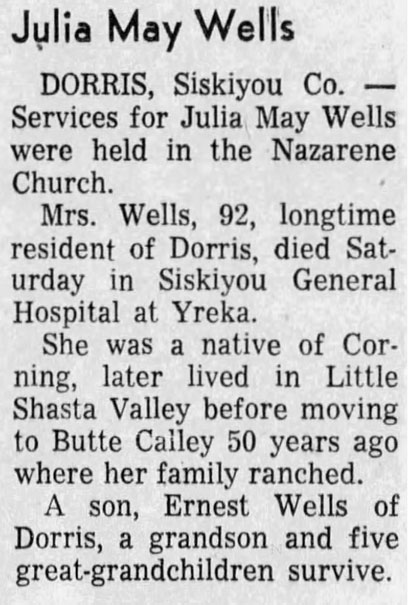
May Wells was Julia May (maiden name Osborn according to family trees), born about 1879 in Corning, CA. She married David Wells and they had a son, Ernest David Wells, born in 1908. May’s obit was found online and appears below. (That should say Butte Valley, not Calley.)

Sources:  Year: 1910; Census Place: Lake, Siskiyou, California; Roll: T624_108; Page: 11A; Enumeration District: 0111; FHL microfilm: 1374121. (Ancestry.com).

Siskiyou County, California. Map from Google.com search. Accessed December 12, 2020.

“Julia May Wells” The Sacramento Bee, October 14, 1971. Thursday, p. 25. (Newspapers.com).

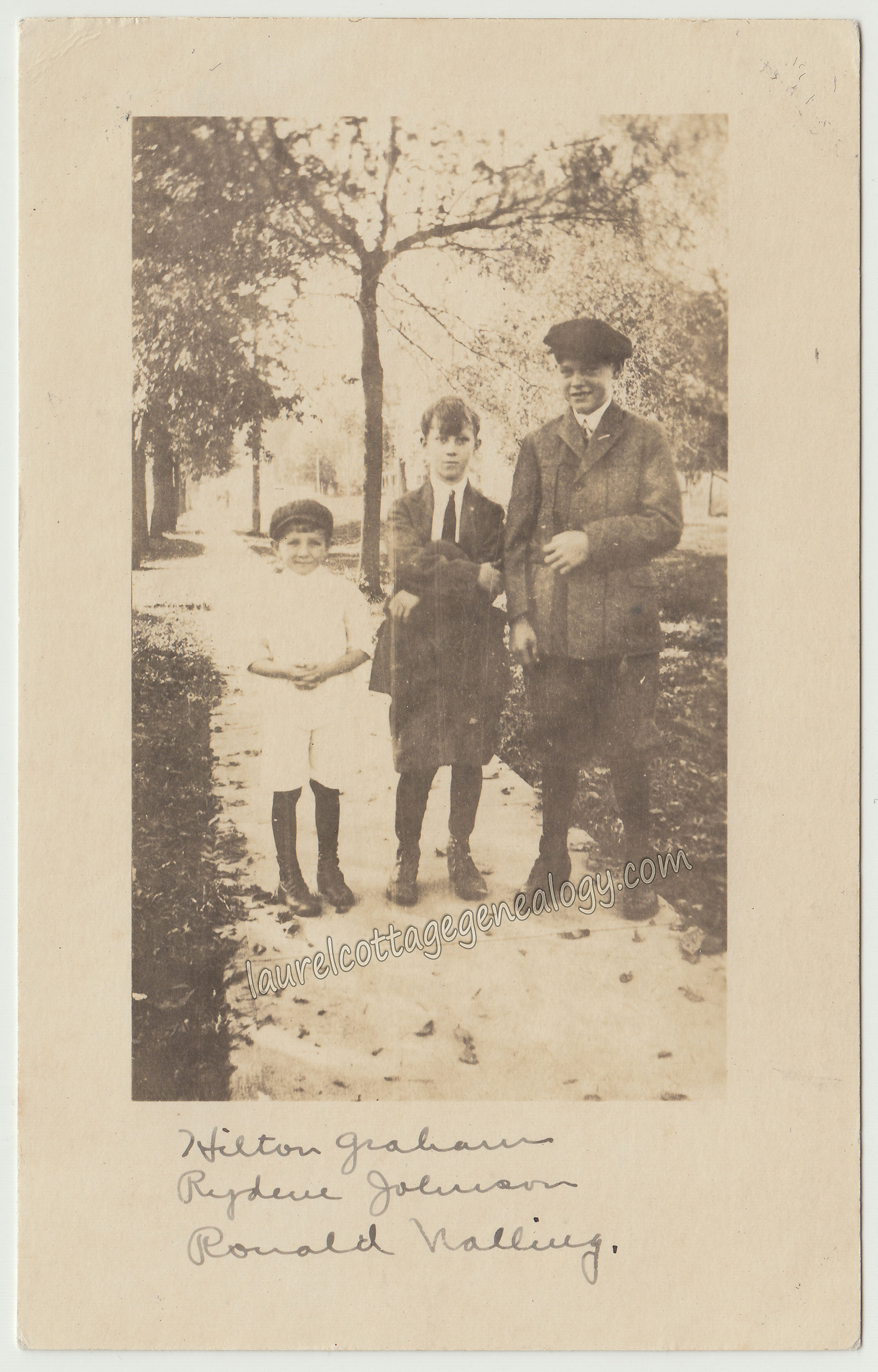
Hilton Graham, Rydene Johnson and Ronald Walling

Divided back, unused Real Photo Postcard. AZO stamp box. Circa 1913.

Price:  $15.00

Pals and neighbors….

From the 1910 Federal Census for Durand, Winnebago County, Illinois:  Hilton Graham, son of John H. and Nellie Graham, was born in Illinois, about 1908; Rydene Johnson, son of Elof and Julia M. Johnson, was born in Illinois, about 1904; and Ronald D. Walling, son of Laura Walling, was born in England, about 1902. We’re judging Hilton to have been about five years old in this photo, thus estimating the date it was taken as about 1913. Hilton and Rydene appear on the same census page and Ronald on the next page over.

Source:  Year: 1910; Census Place: Durand, Winnebago, Illinois; Roll: T624_336; Page: 9B; Enumeration District: 0142; FHL microfilm: 1374349. (Ancestry.com)

George Paden, Sardis OH

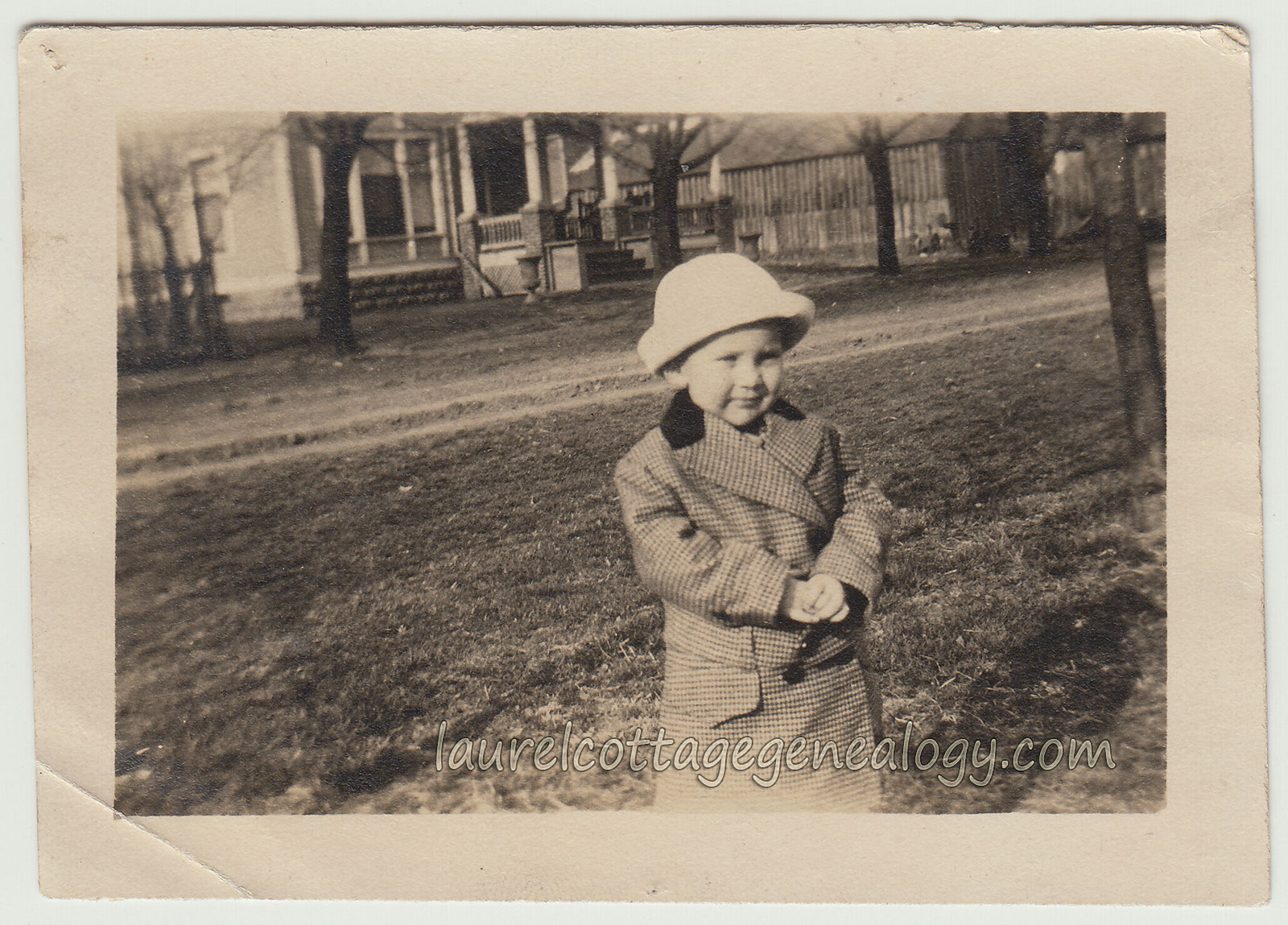
Old photograph, white border, circa 1920 – 1921.

Price:  $8.00            Size:  2 and 1/2 x 3 and 3/8″

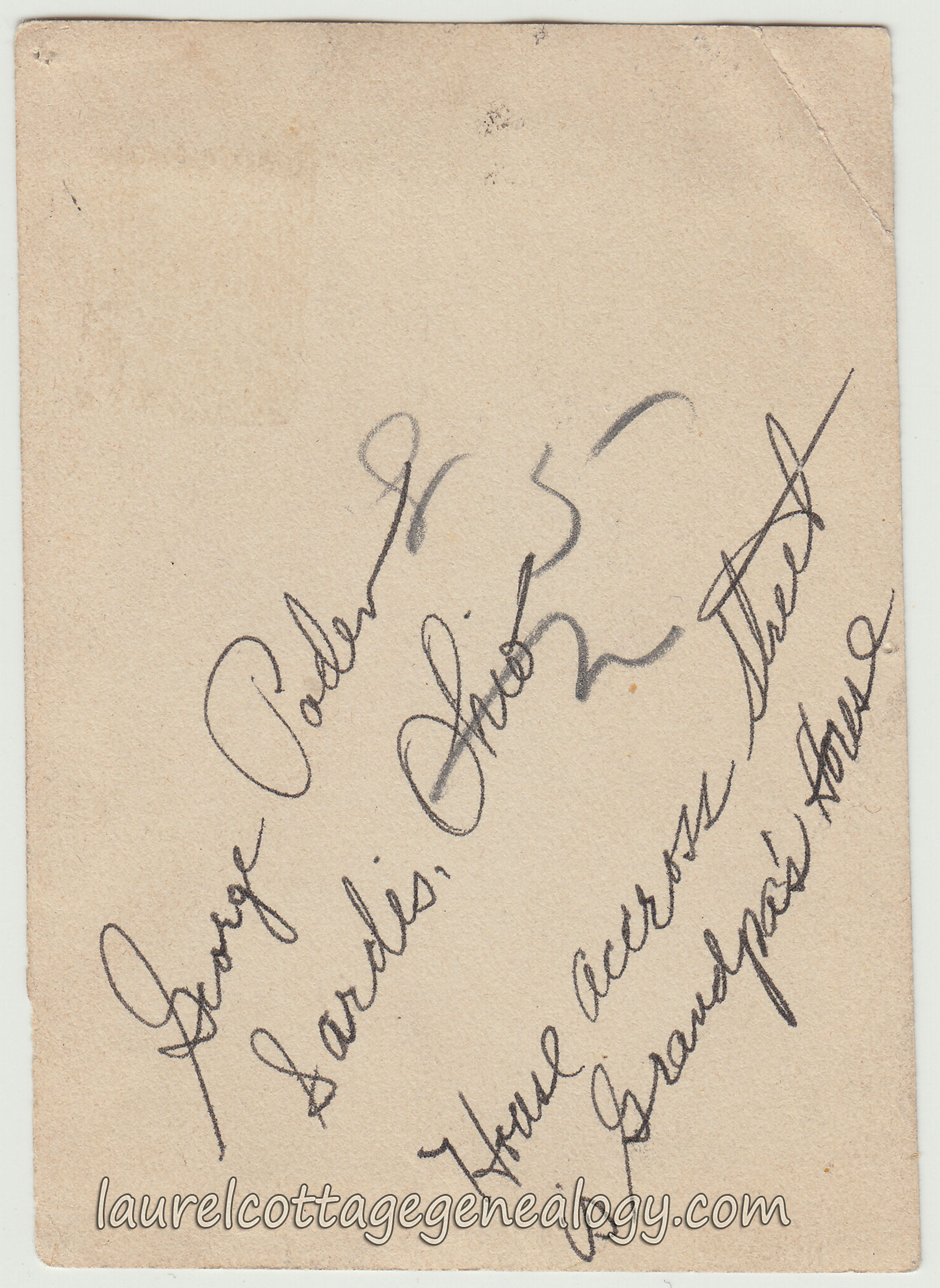
We’re estimating George was four or five years old here, so cute in his double-breasted checked coat and white hat. The house across the “street” is likely George’s paternal grandparents’ George E. and Catherine (Kate) Paden’s house, per the 1910 and 1920 Federal Census records for Lee Township, OH. Sardis is in southeastern Lee Township, Monroe County. George is the son of Clyde Paden and Martha (Mattie) Dunn.

Sources:  The National Archives in St. Louis, Missouri; St. Louis, Missouri; WWII Draft Registration Cards for Pennsylvania, 10/16/1940-03/31/1947; Record Group: Records of the Selective Service System, 147; Box: 1896. (Ancestry.com).

Marriage Records. Pennsylvania Marriages. Various County Register of Wills Offices, Pennsylvania. (Ancestry.com).

Year: 1920; Census Place: Lee, Monroe, Ohio; Roll: T625_1419; Page: 9B; Enumeration District: 52. (Ancestry.com).

Year: 1910; Census Place: Lee, Monroe, Ohio; Roll: T624_1219; Page: 13B; Enumeration District: 0155; FHL microfilm: 1375232. (Ancestry.com).

Mrs. Monika Urbanski and Grandaughter Mary Ann Ferguson, 1942

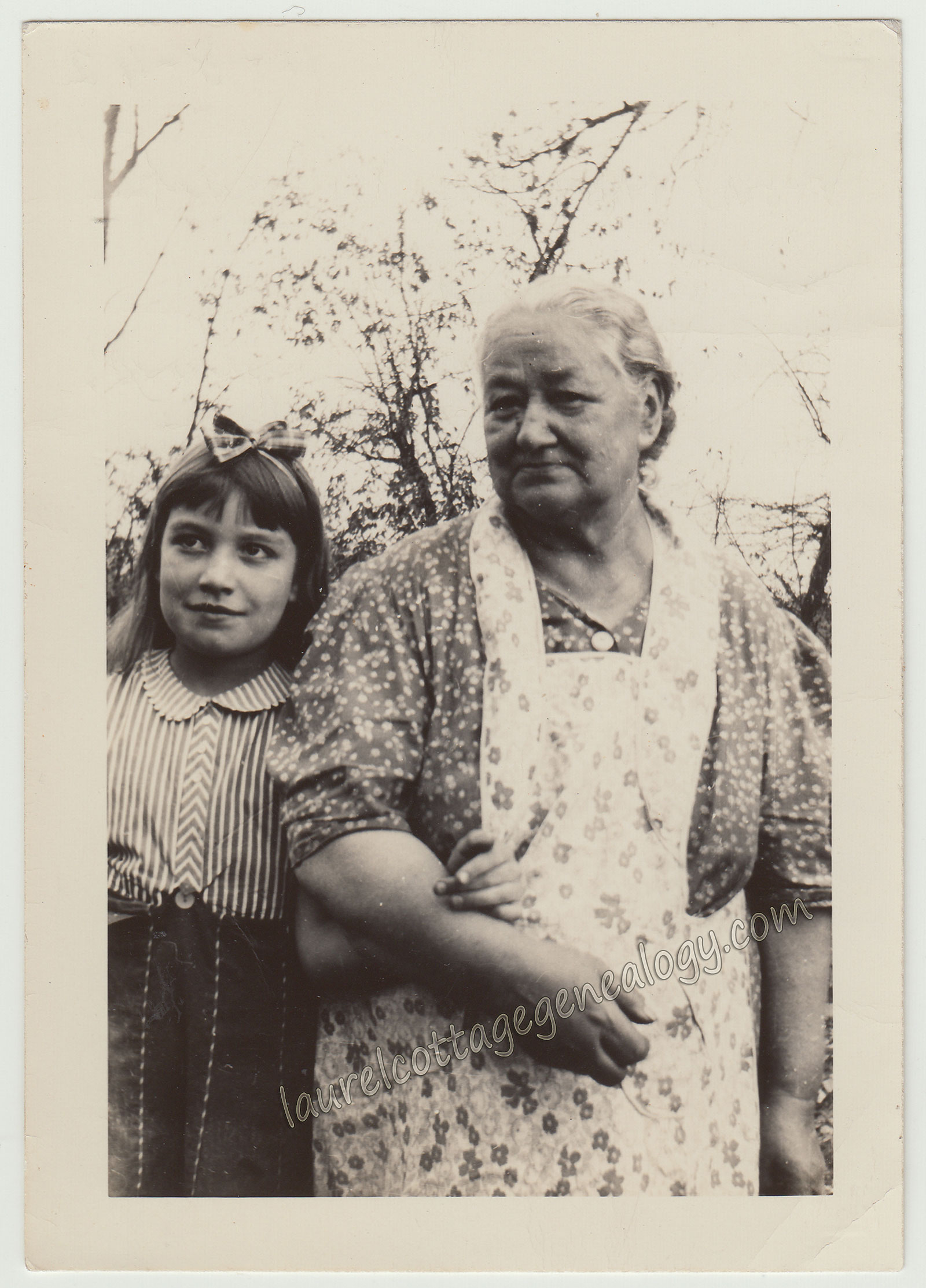
Vintage photograph, white border dated November 8, 1942

Price:  $10.00            Size:  About 3 and 1/4 x 4 and 1/2″

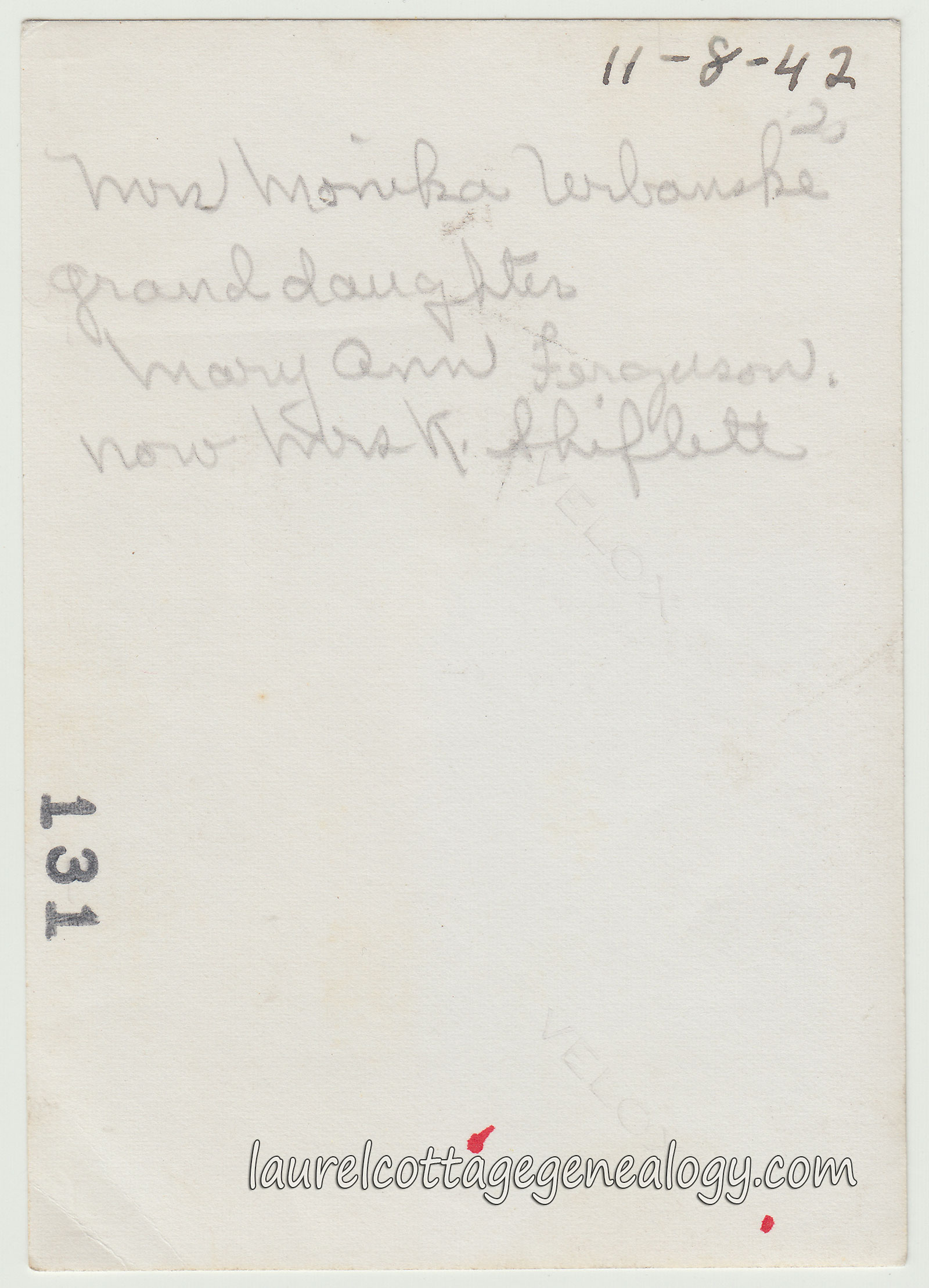
“11-8-42    Mrs. Monika Urbanske      granddaughter Mary Ann Ferguson. Now Mrs. K. Shiflett.”

I thought I had a Thanksgiving card waiting to get put up for this year. Hmmm, well, no – but I like this grandmother/granddaughter one for the holiday. It reminds me of baking pies for Turkey Day (it’s probably the apron that does it) and then just being with family. Mary Ann would have been eight years old when this picture was taken. The photograph seems vivid even though in black and white (love b & w photos!) with those expressions, and then the patterns – plaid (hair bow), stripes, flower prints….the tree branches in the background.

Mary Ann Ferguson, born August 1934 in Washington, DC, was the daughter of James Scott Ferguson and Mary Elizabeth Urbanski. Mary Ann’s second marriage was to Kenneth Shiflett.

Monika (Lubiewski) Urbanski, born in Poland, about 1867, was the daughter of Joseph Lubiewski and Francisca Buszkiewcz. She married Boleslaw William Urbanski.

Sources:  Find A Grave. Find A Grave. http://www.findagrave.com/cgi-bin/fg.cgi.

Virginia Department of Health; Richmond, Virginia; Virginia, Marriages, 1936-2014; Roll: 101168604. (Ancestry.com).

Ancestry.com family trees. (accessed November 25, 2020).


Young Woman With Bow, Circa 1900 – 1910


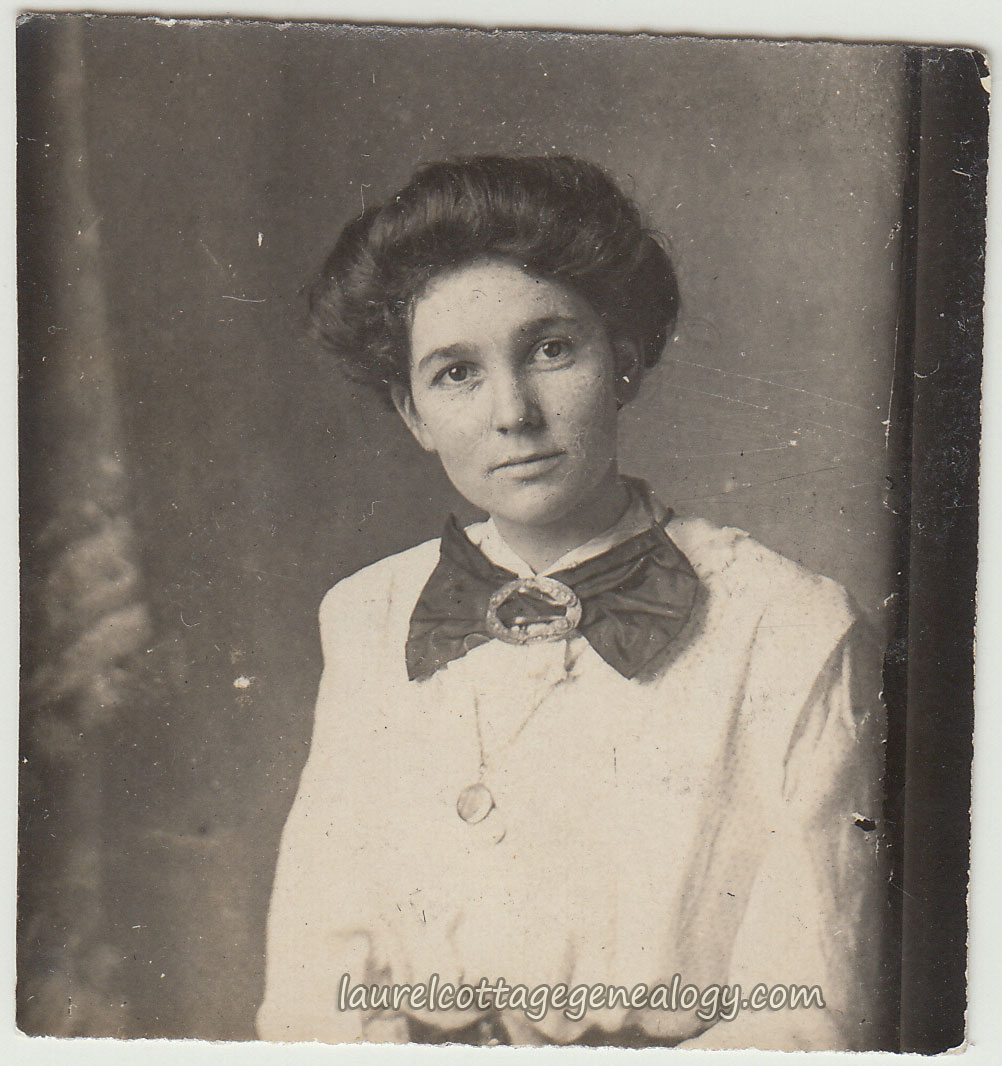
Small photograph, circa 1900 – 1910

Price:  $7.00          Size:  About 1 and 5/8 x 1 and 5/8″

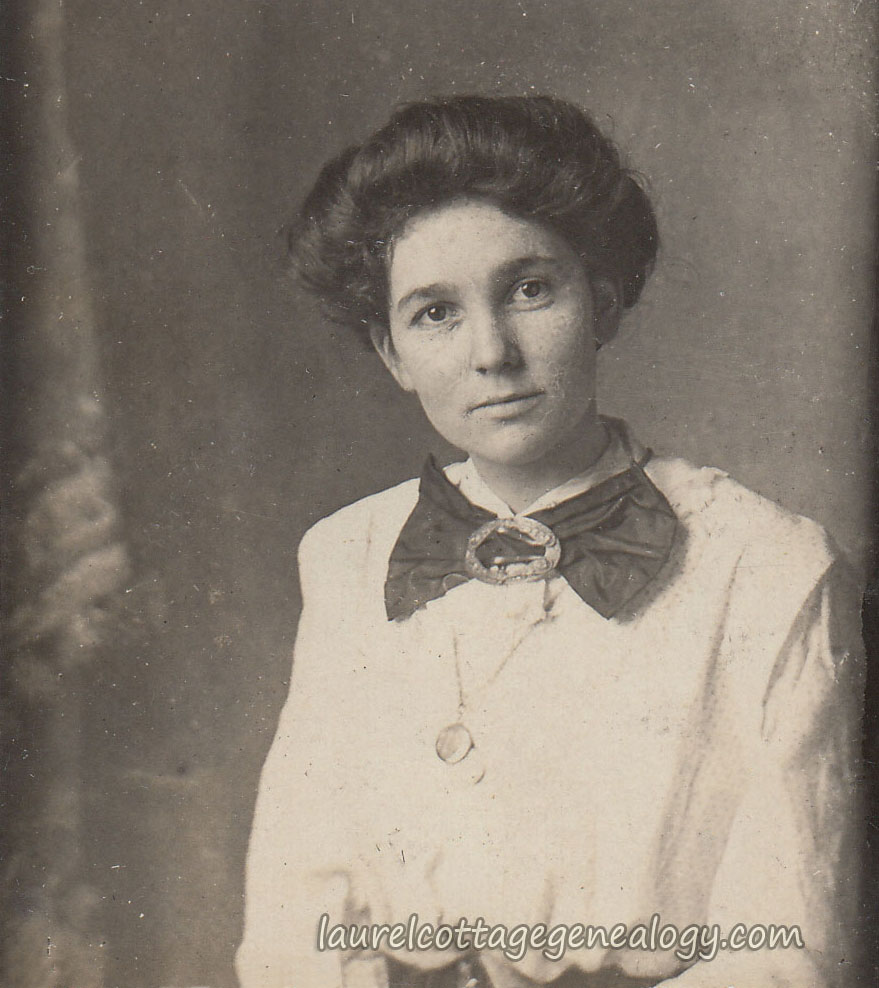
It was so distracting to look at this original because the cropping of the actual photo was so off-kilter, so I cropped it and then ended up cleaning it up, somewhat, in Photoshop. This would be a really nice one, if professionally re-done. There is no name on the back, just evidence that it came from someone’s old photo album. And who was the lovely young woman? We’ll probably never know but we get a sense that she was bright, maybe working-class, a teacher perhaps, or maybe this was a school (or school-era) picture and she was in college. The camera seems to have caught a little sadness or perhaps it’s wistfulness in the look. She wears her hair up, in a style common in the Edwardian Era, and wears a large, dark bow, a brooch at its center, and a round pendant or locket suspended from a chain.

Dutch Woman In Traditional Headdress

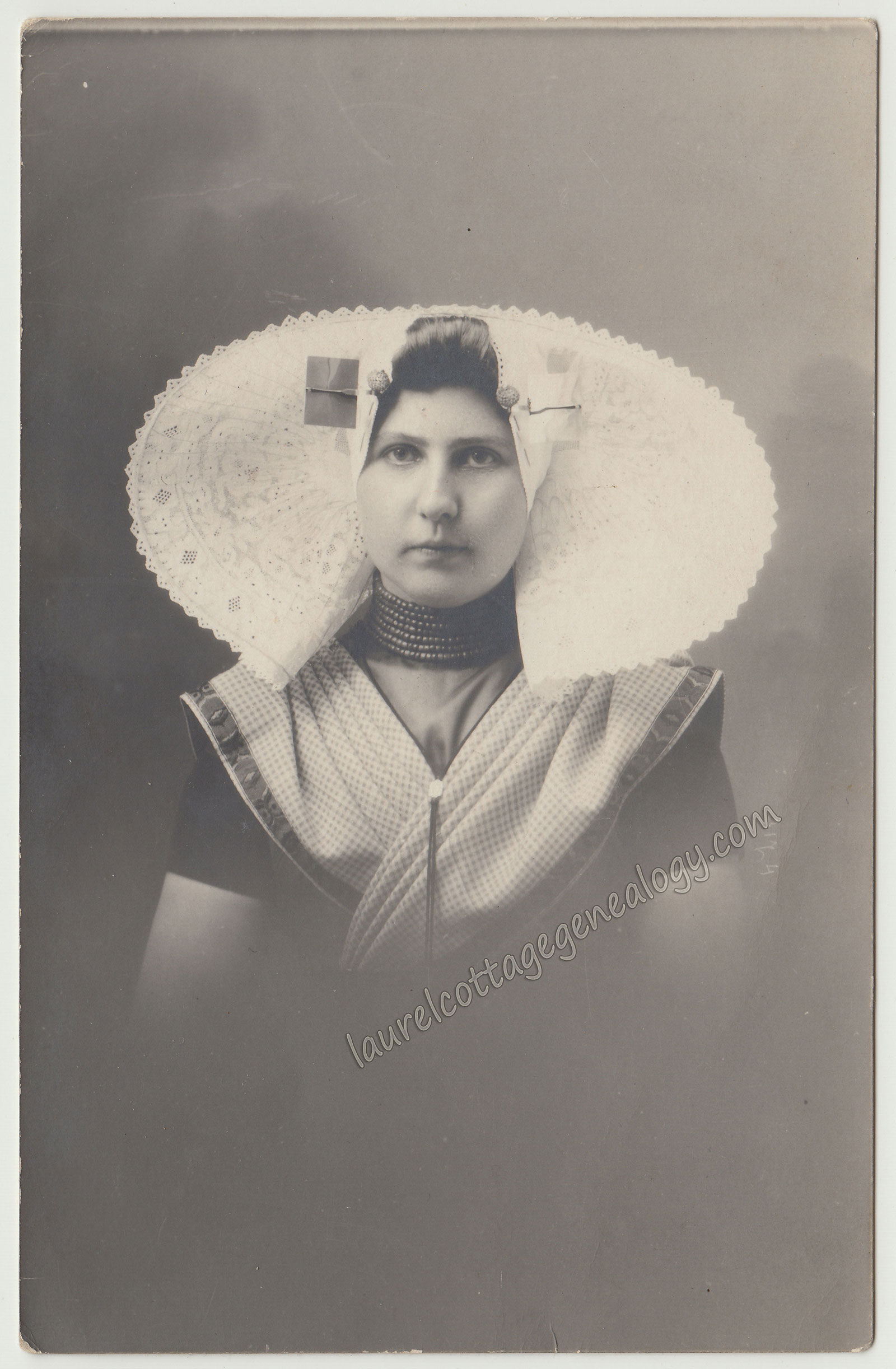
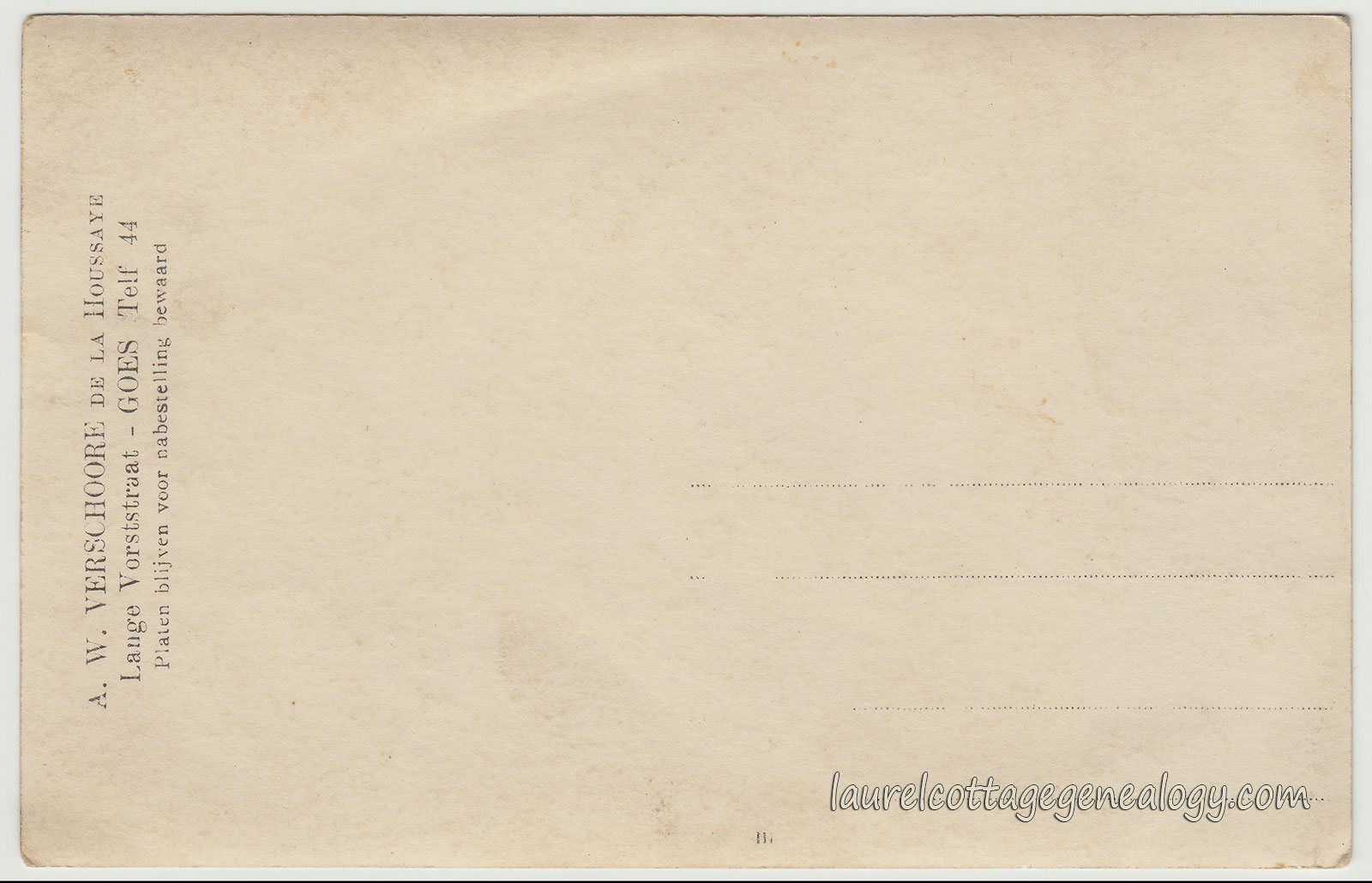
Postcard, unused. Photographer:  A. W. Verschoore de la Hoiussaye. Lange Vorststraat – Goes. Telf 44. Platen blijven voor nabestelling bewaard. Circa late 1910s – 1920s.

Price:  To be determined

That last line above, in the photographer’s information on the reverse, translates to “Records will be kept for reordering.” Lange Vorststraat, is the name of the street (literally translating to “long frost street”) in the city of Goes, province of Zeeland, Netherlands.

Photographer Adriaan Willem Verschoore de la Hoiussaye (sometimes spelled Houssaije) was born November 18, 1896 in either Middelburg or Den Bosch, Netherlands and died August 10, 1981. As of the date of this web post, we’re seeing only one other possible postcard (a digital) example from the website, Saving Photography (wonderful photos on this site, see link below in Sources) but we’ve just reached out to someone who will hopefully be able to help determine this postcard’s potential value.

We see a beautiful young woman (love that direct, soul-searching gaze) in short sleeves with a shoulder wrap of gingham and embroidered border; a carefully arranged bolero necklace fastened with a small, perhaps silver or gold medal; seven strands of possibly coral beads covering her neck; and a white cap fanning out into a grand display of starched lace, framing the subject’s face, and extending all the way past her shoulders – as if the head covering could have been worn down and flowing but, of course, is pulled up and starched to show off the work and identify the location that this young lady was from (or was modeling for). The lacework is gorgeous, no surprise, but click the image twice to enlarge, and you’ll notice some parallel lines running out toward the border on our left, and more lines on our right. Looking at the artist’s patterns – something about them reminds me of angels’ wings or maybe feathers.

I have no idea what the small flag-type things are, one dark, and one light, that are on each side of the woman’s forehead – some part of the traditional costume, it would seem, and maybe they help to fasten the headdress. An expert in the field of traditional folk wear could give us a much better description than I’ve attempted to do here, but I have to say that, were I twenty again (sorry, not trying to cop out on the age thing) I would love to take up this field of study. Maybe as a hobby in upcoming retirement, though!

Sources:  A. W. Verschoore de la Hoiussaye, Dutch Photographer. https://peoplepill.com/people/a-w-verschoore-de-la-houssaye/ (accessed November 17, 2020).

Zeeuws Archief; Den Haag, Nederland; BS Birth. Ancestry.com. Netherlands, Birth Index, 1784-1917.

“Portrait of an unknown lady.” Saving Photography. https://www.nl12.nl/saving-photography/#jp-carousel-3107 (accessed November 17, 2020).

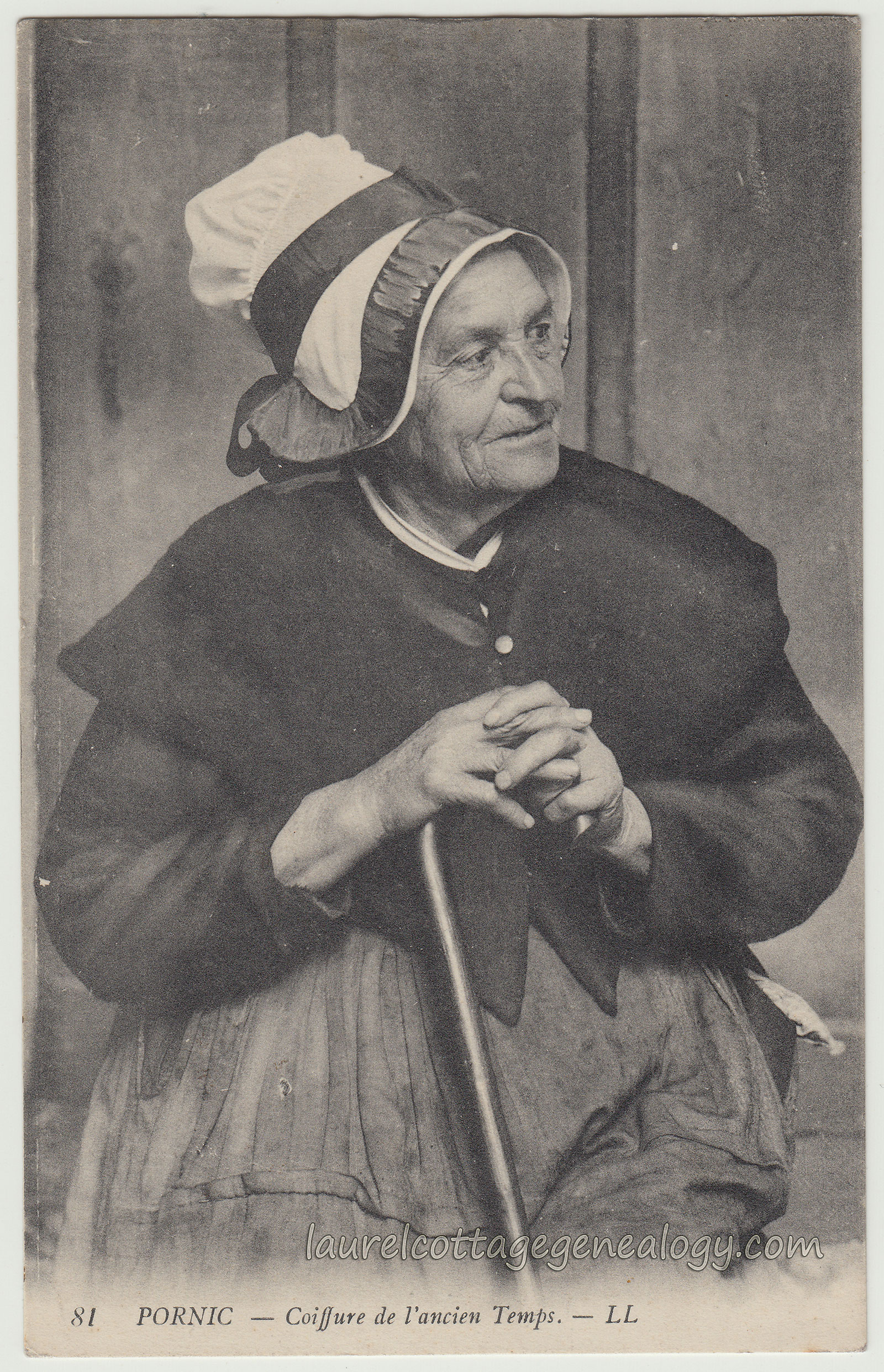
Pornic – Coiffure de l’ancien Temps

Divided back, unused postcard. Series or number 81. Photographer or printer/publisher:  L.L. Circa 1920.

Price:  $7.00

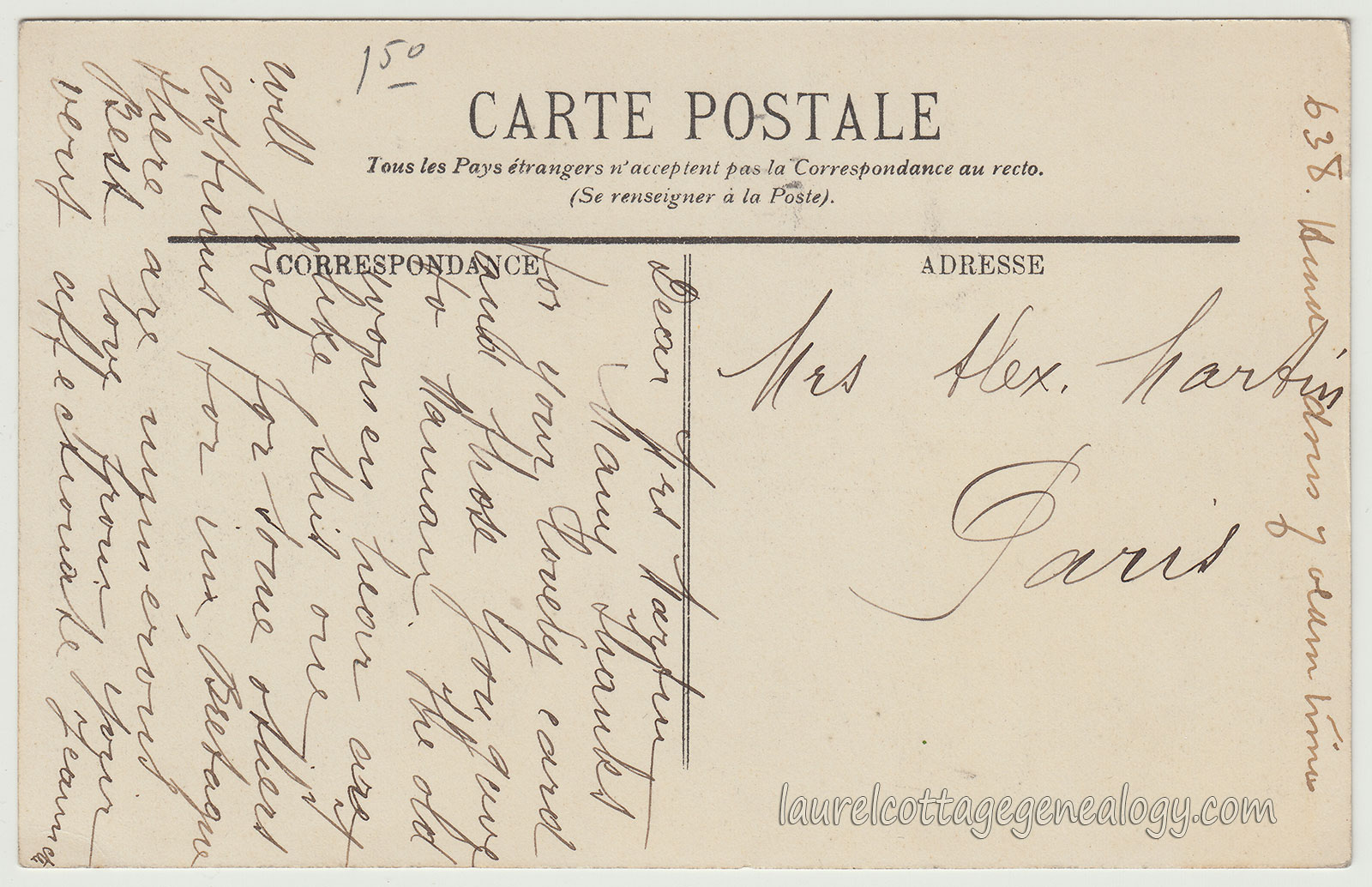
Addressed to:   “Mrs. Alex. Martin. Paris.”

“Dear Mrs. Martin, Many thanks for the lovely card and those you gave to Maman. The old women here are like this one. I will look for some others costumes for in Bretagne there are numerous. Best love from your very affectionate Jeannette.”

By coincidence, the prior post was also signed with “Best love.”  Notable also is the unusual way that Jeannette writes the capital letters M and P. And this card had apparently come from another collection, before making its way to ours, as evidenced by the handwriting “638.  Headdress of older time.”  There’s another postcard site that also has a card of this same design right now, and that one has a particular date in 1920, hence the circa date for ours.

Last, but certainly not least, and without going into great detail, the beautiful woman from Pornic, Brittany, France, featured on this card is decidedly someone you would want to have a conversation with – kind and with a great sense of humor. Which brings up the question – who were the individuals that came to be featured as “types” from a certain area on the numerous cards that had circulated at one time? How did they come to have their photographs taken, and were they always paid for their time by the photographer? Looking into these questions might involve heavy research so we’ll not jump at this bait (tempting, though), but it would be nice to happen across the info at some time or another.

Source:  Pornic. n.d. https://en.wikipedia.org/wiki/Pornic (accessed November 14, 2020).